Innovation Is Not 'Linear'
This article was machine-translated from Japanese by AI (Claude). It may contain errors. Read the original Japanese article.
When we think about innovation, we tend to fall back on a linear model (supply model) of basic research ➡ applied research ➡ development ➡ innovation. But working on the front lines of startup support, I feel it would be better to understand it through a somewhat more systemic approach.
For example, I think Charles Edquist of Lund University, a well-known researcher of innovation policy, takes this position.
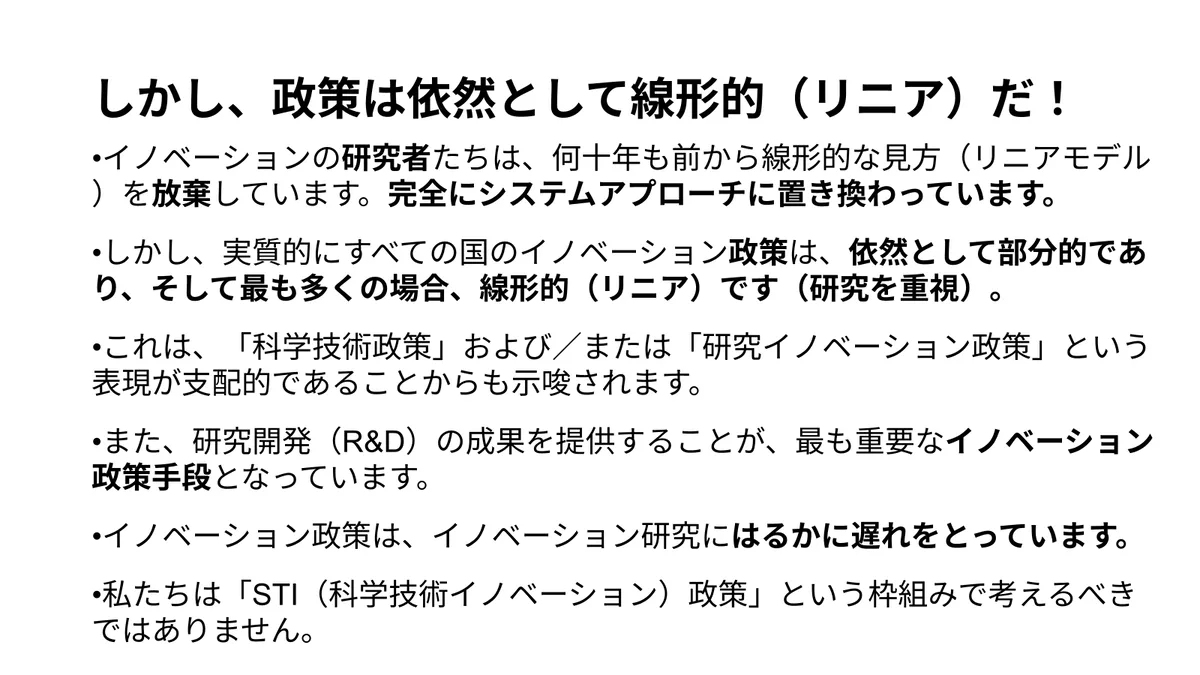
Translation of page 11 of https://web.archive.org/web/20240414112033/https://www.catedrauam-asseco.com/documents/Seminarios/S2019_02_PRESENTACION_EDQUIST_March_2019.pdf
Because this linear model underlies the thinking of many people involved in science, technology and innovation policy, the whole system needed to bring about innovation seems to be given too little consideration. An example of the overall picture is the following.
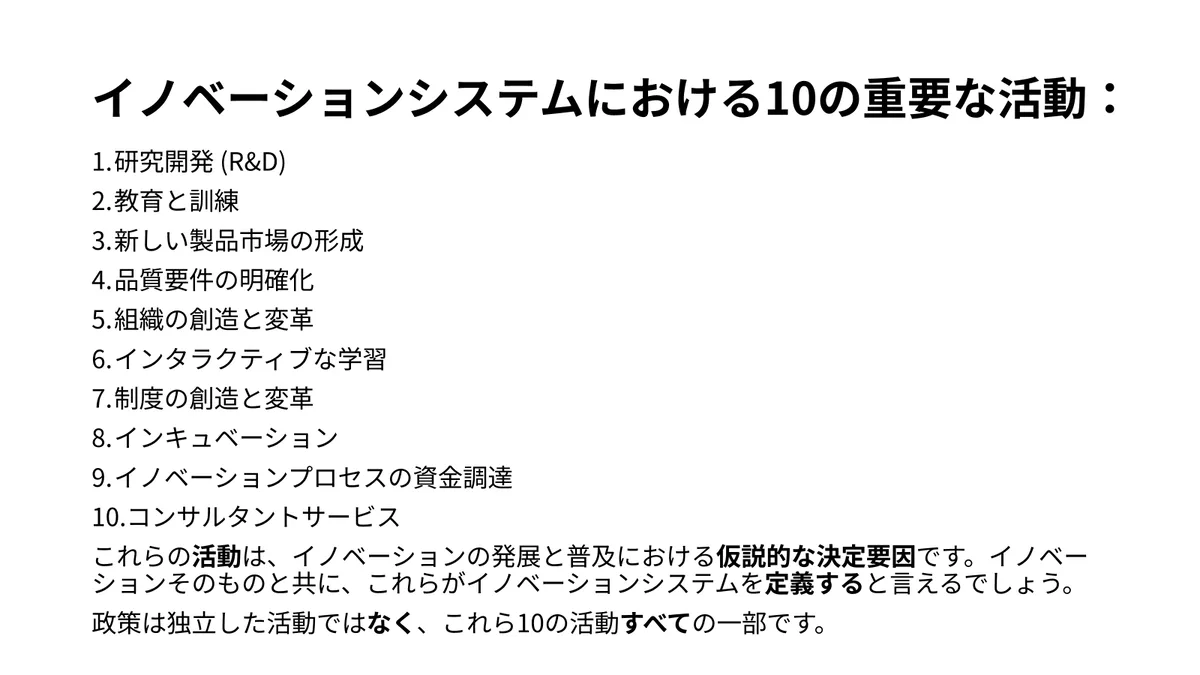
Translation of page 3
For example, to induce innovation, demand-side policies such as public procurement (market creation) are also needed. But if we design science, technology and innovation policy around a linear model that starts from scientific research, attention goes only to maximizing research output, and that kind of thinking rarely arises.
Also, looking from the demand side (in fields such as climate tech, for example), it is often the case that the scientific research needed for commercialization is not being carried out in Japan.
In such cases, I think additional demand-driven scientific research could lead to innovation. But if the research and development system is built around commercialization that "bridges" existing R&D to the next market, based on a supply model or a linear model, that approach is hard to accept.
For example, even when a startup tries to do R&D with such an approach, it continues to have difficulty getting government support because "it is not the latest university research" (for example, it is hard to win NEDO subsidies).
I talk a little about this in the following slides, among other places.
That said, from the standpoint of those who support startups, I feel that a top-down approach, starting from the market and demand and developing the technology needed to meet it, makes innovation more likely to happen.
This does not deny scientific research. Rather, I think both research from the supply side and research from the demand side are needed. I think innovation has to be approached as a pincer movement from the supply side and the demand side.
I also think one problem is that talking about "science, technology and innovation," or STI, as a single thing makes this easy to confuse.
As proposed in Edquist's PDF above, I think we should either state explicitly that we are taking a systems approach rather than a linear model, or, as the same PDF suggests, think of innovation policy and science policy as somewhat separate.
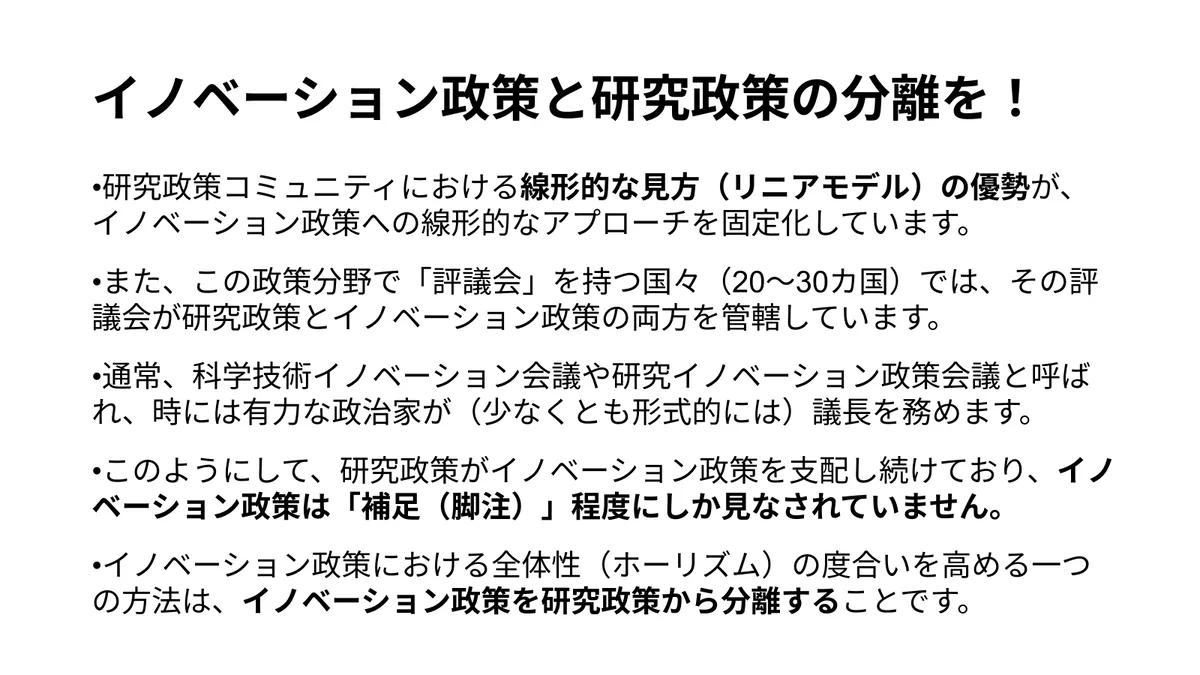
Translation of page 11 of https://web.archive.org/web/20240414112033/https://www.catedrauam-asseco.com/documents/Seminarios/S2019_02_PRESENTACION_EDQUIST_March_2019.pdf
Research policy and innovation policy are each important in their own right. This is because research that does not lead to "innovation," which presupposes economic effects, is also important. On the other hand, innovation is important too, but it does not necessarily require research or invention. Innovation ≠ Invention is something that is often said.
So my personal impression at present, as someone who works on the innovation side, is that talking about them together is likely to have bad effects on both.
I once posted something along these lines to an idea box, and I am laying it to rest here as a blog post.