The Age of Supply Capacity and Startups
This article was machine-translated from Japanese by AI (Claude). It may contain errors. Read the original Japanese article.
Summary by NotebookLM
Over the past decade, I think "how to stimulate demand" has been an important agenda. Recently, however, the center of gravity seems to be shifting to "supply."
Of course, demand remains important, and in some individual areas demand is, if anything, the more important matter. In the green field I am involved in, for example, demand will continue to be a relatively important theme.
Looking at the broader currents of politics and the economy, though, supply seems to be becoming a challenge in many respects. And Japan, too, appears to be at a point where it needs to increase the discussion of supply capacity.
I thought startups also need to think about this trend, so I have put it together in this article.
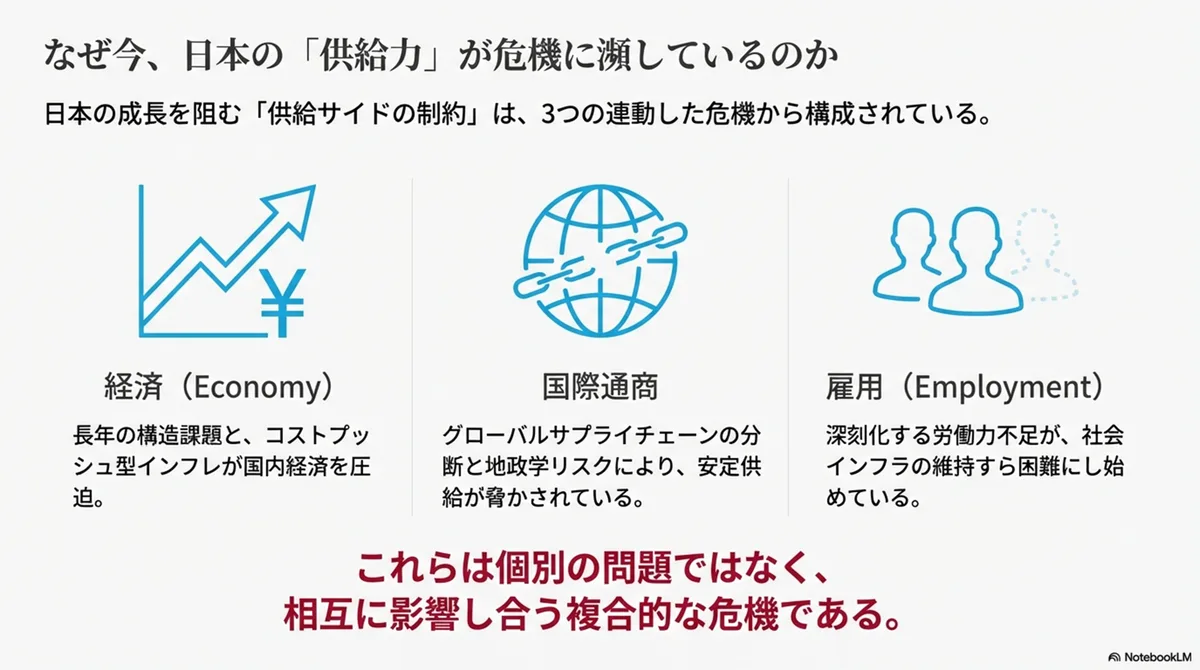
First, I will lay out why we should increase supply capacity, mainly from three perspectives: the economy, international politics, and employment.
(1) Economy
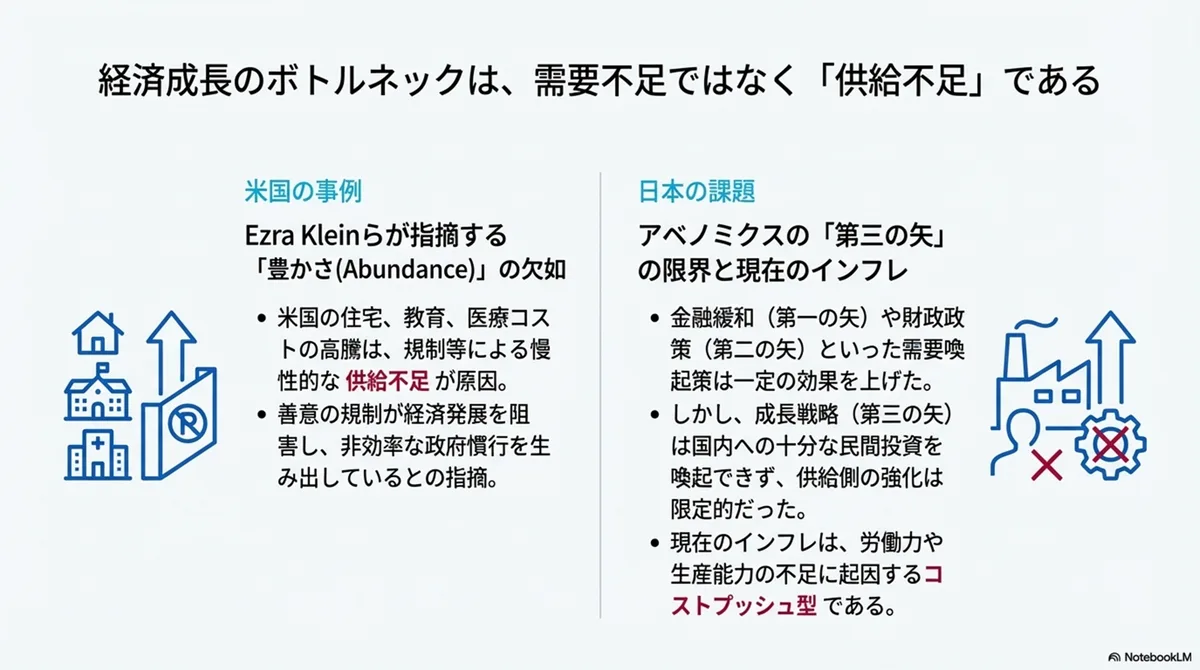
As of April 2025, "Abundance" by Ezra Klein and Derek Thompson is getting attention as a book setting out a vision of a "liberalism that builds." (Although it went on sale on March 18, it has nearly 400 reviews on Amazon as of this writing.)
At the opening of this book, it is stressed repeatedly that in the current American economy "supply is the problem."
In the United States, for example, the costs of housing, education, and healthcare keep rising. This is because supply is insufficient (for housing, mainly because of regulation).
It is pointed out that behind this lie well-intentioned regulations on the liberal side, meant to prevent bad economic development, and the claim running through the book is that liberals should therefore emphasize cutting inefficient government practices and deregulating for growth. Indeed, the American housing price problem is probably a major problem rooted on the supply side.
In Japan, too, the supply side has long been a challenge. Regarding Abenomics, the first and second arrows, monetary easing and fiscal policy, which were demand-side measures, are assessed as having had some effect (though they did not lead to sustained expansion of domestic demand). The third arrow, which corresponds to the supply side (a growth strategy to stimulate private investment), carried out regulatory reform and corporate tax cuts. Although investment by domestic companies abroad increased, the general assessment is probably that it failed to draw out sufficient private investment within Japan, and its effect on the domestic economy was limited.
Furthermore, current inflation is regarded as cost-push, which is said to be because the productive and supply capacity of workers and the supply side is insufficient (plus imports from abroad have become more expensive because of the weak yen).
What these economic challenges have in common is a supply-side problem. For future economic growth, Japan too needs to think about supply anew.
(2) International Trade
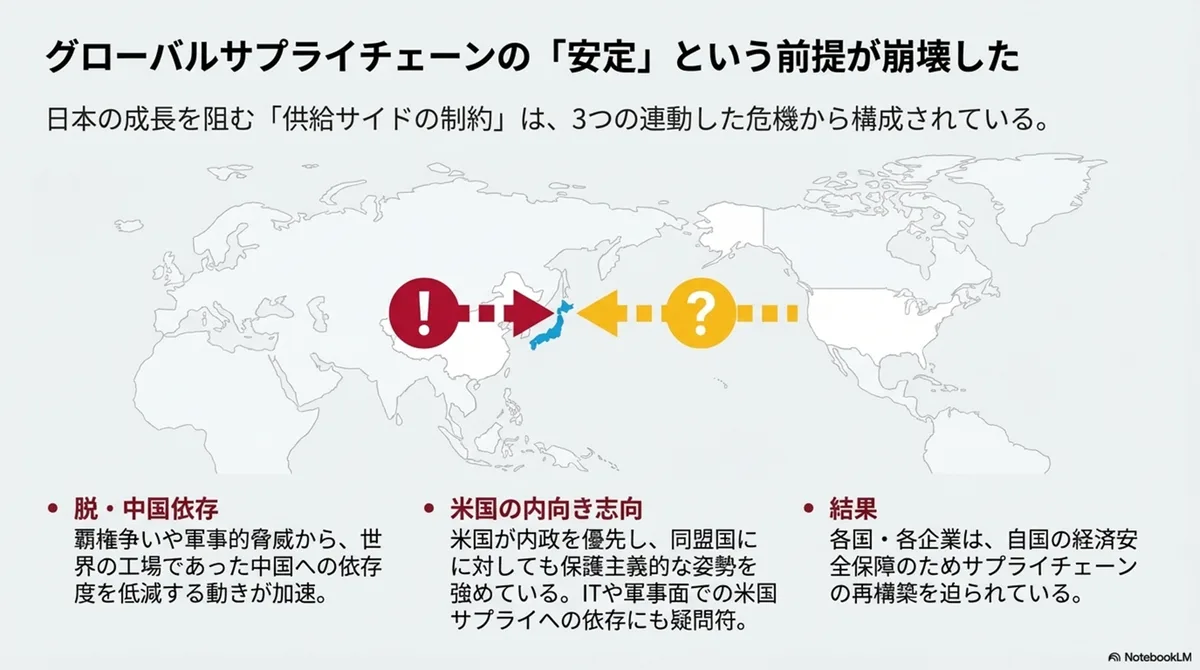
In addition to these, change is also under way in international business.
First, China has been the world's source of manufactured goods so far.
However, for reasons such as ideological differences, the struggle for hegemony, military threats, and the protection of industries and jobs within each country, the geopolitical and geoeconomic judgment that countries want to reduce their dependence on China has drawn attention as an issue in recent years.
On top of that, the United States has also become unstable, putting domestic politics first and even baring its fangs at its allies. The United States is the center of the world's demand, a country that has consumed the world's supply, but it has also played a role as a supplier in IT, military affairs, and other areas. Amid this, a debate is emerging over whether it is wise to rely on American supply.
Given this situation, global supply chains are being reconsidered by countries and companies alike. This is precisely a problem of supply. In Japan, too, concern is growing over how to secure the supply capacity that is essential for daily life and defense.
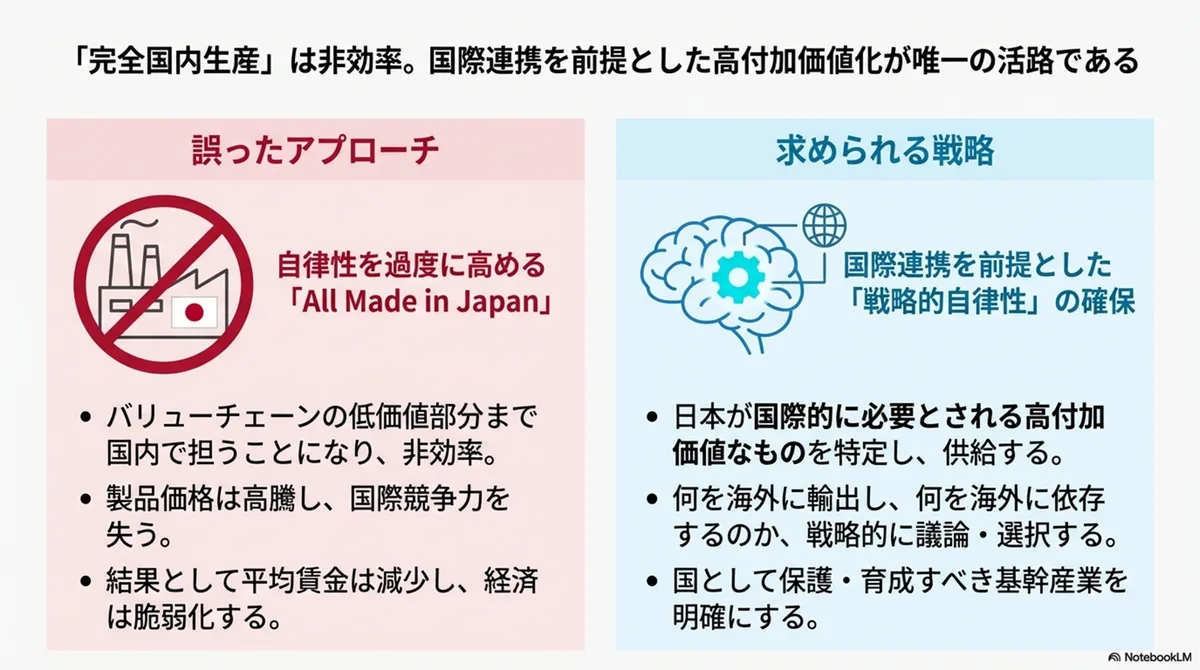
So, should Japan be able to cover nearly all of its supply domestically? Probably not.
Japan will almost certainly depend on other countries for energy and food (although the degree can be raised or lowered, for example by reducing foreign dependence for energy through renewables). And even if an All Made in Japan iPhone built only from Japanese parts could be made, it would cost many times what it does now. This is because Japan would have to take on the low-value parts of the value chain domestically. That is far too inefficient.
Of course, that might create jobs, but average wages would probably fall, because Japan would be responsible for the relatively low-value parts. Needlessly raising a country's autonomy does not lead to a "strong Japan"; rather, it can even leave the country in a vulnerable position in global economic competition.
If so, on the premise of international cooperation, the larger challenge becomes how Japan supplies what is needed internationally and what is high in added value. In other words, what Japan should export and what it should depend on other countries for seems to be what we should be discussing now.
On that basis, it is increasingly necessary to think in terms of how to secure the country's autonomy while benefiting from the global economy, and, to that end, which industries the country should protect and which new ones it should create.
(3) Employment
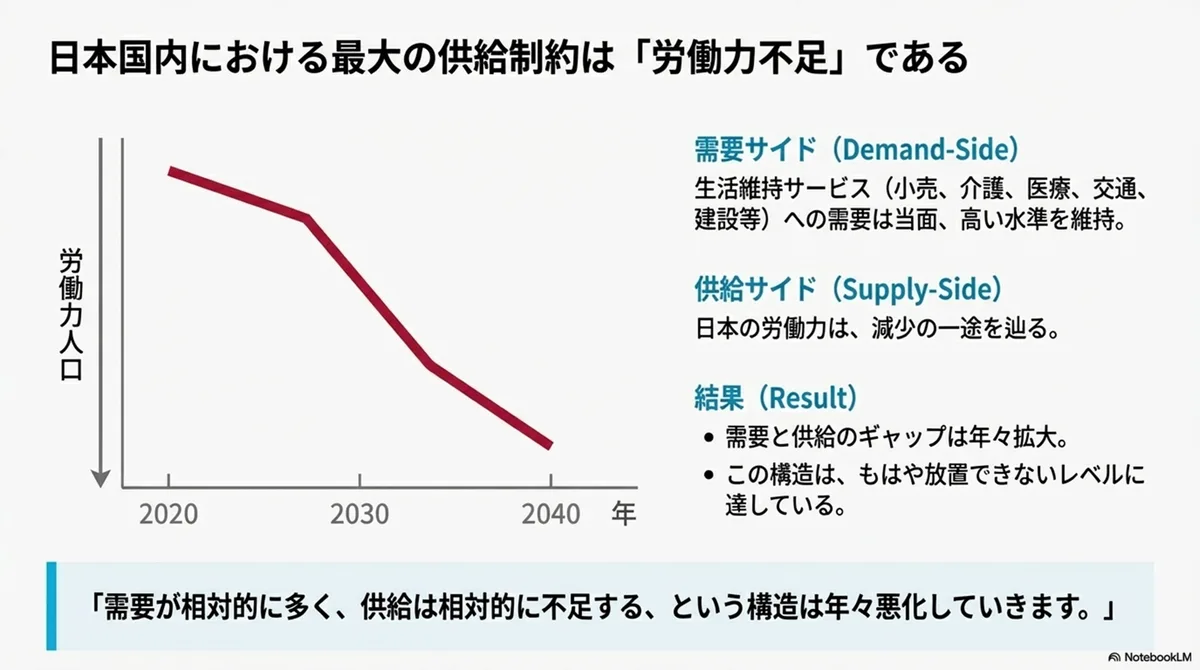
From the perspective of supply, what is becoming a visible constraint on Japan domestically is the labor shortage.
Japan's labor force will keep shrinking. Meanwhile, demand, centered on services that sustain daily life (retail, nursing care, healthcare, transportation, construction, and so on), will hold at a certain level for some time.
As a result, the structure in which demand is relatively high and supply relatively short will worsen year by year. If left to nature, much of the labor force will flow into the highly urgent services that sustain daily life. People tend to react to short-term crises, and, considering elections and the like, government subsidies will probably go there as well.
If that happens, people will find it harder to flow into work that is low in urgency but high in importance, such as uncertain, long-term work that tries to create innovation, and the ability to earn foreign currency will gradually be lost. The result is a dead end. Japan's economy today is sustained by automobiles and tourism, but if the layer of such foreign-currency-earning industries thins out and, for example, Japan can no longer import energy resources, it may become a "country where the lights sometimes don't come on."
To prevent that, I think we need a stronger supply-side intent: how to create high-value-added industries and how to move labor into them, while saving labor in services that sustain daily life through automation and the like.
Policies for Addressing the Shortage of Supply Capacity
So far I have laid out the supply-side challenges from three perspectives.
From these perspectives as well, it seems to me that Japan needs to increase its supply capacity, or at least needs a discussion toward that end.
In Japan at present, tax cuts and the like are being actively debated, but a consumption tax cut, for example, is rather a measure to stimulate demand, and stimulating demand when supply cannot keep up will only accelerate inflation. I believe what should be done, and discussed, is rather making up for supply capacity. (Of course, for people struggling with the cost of living because of inflation, there is also the option of considering, politically, thicker support such as benefits.)
Looking at other countries, China and others still have excess supply capacity left over (in production capacity, youth unemployment, and so on), and now that US tariffs will likely cause a glut of supply worldwide, without appropriate demand stimulation the benefit to domestic industry will be small.
Startups' Contribution to Increasing "Supply Capacity"
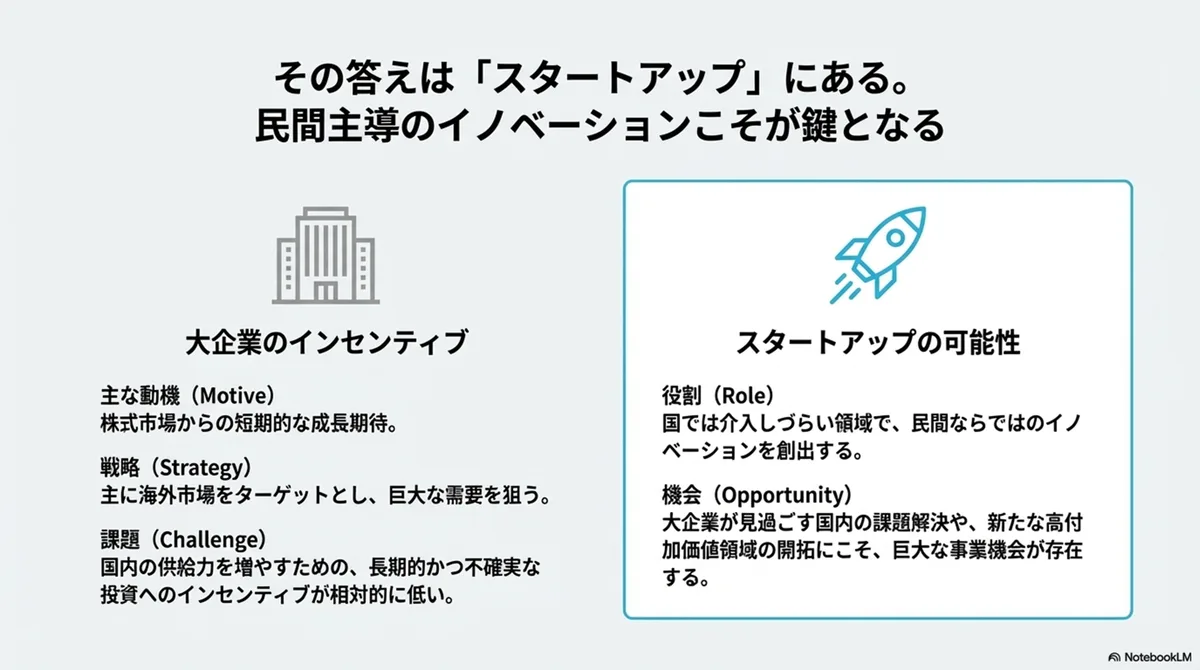
Increasing supply capacity is an area where it is hard for the government to intervene, and one that calls for innovation on the private side.
Meanwhile, because of the growth expectations demanded by the stock market, large companies basically aim at overseas markets, and the current situation is probably that they have relatively little incentive to increase supply capacity through domestic investment and the like.
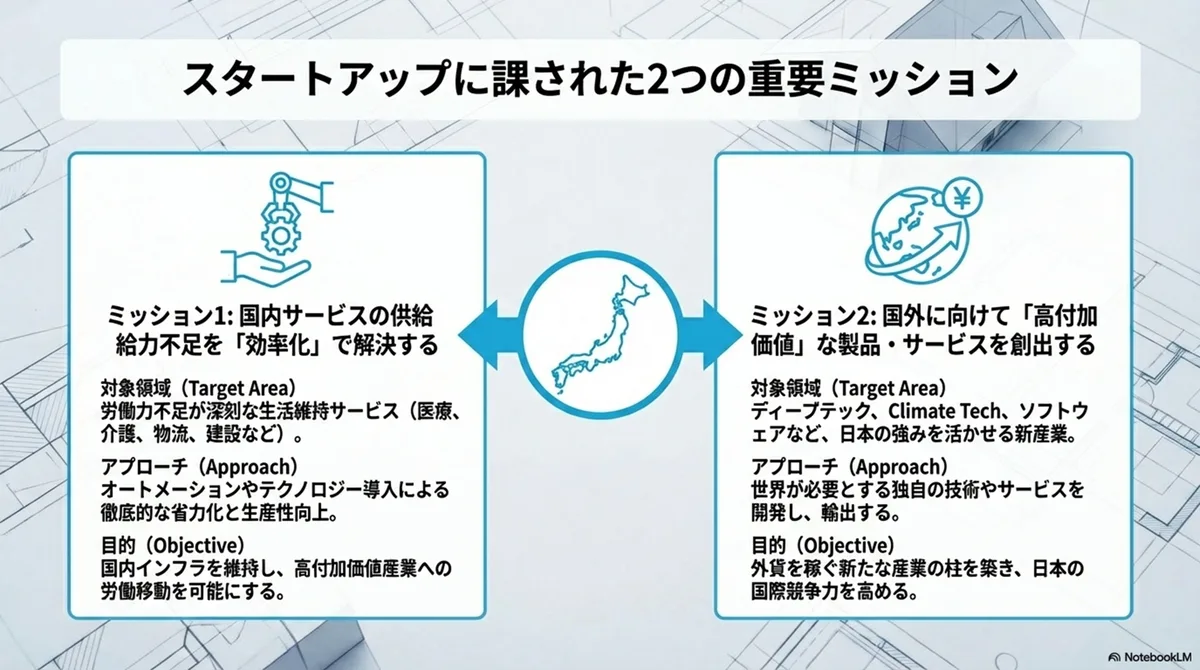
That is exactly why I think there are scenes where startups can be useful.
For example, they can make the domestic services hit by the labor shortage more efficient while newly creating high-value-added products and services for overseas markets.
For startups, too, in order to increase their social significance, it seems to me that how startups approach these social and national challenges is being called into question.
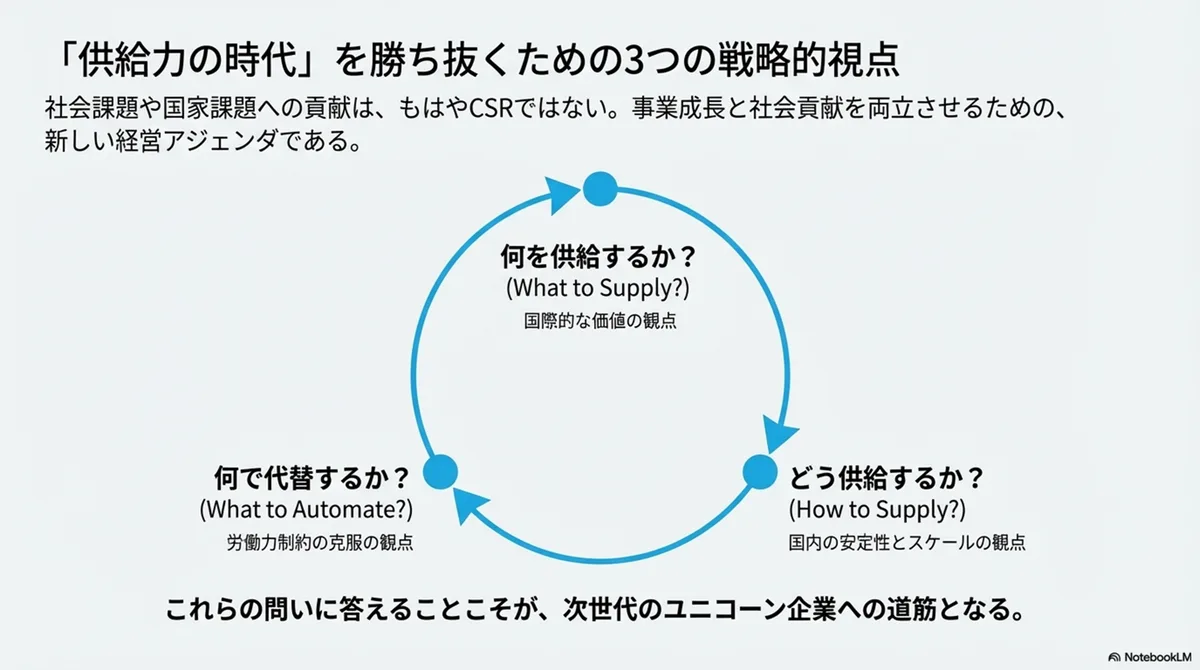
For some people in startups, especially those trying to tackle big problems, I think a strategy will be needed in which they hold this perspective, consider what is needed when seen at the global and national scale, and expand there while gaining support from the Japanese government.
To that end,
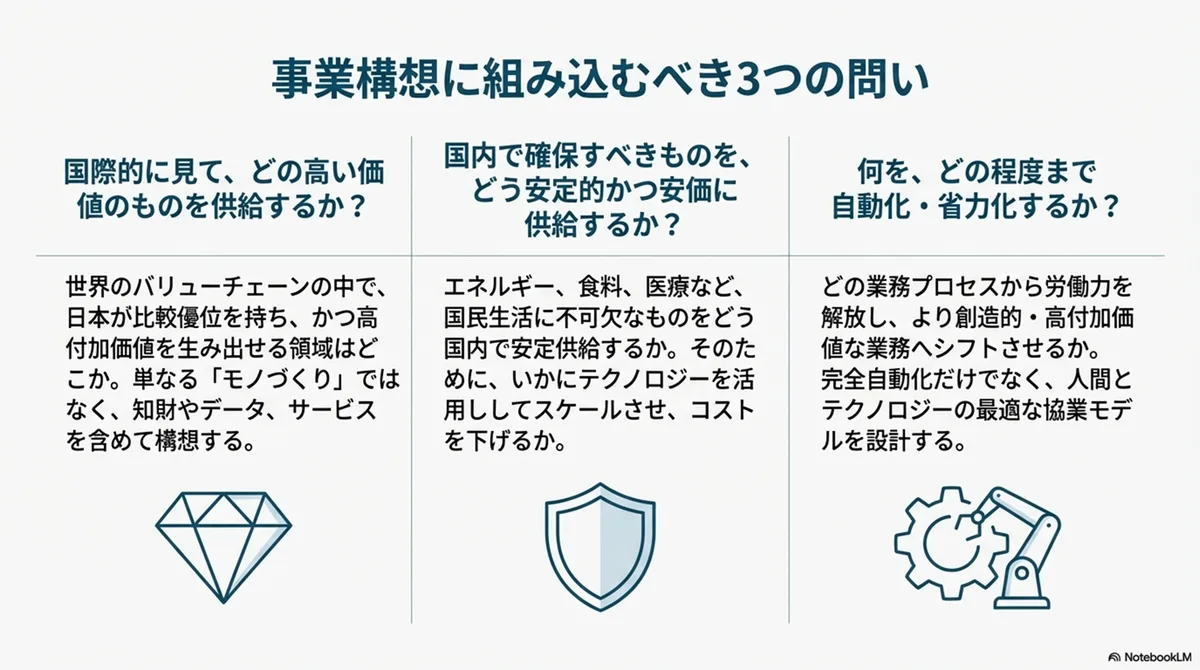
- Which high-value things to supply from an international perspective
- How to supply stably and cheaply what must be secured domestically (and how to scale for that purpose)
- What to automate, and to what extent
I think we should also be having discussions that take such perspectives into account.