Industrial Policy and the Industrial Dynamism Created by Startups
This article was machine-translated from Japanese by AI (Claude). It may contain errors. Read the original Japanese article.

Summary by NotebookLM
Countries are trying to bring industrial policy back.
"Bringing manufacturing back to America" is probably a major example.
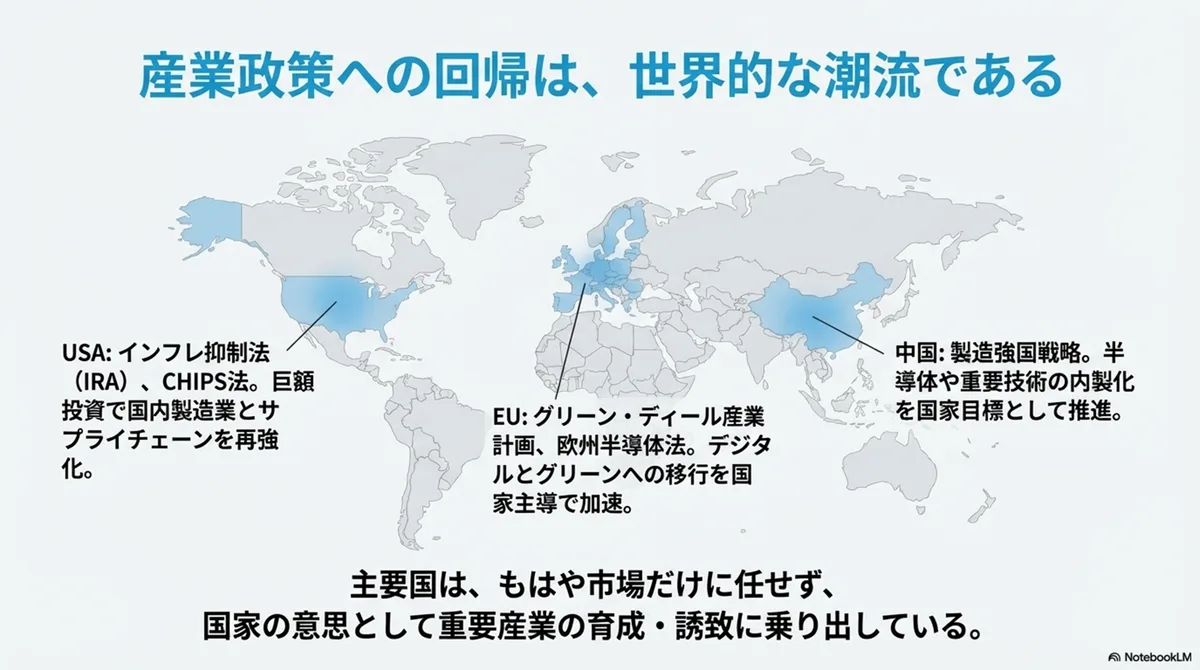
Such policies can look inefficient from an economic standpoint. But if leaving things to the market widens inequality within a country and makes society unstable, it seems to me that countries pursuing industrial policy is an unavoidable trend (though I hope it is only temporary).
Japan, too, has examples where leaving things to the market did not work well.
One is the fact that wages did not rise for 30 years. And one cause of this is said to be "leaving too much to the market."
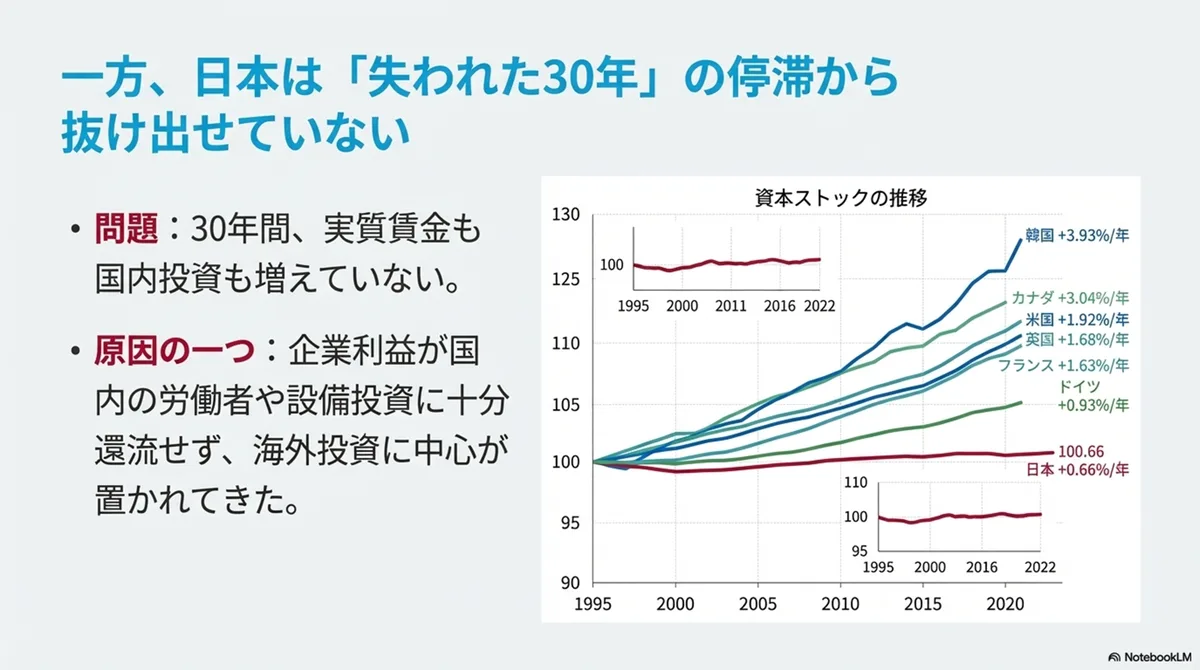
As the Fourth Interim Summary Report of the New Direction (June 6, 2025) by the Ministry of Economy, Trade and Industry (METI) shows, for some time Japanese companies grew by focusing on investment abroad rather than at home. And because profits earned abroad were reinvested abroad, those profits did not flow back into Japan sufficiently, and the wages of workers in Japan did not rise1.
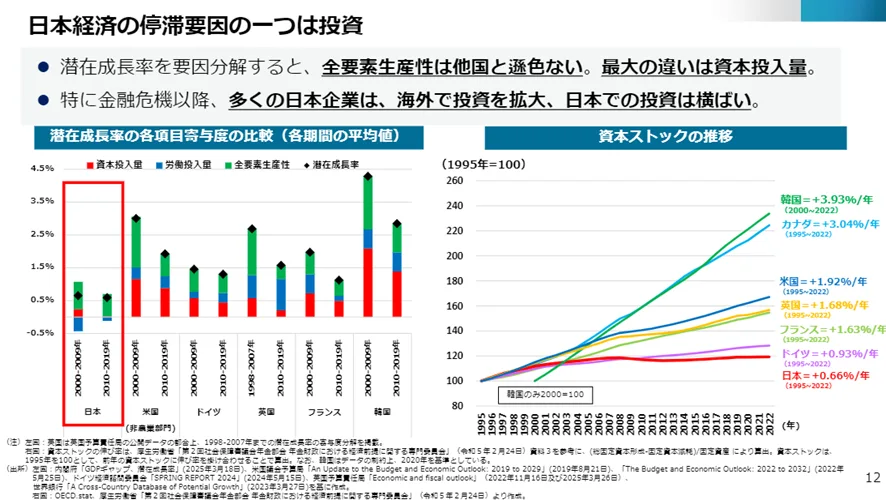
https://www.meti.go.jp/shingikai/sankoshin/shin_kijiku/20250603_report.html
If this continues, Japanese society will probably also become unstable, as America has.
Markets often fail, including on environmental issues. So if we leave everything to the market, the logic of capital can produce outcomes that do not benefit the people, and this can lead to social instability. If we want to do something about it, policies that intervene in the market will become necessary.
Countries have already begun adopting such policies.
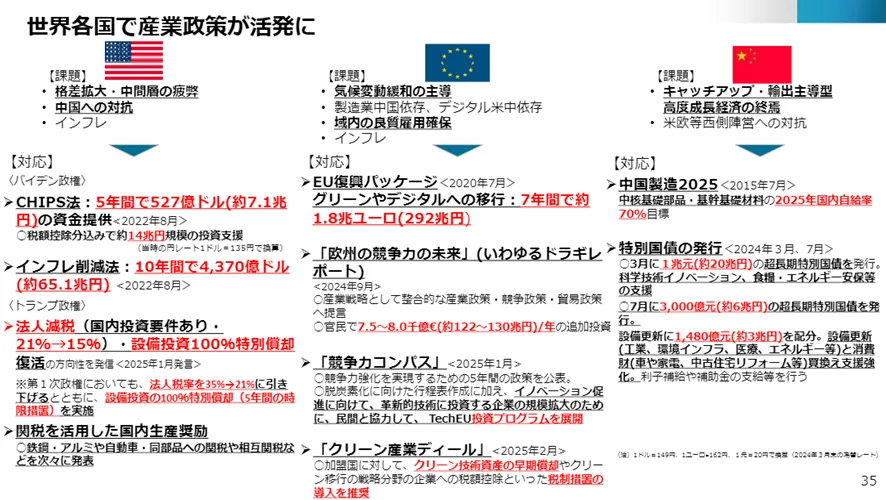
https://www.meti.go.jp/shingikai/sankoshin/shin_kijiku/20250603_report.html
The Convergence of Startups and Industrial Policy
As such industrial policy gains momentum, American startups are beginning to align themselves with the national agenda.
The most prominent example is probably American Dynamism from Andreessen Horowitz. It declares that it will "invest in companies that support the national interest," with defense and manufacturing as its central themes.

Y Combinator, which trains startups, also issued a Request for Startups on the theme of Techno-Industrialist in June 2025.

This comes from the context of Reindustrialize, which some American groups champion, and it can be said to be in line with America's current agenda of rebuilding manufacturing.
Personally, I wonder whether highly automated manufacturing will not create that many good jobs. But I can understand the desire to keep manufacturing capacity at home, in the context of security in its various aspects (for startups, the context of It's time to Build).
The reason VCs and startups like a16z are moving closer to industrial policy is probably that national investment flows into these areas and there are commercial opportunities.
If there is one more reason in addition to that, I think it may also be a move to place the role of startups in areas beyond "economic growth," and to raise social trust in startups and technology.
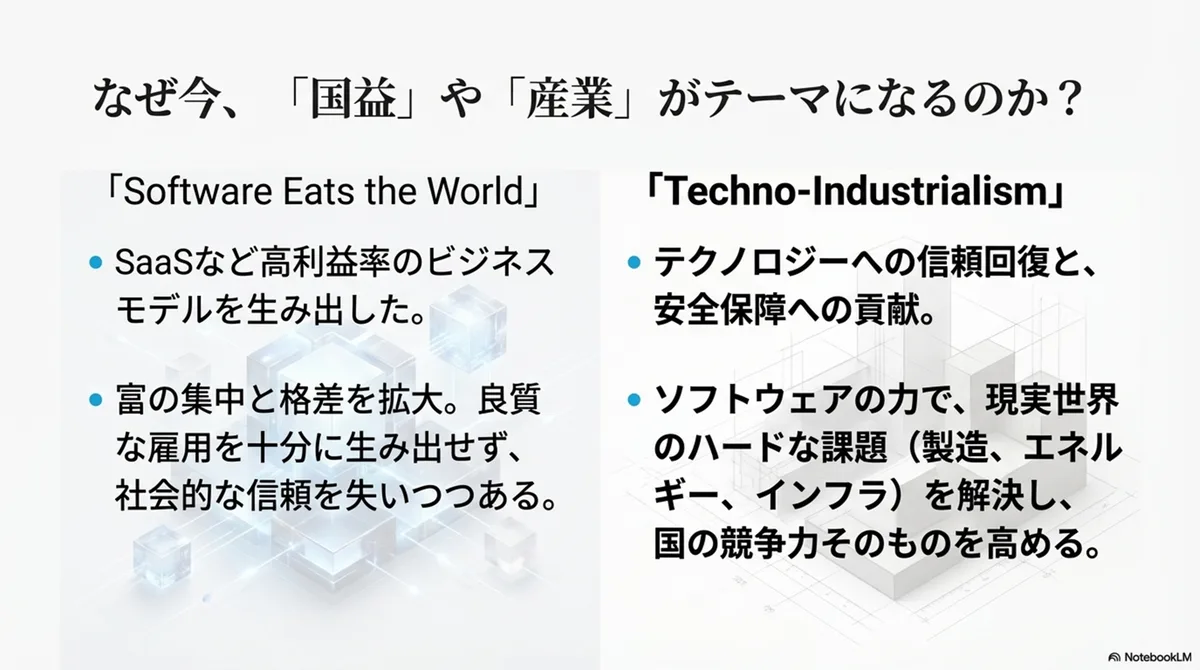
Today, trust in "tech companies" is being lost, mainly in Europe and the United States (a recent example). Concepts such as surveillance capitalism and techno-feudalism are in circulation, and, beginning with the influence on elections, we can no longer believe in the potential of software as innocently as we once did.
There is also a criticism beginning to appear: because software and SaaS are business models with high profits and low investment, they easily generate economic returns, but outstanding founders and talent flow into them, which delays innovation in other fields; these fields also create few jobs; and because the resulting economic growth comes with widening inequality, it harms a country's advantage in the long run.
Thus, now that trust in technology and startups is not what it once was, I think the movement to secure that trust in a different form is one of the backgrounds behind the message of "serving the national interest."
And entrepreneurs with exactly that kind of intent are actually beginning to emerge, and discourse has also appeared saying that such entrepreneurs are eagerly awaited.
I do not know how far these messages reach beyond the elite to the general public in America. But over the past few years, in both the US and Europe, expectations for startups have risen and support and attention have gathered. One could also read this as meaning that, precisely because of that support and attention, responsibility has arisen, and startups are trying to answer it.
Startups as the "Live Ammunition" That Drives Industrial Policy
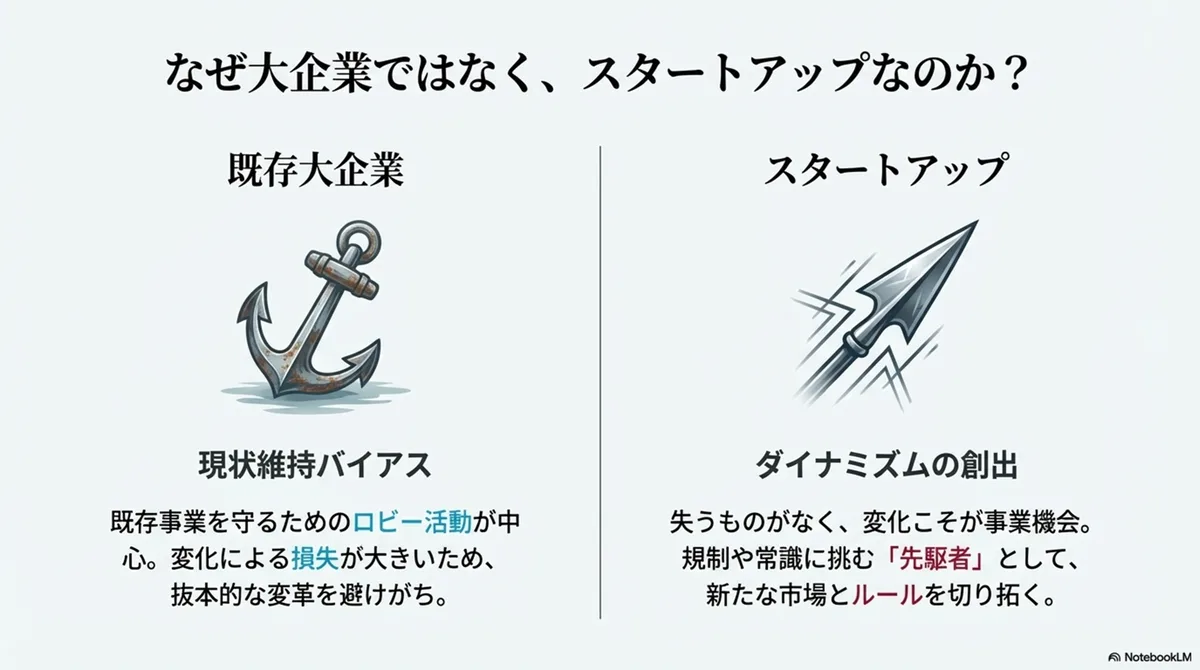
What is interesting is that the movement to advance industrial policy in each country is in sync with startups, not with large companies.
One reason that comes to mind is probably that when a government plans industrial policy, it needs "real examples" to support.
In general, without policy the predictability of the market does not improve, and businesses do not emerge. On the other hand, without businesses that serve as real examples, there is no movement to change policy. It is, so to speak, a chicken-and-egg relationship.
The phrase "public-private partnership" is used here, but it is probably rare for the government to move first. In many cases, the private sector moves first, and only when issues on the private side become visible does policy change.
Among the bureaucrats of Kasumigaseki, it seems that concrete policy proposals and material are called "tama" (bullets). There are terms such as "loading bullets" and "firing bullets."
In that sense, to change policy, politicians and bureaucrats need "live ammunition." Unless there are examples that can be cited as live ammunition or real cases, policy will not change.
And the part of the private sector that can move fastest is startups. As industrial policy is pursued in each country, I think startups are becoming increasingly important as live ammunition that moves industrial policy.
Industrial policy tends to be captured by incumbents that have thick pipelines to the government, loud voices, and the spare capacity to conduct lobbying. These players also have more obvious losses from change.
As a result, small voices calling for change often go unheard, and no dynamism arises in policy or industry.
But startups, which are agile and run at the cutting edge without entanglements, can become the actors that generate dynamism. And in fact, startups are pioneers of change, and are also entities that readily collide with regulation.
If political resources are now being invested in startups in Japan, the likelihood of generating that dynamism rises further.
Startups Create Industrial Dynamism That Moves Policy
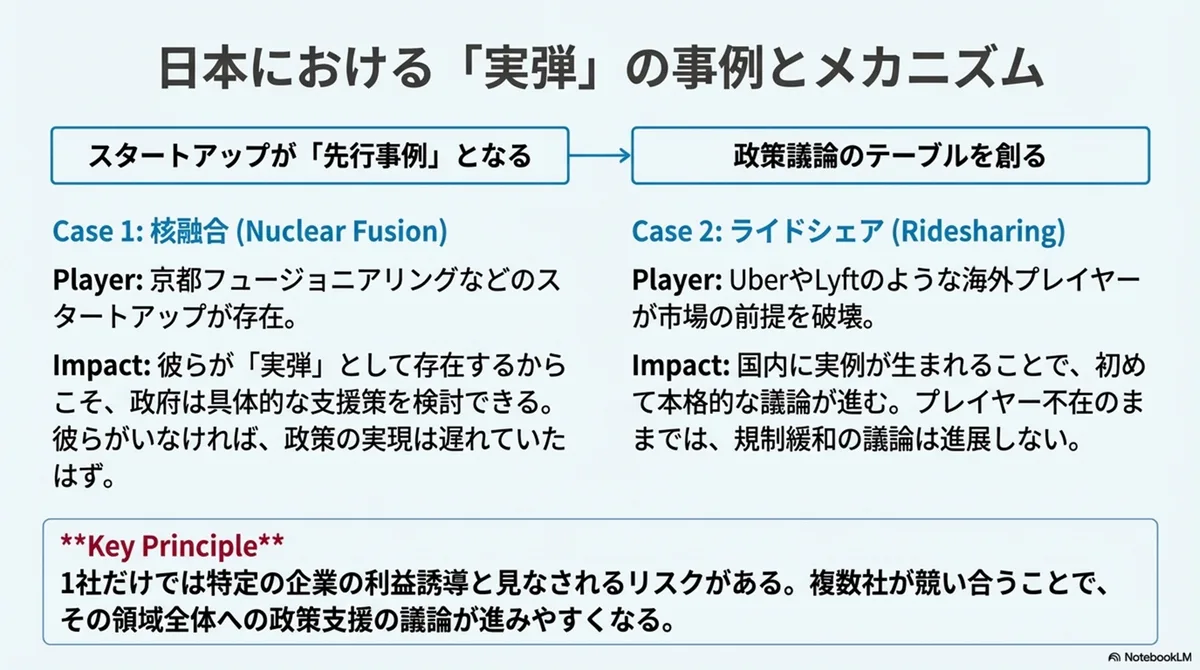
For example, the progress of discussion and policy on nuclear fusion in Japan owes a great deal to the fact that startups such as Kyoto Fusioneering existed beforehand as live ammunition. Without such companies, there would have been no one to support even if policy were enacted, and the pace of policy realization would surely have been slower.
The same goes for the discussion on ride-sharing. If the only players were foreign companies such as Uber and Lyft, then once ride-sharing was opened up, foreign companies would hold the key positions. So unless it is opened up while there are domestic players, the Japanese market would be used to their advantage without any competition. In such fields as well, discussion advances precisely because there are real examples at home.
More than one round of live ammunition is needed. With only one company, there is a risk that it will look like the government is handing out benefits, and a single company is not guaranteed to succeed. Even if in the end someone will win, to strengthen policy support for a field, discussion moves forward more easily if multiple companies compete in it.
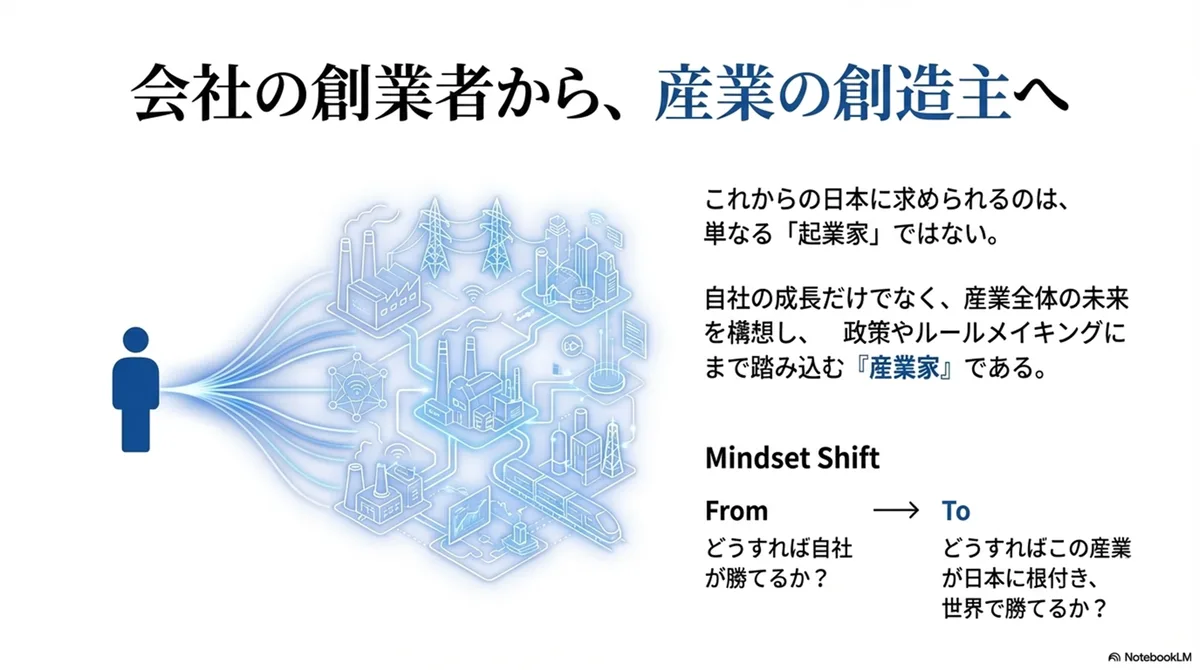
In a sense, this is the vanguard for bringing change to society, something like a "hitman" (teppodama). The risk is high, and there may be times without reward. Yet if startups do not do it, it is hard to name who else in the private sector could take on that role. The movement of startups centered on America appears to be an attempt to take on that role as an ecosystem.
I think Japan needs similar dynamism. I believe an opportunity has come for startups to take on the role of pioneers: identifying the industries Japan will need going forward, moving ahead of others, and becoming the actors that generate the dynamism of such industrial policy.
To Increase the Number of Startups That Can Speak About Industry
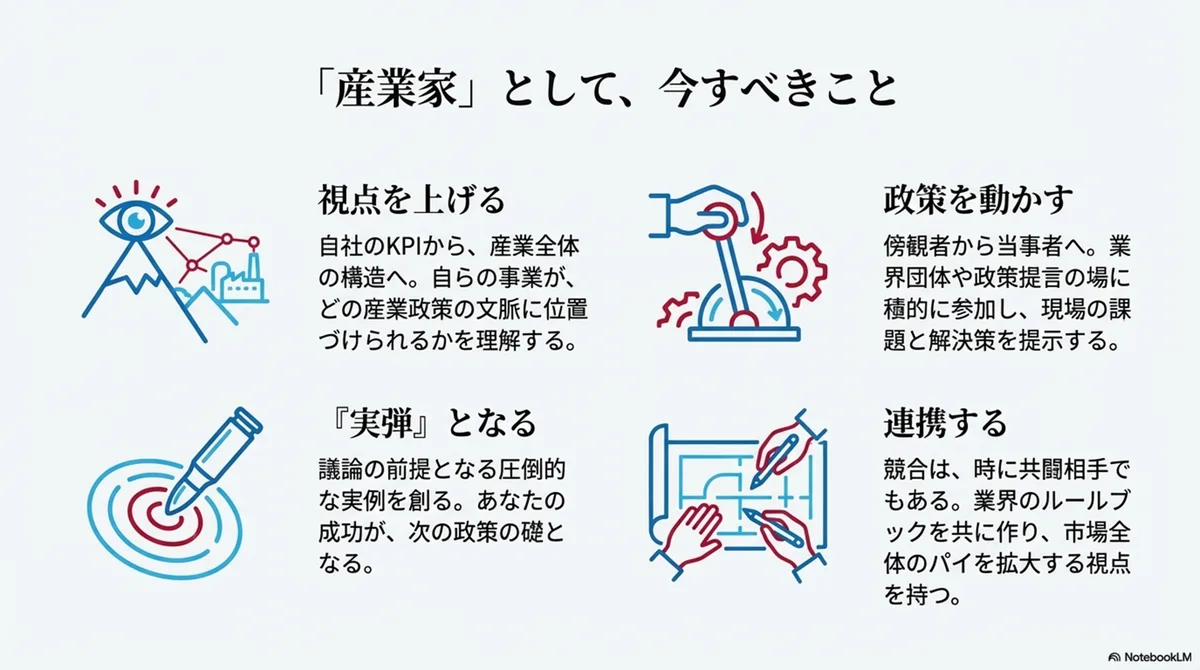
Until now, the involvement of startups with policy has centered on improving the startup ecosystem, such as stock options. These matter too, but in the current social climate, I think we also need to go beyond these areas, take a more big-picture view, and work to improve industrial policy for each industry in order to create new industries or rebuild existing ones.
In the United States, several startup-related organizations have jointly published a collection of policies for multiple industries, the "Techno‑Industrial Policy Playbook," under the domain rebuilding.tech.
A few years from now, after the Five-Year Plan for Startups ends, if startups want to keep earning the trust of society, I think we will need to have prepared a move to define the significance of startups in Japanese society.
For that, we need people who think about things at the industry level in the startup world, and we need real examples in bundles. And we need more people who envision the industries Japan's future requires and take the first step.
I would like to increase the number of industrialists who shoulder such industries, and to discuss with interested people how the significance of startups within Japanese society should be positioned.
Footnotes
-
Wages in the medical and nursing care fields can be raised to some extent if the government decides so, so the failure of wages to rise is not solely the fault of companies. That said, since officially set prices must also be balanced against the national budget, raising them in a period without inflation would likely mean discussing tax increases and government bond issuance. ↩