From Entrepreneurs to Industrialists: People Taking On 'Creating New Industries' and 'Rebuilding Industries'
This article was machine-translated from Japanese by AI (Claude). It may contain errors. Read the original Japanese article.
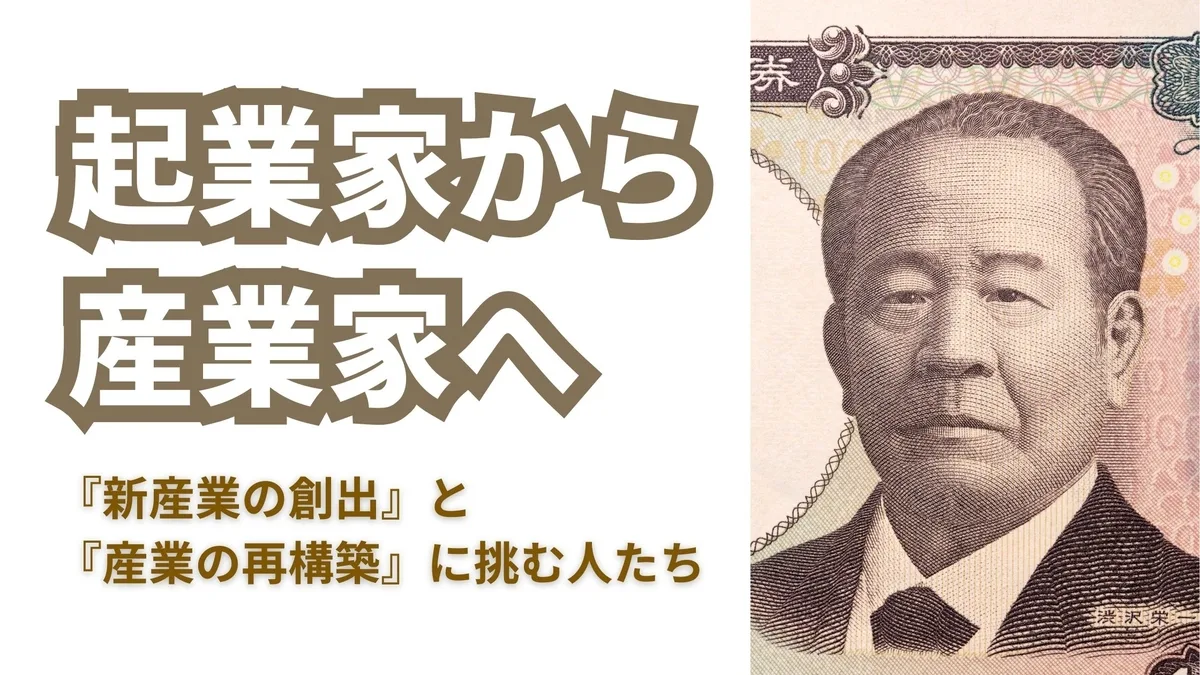
In times of great change, legendary entrepreneurs emerge.
In Japan, examples include Eiichi Shibusawa and Yataro Iwasaki, and in the postwar era Soichiro Honda and Masaru Ibuka, people who contributed greatly to building industries. These people went beyond the frame of the "entrepreneur" who simply starts a new business, and can be called "industrialists" who thought about how to build industries for the sake of the nation and society.
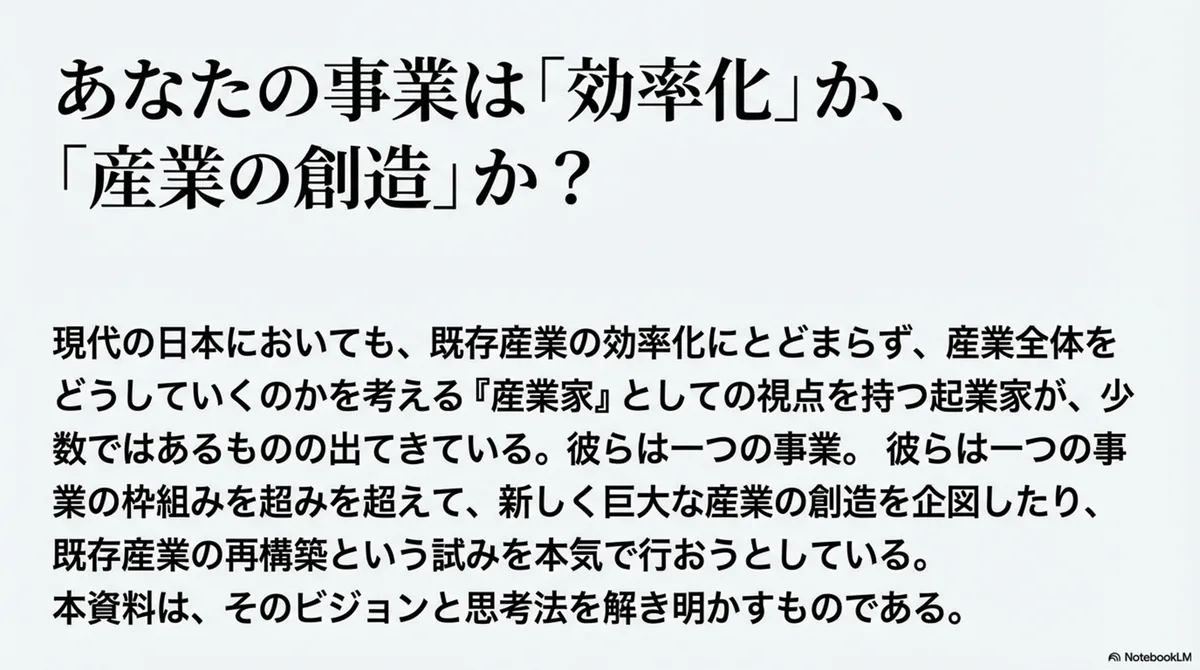
In present-day Japan too, I sense that a small number of entrepreneurs are emerging who do not stop at making existing industries more efficient, but hold the perspective of an "industrialist," thinking about what to do with an industry as a whole.
These people are earnestly attempting to go beyond the framework of a single business to envision the creation of new, enormous industries or the rebuilding of existing ones, and every time I encounter their vision and strategy, I receive great inspiration.
For example, I feel the stirrings of this in the following areas.
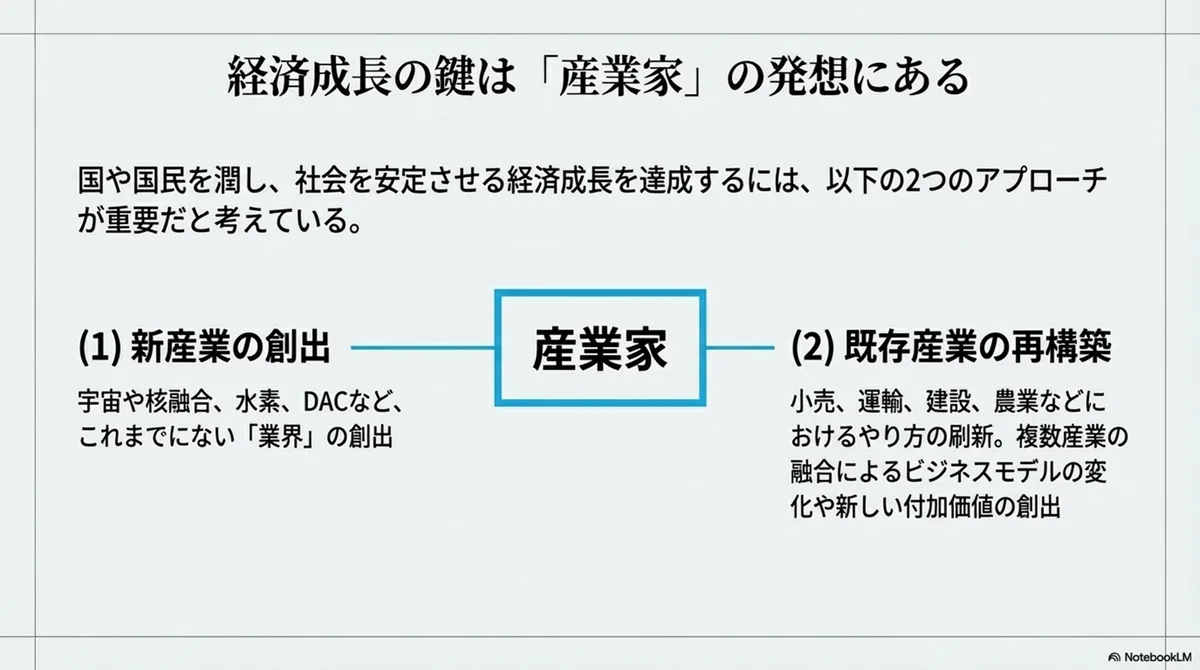
(1) Creating new industries … Creating "sectors" that never existed before, such as space, nuclear fusion, hydrogen, and DAC
(2) Rebuilding industries … Overhauling the way things are done in retail, transportation, construction, agriculture, and so on. Also changes in business models and the creation of new added value through the fusion of multiple industries
As I will discuss later, I believe that to achieve the economic growth that enriches the nation and its people and stabilizes society, it is important to either "create new industries" or "rebuild industries."
That is exactly why I think entrepreneurs with this kind of industrialist perspective are what Japan needs now, and I am writing this article in the hope that it will reach people who hold such a will, beyond entrepreneurs alone.
- Economic growth requires either "creating new industries" or "rebuilding industries"
- The situation in Japan
- (1) Creating new industries
- (2) Rebuilding industries
- Discussions among "industrialists"
Slides by NotebookLM
Economic growth requires either "creating new industries" or "rebuilding industries"
The S&P 500, which drives growth in the United States, is said to be effectively not the S&P but the S&P 8 + 492.
The top 8 companies now account for more than 30% of the entire S&P 500, and these 8 are said to have profit margins more than twice as high as the other 492 companies.
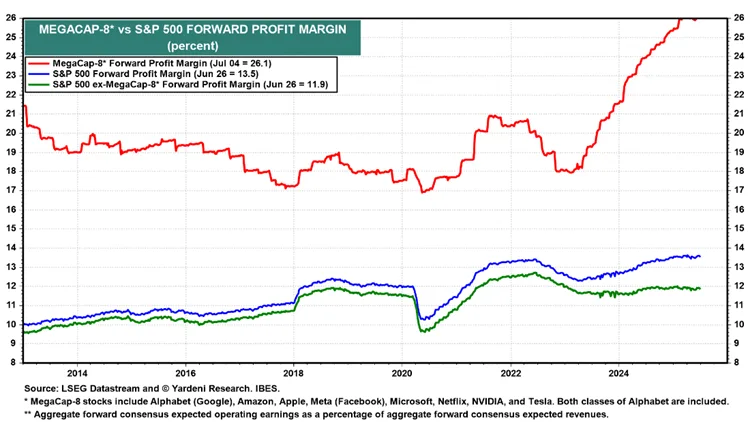
If we classify those 8 companies, they seem to fall broadly into two categories.
(1) Creating new industries - Alphabet, Amazon, Apple, Meta, Microsoft, Nvidia
(2) Rebuilding existing industries - Netflix and Tesla
We can sort them out this way: each of the first six created a new industry, Netflix rebuilt part of the entertainment industry using software, and Tesla rebuilt the automotive industry with a new category, the EV (Amazon created the cloud industry with AWS and also rebuilt commerce, so it could be seen as both).
The proportions are somewhat distorted, but in this way, I believe that creating new industries or rebuilding existing ones is the key to economic growth.
The situation in Japan
Looking at Japan, on the other hand, the labor supply will shrink over the medium to long term. At the same time, the terms of trade have worsened due to the weak yen and other factors, and it is even said that in real terms we are now at the level of 360 yen to the dollar in 1971.
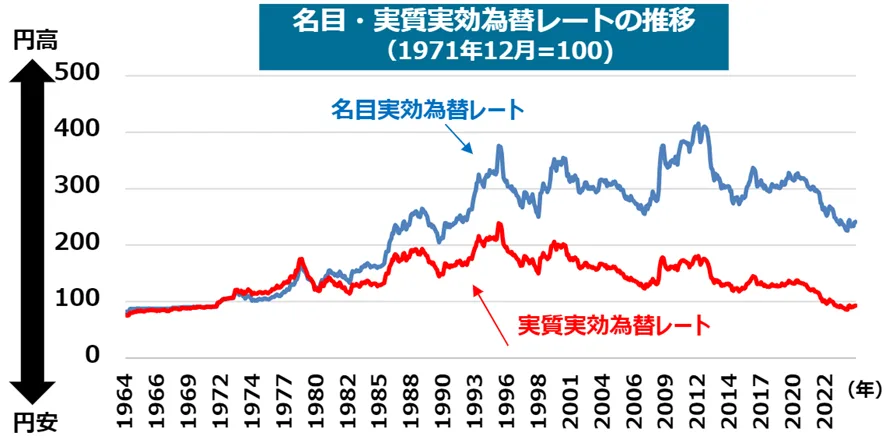
https://www.meti.go.jp/shingikai/sankoshin/shin_kijiku/20250603_report.html
Japan, which relies on imports for resources and food, will find itself in an extremely severe situation in the near future if things continue at this level.
So the major challenges become how to keep local demand such as essential services running with fewer or no workers, and how to bring about a shift of labor into high-value-added industries so that more people can earn higher wages.
In the materials of the New Axis Subcommittee released by the Ministry of Economy, Trade and Industry in June 2025, the direction for 2040 is likewise summarized as: (1) higher added value through Manufacturing X, (2) new added value from the information and communications industry and professional services, and (3) higher added value and labor saving through advanced essential services.
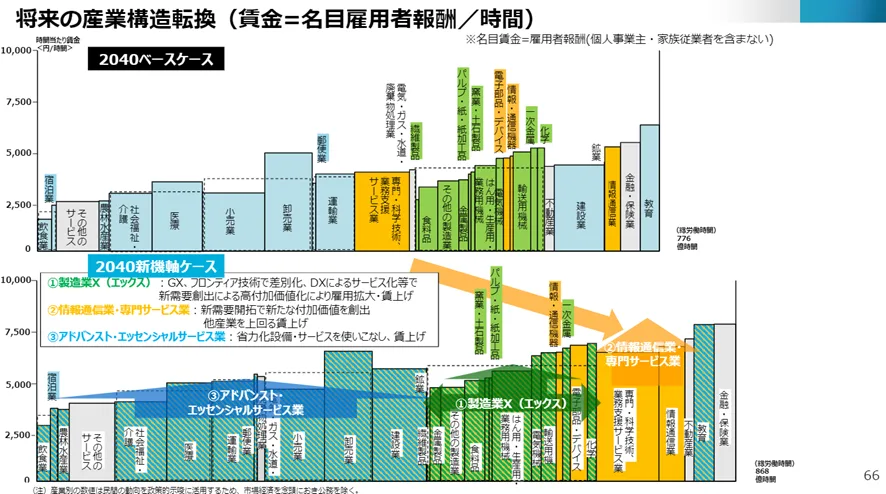
https://www.meti.go.jp/shingikai/sankoshin/shin_kijiku/20250603_report.html
Given these immediate conditions, together with the fact that we must bring about GX (green transformation), major change will be required in each industry.
When I talk with entrepreneurs working on the ground who recognize this situation, they seem frustrated that simply providing software services to make existing industries more efficient cannot create a large impact.
At the same time, they also seem to hold the hope that, thanks to advances in technology and finance, it may be possible to bring about major transformation now.
So I think that having more people consider either creating new industries or transforming existing industries with new technologies (such as software) could be one perspective for further developing the startup ecosystem going forward.
What is needed to solve these challenges, I believe, is to think more deeply about two approaches: (1) creating new industries and (2) rebuilding industries.
(1) Creating new industries
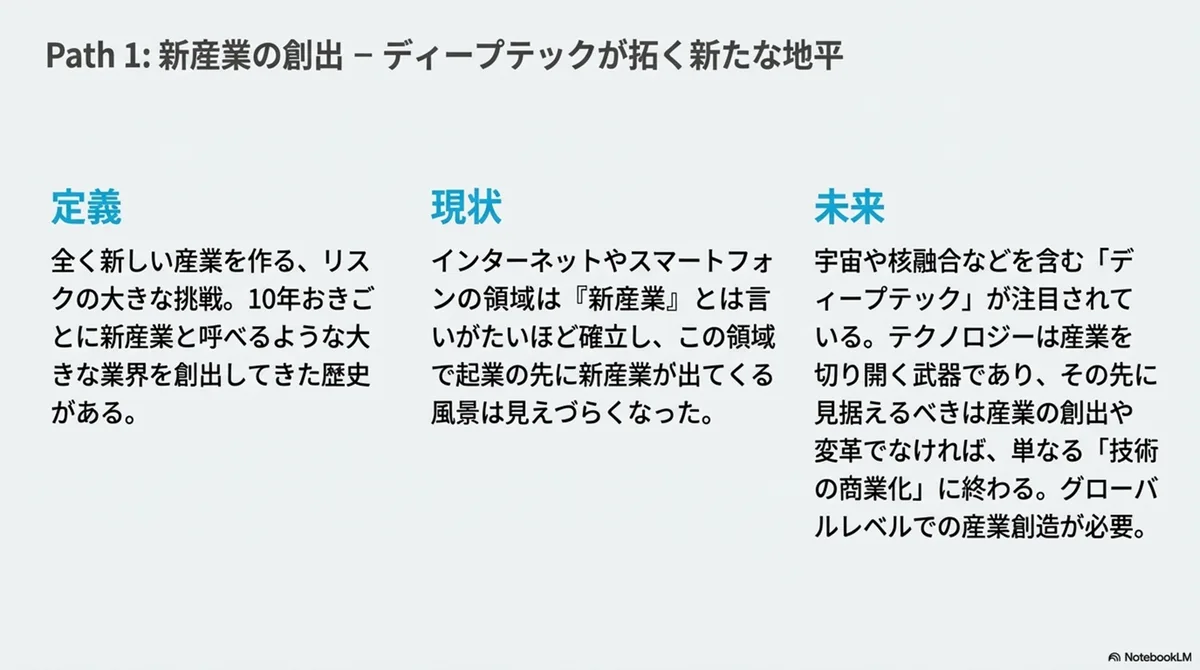
One approach is to create an entirely new industry. This carries great risk. That is exactly why it can be called an area that startups should take on.
In fact, startups in the past created large sectors that could be called new industries every ten years or so, such as semiconductors and personal computers.
(When the term "new industry" is used, people differ in the scale they have in mind. Here, by new industry I mean something on the scale of a large ecosystem: one in which a term like "the XX industry" comes into common use, many companies emerge around its central players, and hundreds of thousands of high-value-added jobs are created domestically.)
Many people will think of the internet and smartphones when they think of new industries. Indeed, the internet of the past and internet startups could certainly be said to have been producing new industries.
But now that the internet industry has become fairly well established as an industry, it is hard to call the internet and smartphone domains "new industries," and it has become difficult to picture a landscape in which new industries emerge from startups in those domains.
You could also say that ordinary entrepreneurship in the internet domain is becoming ordinary entrepreneurship, like opening a restaurant, rather than industry creation. (In a sense, that is also a very good thing.)
Perhaps because the recognition that the era of internet = new industry has ended is becoming tacitly understood, "deep tech," including fields such as space and nuclear fusion, is attracting attention.
But I also feel some danger there. Technologies such as deep tech can certainly be powerful weapons for opening up industries, but technology is only a means. If what lies beyond it is not the creation or transformation of an industry, it will end up as mere "commercialization of technology."
If you aim at gaps and niches within an industry, you may be able to increase the wealth of the individual entrepreneur or a few executives, but it will be difficult to build a mechanism that benefits more people.
That is exactly why I think we must be more strongly conscious of "creating new industries."
On the other hand, among deep tech entrepreneurs, those who are trying to create such new industries at a global level seem to hold the "industrialist" perspective: going beyond the interests of individuals or single companies, and beyond technology, they think about truly large businesses and about the nation's industry as a whole. Such a perspective is likely to be strongly needed.
There is also a difference between the era of Eiichi Shibusawa and his contemporaries, or the dawn of the internet, and today. In those eras, bringing in foreign industries, like a time machine, could become a new industry in a local region such as Japan. But now we need to create new industries at the global level (although some security-related fields may differ), and I think this is one of the difficulties of thinking about new industries.
Yet it is by overcoming that difficulty that one becomes an industrialist who leaves a name in history.
(2) Rebuilding industries
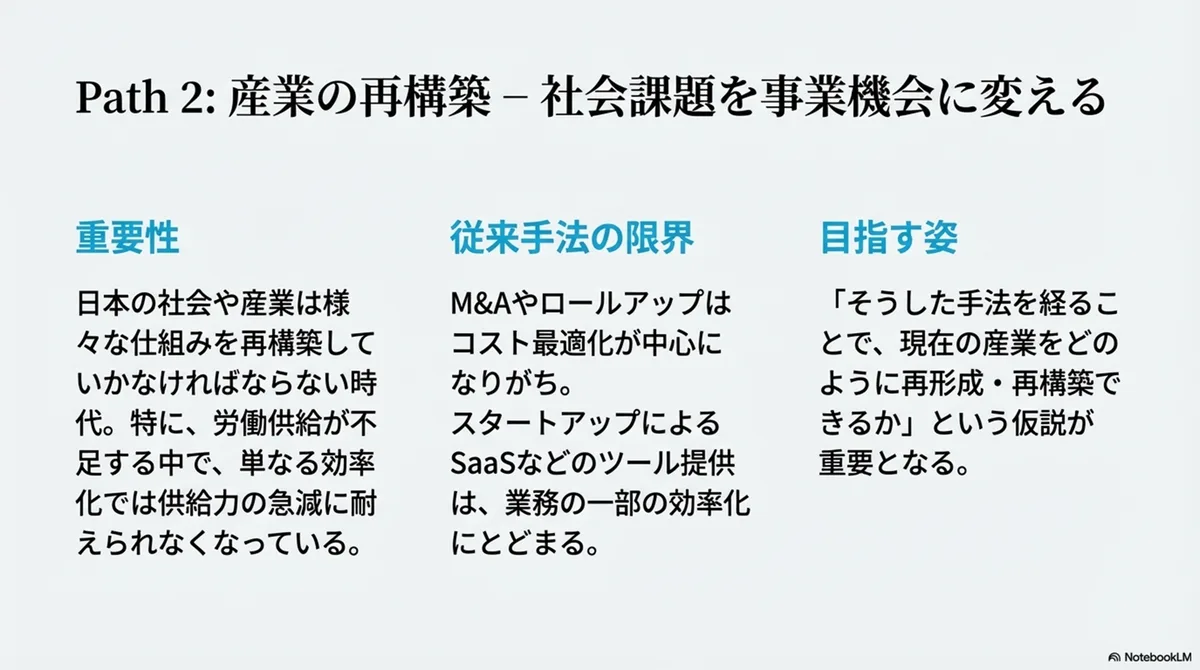
The second is "rebuilding industries." It seems that we are entering an era in which Japanese society and industry must rebuild various systems.
Going forward, although the working population may increase, mainly among older people, working hours are expected to decrease, and the job openings-to-applicants ratio for light work, which such people want, is still below 1. In the other areas, simple efficiency gains will not be enough to withstand this sharp decline in supply capacity.
Likewise, if startups merely provide tools like SaaS to essential service industries, it will only make part of the work more efficient. That efficiency alone limits the upside in revenue.
So methods such as M&A and roll-ups are now being considered. But PE-style roll-ups tend to center on cost optimization and efficiency through consolidation, which preserves the existing ways of doing things. Of course, such efficiency is the minimum necessary, but we need to consider whether efficiency alone can sustain us through the labor supply shortage that is coming. In some cases it may, but I think that in many sectors, at some point, the way things are done will probably have to be fundamentally overhauled.
Roll-ups, full-stack startups, vertical integration and compounding, and the automation of operations are merely methodologies. If we are to rebuild industries, what matters, I think, is to treat such methods as waypoints and to have a hypothesis about "how, by going through such methods, we can reshape and rebuild the current industry."
Chris Power, founder of Hadrian, which is building aerospace and defense factories in the United States from scratch, reportedly felt at first the limits of efficiency gained through software alone, and was planning a business that would use the power of finance to roll up companies and secure scale, then vertically integrate and automate; but after seeing how chaotic the operations were at the manufacturing sites of the acquisition candidates, he gave up on rolling up and improving existing factories and chose to build from scratch. There is also this quote.
"We realized that the right way to bring technology to industry was not to sell software to these companies, but to use software to build industrial businesses from scratch."
I think that, thanks to the advance of software as a general-purpose technology, we have reached the point where such rebuilding is possible. For example, when automobiles became widespread, they created a means of mobility, Walmart and others emerged, and the retail industry changed greatly from small shops to large mall-type stores. Likewise today, software and robotics have brought some industries to the point where they could change their ways of working dramatically.
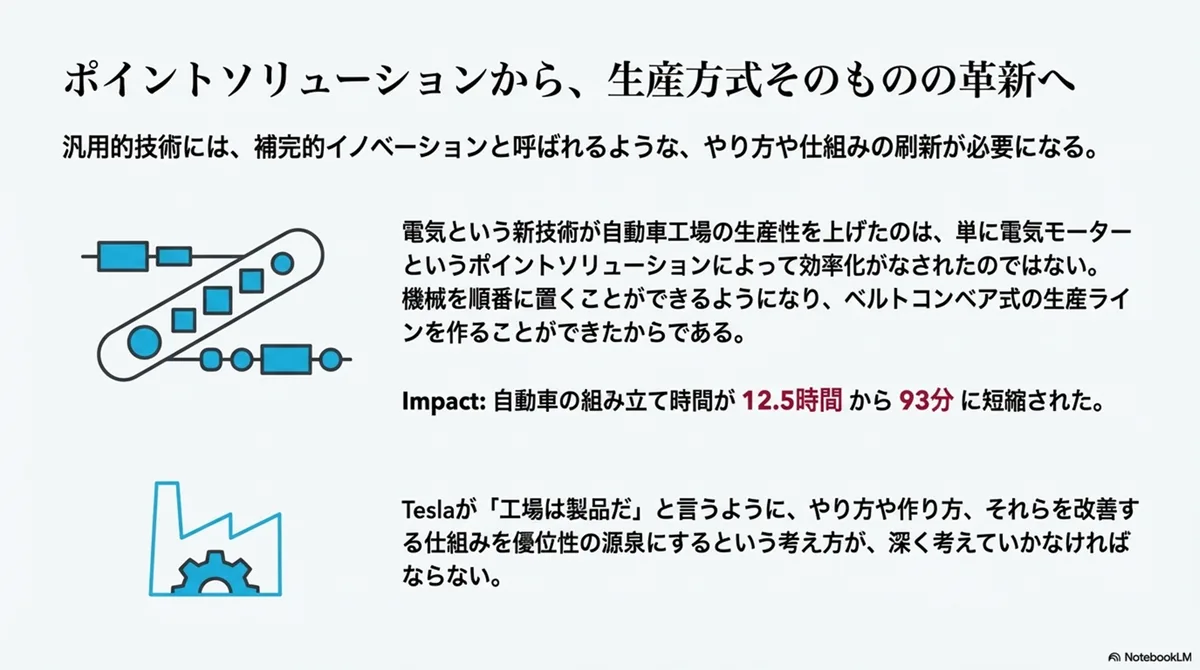
As I also wrote in my book Implementing the Future, general-purpose technologies require a renewal of methods and systems, what are called complementary innovations. The reason electricity, a new technology, raised productivity in automobile factories was not that efficiency was gained through a point solution like the electric motor, but that machines could be placed in sequence, making it possible to build belt-conveyor production lines. As a result, it became possible to cut the assembly time of an automobile from 12.5 hours to 93 minutes, and many automobiles reached consumers.
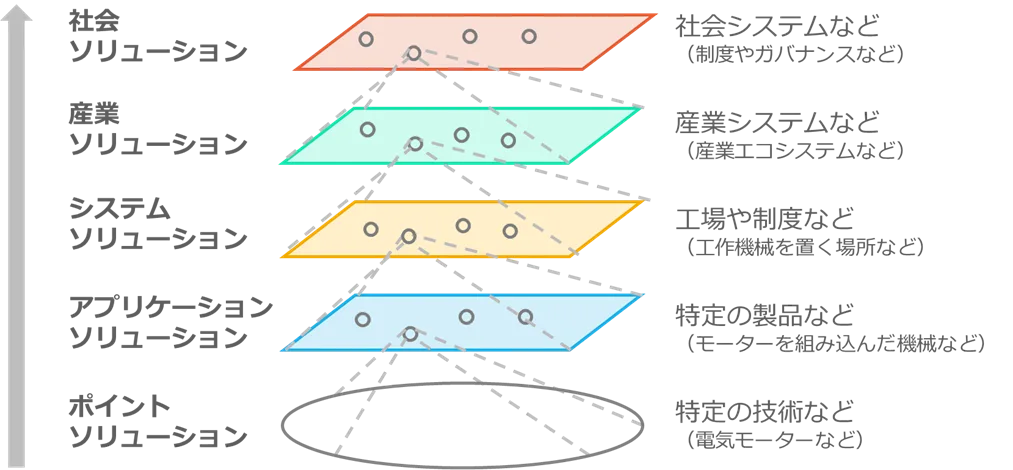
In Japan, where a shortage of supply capacity, starting with labor supply, is occurring, I think the social demand to renew methods in this way and achieve dramatic efficiency gains is also growing stronger.
And, as Tesla says "the factory is the product," we must think deeply about the idea of making the way things are done and made, and the mechanisms for improving them, the source of competitive advantage.
Hadrian, mentioned earlier, is an example of an attempt at rebuilding. Movements that advocate Reindustrialize are another. In Japan, I think newmo and others are considering new ways of taxis and mobility, and interesting efforts also seem to be starting in the energy field. And I think these are easier to make sense of when viewed as movements to rebuild industries.
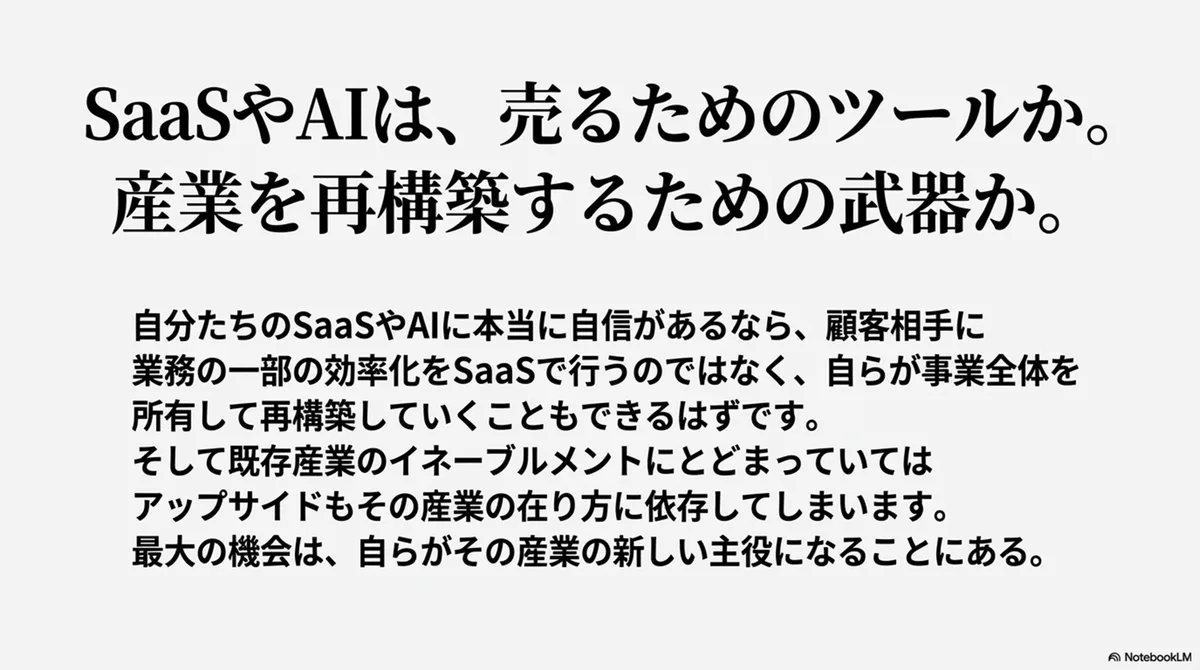
If you truly have confidence in your own SaaS or AI, you should be able to own the entire business yourself and rebuild it, rather than using SaaS to make part of a customer's operations more efficient. I think taking such bold action is the original role of a startup, and if you stay within the enablement of existing industries, your upside also ends up depending on how that industry is structured.
Enabler startups that help bring about the creation of new industries and the rebuilding of industries are also important. But without a direction, there can be no enablement either. Showing that direction is, I think, also one of the roles of startups.
How should we think about rebuilding industries, combining digital efficiency and green added value, and building mechanisms that can run even with orders of magnitude fewer workers or none at all? To that end, how should software and hardware be combined? And how should regulation and policy change?
People who think that far are truly "industrialists," and I believe such industrialists are needed now, including among some of the entrepreneurs who start businesses in existing industries.
Discussions among "industrialists"
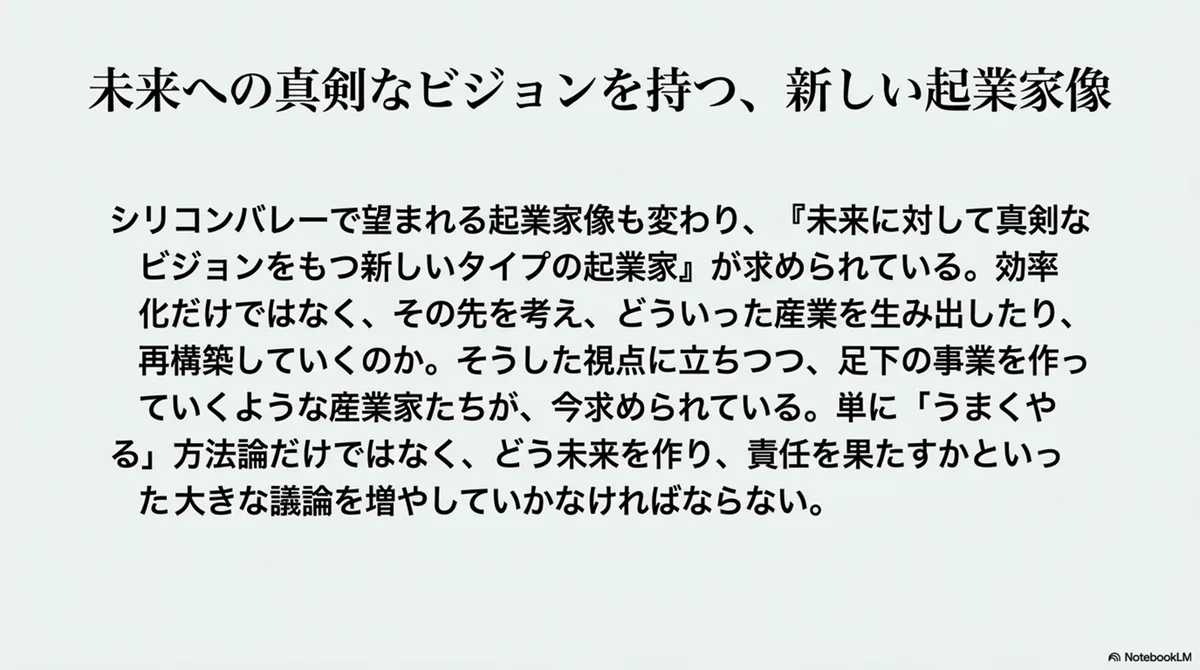
A recent article in Wired also pointed out that the kind of entrepreneur wanted in Silicon Valley is changing, and that 'a new type of entrepreneur with a serious vision for the future' is beginning to be sought.
Industrialists who think beyond mere efficiency, about what kinds of industries to create or rebuild, and who build their current businesses from that standpoint, are few even among entrepreneurs, and as far as I know, there are not many people with whom one can have such discussions.
I don't think every entrepreneur needs to become one, but I still want the proportion of such industrialists to grow. And unless we increase the larger discussions, not just methodologies for doing entrepreneurship "well," but how to build the future and fulfill our responsibilities, I think it will be difficult for startups to contribute to industrial policy or bring about large impact.
I wrote this article in the hope that it becomes a message to people who share this feeling, and an occasion for the existence of such people to come to the surface.
I hope it can become an environment where we discuss and learn from one another about what we can do with Japan's industries, across industry boundaries.