Product/Society Fit (PSF) for Non-Profit Organizations and Its Journey
This article was machine-translated from Japanese by AI (Claude). It may contain errors. Read the original Japanese article.
It is said that the first thing a for-profit startup aims for is Product/Market Fit (PMF). As the name suggests, it is a state in which the product fits the market, and once it is reached, a phenomenon is said to occur in which the company is overwhelmed by inquiries from customers.
On the other hand, the ultimate destination of the products and services created by non-profit organizations and social enterprises is not necessarily a "market" in which buying and selling take place. They will aim to be accepted by "society," including areas outside the market.
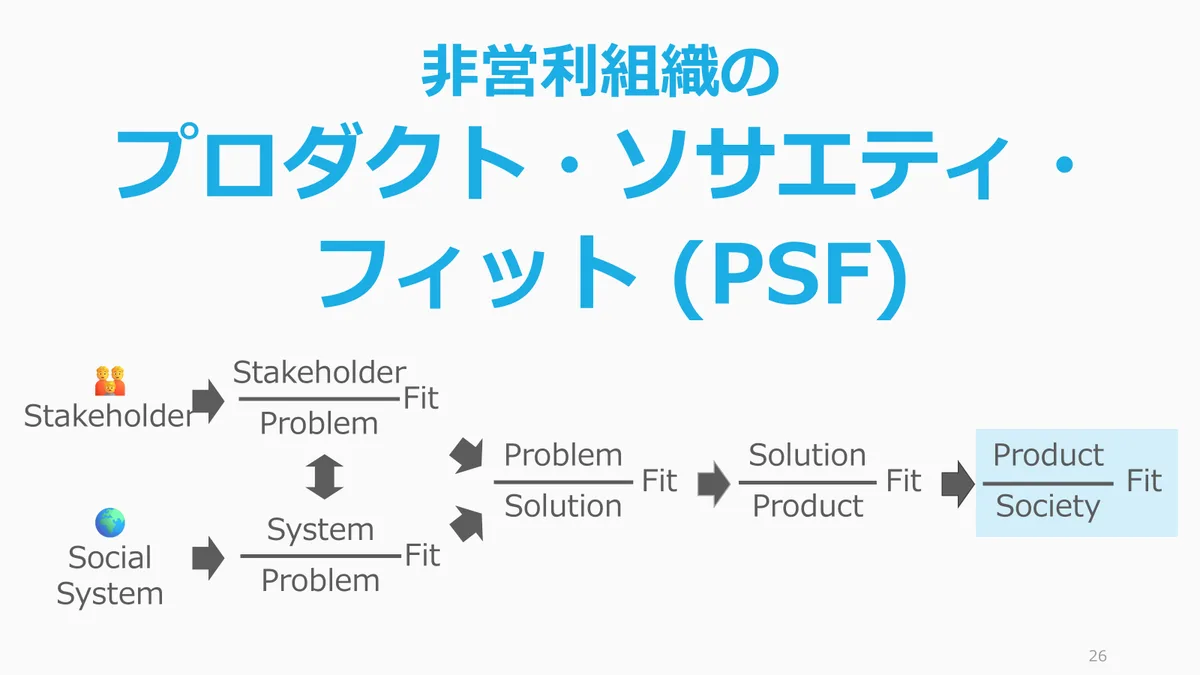
So let us try to organize this by calling the state of arriving at a product or service that functions in society Product/Society Fit (PSF).
(The "society" here comes in various sizes. There is human society at the global scale, and there are local communities targeting only some people. Schools and communities are also societies.)
Organizing things in this way, I think, makes startup metaphors work, and makes it easier to reuse some of the know-how cultivated in startups.
One example is the staged model of the order in which startups proceed with validation, which I call the Startup Fit Journey, and its application.
In this article, in order to make use of the journey below and startup best practices, I would like to go step by step through what is the same and what is different between for-profit and non-profit.
Organizing the Fit Journey up to PSF
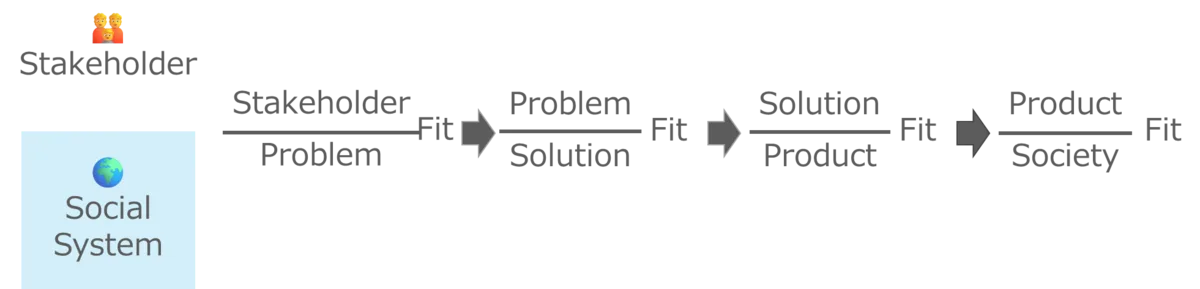
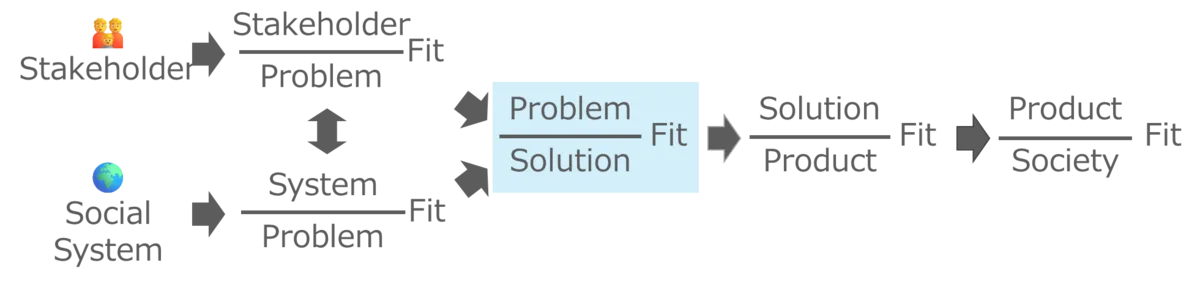
For startups in for-profit companies, the following framework was used.

The Startup Fit Journey of a for-profit company (startup)
If we apply this to the Product/Society Fit above, the final Market becomes Society. That is, the rightmost stage becomes Product/Society Fit.

The left end needs to change as well.
When the market is the goal, the starting point was the Customer. A customer generally refers to a person who buys a product or service. In many cases, customer = user, but not always. For example, in a service like Google, the customers (such as advertisers) and the users (people who use search) are different.
Being conscious of this difference in terms, for a non-profit endeavor it seems better to organize things so that they begin not with the customer but with the Stakeholder. Therefore, the first step becomes Stakeholder/Problem Fit.

I believe the stakeholder here should be placed mainly on the beneficiary (Beneficiary), but it also includes the following people. (This differs depending on the project.)
- Beneficiaries
- Donors and supporters
- Government and local governments
- The general public
Unlike for-profit companies, which basically only need to face in the direction of the customer, non-profit organizations start by carefully thinking about who these stakeholders are. For that reason, stakeholder mapping and the like tend to be done early on.
Once the stakeholders have been identified in this way, in order to identify the "burning need" that was said to be the task of the conventional Customer/Problem Fit, it would be useful to do things like the following with the important stakeholders:
- Stakeholder interviews
- Research on substitutes and competitors
- Observation on site
- Working on site
- Reading related books, no matter what
I have organized various differences, but basically, if you are trying to solve a social problem using a product or service, what should be done at each stage is similar to what is said about conventional startups, and I think the know-how can be reused.
Understanding the Social System
However, when tackling a social problem, it is not the case that it is enough to be conscious only of the beneficiaries, who are the main stakeholders.
Giving emergency aid to people in distress is of course important, but it tends to be symptomatic treatment that provides temporary relief from the symptoms, and in many cases it does not lead to a cure. The burning needs that beneficiaries feel are, in most cases, truly short-term needs, and continuing to address only those is like pouring water on hot stones over and over (to repeat, such emergency aid is also important). For example, measures such as providing cash benefits or subsidies because the price of rice or gasoline is high may be effective in terms of temporary relief and gaining political support, but they will not lead to a cure.
Many social problems arise from some kind of social structure or distortion in society. If you want to provide a fundamental cure, or if you want to solve a problem with large impact, you must understand the structure or system that produces the problem, and solve the problem that acts as a lever.
In that sense, unlike for-profit companies, non-profit organizations also need to understand the social system.
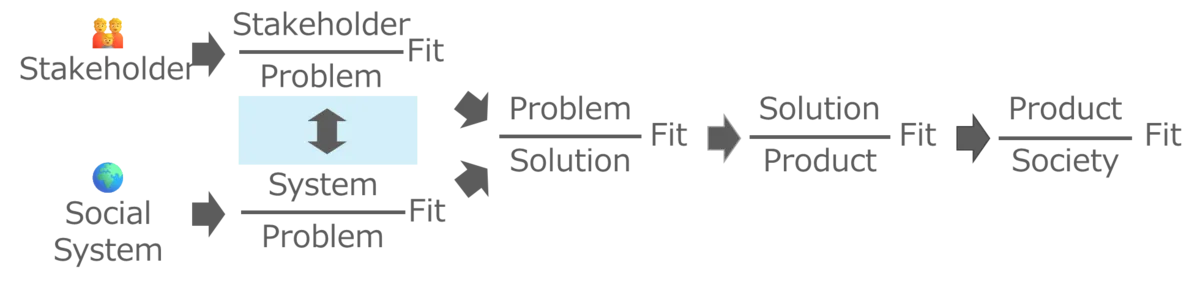
This means that you need to identify problems while moving back and forth between problems from the micro perspective held by stakeholders (people) and problems from the macro perspective of the social system (Social System).
In that sense, alongside the conventional exploration of Stakeholder/Problem Fit, you need to run the exploration of Social System/Problem Fit in parallel.
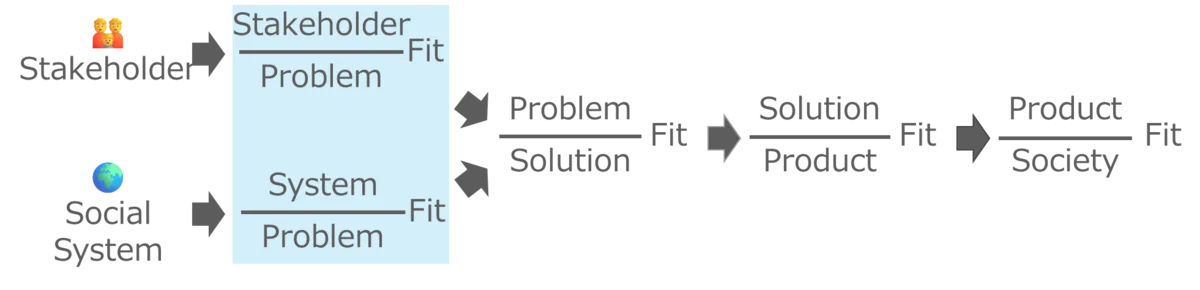
When organizations in the non-profit domain try to receive grants, I think they are often encouraged to organize social problems with a systems map or a problem structure map in order to maximize impact. This seems to be exactly the work of understanding the Social System at the left end of the lower row, and finding the problem (Problem) that acts as a lever within it.
On the other hand, even if you understand the whole system appropriately and can draw a clean solution, nothing will start unless it is accepted by the beneficiaries and stakeholders.
Moreover, we often notice such systemic, macro-level problems only after getting to know the front lines of the social problem (the stakeholders' problems), so it is not that one should not move until the structure of the social system has been sorted out.
For that reason, you are required to move back and forth between multiple problems of the stakeholders and multiple problems of the social system. Among those problems, you must identify one that can be solved now and that, if solved, would bring large impact.
Once such a problem has been identified, you devise a solution for it and head toward Problem/Solution Fit.
And if the solution looks likely to work, you will scale it as a product.
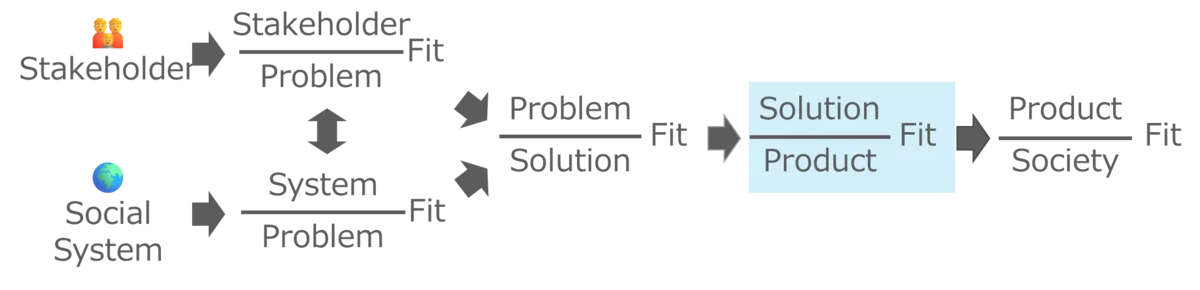
Note that the "product" of a non-profit organization here can be not only a product in the usual sense (goods and services), but also things such as
- Policy
- Franchise (packaged services)
(as in the typology of endgames).
And when that product is well accepted by society and demand grows, you can say that PSF has been achieved.
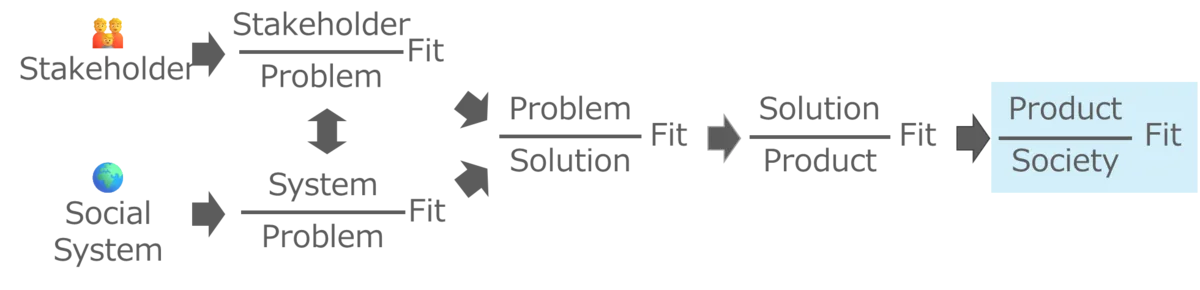
I think that, at each stage leading up to this, some of the know-how of startups can be put to use.
Summary
There are several major differences between for-profit and non-profit organizations, but I have organized this on the premise that, if you intend to solve social problems using products or services, some of the best practices of startups can be used once you are conscious of those differences.
Note that you do not necessarily have to follow this path, and this is not to say that it is correct. I hope you will take it only as one reference framework.
For the detailed know-how of startups, please see the slides above.
This framework first appeared in the Non-Profit Startup Accelerator Program, but I hope this way of thinking can also be used in The University of Tokyo Social Tech Startup Accelerator Program, which starts on June 16, 2025.