The Shifting Meaning of "Social Impact" and the Thought Behind Business
This article was machine-translated from Japanese by AI (Claude). It may contain errors. Read the original Japanese article.
National defense and security are regarded as public goods. Because markets alone struggle to supply them sufficiently and their benefits are hard to limit to particular people, the state supports them through taxes. From the perspective that defense businesses produce benefits that underpin all kinds of activity, namely people's lives and safety (and fill a domain that markets alone struggle to supply), they can be considered to create positive social impact by raising people's safety.
At the same time, I think quite a few people feel reluctant to call defense "impact." They feel it is wrong to describe technology that could be used in war as being "for society." I believe this feeling has its reasons. When one country strengthens its defense capabilities, other countries may perceive it as a threat, and when a conflict actually breaks out, the technologies and businesses developed there can hurt people. From the standpoint of "making the world sustainable," it is better for conflicts not to occur, and if defense businesses raise the probability of conflict, it is no surprise that some feel they have a negative social impact.
I think which position one takes depends on one's thought. By thought here, I draw on Mullins' definition of ideology and take it to be a concept that integrates (1) a perception of the world, (2) evaluative guidelines (norms), and (3) guidelines for action.
For example, whether one sees deterrence as effective or as inviting a chain of arms buildups is a difference in perception of the world. Whose safety to protect and how far to count something as good can be understood as differences in the evaluative guidelines (norms) one adopts. And on the basis of such a perception of the world and such norms, guidelines for action emerge: for which uses and under what conditions to allow investment, and what to exclude.
(※That said, it is not enough to treat perceptions of the world about deterrence and arms buildups merely as differences in thought; they also need to be verified against concrete conditions and evidence.)
I have written before about the closeness of business and thought, and I think that in practice, this issue may be raised first in Japan's impact investing and impact startup industry.
Efforts to quantify impact have existed for some time, but what is now becoming a subject of debate is the qualitative side of impact. In terms of a ruler, if quantification is about deciding the graduations on the ruler, the qualitative debate is about which direction the ruler points. Defense, mentioned at the start, is one example.
If people differ on whether to include defense and security, which are now becoming familiar topics, in "impact," then I think the word "impact" needs further discussion and clarification once again.
Shared Thought and Changes in Thought
Over the past few decades, there was a somewhat common understanding of what social impact meant.
There were goals to aim for, starting with the SDGs, and I think there was a tacit agreement that social issues are things like poverty, climate change, educational disparities, gender equality, inclusion, and maximizing individual freedom. Behind this was an agreement that globalization and liberalism are good things, and so the content the word impact referred to was probably easy to share.
However, critics of liberalism point out that this was precisely the problem. Looking at the arguments of Patrick Deneen, who advocates common good conservatism, and Yoram Hazony, who advocates national conservatism, I think there is a recognition that behind this agreement, liberalism was being imposed as a tacit premise while posing as neutral.
Backlash against such liberalism and globalization is also gradually growing in countries around the world.
For example, in the United States, the state of Florida in 2023 stipulated that, in managing state public funds, only financial factors affecting risk and returns should be considered. The Net-Zero Banking Alliance, a coalition of banks for decarbonization, also ended its activities in October 2025. These can be seen as phenomena in which the perception of whether climate change is a problem, and norms about who should solve it, are wavering. (However, these are just matters concerning one region, Florida, and one industry, banking.)
That is not all. There are also moves to replace the content of what is good. Deneen, mentioned above, has expressed a position called common good conservatism, which values social stability through families, local communities, and religious communities. Under norms based on this position, businesses that encourage the formation of conservative families would be evaluated as having impact.
By the same logic, for those who advocate excluding immigrants, the position that businesses excluding immigrants create social impact is also logically possible. Of course, what the parties concerned call impact and whether those around them accept that evaluation as valid are separate matters, but if more people come to agree with such views, exclusionary businesses may gradually come to be called businesses with impact.
In other words, if the norms adopted differ, the evaluation of impact differs as well. And because the thought underlying it is wavering, the scope that impact refers to can be said to be wavering too.
The Choice of Entrusting One's Thought to Others
Of course, one can also take the position that solving social issues that markets struggle to solve is impact. However, there are countless phenomena that markets struggle to resolve, and at the point of deciding which of them to certify as a "problem to be solved," a particular norm has already entered in. A non-political stance that is unaware of that choice can also be said to end up endorsing the judgment of the majority of the time.
Another way of choosing is to regard what contributes to the government's problem-solving as impact. In Japan, there seems to be a tendency to equate "the public" with "the government," so I think this view is easily accepted. However, governments also make mistakes in judgment, and supporting the government when it is heading in the wrong direction could not be said to have a positive social impact.
There is also a way of choosing that entrusts norms to someone overseas. In a previous article, I wrote about the structure in which ideas coming in from the United States are accepted without much friction. In the case of defense, the UK and the EU re-clarified in 2025 that they would not uniformly obstruct financing for weapons and arms-related businesses, which had been treated cautiously in sustainable finance, and Japan may end up accepting that answer as it is.
Adopting the standards of the government or of other countries is in itself a choice. But if we cannot explain for ourselves why we adopt those standards, we cannot say we have thought about impact. Indeed, in the discussion on sustainable finance as well, the conclusion at present is that while decisions to forgo investment are not obstructed, investors are to think through the final answer on their own.
Practice and Thought
As the ruler for measuring social impact wavers, how we understand "social issues" will waver as well. And precisely because, over the past decade or so, many organizations have put forward "solving social issues," I think many companies are being asked anew what thought lies behind the way they try to grasp social issues.
Conversely, if a company or organization avoids sorting out that perception and those norms, the sense of resistance mentioned at the start, that is, the discomfort with the words "social issues" and "impact," will continue to remain.
But that discomfort should also become an opportunity to think again about what we regard as desirable change, and about whose disadvantage we take into account and to what extent.
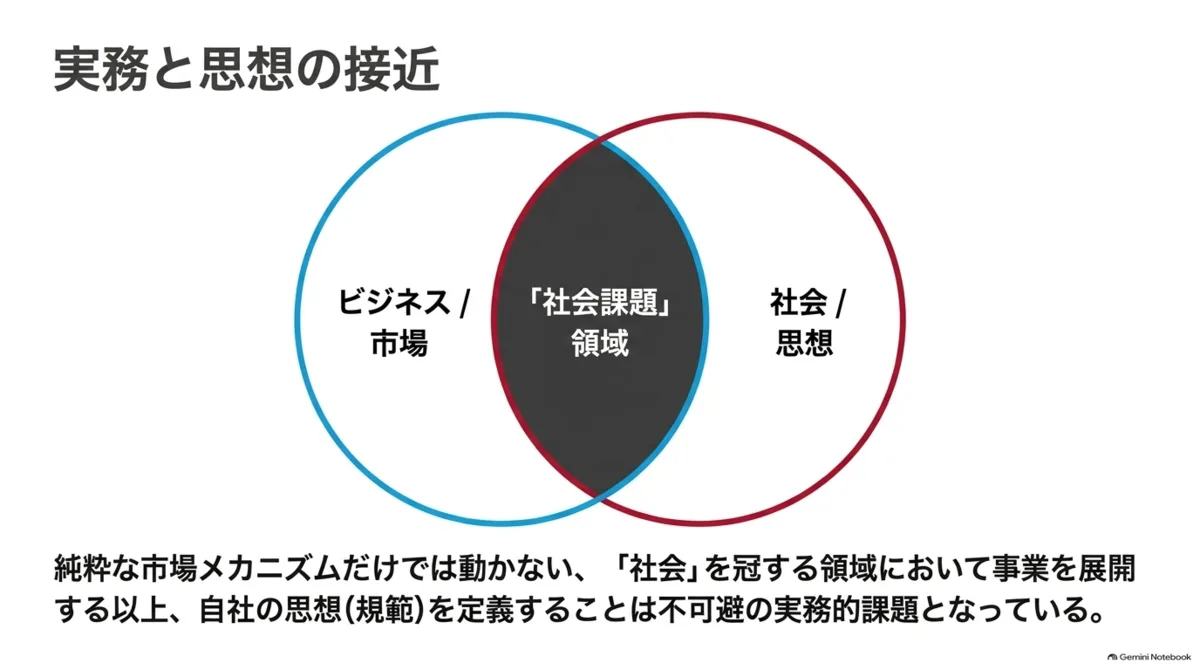
I have written several articles so far on the closeness of business and thought. My feeling is that, especially in domains that are not pure markets, domains that bear the word "social," the closeness of thought and business becomes a practical issue as well, and what I have been saying is that the impact domain would be at the forefront of this. I also think that precisely because more companies now carry the labels of social issues and social impact, discussion and clarification of thought are needed anew in business.