Non-Profit Startups: Startups in the 'Non-Market Domain' That Rapidly Scale 'Social Impact' in a Short Time
This article was machine-translated from Japanese by AI (Claude). It may contain errors. Read the original Japanese article.
Update, 2025-01-18: We are now able to run a support program for Non-Profit startups. Details are here.
Decades have passed since the cloud and smartphones appeared. Thanks to their spread and to contributions such as open source, software-based services can now be developed, distributed, and operated more cheaply.
As a result, it has become easier to launch high-growth startups in the software domain, and many companies have been born over the last few decades. With the further development of developer services, AI, and more, the development and operation of basic software will likely become cheaper still.
When the costs of development and operation fall far enough, the level of revenue needed to sustain a service goes down. If so, I think that for some software-based services, the size and potential of the domain in which they can be run as "non-profit" services, not oriented toward profit, may be growing.
For example, Humanitix, an event service I have been using recently, takes a non-profit form. Event services like this play an important role in creating local communities. Because Humanitix is a non-profit, it balances its revenue against its costs to a certain extent, and its profits go to charity. Additional funding comes from sources such as donations from the foundations of Atlassian and Google. Its ease of use is reminiscent of Eventbrite, and while it lacks Eventbrite's range of integrations with external services, it is fully featured.
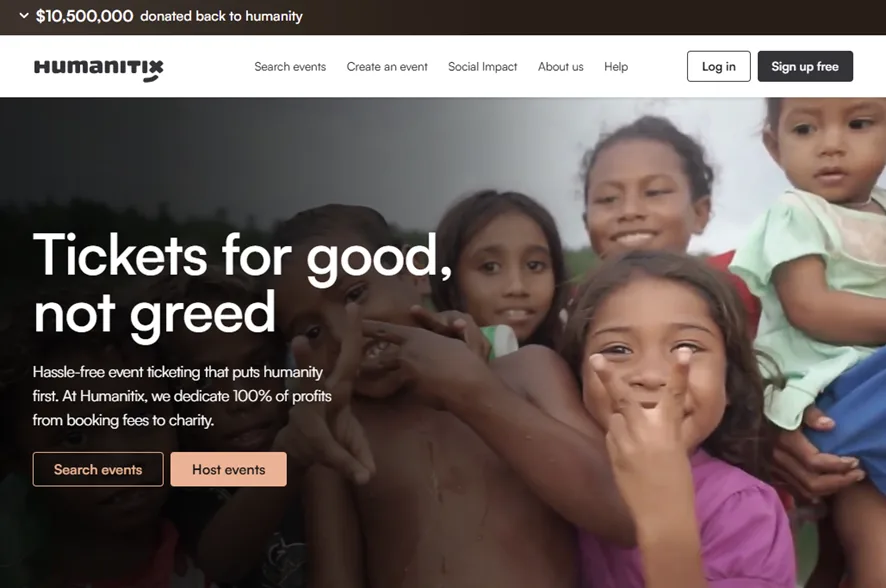
Such services can be free or inexpensive because they are software. Software excels at scaling at low cost and can deliver services to more people.
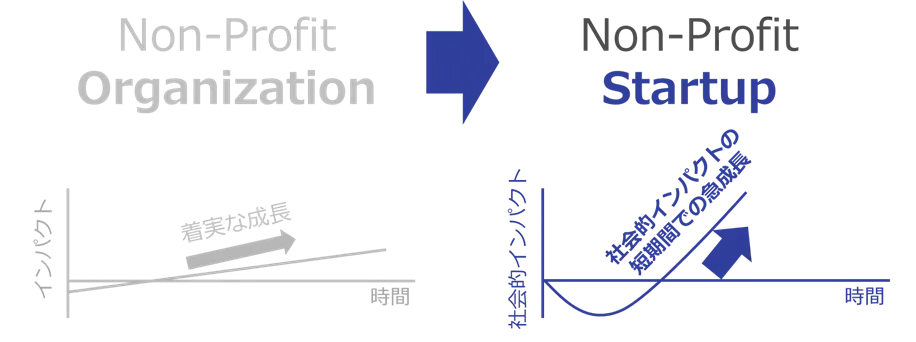
In addition to the power of software, I believe that by combining several elements, it may be possible to realize what are called Non-Profit startups: startups that grow rapidly not on the business yardstick of profit, but on the yardstick of social impact.
Non-Profit Startup
More specifically, I think it is becoming possible to expand social impact in a short time by combining the following four elements:
- Software
- Policy
- Know-how cultivated within for-profit startups
- New sources of funding
Of course, to grow rapidly in a short time, even a non-profit needs to devote effort to awareness and user acquisition, and that requires sales and marketing. "If you build a good product, customers will come on their own" does not hold; on the contrary, precisely because it is a non-profit domain, it will take considerable effort to make yourself known to the people you really want to reach. That incurs personnel costs and requires funding. So I do not think every non-profit service can grow rapidly.
However, I think that for services in some domains, there may be an approach by which a non-profit service can grow rapidly, and I would like to lay out its significance and potential.
- Background
- The Limits of the Market
- Solving Social Issues in Non-Market Domains
- The Potential of High-Growth Startups in Non-Market Domains
- How to Achieve Rapid (High) Growth in Non-Market Domains
- Conclusion
Background
High-growth startups are currently attracting attention, and efforts are under way within them to reconcile solving social issues with running a for-profit business.
Examples include impact startups, which combine rapid growth as a for-profit business with social impact, and zebra companies, which, even if they do not reach rapid growth, pursue growth while running businesses with social significance. In finance, too, there are ongoing attempts such as impact investing, which invests after evaluating social impact, and mechanisms that allow borrowers to obtain loans on favorable terms according to their social impact.
I think the domains in which businesses can solve social issues will gradually increase through skillful use of such market mechanisms and financial arrangements, or through partial modifications to them, and I hope that they will.
Unfortunately, however, I also think that market mechanisms and their modifications cannot address every social issue.
The Limits of the Market
One reason is that, because of the nature of the problems, there are domains in which it is unavoidably hard to make a profit.
For example, looking at the revenue structure of NPOs by field of activity, fields such as healthcare and children, where some money can be collected from beneficiaries, have a relatively large share of business revenue. In welfare fields such as poverty, on the other hand, it is difficult to receive money from beneficiaries, so there is almost no business revenue.
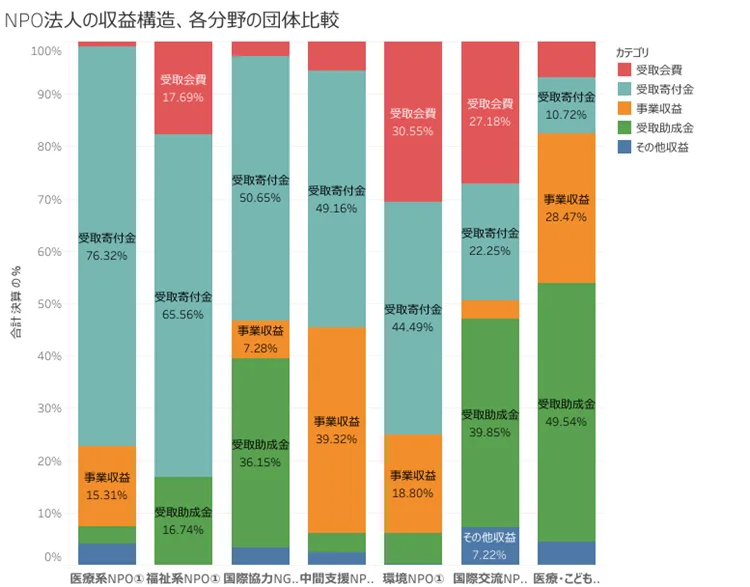
That is only natural: in areas such as poverty, it would be difficult to receive payment for a service from the beneficiaries, who are people suffering from poverty. If one tried to charge money and make it profitable, the service might even end up being something like cramming many people into a small room for the sake of efficiency.
Looking at individual organizations, some have solved such profitability difficulties through ingenuity in their business models and the like. Still, I think it is also true that, as a tendency, there are social issues to which market mechanisms can be applied and social issues to which they cannot.
And if one forces the use of market mechanisms to tackle a social issue, the service can change in nature. In education, for example, one often sees a service that initially tries to reach people widely but is eventually pulled toward the areas where profit can be made and becomes an educational service for children from high-income households.
At the start I said that I use Humanitix in place of Eventbrite, and this is one example. After its IPO in 2018, Eventbrite's performance slumped, and in August 2023 it changed its pricing structure so that the free tier became considerably restricted (although it changed again in September 2024, and those restrictions were lifted).
Market mechanisms are powerful, but they are mechanisms optimized for maximizing financial profit. It is therefore somewhat unavoidable that, depending on the social issue, the market is not suited to it.
Solving Social Issues in Non-Market Domains
Because they are not markets, they do not make money, yet nobody will solve them unless someone does. Governments and NPOs take on solving social issues in such "non-market domains." Education and transportation, for example, are among these domains.
These have social value, which differs from economic value, but they are also domains where economic returns are hard to obtain and there is little economic incentive to enter. That is precisely why they are domains handled by governments.
Of course, I think the digitalization of government now under way has somewhat expanded what government can do. On the other hand, just as NPOs are still needed today, it would be difficult, even in terms of resources, for government alone to address all social issues in non-market domains.
So it is also possible for private companies, not government, to take on non-market domains by using software, a new general-purpose technology, and new business models, while identifying new break-even lines. For example, part of transportation could be made profitable by combining it with real estate value and the like, and it might also be possible to make it pay by introducing new arrangements such as autonomous driving and ride sharing.
While I have hopes for such efforts, I think there are limits to the domains that can be expanded as for-profit companies. That is exactly why domains will remain in which one should deliberately not aim for profit and should operate as a non-profit.
The Potential of High-Growth Startups in Non-Market Domains
At the start I mentioned the cloud and smartphones. Their costs have fallen, and the number of people able to use them has also grown over the past decade. Furthermore, with the arrival of AI, the cost of development is also falling.
On the other hand, I think that many efforts have already been made on businesses that can grow rapidly within the market by utilizing the cloud, smartphones, and the like, and the promising opportunities seem to be gradually decreasing.
Also, many ideas are proposed as for-profit ideas, and among them there seem to be a fair number that would be better pursued as non-profits than as for-profits. In fact, for some ideas, forcing them into a for-profit form makes it hard to achieve the social impact originally intended.
Yet efforts in the non-profit domain have not been made sufficiently. I think there may be an opportunity in this gap.
Japanese NPOs are not run on the premise of software, and they do not appear to be making full use of it. Simply introducing software well there would produce large benefits.
And if the know-how cultivated so far in high-growth startups, along with policy and funding, are used well, I think NPOs may emerge that can grow their social impact rapidly in a short time, unlike conventional NPOs that grow steadily.
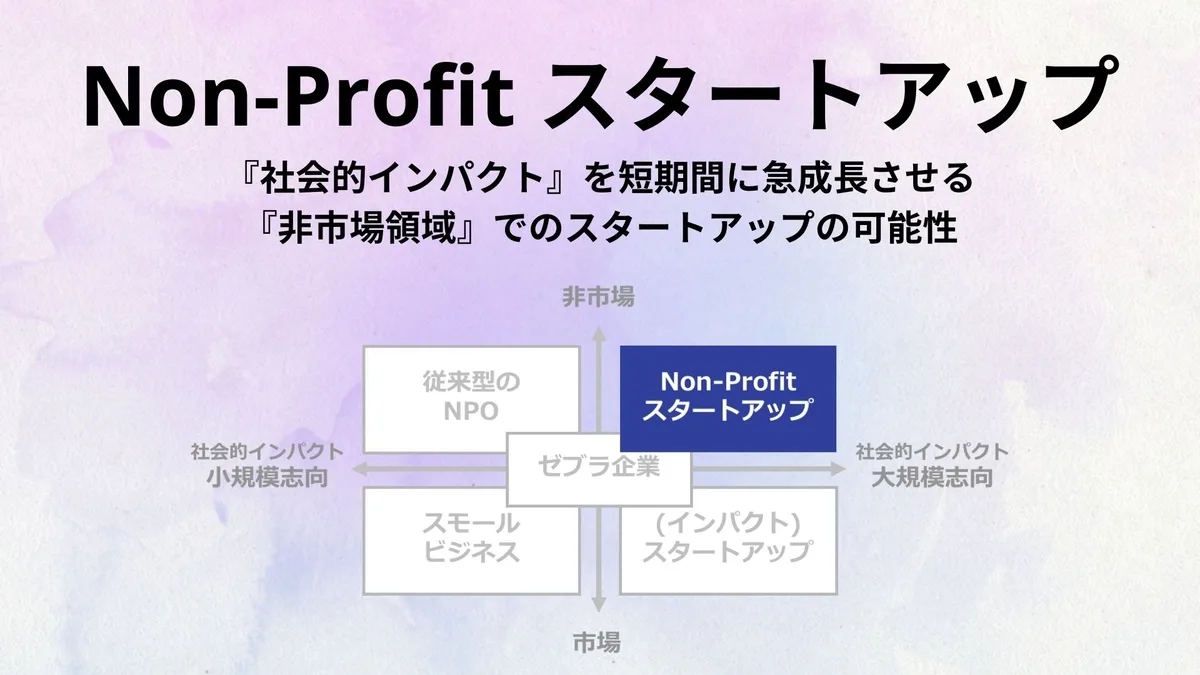
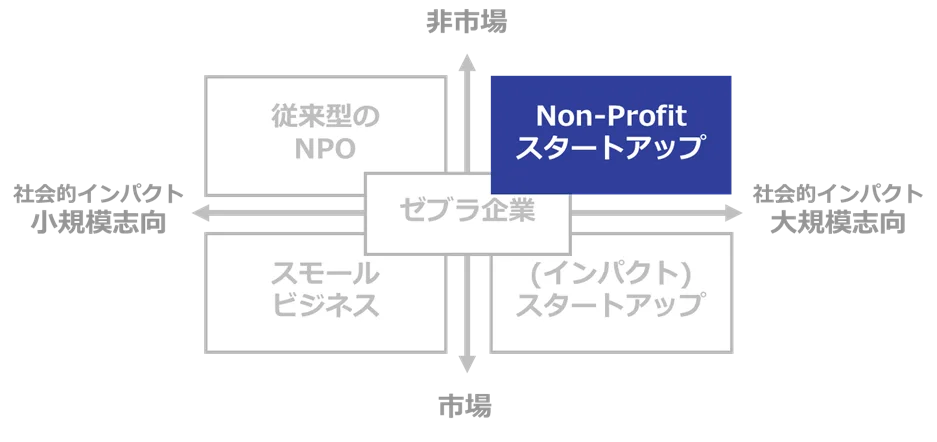
To summarize, it looks like the following diagram.
Take the market-to-non-market domain on the vertical axis and the orientation from small-scale to large-scale impact on the horizontal axis (it is only an orientation, and neither is better than the other). The idea is that a Non-Profit startup could exist in the upper-right quadrant.
How to Achieve Rapid (High) Growth in Non-Market Domains
To realize Non-Profit startups that rapidly grow social impact, I think the following four can now be used as new tools:
- Software
- Policy
- Startup methodologies
- New funding
(1) Use Software
As I have been saying, software is a tool that we have newly acquired.
In fact, groups referred to as Tech for Good have been emerging overseas. Japan has a field called Civic Tech, but overseas there is also Fast Forward, which supports organizations under the category of Tech Nonprofits. I think the NPOs it supports include ideas that could become Non-Profit Startups (NPS).
(2) Use Policy
If there is a tool other than software that can be used in solving social issues, it is policy.
Policy has traditionally been something for legislators and government officials to devise, but policy proposals and policy entrepreneurship from the private sector and citizens are increasingly being called for. If appropriate policy can be created, social issues can be solved on a large scale.
(3) Use Startup Methodologies
I think that part of the startup know-how cultivated over the past few decades can be used in the non-profit domain too, especially in the early stages of exploration and launch. For example, I think interview techniques in early exploration, how to build an MVP, and how to build a service can be applied to creating Non-Profit startups as well.
In fact, Y Combinator, a startup support organization, also supports many NPOs, which I take to mean that it believes some startup know-how can be used.
(4) Use New Funding
I think people who made their fortunes in high-growth startups are beginning to engage in support activities in the non-profit domain. For example, the foundation of Atlassian's founders, the company behind JIRA and other products, donates to Humanitix. I think similar flows of funds are emerging in Japan too.
Furthermore, in the UK and Japan, programs that put dormant deposits to use have begun, and I think new funding is starting to flow into non-market domains.
Conclusion
For-profit and non-profit organizations are not clearly divided into two. Impact investing, too, falls on a gradient, from investing that prioritizes financial returns to investing that prioritizes impact. As in the diagrams below.
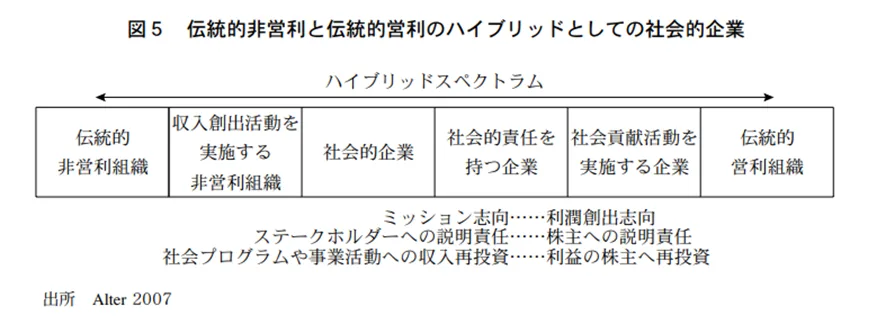
https://oisr-org.ws.hosei.ac.jp/images/oz/contents/662-05.pdf
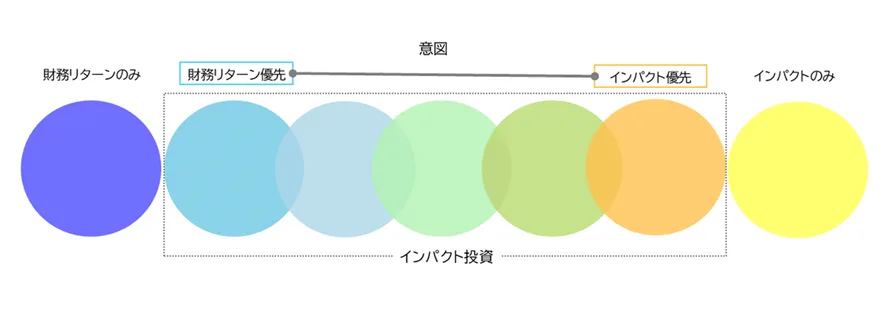
And each social issue needs the solution and funding suited to it.
We are now gaining software, policy, new funding, and new know-how, and I think efforts are beginning to appear that use these new tools to maximize social impact in a short time.
When the term "sharing economy" emerged, it allowed initiatives of that kind to be grasped well and encouraged even more people to enter. In the same way, I hope that the term "Non-Profit Startup" will allow similar efforts to be grasped, increase the number of challengers in this domain, and lead to many social issues in non-market domains being solved.
Postscript:
I think Non-Profit startups may be an opportunity especially for students. The for-profit startup-style businesses that students can aim for are gradually decreasing, but in the non-profit domain there is still much they can do, and it should be easier to gain successful experiences and good learning. I hope you will take on this domain from that perspective as well.
Supplement: I also recently talked about this same topic on YouTube.