Starting a Discussion on Sustainability for a New Era
This article was machine-translated from Japanese by AI (Claude). It may contain errors. Read the original Japanese article.
The word "sustainability" tends to give the impression of meaning "good for the environment," but its original meaning is "the ability to be sustained."
If we take sustainability in the narrow sense as environmental sustainability, I feel that from now on we will need to think about sustainability in a broader sense, closer to the original meaning of the word.
In terms of more specific challenges and domains, these are:
- Security
- Social security
- Health
- Labor shortages
- Industrial structure
- Climate change
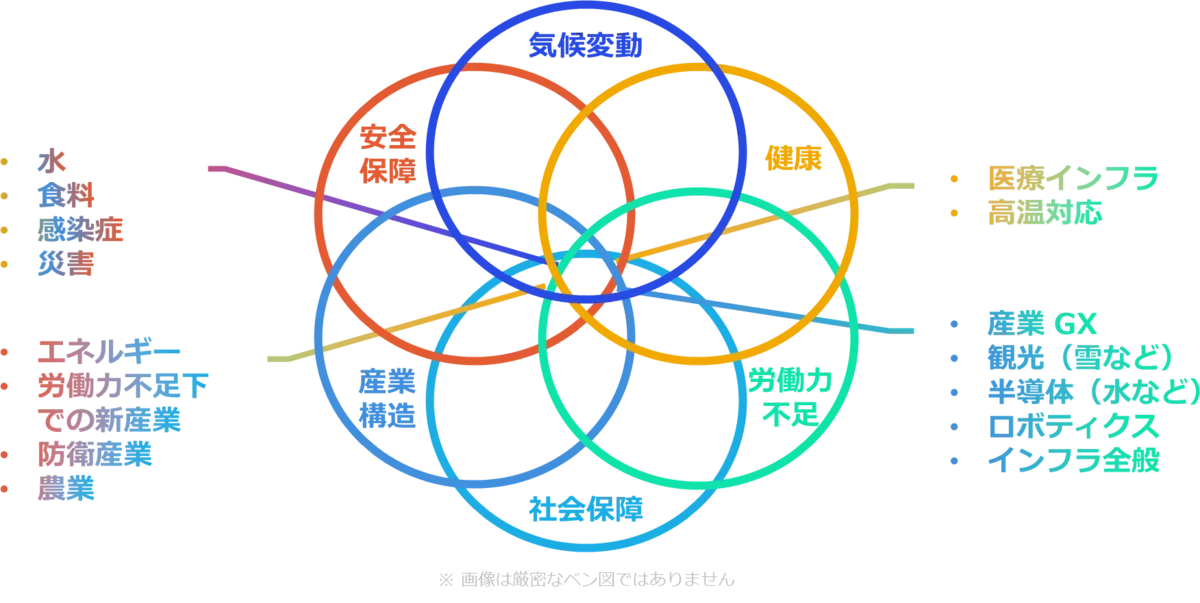
I believe we need to think about how to make our economy, society, and daily lives sustainable in the areas where at least two or more of these six domains of challenges overlap, and how to create innovation in each of those overlapping areas.
The diagram below illustrates this. Strictly speaking, a Venn diagram cannot fully express the overlap of six quadrants, so please take it as an image.
Example: Maintaining a Healthy Diet
At present, it seems to me that maintaining our economy and society, centered on the six domains above, is becoming considerably harder. As one example, let's take up the difficulty of making food sustainable.
We need food for our health. But climate change threatens it. This is because damage to crops due to global warming is already being seen in Japan.
This also affects the employment of farmers involved in food production. For example, the regions suited to growing grapes have already shifted. Some regions may gain new opportunities as a result, but current farmers will suffer major damage. Some of them will end up quitting farming.
Even setting aside the effects of climate change, the number of farmers in Japan is declining. The labor shortage, especially in rural areas, goes without saying, and the farming population is aging; the number of farmers is projected to fall to 350,000 by 2050.
On top of that, as global warming progresses and daytime temperatures rise, working outdoors during the day becomes difficult, and health damage such as heatstroke becomes more likely. In addition, 70% of today's core farmers are aged 65 or older, and they tend to leave farming after 75, but doing physical labor in the harsh daytime environment is hard on older people, so more of them will retire even earlier than before.
As a result, farmers will leave the industry at a faster pace, and combined with the labor shortage that already existed, the prices of domestically produced crops will soar, harming the health of consumers, especially poor people.
You might think we can simply rely on imports. However, climate change has global effects. In fact, the price of cacao used in chocolate has become about three times higher, and the surge is expected to continue for some time.
The issue of water cannot be overlooked either. Climate change has a major impact on water. In regions where water is scarce, social tensions rise. And food is also water, because 70% of water resources are used for agriculture. Japan is often thought to be rich in water resources, but when we look at the water used for food and so on as virtual water, Japan is said to be the country that imports the most virtual water. Water consumption also tends to increase in the industries of various countries. For example, data centers use large amounts of water.
If water shortages occur in various countries, they will gradually reduce exports in order to protect their own food supply and industries. When that happens, how much food Japan can import, and at what prices, will depend on diplomacy.
On the other hand, if we ask whether we should assign many people to domestic agriculture in order to raise food self-sufficiency, the question becomes whether Japan's economy should be given that kind of industrial structure amid a labor shortage. Protected industries are somewhat less likely to become globally competitive, and they rarely become industries that earn foreign currency.
Yet without industries that are globally competitive, we cannot earn the money to import crops, energy, and pharmaceuticals, and we will not be able to bear the ever-growing costs of social security.
Moreover, if employment is directed to agriculture, employment in fields such as research and construction will decrease in relative terms. The probability of innovation that contributes to climate change countermeasures may then fall. If that happens, the effects of climate change will become greater.
In addition, on top of the long-standing labor shortage, if the number of people working in construction declines as the heat becomes more severe, the costs of all kinds of construction will rise, and so will the construction costs of climate change mitigation measures such as wind power and DAC. In fact, the recent surge in materials and labor costs is affecting a variety of green projects.
If this situation continues, the blow to agriculture mentioned at the start will grow larger, and this cycle may accelerate and make things worse.
That was a look at the familiar topic of "food." Each domain is interconnected, and if we try to raise only the sustainability of food, the sustainability of other domains will be undermined. Similar structures exist in familiar areas such as transportation, construction, healthcare, and tourism.
In recent decades, in the face of changes in the global environment and relations between nations that underpin economic and social activity, the stability of climate change, security, industrial structure, labor shortages, health, and social security has been gradually growing more fragile, and it can be said that making each of them sustainable is becoming harder by the day.
That is precisely why I think we could have more productive discussions if we aim not to optimize each domain separately but to pursue a "new, broad sustainability" that is conscious of sustainability across all of these domains.
The Change and Resilience Needed to Become Sustainable
As the environment changes greatly, it is difficult to try to stay the same or to resist and return to the "good old" state of the past. Trying to avoid or prolong things through mere efficiency gains or savings is also difficult amid such change.
That is exactly why I think we must change the very structure of our society and lives in a dynamic and resilient way.
To do that, we must create innovation in each domain, and in the areas where they intersect.
For example, look at public transportation in non-urban areas. With population decline almost certain to reduce tax revenue, it will be quite difficult to maintain existing public transportation such as trains and buses as they are. If we want to maintain local transportation, we must face up to change, for example by introducing new mechanisms such as ride-sharing.
And if EVs are introduced at that time, we could also curb climate change. Reduced air pollution from EVs can also keep down health damage and social security costs. By developing recycling technologies and the like in parallel, we could keep resources within Japan, which may also contribute to security. And if we can find such pathways, they will also connect to environmental sustainability.
Changing resiliently in this way should lead to sustainability in its original sense.
Summary
In this way, I think there are many things that are maintained or even improved as a result of "changing dynamically" rather than "staying where we are now." That is, so to speak, dynamic and resilient sustainability.
Rather than preserving "the present" or "the present way of doing things" and making it sustainable, I think we now need to discuss "how to make our economy and society sustainable" in a way that goes beyond what the traditional word sustainability means: focusing on the outcomes we enjoy today, thinking about how to change the "ways of doing things," and considering the interactions among sustainability in various domains.
By keeping the six domains above in mind when having that discussion, I think we can increase the stakeholders involved in each domain and hold discussions that respect each domain and lead to better solutions.