Climate Tech Startups as "Storytellers of Hope"
This article was machine-translated from Japanese by AI (Claude). It may contain errors. Read the original Japanese article.
In Japan, we now go through summers of days above 35°C, often feeling dangerous heat. Sudden downpours, which did not seem so frequent ten years ago, have also clearly increased. Haven't many people in Japan come to feel changes in the weather sharply over just the last few years?
These changes are said to be affected by climate change.
In fact, from January to June 2024, we lived through "the hottest half-year" on record.
As the thick line in the figure below shows, global temperatures were the highest on record in every month of 2024. At present, 2024 is said to be 0.14°C hotter than 2023, and about 0.4°C hotter than 2016, just eight years ago.
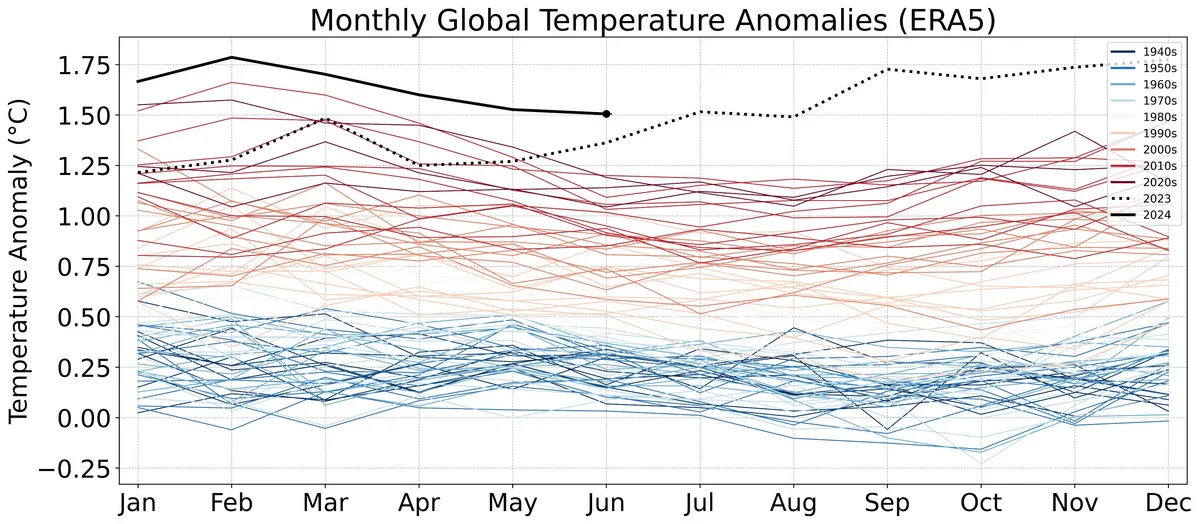
There was also news that for the period from February 2023 to February 2024, the global average temperature rose 1.52 degrees compared with pre-industrial levels. Looking at the dotted line (2023) and the black line (2024) in the figure above, you can also see that temperatures have stayed above 1.5°C for several months.
The Earth's climate is changing.
The Current Situation
Efforts to Communicate the Threat Are Growing in Japan, Too
Climate change is expected to have a severe impact on ecosystems and human society. Because of that danger, the term climate crisis is often used these days instead of climate change.
Japan was said to be a country with little reporting on climate change and the climate crisis, but the situation is beginning to change.
For example, earlier this year, a joint statement by weather forecasters and weather broadcasters was issued, declaring that they would put more effort into communication that links the weather with climate change. A policy recommendation that climate action is needed in the health care field has also come out from the Health and Global Policy Institute.
I expect that climate change will be covered more in Japan from now on, and that more alerts and warnings will be issued.
People Freeze in Fear
As awareness of the climate crisis spreads in this way, more people will probably feel threatened and anxious. This is what is called climate anxiety or eco-anxiety, and it is a natural reaction.
In particular, Japan has been a country where relatively few people feel climate anxiety, so if coverage increases, I think the number of people with that kind of anxiety will grow compared with other countries.
What we should be careful about, however, is that when people feel threatened or anxious, they can freeze on the spot. They may feel resigned and choose to do nothing, or conversely react by denying the threat.
For example, when told that an approaching threat is large, some people lose the will to resist and give up. They may take a passive attitude of "there's nothing we can do," "whatever happens, happens," or "it can't be helped."
Cognitive biases are also a problem. Because of normalcy bias, we ignore or underestimate crises and their warning signs. There is also a tendency, such as status quo bias, to dislike the burden of change.
Even if people accept for the moment that a crisis is occurring, cognitive dissonance may push them toward denial, such as "climate change isn't happening," "even if there is climate change, there's no need to deal with it, it'll be fine," or "climate action has other problems, so we'd better not do it."

The meme of a dog sitting in a burning house, muttering "This is fine" https://gunshowcomic.com/648
Something similar happened around 2020. Perhaps because people thought "I don't want to feel anxious about the coronavirus," they denied the problem with claims like "the coronavirus doesn't exist," and went further, to "since there's no problem, we don't need a solution like vaccines" and "the vaccines said to be the solution are meaningless, and even dangerous." I suspect many of you saw statements that seemed to follow this line of thinking.
In those words, try replacing coronavirus with climate crisis, and vaccines with climate mitigation measures. You may notice that you often see statements like "I don't want to feel anxious about the climate crisis" ➡ "the climate crisis doesn't exist," "since there's no crisis, we don't need a solution like mitigation measures," and "the various mitigation measures said to be solutions are meaningless, and even dangerous."
(However, unlike vaccines, each mitigation measure has its merits and demerits, so I do think some mitigation measures are meaningless. But it is not the case that all mitigation measures are meaningless.)
Hope Is Needed to Move People
In the book The Influential Mind, it is explained that:
- When you want people to do nothing, a combination of a request for inaction and a threat, warning that they may suffer consequences if they do something, is effective
- When you want people to change, a combination of a request for action and a positive outcome is more effective at bringing about change than a combination of a request for action and a threat
This is close to a request for inaction: in the context of climate change, I occasionally see articles saying, "If you rush into climate action, you will lose out economically. So it's better for you to do nothing and stay as you are." This is an effective message for stopping people from changing, and since people have a bias against changing in the first place, some will actively choose not to act.
Conversely, if you want to encourage action, you need to convey the positive aspects that result from acting.
So if we want people to change, I think we need to use positive messages as well, not "only" cautions and warnings.
In other words, if references to and narratives about the threat of the climate crisis are going to increase from now on, we need to increase references to and narratives about hope along with them, and I think there need to be more storytellers of hope.
Hope in Climate Change
So what activities and findings are there regarding hope in the field of climate change?
On hope in climate change, sometimes also called climate hope, there is a 2023 review from a psychological perspective by Ojala of Örebro University. Let me pull out a few findings from it.
- First, "hope" comes in two kinds: hope as a cognitive concept and hope as an emotion.
- "False optimism" and "hope based on denial," which deny reality, such as the belief that the threat of climate change is not serious, are negatively correlated with action on and engagement with climate change.
- Constructive hope is positively correlated with engagement with climate change.
- Hope not only leads to action, but action also leads to hope (engaging makes people feel more hopeful).
Even in the research so far, the short paper points out various nuances, but creating constructive hope appears to have a positive effect. Among the sources of constructive hope, it lists technological development and young people's climate movements.
As for climate movements, a campaign focused on hope, #performinghope, was also held recently. Activities like this are effective as well.
The other source it lists is technological development. I myself lean toward technology, so I have hopes for technology. And I personally believe that startups, which put that technology to practical use and spread it, can bring a different kind of hope to climate action, and can become an "entrance" for people who have not previously been very interested in climate change.
And I also think that Climate Tech startups can play a large role as the storytellers of "constructive hope" that will be needed more and more in the future.
The Hope Climate Tech Startups Create
I think there are several roles that Climate Tech startups, which work on climate action, can play in creating constructive hope for climate change.
(1) They Can Make the Option of "Technological Solutions" Stand Out, Distinct from Endurance and Burden
First, conveying that there are "solutions" to the problem of the climate crisis is an important element in forming hope.
However, many people, especially in Japan, seem to perceive that "doing what is good for the environment," as a solution, leads to endurance and economic burden.
In a somewhat old survey from 2015, when asked "What is climate action like for you?", 60% of Japanese respondents answered "In many cases, it threatens the quality of life," far higher than 27% worldwide.
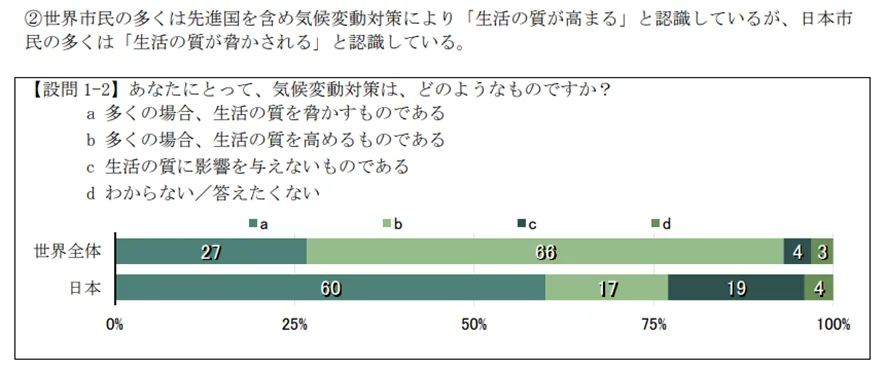
https://www.jst.go.jp/sis/scienceinsociety/investigation/items/wwv-result_20150709.pdf
Many people probably feel that climate action leads to new burdens and endurance. It is indeed true that some measures force new burdens and endurance on us.
But there are other measures as well. That is technology.
As technology develops, we may be able to bring about change while keeping the burden on people small. Or better products than the conventional ones may appear.
In fact, many technologies so far have brought prosperity to humankind. Crops, water supply, software and the like: technology has made what used to be hard faster and more convenient.
And one activity that spreads technology quickly and efficiently is commercial business. By making good use of market incentives, products and services that use technology can be scaled up.
Environmental problems are themselves problems born of such technology and markets, but rather than saying "so let's abandon the technology and markets that caused the problem," I think it is an effective attitude to say, "let's solve the problems born of that technology and those markets by modifying the technology and markets." And if that view spreads, there will be one more way to take part in the solution, and hope will probably arise more easily.
However, this applies to decarbonization efforts across industry in general. So what is unique to Climate Tech startups?
First, fortunately, startups in general are attracting attention in Japan. If, amid that attention to startups, we can convey that the field of Climate Tech exists and that people who want to take on solutions are gathering there, we can once again convey that there are solutions distinct from endurance and burden.
It is also said that a clear path and clear goal-setting are effective when creating hope. As Climate Tech startups grow, they will be able to communicate their progress explicitly. And if we can convey that such startups are also succeeding overseas and opening up new markets, I think that too can become hope.
(2) They Can Increase Employment, and Thereby the Number of People Involved and the Time They Spend on the Issue
I believe that increasing the number of people involved in climate action, especially people who take action, is very important for solving this problem.
One way to get involved is through civic activities, but another is to get involved in economic activity as a worker. By expanding economic opportunities for involvement as well as civic ones, we can bring in more people.
Until now, though, what workers could do came down to options like "avoid companies that do harm to the environment" or "join a company that does good for the environment through CSR and the like, outside its core business." But this had its limits: it could only offer a bit of comfort, or a little involvement on the side of one's main job.
There was also the option of becoming a government official and working on environmental issues, but that is a narrow gate, and officials and large companies often have transfers, with the drawback that you may not be able to do what you wanted.
But if many companies like Climate Tech startups emerge, "companies that do good for the environment as their main and sole business," you can spend 8 hours a day working on the problem of climate change. It has long been said that the goal is CSV (Creating Shared Value) rather than CSR, and this is the climate change version of that.
I think the strength of involvement through economic activity is that many people can spend a lot of time on it. If you get involved as a job, you can spend 8 hours a day (even if you are limited by the demands of for-profit activity). In fact, regions with a high share of people in green jobs are said to show favorable behavior toward a circular economy (survey paper), so I think the working environment also has a large influence on individual beliefs.
Looking at the 3M global survey announced in March 2024, the share of Japanese people who answered that they "feel the effects of climate change" is higher than in the world overall. In other words, awareness is high.
On the other hand, looking at trends such as young people answering "no particular opinion / don't care" at a rate higher than the world average, and understanding of carbon footprints being strikingly low compared with other countries, the situation is that "people are aware of climate change but do not understand it very well."
To change that situation, I think employment is an effective opportunity as a chance to be deeply involved in climate change.
When such companies grow and create jobs, even more people become involved. In that respect, I think startups can contribute.
That said, there is no doubt that large companies provide far more jobs.
I think the advantage unique to startups is that they can start from a small community. This is because it is said that small communities are more effective for changing people's social behavior in particular.
In the book Change by Centola of the University of Pennsylvania, it is pointed out that social change arises from the periphery. It also says that changing people requires strong ties, not weak ties. One means of producing those seems to me to be a new company organization, a startup.
Of course, if large companies change, that would also be a big change. But the book points out that people with many social connections, like influencers, are slow to accept change, because the very fact of having many connections puts them in a situation where "there are a lot of people who are not moving." Large companies probably cannot help but be the same. I think it could produce big change if many organizations like startups, at the periphery, emerge.
Moreover, even if startups cannot threaten the businesses of large companies, if many people moved from large companies to Climate Tech startups, large companies, which are likely to suffer from labor shortages, would also change greatly. I think startups are what can induce such change.
To bring about social change, not everyone needs to change. It is said that once a threshold of 3.5% or 25% is exceeded, change happens all at once. I think an option that uses the power of the market to increase the number of people who can get involved and bring it up to that threshold also becomes part of the hope that Climate Tech startups create.
(3) They Can Increase the Number of People Who Speak of Hope
Hope-filled messages from leaders are said to help followers feel hope.
When a leader such as the president of a large company speaks (however seriously that person means it), it tends to look like a large company talking its own book. Attention also tends to go to the company rather than the individual.
Startups, on the other hand, tend to draw attention to their founders, and although there is some talking of one's own book there too, the individual side is more likely to be featured. When they are featured, they often speak of a bright future and hope.
I think that having many such leaders with visible faces will surely make it easier for hope to spread around them. In fact, my impression is that not only startup founders but also the employees who work there often speak of the future.
The role society expects of startups is to take on new challenges and speak of the future. That leads to business growth and also to more jobs. I believe that increasing the number of such startups leads to more people speaking of the future and hope, and that this in turn leads to actual hope.
Things to Keep in Mind
Climate Tech startups can be used when building narratives of hope. That said, please let me add that it is not a matter of simply praising Climate Tech startups without reservation.
(a) Avoid Over-Reliance on Technology
Technology will not solve everything. Extreme technological solutionism can in fact hinder social change.
For example, it may give a false hope that "(someone other than me) will develop new technology, so it'll be fine." Also, if technologies or scientific discoveries with little chance of materializing are presented too much as hope, they may foster the illusion that "if this comes true, everything will surely be solved," and fail to encourage what can be done right now.
For a complex problem like climate change, there is no silver bullet that solves everything on its own. Accumulating small changes and social change are also needed. Technology development and business development, too, will not solve it unless they encourage a great many challenges. I think communication that does not stop that is important.
In particular, people who have been immersed in technology (myself included) are often pure, or rather naive, about social problems, and I think we need to be careful about that.
(b) Don't Reduce It to Just an Economic Issue
As mentioned above, making good use of the power of the market can provide momentum. On the other hand, looking at Japan's business environment, I get the sense that discussion of the social side of climate change never came to a head, and that international demands and top-down decisions led to a situation of "we don't really understand it, but anyway, let's decarbonize."
However, I think we need to emphasize again that this was originally an agenda that arose from justice/fairness and ethics. Many technologies function within the market, but it is policy that creates that market, and policy rests not merely on economic rationality but on social ideals and ethics.
Moreover, if we discuss it only in terms of practical matters such as business, the economy, industry, and economic security, we cannot reach the issues we originally wanted to solve, such as justice and what kind of society we should be.
Even in business practice, when engaging in international rule-making in business and the like, I suspect that without such a perspective, discussions with Western countries will talk past each other...
(c) Consider the Balance Between Hope and Crisis
The reality is that balancing talk of crisis and hope is difficult.
If you talk too much about hope, people become optimistic and conclude that they need not act. It is not a matter of just talking about hope. On the other hand, if you convey the crisis too much, people may feel fear and stop acting. Yet if you do not convey the crisis, you cannot convey the meaning of the technology or business. There is a difficulty in conveying messages within that balance.
Also, even when conveying hope, it is still urging the other person to change. Some people will find such change-urging or crisis-warning rhetoric preachy and mock it as "self-righteous" or "Woke." Pushing ahead with business while enduring such criticism takes a certain amount of guts.
(d) Making It Happen Takes Effort
Climate Tech startups are ultimately only hope, only a possibility. To truly affect the climate change problem, enormous effort is needed to make it happen.
Hope is only hope, and making it come true is the real work. It is not enough simply to have hope; I think we should convey that the effort to realize that hope is accompanied by difficulties.
Even with such difficulties, I think the role imposed on startups as a social presence is to speak of the future and hope and to make them come true, and I think the field of Climate Tech can function as an "entrance" for bringing in people different from those who have been in climate and environmental circles until now.
Now that the storytellers of crisis are increasing while the storytellers of hope are not so many, it should be a great contribution to the future for Climate Tech startups and those involved with them to speak of the future and hope, grow their businesses, and increase their fellow travelers.
Summary
There are many storytellers of hope besides Climate Tech startups. Many people should also emerge from civic activities and elsewhere.
On top of that, as a new means of creating hope by drawing in new stakeholders such as the business community, I think Japan today has one option: making good use of Climate Tech startups. And the growth of those Climate Tech startups will lead to growth in the number of people involved with the climate.
Personally, I hope that the increase in people who speak of such hope will contribute greatly to the climate change problem in Japanese society.
Other Reference Materials
There is a range of skepticism, from doubt about climate change itself, to doubt about various countermeasures, to doubt about economic rationality, but for responses to common skeptical arguments, please see resources such as the Japanese pages of Skeptical Science.
I also recommend the following article by Professor Emori, among others.
気候変動リスクをめぐって ガバナンスとコミュニケーションの観点から | 地球環境研究センターニュースcger.nies.go.jp