Thinking About Japan's Defense Tech (1) (June 2026 Edition)
This article was machine-translated from Japanese by AI (Claude). It may contain errors. Read the original Japanese article.
I will be speaking at an event on Defense Tech on Monday, June 29, so I am writing down and organizing my thoughts in advance.
Note that this is my current thinking and framing, mainly from the perspective of someone involved with startups, so it may feel off to people in the defense community. My thoughts and opinions may also change in the future as I receive feedback.
The article got long, so I have split it into four parts. This is the first. You can find the other three below.
- Defense capability - Does the business raise Japan's effective defense capability?
- Business viability - Can the business grow rapidly as a startup?
- Ethics - Should the business be pursued at all?
Organizing three concepts and sets of information
When thinking about Defense Tech startups, I believe it is useful to organize some information and concepts and align on the premises.
There are three things I want to organize this time.
- The term "Defense Tech"
- The concept of dual use
- Differences between Japan and the US
(Part 1) Organizing the term "Defense Tech"
First, as is often the case with "XX Tech" terms, what the term means often differs from person to person. So let me organize it as follows for now.
Term | Examples |
① "Defense Tech" that emphasizes technology | Technologies used for defense, such as drones, AI, satellites, and robotics (not business) |
② "Defense Tech" that refers to business in general | Defense business using the above technologies and others, including the existing businesses of large corporations. Includes Lockheed Martin and the like. |
③ "Defense Tech" that emphasizes entrepreneurship and new ventures | New defense business, including startups, small businesses, and new ventures within large corporations. |
④ "Defense Tech" in which high-growth startups take on the defense domain | Businesses taking on the defense domain as fast-growing startups that are backed by VCs and have events such as IPOs or M&A. Anduril and others. |
These cannot be separated completely, but we need to move the discussion forward while distinguishing among them to some extent.
Today I will mainly consider ④, Defense Tech in high-growth startups.
(Part 2) Dual use
"Dual use" is another term that is mentioned just as often, yet I get the impression that what people imagine by it differs quite a lot.
Experts in dual use may have a different framework, but I will lay it out as it appears to someone involved in the private sector.
(1) The direction: military to civilian, or civilian to military
First, I think the positioning differs depending on whether the main starting point is the military or the civilian side.
Direction | Meaning | Examples |
Military ➡ civilian | Advanced military technology is repurposed for the private sector | Jet engines, GPS, some cryptography, etc. |
Civilian ➡ military | Advanced private-sector technology is repurposed for military use | AI, cybersecurity, drones, etc. |
In the past, I think there were many cases where cutting-edge things developed for military use became usable in the private sector, but the recent trend seems to be that the weight of civilian → military is growing. This is because there are more situations in which the military takes in technologies that have advanced first in the private market, rather than developing them on its own.
(2) The positioning of technology: advanced or general-purpose
Next, I think there are broadly two kinds of discussion about technology.
Type | Purpose | Examples |
Advanced-technology dual use | A qualitative change in the course of war | GPS, nuclear technology, biotechnology, etc. |
General-purpose-technology dual use | A change in how wars are fought, through supply volume and cost | Cars, ships, smartphones, etc. |
Advanced technologies are mainly those that can bring about a qualitative change in warfare.
Technologies such as nuclear and biological ones can, once turned into weapons, greatly change the way wars are fought in a qualitative sense. GPS, too, was expected to greatly change the course of battle by making it possible to know the enemy's position accurately. Once they become weapons, these are military, but we can frame it as each underlying technology base having dual-use properties.
General-purpose technologies, on the other hand, offer the advantage that technologies, facilities, personnel, data, and supply chains used by the private sector in peacetime can be converted, in a crisis, into the nation's capacity to sustain a war. And if using general-purpose technologies can dramatically cut costs, they can become technologies that change the course of war qualitatively. In fact, even from the standpoint of offense, it is well known that general-purpose items such as drones have created an asymmetry between the cost of attack and the cost of defense.
Technologies that can cause disruptive change, such as nuclear and biological weapons, are expected to be used offensively, so Japan, which upholds an exclusively defense-oriented policy, may appear to stay away from such technologies. However, if an adversary may use such means of attack, defense is impossible without understanding the technologies, so even if Japan does not actively use them in actual combat, it will presumably still research the technologies themselves.
(Note that stand-off defense capability and counterstrike capability cannot be dismissed simply as "offensive, so not to be handled." They are also positioned as capabilities to deter and block an adversary's invasion or missile attacks.)
Organizing dual use along two axes and four quadrants
Organized simply along these two axes and four quadrants, it looks as follows.
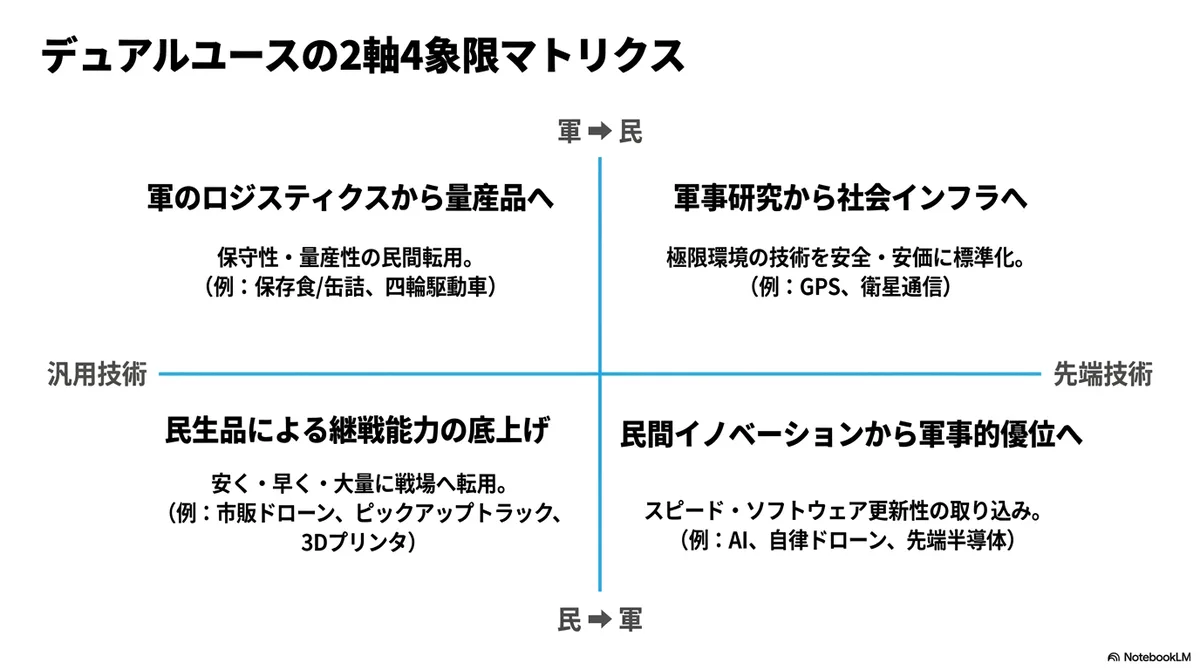
The characteristics of each quadrant would be as follows.
Direction × technology type | What is emphasized in this quadrant | Examples of technologies and products | Main use |
① Military → civilian × advanced technology | Making technologies honed in extreme environments safe, inexpensive, and standardized so they can be widely used in the private sector. On the military side, performance, secrecy, and fault tolerance are emphasized; on the civilian side, standardization, mass adoption, and becoming social infrastructure. | GPS, jet engines, satellite communications, space development technologies, some cryptography, etc. | From military research to social infrastructure |
② Military → civilian × general-purpose technology | Bringing the military's know-how in supply, transport, maintenance, and standardization into private industry, logistics, and everyday goods. Durability, maintainability, mass-producibility, unified standards, and lower costs are emphasized. | Canned and preserved food, four-wheel-drive vehicles derived from military vehicles, standardization of air transport and port operations, durable clothing and outdoor goods, ruggedization of communications equipment, etc. | From military logistics to civilian mass-produced goods |
③ Civilian → military × advanced technology | Quickly bringing private-sector technological innovation into military operations, information superiority, and decision-making speed. Speed, software updatability, data integration, cyber resilience, procurement flexibility, and compliance with ethics and regulations are emphasized. | AI, machine learning, image recognition, cybersecurity, cloud, commercial satellite imagery, autonomous drones, quantum sensors, advanced semiconductors, biotechnology, etc. | From civilian innovation to military advantage |
④ Civilian → military × general-purpose technology | Repurposing consumer products already on the market, cheaply, quickly, and in large quantities, for the battlefield and military rear-area support. Availability, ease of repair, parts procurement, field modification, distributed operations, and the capacity to sustain a war are emphasized. | Pickup trucks, consumer drones, smartphones, messaging apps, generators, commercial trucks, ships, and aircraft, construction machinery, 3D printers, off-the-shelf cameras and sensors, etc. | Boosting the capacity to sustain a war with consumer products |
(Part 3) Differences between Japan and the US
The US is the front-runner in the Defense Tech field, and many people will look to American startups as reference examples. However, I think we also need to lay out as a premise that the defense environments of the US and Japan are quite different.
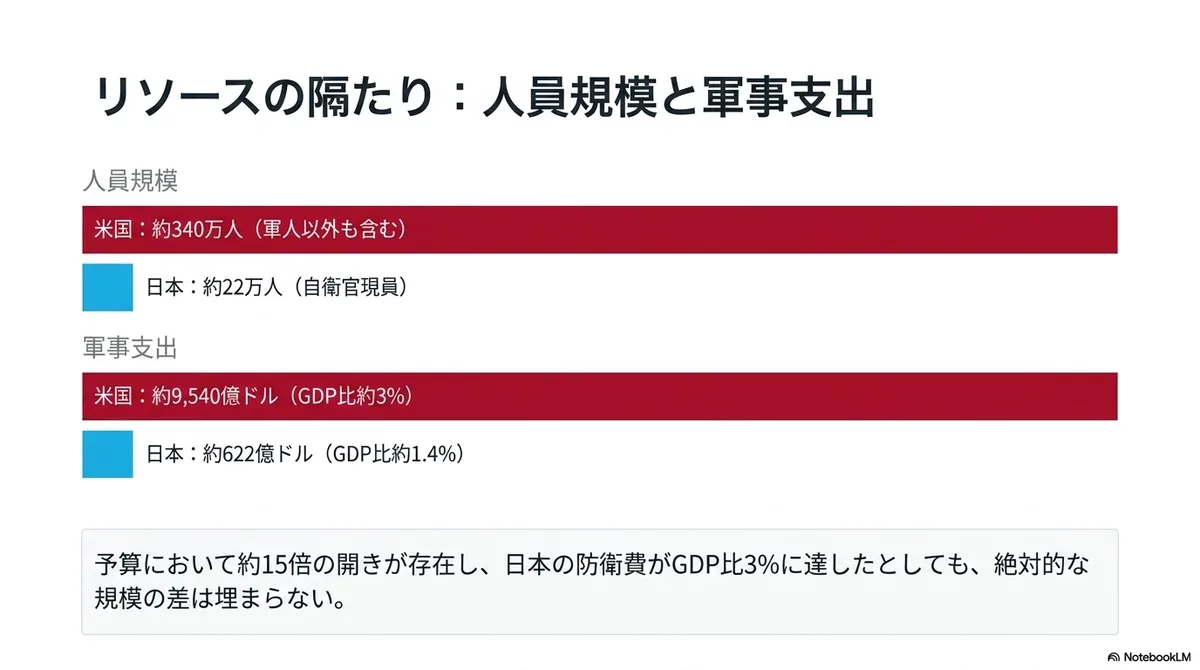
For example, the US Department of Defense has an organization of about 3.4 million people (although this includes non-uniformed personnel, with about 800,000 civilian officials and administrative staff). Non-US NATO also appears to be about 2.1 million. By contrast, Japan's Ministry of Defense and Self-Defense Forces had about 220,000 active-duty personnel as of March 31, 2025. It is not an apples-to-apples comparison, but the scale of personnel is undoubtedly different by an order of magnitude.
As described in Hacking for Defense, the US Department of Defense is the largest employer in the world and, in a sense, "the largest enterprise in the world" (next is Walmart, with over 2 million). In Japan, by contrast, the Self-Defense Forces, viewed as a single organization, are the largest employer in the country, but Toyota and NTT each have over 300,000 employees on a consolidated basis (Panasonic and Honda about 200,000), so the SDF cannot be called the largest.
It is not only personnel; budgets differ greatly as well. According to SIPRI estimates, US military spending in 2025 was $954 billion (about 3% of GDP), while Japan's was $62.2 billion (about 1.4% of GDP), which is again a difference of roughly 15 times. Even if Japan's defense-related spending rises to around 3% of GDP, the gap will likely remain large.
It is not only a matter of scale. The US has several conflict zones that serve as "the field," and its challenges tend to be made visible. Having many fields means having many test environments and much to learn after deployment, and once something has been deployed, there is also large room for rolling it out horizontally, which tends to lead to deployment in actual operations.
Japan, on the other hand, is fundamentally exclusively defense-oriented and does not go to the front lines, so it has a structure in which feedback from the field to products, in the case of weapons and the like, is relatively scarce. (Of course, surveillance and monitoring are real operations, and there are also joint Japan-US exercises, so it is not that there is none. It can also be supplemented by exercises and simulations, so it is not entirely absent.)
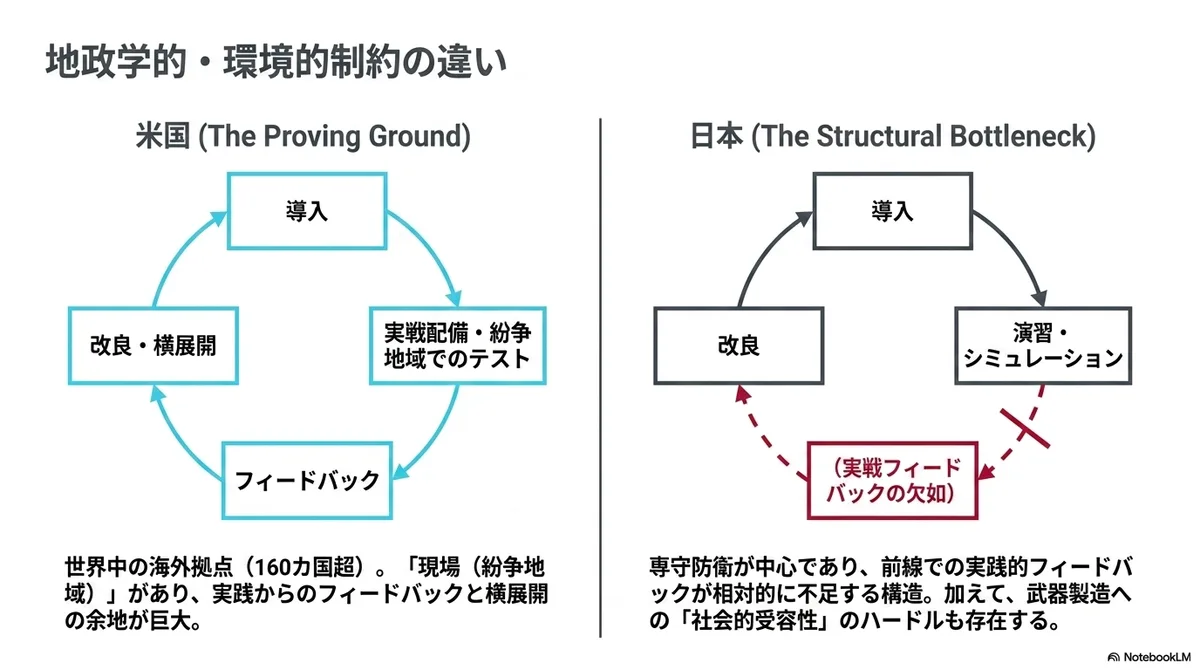
Social acceptance of making weapons also differs from that in the US.
Defense Tech startups worldwide are said to have quadrupled over the past four years, from 300 to 1,200. This seems to be partly because of an ecosystem in which large corporations carry out their R&D functions outside the company.
Given such differences in premises, the way of thinking about "defense" and "defense tech" in Japan and the US should differ.
I have also compiled other premises and environments that are useful for comparing Defense Tech (I used ChatGPT).
Comparison axis | US | NATO (excluding the US: Europe + Canada) | China | Japan |
Personnel scale: comparison of military and active-duty personnel | Military personnel in NATO statistics is estimated at about 1.30 million for 2024. Meanwhile, the official US broader expression gives service members & civilians at 3.4 million. (North Atlantic Treaty Organization (NATO)) | Military personnel in NATO statistics is estimated at about 2.114 million for 2024. Excluding the US, the headcount alone is larger than US military personnel. (North Atlantic Treaty Organization (NATO)) | According to IISS estimates, active-duty PLA as of 2024 is about 2.035 million. Adding about 500,000 People's Armed Police and about 510,000 PLA reserves brings it to about 3.045 million. The militia is separate, however, and its scale is unclear. (War on the Rocks) | As of March 31, 2025, active-duty SDF personnel numbered 220,252, against an authorized strength of 247,154. |
Defense spending and military spending | Estimated 2025 defense spending by the NATO definition is $980 billion, or 3.22% of GDP. According to SIPRI estimates, US military spending in 2025 was $954 billion. (North Atlantic Treaty Organization (NATO)) | Estimated 2025 defense spending by the NATO definition is $608 billion, or 2.27% of GDP. About 62% of the US scale. (North Atlantic Treaty Organization (NATO)) | According to SIPRI estimates, 2025 military spending was $336 billion. About 35% of the US SIPRI figure and about 5.4 times Japan's. (SIPRI) | According to SIPRI estimates, 2025 military spending was $62.2 billion, or 1.4% of GDP. The Japanese government's FY2026 (Reiwa 8) defense-related budget is ¥9,035.3 billion in total, and expenses covered by the Defense Buildup Program are ¥8,809.3 billion. (SIPRI) |
Overseas bases and forward deployment | According to the CRS, US defense organizations manage and use at least 128 overseas bases in 51 countries outside the US and its territories. In the official US broader expression, 4,800 sites in more than 160 countries. (Every CRS Report) | NATO as a whole does not have a single base network of the US type. NATO's forward land forces place multinational battlegroups in 9 countries on the eastern front: Bulgaria, Estonia, Finland, Hungary, Latvia, Lithuania, Poland, Romania, and Slovakia. However, the US contributes to some of them, so it is hard to separate out a "count of NATO bases with the US completely excluded." (North Atlantic Treaty Organization (NATO)) | It has not reached a US-style global base network, but it is expanding its overseas logistics network through the PLA support base in Djibouti, the joint logistics and training center at Ream Naval Base in Cambodia, and so on. The US Department of Defense sees China as considering additional facilities, while its systematic overseas command-and-control structure remains immature. (U.S. Department of War) | The SDF's only overseas facility is in Djibouti. It serves as a base for counter-piracy, intelligence gathering in the Middle East, and transporting Japanese nationals and others. (Ministry of Defense) |
Main strengths | Outstanding in budget, logistics, overseas bases, sea and air transport, C4ISR, nuclear deterrence, alliance network, and combat experience. | Large in personnel, economic scale, and geographic depth. European rearmament is advancing the recovery of artillery, air defense, ammunition, and production capacity. | Personnel scale, missile forces, shipbuilding capacity, geographic advantage around the First Island Chain, and state-led military-civil fusion. | Geographic position, anti-submarine warfare, air defense, and missile defense, the quality of the Maritime and Air Self-Defense Forces, and interoperability with the Japan-US alliance. |
Main constraints | Because of its global deployment, its theaters are broad, and simultaneous crises strain logistics, ammunition, and ship availability rates. | The combined figures are large, but there is great variation among the 31 countries in political decisions, equipment systems, readiness, and ammunition stockpiles. | Inferior to the US in overseas logistics, carrier operations, joint operations, and combat experience. The gap between published figures and reality is also large. | Constrained by personnel shortages, ammunition and the capacity to sustain a war, base resilience, the speed of equipment procurement, and population decline. |
Japan's Defense Tech must be considered on the basis of these differences.
The next piece is the second article, on "defense capability."
List of related articles
Organizing the premises: Defense Tech, dual use, and differences between Japan and the US
- Defense capability - Does the business raise Japan's effective defense capability?
- Business viability - Can the business grow rapidly as a startup?
- Ethics - Should the business be pursued at all?