Can Japanese Defense Tech Become a High-Growth Startup Sector? - Thinking About Japan's Defense Tech (3)
This article was machine-translated from Japanese by AI (Claude). It may contain errors. Read the original Japanese article.
I'm going to speak at an event on Defense Tech on Monday, June 29, so I'm writing down and organizing my thoughts beforehand. The article became long, so I've split it into several parts.
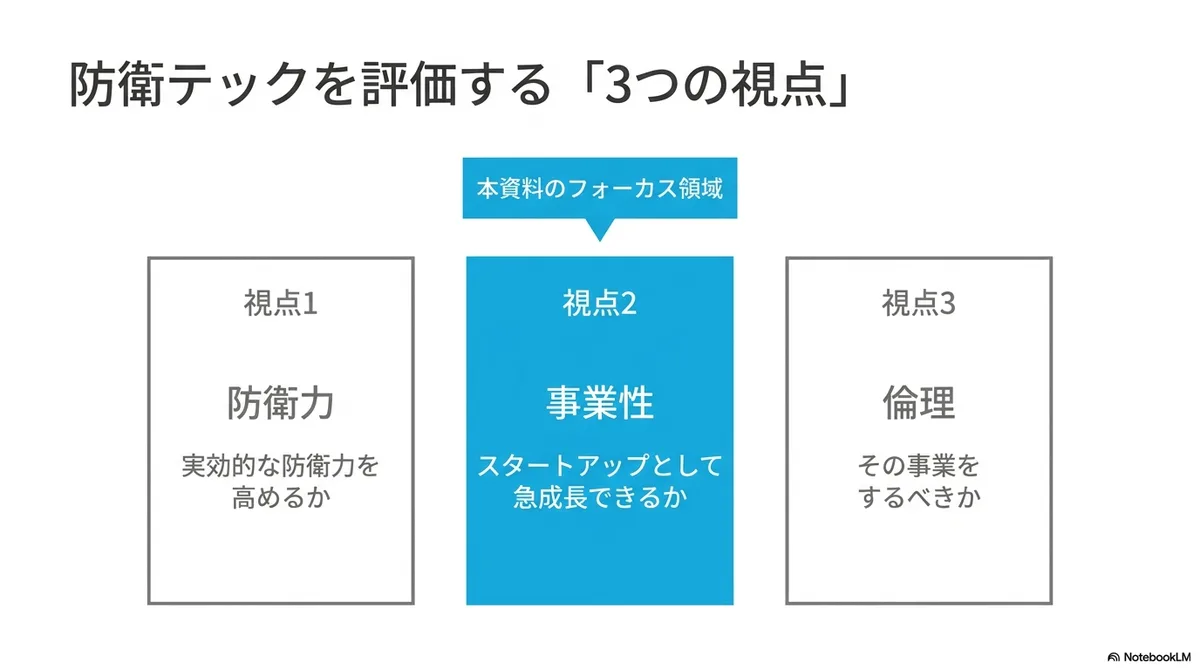
Building on the premises laid out in the first article, I think there are three major points to discuss when thinking about Japan's Defense Tech.
- Defense capability - Does the business strengthen Japan's effective defense capability?
- Business viability - Can the business grow rapidly as a startup?
- Ethics - Should the business be pursued at all?
Having considered effective defense capability in the second article, what we need to think about as a high-growth startup is, after all, business viability.
That is because, even if a business is important for defense, whether it works as an attractive business for a startup is a separate question.
When we think about the business viability of a VC-backed high-growth startup, simplifying the items that need to be considered, it comes down to whether the following two conditions can be met
- Can it grow rapidly and exceed a certain market capitalization?
- Can it achieve an exit?
within a short period of about 10 years, which is the lifespan of a fund.
Here too the situation differs greatly between Japan and the US, so I'd like to look at some numbers.
(1) Can it exceed a certain market capitalization?
First, let's look at this based on the share of military-related sales in each company's total sales, according to SIPRI.
United States
In the US, companies that are close to pure-play defense firms command high market capitalizations.
Company | Market cap (USD billion) | Market cap (JPY trillion) | Trailing P/E | Defense/military sales share / Notes |
Lockheed Martin | 117.0 | 18.92 | 24.6 | SIPRI: 91%, military sales $64.65B |
General Dynamics | 93.8 | 15.17 | 21.8 | SIPRI: 70%, military sales $33.63B |
Northrop Grumman | 71.3 | 11.53 | 15.7 | SIPRI: 92%, military sales $37.85B |
L3Harris Technologies | 54.3 | 8.78 | 31.6 | SIPRI: 76%, military sales $16.21B |
Japan
Looking at a comparable group of companies in Japan gives the following.
Company | Market cap (USD billion) | Market cap (JPY trillion) | Trailing P/E | Defense/military sales share / Notes |
Mitsubishi Heavy Industries | 74.4 | 12.03 | 34.8 | SIPRI: 15%, military sales $5.03B. Ministry of Defense central procurement: No. 1, JPY 1,456.7 billion |
Kawasaki Heavy Industries | 14.7 | 2.38 | 21.9 | SIPRI: 19%, military sales $2.65B. Ministry of Defense central procurement: No. 2, JPY 638.3 billion |
Mitsubishi Electric | 76.5 | 12.38 | 29.5 | SIPRI: 5.1%, military sales $1.85B. Ministry of Defense central procurement: No. 3, JPY 495.6 billion |
NEC | 32.0 | 5.18 | 18.7 | SIPRI: 6.8%, military sales $1.54B. Ministry of Defense central procurement: No. 4, JPY 311.7 billion |
Fujitsu | 34.4 | 5.57 | 18.7 | SIPRI: 9.3%, military sales $2.19B. Ministry of Defense central procurement: No. 5, JPY 173.6 billion |
US-Japan Comparison and Market Capitalization
In the US, there are relatively many companies that are close to pure-play defense firms, whereas in Japan, many of the companies winning defense contracts derive 20% or less of their sales from defense.
Also, if we make the simple assumption that sales and market capitalization are proportional:
- US: If 91% of Lockheed Martin's sales are military and its market capitalization is JPY 19 trillion, the military business alone would be JPY 19 trillion × 0.91 = JPY 17 trillion
- Japan: Multiplying Mitsubishi Heavy Industries' JPY 12 trillion by 0.15 gives JPY 1.8 trillion
This means that it takes reaching the level of Mitsubishi Heavy Industries to finally get to the JPY 1 trillion range.
Profit
Let's also consider profit, which is the source of any market capitalization calculation.
First, defense businesses operate on a cost-plus basis, so their profit margins tend to be on the low side. Of course, depending on the world situation, a premium might conversely be added, but that is probably temporary. (If it continued permanently, the economy itself would be in a precarious state.)
This is also somewhat unavoidable: defense budgets are largely taxpayers' money, and it is hard to win public understanding for continuing to earn high margins from that source of funds. For example, if there were a company in the defense industry selling at very high profit margins, wouldn't it provoke antipathy?
Seen this way, a US Defense Tech startup might be able to aim for a business worth over JPY 1 trillion as a pure-play defense company, but for a Japanese Defense Tech startup to exceed JPY 1 trillion looks quite difficult (unless it can break into other countries' markets).
Of course, I think defense business in Japan can certainly work well enough as a small business, and there is plenty of room for improvement, including in procurement, but my assessment is that it is quite harsh for a startup.
(2) Can it achieve an exit?
Next, let's look at it from the perspective of investor exits.
In the Case of M&A
If an M&A of a defense tech startup were to occur, being acquired by a foreign company would probably be quite difficult, so it seems likely to be one of the Japanese companies above. In that case, the acquisition amounts from those companies do not look likely to be very large.
In the Case of an IPO
The business on the Tokyo Stock Exchange with the highest defense-related sales is in the space sector. At present it has a market capitalization of roughly JPY 200 to 300 billion. However, I think the valuation of space-oriented companies and that of pure-play defense companies would differ somewhat.
Looking more at defense-focused companies, Howa Machinery, which gets about 50% of its sales from defense, has a market capitalization of around JPY 20 billion, and Hosoya Pyro-Engineering has a rather small market capitalization of JPY 4 billion, which seems rather small as reference cases for the large exits that VCs expect.
Looking at recent moves by companies such as Anduril, they used to center on defensive products such as surveillance drones, but their current product lineup is shifting its weight toward the "offensive" side, such as attack and strike systems that can be mass-produced cheaply. This even looks like an attempt to chip away at Lockheed Martin's business, but if expansion into such "offensive" businesses is the reason for the rise in valuation, I think it would be quite difficult for a Japanese startup to raise its valuation in the same way, both in terms of market structure and social acceptance.
Fundraising Until the Exit
Considering that several funding rounds will be needed before reaching an exit, it also appears that the major domestic VCs and CVCs are not yet ready to supply funding to that extent.
Overseas VCs may invest in such cases, but compared with other business areas, this seems to be an area where the debate "is that really a good idea?" easily arises. There is also the view that it is fine as long as overseas VCs do not hold a majority, but especially at the middle and later stages, given the scale of funding involved, overseas VCs seem quite likely to end up holding the majority.
Possibility of Selling to Other Countries
By selling products from Japanese startups to other countries, it is also possible to expand the market size that can be reached.
In that case, it would mean selling products refined in Japan, the home market, to other countries. If so, learning from the Self-Defense Forces becomes the key. If it is in a problem area where Japan is facing the cutting edge (such as early warning), there may be a chance, but if not, it is difficult to make Japanese products better than those of other countries, so what to sell becomes the challenge.
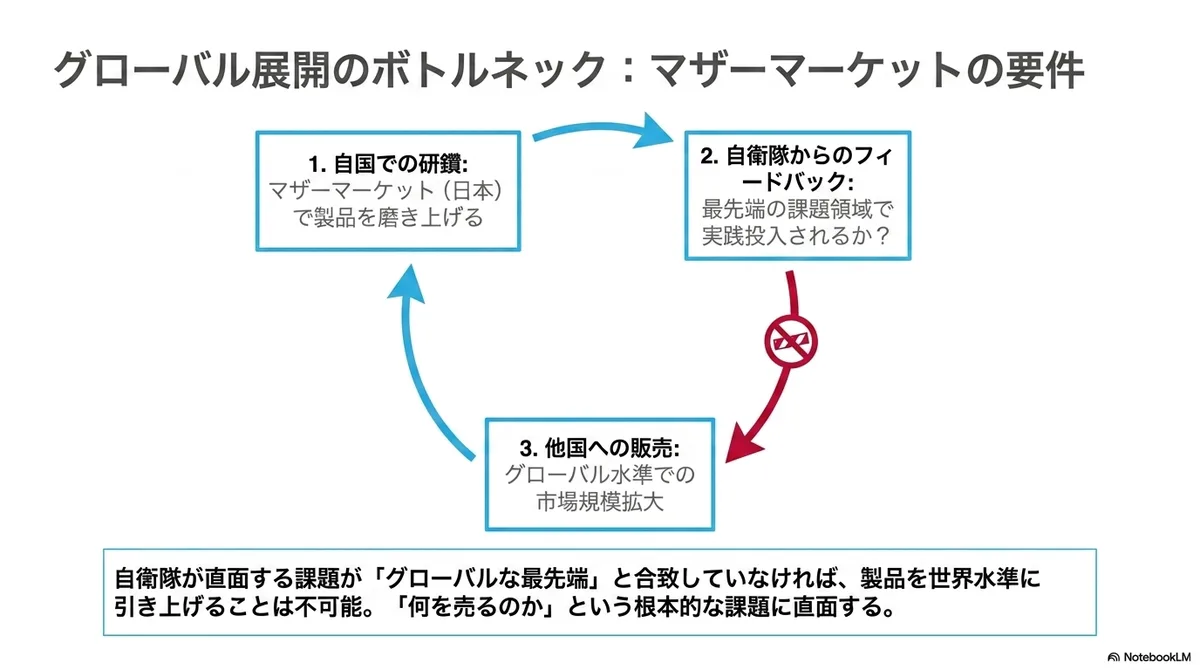
Without such strengths, the pull of capital could lead to the conclusion that "it would be better to do business in the US." In fact, about 27% of EU unicorn startups relocate their base from the EU to the US, and in the defense domain too, the question "Why do this in Japan rather than in the US?" will weigh heavily.
Business Areas for Japan's Defense Tech
Thinking it through this way, my personal view at present is that, among the many defense-specialized businesses in Japan, the business areas that are a good fit for VC-backed startups are quite few compared with the US.
(Note: This is only about VC-backed startups. Businesses that don't use VC money are a separate discussion, and I think some business areas could still work in Japan.)
That being the case, I think many companies will probably settle into one of two distances: moving toward defense uses such as repair and recovery rather than weapons, or basically thinking in terms of civilian products while letting defense use the parts that are usable. Even that may contribute to defense capability by raising the ability to sustain a prolonged conflict.
Yet It Is Also Hard to Be Only Half-Involved
On the other hand, listed companies with defense-related businesses seem to have a hard time dealing with investors (some have removed their defense-related businesses from their investor communications), and seeing the rise in organizational complexity that comes with involvement in national defense, this also looks like an area where dabbling halfway doesn't pay off much.
Moreover, when trying to enter the defense domain, you have to get into the equipment system, including requirement specifications, testing, certification, security of classified information, education and training, supply, maintenance, cybersecurity, life-cycle costs, and so on. It is not just a matter of selling and being done; you have to think about "where in the defense capability system our product will be incorporated," which is a considerable burden, so I think how far to go with defense-related work will be a major choice.
The Present and the Future Are Different
Returning to the opening question, the answer to whether defense tech can become a high-growth startup sector is that the areas are likely to be limited and that it looks quite difficult.
However, I also think that taking on such highly uncertain areas is one of the roles of startups, and even if the market is like this now, that does not mean it will be the same in the future.
The government will probably try to make the market attractive and provide incentives, and may carry out reforms of defense procurement and so on. Revisions of the Three Principles on Transfer of Defense Equipment and Technology and their operational guidelines, expansion of international joint development and joint production, and increased transfers of equipment to allies and like-minded countries could change the market size and the outlook for exits.
On the startup side too, raising the viability of their own businesses will mean lobbying the government and the like. It will also become necessary to hold discussions with funding providers (VCs and the LPs behind them).
However, I think that raising the marketability of the defense domain in this way entails a corresponding public responsibility and requires resolve. I also believe that a stronger sense of ethics and the mechanisms that support it will come to be demanded.
So next is the discussion of ethics.
Related Articles
Organizing the Premises: Defense Tech, dual use, and differences between Japan and the US
- Defense capability - Does the business strengthen Japan's effective defense capability?
- Business viability - Can the business grow rapidly as a startup?
- Ethics - Should the business be pursued at all?