Does Defense Tech Contribute to Japan's Defense? - Thinking About Japan's Defense Tech (2)
This article was machine-translated from Japanese by AI (Claude). It may contain errors. Read the original Japanese article.
I will be speaking at an event on Defense Tech on Monday, June 29, so I am writing down my thoughts beforehand. The article became long, so I have split it into several parts.
Please note that this is my current thinking and organization, seen mainly from the perspective of someone involved in startups, so it may feel off to those who work in defense. My own thoughts and views may also change in the future in response to feedback.
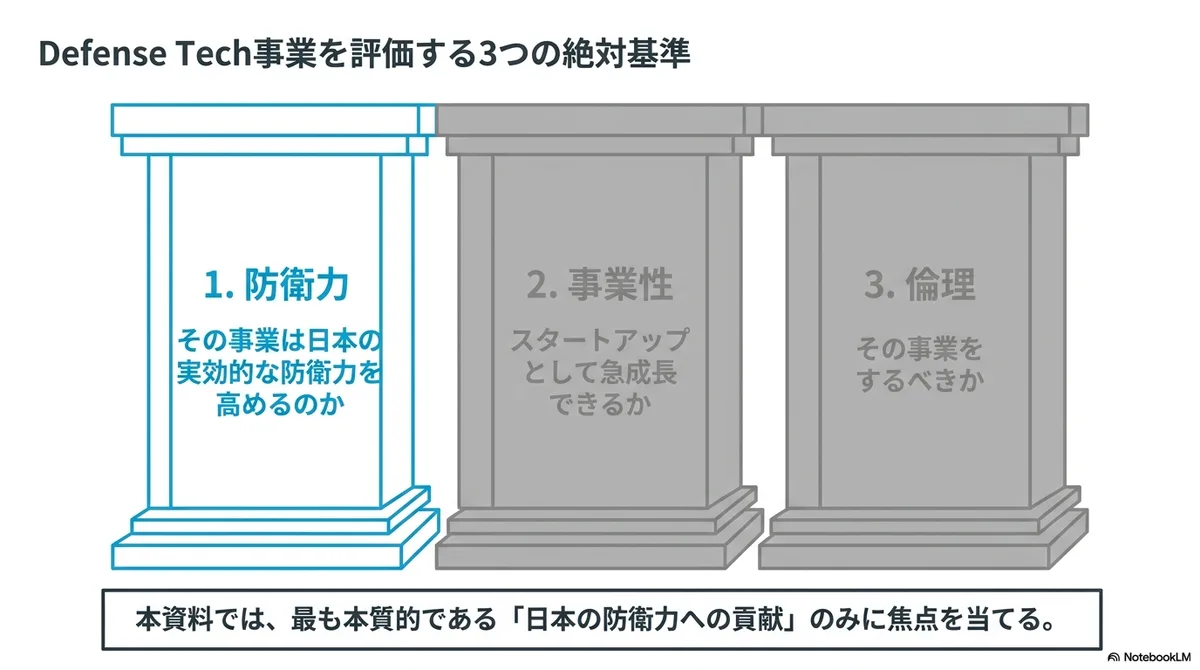
The first article organized the premises. Building on that, I think there are three major points to discuss when thinking about Defense Tech in Japan.
- Defense capability - Does the business raise Japan's effective defense capability?
- Business viability - Can the business grow rapidly as a startup?
- Ethics - Should the business be done at all?
This article deals with "defense capability."
Does Defense Tech Contribute to Japan's Defense?
When considering whether a Defense Tech startup doing business with Japan is a meaningful undertaking, we should first ask how much it contributes to Japan's defense capability. To do so, we need to ask, "What is defense capability in the first place?"
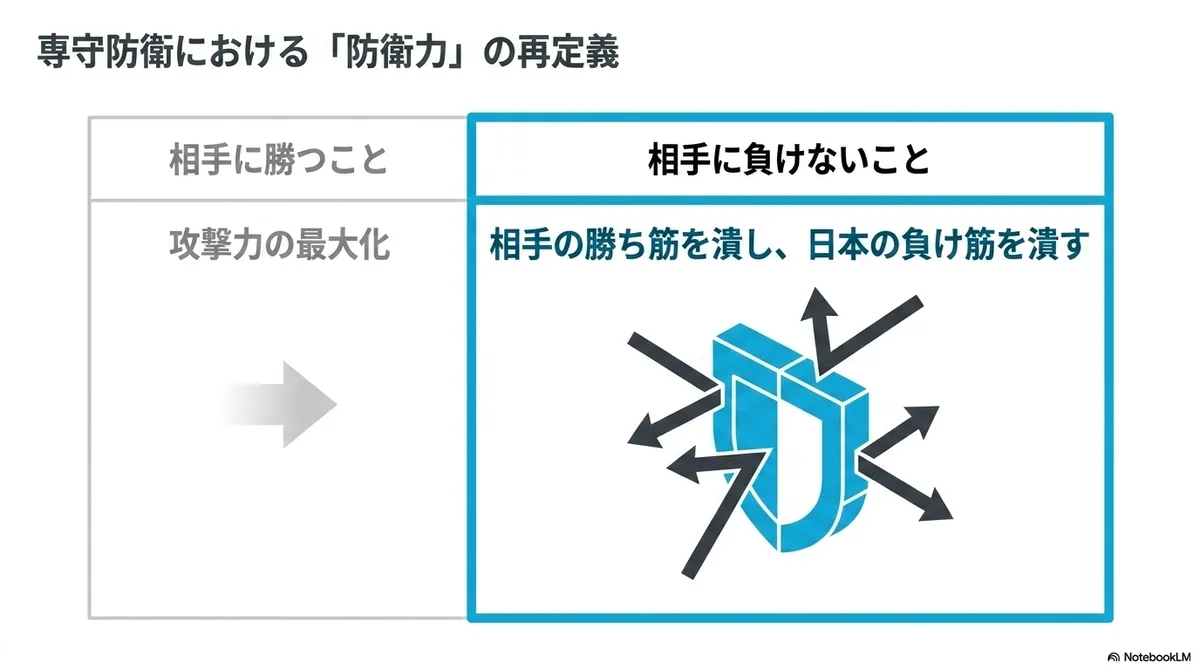
For Japan, which upholds an exclusively defense-oriented policy, it is better to think of defense not as "defeating the opponent" but as "not being defeated by the opponent." In other words, it means eliminating the opponent's paths to victory, and eliminating Japan's paths to defeat. If a business or technology contributes to eliminating paths to defeat, it can be said to contribute to strengthening defense capability.
Defense, moreover, is not only defense against military attacks. Communications jamming, cyberattacks, logistics disruption, paralysis of critical infrastructure, severed supply lines, the splitting of alliances, and even psychological shaking of society are also types of attack, and they are all subjects of defense.
I believe that technologies and businesses that raise defense capability against these various elements, and make the opponent recognize that "even if we attack, we cannot achieve our objectives," "we cannot win a quick decision," and "we cannot paralyze supply or social functions," are the ones that contribute to Japan's defense capability.
When it comes to Defense Tech, my impression is that the intrigue and cutting-edge nature of emerging technologies and commercial considerations tend to come first. Of course, applications of cutting-edge technology may bring disruptive change, so I think they should be studied, but it is often the case that they are disconnected from actual defense capability.
So what those in Defense Tech businesses and related fields should really be asking is not "Is the technology cutting-edge?" but
- "Can this technology or business eliminate Japan's paths to defeat?"
- "Does this technology or business lower the expected risk-return for the opponent?"
- "How much does it make a quick victory harder for the opponent?"
and questions like these, I think.
Furthermore, conventional startups were basically evaluated entirely on the market's yardstick of "revenue," but in public domains like this, the businesses themselves also need to think deeply about how much they serve public purposes.
(This article mainly focuses on Japan's stand-alone deterrence by denial, that is, defense capability that makes the opponent recognize that "even if we attack, we cannot achieve our objectives." Japan's actual security is inseparable from U.S. extended deterrence, counterstrike capability, and cooperation with allies and like-minded countries, and I should add that crisis management and escalation management are also important.)
Decomposing Defense Capability
Thinking about defense capability vaguely does not lead to a good discussion. In such cases, I find it useful to break defense capability down into elements.
Japan divides it into several parts in the 2022 National Defense Strategy, but separately from that, I will organize it as follows (I don't like terms ending in "-power," but I have prioritized clarity).
Decomposition (1): Substantive Combat
The capabilities in substantive combat include the following.
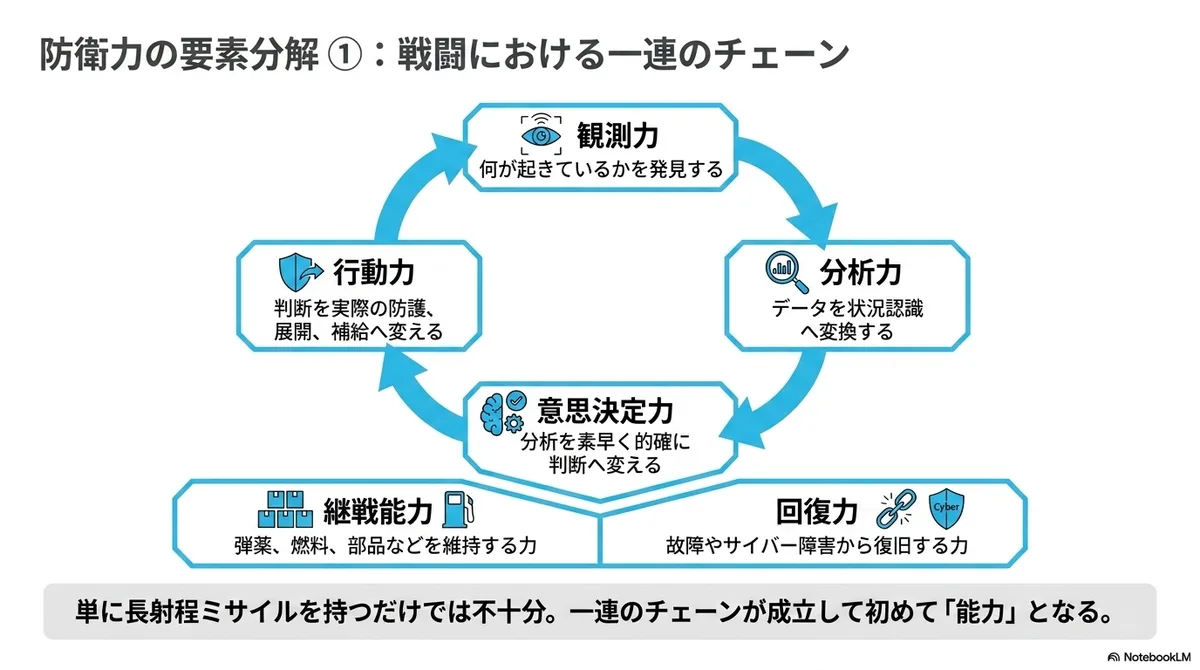
Element | Description |
Observation | The ability to detect what is happening |
Analysis | The ability to convert observation data into situational awareness |
Decision-making | The ability to turn analysis into quick and accurate judgments |
Action | The ability to turn judgments into actual protection, deployment, resupply, and support |
Sustainability in combat | The ability to sustain ammunition, fuel, parts, maintenance, personnel, electric power, and communications |
Resilience | The ability to recover and repair from failures, disasters, and cyber disruptions |
Defense capability increases when several of these elements work together well.
Even in an area such as stand-off defense capability, for example, simply possessing long-range missiles is not enough. To make it truly function, it becomes a capability only when a whole kill chain / kill web is in place: detecting, identifying, and tracking the target, confirming engagement authority, assigning the target, and assessing the effect. It also matters how long this can be sustained rather than done just once, and whether recovery and repair are possible.
If any part of this sequence breaks, even expensive equipment does not become effective defense capability. Conversely, from the defender's side, if the opponent's chain or web can be cut effectively, defense capability increases.
Decomposition (2): Improvement Capability and Friction-Reduction Capability
In addition, to make these capabilities usable or to amplify them, the following elements are also needed.
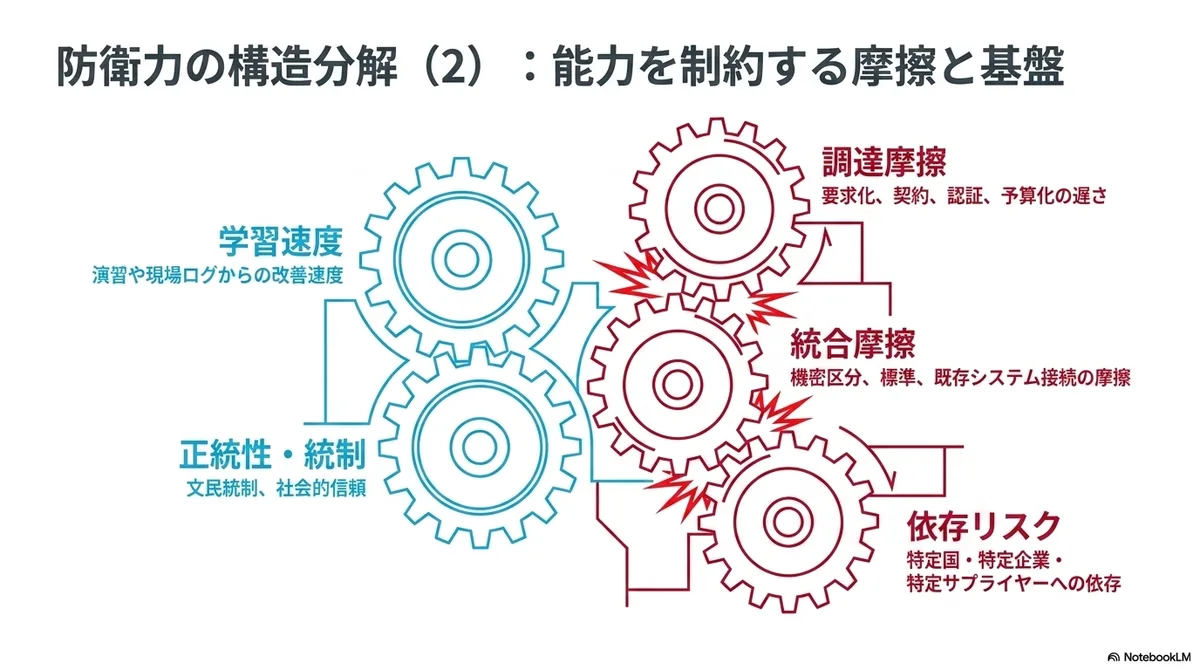
Element | Description |
Learning speed | The speed of learning and improving from exercises, simulations, other countries, and field logs |
Legitimacy and control | Legality, civilian control, accountability, auditability, and social trust |
Procurement friction | Slowness in defining requirements, contracting, testing, certification, budgeting, and fielding |
Integration friction | Friction from classification levels, certification, standards, data authority, export controls, demarcation of responsibility, and connection to existing systems |
Dependency risk | Vulnerability from dependence on specific equipment, companies, countries, clouds, communications, or suppliers |
Decomposition (3): Amplification and Interconnection
We also need to consider the following.
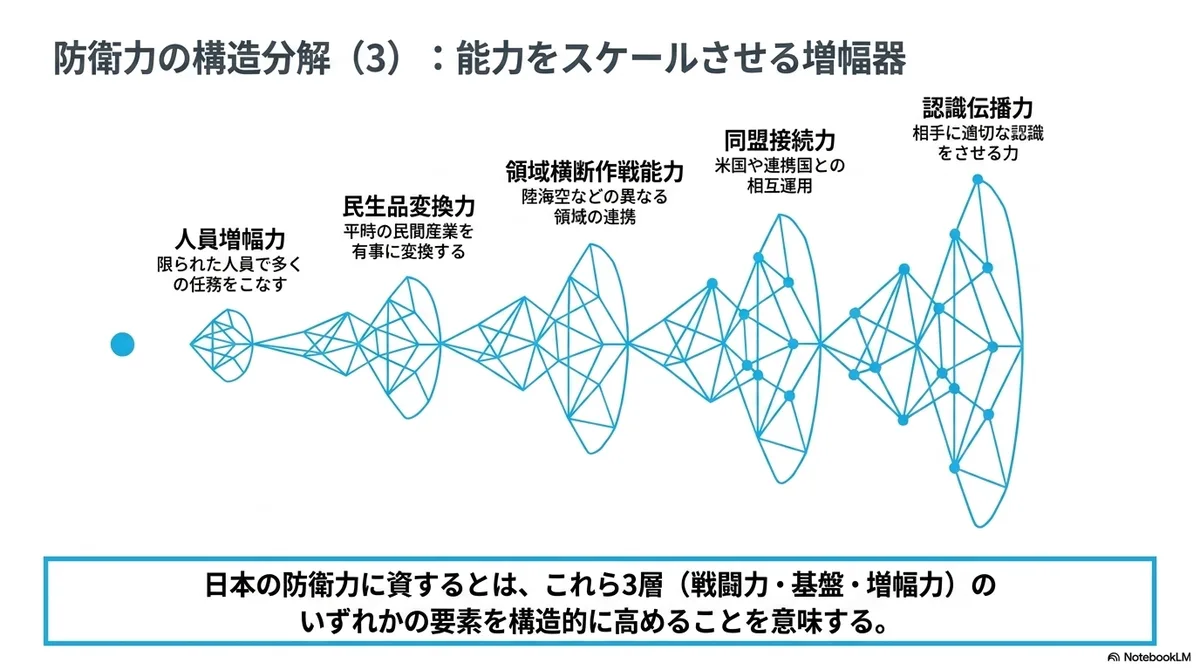
Element | Description |
Personnel amplification | The ability to accomplish more missions with limited personnel |
Civilian-goods conversion | The ability to convert peacetime civilian industry into defense capability in a crisis |
Cross-domain operations | The ability to coordinate across different domains such as land, sea, and air |
Alliance connectivity | The ability to interoperate with the capabilities of the United States and partner countries |
Perception transmission | The ability to make the opponent form the appropriate perception |
I take contributing to Japan's defense capability to mean contributing to raising any of these elements. (This is only one example, and I think there are other ways to decompose it.)
The Relative Importance of Each Element Differs
In many cases, bottlenecks in the chain or web of such activities tend to constrain overall performance, and paths to defeat also tend to arise from the weakest point among them. This deserves attention (though it is not necessarily always so).
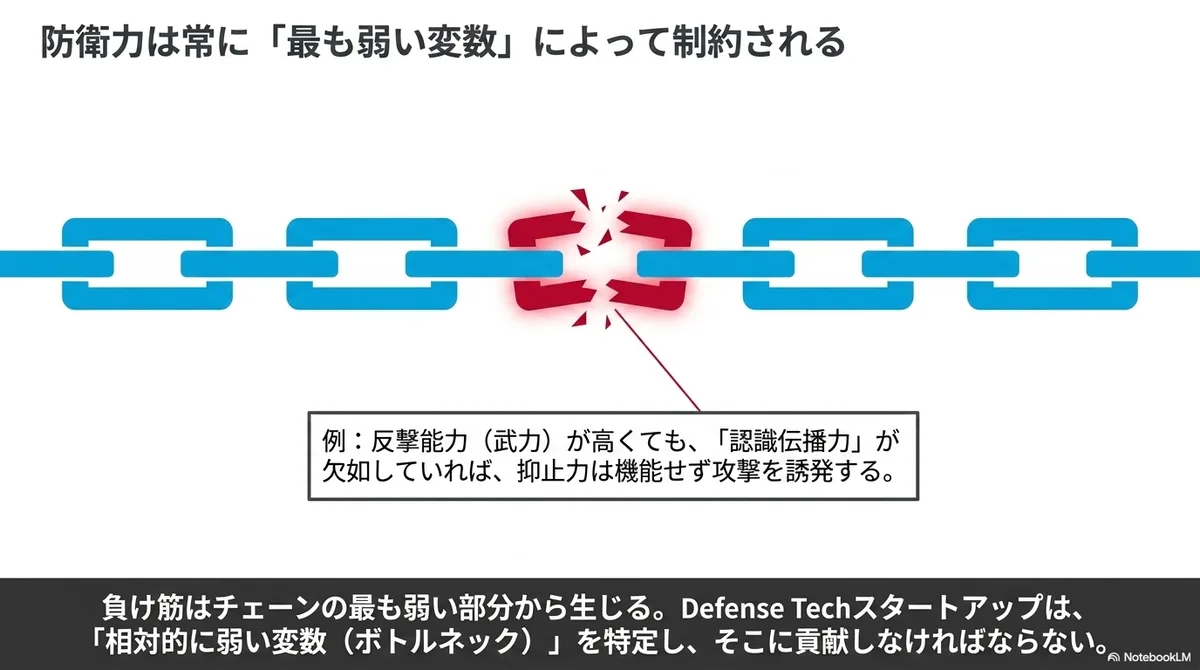
This includes things beyond combat capability. For example, no matter how much substantive counterstrike capability improves, deterrence depends on the opponent's perception. If perception transmission is weak, a situation of low deterrence (defense capability) can arise, such as "we have no intention to attack, but because that is not conveyed to the opponent, it rather tends to provoke the opponent's attack."
Therefore, I think it is important for Defense Tech startups to consider their contribution to defense not merely as "contributing to some element," but from the perspective of how they contribute to the "relatively weak variables" for Japan's defense.
Example: Sustainability in Combat
A problem that has recently drawn attention is sustainability in combat. A series of 2023 CSIS reports also pointed out that in a large-scale conflict in the Taiwan Strait, U.S. munitions expenditure would likely exceed the Department of Defense's current stockpiles, and that long-range precision-guided munitions in particular could run short in less than a week. For this reason, to raise America's sustainability in combat, efforts such as reshoring manufacturing are being made from a defense perspective as well.
The same applies to Japan. What should be done depends on what the defense problem actually is, but sustainability in combat is probably a challenge Japan shares.
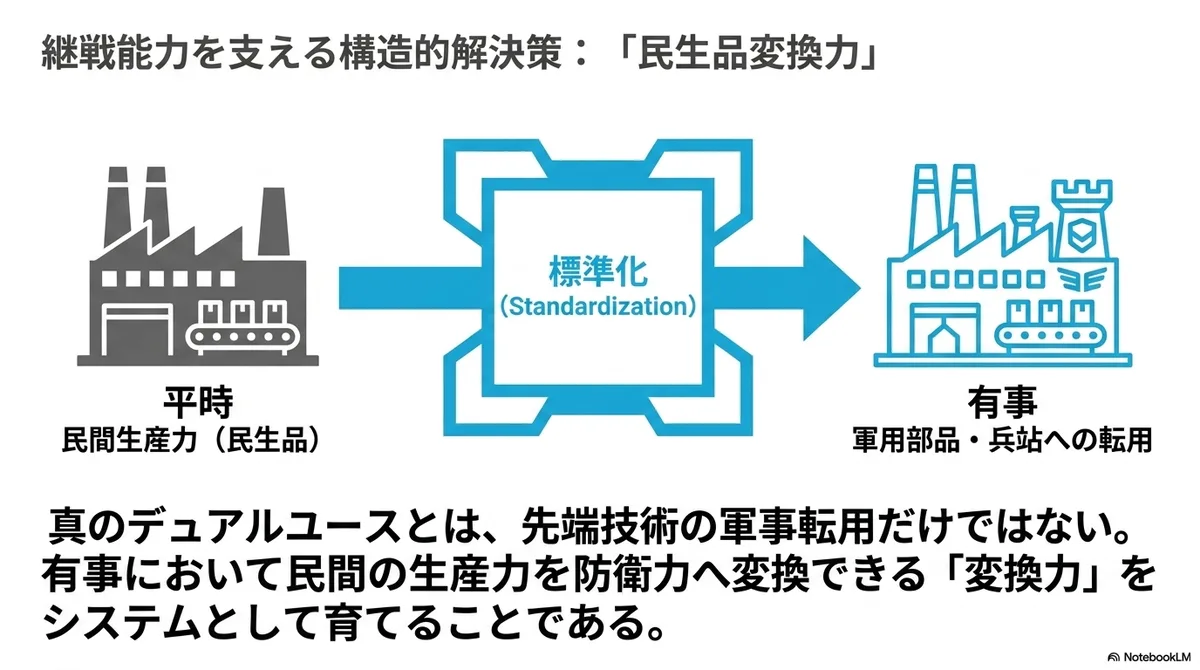
Raising sustainability in combat requires, among other things, strengthening civilian-goods conversion capability. For example, by standardizing military and civilian goods and developing the capability to convert civilian goods for military use when needed, military production using private factories becomes possible.
However, without institutional design and investment from peacetime, this cannot be stood up suddenly in an emergency. To increase the convertibility of civilian goods, standards, certification, contracts, training, secrecy protection, and quality assurance need to be put in place from peacetime. (That said, I think there are also military-specific goods that cannot be covered this way.)
In Japan too, at present, the average impact on actual defense capability seems greater from "dual use that raises sustainability in combat" than from "weaponizing cutting-edge technology."
(That said, I would like to hear the opinions of security experts.)
Summary on Defense Capability
When we think about defense capability, unless we clearly separate such disruptive cutting-edge technologies from realistic matters like sustainability in combat, and think carefully about what defense is, we risk producing "so-called Defense Tech" that wastes public funds. It is also conceivable that what happened when every company once claimed to be a business contributing to the SDGs could happen in the defense domain as well.
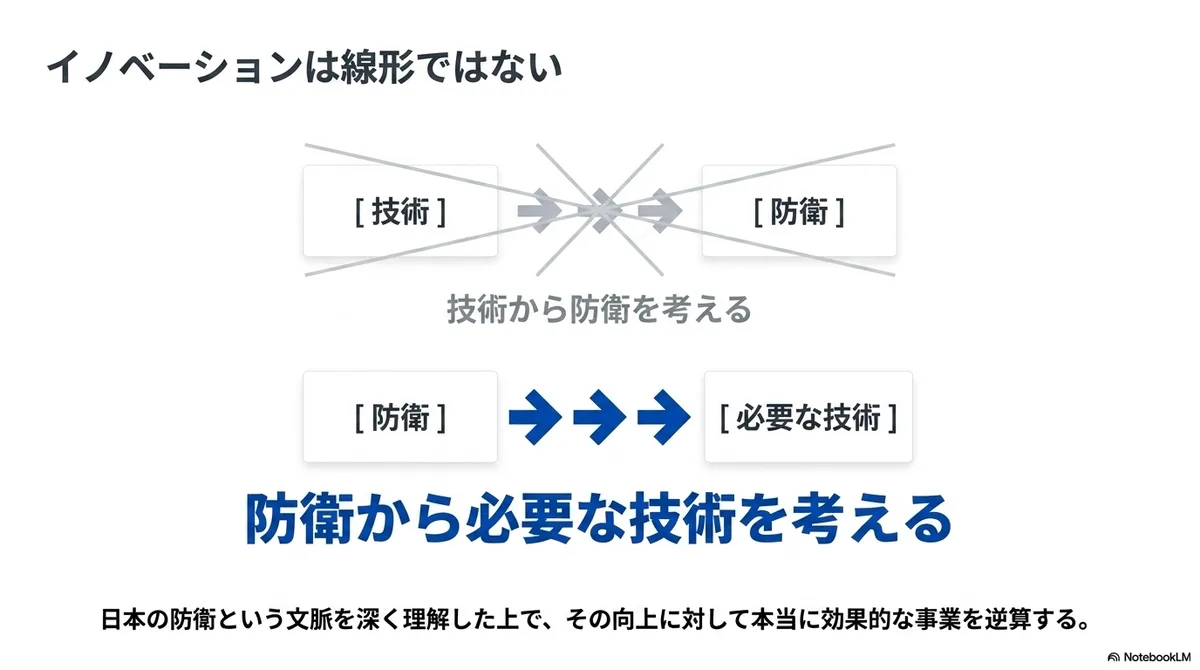
In Japan in particular, my impression is that the singular, linear narrative that "a groundbreaking technology directly turns into an advantage" is common, even in the context of commercializing science and technology.
In the context of deep tech in the for-profit domain, I have long written that "rather than thinking about a business from the technology, think about the technology needed from the business" and that "innovation is not linear." In the same way, in the defense domain too, it is important to "think about the technology needed from defense, rather than thinking about defense from the technology." Drones, too, look to me less like cutting-edge technology than like new methods of attack and defense brought about by falling costs.
Defense depends on each country's context. Therefore, I personally think it is ideally better to think about Japan's defense and aim for Defense Tech businesses and investments that are truly effective in improving it.
However, I hear little of this kind of discussion on defense capability from the startup side (perhaps I am simply far from that community...). It is easy to say dual use, and stepping into this domain because national money seems likely to be invested is an understandable attitude, but if one is going to do it, I think one needs to confront head-on how much one contributes to Japan's defense capability and build a Defense Tech business accordingly.
List of Related Articles
Organizing the premises: Defense Tech, dual use, and differences between Japan and the U.S.
- Defense capability - Does the business raise Japan's effective defense capability?
- Business viability - Can the business grow rapidly as a startup?
- Ethics - Should the business be done at all?