The Ethics of Defense Tech - Thinking About Japan's Defense Tech (4)
This article was machine-translated from Japanese by AI (Claude). It may contain errors. Read the original Japanese article.
I will be speaking at an event on Defense Tech on Monday, June 29, so I am writing down and organizing my thoughts in advance. The article grew long, so I have split it into several parts.
Note that, based on feedback, my own thinking and opinions may change in the future.
In thinking about Japan's Defense Tech, after sorting out the premises, I believe there are three major points to be discussed.
- Defense capability - Does the business raise Japan's effective defense capability?
- Business viability - Can the business grow rapidly as a startup?
- Ethics - Should the business be done?
This article deals with "ethics."
The Social Risks of the Rise of Defense Tech, and the Importance of Ethics
I would like to consider why ethics needs to be thought about in defense tech, using a somewhat exaggerated scenario.
First, the moments when the market capitalization of defense tech companies grows are probably "when conflicts break out" and "when confrontation intensifies and the sense of crisis rises." This is because demand for defense tech companies' products increases, and their market value rises, presumably when an incident occurs.
Venture capital firms that invest in defense tech in particular have a structure in which, regardless of whether they themselves want war, the more the security environment tightens within the fund's lifespan, the more defense budgets grow, and the more the valuations of portfolio companies rise, the larger the investment returns can become.
Then, cashing out at the moment when corporate value has risen because of war or the like, earning the investment return, and leaving the cost of postwar reconstruction to society... This is quite conspiratorial, but there is an incentive to create that kind of structure and narrative.
Even without such active involvement, there is also the problem that "in order to justify the budget that has been secured, it becomes hard to stop a war." For example, it is said that the Imperial Japanese Navy in World War II was quite aware that it did not have sufficient prospects of winning a war against the United States. But for many years it had built its armaments, education, operational plans, and budgets on the premise of the "United States as the hypothetical enemy," so the navy's leaders avoided clearly opposing the war, escaped into ambiguous stances such as "leaving it to the Prime Minister," and as a result the decision to go to war was made (NHK's special feature, for example).
This does not mean that the individuals involved are evil. Even without malice, human beings tend to be greedy and weak in small ways, so when there is an incentive, they easily flow toward it.
Precisely because of such human weakness, we need to bind and discipline ourselves appropriately, and those under such suspicion bear accountability. In particular, now that investment as a kind of wager on "conflict breaking out" is increasing, I think this responsibility has grown all the more.
Because Private Companies Have Grown More Powerful, Private-Sector Ethics Is Needed
The Private Sector as a New Player
I think the reasons for having such discussions on the private-company side in particular are increasing.
Traditionally, ethics was mainly discussed by two parties: academia, such as universities that develop advanced technologies, and the military that applies them. Citizens were of course included as stakeholders, but I think their position was rather passive.
Now, private companies have come to lead advanced technologies and their applications in some respects, ahead of universities and the like, and their presence as players is growing.
In that case, gripping only academia is not very effective, and we have to think about what to do with the private sector. And there is a growing number of things that the private side, too, has to think about in the same way.
Precisely because the private sector has gained power, great responsibility arises there.
Startups Within the Private Sector
In that sense, startups also need to think about this. Precisely because startups, as private companies, are expected to be the bearers of defense tech, commensurate responsibility arises for them.
Startups used to operate in domains where it was enough to follow the rules of the market, and the time has come to change that.
Startups have increasingly been entering various regulated industries, and have been required to bear commensurate responsibility there too, but that has now extended to domains involving human life and death. If so, even greater responsibility will be required.
A Qualitative Change in Involvement Through Information Technology
Also, with the development of information technology, unlike the weapons supply by private companies in the past, there is more room for the will of private companies to enter into combat decision-making, so the influence that private companies have on the military appears to be greater than before. In addition, a major change is that, amid globalization, a single company such as Big Tech can come to have influence that transcends nations.
Now that private companies hold important parts of information and their influence is growing, how to build mechanisms for such private companies to discipline themselves, and mechanisms to control them from the outside, will become increasingly necessary as a subject of future public debate.
Great power comes with great responsibility for foresight, restraint, and accountability. New preparations for that have become necessary.
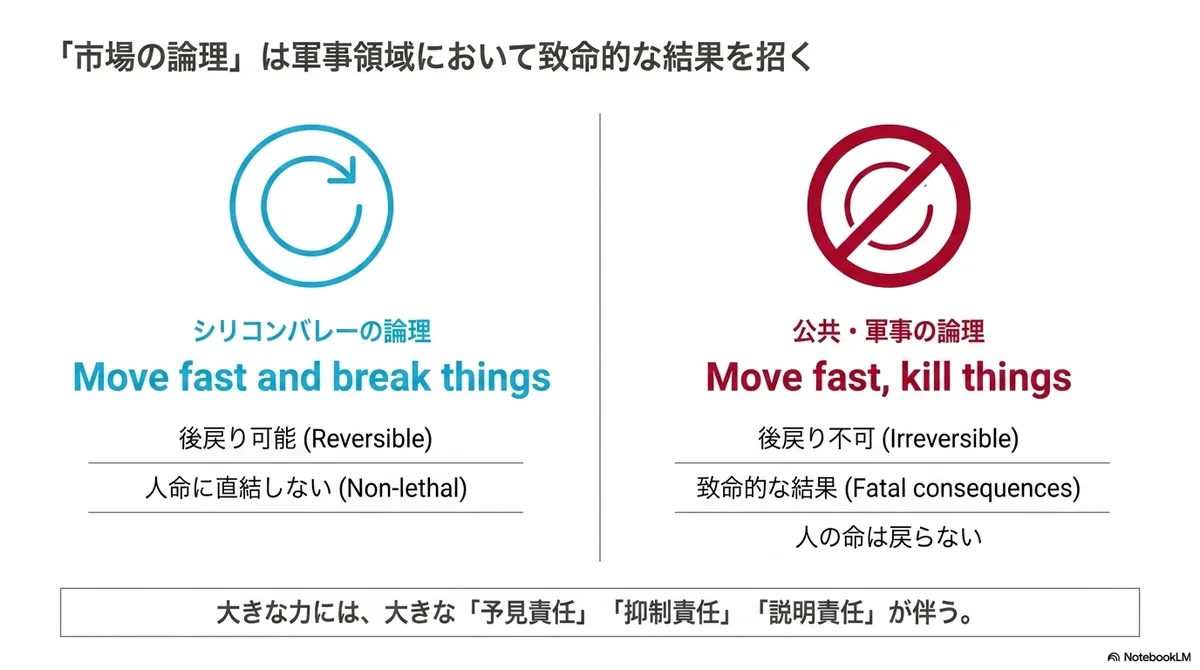
Silicon Valley has traditionally had a way of thinking like "Move fast and break things," but that was because it was a business domain where things could be undone and that was not so closely tied to human lives. If one did that in the military domain, it would become Move fast, kill things, and human lives do not come back.
That is exactly why I think discussion of ethics is necessary.
However, as I mentioned earlier, it is far too simplistic to think in terms of the binary choice of "complicity in war or complete withdrawal." If we lose effective defense capability, that could in turn endanger human lives and society.
What should be asked is not whether to reject involvement in defense technology or the businesses around it altogether, but to look at the complex gradation of good and bad: what may be done and what must not be done.
Ethics and Speed
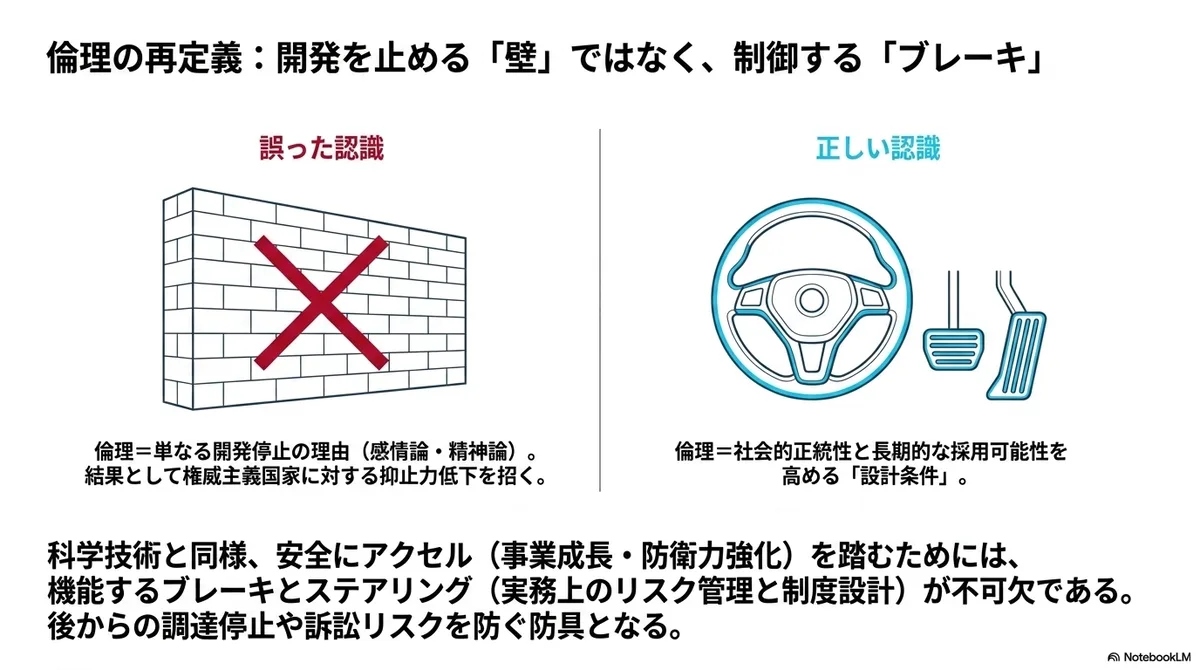
On the other hand, some people may think that if ethics is taken too seriously, technology development in democratic countries will be delayed, and as a result deterrence against authoritarian states will weaken. But if ethics is weak, procurement may be halted or exports may be stopped later. It may also invite lawsuits and reduced interoperability with allies. As a result, the business instead becomes fragile.
As is often said in science and technology as well, in order to step on the accelerator properly, brakes should be prepared, and unless steering is possible and guardrails are installed, trust from society will not be obtained.
In an earlier article, too, I wrote that unless military procurement reform and market reform are carried out, large startups will probably not emerge. If we are to promote such market design, discussing and designing ethics ourselves should also lead to maximizing our own companies' value.
From that perspective as well, while asking "Is this technology militarily effective?" and "Is this business attractive as a startup?", it is important for the people involved to themselves consider and communicate "Should we do this business? (Should we invest in or support this business?)" and "How far is acceptable?" And even if the people themselves are not concerned, I think there is a great need for those around them to pose such questions and to apply brakes.
So in this article, rather than rejecting defense tech across the board, and without treating ethics as a "reason to halt development," I would like to think about ethics as a design condition that increases social legitimacy and long-term adoptability. In doing so, I would like to treat ethics as far as possible not as a matter of emotion, but as a matter of practical risk management, institutional design, and democratic legitimacy.
Making Ethics Concrete in Practice
How Ethical Issues and Risks Change with the Business
Even within the ethics of defense tech, the ethical issues and risks change depending on what kind of business that defense tech company conducts. For example, they can be classified as follows.
Type | Examples | Ethical risks |
Rear-area support and logistics | Resupply, maintenance, inventory management, training support | Relatively low, but it does contribute to the capability to wage war |
Defense infrastructure | Cyber defense, satellite communications, base security, disaster response | Risks of civilian diversion, surveillance diversion, and dependence |
Intelligence gathering and analysis | ISR, OSINT, image analysis, situational awareness AI | Misidentification, surveillance, discriminatory targeting, diffusion of responsibility |
Command and control, decision support | C2, target prioritization, operational planning support | Hollowing out of human judgment, inexplicability |
Lethal and autonomous weapons | Attack drones, autonomous target selection, fire control | IHL violations, excessive attacks, unclear attribution of responsibility |
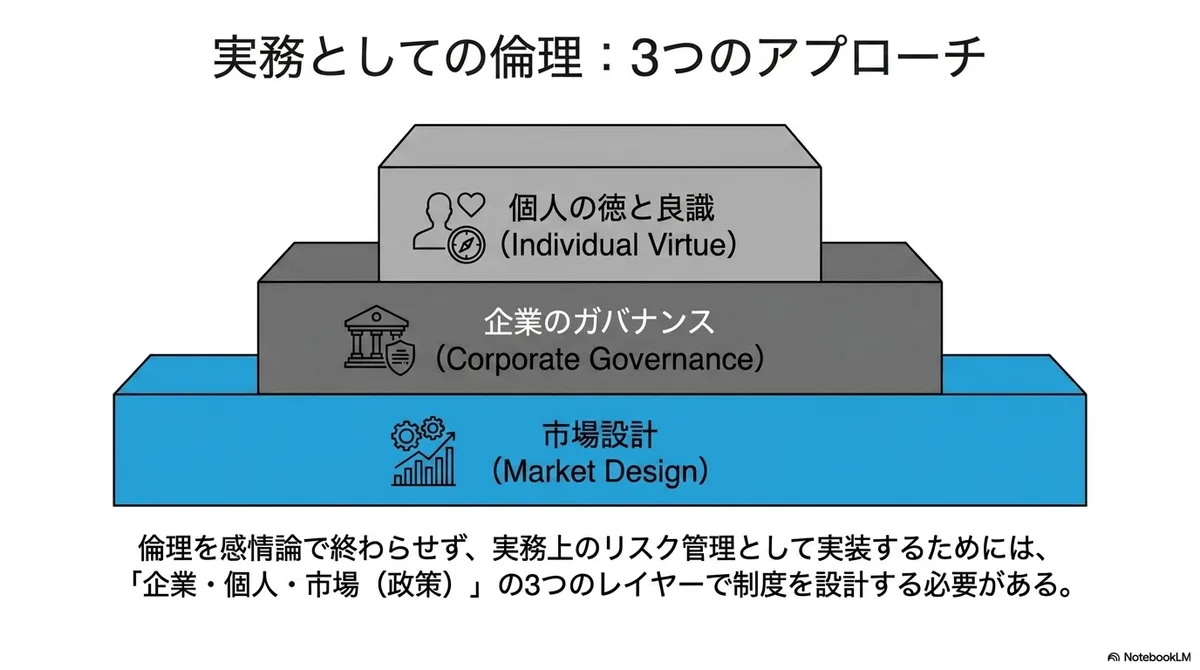
On that basis, I think that in practice we need to start from around the following three.
- Companies: how to design governance
- Individuals: how to demand virtue from founders and investors
- Policy: how to design the institutions of the market as a whole
(1) Corporate Governance Design
One method is how to build an ethical governance structure for the company.
For example, Skydio, a drone company, published its Engagement and Responsible Use Principles in 2020, when it strengthened its business shift from consumer to B2B. Helsing, a German defense AI startup, also lays out information about ethics. Palantir also has a Human Rights Policy in place.
In order not to cross ethical lines, having businesses and investors establish rules and systems about "for which uses, customers, and operating conditions can we get involved ethically" should serve, for companies about to step into dangerous territory, as armor and discipline that protect them.
If one is going to do Defense Tech, preparing such mechanisms on the part of companies, investors, and supporters alike is, I think, one practical solution.
For example, checking against a checklist like the one below is one approach. (This is only an example.)
Question | Specific points to confirm |
Who will it be sold to? | Is the customer under democratic control? Is it not a security agency, military, or government with a high risk of human rights violations? |
What will it be used for? | Which is it: defense, disaster prevention, surveillance, targeting, or attack support? |
How far will we be involved? | Providing information, supporting decisions, selecting targets, or carrying out attacks? |
Will human judgment remain? | Is it designed so that humans can make meaningful judgments? The DoD's directive on autonomous weapons also emphasizes design and accountability structures to reduce the risk of unintended engagements. (U.S. Department of War) |
Can it be audited? | Do logs, model update history, data provenance, reasons for decisions, and post-incident verification remain available? |
Can it be stopped? | Is it possible to halt it upon malfunction, terminate the contract upon customer violation, and restrict access upon deviation from the intended use? |
Are we not externalizing costs? | Are we not imposing reconstruction costs, harm to civilians, mistaken strikes, or surveillance harms on society? |
However, we need to look at how effective these actually are. For example, recently, in June 2026, Palantir, even though 56% of outside shareholders supported conducting a human rights review, reportedly voted it down at the shareholder meeting. This was because it had a share structure that gave the founders strong voting rights. As for Helsing, I can confirm that it sets out such principles, but frankly I do not know what lies behind them.
What this case shows is that having governance and having effective control from the outside are two different things. What kind of rules to prepare for that needs to be discussed.
(2) Individual Virtue and Good Sense
The second perspective is to discuss virtue and ethics.
Startups tend to have immature institutions like those described above within the company. For that reason, the virtue and good sense of the individual founders and investors are called for. Accordingly, it would be desirable to evaluate whether founders and investors have the character and organizational culture suited to handling power related to war, and to have many venues for such discussion.
However, I also think that relying on virtue alone is risky. In situations where competitive pressure is applied, individual good sense alone cannot stop an organization.
(3) Market Design
That is why the design of the external market is important. The defense tech market is justified because it supplies the defense capability that the state and society need more efficiently and appropriately. We need to design a market that functions in line with that purpose.
Joseph Heath, who wrote What Is Ethics to Capitalism?, among others, argues that companies are entities that have been assigned the role of competing, and that it is wrong to demand that companies make society better. He then lays out that, nevertheless, competing by means that run counter to the purpose of market institutions is not ethical.
In that sense, if firms compete through excessive staging of crisis narratives, undue influence over procurement systems, vendor lock-in, or the externalization of responsibility and cost, that is competition that undermines the purpose of the market. To prevent these, we need to translate this into competition rules, procurement systems, investment contracts, use-case review, and auditability that do not exploit market failures.
(That said, as areas that were once not markets, like the defense domain, are being turned into markets, I think there are also aspects where we have no choice but to demand ethics of companies until market institutions capable of governing them are in place.)
Discussions About Ethics
In addition, although they are somewhat abstract, I would like to list several points that concern me from the perspective of ethics.
(1) The Basics
First, what we must at the very least grasp are perspectives such as international humanitarian law, human rights, and just war theory.
Defense Tech companies and investors will need to understand the basic principles that international humanitarian law requires. Saying "it's good because it helps defense" without such consideration strikes me as very dangerous.
In the defense, security, and intelligence domains in particular, products must be designed on the premise of the risk that they will be diverted to surveillance of civilians, suppression of dissidents, excessive use of force, and discriminatory targeting.
However, such discussion does not seem to be happening much, and this leaves me uneasy.
Also, rather than abstract discussions about states and the like, we need to pay attention to care-ethical aspects, such as who is hurt and how, but I have the impression that such discussion is also scarce.
(2) Discussions of Legitimacy and Responsibility
With weapons of the past, decisions were made by the military. But in today's decision-making processes using information technology, private companies become indirectly involved in decisions as well. With technology centered on information sharing, as in the past, the military still held the initiative in decision-making. But once AI built by private companies makes the judgments, questions arise such as how much legitimacy decisions made through things built by private companies have, and how they should be treated.
Also, as long as defense was carried out by the state, mechanisms that place certain checks on the state were built in the form of law. But once it becomes private companies, imposing governance from the outside becomes correspondingly difficult. The Palantir example mentioned earlier is one instance. How to handle this is something we should think about.
The problem of where responsibility lies also arises. What is dangerous about recent defense tech is that responsibility becomes diffused. Engineers may say they merely built the model, companies may say they merely followed the government's requirements, the military may say it trusted the vendor's evaluation, and operators may say they trusted the system. This is a system in which no one is fully responsible. With autonomous weapons, the problem becomes even greater.
We need to sort out the discussion before responsibility becomes murky in this way.
(3) Dependence on Private Platforms and Sovereignty
We also need to be careful about the tendency of defense tech companies to try not merely to sell weapons or software but to build platforms that become the foundation of military operations. Platformization also means that the militaries of various countries come to depend on a small number of companies, making lock-in, monopoly, and oligopoly more likely.
It is easy to imagine that, before long, such private companies will sell their products to various countries as "War as a Service" or "Defense capability/Deterrence as a Service," and even after adoption, there is the risk that national defense would cease to function if the company terminates the contract.
In fact, regarding Starlink, it was reported that in February 2026 access was restricted for terminals allegedly being used illicitly by the Russian military, affecting Russian communications. Also, in 2025, in the context of resource negotiations with Ukraine, it reportedly mentioned the possibility of suspending Starlink access. The facts need to be sorted out carefully, but when private platforms can come to have such a major influence on wartime communications and the continuation of operations, we need to prepare for how to respond.
(4) How to Deal with New Players
So far I have talked about the startup side, but I think the government side, which is trying to draw startups in, also needs a new sense of ethics and a new view of markets.
As mentioned earlier, startups and VCs have time-limited incentives, and they are players moved by the logic of capital, somewhat different from traditional defense stakeholders. Bringing the innovation that such people create into the defense ecosystem has both advantages and disadvantages. If this cannot be governed well, we may be swallowed by those people's narratives, and confrontation may easily sharpen.
For example, a16z has written a manifesto that treats technology ethics as an "enemy". Whether the words, actions, and technologies of such people can be governed will also depend on how much capability the government side has.
(5) Excessive Narratives About the Degree of Contribution to the Nation
I think it is also important not to see defense tech too much as "contribution to the nation."
Ben Buchheim-Jurisson, who is also an investor in defense tech, drawing on his background as a former serviceman, emphasizes the difference: private companies and investors have the "freedom to quit" and can also earn large profits, whereas servicemembers operate under constraints such as strict restrictions by the state and low pay, and actually face danger. He warns that when companies like Palantir and Anduril use the language of "service to the nation," private elites who do not actually bear the costs of war may end up borrowing only the moral authority of war. This is logic that would also apply to Japan's defense tech.
Among the private companies and investors involved in defense, there are surely some who truly want to protect society and the nation. Even so, I think we must not affirm everything under the narrative of "contribution to the nation," and need to look at what responsibilities are borne by whom.
(6) What Kind of Country Does Japan Want to Be?
And finally, in thinking about the ethics of defense tech in Japan, I think we do need to reconsider what shape Japan has as a country and what security means for Japan. This includes discussion of a kind that goes beyond ethics, but with American protection receding, it means thinking about what, at a minimum, Japan wants to protect, how much cost it can bear, and what it must not cross, and then, within that, thinking about what can be done.
However, that kind of ethics does not mean Japan can simply design it on its own; it also needs to be shared to some extent with the ethics of the countries it cooperates with. There is also a business reason: in countries whose ethical views cannot be shared, it is difficult to export what one has made at home. If you want to sell to the EU, you will need to take care to conform to the EU's ethics and ethical debates.
In the United States, as a movement seeking such "ethics," things like a return to Christianity and the common good appear to be under discussion.
And in thinking about the shape of Japan, I also think we must not be swept up by the current mood of Silicon Valley. The current wave of American Defense Tech seems to have arisen from a mixture of American hegemonic thinking, techno-libertarian market fundamentalism, and Silicon Valley's peculiar technological optimism. That is not necessarily always right.
I Am Not Rejecting Defense Tech
I have thought through several perspectives above.
That does not mean it is better not to do defense tech. It means that if it is to be done, it needs to be done properly, for both society and the business. For example, if one is going to lobby to improve the market environment, one should ask the government for environmental improvements and the like with due resolve and reasoning.
If one gets involved after thinking these things through thoroughly, I believe defense tech can be not merely a war business but also a technology for maintaining peace. But for that, design is necessary.
Also, while I am not denying the effort of defense, I personally think it may be better to spend my own time and abilities on creating a peaceful world. Defense may be important in the short term, but if an individual's strength, as with ordinary stock investing, is being able to bet over the medium to long term, I think the overall return would be greater by spending time creating the peace that lies beyond short-term upheaval. I also want to bet not on market trends but on using the market to create the future I want to create, and on human society moving in a better direction.
Related articles
Sorting out the premises: Defense Tech, dual use, differences between Japan and the US
- Defense capability - Does the business raise Japan's effective defense capability?
- Business viability - Can the business grow rapidly as a startup?
- Ethics - Should the business be done?