
What Should We Spend Money on for Defense, Security, and Peace?
This article was machine-translated from Japanese by AI (Claude). It may contain errors. Read the original Japanese article.

According to a World Bank report, direct damage to buildings and infrastructure in the ongoing war in Ukraine reached approximately 29 trillion yen (over $195 billion) during the roughly four years from the start of the full-scale invasion in February 2022 to the end of 2025. The same report estimates that recovery and reconstruction over the next 10 years will require approximately 88 trillion yen (around $588 billion), an amount equivalent to roughly three times the country's nominal GDP in 2025 (calculated at 150 yen per dollar).
Translating this to the scale of Japan's economy based on GDP ratio, direct damage would correspond to roughly 660 trillion yen, and recovery and reconstruction costs to about 2,000 trillion yen. This is merely an illustration using GDP proportions and not a prediction of future war damage for Japan, but the damage Japan suffered during World War II was of a comparable scale. The destruction of capital stock suffered by Japan across all of World War II is said to correspond to 86% of annual GDP at the time, which amounts to roughly 570 trillion yen when applied to Japan's economic scale in 2025.
If Japan were to become the stage for a large-scale war in the future, it is reasonable to expect damage on the order of hundreds of trillions of yen. (Note that these figures are strictly economic and do not include irreplaceable losses such as lost human lives and the time of those who survived.)
Considering losses of 660 trillion yen and the impact on people, preventative annual expenditures on the order of several trillion yen appear fully justified. For instance, an annual expenditure of around 9 trillion yen (Japan's defense budget for fiscal 2026) would pay for itself economically if it lowered the annual probability of war by about 1.4 percentage points (9 trillion yen ÷ 660 trillion yen).
However, because the potential damage is so vast, almost any investment can be justified by this logic. That is precisely why it is crucial to invest in what is genuinely effective, and doing so requires comparing the effectiveness of different means. Moreover, to ensure safety—the goal of defense—there are numerous options beyond defense alone.
In other words, what we must ask is not merely whether to invest in defense, but which defense means we should invest in, and to what extent, to protect our security.
Today, investment in "defense tech" is attracting attention in the startup world as well. Below, without dismissing expenditures in this area, I would like to sketch a way of thinking about "what level is appropriate" and what alternative means exist.
(Of course, alongside expenditures, we must also discuss their funding sources. To secure defense spending, we will need difficult discussions on how much to raise corporate taxes or consumption taxes for security, or whether to cut other expenditures—such as reducing fuel subsidies or social security-related expenses, which account for about 40 trillion yen in the general account. In the startup realm, there is also the question of how to face the relative decline in investment in non-defense sectors as investment in defense tech grows. However, this article will focus primarily on the expenditure and investment side.)
Deconstructing Expected Loss
Probability and Damage
Let us consider the damage mentioned above by drawing an analogy to venture investment in startups. In venture investment, expected return is calculated as "return when successful × probability of success." Applying the same formula to war yields the following:
Here, damage represents an average that includes everything from minor skirmishes to major wars. Investments aimed at reducing war risks lower either the probability, the damage, or both. Deterrence and conflict prevention primarily lower the "probability of occurrence," while protection, evacuation, and infrastructure resilience primarily reduce "damage when war occurs."
Heavy-Tailed Damage Distributions
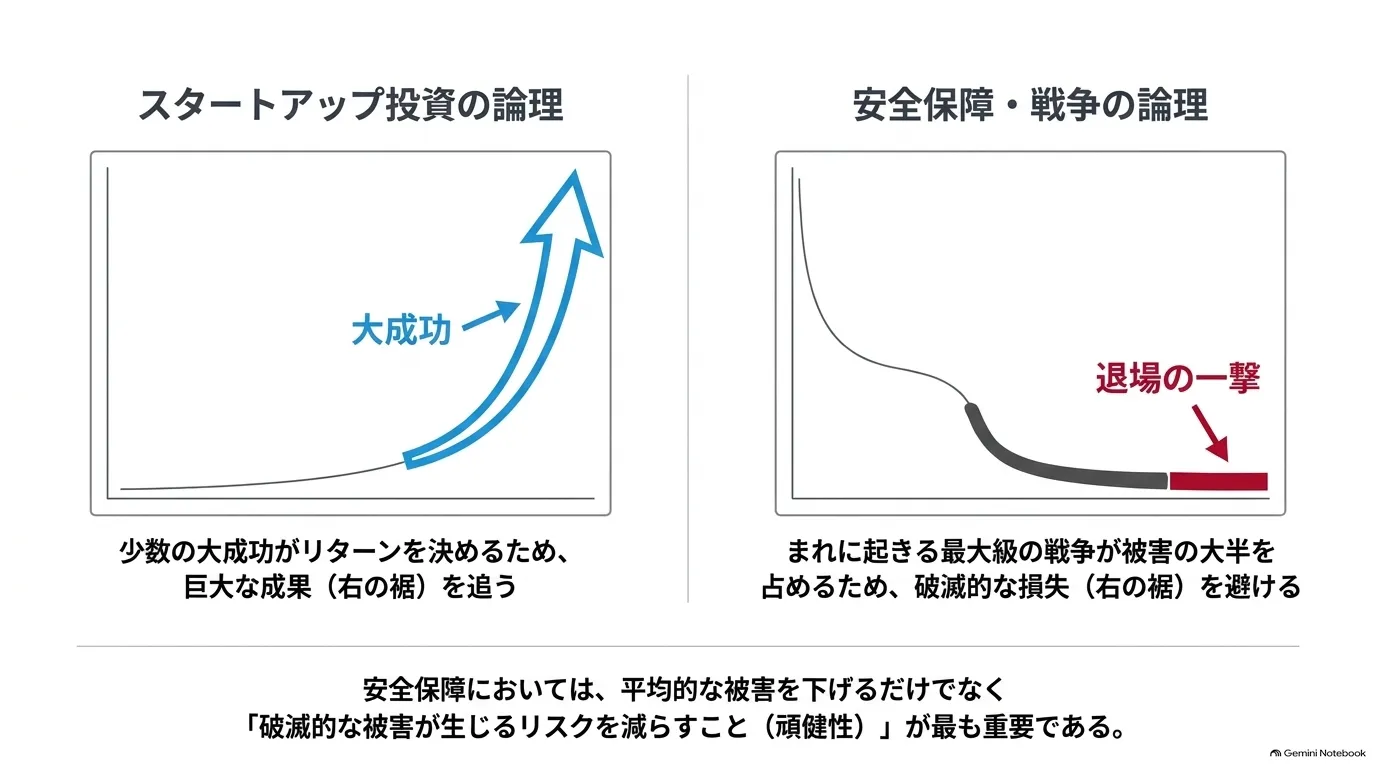
The power law operates in startup investing, where a handful of outsized successes account for the vast majority of returns. Investors therefore pursue the possibility of massive hits rather than average success.
The scale of war is known to follow a similar distribution. Measured by battlefield fatalities, the scale of war damage follows a heavy-tailed distribution, where rare, catastrophic wars account for a major share of total damage. Just as outsized hits determine expected returns in startup investing, gigantic wars largely dictate expected losses in warfare.
However, the directions are opposite. While startup investing chases huge successes in the tail, in war we must avoid catastrophic losses in the tail. Therefore, in the context of security, in addition to lowering the probability of occurrence, we must also examine reducing the risk of catastrophic damage.
In investing as well, losses that force an irreversible exit from the market are not evaluated purely on averages; one focuses on avoiding that "knockout blow." Similarly, building robustness capable of withstanding the worst-case scenario (the catastrophic tail) is essential.
The Security Dilemma
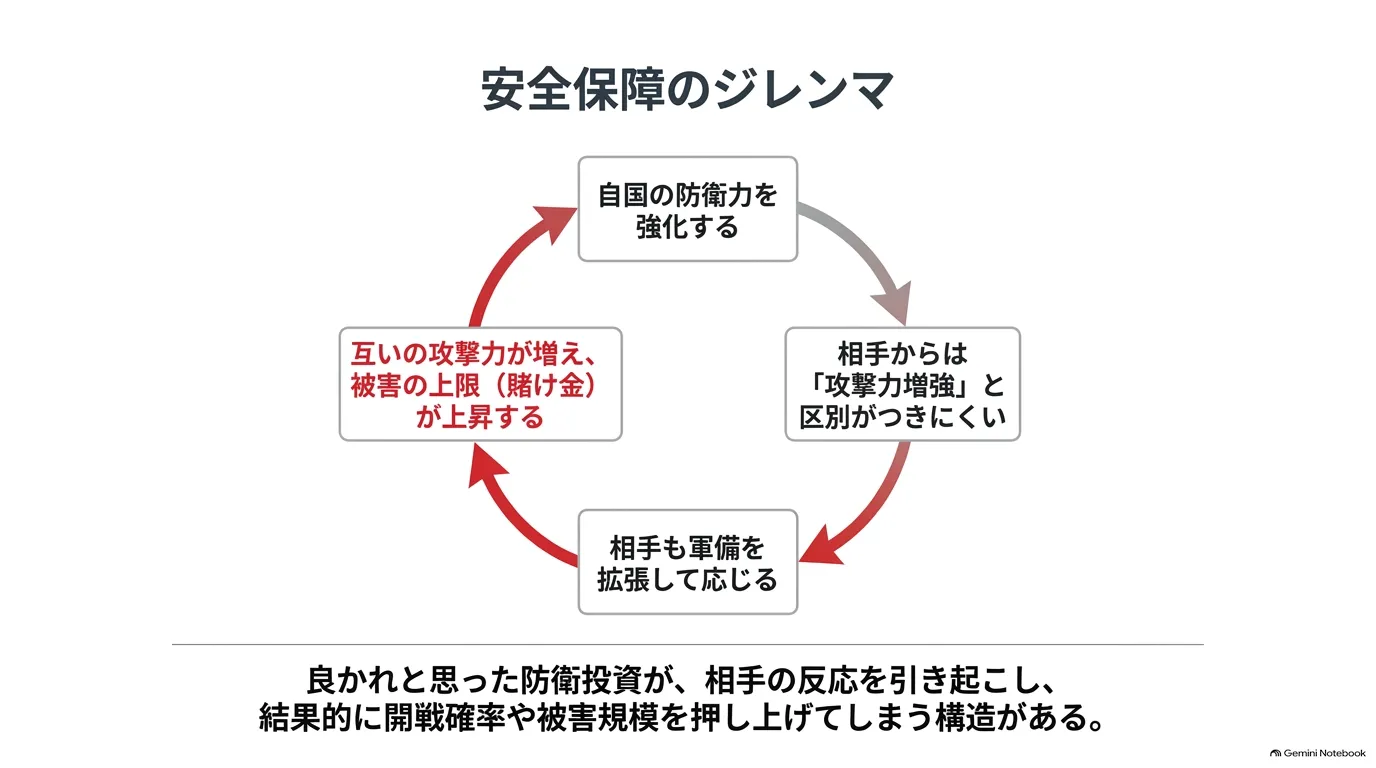
Preparing for such worst-case scenarios resembles earthquake preparedness. However, while earthquakes do not grow stronger in response to seismic retrofitting, rival nations do react to our military buildup. Even if we enhance our capabilities purely for defense, rivals cannot easily distinguish defensive capabilities from offensive escalation, and they respond by boosting their own capabilities. This dynamic is known in international relations as the "security dilemma."
In other words, an investment intended to lower probability can, through the rival's reaction, push that probability right back up, or by increasing offensive power on both sides, raise the ceiling of potential damage. In a sense, military defense has an inherent tendency to raise the stakes mutually, leading to catastrophic destruction on either side should conflict actually erupt.
A 2x2 Matrix of Probability and Damage
Taking these premises into account and analyzing through "probability of war × damage when war occurs," we can see that a single investment can push probability and damage in opposite directions. From here, we will examine investments across four quadrants based on these two components of expected loss.
| Can Reduce Damage | Can Increase Damage | |
|---|---|---|
| Can Reduce Probability | (1) Protection, dispersion, etc. that deter invasion and reduce damage | (2) Strike capabilities that deter war but escalate damage if deterrence fails |
| Can Increase Probability | (3) Defenses that reduce damage but incentivize adversary preemption | (4) Arms race spirals that destabilize crises and increase damage |
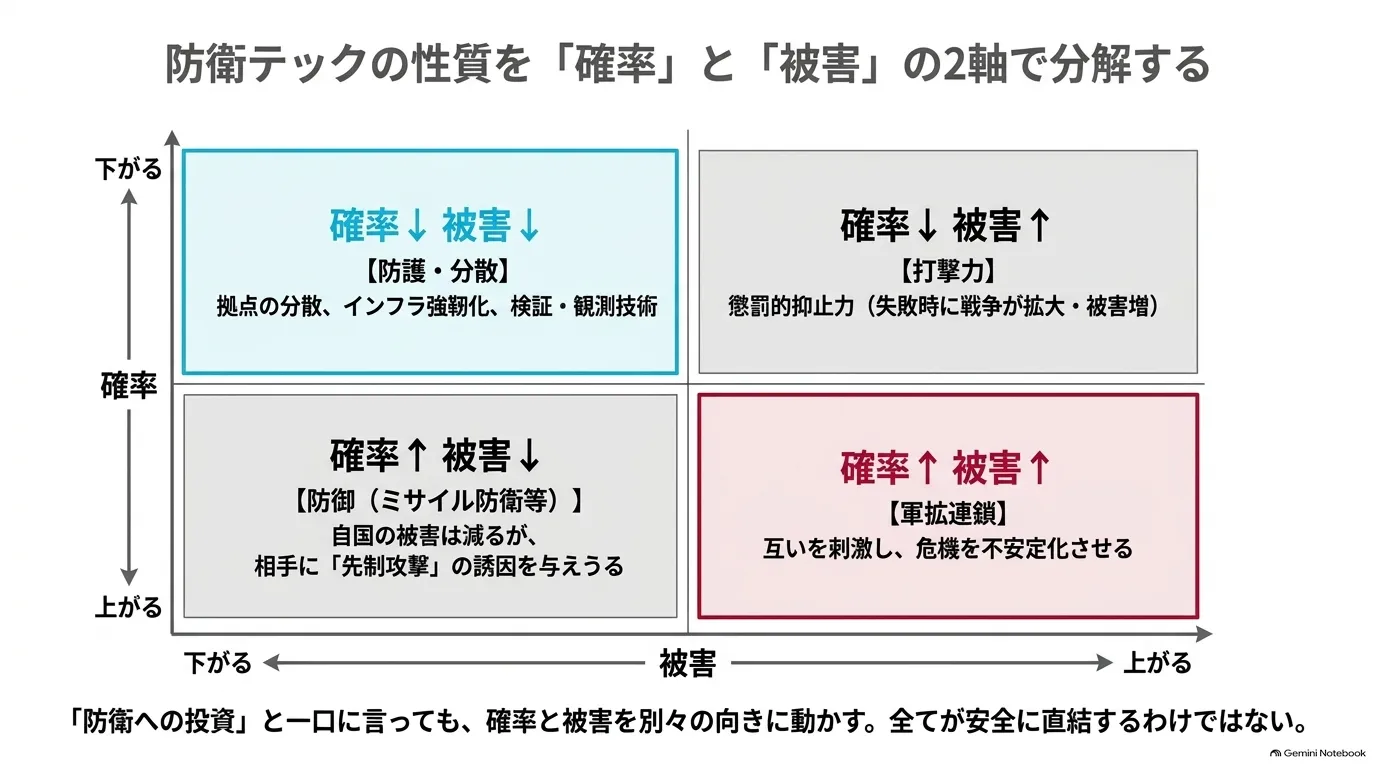
Which quadrant an investment falls into depends on its operational use and the adversary's reaction, so please view these as conditional examples. Satellites, observation and analysis services, and drones lean toward (2) when used for targeting or shortening kill chains, but lean toward (1) when used for verification. In addition, "deterrence by denial"—convincing an adversary they cannot achieve their objectives by attacking—also includes capabilities to destroy invading forces and supply lines. Therefore, we should view the boundaries between quadrants as a gradation.
Quadrant (1) at the top-left represents investments that reduce probability and either reduce or avoid increasing damage. Air defense, dispersal of bases, and hardening of power, communications, and logistics fall here if they deter invasion and reduce damage upon outbreak. Observation and verification technologies that reduce miscalculations, diplomacy, and crisis communication channels also belong here if they reduce probability without adding damage.
Quadrant (2) at the top-right represents investments that reduce probability but can increase damage. For example, strike capabilities that underpin "deterrence by punishment"—signaling that an attack will trigger unbearable retaliation—might deter the outbreak of war, but if deterrence fails, they may provoke adversary counterstrikes and war escalation, thereby increasing damage to Japan.
Quadrant (3) at the bottom-left represents investments that reduce damage but can increase probability. For instance, missile defense systems that appear to neutralize an adversary's nuclear retaliatory capability have long been argued to give the adversary an incentive to "strike first." Even if they genuinely reduce damage, if that reaction raises the probability of war, they fall into this category.
Quadrant (4) at the bottom-right represents investments that can increase both probability and damage. An example is an arms race spiral where provoking an adversary leads to reciprocal buildups, destabilizing crises and increasing damage in the event of war.
Looking at it this way, "defense tech" encompasses a wide variety of approaches. However, in today's startup ecosystem, defense tech tends to be discussed and perceived with a heavy bias toward military capabilities. If our goal is to contribute to defense and ultimately to security, expanding our comparison beyond current defense tech to include non-military means such as diplomacy and cultural exchange seems both possible and preferable when evaluated through the lens of safety.
Means Beyond Military Defense
Stepping back to observe defense tech reveals technologies and initiatives beyond military deterrence and protection that also serve national defense.
Peace researcher Johan Galtung defined peace as "the capacity to manage conflicts nonviolently and creatively." He categorized violence into three forms: direct violence (killing and destruction), structural violence (harm generated by societal structures such as poverty and exclusion), and cultural violence (attitudes and beliefs that legitimize violence).
Drawing on this framework, we can categorize peacebuilding initiatives into the following four areas:
| Category | Role in Peace | Issues Addressed | Timing | Primary Means |
|---|---|---|---|---|
| Security | Preventing violence and protecting people | Invasion, attacks, casualties | Pre-conflict, during conflict | Defense/deterrence, diplomacy, arms control, early warning/crisis management, ceasefire monitoring, civilian protection, critical infrastructure protection |
| Conflict Resolution | Resolving disputes through dialogue and law | Clashes of interests and assertions | Pre-conflict, during conflict, post-conflict | Diplomacy/mediation, international law/institutions, elections/political participation, justice/rule of law, human rights guarantees, anti-corruption |
| Socioeconomic Foundations | Ensuring safe livelihoods and opportunities to diminish roots of conflict | Poverty, inequality, exclusion, economic challenges | Pre-conflict, post-conflict | Employment, public services, economy, humanitarian aid/reconstruction |
| Confidence Building* | Enabling coexistence and reconciliation (reducing hostility) | Hostility, prejudice, beliefs legitimizing violence | Pre-conflict, post-conflict | Education, cultural/human exchange, Track II diplomacy, joint projects, journalism/information environment, civic dialogue, historical reconciliation |
* In security studies, "confidence-building measures" primarily refer to inter-state military measures such as advance notification of military exercises; here, however, "confidence building" is used in a broader sense that includes civic exchange and reconciliation.
What is commonly termed defense tech belongs primarily to the security category, specifically to deterring invasion and mitigating damage. Conflict resolution addresses disputes currently underway. Socioeconomic foundations and confidence building focus on cultivating conditions under which conflict is less likely to arise.
Peace cannot endure through any single pillar alone; peace and security are maintained when all four support one another.
Viewed in this light, conventional defense is merely one component of security among these four pillars, and military force is only one instrument within that component. There are numerous other ways to foster peace and our security. When discussing peace and security, therefore, our questions should not be limited to military and defense, but broadened to asking where we should invest and where tech should be deployed to achieve peace and security.
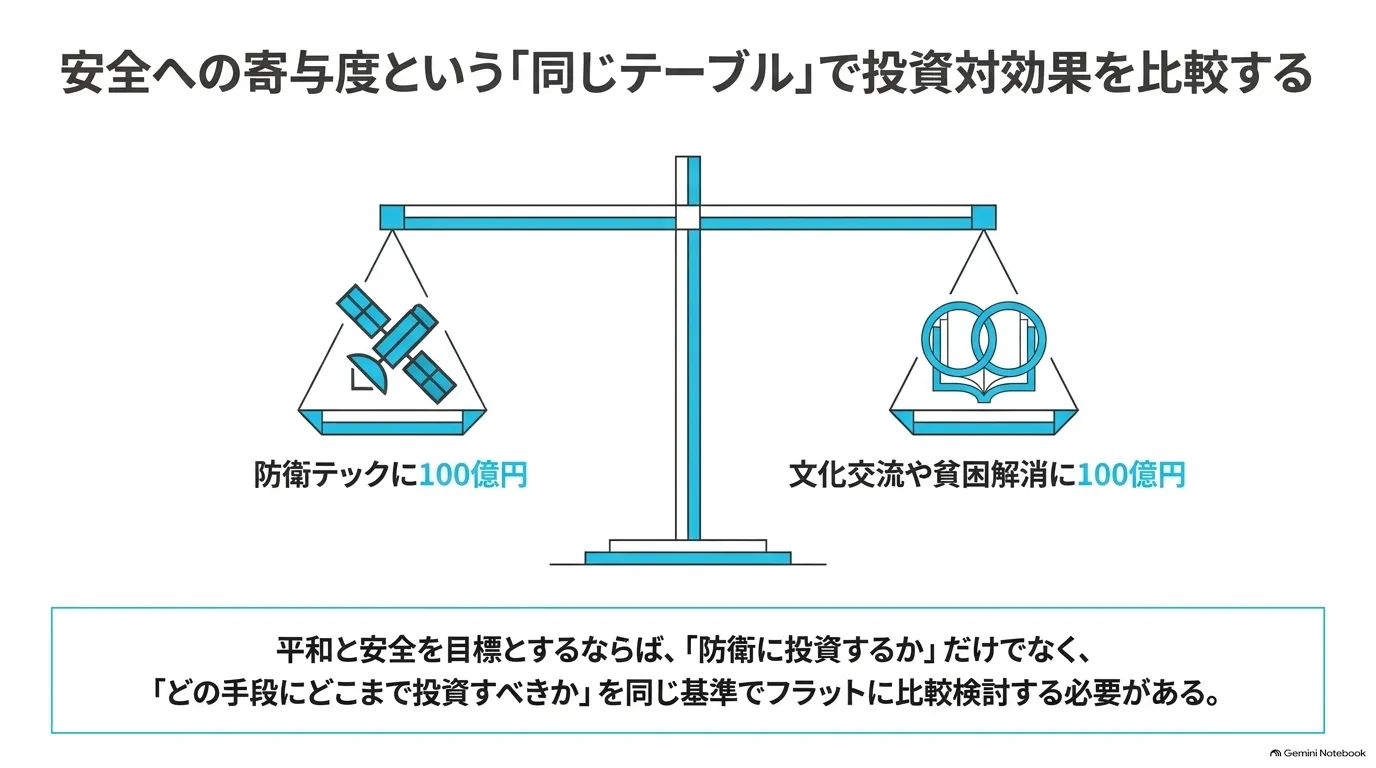
For example, what happens if, instead of allocating 10 billion yen to defense tech, we direct that 10 billion yen toward solutions for international confidence building and cultural exchange, or toward alleviating poverty and inequality in politically unstable nations? Under the shared goal of safeguarding peace and security, such questions deserve a place at the very same table.
Factoring in Peacetime Returns
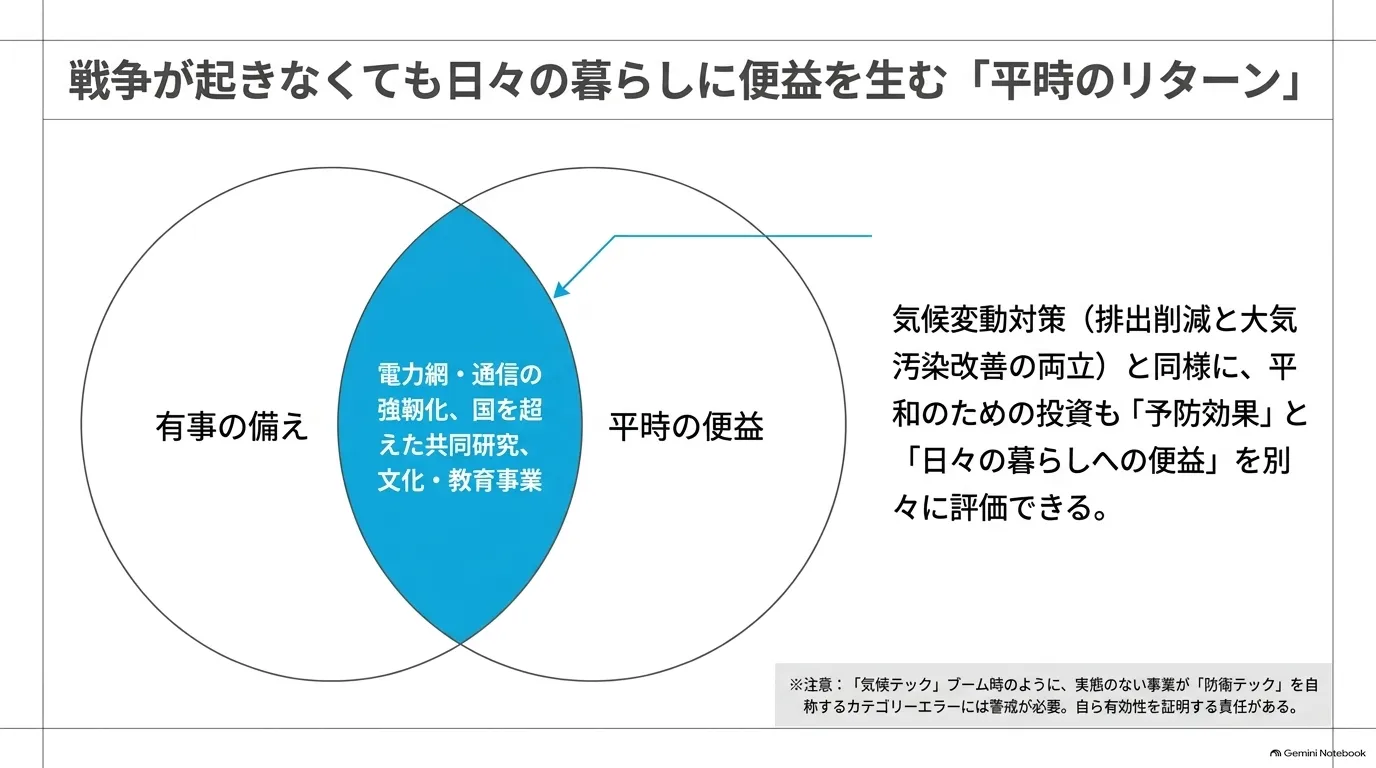
We must also factor in the benefits that each means generates even in the absence of war.
For instance, enterprises in electric power, water, education, and culture generate utility for users even when no war occurs. If energy storage and power diversification lower peacetime costs while ensuring resilience against emergency outages, both benefits can be counted. Cross-border collaborative research yields scientific discoveries, while cultural exchange provides works of art and educational opportunities.
This consideration also applies to climate change measures. The IPCC highlights co-benefits of combining emissions reduction with adaptation—such as improved public health and air quality—separate from avoiding climate damages. In the same way, investments for peace should allow us to evaluate prevention effects and daily quality-of-life benefits separately.
Of course, conventional defense tech should also be credited under the same criteria whenever civilian spillovers or R&D ripple effects can be verified. Conversely, precisely because we define peace investments broadly, we should avoid simply relabeling existing energy investments or education budgets as "peace tech" and claiming that new benefits have been created.
Explaining Efficacy to Avoid Category Errors
Thinking about defense and security in this way is ultimately beneficial for defense tech itself. Disconnects between category labels and actual contributions have occurred repeatedly.
During the recent surge of climate tech, many solutions and services labeled themselves as climate tech despite contributing almost nothing to climate change mitigation or adaptation. As a result, the credibility of climate tech as a category suffered.
The same risk exists for defense tech. If businesses claiming to contribute to defense proliferate without actually doing so, the credibility of the entire category is undermined.
As noted in a previous article, rigorously considering how much defense tech and its businesses genuinely enhance defense capabilities will bolster the persuasiveness of businesses in this category.
In this sense, startups branding themselves as defense tech and the investors funding them must be able to clearly explain how much their initiatives contribute to defense capabilities, and how effective their methods are compared to alternatives.
(Note that this applies not only to startups but to defense as a whole; for example, Yu Koizumi warns against the tendency to desire flashy frontline hardware in isolation, such as nuclear submarines or long-range missiles, arguing that what is genuinely needed in defense is first to clearly establish an overall defense strategy and the division of roles between Japan and the US regarding "what role to play in what scenario," and that, beyond that, what should be invested in first—even if unglamorous—is the gritty infrastructure of war sustainability, such as base hardening [protection and undergrounding], ammunition, and personnel.)
Counterarguments on Deterrence and Interdependence
Several counterarguments may be raised against this framework. Here, I address two: concerns that deterrence will be weakened, and skepticism regarding the effectiveness of economic interdependence.
Counterargument (1): Deterrence Has Thresholds
The first common counterargument is that "appearing weak militarily invites aggression." This is a valid point. If an adversary's perception that an attack cannot achieve its objectives collapses, deterrence weakens sharply, and the probability of war rises. In other words, deterrence has a minimum required level—a threshold. Therefore, one cannot simply claim that "reducing defense investment makes us safer."
What we should debate, therefore, is not a simplistic strategy of defenselessness, but where to allocate the "next marginal yen" once that threshold is crossed. When sufficient deterrence is already established, accumulating additional offensive power may yield diminishing returns in lowering probability. In fact, as discussed earlier, it may trigger adversary reactions that raise the probability or elevate the risk of catastrophic damage.
Pure defense investments that yield no peacetime return are essentially an insurance policy, whose premiums are funded primarily by our taxes. What level of insurance should be maintained depends on assumed invasion scenarios and adversaries, and is not easy to gauge. Even so, the question of "how much preparation is sufficient" remains a critical debate that must be addressed within discussions of defense investment.
Counterargument (2): Interdependence Failed to Prevent War
The second counterargument asserts that deepening interdependence does not prevent war. While this article began with Ukraine, the invasion of Ukraine is an empirical case where economic interdependence failed to avert conflict.
Germany pursued "change through trade" (Wandel durch Handel) to deepen energy ties with Russia, yet the invasion occurred, and dependence on Russian gas became a strategic vulnerability for Europe. Looking further back, Norman Angell argued in his 1909 work The Great Illusion that economic interdependence rendered war unviable even for the victor, yet World War I broke out only a few years later. War can happen even when it makes no economic sense.
However, two points must be clarified regarding this counterargument.
First is the difference in the structure of dependence. There is a fundamental difference in vulnerability and bargaining power between relationships with switchable suppliers and those dependent on a single nation. It also depends on whether the dependence is symmetric—where both parties benefit from preserving ties—or asymmetric, where one party is heavily reliant on the other. Germany's energy relationship with Russia resembled asymmetric dependence with few alternatives for Europe. Discrediting the overall effectiveness of interdependence based on this single case seems unwarranted.
Second, the standards for verifying effectiveness must be applied equally to both approaches. We must examine causal pathways, quality of evidence, side effects, and costs for military defense and international exchange alike. For instance, while proving that cultural exchange prevented a war is difficult, the same holds true for defense investments. Just as there are cases where exchange and interdependence failed, there are cases where military investment for deterrence failed (for example, prior to World War II, the United States deployed its fleet to Hawaii to deter Japan, yet the attack on Pearl Harbor occurred). Demanding stringent proof from only one side does not make for a sound debate.
Where Should Private Investment Be Directed?
Looking at current global conditions, it seems unavoidable for the nation as a whole to allocate a certain amount of capital toward enhancing defense capabilities. That is all the more reason why we need to debate not just "whether to increase defense spending," but how much additional funds—once requisite deterrence and defense capabilities are ensured—will reduce both the probability and the damage of war.
While the discussion so far has focused primarily on the national level, it applies equally to the private sector.
An increase in private investment in defense means that the private sector carries corresponding responsibility. The same is true for startups. If an additional 100 billion yen is invested in defense tech going forward, the question will be "what did we spend that 100 billion yen on?" When future generations look back, they will ask: "What did our generation choose to fund?"
The Ministry of Defense naturally operates under organizational logic to strengthen areas within its remit, and politics tends in the same direction. But governments are run by humans, and they make mistakes (just as governments around the world continue to make mistakes today).
Complying with government intention is not synonymous with exercising civic responsibility. Precisely because it is private, the private sector should look beyond governmental logic and adopt a broader perspective.
Philanthropy as an Investment in Peace
Admittedly, acting independently is also challenging for the private sector. Market investors operate within specific timeframes (quarterly or annual earnings for public companies; roughly ten years for venture capital). Because markets are not optimized for public goods, deploying market capital toward initiatives that take decades to bear fruit is difficult.
This is precisely why philanthropy from wealthy individuals and foundations is urgently needed in this domain.
First, such capital operates on a different time horizon. State budgets are annual and shift with political priorities. VC funds demand returns within roughly a decade. Few capital pools can wait decades for the fruits of culture and education to mature. Philanthropic donations are among the few sources of capital where donors can commit to multi-year or multi-decade support.
Second, philanthropy can embrace unmeasurable outcomes. Public funds demand quantifiable results for accountability. While accountability is proper, it makes it difficult to direct public money toward "wars that never happened." Philanthropy can adopt an approach akin to startup investing: avoiding overly restrictive mandates and accepting that a few substantial successes among many attempts are enough. If that lowers war risks, it ultimately enhances the donor's own security (although some wealthy individuals choose to spend on personal fallout shelters to protect only themselves).
Third is independence. Cultural exchange funded by governments can be difficult for foreign audiences to distinguish from propaganda or influence operations. As Joseph Nye pointed out, much of soft power originates in civil society rather than government. However, private funding alone does not guarantee independence. If donors guarantee independent governance without interfering in content, intellectuals and artists from rival countries can participate with far greater confidence.
Finally, private channels can be sustained when interstate relations deteriorate. When bilateral tensions rise, public exchange budgets are slashed, and corporations scale back engagement. Yet channels of dialogue are most needed precisely when relations worsen. Politically independent philanthropy can keep those channels open through the darkest hours.
Indeed, the Pugwash Conferences, which jointly received the Nobel Peace Prize with Joseph Rotblat in 1995, served as a crucial backchannel between East and West during the Cold War, and participants worked behind the scenes to shape treaties on nuclear testing and non-proliferation. A recent Financial Times article reported how, during a Russian nuclear crisis, private backchannels were used to communicate US government warnings directly to Putin, contributing to averting escalation.
To sustain such channels of communication, maintaining ongoing civic exchange activities requires only several hundred million to several billion yen—a modest sum that can yield immense impact. If, hypothetically, 100 billion yen were directed toward cultural exchange instead of defense tech, and preserving a final dialogue channel ultimately averted war during a crisis, that might prove to be the superior investment.
At the beginning, I noted that preventative expenditures of several trillion yen per year seem justified in light of potential damages of 660 trillion yen. If that prevention could be accomplished through investments or donations of 10 billion or 100 billion yen, it would represent an extraordinarily high-leverage investment. Now that successful founders and investors are growing in number, allocating a portion of that capital to long-term peacebuilding initiatives holds profound significance.
Conclusion
Technology amplifies human capabilities. Yet it also amplifies our capacity for lethality and environmental destruction.
Investments in defense tech and alternative non-military means must be evaluated with the same yardstick: how much additional capital reduces the probability and damage of war, how much peacetime utility it creates, and what costs it incurs. If we invest in defense tech that genuinely serves the defense capabilities required for our era, future generations will judge that choice as rational and sound.
At present, an atmosphere suggests that investing in defense tech is the only rational choice from a market perspective. The fiduciary duty of investors managing third-party capital is understandable. However, deciding purely on market rationality can mean tacitly endorsing the values and existing societal structures embedded within current market rules.
We operate within a broader "society" that extends far beyond the market. The market is merely one subset of society, and we have the agency to think beyond market boundaries and reshape the market from the outside. If market dynamics threaten to increase mutual damage and conflict risks, we have the right to say no. After all, if we are caught up in war and lose our lives, accumulated wealth means nothing.
That is why moving from "whether to invest in defense" to a broader understanding of defense and security—asking "which means should receive capital, and with what expected effect"—should serve as the starting point for rethinking defense tech, and ultimately, peace and security.