The Ideas Surrounding Startups
This article was machine-translated from Japanese by AI (Claude). It may contain errors. Read the original Japanese article.

Update: Because this piece was widely read, I have also published an audio version on Substack.
[Audio version] The Ideas Surrounding Startups - Part 1 / Parts 2 and 3
Why Startups and Ideas, and Why Now?
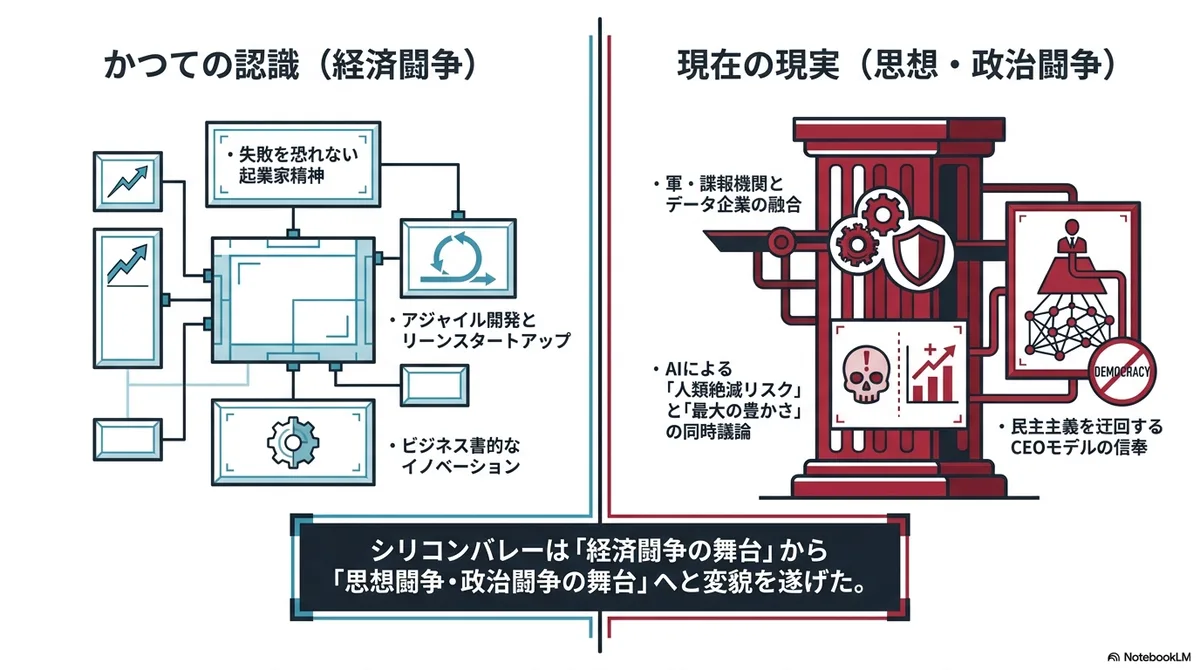
When people in Japan hear "Silicon Valley," what comes to mind is probably either a giant tech company like GAFA, or a business-book image such as "the entrepreneurial spirit of taking on challenges without fearing failure."
But what is happening in the American tech industry now, and the reason Silicon Valley is drawing the world's attention, go beyond that business frame and extend into the realms of politics and ideas.
For example, the following things are happening around Silicon Valley right now.
- A data analytics company works its way into the core of the military and intelligence agencies
- Prominent investors openly say that "governance by a CEO model is better than democracy"
- AI company executives talk, at the same time, about the "risk of human extinction" and "the greatest prosperity in human history"
- Christianity comes to be discussed seriously among entrepreneurs
Taken one by one, such statements and moves could be dismissed as "well, some people are like that." But there is a background that cannot be dismissed: the concentration of capital and power in software companies over the past decade or so.
Platform companies are acquiring power that surpasses that of nation-states, and individuals who made enormous fortunes through startups are beginning to hold social influence. Furthermore, prominent entrepreneurs and venture capitalists are using that wealth to support politicians, have produced a vice president, and are even gaining positions inside the government. This is the political influence now taking place.
In other words, the ideas of Silicon Valley are no longer the offhand remarks of a few people. Backed by real capital and power, they are beginning to affect the world beyond technology and business, or at least are acquiring the structure to do so.
Ideas Driven Not by Big Tech but by Startups and Investors
What is interesting is that the ones speaking so boldly in these situations are not Big Tech but startup-type companies and investors. Platform companies such as GAFAM, perhaps also because of the headwinds in public opinion in recent years, take a restrained stance, while on the startup and investor side the force of their statements is growing.
As a result, startups have come to draw attention not only as bearers of innovation but also as ideological and political presences. And the fact that those ideas strike quite a few people as "dangerous" is itself one of the reasons they attract even more attention.
In a sense, Silicon Valley is shifting from a stage of economic struggle to a stage of ideological and political struggle. Being involved with startups also means being unable to avoid involvement in that struggle. At the very least, you will be asked what position you take, or whether you will take part in the struggle at all.
So in this article I will lay out the genealogy of startup ideas over a somewhat long time span.
Looking back, even over a short time span, the very "reason" Silicon Valley has attracted attention has shifted with the times.
- The 2000s - Silicon Valley, noted for software "technology" and libertarian ideas
- The 2010s - Silicon Valley, noted for software "business" and free-market ideas
- The 2020s - Silicon Valley, noted for software "politics" and multiple ideologies
This article is an exploratory essay that takes a somewhat longer view of this, surveys what is happening, and then looks for the winning path for Japanese startups.
Before getting to the main subject, I have two caveats.
First, the economic strength of Silicon Valley cannot be explained by the strength of its ideas alone. Behind it lie institutional and practical mechanisms such as the legal system, capital markets, immigration, and universities, and management know-how and talent also have a great influence. In addition, much of it is supported by structures of the world economy, such as industrial clusters and dollar hegemony. In this article, however, I will not touch on those practical aspects very much. Even so, please allow me to stress that they are important.
Second, because this article takes up figures who represent each set of ideas, it introduces many extreme people. But most people who live in Silicon Valley or San Francisco are not that extreme, and people who act on the basis of thinking about ideas are probably not the majority in the first place. Most people are probably driven by economic and financial motives.
Even so, the reason it is worth looking at extreme ideas is not simply that they are "loud." As I will describe later, it is that they actually have influence within this ecosystem, and that they are also agitators with an incentive to use sharpened narratives to amplify that influence.
This article has three parts.
Part I looks back at the history of Silicon Valley, mainly from the standpoint of ideas. It covers both why each set of ideas attracted people and in what respects it is dangerous.
Part II steps back and analyzes the "functions" that ideas perform within the ecosystem, and what kind of specific situations those ideas were born as "answers" to. One key here is the structure by which America's questions, while being the country's own questions, became questions for all of humanity precisely because America stood at the leading edge.
Part III builds on that analysis to consider the questions Japan should pose. To state the conclusion in advance, my view in this article is that it is not enough for Japan to solve its domestic problems: unless it consciously poses questions for the world as a whole and sets out to solve them, no world-scale startups will be born.
The claim of this article that follows from this is that the biggest thing to learn from Silicon Valley may be not individual answers or know-how (monopoly theory, accelerationism, network states, and so on) but having one's own questions and ideas.
Part I: The Intellectual History of Silicon Valley
Child of the State (1940s–50s)
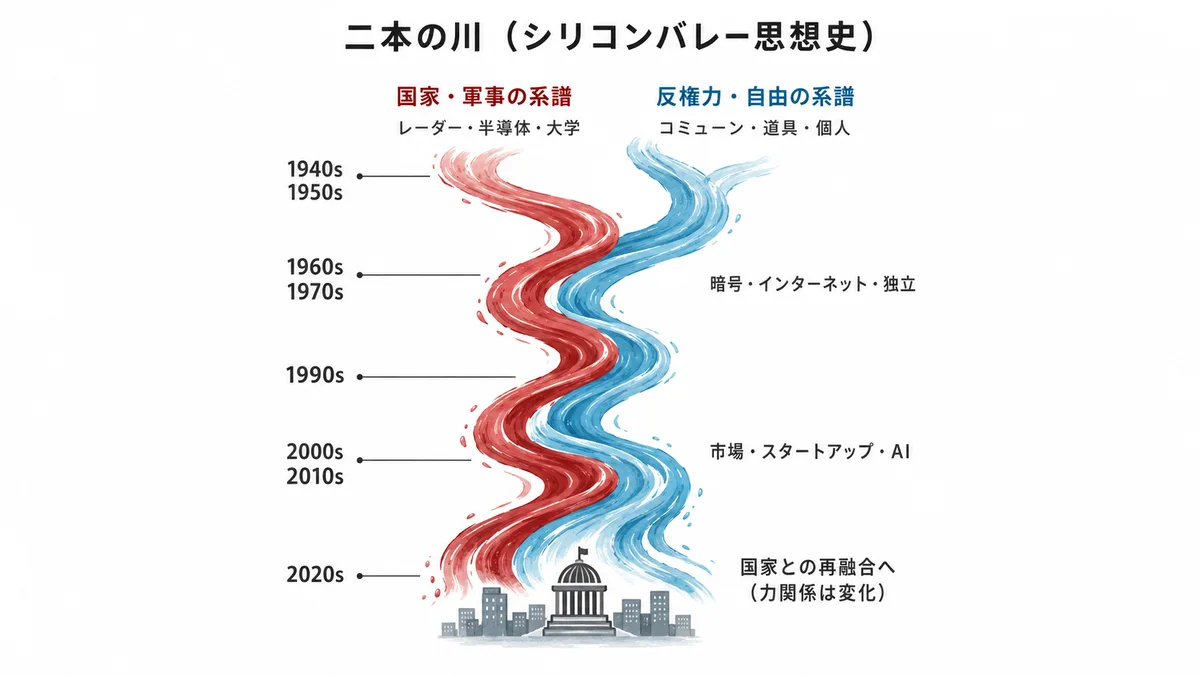
Most writing on the ideas of Silicon Valley begins with libertarianism. But the historical starting point is the opposite: Silicon Valley, as the region that leads technology, was born as a child of the state, and specifically of the military state.
In the 1940s and 50s, Stanford's Frederick Terman built a mechanism linking the university, the defense industry, and federal research funding, and encouraged his students (Hewlett and Packard being the best-known examples) to start companies. The largest customers of the early semiconductor industry were the Department of Defense and NASA, and ARPANET, the prototype of the internet, was a project of the Defense Advanced Research Projects Agency. Neither GPS nor speech recognition would exist without public funding and military demand.
Steve Blank, a serial entrepreneur who teaches startups at Stanford and elsewhere, has compiled that history in "The Secret History of Silicon Valley", which reframes the origins of Silicon Valley through its relationship with the military, the Cold War, and university research. In Japanese, it has been introduced in places such as this article on Gigazine (although there used to be a more detailed translation).
This origin matters in two ways for reading the history that follows. First, the later story that "government is incompetent and only markets produce innovation" contradicts Silicon Valley's own history. Second, the return to defense tech since the late 2010s (Palantir and Anduril, discussed below) is not a deviation but a reversion to type. The period when it was a paradise of anti-statism may, looking back from today, have been the exception in history.
Child of the Hippies (1960s–70s)
Then an entirely opposite gene was added: hippie culture, the commune movement, and Stewart Brand's Whole Earth Catalog.
Brand put forward the slogan "We are as gods and might as well get good at it", presenting a vision in which individuals, rather than states or large organizations, take up tools and design their own way of living. This sensibility is said to have become the ideological soil of the personal computer. In fact, Steve Jobs later recalled the catalog as the bible of his generation.
The hacker culture that grew up in the same period established the hacker ethic: the free sharing of information, distrust of authority, and respect for those who get their hands dirty. The phrase "Information wants to be free," which Brand spoke at the 1984 Hackers Conference, became the watchword of internet culture as a whole.
On the other hand, the media scholar Fred Turner portrays this course of events critically. His point is that the language of the communes, which were supposed to be anti-establishment, was before long translated into "entrepreneurship" and "self-transformation" and put to use to justify digital capitalism. The commune's gesture was not confronting the state (Voice) but leaving for another way of life with tools in hand (Exit). It exited to a place different from the conventional one, namely cyberspace and the digital, but was eventually absorbed by capitalism and arrived at "entrepreneurship" and "self-transformation," seeking the next thing beyond that. It can be read as the prototype of today's Exit ideology.
In other words, Silicon Valley is a region with a strangely twisted origin: it is both a child of the military state and a child of the hippies. Its present form, in which an anti-authoritarian aesthetic and a pursuit of anti-regulatory freedom coexist unperturbed with the reality of immense power, can already be seen in this double origin.
Declarations of Independence (1990s)
In the 1990s, when the Cold War ended and the internet was commercialized, the skeleton of the ideas that continue to the present took shape.
First, the theory of cyberspace independence. In 1996, John Perry Barlow, in "A Declaration of the Independence of Cyberspace", declared to the governments of the industrial world that they have no sovereignty over this new world. The crypto-anarchism of Timothy May and others held that cryptography would neutralize the state's taxation, censorship, and surveillance, and this lineage leads directly to the ancestry of Bitcoin, crypto assets, and Web3.
Second, the 1997 book The Sovereign Individual. It is a book of prophecy that foretold an age in which information technology would erode the nation-state's ability to tax, and individuals with talent and capital would treat the state as a "service one chooses to buy." It is regarded as the scripture of Exit ideology, one that Peter Thiel and Balaji Srinivasan would later refer to repeatedly.
Third, the open source movement. The ethical and political claim carried by Richard Stallman's free software movement (that software freedom is the right of its users) was translated, by way of Eric Raymond's "The Cathedral and the Bazaar", into the pragmatic language of "open source," which companies could readily accept. This process in which the language of ethics was translated into the language of the market is also a software-world replay of Turner's point about hippie language being translated into the language of entrepreneurship. During the same period the magazine Wired, along with Kevin Kelly and others, played a role in spreading this kind of technological optimism as a popular narrative.
Fourth, criticism that had already appeared by this point. In their 1995 paper "The Californian Ideology", Richard Barbrook and Andy Cameron called this current of thought "a strange fusion of hippie freedom and yuppie entrepreneurship" and pointed out that technological determinism had become a device for hiding social inequality. It is a thirty-year-old critique, but one that still applies today.
Fifth, the birth of accelerationism. At the University of Warwick in England in the 1990s, the CCRU (Cybernetic Culture Research Unit), centered on the philosopher Nick Land, developed the idea that the self-multiplication of capitalism and technology cannot be controlled by humans and should instead be accelerated. At the time it was merely an odd speculation on the fringe of academia, but a quarter century later it would revive at the center of Silicon Valley.
Practical Experimentalism and Growth (2000s)
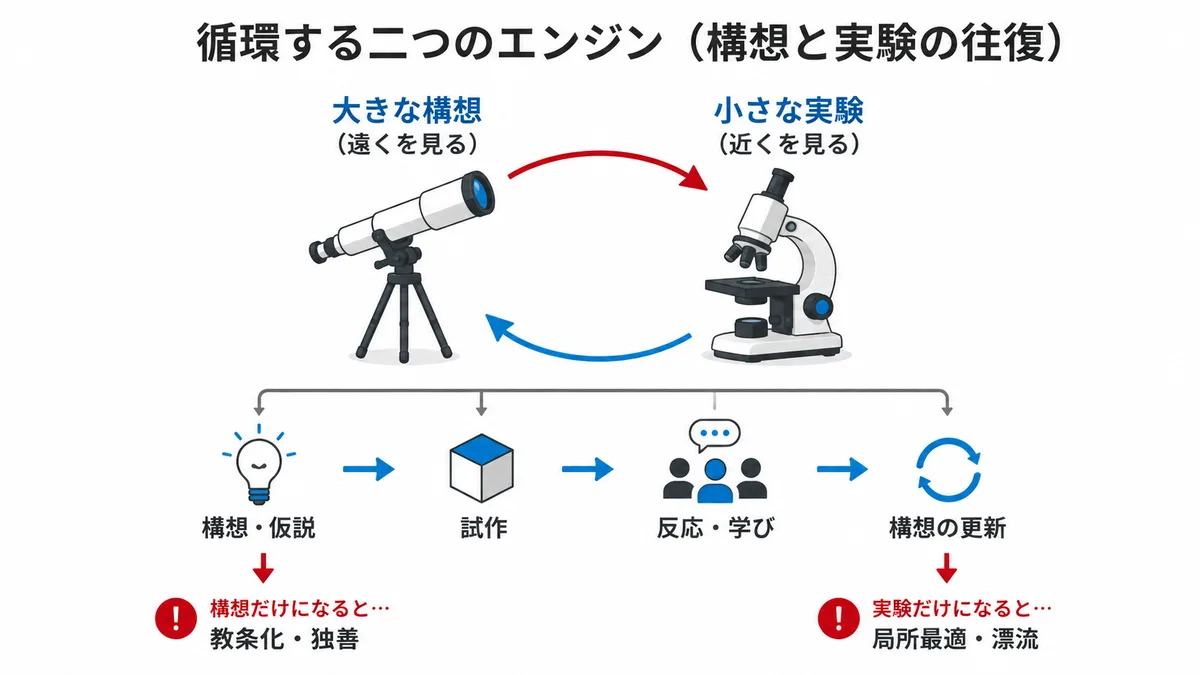
Meanwhile, what characterizes Silicon Valley is not only grand visions of the future. There is also a practical orientation that values "making," "trying," "getting people to use it," and "learning" over abstract ideals. When telling the history of ideas, if this unglamorous lineage is dropped, Silicon Valley comes to look like something made only of concepts. In reality, the back-and-forth between grand visions and small experiments is probably the reason Silicon Valley succeeded.
What embodied that thinking was Y Combinator, founded in 2005. Y Combinator was started by Paul Graham and others in Cambridge, Massachusetts, then shifted its center of gravity to the Silicon Valley side, including Mountain View, and became one of the centers of Silicon Valley.
Paul Graham, originally famous for hacker thinking, gathered entrepreneurs through his essays and Hacker News, and conveyed his thinking together with startup know-how. Y Combinator's slogan "Make something people want" succinctly expresses the attitude of discovering customer demand not through desk-bound market analysis but through actual reactions to the product. From this environment emerged founders such as Sam Altman, who joined one of YC's earliest batches with Loopt and later became known for OpenAI, and Patrick Collison and John Collison, who created Stripe and promote progress studies.
Around the same time, design thinking drew attention around Silicon Valley. IDEO and Stanford's d.school in particular spread a methodology for solving uncertain problems through observation, empathy, prototyping, and iteration. This was not simply a matter of "applying designers' techniques to business." It flowed into software development and new business development as a methodology of reframing problems from users' behavior and context, building prototypes early, and raising resolution while watching reactions.
The Lean Startup is also better understood as an adjacent experimentalist methodology. Eric Ries's Lean Startup combined Steve Blank's customer development, agile development, and the ideas of lean manufacturing, and was articulated as a way to test uncertain business hypotheses in short cycles.
These methodologies were created and spread naturally among people, talent concentrated, and the companies of Silicon Valley themselves became what management studies calls a lead market, creating an environment in which talent, technology, and know-how were rapidly honed. These factors gave Silicon Valley a singular position in the particular industry of software, and the great growth of the software industry in turn established the mechanism by which Silicon Valley gathers wealth. The main reason that second and third Silicon Valleys have not appeared, even when other countries including Japan and other regions of America bring Silicon Valley's methodologies home, is probably that those places lack an ecosystem, including the market.
At the same time as know-how such as these methodologies accumulated, easy money after the Lehman shock flowed into Silicon Valley, and many successful people appeared and the number of people becoming economically wealthy grew. This was also the period when the establishment of the "founder" brand and various campus-festival-like events began to influence American culture as a whole, beyond the tech industry.
What is interesting from the standpoint of intellectual history is that in this period Silicon Valley's methodologies were organized into a form exportable as a set of ideas, and were in fact exported around the world as techniques and ways of thinking under the logic of "Silicon Valley succeeded this way, so you can succeed if you do the same." "Pilgrimages to Silicon Valley" were also made repeatedly. The practical ideas contained in methodologies that look ideologically neutral, and the ideas accompanying Silicon Valley's grand visions around them, were in fact exported together with the methodologies. And the cargo cult problem discussed later arises precisely from the fact that only this "organized form" was exported around the world.
Incidentally, Steve Blank, who advocated "customer development," one of the sources of the Lean Startup, is also known for "The Secret History of Silicon Valley" mentioned earlier. Blank was also involved in Hacking for Defense, which began at Stanford in the spring of 2016, connecting the Lean LaunchPad and customer development methodologies to solving real problems of the Department of Defense and the intelligence community. In other words, Blank occupies an interesting position: while digging up Silicon Valley's military origins historically, he is also someone who reconnected the methodology of civilian startups to the domain of defense and security.
The Rise of the Successful and Anti-Imitation, Anti-Competition (2000s)
Beginning in the 2000s, Peter Thiel took up a central position. A co-founder of PayPal, he and the alumni of that company (Elon Musk, Reid Hoffman, and others), known as the "PayPal Mafia," became the core of the tech industry's networks thereafter.
At the root of Thiel's thought is said to be the theory of mimetic desire of his teacher at Stanford, the literary critic René Girard. Human beings seem to decide their own desires, but in fact imitate the desires of others. Hence people want the same things and fight over them, and competition is not rational selection but destructive mutual crushing among similar people. The famous theses of Zero to One, "competition is for losers" and "monopolize," are business advice and at the same time an application of Girard's theory. The contrarian aesthetic of not following trends and seeking the "hidden truths" the herd overlooks is also placed in the same intellectual lineage. The contrarian aesthetic is continuous with distrust of the herd's consensus (mainstream media, experts, conventional wisdom) itself, and that in turn leads to its affinity with doomism and conspiracy theories.
Still, Thiel's frustration with stagnation is on target in part. That the rate of productivity growth in advanced economies has slowed since the 1970s is a standard observation in economics, and his quip, "We wanted flying cars, instead we got 140 characters," contains a realistic point that cannot be ignored: innovation in the world of atoms (energy, transportation, construction, medicine) has stagnated compared with the world of information.
But it is not enough to position Thiel merely as a management thinker, because his influence in political thought is growing as well. In a 2009 essay, he wrote that he no longer believes freedom and democracy are compatible, and said he places his hope not in persuading politics but in creating places beyond politics' reach (cyberspace, seasteads, outer space, and so on). In writings on political philosophy, he discusses the world in the vocabulary of thinkers skeptical of liberal modernity itself, such as Leo Strauss and Carl Schmitt.
The business theory of "monopolize" and the political theory of "bypass democracy" are, in a sense, continuous. Both are the business version and the political version of the same idea: that competition and consensus-building among the many is "waste," and only those who break out of it can create value. His later support for Vance and Yarvin, discussed below, can be regarded as lying on a consistent extension of this thinking.
And in Zero to One, Thiel set the importance of a clear vision, uniqueness, and long-term planning against excessive faith in the Lean Startup and the MVP. That is, one can say that in the Silicon Valley of this era, the experimental Lean thinking that values short-term hypothesis testing and iteration and the anti-Lean thinking that aims for discontinuous leaps through a strong long-term vision coexisted in tension. This tension is not a contradiction to be resolved; it can also be called the health of the ecosystem. When one side declares the other an "enemy" and begins to exclude it, the ecosystem becomes fragile (this is foreshadowing for a later section).
Singularity and Rationalism (2000–2010s)
During the same period, an entirely different kind of intellectual community grew.
Its prehistory, which should be mentioned first, is transhumanism and singularity theory. In The Singularity Is Near (2005), Ray Kurzweil argued that exponential technological progress would bring a turning point around 2045 when it surpasses human intelligence, and positioned even aging and death as engineering problems that technology can overcome. This lineage of overcoming humanity's biological limits with technology is the successor to the hippie-era sense that "we are as gods." As symbolized by Google bringing Kurzweil in for a key AI role, this story of a "bright singularity" became the mainstream air of Silicon Valley. Following it came Singularity University and Peter Diamandis, known for Abundance among other works.
In contrast, looking at the same singularity from the "dark side" was the rationalist community centered on Eliezer Yudkowsky's blog "LessWrong". Overcoming cognitive biases, Bayesian thinking, and the theory of existential risk, the view that superintelligent AI could destroy humanity, were developed in this community. In Japan too, his book "If Anyone Builds It, Everyone Dies" was published in translation in 2026.
There are several reasons these ideas attracted people. First, they gave those who wished to be intellectually honest a strict discipline: hold your beliefs as probabilities and update them with evidence. Second, in an age without religion, they offered the largest possible meaning, "the survival of humanity," and did so in the form of formulas and arguments. For bright young people, this is probably an attractive discourse. The philosopher Nick Bostrom's Superintelligence (2014) pushed this awareness of the problem into the mainstream.
And Effective Altruism (EA), which grew up alongside, valued rationality and argued that, in order to do the most good with limited resources, one should choose donations and careers by evidence and calculation. This developed into longtermism, which takes into account even the expected value for distant future generations. This milieu was deeply involved in the founding of AI companies such as OpenAI and Anthropic and in supplying them with talent.
This current has had a great influence on today's agenda as well. It was these people who raised the issues of AI safety and governance a decade earlier than regulators, and as stakeholders themselves. They also deserve credit for directing systematic thought and funding to global risks other than climate change (including pandemic preparedness).
Looking also at currents outside Silicon Valley in this period, Matt Ridley's The Rational Optimist (the Japanese translation title is "繁栄") was published, Pinker's various books on rationality drew attention, and so did Factfulness, which became a bestseller in Japan as well, and works such as Predictably Irrational, with arguments from behavioral economics and the like that people's irrational behavior can be explained rationally, also drew attention. It was, in a sense, a period when rationality and optimism were being spoken of at the same time.
Let us turn back to Silicon Valley. These movements did not receive only praise. One example is the collapse of FTX (2022). Sam Bankman-Fried, the poster child of EA, misappropriated customer assets under the logic of earning for the sake of future good, and was convicted. It is an example of the structural risk that the grandeur of the end justifies deviations in the means.
Next is the OpenAI board turmoil (2023). It made visible that a design of nonprofit governance for the sake of safety barely functions in the face of enormous commercial pressure.
The computer scientist Timnit Gebru and others have grouped the set of ideas from transhumanism to longtermism under the name "TESCREAL" and criticize it, saying that narratives that prioritize a hypothetical distant-future humanity divert attention from real present-day harms such as data labor, discrimination, and environmental burden. There are counterarguments that this critique itself overgeneralizes, but the point that grand stories can cover up mundane problems and issues occurring now should be taken seriously.
The Accelerating Backlash (2020s)
From the end of the 2010s through the Covid era of the 2020s, "effective accelerationism (e/acc)" rose as a backlash against AI safety arguments. Its claim is that deliberately slowing technological development is the greatest evil, since it deprives people of lives that could have been saved.
The representative advocate is Marc Andreessen. In his 2023 "Techno-Optimist Manifesto" he all but officially adopted this position, declaring that there is no material problem that cannot be solved with technology. And on his list of "enemies" he put existential risk theory, ESG, tech ethics, degrowth, and even the very words "social responsibility."
This thinking is attractive, and like Thiel's, it is tied to real grievances. The claim that excessive precautionary principles have stalled nuclear power, delayed the approval of new drugs, and paralyzed the construction of housing and infrastructure is an argument backed by empirical research. The feeling that stagnant growth quietly harms people also resonates acutely with those who live in a society where wages do not rise. It cannot be denied either that protection of vested interests in the name of safety and ethics really exists. And above all, because it is simple, forceful, and easy to understand, it has an aspect that easily captures people's hearts.
But the dangers are also clear. First, there is the problem of lineage. Nick Land, to whom e/acc refers, moved in the 2010s toward the "Dark Enlightenment", approaching the denial of democracy and racialist pseudoscience. Andreessen included Land's name in the manifesto's list of "patron saints." Ideas that endorse abandoning control tend toward social Darwinism, which accepts the culling of the weak as inevitable, and caution is needed.
Second, there is the asymmetry of risk. The benefits of acceleration concentrate first among investors and founders, while the costs of failure are externalized onto society. The narrative that all safety arguments are excuses for vested interests destroys the discourse that distinguishes legitimate criticism from criticism of regulatory capture. Moreover, many of these new technologies benefit the wealthy, but unless a proper redistribution system is designed, their benefits will not reach many people. In America, for example, the effective tax rate on the wealthy remains low, but this is because there are moves on the wealthy side to oppose such redistribution, and the situation of being hard to change under the power structure continues (in fact, when there are signs of California's tax rates rising, the wealthy relocate, that is, Exit, to Texas and Florida).
Third, there is the isomorphism of religious structure. AI doom and e/acc are fiercely opposed, yet they share the premise of regarding AI as a transcendent force that will fork human history. One speaks of it as apocalypse and the other as salvation, but either story pushes aside the moderate middle position that treats AI as an ordinary social and engineering object (probably the most productive and important position).
The "bright singularity" of Kurzweil in the previous section, the "dark singularity" of rationalism, and the "accelerated singularity" of e/acc fight a three-way contest while gathering around the same myth that the singularity is coming. As each repeats its own argument, those arguments actually influence politics and policy, and one could say this has created a situation in which politics and policy end up ignoring or continually postponing the issues at their feet.
Exit Ideology as a Basso Continuo
Here, let us leave chronological order for a moment. This is because there is a basso continuo that recurs across eras, from the communes of the 1960s through the crypto-anarchism of the 1990s to the network states of the 2020s. That is "Exit."
In his 1970 classic Exit, Voice, and Loyalty, the political scientist Albert Hirschman organized responses to the decline of organizations into three: exit/defection (Exit), voice (Voice), and loyalty (Loyalty). In the depths of Silicon Valley's attitude, there is consistently a tendency of voice is slow, so exit. Startups and entrepreneurship are an exit from large corporations, and Bitcoin is an exit from central banks. Coinbase's economic freedom is a modern version of Hayek's theory of currency competition, and seasteading (ocean cities), which Thiel supported for a time, was an attempt at physical exit. And Balaji Srinivasan's "network state" depicts one ultimate form of Exit: a community united online acquires land and ultimately gains diplomatic recognition to become a state.
Exit ideology has good sides. This is because it applies competitive pressure to institutional monopolies. A government that knows its citizens can exit is exposed to competitive pressure and is less likely to deteriorate. Crypto assets have also played real roles, such as financial inclusion for people who cannot hold bank accounts and asset protection in authoritarian countries.
But the problems are also clear. First, those who can exit are often only those with assets and skills, and it can become, in effect, the privatization of sovereignty and a redistribution to the wealthy. Second, exiting regulation is also exiting the gains of the long struggles for labor, environmental, and consumer protection (the repeated frauds and collapses in the crypto industry were a demonstration of this). And at the deepest level, the ideology of exit works in the direction of abandoning democratic voice and investment in public goods.
In a society where everyone chooses Exit, no one is left to repair the remaining institutions. As Hirschman himself pointed out, Exit and Voice are substitutes, and in an organization from which the capable leave first, the quality of voice is also lost.
And another movement related to the ideology of Exit is probably the return to religion seen in America. After the relentless competitive environment found beyond Exit, the desires that remain unfulfilled even after acquiring assets, some people's fatigue with being free, the social systems and international order breaking down underfoot, and all manner of present circumstances, it is symbolic that even the entrepreneurs who chose to exit existing institutions are returning to the narrative of religion, America's oldest institution and foundation, as if they had realized that what lies beyond Exit is not salvation but the end of the world.
And the movement to seek a firm foundation other than religion is a connection with the state, which was once one of the sources of Silicon Valley.
Fusion with Power (Late 2020s)
The newest chapter in the intellectual history of Silicon Valley is the fusion with power.
Curtis Yarvin, whose book "Neo-Prince" was translated in Japan in 2026, has argued since the late 2000s that democracy is a failed operating system and that the state should be governed like a company run by a CEO. He calls the complex of universities, media, and bureaucracy "the Cathedral" and advocates its dismantling and the unification of power. Once an eccentric theory in a corner of the internet, this thinking became, through networks that received Thiel's support, a reference point in the 2020s for young politicians near the center of government and for the tech right.
Vice President J.D. Vance worked at Thiel's VC firm, became a senator with Thiel's money, and is said to have been prompted to convert to Catholicism by encountering Girard through Thiel; he is something like a junction in this whole map of ideas. He has also taken in the new conservative economic thought that argues for industrial policy over free trade and for the state protecting workers and families.
Another person indispensable to this chapter is Elon Musk. Musk is important less as an advocate of a particular set of ideas than as a performer of several. Migration to Mars is a story of salvation, that "even if something happens to Earth, the species survives," and a planetary version of Exit ideology. The acquisition of the former Twitter was a forceful enactment of the critique of "the Cathedral," placing speech, a public good, under the judgment of a single owner. And the direct involvement in government efficiency can be seen as the first large-scale social experiment in the Yarvin-style prescription of applying the logic of corporate management to the state. From the standpoint of intellectual history, Musk is someone who embodies, faster than anyone, the phase in which written ideas are tested as real power.
Sam Altman also occupies a distinctive position. In "Moore's Law for Everything", he depicted a future in which AI lowers the cost of all goods and the fruits are redistributed in the manner of a basic income. His discourse and narrative, which use the vocabulary of existential risk and the vocabulary of the greatest prosperity in human history depending on the situation, can be called the very style of AI company management in this era: gathering capital and talent between the two opposing stories of safety and acceleration.
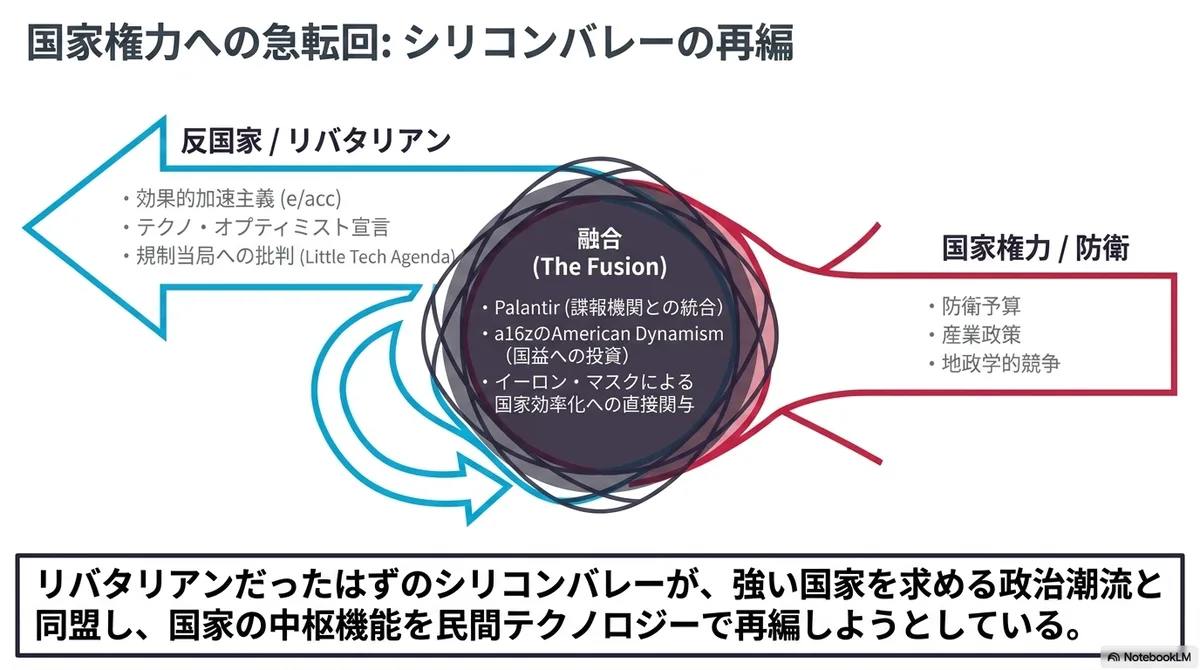
And a16z and others, while maintaining a libertarian anti-regulatory stance, do not keep their distance from the state but rather approach its policymaking. Their recent thinking is not simply a "small government" theory; centered on techno-optimism, which criticizes bureaucracy, over-regulation, and regulatory capture by incumbent large companies and seeks an environment where startups can deploy technology faster, it positions stagnation, bureaucracy, central planning, and regulatory capture as enemies.
In fact, in 2024 a16z, in the form of "The Little Tech Agenda", positioned not Big Tech but "Little Tech," that is, startups, as the actors that support America's technological advantage. They argued that bad policy has become the greatest threat to startups, and criticized regulators' investigations, prosecutions, blocking of M&A, intervention in AI and blockchain, and proposals to tax unrealized capital gains as obstructing the growth of startups and venture investment. Underlying this is the view that regulation ends up becoming an entry barrier that only large companies can meet, putting startups at a disadvantage.
For that reason, they do not simply negate the state but try to move the power of the state in the direction of "opening it up to startups." That is, their political participation, despite their libertarian thinking, should be seen not as withdrawal from the state but as entry into the competition over the state's regulation, procurement, and industrial policy.
Their involvement with government extends to defense as well. a16z's American Dynamism sets out a policy of investing in startups in domains tied to the "national interest," such as aerospace, defense, public safety, manufacturing, and supply chains. Here the state is positioned not so much as something to be opposed but as a customer, a competitor, and an important stakeholder. a16z further argues that, in order to rebuild the defense industrial base, defense procurement should be opened up to commercial technology and startups, rather than centered on the existing giant prime contractors.
However, if we widen our view to more radical libertarian thought, other claims exist. For example, in the lineage of anarcho-capitalism such as Murray Rothbard, the state's monopoly on defense, police, and courts is itself criticized, and it is argued that defense services too should be supplied competitively on the market. David Friedman likewise argued in The Machinery of Freedom that services including law and governance functions could be provided by voluntary private cooperation rather than by the state. We cannot rule out that a16z's position is of the form in which such radical libertarian thought remains the ultimate ideal and they are temporarily engaging with government in order to realize it.
In other words, the position of Andreessen and others in today's Silicon Valley is not one that "completely dismantles the state's defense monopoly" like classical libertarianism or anarcho-capitalism; rather, it is a new movement that, while emphasizing national security, tries to embed startups, VCs, AI, autonomous weapons, and commercial technology deeply within it.
There are, however, obvious contradictions here. While using the language of anti-statism and anti-regulation, they are in practice connecting strongly to the state's defense budget, procurement system, and geopolitical competition. But that contradiction itself can also be called the new politics of contemporary Silicon Valley.
What happened after the phrase "software is eating the world" became popular around 2011 was that software went beyond the world of bits into the physical world of atoms and, instead of the frontier of cyberspace, stepped into regulated domains such as finance. As the end point of capitalism in which the subsequent development of software and post-Lehman finance fused, software and startups now are beginning to step beyond even those regulated domains into areas such as defense and the public sphere, where it is unclear whether marketization is truly acceptable.
And unlike eighty years ago, when the government was strong, now that the private sector rather than the government holds greater power, we are approaching a situation in which bullets that the military once fired with a certain sense of responsibility may be fired by autonomous weapons built by specific private companies, by AI containing the will of private companies, and even conflicts may be started that way.
The land of contradiction that began with two entirely different genes, the defense industry and the hippies, after passing through the eras of liberal freedom and libertarian free-market thinking, is now fusing the state (defense) and anti-statism and letting them coexist. Rather than resolving the contradiction, containing it, ignoring the small contradictions, and continuing to seek a frontier may be the style of Silicon Valley.
There, one can see the union of libertarian free-market thinking, techno-nationalism, and a startup culture once again turned into a defense industry, in the attempt not to shrink the state but to reorganize the state's core functions through private technology companies.
Thus part of what was supposed to be a libertarian Silicon Valley, for various reasons, allied with a political current seeking a strong state. This can be called the greatest ideological turn of the 2020s.
In fairness, the problems that set off this current are real.
The dysfunction of American governing institutions, the devastation that deindustrialization brought to workers, and the collapse of trust in existing elites are realities that show up in statistics and in election results. But the prescription of replacing slow democratic procedure with the quick decisions of a capable executive is a dangerous move that tries to apply the startup methodology and success stories such as "Founder Mode" directly to running a society. A state has residents who cannot exit, and it cannot be shut down even if it fails. A startup's failure ends in investors' losses, but a state's failure is paid for with the lives of people who cannot exit. In some cases, when a country is thrown into turmoil, even human lives can be taken, and it may come to take lives in the form of an invasion of another country. Checks and balances on power are not a bug of inefficiency but a function invented on the sacrifices of several hundred years.
Occupying a distinctive position in this context is Palantir. A data integration and analysis company founded in 2003 by Thiel and others and nurtured with investment from a CIA-linked venture capital firm, its customers extend to the U.S. military, intelligence agencies, police, immigration authorities, and governments of various countries. CEO Alex Karp is an unusual figure who earned a doctorate in social theory at Frankfurt University, and in his book The Technological Republic he argues that Silicon Valley has squandered its intelligence on consumer apps and that tech companies should serve Western defense and national purposes.
It is true that the state needs excellent software, and this is no longer an age in which security can be kept separate from private-sector technological capability. And as we saw at the outset, this is also a return to Silicon Valley's origins.
But compared with conventional military technology, the information age has several different problems. There is the problem of surveillance: data that is legal individually can, once integrated, reconstruct the whole picture of a person's life. There is the problem of accountability: when proprietary software is built into the decision process for the state's exercise of violence (arrest, deportation, attack), verification by legislatures and courts becomes difficult. And there is the problem of ideology: a narrative that positions itself as a defender of Western civilization and retorts to criticism with "naive" absorbs the mundane discussion of monitoring individual contracts and operations into a litmus test of civilizational theory.
The incentive structure in which surveillance and war have become growth markets is itself deeply disquieting. To raise the market capitalization of such companies, it comes down to spreading through the media narratives that heighten conflict among nations and promoting political interventions that provoke conflicts. And, with market rules broken, the better the market functions, the stronger that tendency becomes.
"In the U.S., individuals who break the law face fines or prison, but corporate compliance is different. There are people in Western society who think that when the penalty is lower than the cost of compliance, not only may you break the law, but the CEO has a fiduciary duty to break it." Words like these have been introduced in Japan, and if the goal is to maximize returns, breaking laws and ethics not yet established, that is, making the fullest use of market failure, can become the optimal solution for a for-profit company. If starting a war would be optimal for a private company to maximize its own profit, what would it do?
This question carries a weight different from that of the Cold War period precisely because we are now in a time when companies are gaining more power than governments and companies are driving innovation. And unlike before, the fact that companies and investors are themselves actively speaking of the ideological justification of defense and the military is also a dangerous point.
(As a warning about such matters, Joseph Heath's "What Is Ethics to Capitalism?" also discusses several problems.)
Relatively Moderate Ideas of Progress
Sharp ideas have continued up to here, but let me introduce the middle ground and the opposing forces as well.
"Progress Studies", proposed by Stripe founder Patrick Collison and the economist Tyler Cowen, is a movement that asks why progress is slowing even though there are more researchers and more research funding, and tries to experimentally improve the design of science funding and research organizations. Fast Grants, which distributed research funds within days during the Covid period, was an example of its implementation. Metascience and the like could also be included in this current.
In the mid-2020s, from the liberal side, the "Abundance" argument also appeared as a response. It is a discussion of reforming, within the framework of democracy, the regulations and procedures that obstruct the supply of housing, energy, and infrastructure. Here is a sound counterproposal that takes in accelerationism's challenge while not letting go of democratic governance (though there is also the criticism that redistribution is weak). Affirming technology and growth and bypassing democracy are, by nature, entirely different matters. It is discourse that deliberately confuses the two that needs caution.
Let me also introduce the lineage of critique. Shoshana Zuboff's theory of surveillance capitalism made a problem of the business model itself of converting human experience without permission into behavioral data and selling it as prediction products. Cory Doctorow named the process in which a platform favors users and then businesses in turn, then exploits both and degrades, “enshittification”. Lina Khan criticized antitrust doctrine that looks only at consumer prices and cut into the structural dominance of platforms (a direct response from the legal-institutional side to Thiel's "monopolize"), and Daron Acemoglu and others showed over a thousand years of history that there have been few eras in which technological progress automatically brought prosperity, and that the distribution of benefits has always been a function of power and institutions.
In fairness, let me also touch on the limits of the critics. There is the rebuttal that the hard antitrust line has also suffered court defeats, and that its chilling effect also deters new entry. Critiques of surveillance capitalism tend to underestimate the benefits that the advertising model has delivered through free services. Degrowth arguments do not adequately answer the fact that it is the weak who pay most of the cost of stagnant growth.
What matters is that many of the critics are not enemies of technology but are asking the classic question of power: in whose hands are the benefits and the control of technology? The very setting of the arena as pro-tech versus anti-tech is built to favor one side.
Summary So Far: The Pendulum and Its Swing
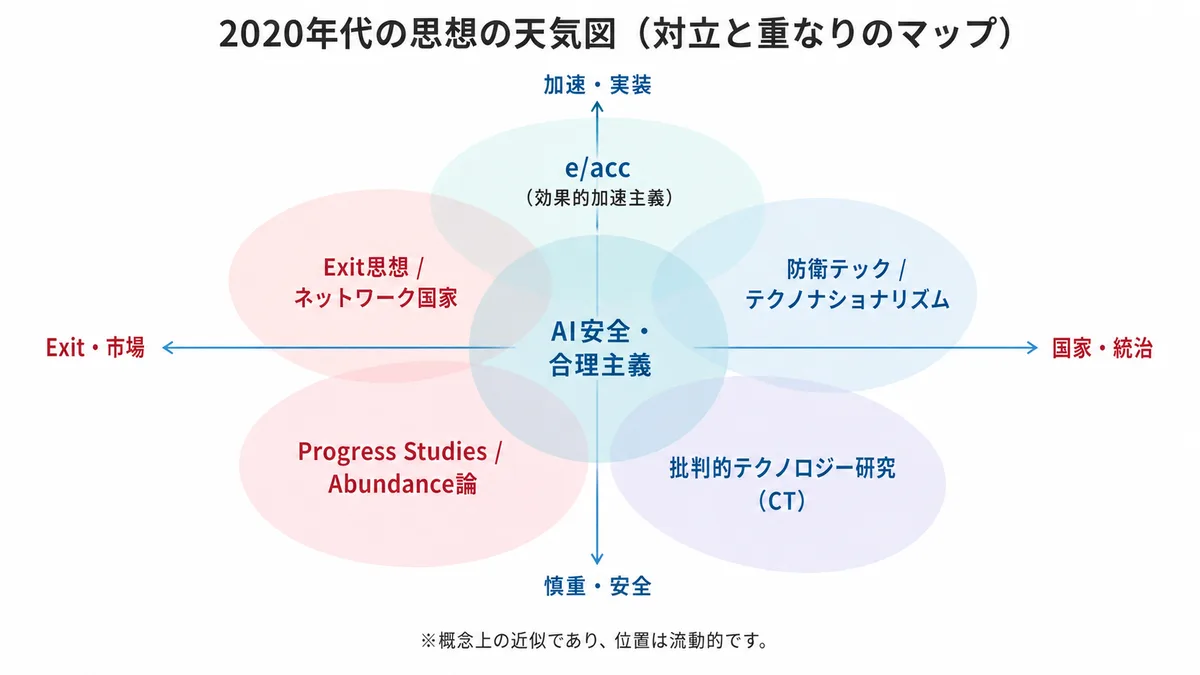
Let me summarize what we have covered.
First, the major figures are not monolithic on this map. Thiel swings between exit and authoritarian politics, Andreessen goes all in on acceleration, Altman switches between the language of acceleration and safety, Musk performs several sets of ideas with real power, Karp merges with the military state while calling himself progressive, and Collison keeps his distance from political radicalization and turns toward institutional improvement. Within the same "ideas of Silicon Valley," positions differ greatly.
Second, the whole history can be read as a pendulum between state and market, counterculture and power. Born as a child of the military (the state), it acquired the hippie gene (anti-power), declared independence (anti-state), won in the market (the market), and now moves toward re-fusion with the state (the state). But the pendulum does not return to the same place. In the fusion of the 1950s the state was primary and companies secondary, but in the fusion of the 2020s the companies are the ones speaking of ideas, sending people into the administration, and trying to redesign the very form of governance. The pendulum is widening its swing as it goes back and forth.
Third, running through this history, two modes have coexisted: grand visions (monopoly, the singularity, the network state) and small experiments (MVPs, customer development, Fast Grants). The ecosystem was healthy when the two kept a tension between them. The present danger lies in the grand-vision side beginning to make lists of "enemies" and to exclude criticism and experimental humility.
Based on this summary, we move on to the next question.
The question is: what function have ideas performed in this ecosystem in the first place?
Part II: What Function Do Ideas Perform in Silicon Valley?
The Five Functions of Ideas
When we read what functions these ideas have performed, we see that ideas were never decoration or by-products but the infrastructure of the ecosystem. At least five functions can be identified.
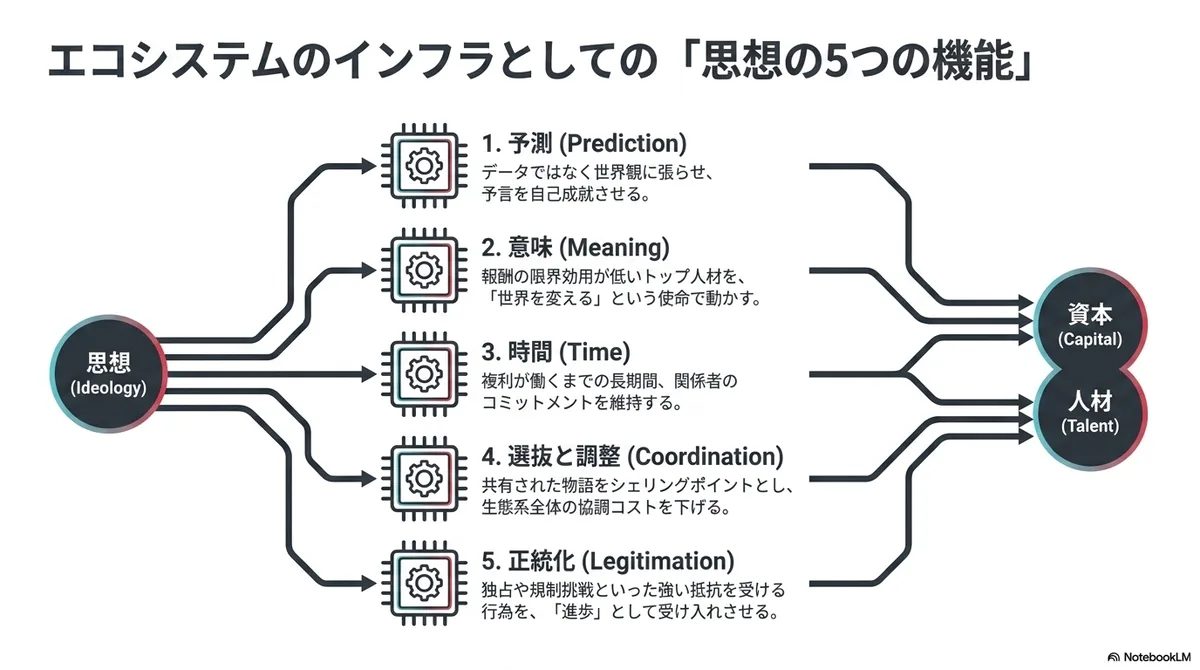
First, ideas supply prediction (and expectation).
Venture investment returns follow a power law, and performance is determined by a very small number of extreme successes. This means that the essence of an investment decision lies in what to believe and bet on before evidence such as revenue is in. Therefore, it depends not on data but on a worldview. Statements such as "software is eating the world" and "AI is a general-purpose technology comparable to electricity" are not verified facts but position-taking predictions and narratives meant to get capital to bet in a particular direction.
Investors and entrepreneurs take particular positions and tell narratives that affirm those positions. Investors who see many deals in particular come to speak from the standpoint of thinkers or prophets. They say "software is eating the world," raise expectations for software, gather entrepreneurs there to provide services, and make customers feel a sense of crisis so that they buy software. By telling their own prophecy, they not only justify their investments but also gather enough expectation to make the prophecy self-fulfilling, raising funds from LPs and increasing the revenue of the startups they have invested in. If "Fake it till you make it" is the startup motto, the investor's could be called "Hype it till you make it." Whereas an individual's bluff concerns one company, an investor's narrative can move an entire market, and so it is a scaled-up version of the self-fulfilling prophecy. If it is right, the investment succeeds; if wrong, it fails.
In addition, even money that seeks to learn "revolutionary ways of working" such as design thinking as know-how comes to gather. A prophecy has value not because it comes true, but because if it moves enough people, it comes true. That is probably also part of why VCs want to own media.
Conversely, being without ideas is not a state of having no ideas but a state of executing under someone else's ideas. An ecosystem that can bet money only on verified facts is structurally destined to be second.
Second, ideas supply meaning to talent.
The top talent that makes the decisive difference has a low marginal utility of compensation and is sensitive to the question of what to spend their lives on. Mission narratives such as changing the world or making humanity a multi-planetary species tend to be ridiculed, but as a source of motivation that moves people who are not moved by money, they are functionally extremely rational.
Third, ideas extend time.
Only when investors, founders, and employees share a picture of industry and civilization twenty years out can capital wait through the long period until its realization. Ideas are a social technology of time for maintaining the patience and commitment of the people involved during the years needed for compounding to work, and, for better or worse, they function as a tool for rewriting people's sense of time.
Fourth, ideas perform selection and coordination.
The vocabulary of ideas works as a shibboleth for recognizing allies. Whether someone can naturally use words like "Zero to One," "PMF," "alignment," and "e/acc" instantly shows which community's context they have internalized. More important is the function of coordination. When everyone believes in the same future, "AI is next," entrepreneurs can hire, investors can pile in, large companies can consider acquisitions, and the media can write stories. A shared prediction acts as a Schelling point (a focal point of coordination), in game-theory terms, and dramatically lowers the coordination cost of the entire ecosystem. The reason Silicon Valley can avalanche in one direction is not that it has a central command but that ideas work as a coordination device.
Fifth, ideas perform legitimation.
They supply narratives that make acts that would originally meet strong social resistance, such as the pursuit of monopoly, challenges to regulation, and entry into the defense industry, acceptable as progress, freedom, and the defense of civilization. And most of the dangers of ideas that we have seen so far are a runaway of this fifth function.
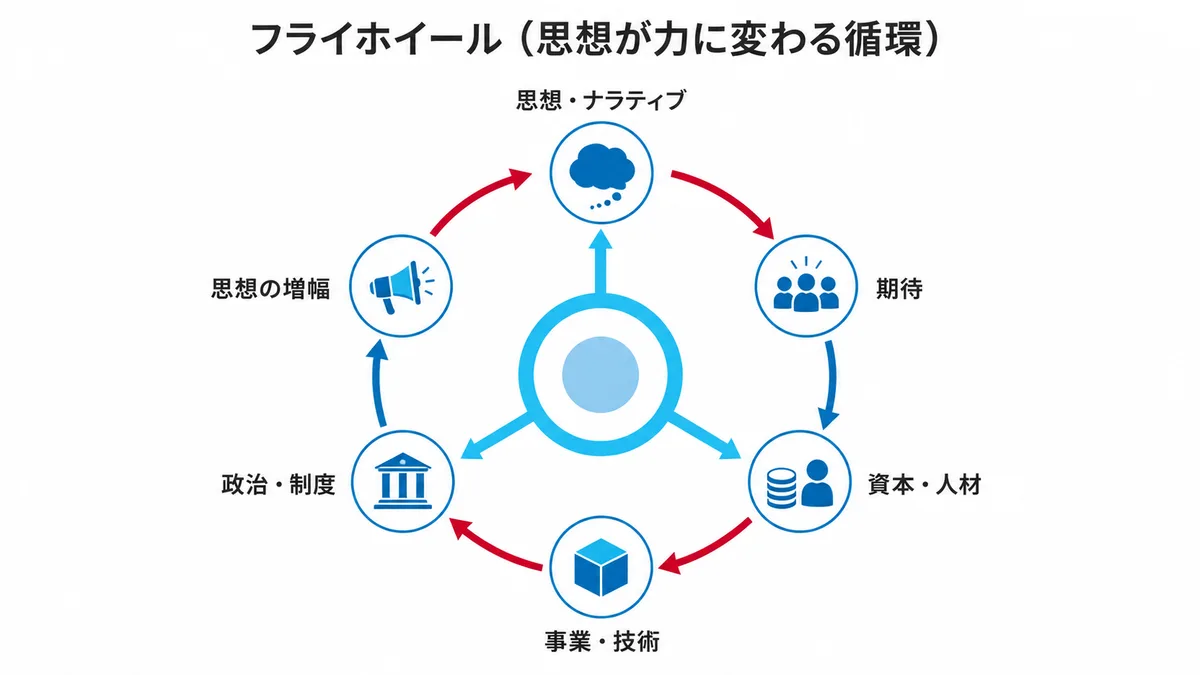
Criticism as Infrastructure and the Immune System
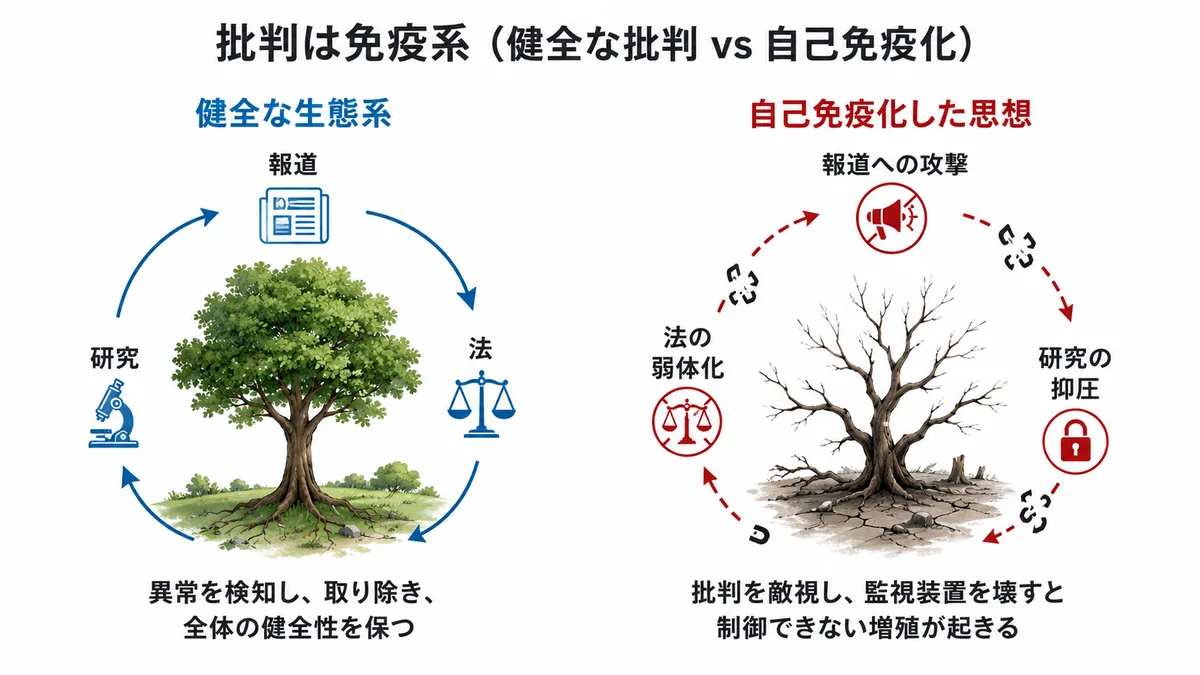
Lining up the five functions leads to one conclusion: an ecosystem that has ideas as infrastructure must also have criticism as infrastructure.
The reason is simple: none of the five functions above has built-in verification of truth. Because predictions and expectations can be self-fulfilling, wrong predictions also survive for a long time. The supply of meaning, as FTX showed, can cover up deviations in the means. Extending time can prolong commitment to bets that do not bear fruit. Selection and coordination can create closed circuits (echo chambers) of only those who believe the same story. Legitimation can legitimate even what should not be legitimated.
In other words, a powerful activator such as ideas must be paired with immunity. That means external criticism, internal dissent, journalism, universities, the legal system, and a culture that keeps asking "is that story really true?" In fact, the lineage of critique, from the 1990s critique of the "Californian Ideology" through Turner, Zuboff, Gebru, and Khan, has not stood outside Silicon Valley but has functioned as part of the immune system that preserves the health of this ecosystem.
If there is a present concern, it lies here. That the Techno-Optimist Manifesto included even words like tech ethics and social responsibility in its list of "enemies" is a sign of a kind of autoimmune disease of ideas, treating the immune system itself as a foreign body. Considering that the faction that defines criticism as an enemy and excludes it is growing stronger economically and politically, this can also be seen as a long-term risk to the ecosystem itself. I will come back to this point in the implications for Japan.
Ideas as Answers to America's Questions
If ideas are a resource that does this much work, should we simply import them? No, is the view of this article.
Ideas are not born out of nothing. They are born in a specific place as answers to pressing questions.
The set of ideas of Silicon Valley can also be taken as answers to several specific questions that the nation of America has carried since its founding.
The first is the frontier. Ever since the historian Frederick Jackson Turner declared the closing of the frontier in 1893, an obsession has been embedded in America's self-understanding that without a frontier to open up, America would cease to be America. Cyberspace, outer space, and AI have been spoken of with religious fervor as substitutes for the lost frontier.
The second is the failure of governance. The extremity of Exit ideology and neoreaction can be understood as a response to the actual crumbling of trust in governance, from medical costs and infrastructure to Congress and urban public safety. The acuteness of the despair that "this system can no longer be fixed" lends persuasiveness to the answer "then let's build outside."
The third is religion. America is a society founded on a story of the end times and salvation, and secularization left a void in the shape of that story. AI extinction theory and paradise theory, the distant future of longtermism, and the salvation of the species through migration to Mars have the power to mobilize precisely because they fit this void.
The fourth is hegemony. At the root of ideas such as the defense of the West, American Dynamism, and export controls on China lie both the self-image that "America is number one" and an imperial anxiety, brought on by China's rise, over whether it can really remain number one.
Why Did America's Questions Become "Humanity's Questions"?
Here let me touch on an idea that is key to the second half of this article.
The four questions just listed are all local questions rooted in the specific history of a specific place, America. Even so, the internet, smartphones, AI, and space development, which are the ideas and businesses born from them, have changed the lives of people around the world. Why did answers to local questions become global industries?
The answer is that America stood at the leading edge of technology and the economy, that is, at humanity's frontier itself. For those standing at the leading edge, their own country's next problem is humanity's next problem as is. America's questions of "how do we connect information," "how do we make intelligence," and "how do we get out into space" coincided with the questions of all humanity even if left alone, because America was at the frontier. It is not so much that Silicon Valley entrepreneurs posed questions "for humanity"; it is that, because they stood at the frontier, their own questions automatically became humanity's questions. That their ideas can casually use subjects like "humanity," "civilization," and "the species" is a product of this position.
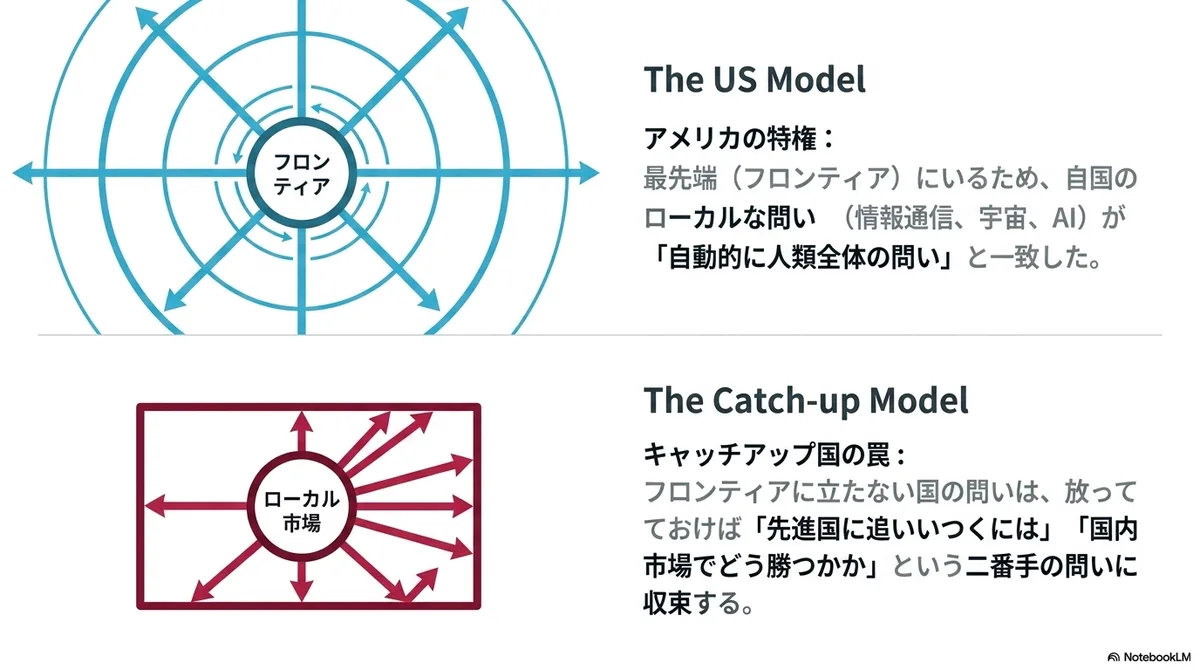
This idea leads to two important consequences.
First, countries that do not stand at the frontier cannot enjoy the benefits of this "automatic conversion." Solving one's own country's questions does not necessarily make them automatically answers to the world's questions. If left alone, the questions of a catch-up country take the form of "how do we catch up with advanced countries" and "how do we win in the domestic market," which by definition are questions converted to that country's local terms and, seen globally, second-tier questions.
Second, however, the reverse also holds. Being at the frontier is a sufficient condition, but not a necessary condition, for posing humanity's questions. Consciously posing questions for the whole world can be done from any position. In fact, the humanity-scale question of AI safety was initially posed not by the center of the industry but by a community on its periphery, and the question of climate change too was pushed up into a world question not by the government of the hegemonic power but by the EU, scientists, and citizens' networks. The reach of a question is determined not by the position of the one who poses it but by will and design. This becomes the foundation for the next discussion.
The Cargo Cult Problem
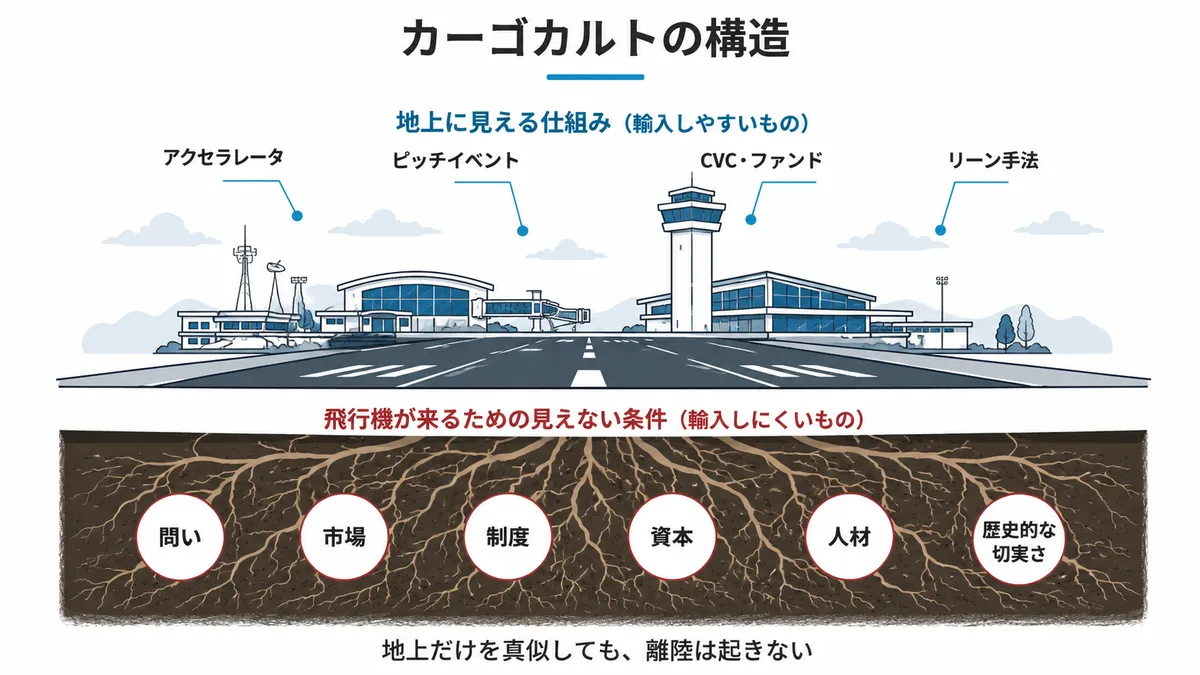
The physicist Richard Feynman called the act of importing answers alone, cut off from their questions, a cargo cult. Copy the shape of a runway and planes will not come down. Japan's startup promotion has carefully imitated Silicon Valley's mechanisms, such as accelerators, pitch events, CVCs, and Lean methods, yet has somehow been spinning its wheels. The reason probably lies in clinging to a second-rate imitation of "small practical experimentalism" while not looking to the "grand visions" that come out of America's questions, and in the problem of the structure of questions behind that.
To begin with, Japan and America have different underlying questions. Japan's governance has deterioration and rigidity but has not collapsed as much as America's. Because of universal health insurance, medical costs are not as expensive as in America. Because public transportation functions, the pressing need for something like Uber does not appear in the same form. What is provided in Japan by public mechanisms is provided in America within the market, so a large market arises there. Furthermore, there is a structure in which success in America naturally connects to the global market, accelerated by a large-scale financial system. America is such a special environment.
In terms of ideas too, Japan has neither America's acute need for Exit, nor a frontier myth, nor a religious void of the end times and salvation. Rather, because of a catch-up mode of thinking, answers are imported directly, and if there is a success story of executing downstream of other people's ideas without holding original questions, one can only take a structurally second-place position. To be sure, in the past Japan could catch up rapidly, grow domestically through economies of scale that used the size of Japan's economy, and win in the world later. But that way of fighting is now China's specialty and is probably not the strategy Japan should take today.
Therefore, it can be said that the reason Japanese startups cannot fully win in the world is, before any shortage of effort or institutions, also the inevitable consequence of the method of "imitating" answers to other countries' questions (a method that nonetheless once succeeded).
Part III: Japan's Questions - Consciously Posing the World's Questions
I suspect many people think, "We can write a history of Japanese startups, but we could not write an intellectual history of startups like Part I of this article." But it is not that Japan had no seeds of ideas. There were some. i-mode and Niconico are examples. What Japan lacked was not the seeds of ideas but the circuit that converts prediction into capital, meaning into talent, and story into time, that is, the device on the ecosystem side that makes ideas function.
And if there was one more limitation common to those seeds, it was that they had no language for speaking of them as "questions for the whole world." They stopped at "optimization for Japanese users" and were not elevated to a bet-like statement such as "this is how human communication will be." The absence of the circuit and the short reach of the questions. These two can be said to be the factors that kept Japan's seeds of ideas as domestic phenomena.
America was an environment in which it could do all this naturally without thinking about it, because it was the hegemon. Its questions were also the world's questions. The EU, meanwhile, held questions such as the environment and equality as global questions beyond its own borders and shared them as questions for the world. If Japan, from here, is to aim at the world in certain domains, it must aim strategically with this kind of asymmetric structure in mind.
The Four Conditions of a Good Question
So what questions should Japan pose? First, let me list three conditions for a good question.
1. It is pressing
We bear the pain as parties directly involved.
2. It is universal
The world will eventually face the same problem.
3. It can be answered by making
We can respond with technology, institutions, and business, not with lamentation or commentary.
However, in light of Part II, we should note that condition 2, "universality," is not something achieved if left alone.
Because America stood at the frontier, its own country's questions automatically became humanity's questions. Japan is not in that position. So even if Japan works hard to solve pressing domestic problems, that does not automatically make them answers to the world's questions.
In that sense, the term "problem-advanced country" carries a danger. This is because between facing problems first and formulating those problems as the world's questions and building answers that work in the world, a conscious leap is needed. No matter how carefully we handle domestic aging, if it ends as "Japan-specific elaboration," it will be a replay of Galapagos.
Therefore, in addition to the three conditions, Japan needs a fourth.
4. Consciously pose the question for the whole world
This means formulating it not as "solve Japan's problem" but as "solve the problems humanity will face, with Japan as the first testing ground."
If the subject of the question is "Japan," product design, the talent hired, the capital raised, and the dialogue with regulators are all optimized for the domestic market. If the subject of the question is "the world," one speaks of one's ideas to the world's capital and talent from day one. The five functions of ideas we saw in Part II, prediction and expectation, meaning, time, selection and coordination, and legitimation, have a scale of mobilizable resources determined by the scale of the question's subject. World-scale startups are born only from world-scale questions.
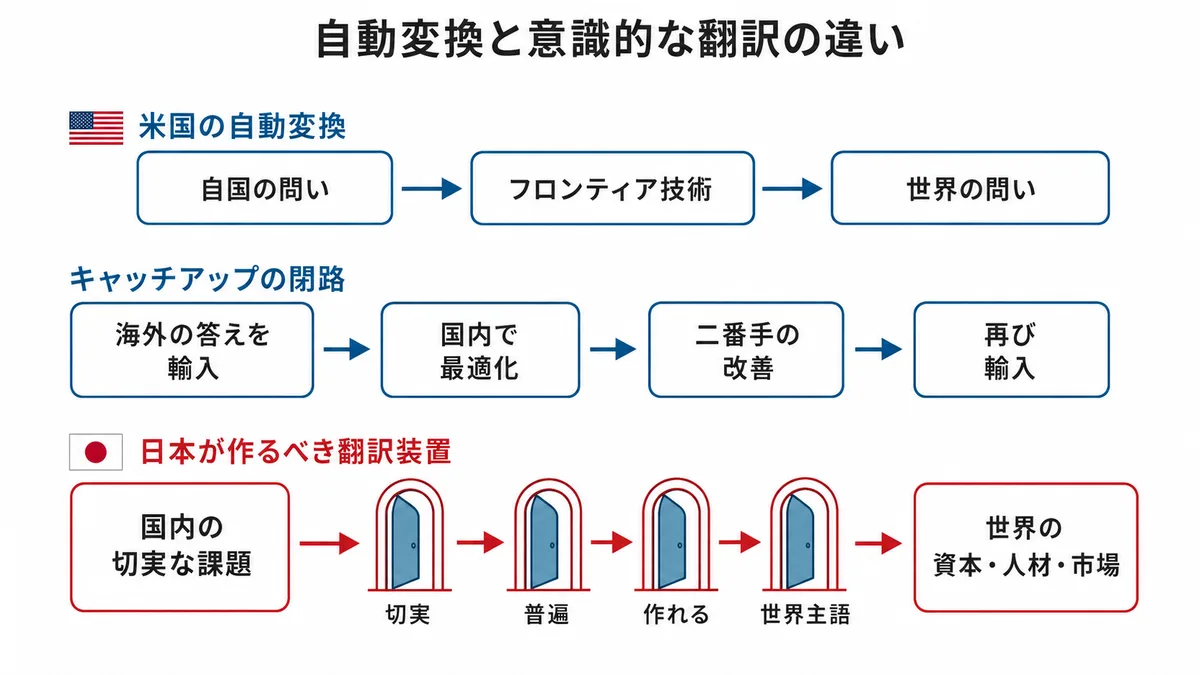
Candidates for Japan's Questions: Translating Domestic Problems into the World's Questions
What follows is not a conclusion but an attempt at testing against the four conditions. What I want to keep in mind in each item is translating "Japan's problem" into "the world's question." Since my thinking is still in progress, please regard these as examples only.
First, the frontier of contraction. Japan is the first major country in human history whose population is beginning to decline in earnest while it maintains its affluence. The pressing nature needs no explanation. But formulating this as "Japan's measures against population decline" is not enough. Formulated as a world question, it would be: "Can humanity prosper without presupposing expansion?"
China, South Korea, Taiwan, and much of Europe will follow the same curve with a time lag. Automation and robotics premised on the disappearance of the labor force, designs for smartly folding up the infrastructure of shrinking cities, the reinvention of social security that supports many elderly with few working-age people. If America's frontier was "how to build amid expansion," this is the question of "how to invent growth amid contraction," to which humanity does not yet have an answer. Japan is the first party to this question and its first testing ground. And within that, it needs to take on the challenge of the domestic social system, of how to achieve a soft landing and redistribute, and to develop the technology that supports it.
Second, the question of aging and life. What does it mean to "age well" in the world's longest-lived society? This is the possibility of a completely different answer to the question that American thought answered in the form of "conquering death" (transhumanism). Rather than eradicating death as an enemy, how can technology support a life that includes aging and death? Formulated as a world question: "How should a longevity-extending humanity design dignity in the final stage of life?" Responses to caregiving, dementia, and loneliness will become answers that every advanced country, and eventually emerging countries, will need.
Third, disasters and resilience. Earthquakes, typhoons, and climate change. Japan is a society that has continued to build systems that "assume breakage and still function." In the age of climate change, there is no country that does not need the question, "How can society avoid breaking down on an Earth with an unstable climate?" Speed of recovery, disaster-mitigation technology, and order in crisis are the materials of answers Japan has accumulated ahead of the world. In some cases, Japanese businesses may prove useful in reconstruction after the conflicts now occurring, and after emergencies in various countries that may occur in the future.
Fourth, constraints of energy and resources. The question of how a country without resources can reconcile decarbonization with economic security is a pressing question for Japan since the oil shocks, and Japan once produced a globally relevant answer in the form of energy-saving technology. As a world question, it can be formulated as: "To what extent can technology neutralize the structure in which the uneven distribution of resources breeds conflict?" This formulation leads to the next question.
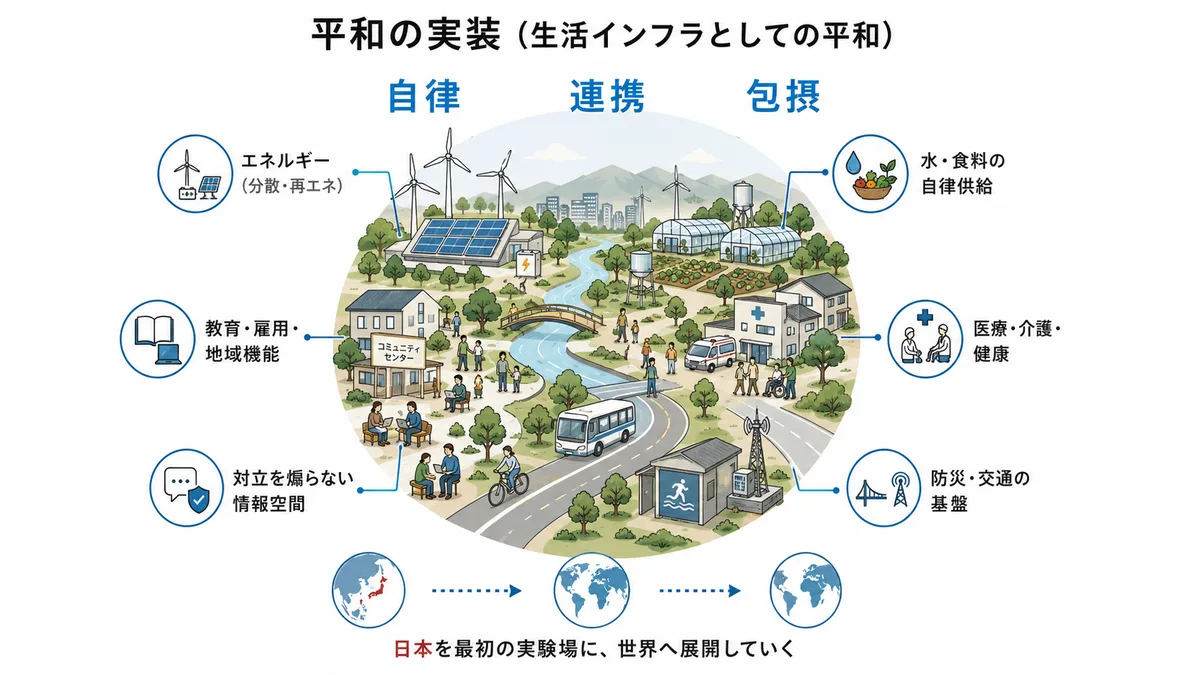
Fifth, implementing peace. The one with the potential to bind all of these together is the question of peace.
The world's peacefulness continues to deteriorate, and state-involved armed conflicts have reached their highest level since World War II. Japan has low energy and food self-sufficiency, and is a country whose daily economic and cultural activity rests on the infrastructure of "the world being at peace." World peace is, for Japan, not an abstract ideal but infrastructure directly tied to the national interest.
There is much the private sector can do here as well. If countries no longer struggle for energy and water, conflicts over resources decrease (autonomy); if there is a trustworthy information space and cultural exchange, adversaries can be imagined as human beings with faces (connection); and if employment, education, healthcare, and transportation give people a sense of "not being abandoned" and hope for the future, destabilization from within can be prevented (inclusion). Renewable energy, energy storage, alternative protein, precision agriculture, water treatment, platform design that does not inflame conflict, AI governance, local transportation, caregiving, disaster response — viewed individually these are separate businesses, but under the umbrella of "implementing peace" they are a group of answers to one question.
And this question satisfies all four conditions. The loss of peace is of vital and pressing concern to Japan (condition 1), peace is a universal good that every country needs (condition 2), and as listed above it can be answered with technology, institutions, and business (condition 3). And above all, this question has the world as its subject from the start (condition 4). Precisely because it places "the world's peace" rather than "Japan's security" at the center of the question, the technologies and businesses born from it can be deployed to every country facing the same problem. The preamble of the Constitution of Japan, which affirmed the right of all peoples of the world to live in peace, free from fear and want, already gives Japan the legitimacy to pose this question. Here is a third position, different from the thinking of America, which turns to the defense industry out of hegemonic anxiety, and from the Chinese model, which speaks of stability through control.
These are examples, but squarely facing such heavy issues is the premise of solving them. There are times when we have no choice but to avoid issues temporarily, but in order to produce true solutions, we will probably have to face these heavy issues head-on.
But, as I keep saying, these are only candidates. What matters is to begin choosing which question to take up from ourselves, not by looking for Silicon Valley's correct answer. And, rather than leaving it as a domestic matter, to translate it thoroughly into a question for the whole world.
Startups as Bets
To say it once more, a startup is a bet on a question and a mechanism for obtaining a large return when that bet pays off. And the object of the bet is no longer confined to the realm of business. A competition of ideas in international society, over what questions to hold and what futures to bet on, has begun.
In America, while various intellectual movements trying to answer pressing questions have appeared, some ideas that seem dangerous are gaining real power on the strength of capital. If such a bet "comes true," for example if bypassing democratic procedure becomes routine, it will reach beyond the tech industry. For those of us working in Japan, this is not a fire on the other shore. Being involved with startups that compete in the world also means being asked, at the front line of these tangled ideas, how I think and what position I take.
The life-and-death question of security has become real again, and countries including Japan, which has lived under America's protection, are being asked to reconsider their own way of being. What questions Japan holds and what answers it produces is a matter of ideals and at the same time a real matter that will determine Japan's future business environment and our lives themselves.
For example, which country to partner with depends on our values, and thinking about it makes it unavoidable to reconsider our values anew. And if we go beyond defense to the weapons business and its production, we will at the same time have to think about ourselves and the people around us being killed by such weapons. We must go beyond ways of thinking such as "we do it because it's technically possible" or "we do it because it makes money," and think and discuss our own life and death and way of living. And if society allows players who aim to maximize money and returns in such domains, the generation that allowed such a social structure will be reproached by the next generation.
On the other hand, we also need to think seriously about where we draw our ethical line, having considered the reality of what countermeasures and deterrence to hold against counterparts who might step over ethics and use weapons.
We who work in Japan, a middle-power country, must ask what questions to pose, what ideas and narratives to shape, and how to convert them into business. Without thinking about that, we cannot create narratives that work in the world.
And as answers to those questions, we may turn to the identity of our country's past, to our country's defense, and to patriotism as a false reassurance, such as "this country has no faults." But I think it would be better for more people to make the effort to head toward building a new future, to hold questions for creating a new international harmony, and to produce hopeful answers that can involve as many people as possible.
If the postwar international order is fraying, creating a new structure is the work of this generation. Precisely because Japan does not stand at the frontier, it must choose the reach of its questions by its own will. And that choice will become the watershed for whether world-scale startups are born from Japan.
Silicon Valley as a Negative Example
Finally, I want to emphasize that what we should learn from Silicon Valley includes not only the patterns of success but also the patterns of failing.
As we saw in Part II, ideas are the infrastructure of the ecosystem, but ideas that lack the immune system of criticism run out of control. If Japan is going to build a circuit of ideas and capital from now on, it should build in the infrastructure of criticism from the start: journalism that verifies investors' theses, research that keeps its distance from industry, and dissent within the entrepreneurial community. A culture that treats these as "throwing cold water on the excitement" is comfortable in the short term, but in the long term leads to excessive purification and the wrong direction.
This matters all the more when holding up a "question for the world." If every business is called "for peace" or "for humanity," those words will quickly be hollowed out. To avoid falling into what might be called peace-washing or humanity-washing, in the manner of greenwashing, we need mechanisms to ask rigorously how much a business is reducing people's fear and want and whether it is creating an information environment or structure of vested interests that inflames conflict, and to measure its contribution. The more grand the question one raises, the more one should welcome rigorous verification; that should be the etiquette of those who handle grand visions and ideas. Fortunately, latecomers have latecomers' advantages. Japan can start with the lessons that Silicon Valley has been learning over fifty years already built into its design.
Conclusion
The discussion in this article may seem roundabout. But such accumulation of thought is the very infrastructure for Japanese startups to compete in the world from now on, and I believe that what startups are called upon to do from here is not to leave it as mere ideas but to build it up as effective capability in the world.
With that in mind, I would like to hold events and discussion sessions on startups and ideas. I will announce the date and place once they are decided, so please register for advance notice and help with the survey.