Time to Move Away from Silicon Valley as the Answer
This article was machine-translated from Japanese by AI (Claude). It may contain errors. Read the original Japanese article.

Overseas startup and technology ideas are now flowing into Japan one after another.
Peter Thiel, a co-founder of PayPal, has repeatedly been introduced as a key figure for understanding contemporary America, and more recently The Technological Republic has also become a topic of discussion. Many essays on the relationship between the state and technology companies are being introduced as well.
Japan imports a wide range of things from Silicon Valley. In the 2010s, for example, what we imported were the narratives of future forecasts told in Silicon Valley, cutting-edge engineering practices, and business methodologies such as Lean Startup, design thinking, and OKRs.
And now, in the late 2020s, what is coming in is a group of ideas such as techno-optimism, effective accelerationism, and the Dark Enlightenment, along with businesses related to the state, defense, and governance.
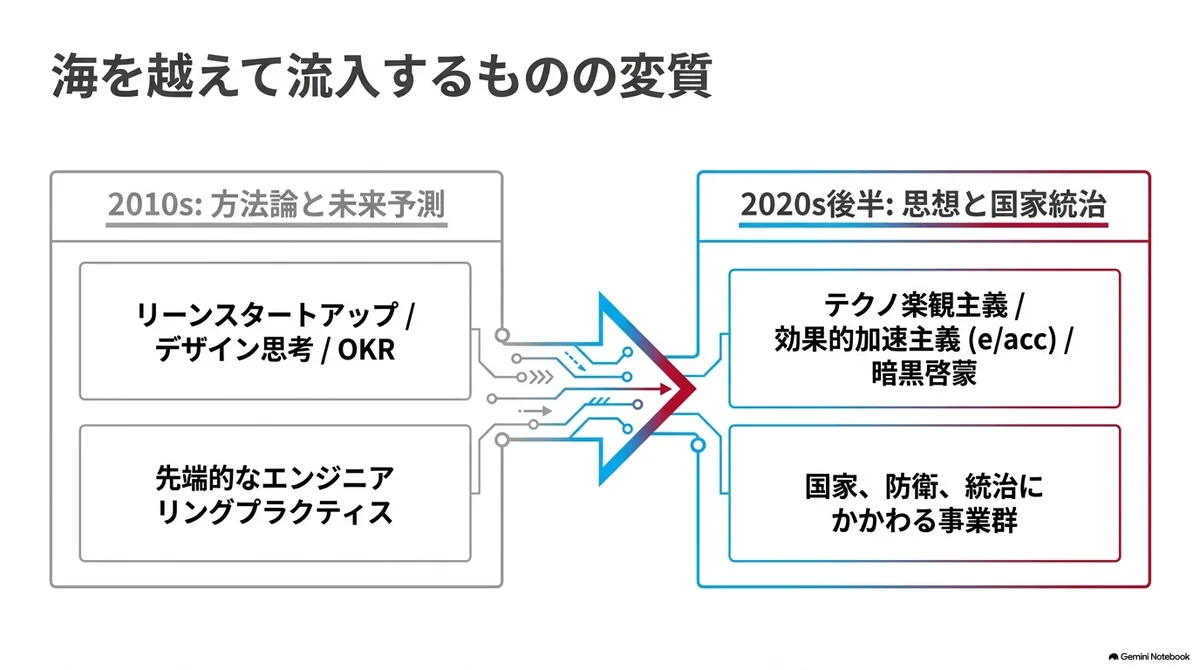
Looking back, in the 2010s Silicon Valley was treated as a place where a slightly advanced future could be found, and many businesses operated by referring to "Silicon Valley as the answer" and using whatever in that answer was useful. But watching Silicon Valley come to hold capital on an entirely different order of magnitude, and its substance change, I feel that this is no longer possible, and that we should no longer do it.
In that sense, perhaps "the time to move away from Silicon Valley as the answer" has come.
Of course, there is still much to learn from Silicon Valley's technologies and businesses, and we should continue to refer to them. I have no intention of denying the people who work hard there. Nor do I think we should withdraw from capitalist competition.
But when I think about Japan as a whole, I feel that it is becoming difficult to take the businesses of Silicon Valley, that is, the questions raised there and the answers to those questions, as a single set, and to regard those concepts and businesses themselves as answers that Japan should refer to.
As the Assumptions of the 2010s Are Breaking Down
Until the 2010s, many business entities operated in a free market where they did not need to be conscious of ideas. In that era, I think, the economy and politics were basically regarded as separate, and it was thought that they should be.
But that separation rested on an implicit sharing of the values of free markets and globalization (what might be called neoliberal values). Those assumptions are no longer working well, and as the domestic politics of various countries become unstable, a variety of changes are occurring. Examples include the rise of political groups called the radical right and the radical left, and industrial policies and tariffs in various countries. In response to these movements, politics and the economy appear to be merging again.
As the structure of the market gradually changes, the businesses that startups in Japan and abroad pay attention to are also shifting. Defense, mentioned at the beginning, is one such example.
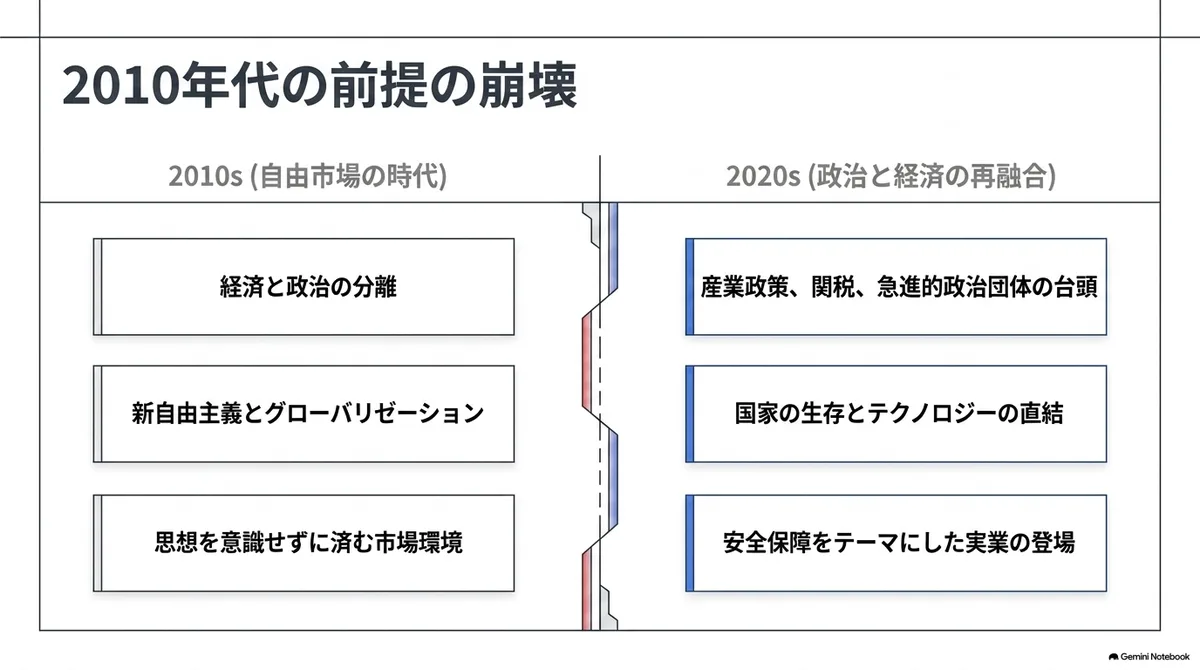
Meanwhile, I think ideas and narratives concerning the state and governance are entering Japan by making good use of the attention to "startups" that grew in the 2010s.
Startups have the function of quickly receiving the language of overseas technology and capital, introducing it as the "next market to come," and legitimizing it through investment and entrepreneurship. In other words, they stand on the front line of sensing these movements.
Until now, we could pick out from the vision of the future that Silicon Valley presented the technologies and methodologies that could be used in Japan. I think the need to start by posing questions was not felt as strongly as it is now, at least.
Ideas That Arrive Together with Real Business
Seen in this context, Palantir and The Technological Republic appear to be neither merely a business nor merely a book of ideas.
Alex Karp, one of the authors and also the CEO of Palantir, argues that the software industry should turn back to national challenges, including the race to develop AI, so that the United States and its allies can maintain their advantage and preserve freedom, and on that basis he is expanding business in various countries, including Japan. Palantir itself, in its 2025 policy recommendations to the U.S. government, positions its work as supporting U.S. national interests and its civilization, and argues that the United States should lead international discussion and institution-building on AI.
Unlike the conventional startup scene or the world of ideas, this means that "ideas backed by technology and real business" are now entering Japan under the theme of security, clothed in the humanities and liberal arts such as philosophy.
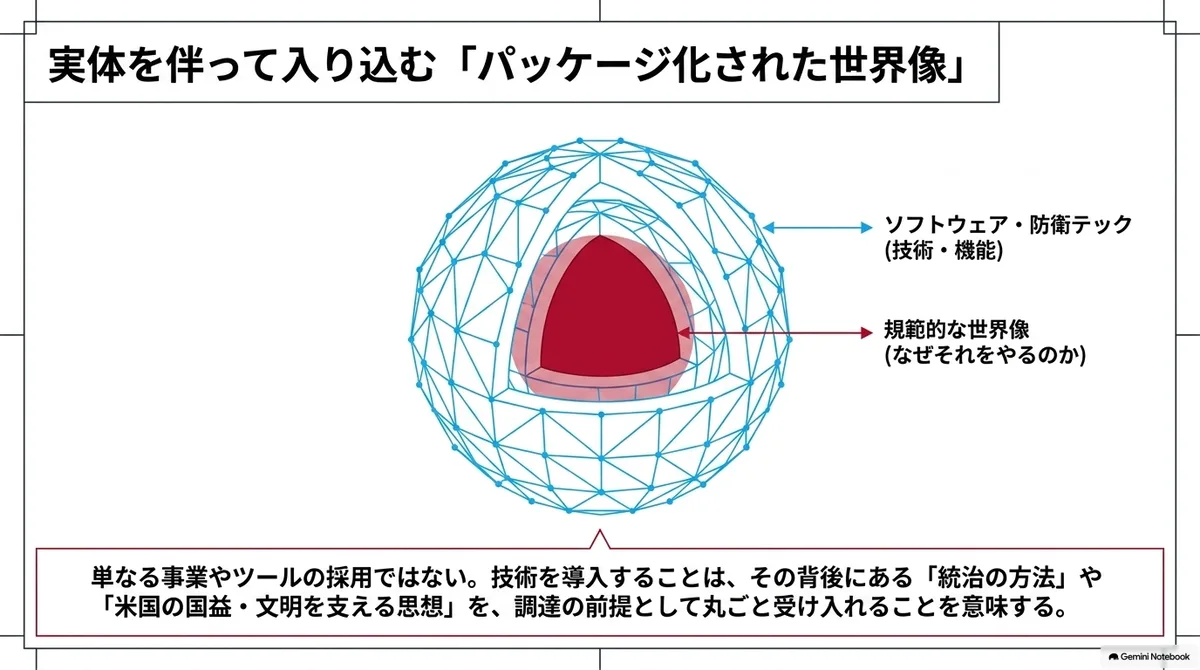
Palantir is not the only special case. a16z's American Dynamism also explicitly names areas bearing on U.S. national interests, such as defense, public safety, manufacturing, and education, as its investment targets. And Anduril and others that received investment from such VCs are also trying to enter Japan. In other words, this is a movement in which ideas, companies, capital, and national policy are connected.
On the surface, and as a primary matter, it is a question of which technologies and services to adopt. But these groups of businesses appear to be supplied as a whole bundle, together with a normative worldview of "why we do this." As a result, when those technologies and services are adopted, the ideas and methods of governance behind them can come in at the same time as premises of procurement and operation.
Of course, there are parts that we have no choice but to adopt from the standpoint of defense capability and deterrence. Even then, however, we must decide how far to accept and from where to refuse the functions of such services, by weighing them against some set of values. Yet these ideas are trying to enter in a way that exploits the gap in the circuit that connects Japanese thought to implementation, and my present sense of crisis is that, if we let our guard down, we may end up accepting those ideas wholesale without realizing it.
In the United States, Ideas, Capital, and Policy Converge to Form Power
What especially characterizes American technology thought is its pathway. In the United States, organizations that pose questions on their own, such as universities, government research funding, foundations, and think tanks, were secured between the state and the market, and honed ideas through competition. On top of that, in recent years the presence of VCs has grown.
A VC is an organization that converts visions of the future into investment theses, and gathers and distributes capital and talent by telling those theses as stories.
Moreover, a16z has brought into one organization not only the distribution of funds but also owning media, publishing books, supporting recruiting, and even lobbying on policy. By publishing its investment hypotheses, it gathers promising founders, specialist talent, LPs, and co-investors into a particular domain and tries to shape the very market to which its portfolio companies belong. The translation of visions of the future, the allocation of capital, and the dissemination of messages are coming to be done by the same actor.
It is better to see this dissemination as more than mere public relations. Marc Andreessen explains his own communication strategy using the concept of the "availability cascade" proposed by Kuran and Sunstein. The more people talk about a topic, the more important and plausible it appears, and that in turn increases the number of people who talk about it. Kuran and Sunstein call the instigators of this self-reinforcing mechanism "availability entrepreneurs."
Andreessen applies this concept to startup founders as well, and tries to design the very focus of society's attention. The import of future forecasts from Silicon Valley can be taken as one manifestation of Japan's having been positioned downstream of this cascade, and the reception of defense tech in Japan, which is happening right now, can also be seen as one example of it.
The relationship among ideas, capital, and dissemination up to this point can be shown in a diagram as follows.
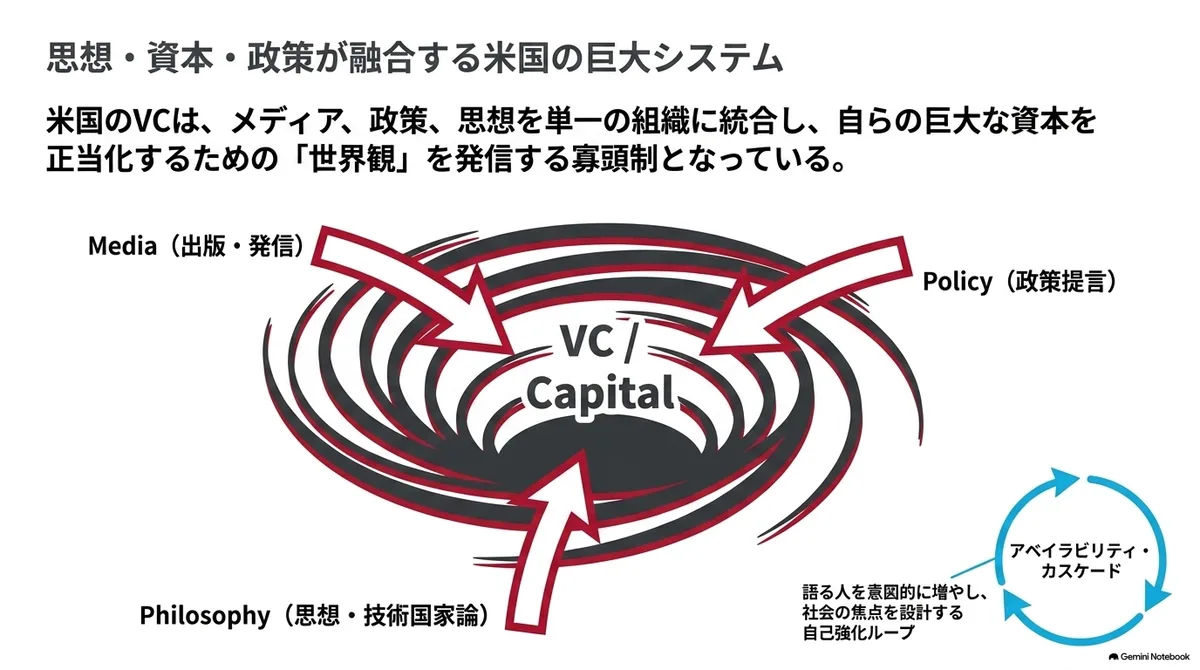
However, it is not the simple sequence in which ideas came first and capital followed them.
In the United States, capital that had grown large needed, in order to earn returns on that capital, large visions of the future and stories of the same size. If you create a fund of one trillion yen, you need businesses and stories that could reach a market capitalization of 10 trillion or 100 trillion yen. As a result, they cannot help but connect to challenges on the scale of nations and humanity (I wrote about this back-and-forth before in "The Pendulum Between Culture and Finance").
In other words, it can be said that not only did ideas move capital, but capital that had grown large also came to need large ideas. In a sense, a "capitalization of ideas" has occurred.
The current situation in the United States, where a small number of organizations handle everything from investment to involvement in policy, can be seen as lying on the extension of this. It was probably in response to such a situation that President Biden, in his farewell address, warned that "an oligarchy is taking shape."
Still, let me add one reservation. a16z and Thiel are not the average of U.S. VCs. As far as I know, there are almost no VCs in other countries that write and spread ideas going beyond investment theses. So I do not mean to say that VCs in general are dangerous.
However, there is a structure in which VC funds concentrate in such funds that hold some of that power, and in 2025 the top 10 funds accounted for 32.9% of the capital raised by U.S. VCs. What is distinctive is the United States, where ideas have been built into the circuits of capital and part of that has been expanding. And precisely for that reason, the ideas that are written arrive with large capital behind them, clothed in a power of implementation that ideas in other countries do not have.
And on the American side, people who write ideas, people who distribute funds, people who build companies, people who introduce products, and people who propose policy to the government are connected, and it is because there are concrete examples of various "successful founders" that those ideas are persuasive.
I should add that I do not think all American ideas are bad. The problem lies in Japan receiving them uncritically.
The technology thought being born in the United States today is also an answer to problems specific to American politics, industry, and security. To accept that thought is to take in not only the answers presented but also the problem settings, institutions, and priorities that those answers presuppose. There are cases where such options are useful for Japan as well. But if we import answers to uniquely American problems together with their premises, we may end up accepting criteria for judgment that do not suit Japan's conditions.
Commentary Alone Cannot Stop Mobilization or Decisions
Here let me divide modes of reception into two. Reception that is completed by understanding, positioning, and criticizing an idea I call "commentary-type reception," and reception that incorporates an idea into one's own decision-making premises I call "implementation-type reception." Even when reading the same book, writing a book review is the former, while rewriting an investment thesis or a business plan is the latter.
Japan's reaction to Thiel and accelerationism has mostly ended with commentary-type reception: book reviews, explanations, and warnings. This is not a lack of ability; rather, it is probably a sign of the high capacity for commentary nurtured by a tradition of criticism.
But commentary is the first step of selection, not the axis of selection itself. To the questions "So what will you do?" and "What should we do?", commentary and analysis can give hints, but they do not answer. Moreover, within an availability cascade, criticism too is counted as one of the "people who talk," and may end up on the side that raises the importance of the topic. Commentary alone has difficulty stopping either the mobilization of attention and capital or individual decisions to adopt.
Selection requires something to compare against. Only when there is a counterproposal, an answer of our own to the problem that the incoming idea is trying to answer, can we judge which parts to accept and from where to refuse. Without a counterproposal, selection does not hold, and we move closer to a binary choice of accepting everything or rejecting everything.
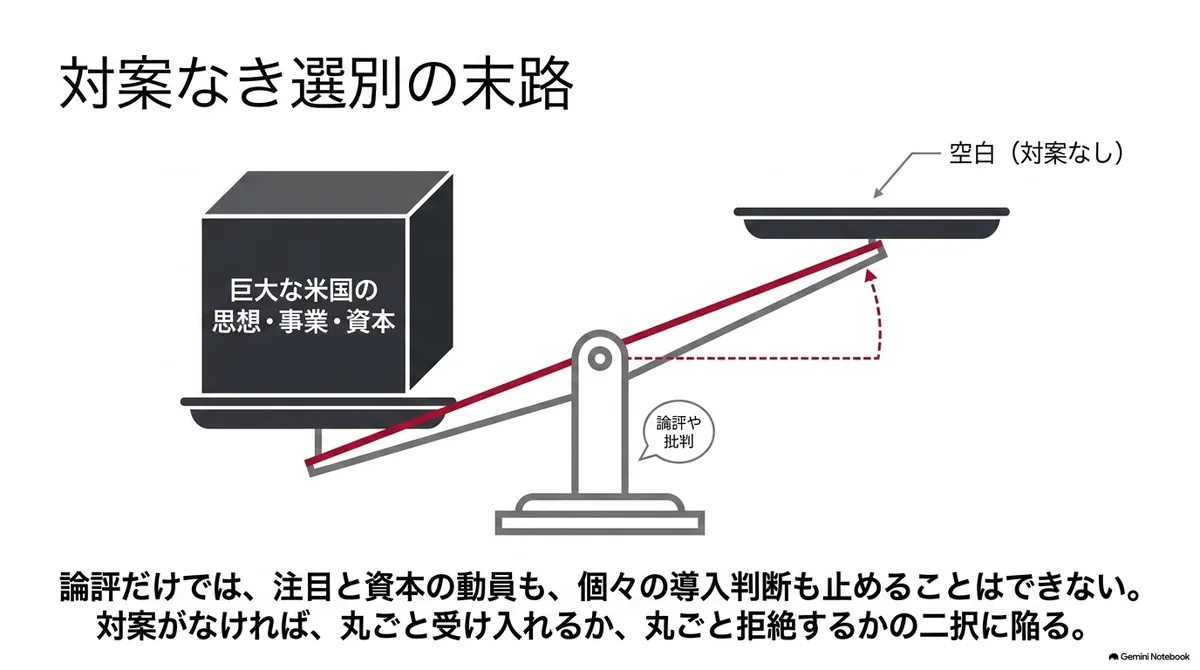
Japan has rich critics and storytellers of ideas.
But most of such discourse stays within the conventional domains of criticism and thought, and has hardly yet covered the domains of technology, security, and industry, where ideas are even now arriving together with real business. The number of people who have emerged to carry it is also very small. What is empty now is not the capacity for commentary but counterproposals that stand on the same ground as the incoming ideas.
The "gap in the circuit that connects ideas to implementation" I wrote about earlier refers to this emptiness. If the counterproposals to load onto the circuit are themselves scarce, and there is also no connection between those who speak counterproposals and those who procure and deploy, then American ideas themselves may be criticized in the world of public discourse yet implemented unconsciously on the ground.
Having Our Own Values and Questions
Therefore, examining ideas cannot be a critique done after the business or the deployment; before business and policy are settled, we need to show what we will build, what we will buy, which capabilities we will hold domestically, and which decisions we will not entrust to foreign companies. We will also need to increase counterproposals not just as commentary but as businesses with substance.
This is probably not the job of the world of public discourse alone, nor of the government alone. For example, organizations involved in the procurement of defense and infrastructure need to have, and discuss, before deployment, the criteria for selecting which functions of overseas-made services to accept and from where to refuse. Or perhaps it is also possible to make differences in values easier to see by creating businesses that serve as counterproposals.
For that, merely selecting from the answers coming in from the United States is not enough; on the Japanese side, we will need to first pose the questions: what problems do we ourselves face, what do we want to protect, and what do we want to change? For example, if we should originally be solving problems such as social security, but an availability cascade directs excessive attention elsewhere, we would get the problem to solve and the allocation of resources wrong. If the question we hold is wrong, the effectiveness of its answer drops sharply.
If we have questions of our own, we can also evaluate technologies and businesses coming from overseas according to those questions. But if we leave even the decision about what is a problem for Japan to the American side, the capacity to pose questions on the Japanese side will not grow.
I think that moving away from Silicon Valley as the answer means neither stopping learning from Silicon Valley nor simply rejecting all American technology and thought. It means not receiving the questions and answers posed there as a whole, but posing questions ourselves and, as part of the answer, re-selecting Silicon Valley's technologies and ideas. It means making good use of the technology Silicon Valley has built to solve our own problems.
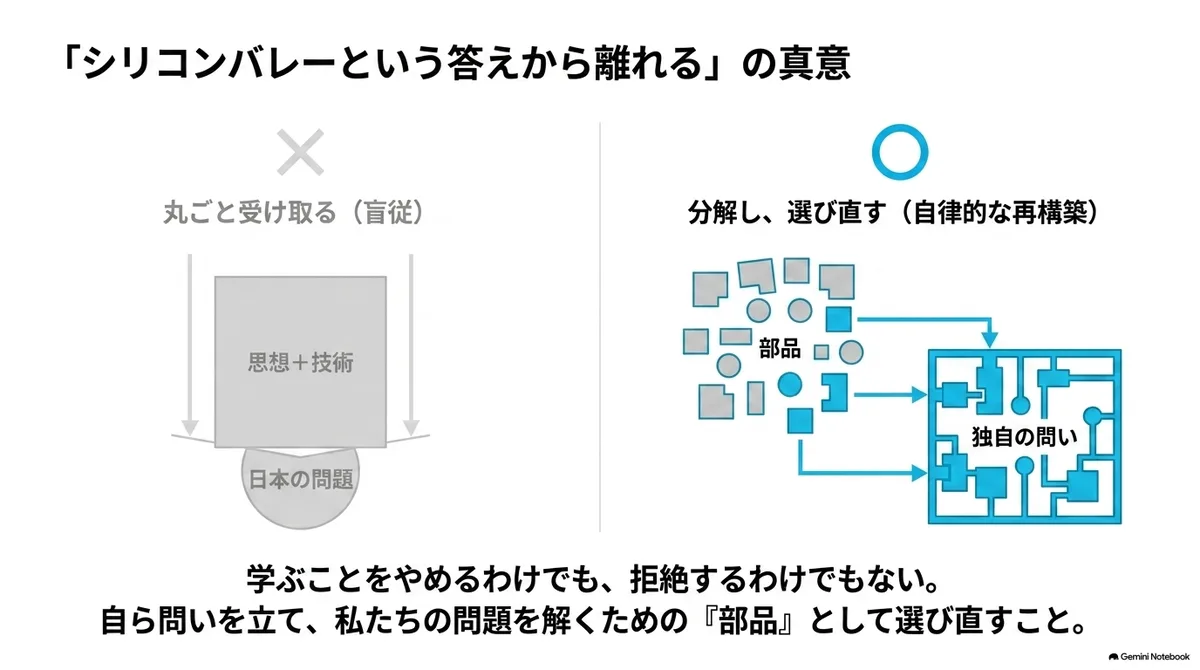
I think this is a move from commentary-type reception to implementation-type reception, and also a matter of filling the gap in the circuit from the Japanese side.
From that perspective, my present awareness of the issue is that Japan now needs visions and ideas for its state and industry. Ultimately, I also think this could become an opportunity to consider who we want to be.
As for concrete ways of proceeding, such as how to create places for posing questions, I would like to discuss them in a separate piece.
➡ As a follow-up, I wrote The Structure That Makes The Technological Republic Easy to Accept Without Friction.
※ The previous article: "The Ideas Surrounding Startups." This piece is its sequel. Proofreading and similar work on this piece was done with the help of AI.