When an Organization That Gave AI to Everyone Loses Productivity
This article was machine-translated from Japanese by AI (Claude). It may contain errors. Read the original Japanese article.
(Note: On 8/10, I substantially changed how the argument is structured.)
In the Cheonggyecheon restoration project in Seoul, completed in 2005, an elevated highway running through the city center was removed and the stream buried beneath it was restored. It seems that removing the main artery of a city center would paralyze traffic.
In fact, there appears to have been a temporary drop in speed immediately after construction. But afterward, subway use increased and road travel decreased, and the feared massive congestion did not become permanent. (That said, around the same time, public transportation reforms were also carried out, such as the reorganization of bus routes and the creation of median bus-only lanes. The effect should not be attributed to the road removal alone.)
In the field of transportation, it is known that even when roads are added, traffic grows in step with the added capacity, so congestion is hard to resolve (induced demand). Conversely, it has also been repeatedly observed that when roads are reduced, congestion does not occur as badly as feared, and part of the traffic simply disappears (traffic evaporation). What happened at Cheonggyecheon can be seen as one example of this evaporation. In other words, congestion is often not a problem of the total amount of road, but a problem of how the flow is designed.
Turning to modern society, many companies are now trying to roll out new vehicles and roads for information all at once inside their organizations, in the form of "giving AI to every employee." But in some cases, this could create congestion inside the organization and end up slowing the whole thing down.
If so, just as with roads, individual productivity and the productivity of the whole route would need to be measured separately. And going one step further, the central job of management in the AI era may be to introduce AI while measuring the flow of work as a whole and optimizing that flow.
In this article, I introduce that hypothesis.
Uncongested and Congested Roads Inside a Company
Let me begin by viewing a company as "a network through which work and information flow." The things that correspond to roads then fall into two types.
The representative relatively uncongested road is generation by AI. Drafting text, creating materials, generating code, and the first pass of analysis do not greatly extend another person's creation time just because one person in the organization uses them.
Congested roads, on the other hand, are getting a review, obtaining approval, reaching agreement at a meeting, passing legal or quality assurance checks, and winning the customer's attention. These have an upper limit on processing capacity, and the more people use them, the longer each person's waiting time becomes.
Within this picture, the measure of giving AI to every employee amounts to "giving everyone a vehicle and a road that take almost no time." On existing roads, each employee drafts proposals with AI, makes materials with AI, and drafts replies with AI, so the flow becomes faster and larger.
Using AI also makes possible roads that could not exist before. For example, people who are not IT engineers become able to build apps.
The problem is that all of these roads lead out to the same narrow routes, such as review and approval.
For work involving external communication, contracts, safety, regulation, and money, AI output does not become work until it goes through someone's approval, someone's verification, and someone's acceptance of responsibility. As long as no one hands final responsibility to AI, work that flowed along the wide road of generation merges at the end into the narrow bridge of approval and verification.
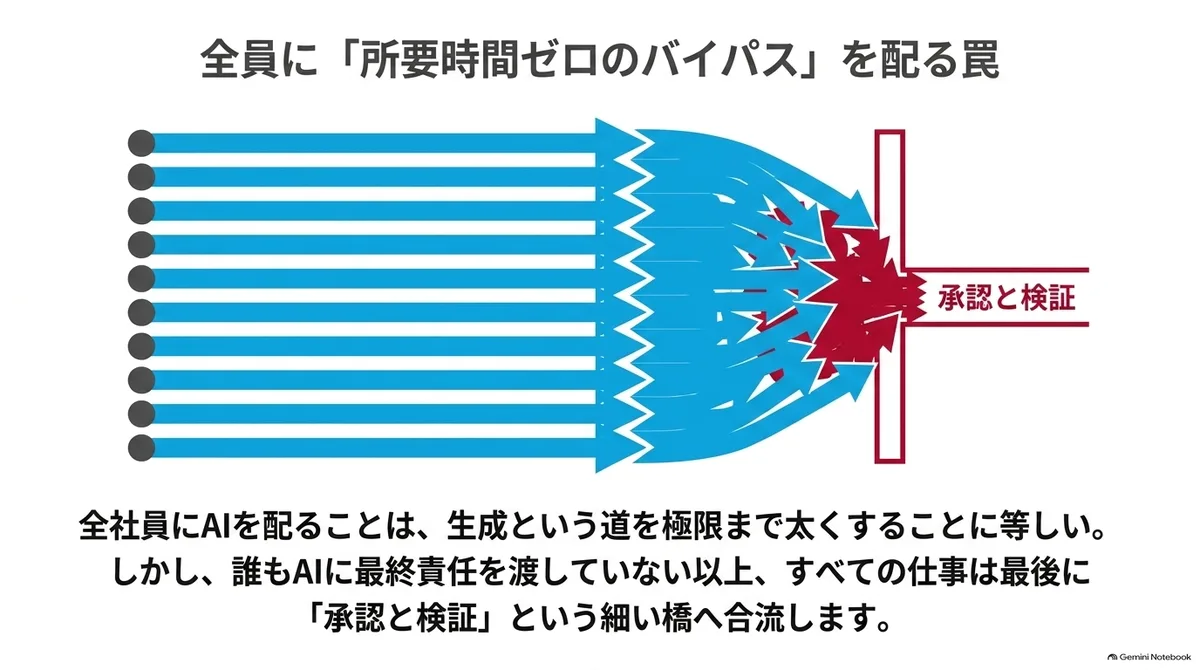
Take a heavily simplified calculation. Suppose the time needed for one draft drops to one-tenth, and the number of submissions rises several-fold. But the approver's day is still 24 hours. Then what determines the time for the whole organization is not the speed of generation but the queue at the narrow bridge. A strange phenomenon occurs: "drafts are finished in an instant, yet the time until release has grown longer than before."
Moreover, in work where a lower cost of creation leads to more submissions, this increase in volume may raise the inflow. When the cost per item falls, it becomes rational for each person to submit more. It is the same dynamic as induced demand in the world of roads, where adding lanes makes traffic grow accordingly.
Worse still, when overload causes lower accuracy and rework, accidents occur through oversights. As a countermeasure, verification steps are added, and the bridge becomes permanently even narrower. It is like a road that lost lanes because of an accident.
Of course, AI can also widen the narrow bridge itself. In a study of 5,172 customer support agents, AI assistance (GPT-3-based AI assistance introduced in 2020-21) raised the number of issues resolved per hour by 15% on average. This is a study of handling inquiries, but if review, verification, and inquiry handling can also be made faster with AI, the whole organization gets faster too. The problem arises when the growth in generation capacity outpaces the growth in review and verification capacity.
It Cannot Be Solved by Individual Rationality
You may think that this discussion of bottlenecks and the theory of constraints is not new in itself. Indeed, the major problem that arises with AI is flow volume, and it should basically be treated as a problem of controlling that flow.
But this congestion has a troublesome property. The increase in flow is not the result of anyone's failure or negligence, but of each person's rational choices. One submission extends the waiting time of everyone in the same review or approval queue a little, but the submitter does not pay that cost. Economics calls this the "congestion externality." The more rationally each person behaves, the longer the queue at the shared narrow bridge grows.
And this structure cannot be solved by individual self-restraint. An employee who alone stops drafting with AI simply becomes a slow employee. If only one person reduces submissions, only that person's output shrinks. If everyone held back the flow, the whole would become faster, yet no one can do so alone.
Traffic engineering has long dealt with this kind of structure, in which "individual rational choices slow down the whole." The most vivid example is "Braess's paradox." It is the paradox that, even when the total amount of traffic does not increase at all, simply adding one road can make everyone slower.
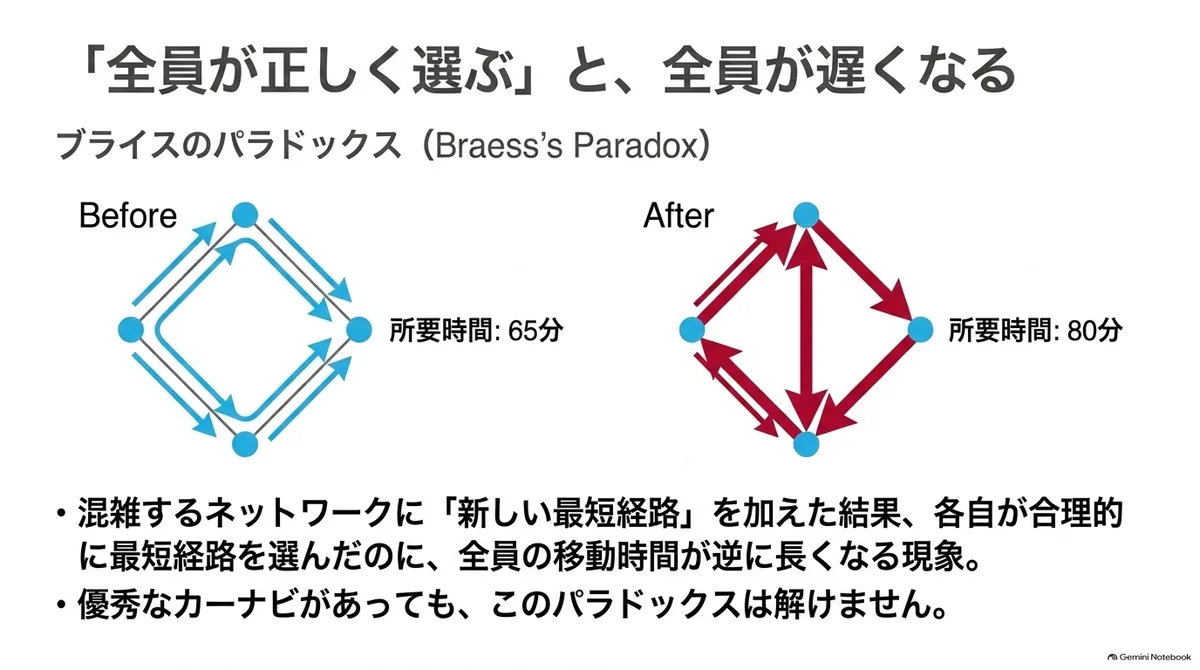
This is a story about structure, in which the equilibrium of rational individuals diverges from the overall optimum. In fact, model studies using real-time traffic information have also shown that navigation does not necessarily eliminate this kind of deterioration (Bittihn & Schadschneider, 2021). Therefore, even if everyone has an excellent car navigation system, this congestion will not be resolved.
However, most of the congestion that occurs when AI is introduced into an organization is, strictly speaking, probably not Braess's paradox. Braess's paradox is a phenomenon in which, with the total amount of traffic held constant, the whole becomes slower merely because each person switches routes. It also requires a special network shape, in which everyone abandons a wide road and moves to a detour passing through two narrow bridges in series.
The organizational congestion described so far, by contrast, is a phenomenon in which generation becomes cheap, the flow itself increases, and queues grow at the approval and verification bridges, which are essential from the start and have no detour. So it is more accurate to explain organizational congestion not as a reproduction of Braess's paradox but as a combination of induced demand, bottlenecks, and congestion externalities.
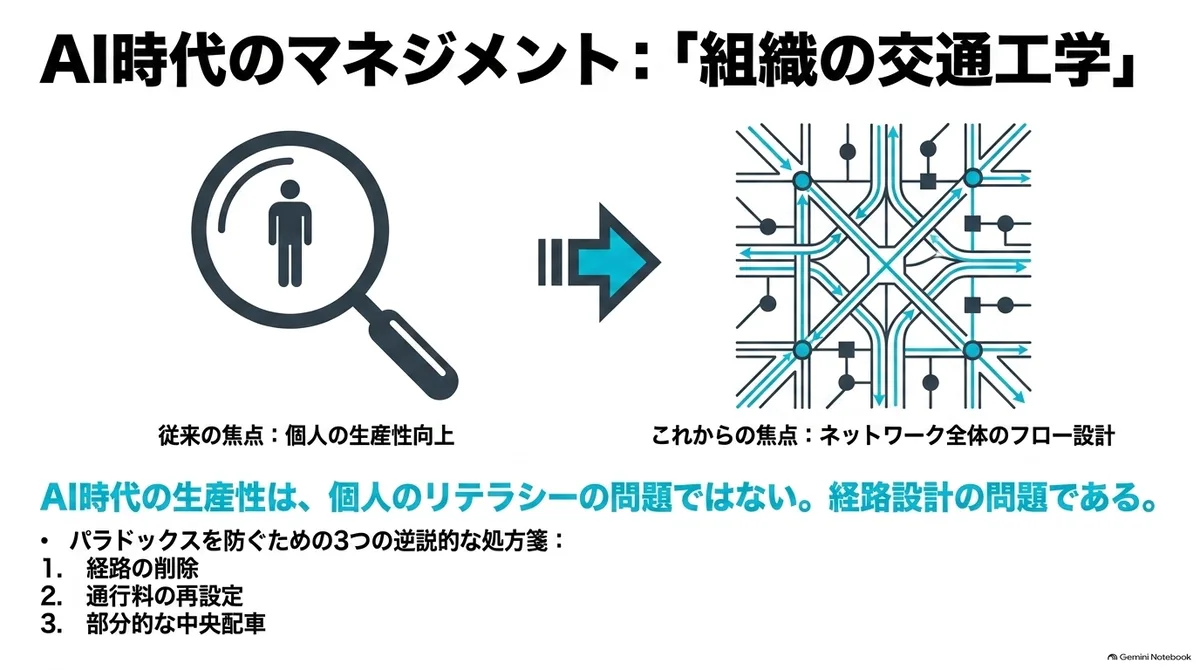
Even so, I introduced this example because I think two general lessons can be borrowed from it. One is that the flow of a network can run counter to intuition, and there are cases where "adding" does harm and "reducing" does good. Whereas bottleneck theory, which assumes the linear flow of a factory, tends to lead toward "strengthening the clogged point," in an organization seen as a network, deleting or restricting routes is also a candidate solution. The other is that even when everyone correctly chooses the shortest route, they may be unable to escape a bad equilibrium, and solving it requires intervention from a level above, in the form of designing routes and fees.
In other words, productivity in the AI era is a matter of route design, not only of individual literacy.
The Stronger the Front Line, the Easier It Is to Fall into This Trap
In AI adoption, it is often said to "start small on the front line first" and "spread it from the grassroots." It is also often pointed out that partially introducing only the technology is unlikely to produce results unless work and authority change at the same time.
In fact, in an experiment covering 66 companies and 7,137 people, generative AI (Copilot) users reduced their email time by about two hours per week, but no clear change was detected in the amount or composition of their work. This probably means that even if work that a person completes alone can be shortened, coordination with others and dependencies within the organization do not necessarily decrease automatically.
Furthermore, the discussion of congestion so far suggests one more, different thing. It is that grassroots adoption led from the front line not only yields zero effect but can worsen the lead time of the entire company through congestion of shared review processes.
Of course, this does not mean that "a top-down organization is safe." Rather, if the center gets the routes wrong, that affects a wide range all at once. Even so, one can fully form the hypothesis that this form of failure called "congestion" is more likely to occur in organizations whose entry points are dispersed and in which review processes are shared across multiple departments.
This view offers a slightly different perspective on the conventional wisdom that "our company will lose because its AI adoption is behind."
(※ However, the research so far has not demonstrated that company-wide AI adoption worsens the lead time of the whole organization. What the call center study measured was inquiry handling, and what the Copilot study measured was individual work patterns. Neither measured the lead time or quality of results for work as a whole, including review, approval, and decision-making. What this article presents is an unverified hypothesis that waiting times may grow when upstream inflow increases faster than downstream processing capacity. Added 8/12)
Tedium Was a Toll That Society Had Tacitly Imposed
Widening our view to society, the same structure appears on a much larger scale.
Take job hunting, for example. If AI makes writing application forms nearly free, it becomes rational for each person to greatly increase the number of companies they apply to. But the capacity of the narrow bridge, the selection slots at popular companies, does not change, so in an equilibrium where everyone increases their applications, the pass rate falls. Employers defend themselves with AI screening, and applicants increase their applications even further. As a result of everyone acting rationally, the hiring cost for society as a whole grows. Here too, the structure of the congestion externality is at work: each person's application is rational, and its cost is thinly spread across everyone waiting in the selection queue.
The same picture holds for sales emails, inquiry desks, public comments, and freedom of information requests. This kind of self-perpetuating cycle will spiral up not only the costs to each side but also social costs such as the electricity that powers AI. It is like how a drop in the cost of email increased spam, and regulation followed.
Let me bring in another perspective here: what has protected the processing capacity of these systems until now. One answer is the tedium of access, such as the effort of writing documents, the effort of going to a counter, and the effort of even learning that the system exists.
Many of society's systems have been protected from inflows beyond their processing capacity by an implicit toll called "tedium." In other words, ignorance and tedium have functioned as flow-control devices embedded in society. This can also be read as sludge (negative nudges) from behavioral economics and elsewhere having been at work, for better or worse (though mostly for worse).
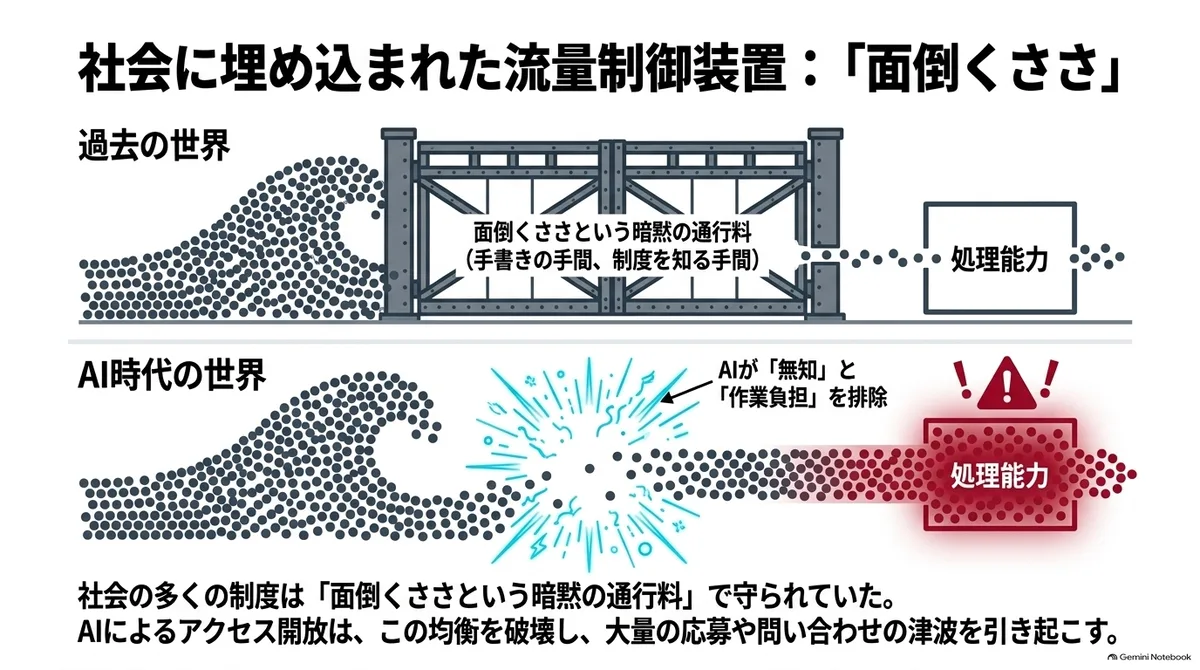
What makes AI different from earlier technologies is that it lowers both ignorance and workload over a wide range at the same time. Flows that lay dormant all over society will improve all at once. And what will be observed then will probably look like individual cases of institutional fatigue, such as "government offices have gotten slower" or "the hiring process has broken down," and the diagnosis that the equilibrium of the entire network has deteriorated will probably not be made easily.
So, once the implicit toll is gone, what can the institutions do? There are broadly four options.
- Increase processing capacity - automate the first-stage screening and shift routine processing to machines
- Set priorities - sort by reservations, lotteries, intake quotas, and urgency
- Impose a toll - charging fees, requiring deposits, and requiring applicants to provide a certain level of evidence
- Close routes - switching to referral-only, invitation-only, or membership-only systems.
A somewhat ironic consequence can be seen here: AI, a technology that opens up access, may bring closed networks back into favor. In a world where applications arrive without limit, accepting only referrals from trusted people becomes a rational defense for the recipient.
The Job of Management Is to Manage Flow
So what should companies and organizations do?
First, naturally, they should measure the flow of work from entrance to exit. They should check, after introducing AI, which steps saw increased inflow and where waiting time and backlogs arose. Individual work getting faster and the organization finishing one piece of work faster need to be thought of separately.
From the insights of traffic, four more prescriptions emerge.
The first is to widen the clogged bridge itself, eliminating the bottleneck in flow capacity. Examples are first-pass review by AI, automated testing, standardization, and delegation of authority. If downstream review and verification are made faster at the same time as upstream generation, congestion becomes less likely. Care is needed, though, because induced demand can occur.
The second is to narrow routes and entrances. Just as traffic was not paralyzed when Seoul removed the elevated highway, it is known in the world of traffic that when capacity is reduced, the demand side adapts. In organizations too, it is possible to unify submission routes into one, or to bundle review intake into scheduled batches. Once the queue becomes a single line, prioritization also becomes possible. By deliberately imposing restrictions, we may be able to make the whole faster.
The third is to introduce costs to control the flow. The standard prescription of transportation economics for the congestion externality has been charging for congested roads. It is known that appropriate charges can move the equilibrium produced by individual choices closer to a state that is desirable for society as a whole.
Applied to an organization, this means putting an internal price on congested routes. Examples include giving each department a budget quota for review requests, capping the volume of documents sent up for approval, and obligating drafters to provide evidence of self-verification. If AI has abolished the toll of tedium, then this time a designed toll is deliberately reintroduced. The point is that this can be considered not as mere bureaucracy but as a countermeasure to congestion of shared judgment capacity. That said, I expect considerable opposition from the front line on this, so caution will be needed in introducing it.
The fourth is partial central control. A method in which the center assigns only some of the flows and leaves the rest to each actor's judgment is treated in route-choice research as Stackelberg routing (an optimization technique that applies the Stackelberg model from game theory to network routing control). The effect depends on the shape of the network, but full centralization is not the only option. In a company, for example, this would mean coordinating across the whole company only the steps shared by multiple departments, such as legal, quality assurance, the management meeting, and proposals to key customers.
Seen this way, business opportunities also emerge. These include work that measures where work in progress is piling up in an organization, work that prices the internal markets of approval and review, and work that designs and operates closed networks based on referrals or invitations. AI will require capabilities from the viewpoint of "organizational traffic engineering," and new work for the management layer will be born. In doing so, insights from spontaneous traffic jams and the science of jamology may also be useful in some cases.
AI will enter the network of human intellectual work. When it does, just as one would think about a factory workflow, organizations in which people and AI are mixed will be required to keep carrying out the measurement and changes needed to improve the whole complex network of intellectual work.
Moreover, because these designs need to be continually changed while watching the performance improvements of AI itself, integrating AI strategy and HR strategy will be necessary.
Summary
Based on the insights of traffic, namely induced demand, bottlenecks, and congestion externalities, I have considered the congestion that may occur in an organization after AI is introduced.
In the short term, handing out AI itself will become a competition, and I do not think it should be stopped. But eventually, among the companies that have introduced it, we will need to verify whether this hard-to-explain phenomenon of "we handed it out, yet things got slower" is occurring.
At that point, I think whether a company can optimize its network structure and control its flow volume will show up as a bigger difference than differences in model performance. Just as research on congestion moved from "build more roads" to "design the flow," management using AI will eventually move in the same direction.
After handing out AI, I think checking whether the phenomenon of "we handed it out, yet things got slower" is actually occurring will raise its effect. And what divides competitiveness in the AI era may be not only model performance but the ability to measure and redesign the flow of the whole organization. When particular roads and cars suddenly become faster because of AI, remembering traffic engineering and starting by measuring at which narrow bridge your company's work is piling up may be one way to proceed.
(Added 8/9, revised 8/10: In the original version, I made Braess's paradox the main axis of the article, but I received several comments to the effect that "strictly speaking, this is not Braess's paradox." After consideration, I believe this point is valid. I have therefore reorganized the article so that induced demand, bottlenecks, and congestion externalities form the main axis, and Braess's paradox is positioned as one example from which a general lesson is borrowed. I considered cutting it, but since it has already been read by many people, I have left it in. Once again, thank you for pointing this out.)
(Revised 8/12: After receiving a comment, I revised the article further. I have added a statement that this remains an unverified hypothesis. I have also made other minor additions and corrections.)