Thinking About the Second- and Third-Order Consequences of AI
This article was machine-translated from Japanese by AI (Claude). It may contain errors. Read the original Japanese article.
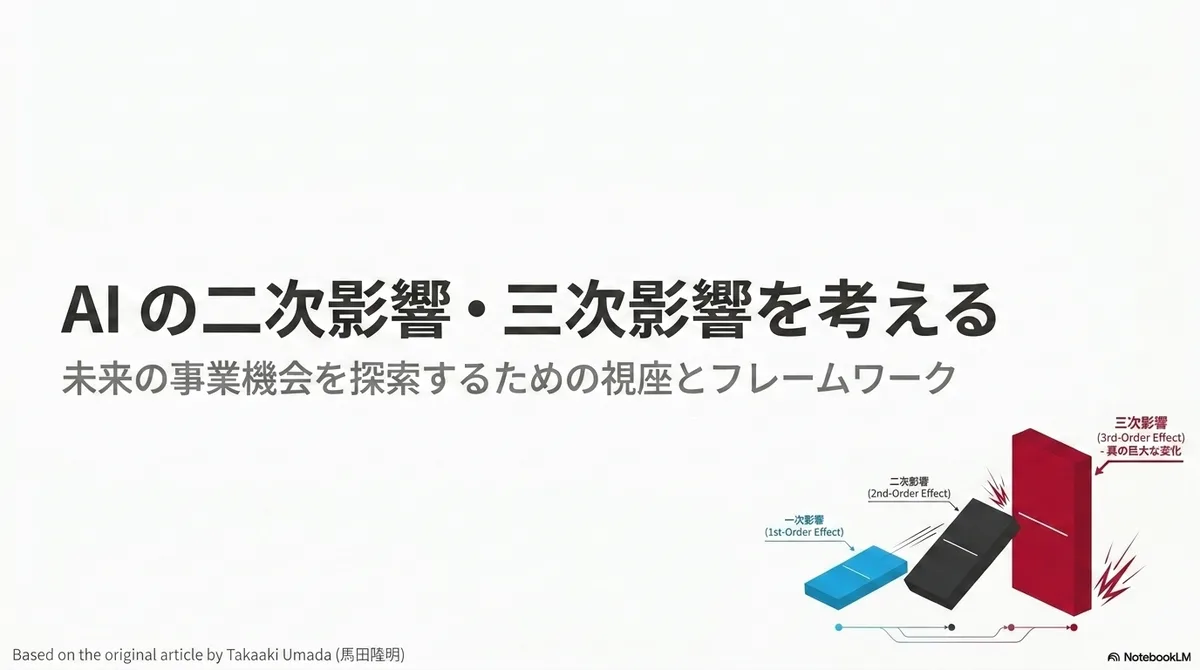
When a big change happens, second-order and third-order consequences follow.
The automobile was once a big change. Looking back now, its spread seems obvious, but at the beginning of the 20th century, many regarded the automobile as a hobby of the wealthy few, and apparently not many people were confident that it would become a mass-market product.
Even fewer people could have bet on the business opportunities around it, such as auto repair and insurance.
But what was truly hard to predict was the consequences one step further on.
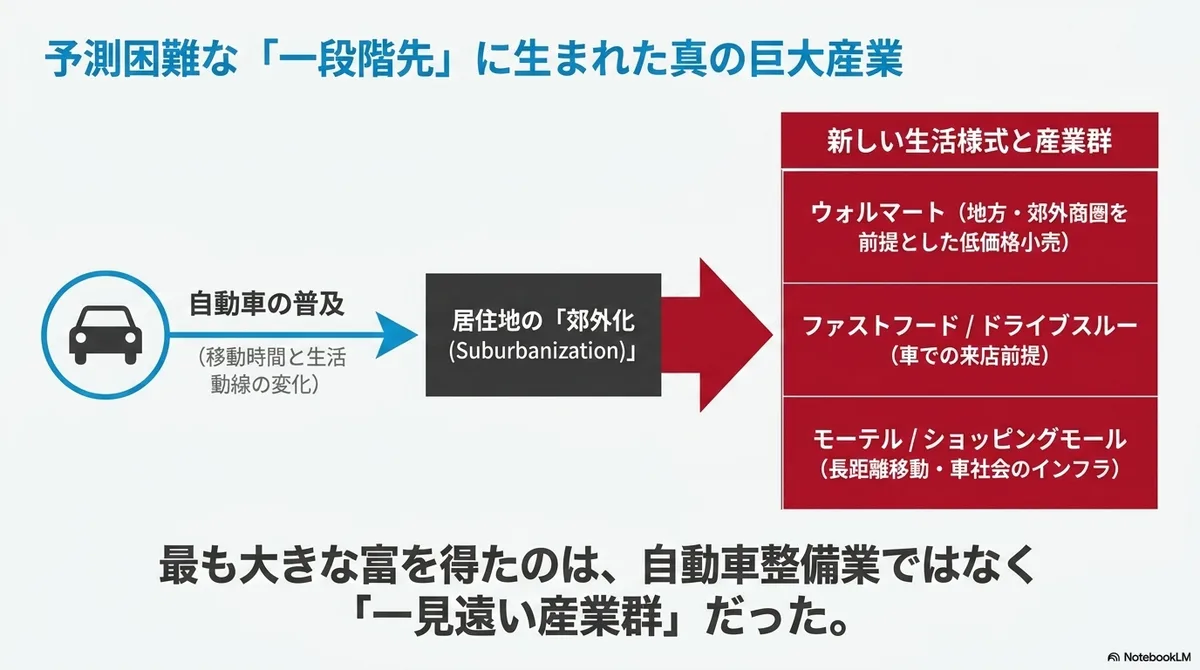
As having one car per household became the norm, people's places of residence spread out to the suburbs, and the value of land changed.
Moreover, because it changed travel time and the paths of daily life, opportunities expanded into things like:
- Low-price retail premised on rural and suburban trade areas, like Walmart
- Fast food and drive-throughs premised on customers arriving by car
- Motels that supported long-distance travel
- Shopping malls
- Networks of gas stations
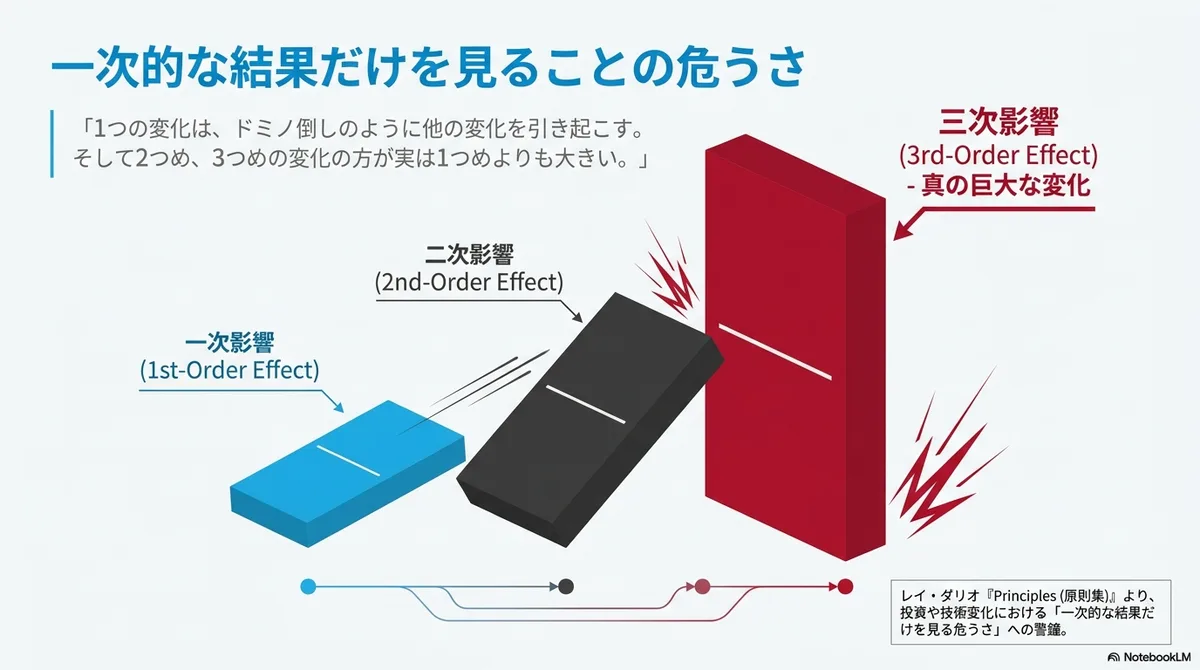
One change triggers the next like falling dominoes.
And the second and third changes can actually be bigger than the first.
In the case of the automobile, not only did the automakers themselves succeed, but wealth and opportunities were created around them.
And as the cost of travel fell ➡ land, roads, parking, fuel, and suburban commercial sites became relatively more important.
Among them, one could say that many of the industries that gained the most wealth were not the direct periphery, like auto repair, but a group of seemingly distant industries one step further along the chain of "automobile → suburbanization → a new way of life."
In Principles, Ray Dalio points out the danger of looking only at first-order consequences. I think this applies not only to investing and life, but also to how we look at technological change.
AI Moves the Bottleneck
These second-order and third-order consequences emerge because the bottleneck moves.
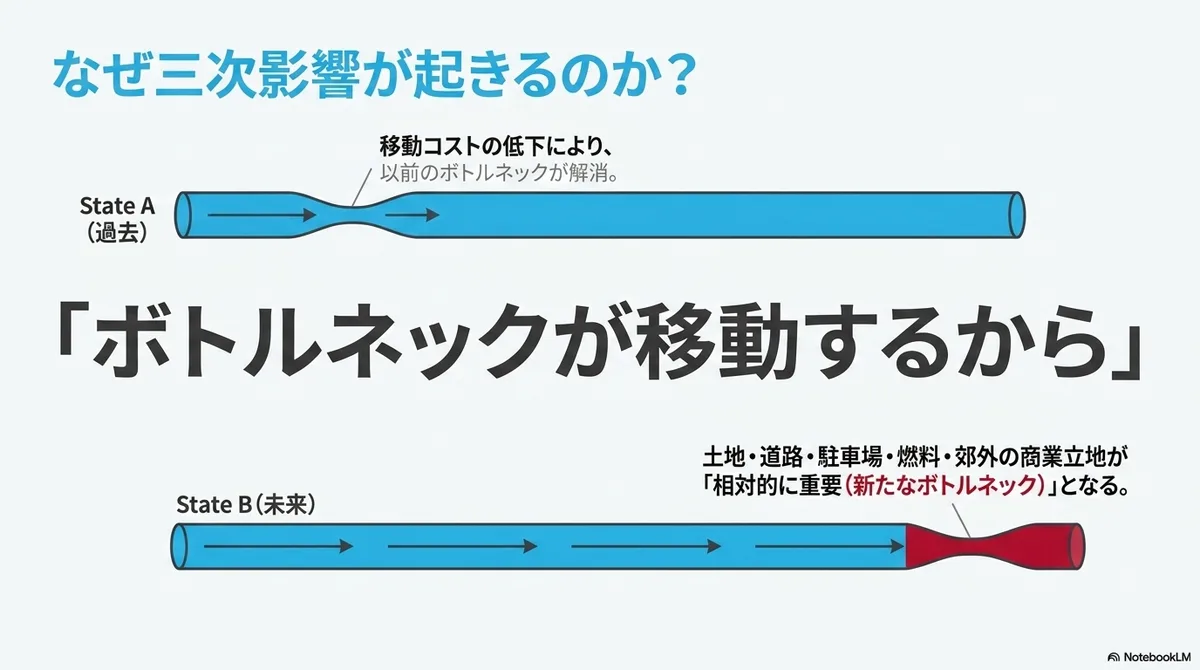
AI strikes me as exactly the kind of technology that can move the location of the bottleneck.
In today's discussions of AI, too, many people predict the spread of AI itself.
Some will predict the directly related needs for AI adoption, maintenance, operation, and consulting. How AI will change organizations is also being actively discussed.
But what the history of the automobile suggests is that the truly big opportunities may lie not in AI's direct periphery, but beyond the point where AI rewrites people's paths of daily life, their decision-making, and where value is created.
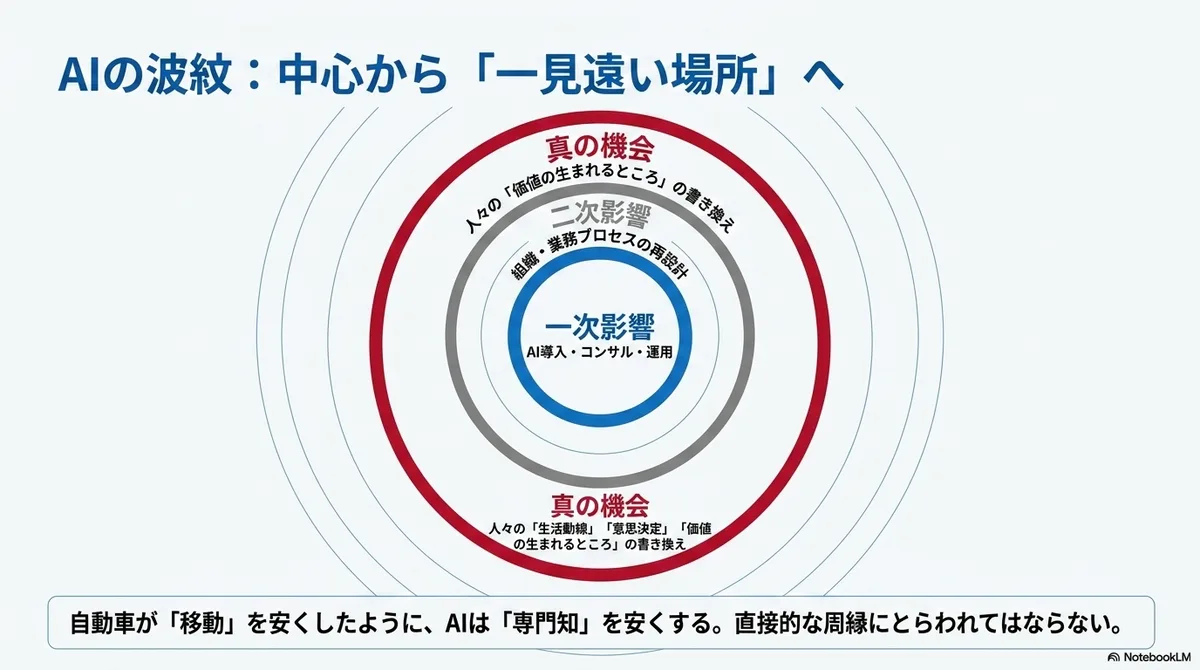
The automobile made travel cheap and made land, roads, and suburban commerce important.
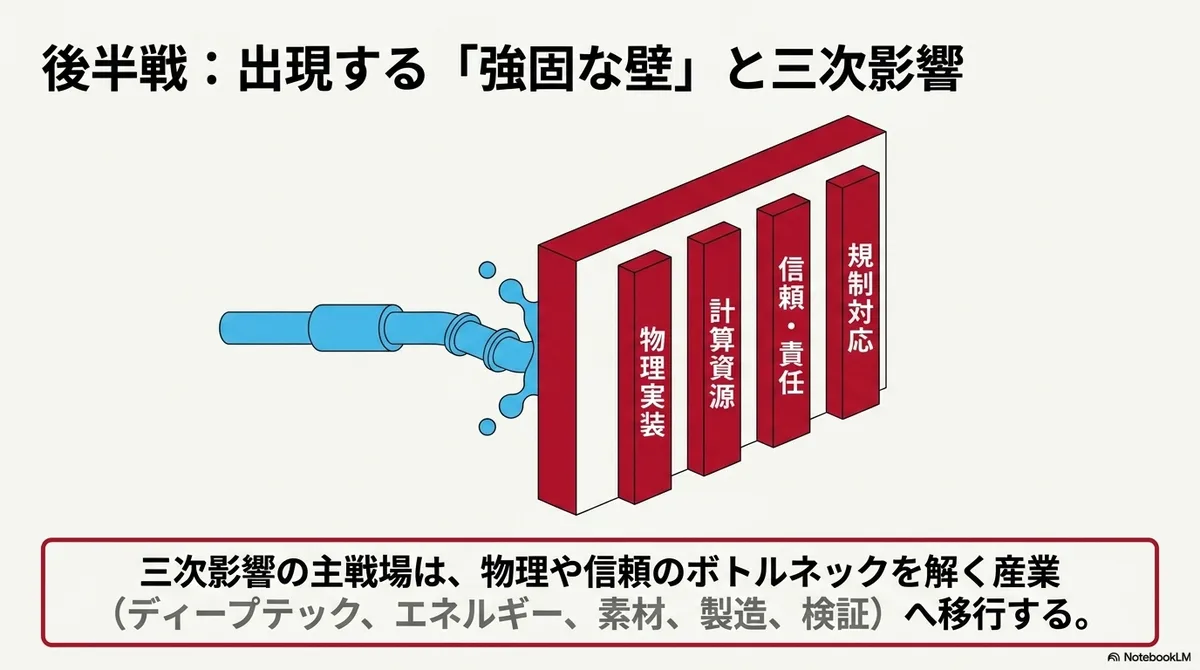
AI makes access to expert knowledge, generation, and trial and error cheap, and may turn physical implementation, trust, computing resources, regulatory compliance, and the like into new bottlenecks.
I think that with this way of thinking, we can predict a variety of other consequences as well.
In an earlier article, I captured the change now beginning to unfold, "when experts' skills become cheap, the bottleneck of expertise dissolves, and innovation on the physical side, which had been clogged, begins to happen," and organized it as follows.
Perspective | Automobile | AI |
Cost that fell | Cost of travel | Cost of expertise, judgment, generation, and coordination |
First-order consequences | Automakers, repair, fuel, roads, auto loans, auto insurance | AI models, AI adoption support, AI operations, AI consulting |
Second-order consequences | Suburbanization, roadside commerce, the normalization of long-distance travel | Non-experts entering specialist fields, smaller organizations, work designed around AI |
New bottlenecks | Land, roads, parking, fuel, logistics | Computing resources, physical implementation, regulation, trust |
Third-order consequences | Suburban retail, drive-throughs, motels | Industries that resolve physical and trust bottlenecks (deep tech, energy, materials, manufacturing, verification, accountability) |
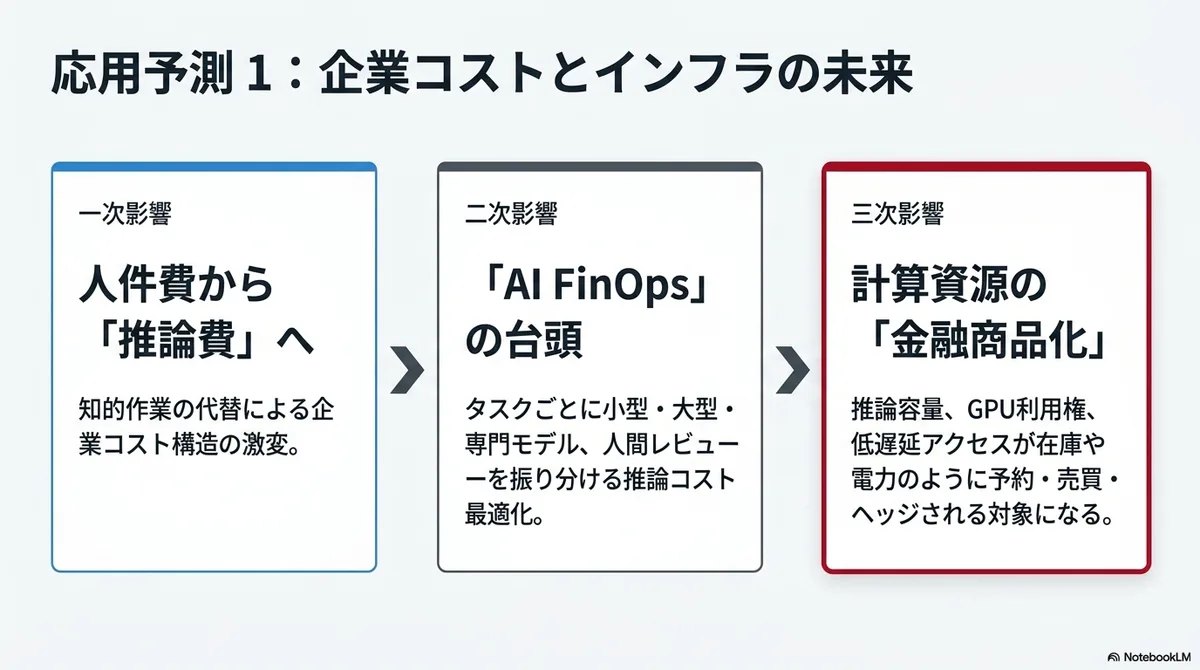
Beyond that, one could also come up with ideas like the following.
- First-order consequence
AI replaces part of human intellectual work, and in companies' cost structures, "inference costs" become a major item alongside "labor costs." - Second-order consequence
Because using the highest-performance model for every task is too expensive, "AI routing," "AI FinOps," and "inference cost optimization," which allocate each task among small models, large models, specialized models, and human review, become important. - Third-order consequence
Inference capacity, GPU access rights, priority execution rights, and low-latency access become things that are reserved, traded, and hedged, like cloud reserved instances or power contracts. In time, they may come to be treated not as mere IT costs but as objects of management closer to inventory, electric power, and financial products.
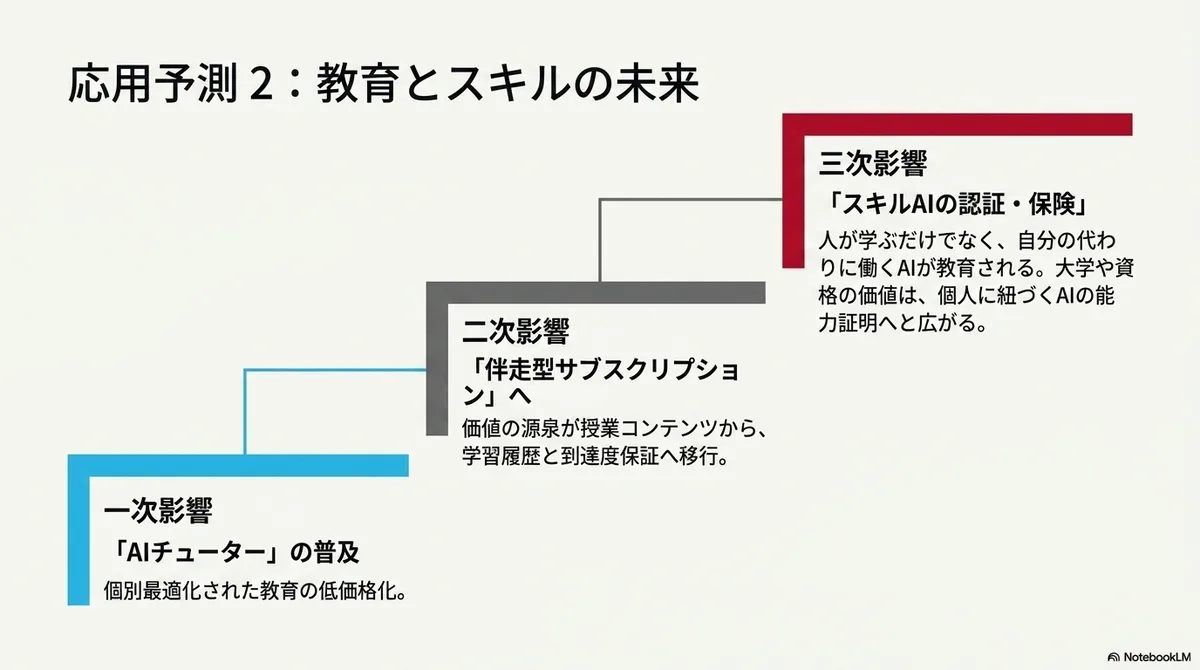
The following could also happen in education.
- First-order consequence
AI tutors make education tailored to each individual learner available cheaply. - Second-order consequence
The value of education shifts from "lesson content" to "a companion AI optimized for each learner," "learning histories," and "guaranteed attainment." Education becomes not a product bought outright over a few years but a continuously updated subscription. - Third-order consequence
Not only do people learn, but "AI that works on their behalf" is also educated. The value of universities and credentials expands into "skill AIs" tied to individuals, and into the evaluation, certification, and insurance that prove their abilities.
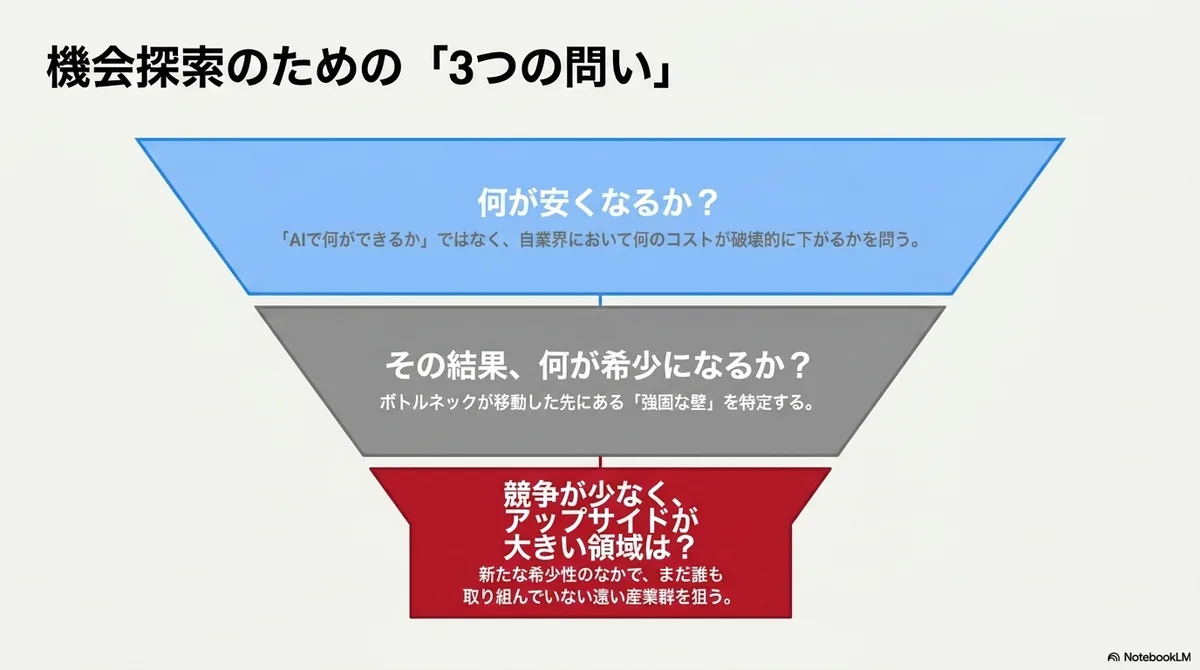
Thinking Through to Third-Order Consequences: What Becomes Cheap, and What Becomes Scarce?
Because this wave of AI affects a wide range of specialist fields, I think the bottleneck may begin to move in many industries.
What are the second-order and third-order consequences of AI that you can think of?
It means thinking not only about "what AI will make possible" but about "what AI will make cheap," and conversely, what will become scarce.
Going further, among the things that become scarce, where are the overlooked areas with large upside and little competition (that few people are working on)? And "when" will that change in the bottleneck arrive?
By making such predictions, you may be able to find big opportunities even now.
Think about the second-order and third-order consequences of a change, and think about where the bottleneck will move.
I think that can be a hint for finding the even bigger business opportunities that lie beyond AI's big change.