Not "Cutting Headcount with AI" but "Expanding TAM with AI"
This article was machine-translated from Japanese by AI (Claude). It may contain errors. Read the original Japanese article.
In recent discussions of AI startups, the talk of automation and efficiency, such as "with AI you can generate the same revenue with a fraction of the people," tends to draw the most attention. For Silicon Valley companies, which face high labor costs and compete in huge markets, being able to generate large revenue with a small team is an important point, one that can become a major competitive advantage.
However, in the context of Japanese SaaS, especially vertical SaaS and business software, I think there is a bigger issue.
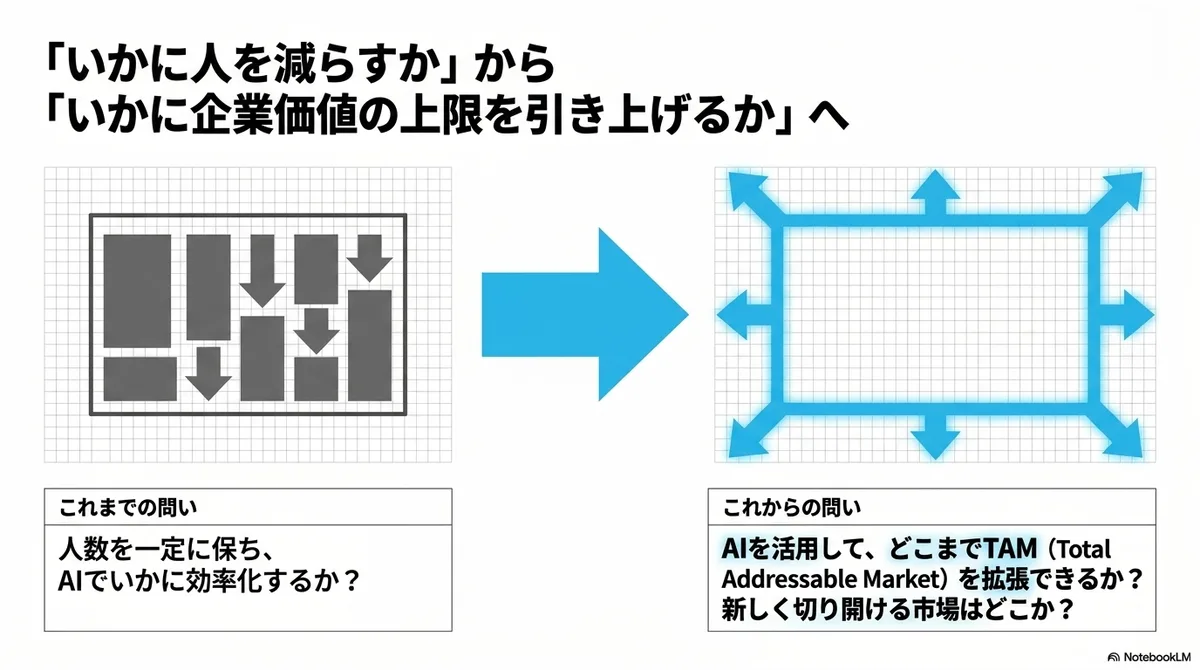
It is not "how many people can we cut with AI," but "how much can AI raise the ceiling on company value." To put it more precisely, it is a discussion about:
- How to use AI to make TAM larger
- Where AI can open up new markets
Background
As background, one of the big discussions in Japan's startup ecosystem is the problem of the "¥10 billion market capitalization" on the Tokyo Stock Exchange Growth Market. The problem is that companies have a hard time getting past that wall.
I think the reason such companies are valued low has less to do with whether a startup's profit margin is high, and more to do with the small ceiling on the ARR reachable in a single market, the small room for growth after listing, and the small maximum market size one can expect.
Considering this, the discussion that should take place more in Japan is not one about
- Making operations more efficient with AI
- Needing fewer people with AI
- Growing while keeping headcount constant
which are discussions about "raising profit or revenue by tens of percent," but about how far we can expand TAM with AI and raise profit and revenue by an order of magnitude.
How to Expand TAM with AI
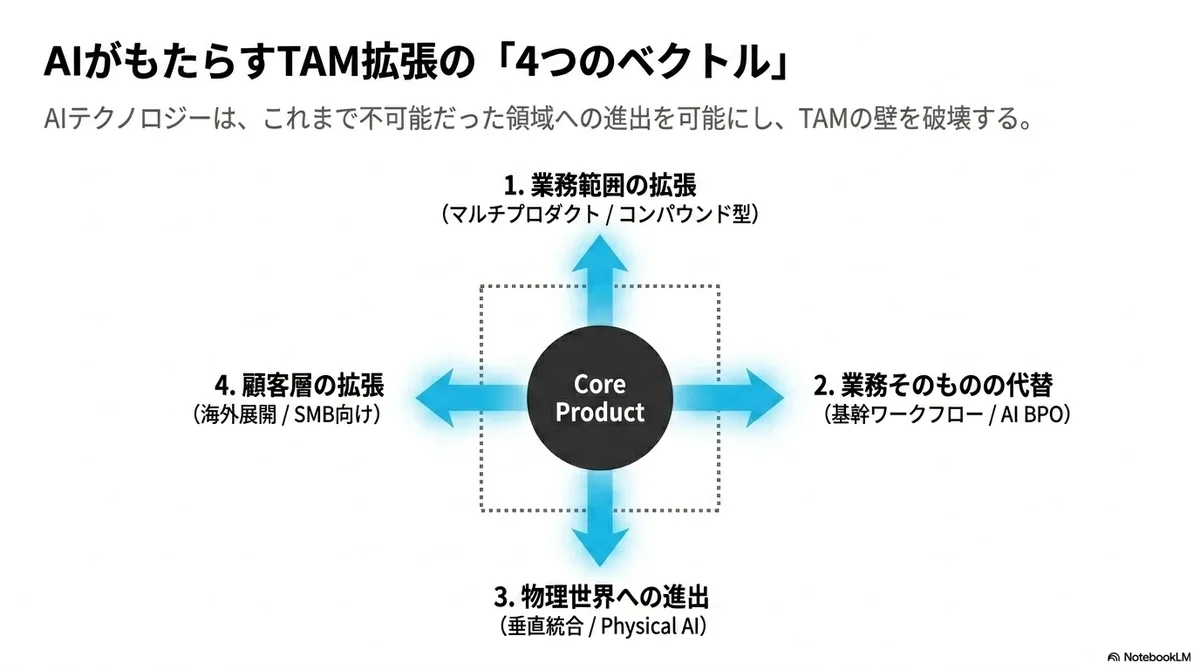
Fortunately, I think AI can also make it possible to expand TAM.
For example:
- Becoming multi-product or compound, and expanding the range of operations you target
- Taking over core workflows and work such as BPO
- Vertical integration
- Getting involved in hardware, as in Physical AI
- Expanding the customer base through overseas expansion or SMBs
I think these are all possible with support from AI.
There are probably various other methods besides these, but it looks to me as though AI is making it possible for some businesses to expand their TAM. (That said, in vertical markets, I think TAM doesn't easily grow even if you build multiple products, and not every approach will necessarily be effective.)
And I believe that this is the way to raise expected company value.
Expanding TAM or Expanding Profit Margin
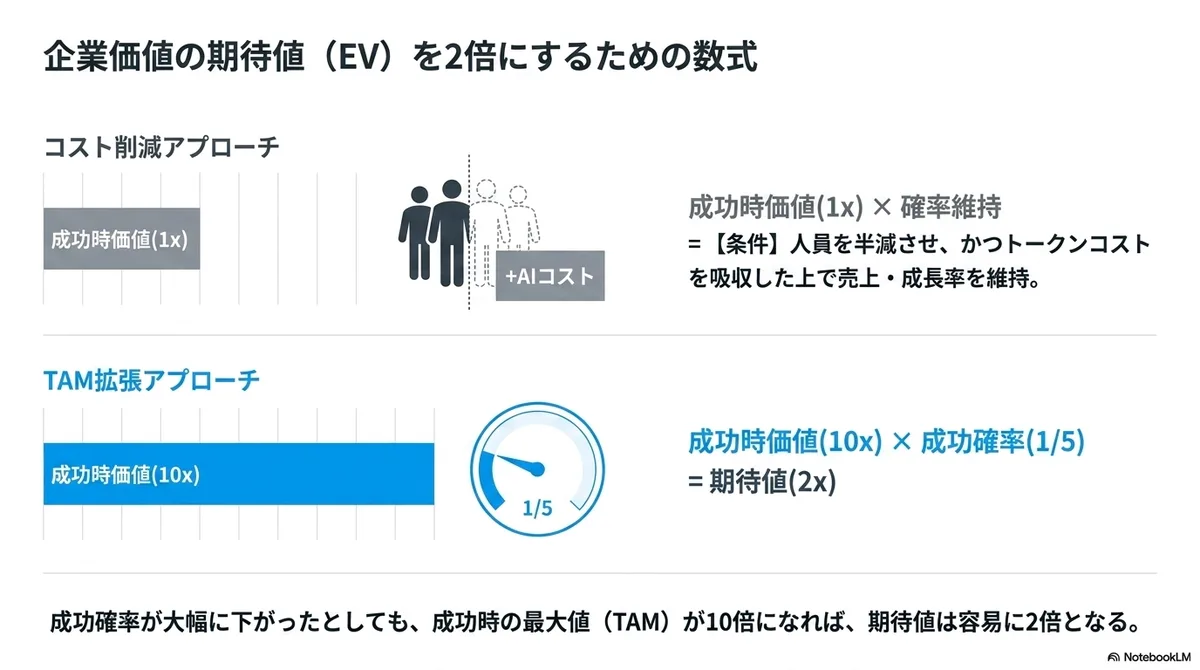
In simple terms, if the maximum company value upon success becomes 10 times larger, the expected value stays the same even if the probability of success falls to 1/10. But if the maximum company value upon success becomes 10 times larger and the probability of success only falls to about 1/5, the expected value doubles.
On the other hand, if many software companies aim to roughly double their expected company value, then, holding the company value upon success constant, they would need to cut headcount by about half while maintaining revenue and growth rate. And since token costs take the place of labor costs, they might need to cut even a bit more.
Tactics or Strategy
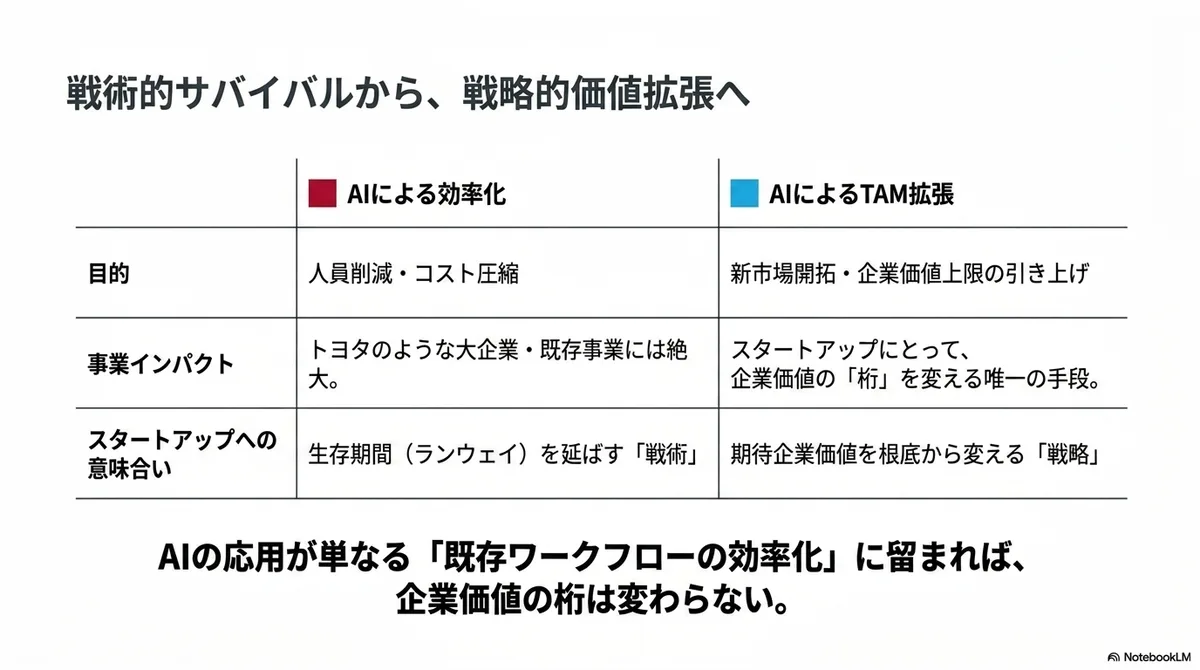
The cost-cutting discussion has an impact for large companies like Toyota, with large-scale businesses whose business models are already established, but for startups it is in most cases a discussion about extending their runway.
Unless supply is the bottleneck or demand changes drastically, if the application of AI ends up as merely making existing workflows more efficient, it rarely becomes a discussion that changes the order of magnitude of company value.
And in most cases, cost reduction and workflow improvement are matters of tactics. By contrast, "how do we use AI to raise company value by an order of magnitude" is a strategic-level discussion, and what matters when raising company value by an order of magnitude is the strategic-level discussion.
What Does AI Make Possible?
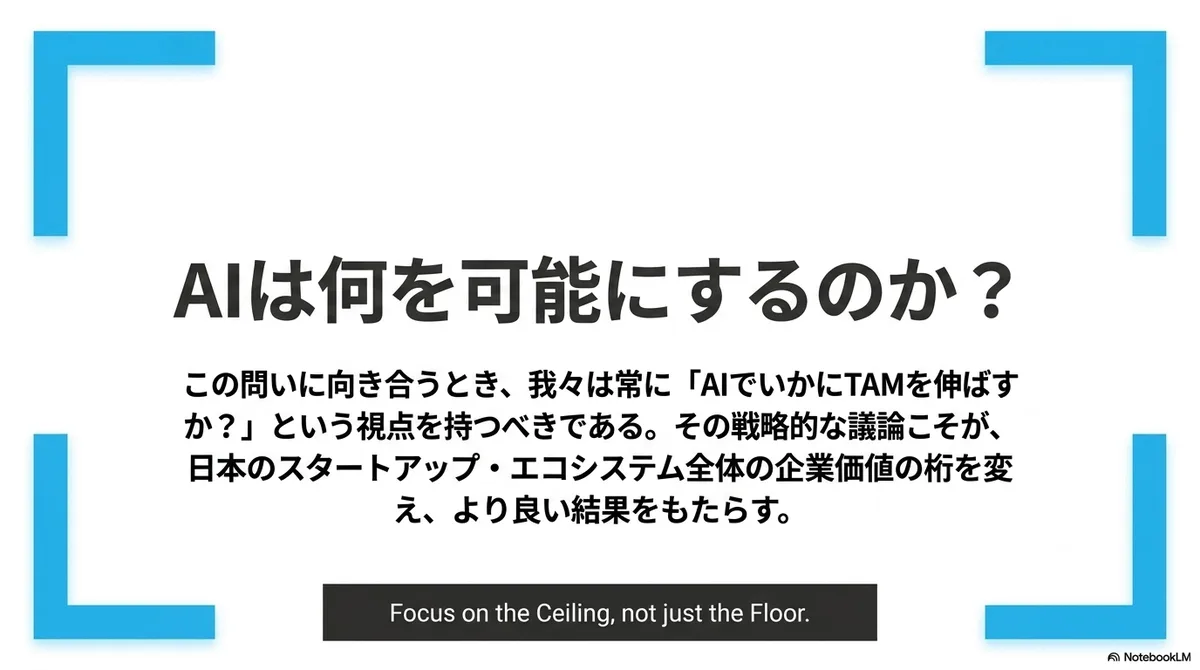
In that sense, I thought that when asking "What does AI make possible?", holding the question "How can we expand TAM with AI?" and discussing it would lead to better results for the Japanese startup ecosystem as a whole, so I am leaving this as an article.
(Of course, if AI automation fundamentally changes workflows, as with electrified factories in the past or the expansion of the taxi industry by Uber, TAM might also expand greatly, but I think the impact is large only in areas where there is hidden demand and supply is the bottleneck.)
Also, in this article I have been contrasting efficiency through AI (improving profit margin) with the expansion of TAM, but I think they are not in opposition and that you can do both, so I will add that note at the end.
Related articles
Thinking About the Second- and Third-Order Effects of AI - 🐴 (Horse)
What Happens When Expert Skills Become Cheap, and What Is Starting to Happen - 🐴 (Horse)