What Happens When Expert Skills Become Cheap, and What Is Happening Now
This article was machine-translated from Japanese by AI (Claude). It may contain errors. Read the original Japanese article.
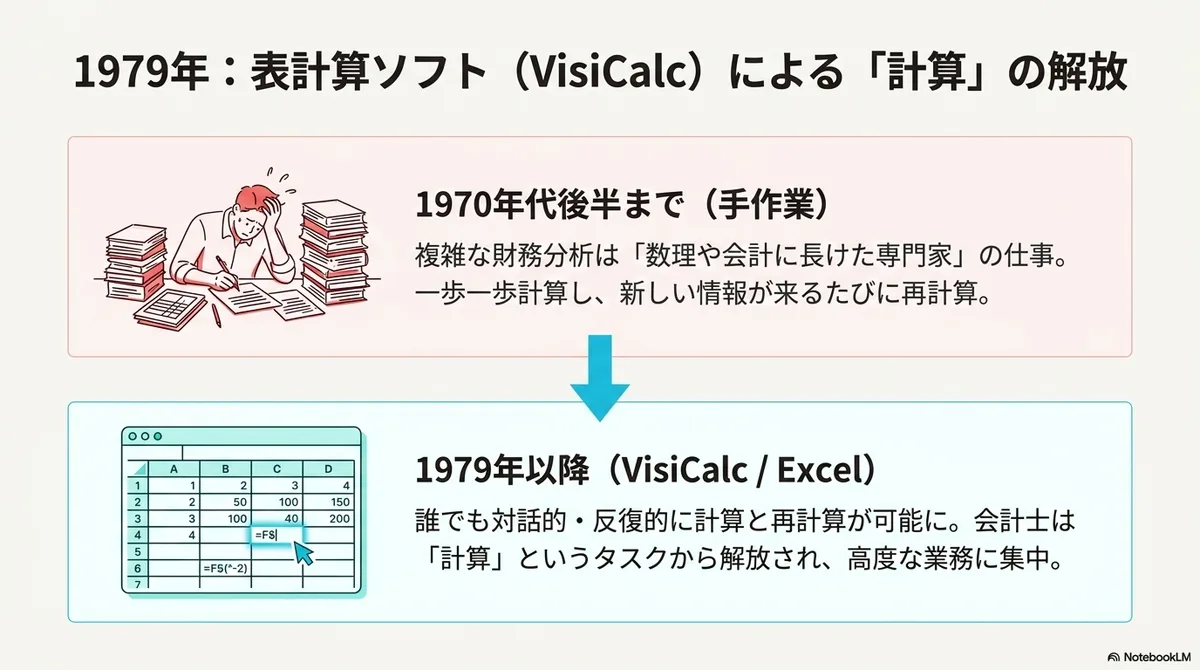
Until the late 1970s, complex financial analysis was the work of specialists.
People skilled in mathematics and accounting handled complex formulas, checking at each step that the calculations were right, and when they noticed a mistake, they went back and redid everything from the point where it went wrong. Even when the calculations were correct, they had to recalculate whenever new information or figures arrived.
Only by repeating this work could they finally grasp a company's exact financial position, and management improvements and investment decisions were made on that basis.
A VisiCalc screenshot is available here: https://commons.wikimedia.org/wiki/File:Visicalc.png (Public Domain)

Amid this, Dan Bricklin, who was taking a finance class at business school, conceived of a spreadsheet program (VisiCalc) out of the pain of recalculation. He developed it in two months at the end of 1978 and began selling it in 1979.
After VisiCalc came spreadsheets such as Lotus 1-2-3 and Excel, and as they spread, many people became able to do calculation and recalculation interactively and iteratively.
It is fair to say that spreadsheets made the tasks of accountants and others skilled at calculation more efficient, and reduced them. In some cases, they may have eliminated not just tasks but the jobs themselves.
But as is often said in today's discussions of AI, it also meant that people could spend their time elsewhere. Spreadsheets freed accountants from the task of calculation and let them concentrate on work requiring more advanced expertise.
But it did not end there.
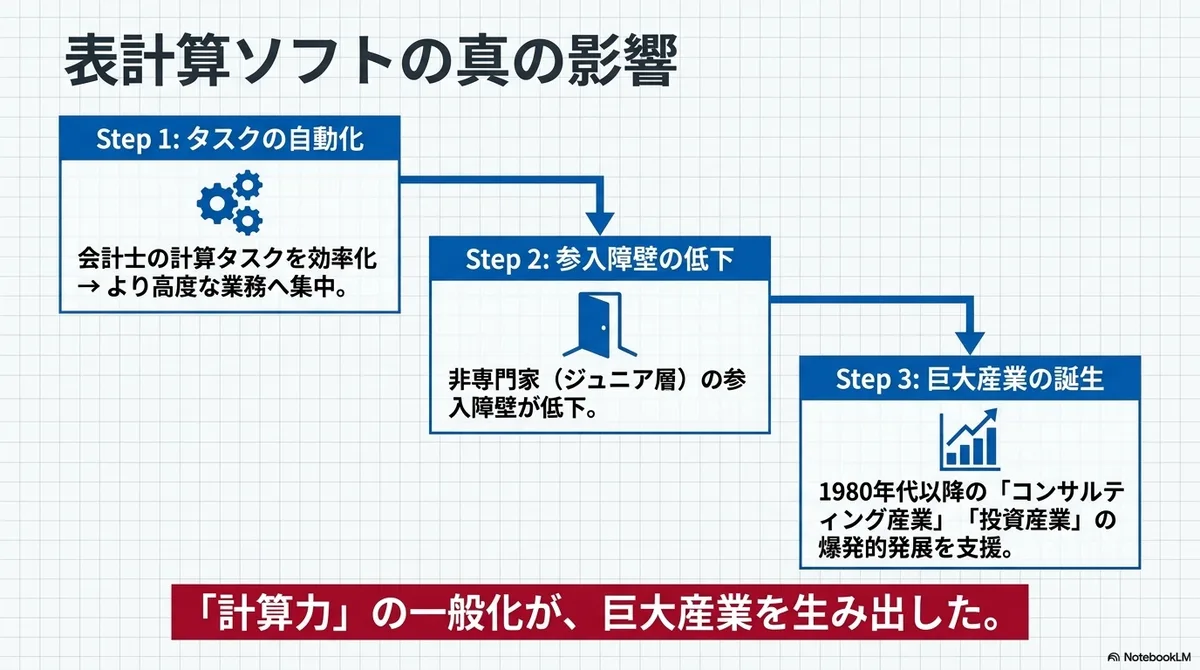
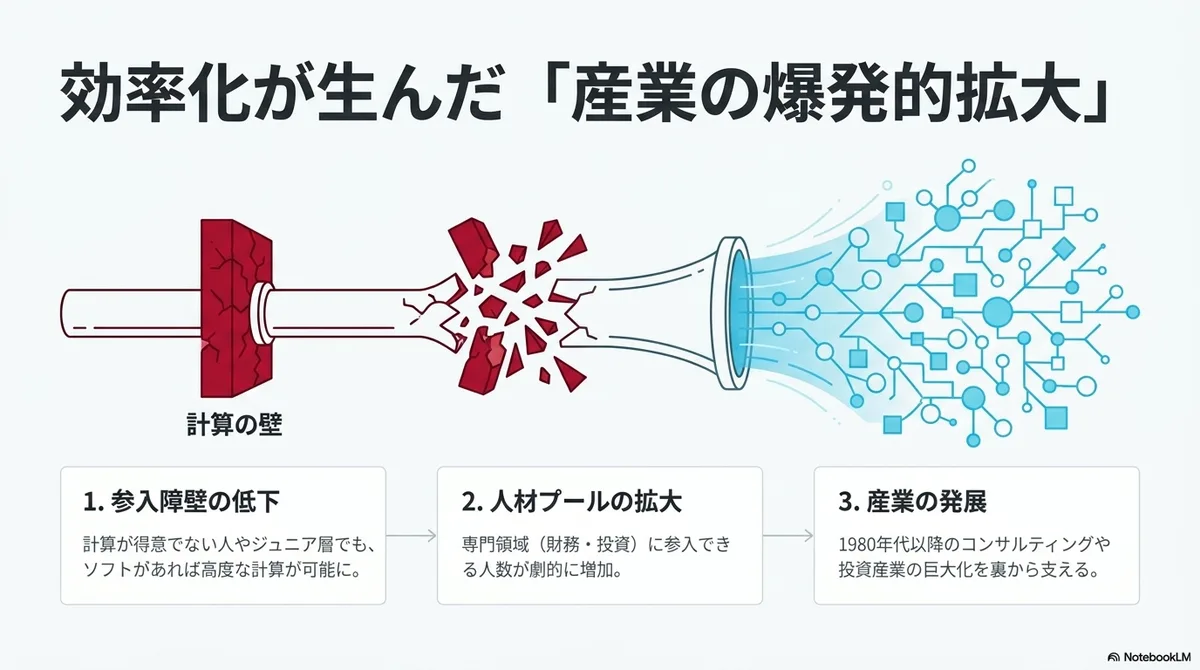
Spreadsheets supported the growth of the consulting and investment industries from the 1980s onward. Even people who were not especially good at calculation, or junior staff, could do a certain amount of calculation as long as they had the software, and so the number of people who could enter that work grew.
Although spreadsheets cannot be called the biggest factor in the growth of the consulting and investment industries, it is fair to say that behind the growth of these industries from the 1980s onward lay this generalization of "calculation" by spreadsheets.
Those who actually made large profits were the software companies that provided tools that made calculation easier, and "the people who made good use of the power of generalized calculation."
What if AI provides diverse expertise beyond software?
Just as spreadsheets once generalized calculation, AI is now about to generalize the intelligence and skills of various experts. This will have a number of effects.
In a recent article, "What Happens When Software and Intelligence Become Cheap," I introduced a software version of the Jevons paradox. That is what can happen when the skills and intelligence of software engineers are generalized.
But AI also provides intelligence "other than" software development. At present, its application is advancing first in the software domain, but its influence will probably extend to other kinds of intelligence as well.
And whereas spreadsheets were a replacement specialized in the skill of calculation, the capability of today's AI is that almost every area of expertise is a target (up to a certain level).
So in this article, I would like to summarize what will happen if the intelligence and skills of other experts are generalized, and, as signs of that, what is beginning to happen around me right now.
"What would you do if experts were cheap and available right away?"
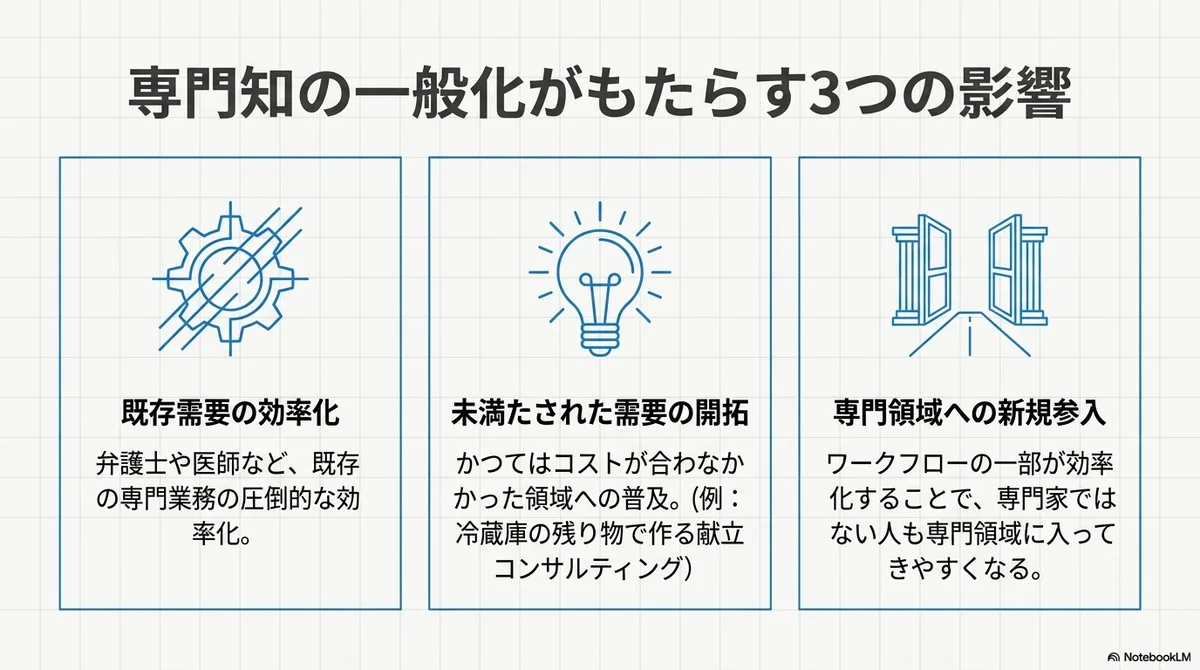
One change that will probably occur is greater efficiency in existing demand. For example, it will become possible, to some extent, to make the work of lawyers and doctors more efficient.
Beyond that, spread into places where demand had gone unmet can also occur. Like light and light bulbs in the past, products that have become cheaper begin to be used even where the cost-performance had not worked before.
In the case of AI today, cooking consultations such as "a meal plan I can make from tonight's leftovers in the fridge that my kids will enjoy eating" are an example of expert intelligence and skills reaching places they never reached before. The fact that this article can now use so many explanatory images is also because the cost of generating them has fallen sharply (until now they were made by hand).
And as in the spreadsheet example above, when expert skills are generalized, the work that uses them increases. As part of a workflow becomes more efficient, opportunities grow in the areas that use it as a component, and people who are not experts also find it easier to enter specialized areas than before.
What happened with spreadsheets was that the consulting and investment industries, which could answer well the question "What would you do if calculators were cheap and available right away?", gained wealth.
If so, the important question now is also "What would you do if various experts were cheap and available right away?"
In fact, working in startup support, I feel that the same thing that happened when VisiCalc lowered the barriers to entry into the accounting and investment industries and led to the expansion of the consulting and investment industries may now be happening in the deep tech domain because of AI.
AI for Engineering: What Is Beginning to Happen in Deep Tech Startups
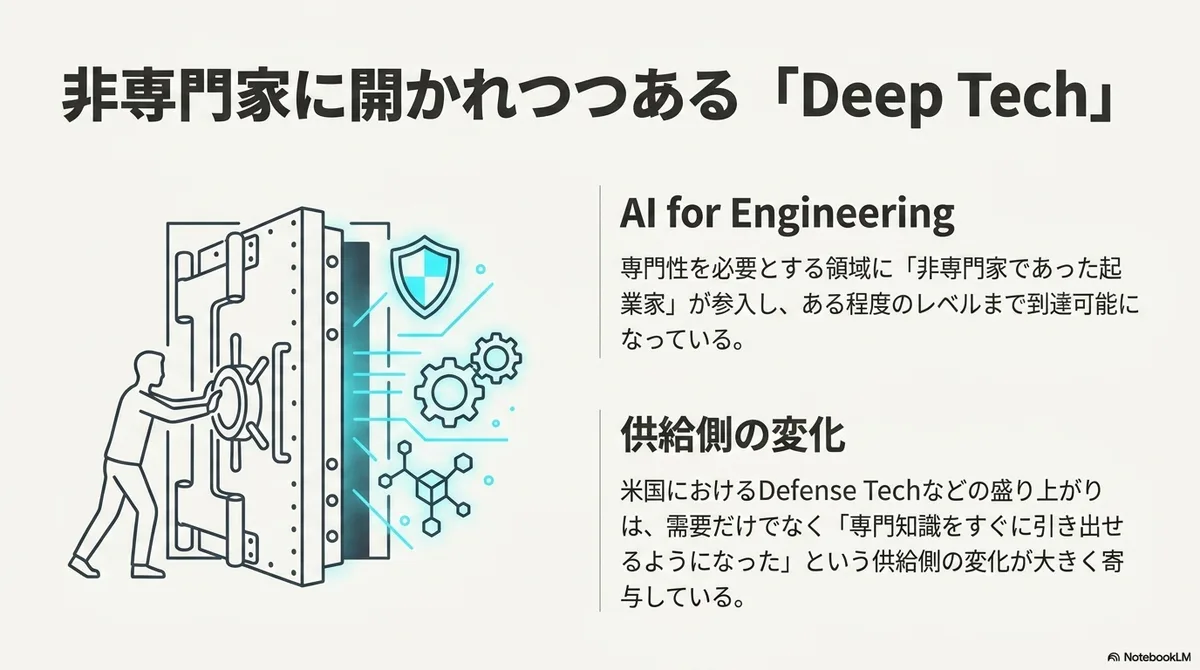
The area called AI for Engineering will first greatly help the experts themselves, just as calculation became easier for accountants.
And what will happen next is that, as with consulting and investing, work that uses that capability as one component will increase.
In fact, what I sense as a sign while supporting deep tech startups in their early stages is this change: entrepreneurs who were non-experts in the field can now, as long as they work hard, quickly reach a certain level even when they enter an area that requires expertise.
For example, before, when someone tried to start a business outside their own area of expertise, this is what happened.
Spend several days looking for an expert in the field, ask that person, and wait several weeks. A single hypothesis test takes several weeks.
With ChatGPT, it now looks like this.
Even for somewhat difficult questions, a desk-based verification is done in an hour or two
In particular, I feel that models since ChatGPT 5.2 Pro, released in December 2025, can handle numerical verification work at a fairly advanced level.
Generative AI has long been said to be "weak at verification," but hallucinations have been reduced considerably, and it also performs, with a certain degree of accuracy though not perfectly, simplified techno-economic analysis and work that rebuilds things from the ground up in the manner of first-principles attempts.
Moreover, if you have it output results in Excel or the like, you can correct the numbers yourself if the AI got them wrong.
Recently, cases have also emerged such as a series of cases in which Terence Tao, a Fields Medal winner, worked with GPT-5.2 Pro to solve open Erdős problems (January 2026). This means that the most advanced models today have risen to a level where they are useful as "a tool that quickly disposes of problems solvable with standard techniques."
Contrasting this with VisiCalc, I think it comes to the following.
Past (when Excel appeared) | Present and future (when AI appeared) |
The bottleneck of calculation | The bottleneck of expertise |
Generalization of the accountant's profession | Generalization of the intelligence of experts in each field |
Expansion of the talent pool for consulting and investment | Expansion of the talent pool for deep tech entrepreneurs |
Looking at startups in the United States and Europe, areas such as Defense Tech are heating up. Although the change on the demand side is the biggest factor here, I also feel that it would not have happened without the change on the supply side, that AI has made it possible to "draw out expertise right away."
I think this can also be called one example of AI for Engineering.
Deep Tech Opening Up to Non-Experts
When specialized skills become easy to use, many more people can enter the areas that use those skills as components. In deep tech, this means that the room for non-experts to enter entrepreneurship in the deep tech domain is wider than ever.
And in fact, even in a startup support program that helps with idea exploration, I feel that examples are beginning to appear of non-experts in the deep tech domain who, with the help of AI, acquire specialized knowledge and get through the first early-phase hypothesis testing at a speed never seen before.
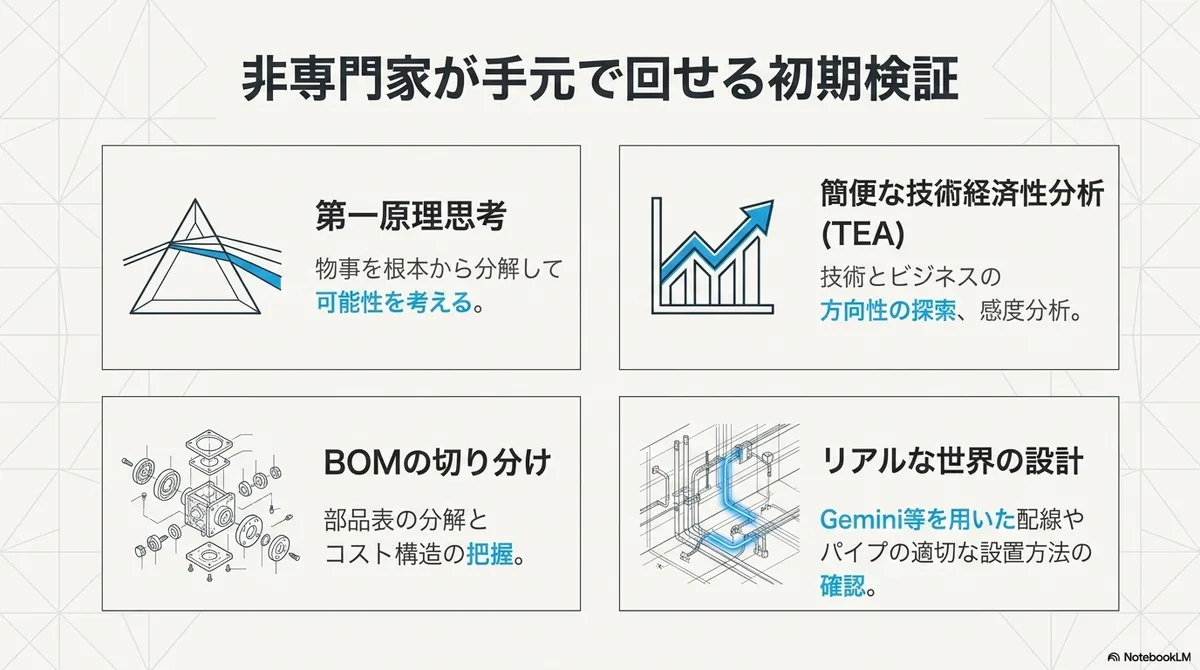
For example, the following tasks can be carried out with a certain degree of accuracy.
- First-principles thinking (breaking things down from the ground up to consider how far something is possible in the first place)
- Simplified techno-economic analysis (TEA) and sensitivity analysis
- Exploring business and technology directions
- Breaking down the BOM
- (Listing applicable subsidies and the like)
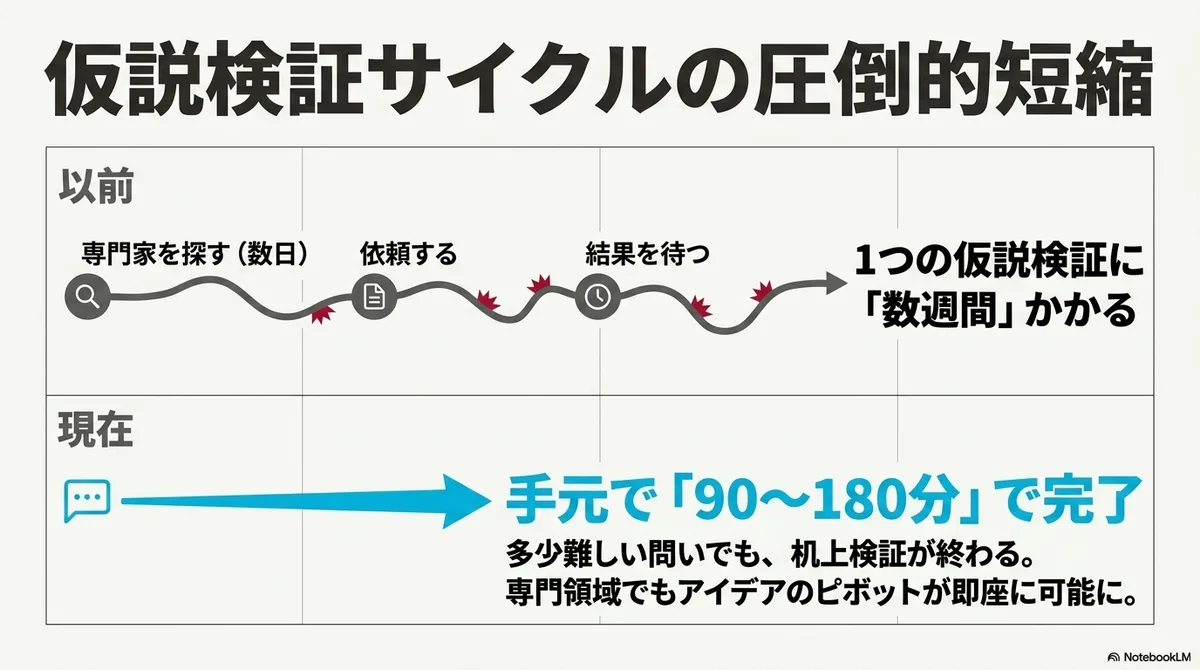
This means that the early desk-based verification that used to be commissioned from experts, or that required hiring part-timers to spend several weeks calculating, can now be run on your own in 90 to 180 minutes.
Changes like this have also made it possible for non-experts to test ideas in parallel. Just as spreadsheets such as Excel made recalculation easy, pivoting ideas is becoming possible even in specialized areas.
That is not all. Even for how to properly install wiring and pipes in the real world, if you take a photo and ask Gemini, it will tell you to some extent. In other words, even in actually making things, using AI now lets you get fairly far.
Of course, it cannot be used in areas like drug discovery that use cutting-edge knowledge the AI does not know, and in fine-grained know-how it still cannot match experts. When doing dangerous work, expert advice will be necessary. Still, for checking a rough direction, considerable time savings are now possible.
A Prompt Library for Deep Tech
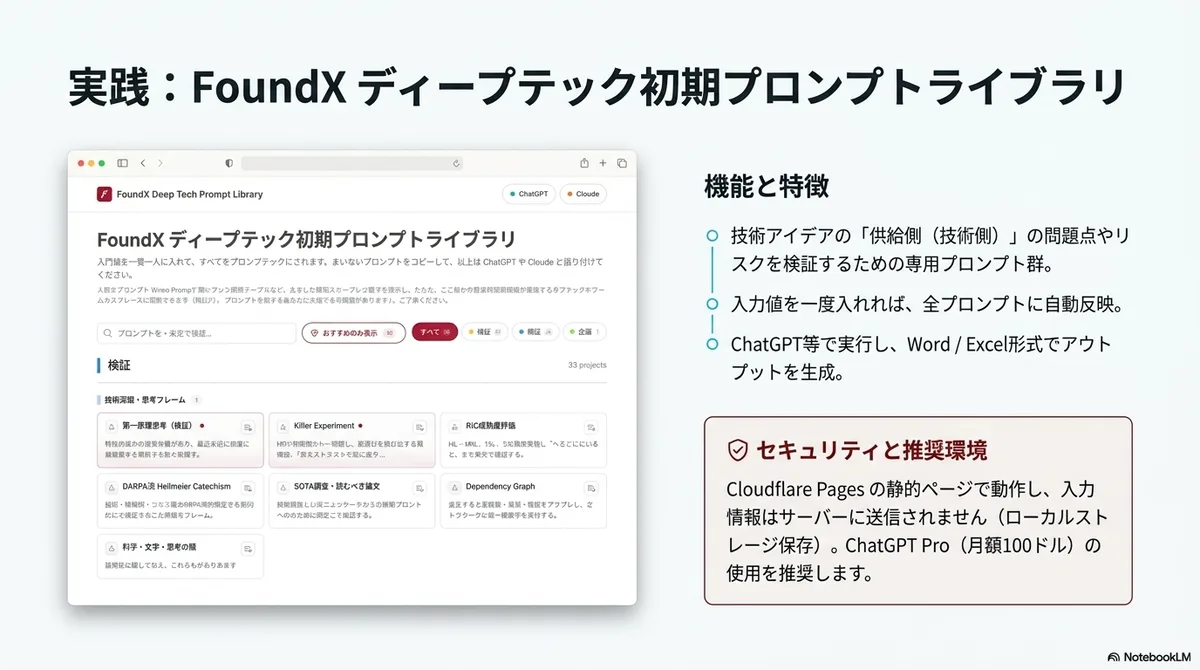
With these technical advances, I have recently often used ChatGPT Pro to analyze areas relevant to the entrepreneurs we support.
So this time, we have published the prompts and other materials we use as the FoundX Deep Tech Early-Stage Prompt Library.
Try the FoundX Prompt Library →
This library stores prompts for verifying the problems and risks on the supply side (technology side) of a technology idea, and works from the business you enter. Specifically, it has the following features.
- Enter your input values once, and they are automatically reflected in all prompts
- Then, by running them in ChatGPT or similar, you can generate outputs in Word / Excel
It runs as a static page on Cloudflare Pages, and the information you enter is not sent to a server. (The text is saved in local storage.)
Please note the following.
- It also works with Claude, but at present GPT Pro seems to give better results, so ChatGPT Pro (US$100 per month) is recommended.
- With ChatGPT Pro, each run takes 90 to 180 minutes.
However, such prompts have cases where they are effective and cases where they are not.
- ✅ Effective: technology-side verification that can be worked out quantitatively in a closed system, such as physical laws, cost structures, and manufacturing processes
- ❌ Not suited: demand-side verification that deals with the open system of human beings, such as customer behavior and market acceptance
The physical laws on the supply side are a closed system and basically do not change, but the demand side is not suited because people and markets change a great deal and much of it is unpredictable. Verification on the demand side therefore still requires activities such as customer interviews.
Still, whereas in the past both supply and demand had to be verified, verification on the supply side has become considerably easier.
Toward a Hardware Renaissance
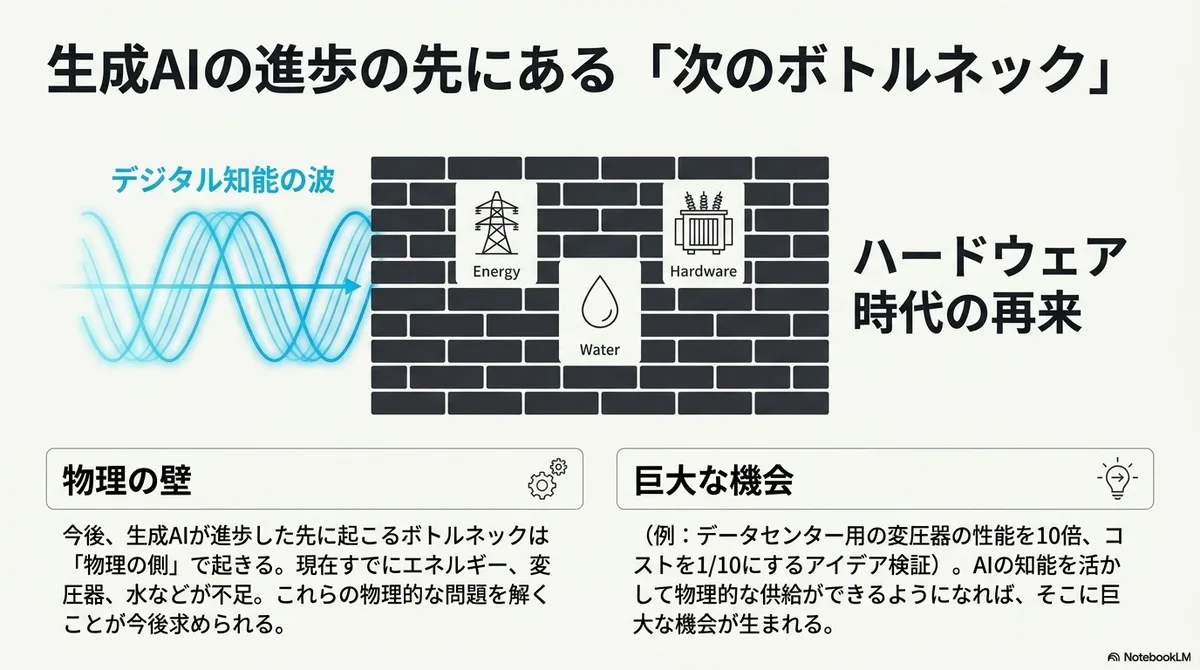
As generative AI advances, the bottleneck that arises will probably be on the physical side. Even now, energy, transformers, water, and the like are in short supply. Solving such physical bottlenecks should begin to be demanded even more.
While physics is thus gaining presence on the demand side, I also think there is a big opportunity if physical supply can be provided on the supply side by making use of the intelligence of AI.
In that sense too, I feel that right now the power of software may bring about major change on the hardware side, and that in fact the age of hardware may be returning.
For example, if you hear that "there aren't enough transformers for data centers,"
"Transformers for data centers. But not heavy R&D: something built by integrating existing technologies that can deliver more than 10 times the conventional performance, or cut costs to 1/10 (including use of space and so on)"
enter wording like this into the library above and have it output a business proposal and a funding landscape. Several ideas should come out.
By asking about how to proceed within them, you can arrive at a reasonably solid hypothesis. In the past, this would have taken a considerable amount of time.
That said, of course, whether an idea is really realized depends on the entrepreneur's own examination and execution, and verification on the demand side requires human hands. Also, when actually building things, it is engineers who do the hands-on work, and AI alone does not solve everything.
But the early work of breaking down your own ideas and refining them again and again has certainly become easier with the evolution of these models.
If an area catches your interest even a little, please do try the prompts as "a tool to raise the quality and speed of your hypotheses." And precisely now, when everyone is looking toward software, I hope more people will take on challenges in these physical domains and in deep tech.
We are also recruiting applicants for the Studio program, where you think through ideas together with us. If you are interested, please join.