What Happens When Software and Intelligence Become Cheap
This article was machine-translated from Japanese by AI (Claude). It may contain errors. Read the original Japanese article.

(See here for a list of my other AI-related articles)
Around 1830, obtaining a small amount of light at night required about three hours of labor. By around 1992, however, it is said to have taken less than a second of labor. The technological progression from candles to incandescent bulbs to fluorescent lamps made light dramatically cheaper.
But when light became cheap, people did not simply buy the same amount of light for less and leave it at that.
People placed light in spots where they had never even considered putting it, and laid the cheapened light across every corner of society: streets, factories, signboards. As a result, factories could keep running on cloudy and rainy days, and new activities such as late-night business hours and reading at night became possible.
The ones who profited were not only the companies that supplied light, but also the companies that put it to good use.
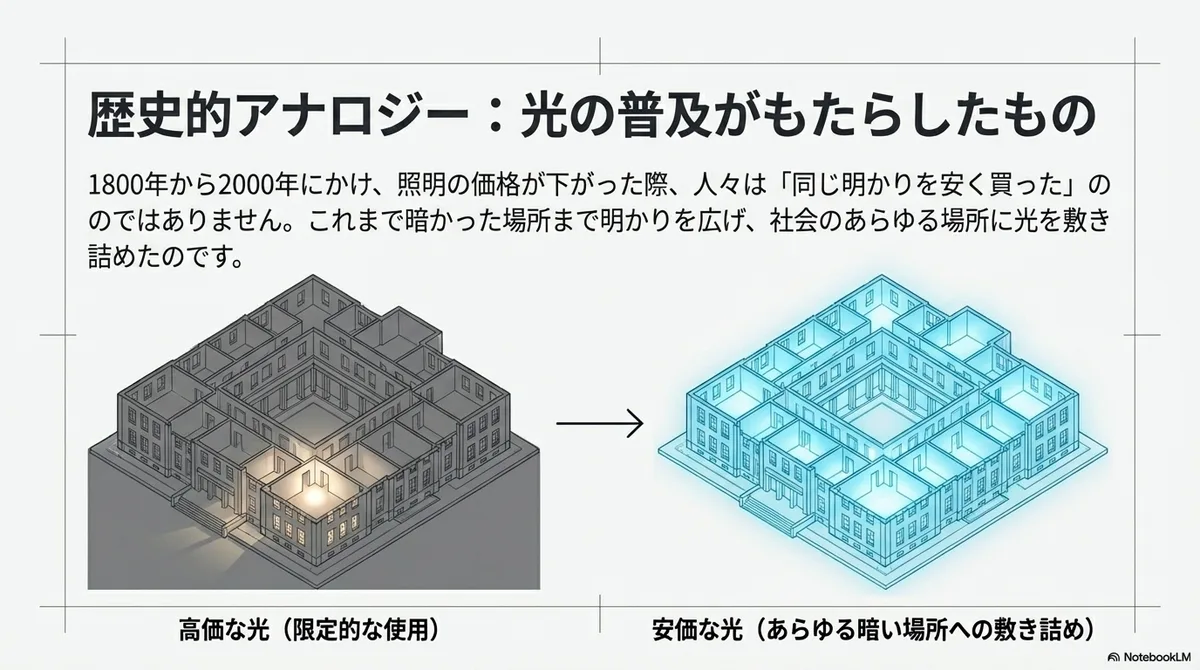
So, when software and intelligence become cheap, how will we use them?
I think the major change brought by generative AI is posing exactly that question to us.
What Is Becoming Cheaper?
As AI advances, the cost of certain kinds of intellectual work and of building software is falling rapidly. The Stanford HAI 2025 AI Index also notes that the inference cost for GPT-3.5-level performance fell by more than 280 times in 18 months.
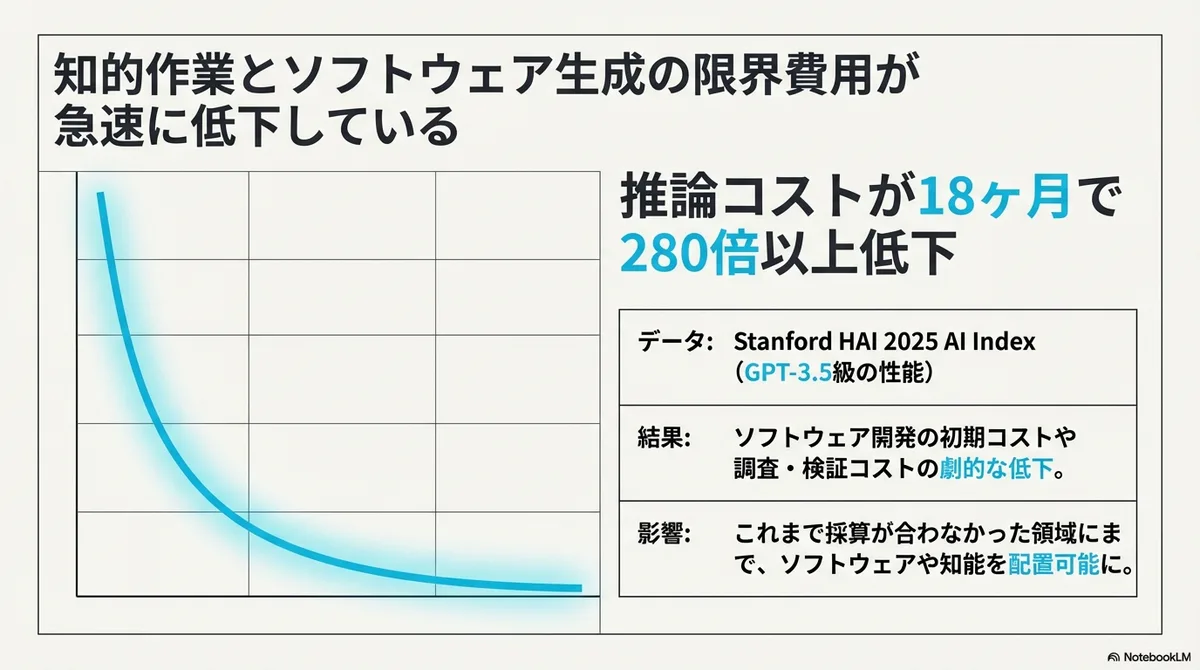
That AI is now beginning to be used most heavily in software development. Software prices are expected to fall, and this is affecting the valuations of some SaaS companies (though there are compounding factors, such as changes in the interest rate environment and the normalization of multiples, so AI is not the only cause).
In reality, when you consider operations, quality assurance, deployment, and where responsibility lies, it is not the case that "all of the costs of software are falling." Even so, the initial cost of software development and the cost of some kinds of research and verification have dropped dramatically.
We do not know what level the current wave of artificial intelligence will ultimately reach. But it is almost certain that, even with AI at its current level, the cost of software development and of some kinds of research will fall dramatically.
If so, thinking about "what happens when software and intelligence become cheap" seems like a question that offers a great deal of insight for business going forward.
When Things Get Cheaper, the Base Widens
What can guide us here is the history of past technologies.
Take the lighting example from the beginning. Between 1800 and 2000, the real price of lighting fell substantially, and total consumption rose greatly along with it. People did not "buy the same light for less"; they spread light even to places where there had been none before.

This analogy cannot be applied directly to software, but a similar structural change will probably still occur. When prices fall, people do not merely use the same thing more cheaply; they start using it in places where it previously did not pay.
For example, I myself develop AI-powered apps for my classes. It has become entirely affordable to build an app for a single class session.
My efforts to promote software development in the nonprofit sector (Non-Profit Startup and the University of Tokyo Social Tech Program, among others) are also examples of activities that began with the idea that "problems that used to require an engineer might be solvable now."
Activities that used to be dismissed as "not worth building for" or "not viable as a business" may, now that software and intelligence have become cheaper, be starting to become viable.
Looking at such examples, I think the question to ask is not only "how much cheaper can AI make existing work?" but rather "what problems, in domains that have not been turned into software until now, will become newly solvable through cheap software and intelligence?"
Where Does the Value Remain?
For a while, demand will arise for the problems that this software and intelligence can newly solve.
However, this expansion of software into new problem spaces will not necessarily become big business for software. Some of these problems remained unsolved precisely because they were hard to profit from, and as software gets easier, its value declines in relative terms.
What happens as a result is a shift in where value is created.
Value arises where a blockage in a flow is cleared. Software has created great value so far precisely because it solved business bottlenecks in the accuracy and speed of information processing and decision-making. But if software and a certain level of intelligence become cheap and abundant enough, the bottleneck will move elsewhere.

Examples include deployment in the field, taking on responsibility, quality assurance, regulatory compliance, proprietary data, integration into business workflows, and implementation in the physical world.
In fact, in the context of AI, the bottleneck is shifting to GPUs, data center transformers, electricity and water, and the queue for grid interconnection (regulation). AI so far has been built on an abundance of physical resources, but physical constraints are becoming the bottleneck.
In other words, value may shift away from software alone and toward whatever makes it actually work in reality.
Complementary Innovation
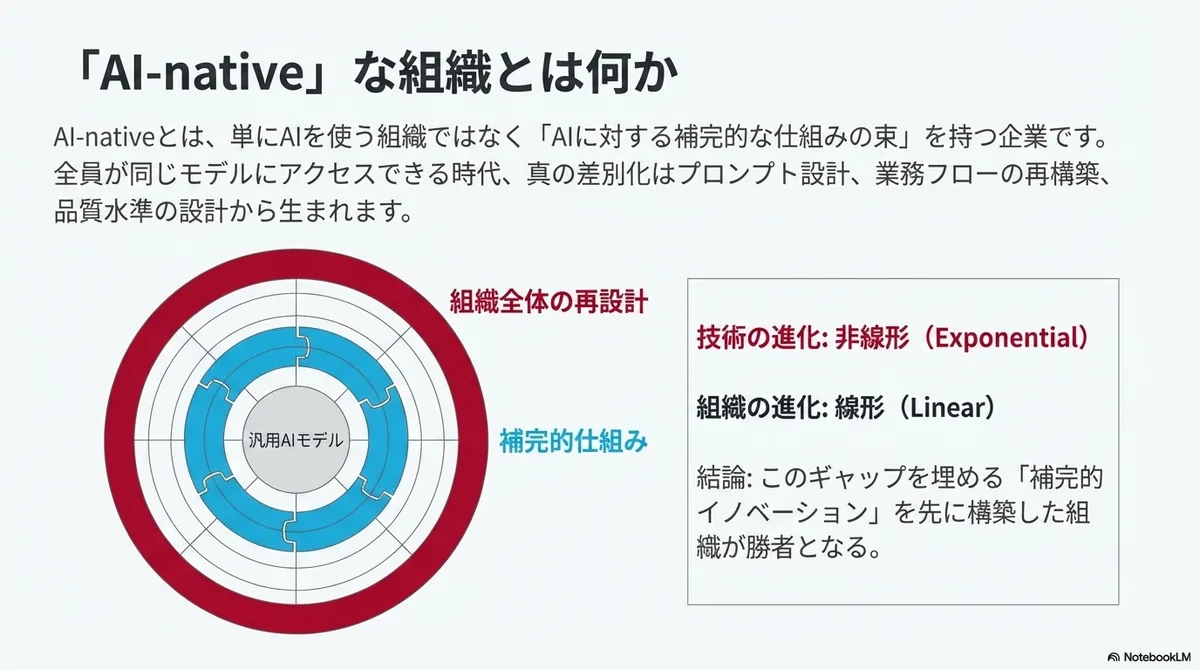
This argument connects to the idea of "complementary innovation" that I also cited in books such as Implementing the Future.
The productivity gains from electricity and electric motors are said to have come not from electricity itself but from innovations such as the arrangement of machine tools in factories that electric motors made possible.
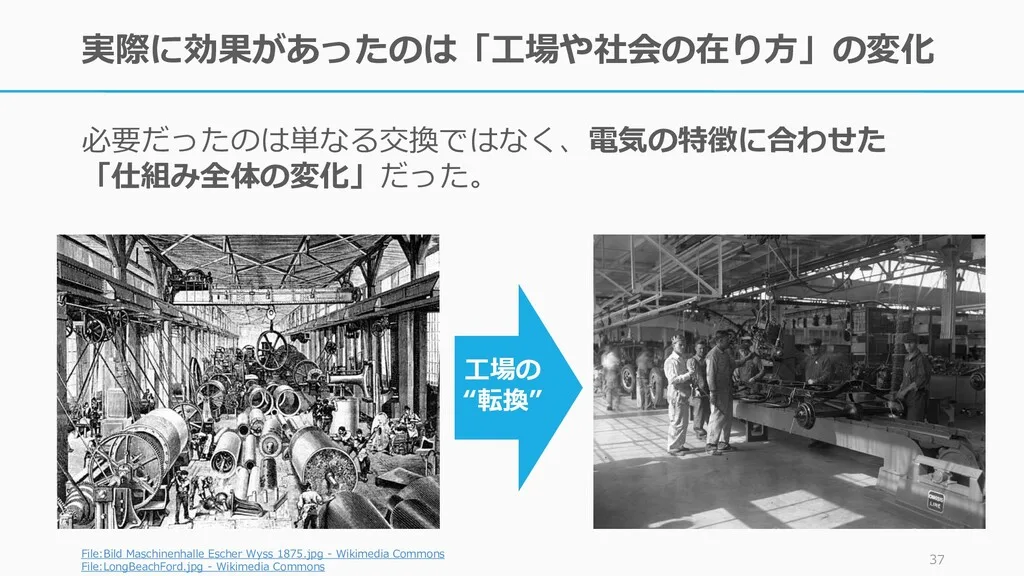
A general purpose technology (GPT) does not create value through the invention alone; value comes from the complementary functions that arise around it, such as complementary inventions, organizational redesign, talent, and governance.
The same is probably true of today's AI. Even in the current situation, where everyone has access to the same models, whether you can actually produce results from them varies greatly depending on complementary factors: how you design prompts and workflows, which tasks you embed AI into, and at what quality level you operate it.
Moreover, while the performance and cost of technology change nonlinearly, complementary mechanisms such as organizations and institutions change only linearly. Because of this gap, a large advantage goes to those who manage to produce complementary innovation appropriately.
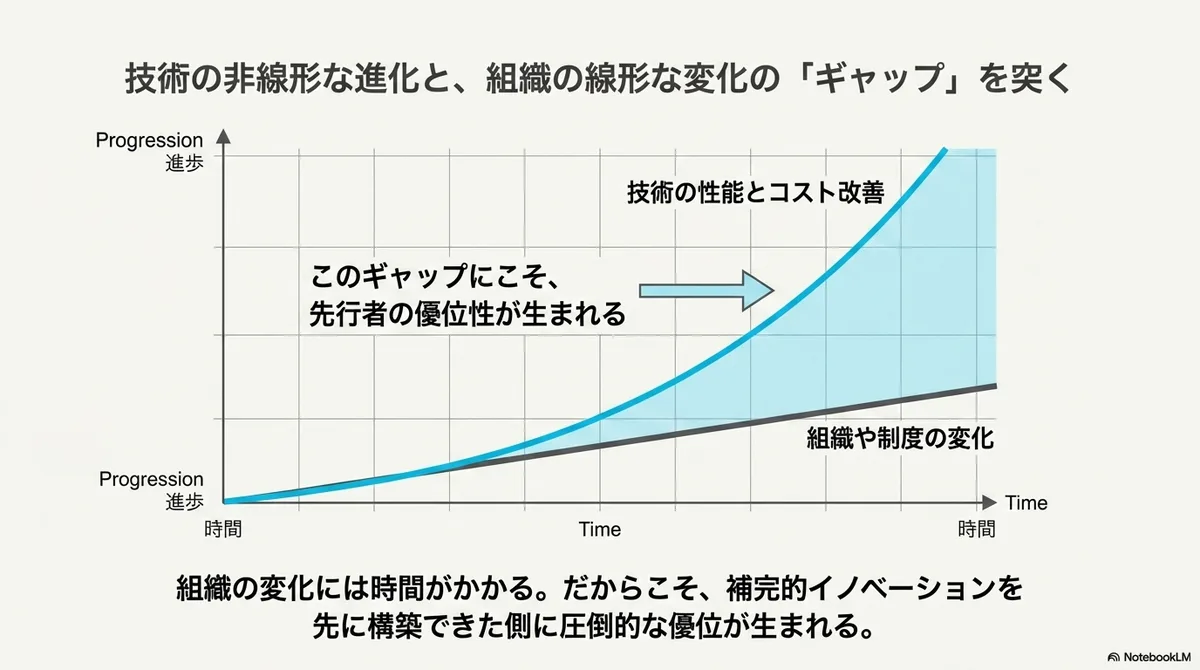
The notion of an "AI-native company" can also be understood within this framework.
In this context, an AI-native company is one that has a bundle of complementary mechanisms for AI. Just as the ubiquitous placement of electric motors in factories led to productivity gains, I believe the organizations that can benefit from AI are those that, now that software and intelligence can be made ubiquitous, have managed to realize new mechanisms and institutions.
(A caveat, though: this holds only as long as that infrastructure is available to them. Depending on how international politics develops, access to AI may be restricted for middle-power countries, so I note that here.)
Deep Tech May Be the Prime Example
Seen this way, an area like deep tech is interesting.
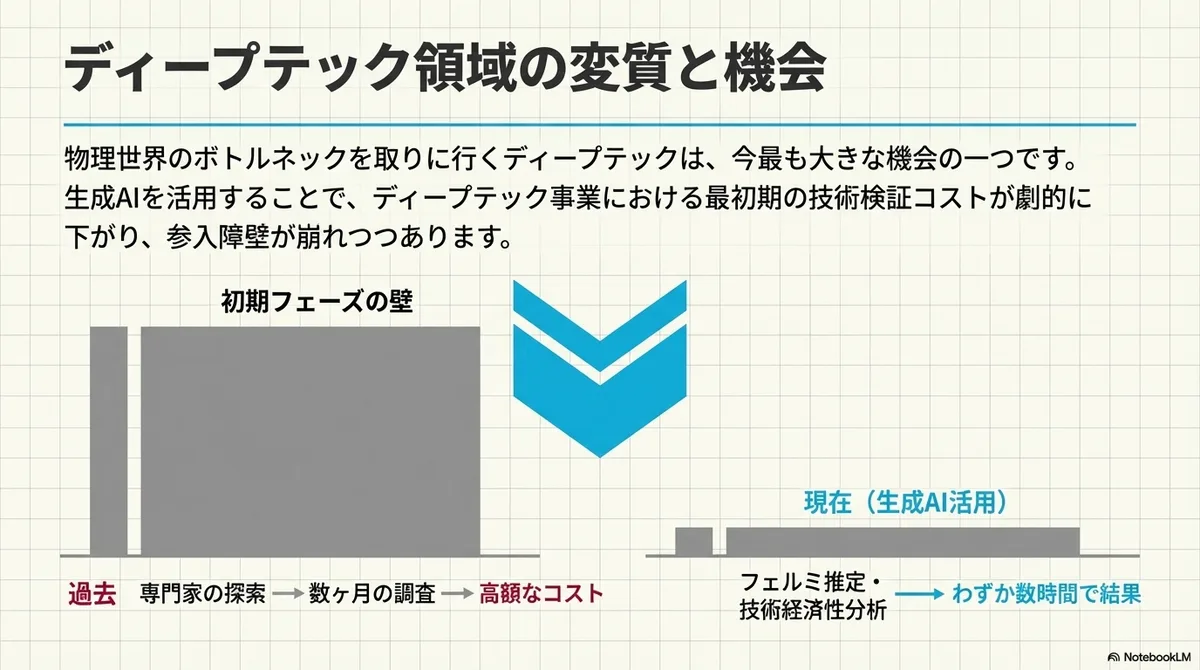
First, in the near term, using generative AI has made some of the verification of technologies used in deep tech businesses much faster (especially verification at the very earliest stage, at the level of Fermi estimates, and simple techno-economic analysis). Work that used to mean finding an expert and asking for their help can now return results in just a few hours. This can be called a change that substantially lowers the barrier of the early phase when aiming to build a deep tech startup.
Furthermore, if AI for Science gets on track, more scientific discoveries will be made. Then the bottleneck will arise in commercializing some of those discoveries.
I also think that the sectors where becoming AI-native will greatly raise productivity are likely to be industries other than software, not software companies. Software companies already have a lot of software in place, whereas other companies are only now getting it, so there is more room for improvement.
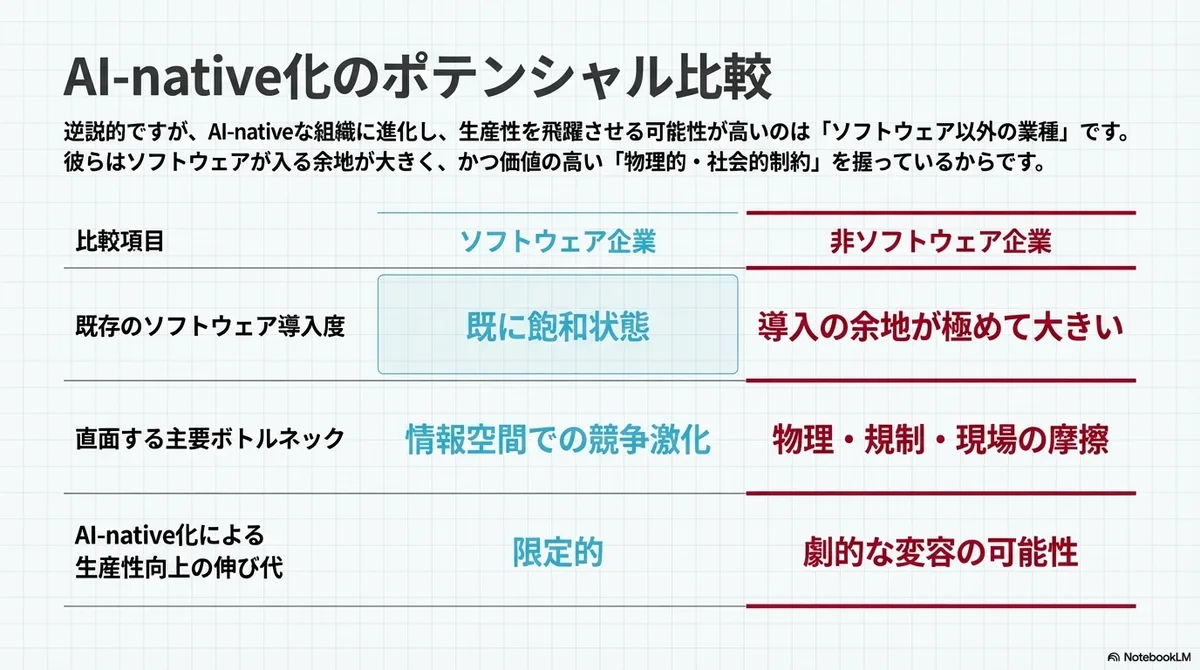
To make the businesses of these non-software industries AI-native while actually implementing them in society, you still have to get through heavy work such as experimental facilities, manufacturing, regulation, and safety. But value remains where implementation is hard, and that can also easily become a moat.
This context is also part of why we can have expectations for full-stack deep tech startups and deep tech where things other than research matter.
Conclusion
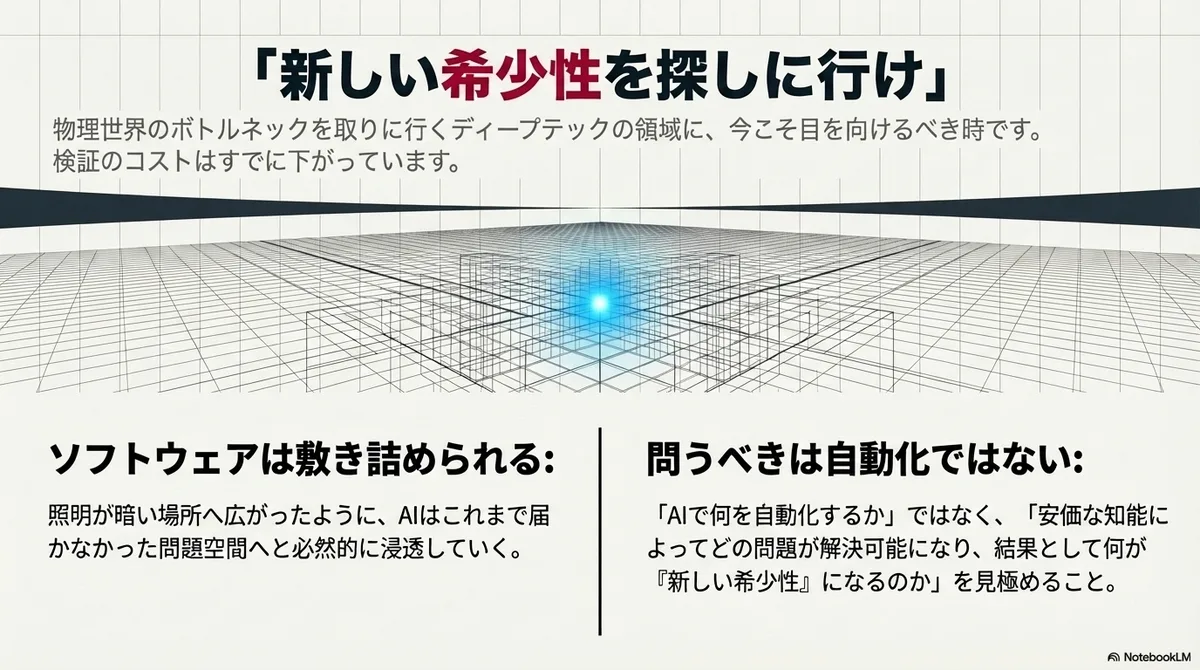
What is happening now is that the cost of certain intellectual work and of generating software is falling rapidly. As a result, software will spread to problems that previously did not pay. Just as lighting spread to dark places, software and intelligence too will be laid across problem spaces they have not reached until now.
So the question to ask is not what AI can automate, but which problems become newly solvable with software thanks to cheap software and intelligence, what happens then, and what becomes the new scarcity.
In the short term, demand for AI itself and for AI-powered software will rise. But looking beyond that, I suspect that value will come from other places, probably more than from those.
In that case, deep tech, which goes after the bottlenecks of the physical world, is one of the greatest opportunities. In that sense too, I hope more people will turn their attention to the area of deep tech that uses AI and software.
It has genuinely become easier to research, so if you've become interested, please do take a look at the deep tech space.
Announcement
I run podcasts that introduce overseas deep tech startups and articles from think tanks. Please have a look if you are interested.