Why AI Strategy and HR Strategy Can Be Integrated
This article was machine-translated from Japanese by AI (Claude). It may contain errors. Read the original Japanese article.
In June 2026, Mercari appointed its CTO as both CHRO and CAIO, and Sansan had its CHRO concurrently serve as CAXO (Chief AI Transformation Officer). They start from opposite directions, but what the two companies have in common is that they treat the use of AI not as an issue for the technology division alone, but as an issue of rebuilding the foundation for how people and the organization are run.
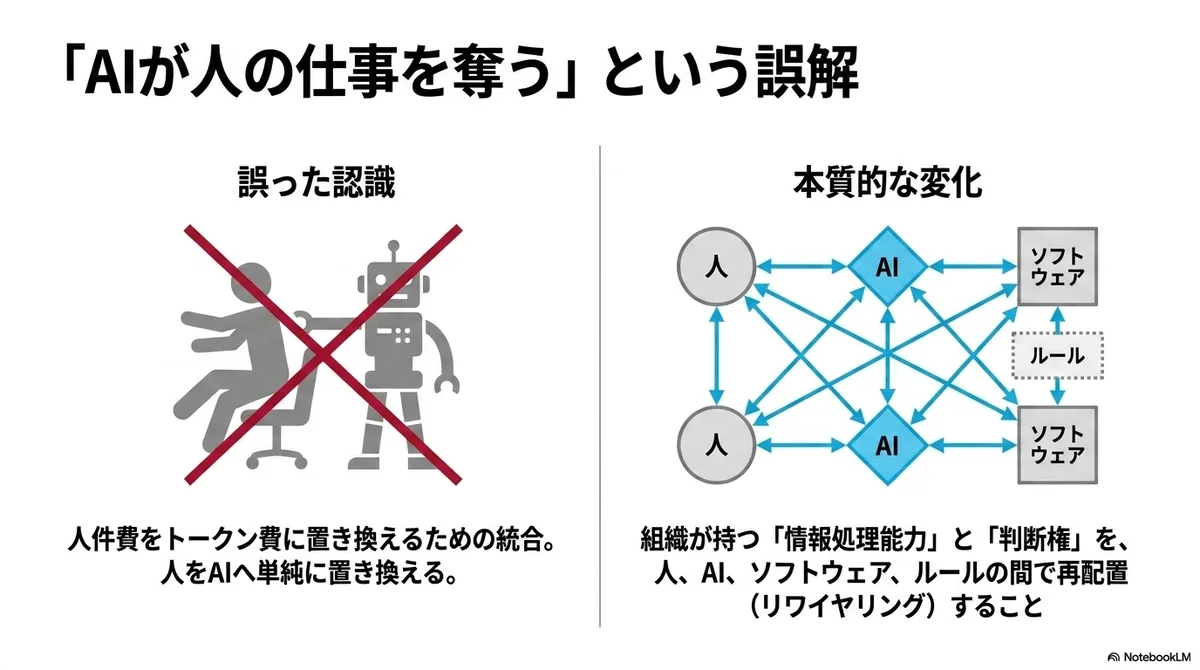
I think that understanding this move only in terms of the "AI takes human jobs" argument, as in "to replace labor costs with token costs, one executive now manages both people and AI," would slightly misread some of the thinking behind it.
As I will explain in detail later, if we think of introducing AI as "reallocating the information-processing capacity and decision rights of an organization among people, AI, software, rules, and so on," then designing it requires not only someone who understands what AI can do, but also someone who has the authority to change HR and the organization, and who can design jobs, authority, development, evaluation, and organizational structure in an integrated way. Seen this way, there is a certain persuasiveness to integrating functions such as CHRO and CAIO.
In an earlier post, "Organizational Theory for the AI Era, Seen Through the "Theory of AI-Driven Firm Boundaries"," I touched briefly on how "the move for HR leads to also take charge of AI seems to reflect how organizations should be designed in the AI era." Here I would like to pull the points together once more.
The Social Implementation of Electricity and the Social Implementation of AI
More and more often, I hear that companies have distributed generative AI licenses to the whole firm, run training, and seen usage rise, yet organization-wide productivity and decision-making speed have not improved as much as expected.
When a new technology emerges, the first thing that happens is that a new tool is added to the work already being done. AI summaries, draft writing, and document creation are how most of it is done.
However, as I mentioned in an earlier article, "What Happens When Software and Intelligence Become Cheap," it seems that for a technology to truly improve productivity, a somewhat larger change is needed.
Let us look, for example, at how electricity raised the productivity of manufacturing plants. It seems to have taken several decades for the look of the factory to change and for electricity to improve factory productivity.
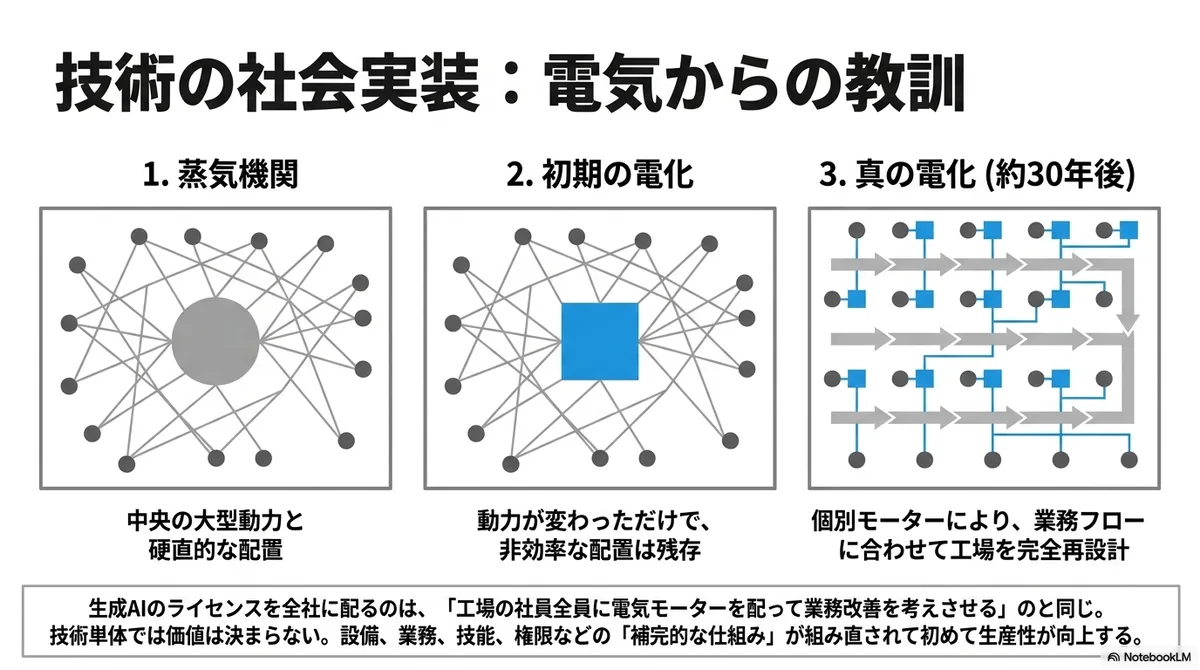
Before electricity arrived, factories ran on steam engines. There, power was apparently sent from a large central engine to multiple machines through line shafts and belts. In this structure, the position of each machine is bound by the constraints of power transmission.
In early electrification, even when the central steam engine was replaced with a large electric motor, the line shafts and the factory layout sometimes stayed as they were. This lowers some of the fuel and maintenance costs, but does not fully exploit the possibilities of electricity.
The big change came after unit drive, in which a small motor is placed at each machine, spread. Because the position of machines could be separated from the central power source, equipment could be arranged to suit the flow of materials and work. Productivity rose greatly only once the machine layout, processes, supervision, maintenance, and even investment decisions of the factory had changed. According to the classic account, it took about 30 years for this approach to become widely established. (There are various views on the number of years. For more detail, please also see books such as "Implementing the Future.")
In other words, the value of a technology is not determined by the technology alone; it grows when complementary arrangements such as equipment, operations, skills, authority, and evaluation systems are reconfigured to fit the technology.
From this perspective, handing out generative AI licenses to everyone is much the same as, around 1900, "giving every factory employee an electric motor and having them think up proposals for improving their own work." Of course, unlike a motor, AI is a tool for intellectual production, so I expect that giving people that tool will produce gains in individual productivity, but basically only partial improvements to current work will come out of it.
If today's AI is a general-purpose technology, then what should really be done is for the executive team to envision the whole future organization built with AI, and to consider how AI will be used within it. I think the assignment of one person to serve concurrently as CHRO and CAIO is a way to explore that answer.
The Organization Is Also an Architecture for Information Processing
AI has aspects that differ from the traditional replacement of "physical force" with machines.
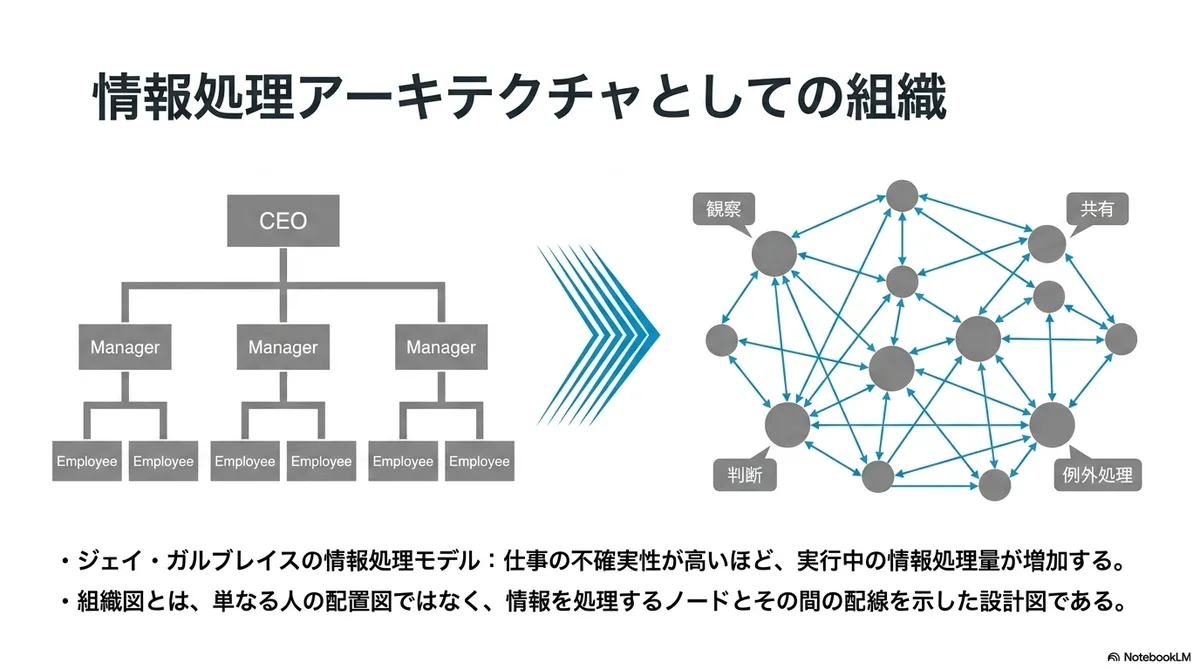
Looking at it from the standpoint of organizations, organizational theory has long had a view that treats an organization as an information-processing system. According to Jay Galbraith's information processing model, the higher the uncertainty of a task, the more information must be observed, shared, and judged during execution. Rules, hierarchy, approvals, management by objectives, and cross-functional teams are all devices that organizations have built to process that information and those exceptions.
In fact, organizational structure determines the following.
- Who observes information in the field, and in what format it is recorded
- Who can access that information, and where it is consolidated
- Who interprets, decides, and approves
- To whom exception cases are sent
- Where results are fed back
In this sense, an organization chart or a workflow is both a map of where people are placed and a blueprint showing the nodes that process information and the wiring between them. Stepping back, the organizational architecture itself is a mechanism that governs information processing.
For example, when a hierarchical organization is adopted, information processing flows in a cascade, and because superiors allocate information, communication tends to be slow, but information tends to come down filtered, and it is clear where responsibility lies. A flat organization, on the other hand, communicates faster, but not all the information that travels fast is necessarily needed, and where responsibility lies becomes harder to see. The organizational structure itself has built-in advantages and disadvantages in terms of information transmission and responsibility.
From a management perspective, if we look at only one aspect of the functions of the resource called "people," a human being is a kind of information-processing node. People receive information from customers and the field, check it against past experience and expertise, give it meaning, make judgments case by case, and in some cases pass the result on to other people or systems.
AI, too, is a new node placed on this wiring called the organization. It searches, classifies, and summarizes information, generates text and code, and sometimes operates systems.
As long as we view the organization as an information-processing architecture, both humans and AI can be recognized as "agents that receive information, process it, and pass it to the next step." If so, there is some sense in lining them up flat and thinking about how to run them. By using the advantage that AI can process information in large volumes, we may even be able to consider new organizational forms.
What makes AI different from conventional software is this. With conventional software, inputs, processing steps, outputs, and exception conditions were relatively easy to specify explicitly. Generative AI, by contrast, can produce open-ended outputs for unstructured inputs and vague requests, but it is hard to list its performance boundaries and failure conditions in advance. You could say that because AI has come closer to the nature of human intelligence, these organizational and HR questions have come closer too.
Similar in Function, Asymmetric in Institutional Terms
Of course, humans and AI are not the same kind of resource.
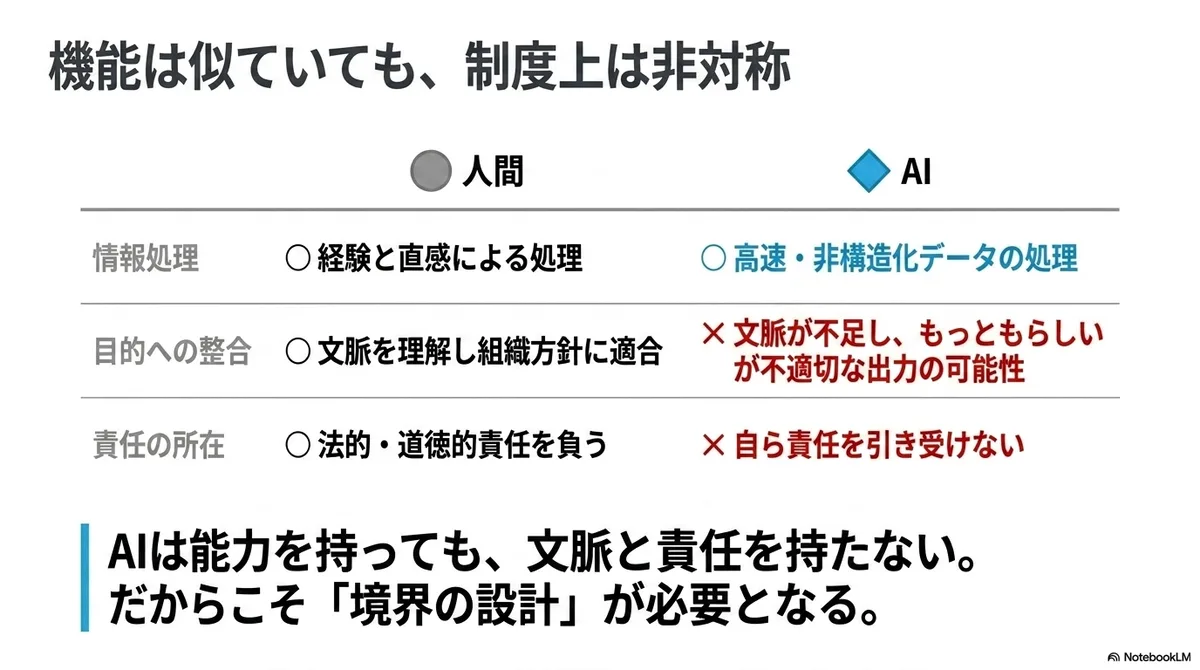
Humans grow through experience and take on legal and moral responsibility. AI can process information, but it cannot take on the purpose of an organization by itself, nor bear responsibility when an accident occurs (at least under current law). Also, current AI cannot hold contextual information as fully as humans can.
In practice, these differences show up as at least two problems.
The first is misalignment with purpose. AI can generate average, plausible outputs, but at present it is not so good at making the right judgment "for the organization" with sufficient contextual information. For example, it may write a natural-sounding reply to a customer, but that reply is not necessarily appropriate in light of company policy, contract terms, or legal obligations.
Of course, humans are not always aligned with organizational purposes either, which is why organizations have built mechanisms such as hiring, development, evaluation, incentives, and culture. But what AI needs is not such measures aimed at humans; it is things like access rights to data, execution authority, the knowledge it can refer to, and verification steps and stopping conditions, which are entirely different methods from those for humans. Bringing these into line takes considerable effort.
The second is misalignment of responsibility. You can delegate work to AI, but you cannot delegate accountability as an organization. When placing AI in operations, you need to prepare, around it, a responsibility structure: who approves, who supervises, who stops it, and who holds final responsibility.
In other words, what both need in common is a design of the boundary: what to entrust to AI, and beyond what point not to. And this boundary design cannot be derived from a mere cost comparison of "reducing labor costs and token costs."
Put differently, introducing AI involves
- Economics (which of human and AI can process it, and at what cost)
- Work design (in what order people, AI, and systems process what)
- Institutional design (who holds authority, who learns, who is evaluated, who bears responsibility)
three distinct problems, and a cost comparison answers only the first, while what the integration of CHRO and CAIO deals with is mainly the second and third.
Thinking Through Customer Inquiry Handling
Since the abstract discussion has gone on for a while, let us look at an example: customer inquiry handling, which exists in every industry.
Traditionally, a staff member read the inquiry, searched past materials, wrote a draft reply, a supervisor checked it, the reply was sent to the customer, and a record was kept.
If you add only an answer-generating AI here, the time to write drafts certainly gets shorter. But if the practice of the supervisor checking every reply remains, cases pile up at the approval step. This is because only the processing capacity of the drafting step has increased, while the downstream approval capacity has not changed.
This is not a lack of AI performance, but a problem that arises because the wiring of information processing and decision-making that is the organization remains as it was before. The cause of the worry many companies have, that "AI usage went up, but organization-wide productivity did not rise as expected," probably lies in this kind of place.
If you were to redesign the whole workflow with AI as a premise, it might look like this, for example.
- At intake, structure the inquiry information and classify the type and risk of the case
- AI refers to approved knowledge and presents a draft reply and its grounds
- Low-risk cases are handled automatically, with a certain proportion sampled for audit
- For medium-risk cases, the staff member checks the grounds and approves
- High-risk and exceptional cases are escalated to specialists
- New exceptions and errors are fed back into the knowledge base after approval
- Measure time to resolution, wrong-answer rate, rejection rate, and customer ratings
What I want to point out here is what moved in this design change.
- The staff member's job shifts from writing replies to verifying the grounds and judging exceptions.
- The supervisor's role shifts from checking every case to designing risk criteria and overseeing anomalies.
- The abilities that junior staff need also change, from writing quickly to questioning the premises of AI's answers, checking the grounds, and finding exceptions.
- The evaluation metrics become not the number of replies written, but time to resolution, quality of judgment, fewness of incidents, and contribution to the knowledge base.
And the authority structure of who holds final responsibility for which case changes as well.
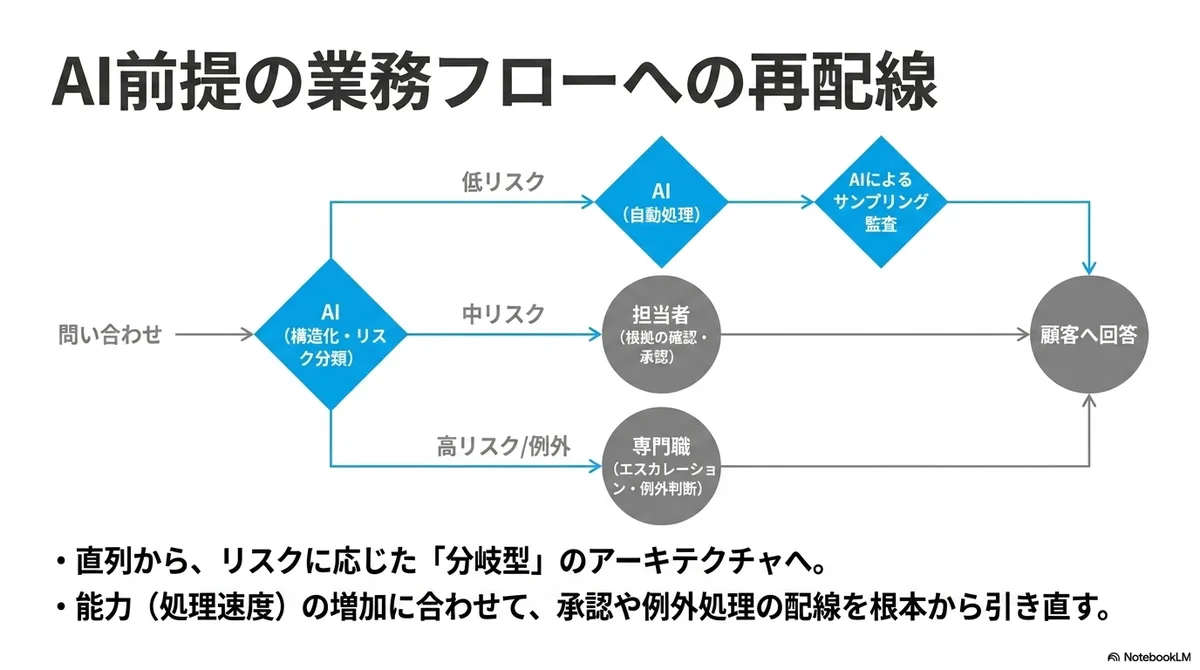
In other words, what has to change is people's jobs, the role of managers, the skills needed for them, and also evaluation, authority, and responsibility. "Where to place AI" and "what to entrust to AI," and along with them "where to place people" and "what to entrust to those people," are precisely the reason that AI strategy, HR strategy, and further organizational strategy intersect.
To put it another way, if we suppose that current AI has the intelligence of a new hire and is an entity that cannot bear responsibility, then what is being asked is the answer to the question: "If you could obtain a reasonably smart new hire in unlimited numbers at low cost, what kind of organization should you build to raise overall performance?" If you simply increase their numbers, managers and those in charge become bottlenecks because of the burden of review and the like. The question is how to avoid that while getting maximum performance.
What HR Handles Is Not Only the Optimization of "Current Capabilities"
There is another reason HR is involved in AI strategy. HR is responsible not only for the allocation of current capabilities but also for the formation of future capabilities.
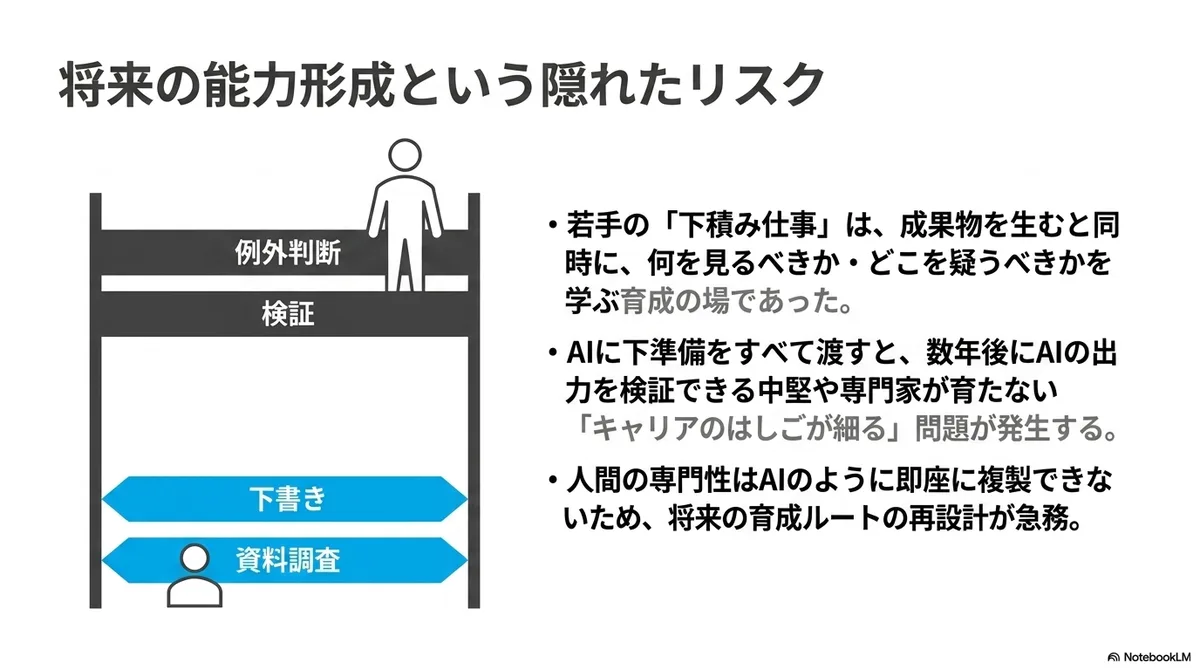
The work that newcomers have traditionally done has had two functions. One is the production of deliverables: researching materials, organizing them, and preparing drafts. The other is the developmental function: learning, through that work, what to look at, where to be skeptical, and which exceptions matter.
If you hand the preparatory work to AI, the first can be made more efficient, but if the design is wrong, the second is lost along with it. Even if productivity rises in the short term, it is possible that a few years later, mid-level staff and experts who can verify AI's output will not have been developed. This problem of "the rungs of the career ladder getting thinner" I wrote about from the societal side in "AI, Employment, and the Overproduction of Elites, and How Education Will Change," but from the company's side, it is the question of how to develop in-house the capabilities it will need in the future.
In particular, unlike AI's processing capacity, human expertise cannot be replicated instantly; it is formed over a long time through experience, feedback, failure, and relationships with others. That is why AI strategy cannot stop at maximizing current processing capacity.
Reducing work through AI adoption and developing the people needed in the AI era are not separate discussions; they can be two sides of the same work design.
Integrating the Role That Draws the Blueprint of the Organization
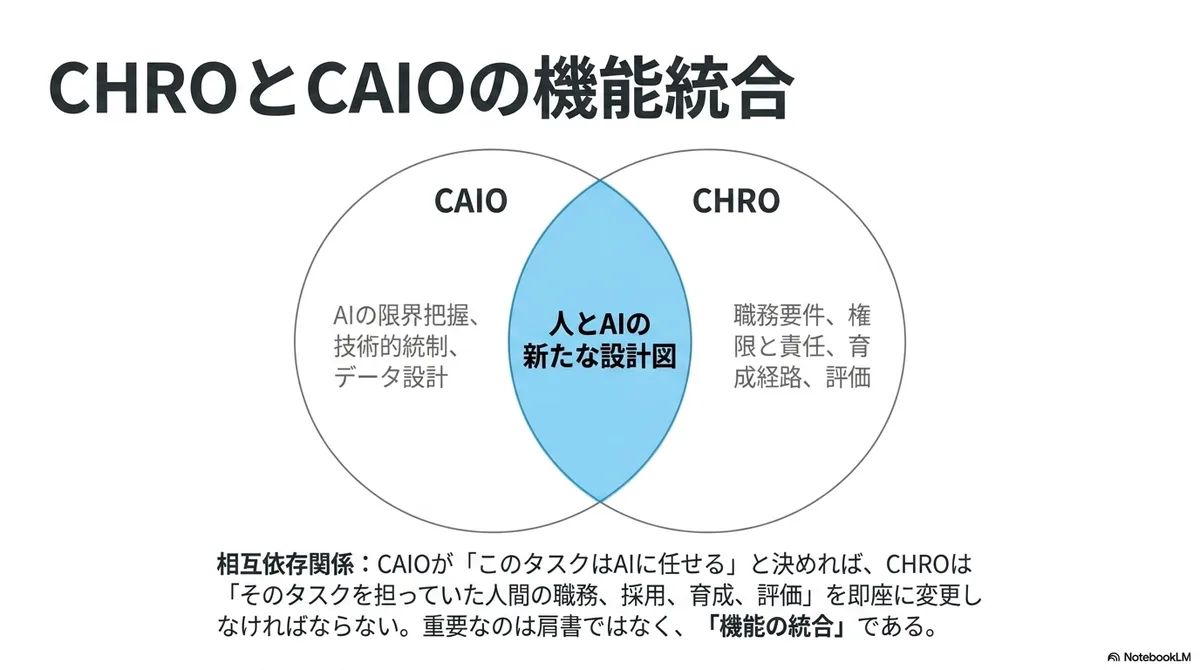
Given all this, the meaning of integrating CHRO and CAIO becomes visible.
The CAIO, understanding AI's capabilities and limits, designs the data, technical controls, model updates, logs, and evaluation methods needed to use AI.
The CHRO, as before, handles jobs and placement, hiring, development, evaluation, compensation, and also organizational structure, authority, and responsibility.
Before AI was introduced, these two could be thought of relatively separately. But once people and AI share work within the same workflow, a close interdependence arises between them. If the CAIO decides that "this task can be left to AI," then on the CHRO side, the jobs, hiring requirements, development paths, and evaluation metrics tied to that task must be changed. If the CHRO decides that "this judgment stays with humans," then on the CAIO side, AI must be made able to present the grounds needed for that judgment, and interfaces and logs must be built that let humans intervene.
In other words, what is needed is a blueprint of how people and AI divide work, how authority is granted, how things are verified, who bears responsibility, and who is to be developed, designed while anticipating, to some degree, how AI's capabilities will advance and the range in which it can be used.
However, CHRO plus CAIO Is Not the Only Answer
Of course, I am not saying that the CHRO should serve as CAIO in every company. What matters is not holding both posts concurrently but integrating the functions. Also, at a company where AI determines the competitiveness of the product itself, the CAIO should probably be closer to the CTO or the head of product, and if the focus is on redesigning the supply chain or operations, integration with the COO might work better.
And what matters is not the title, but grasping the capability boundaries of AI and redesigning business processes, and, along with that, whom to assign as someone who can design what the organization should look like when AI is used, including the division of work between people and AI, changes to development and evaluation, and the redefinition of authority and responsibility. I understand CHRO plus CAIO to be one organizational expression of realizing that integration.
That said, let me add that this also differs by industry and line of business. Electric motors greatly changed the productivity of manufacturing, but they presumably did not do so to the same extent for service industries. Likewise, this time AI may be highly effective in industries centered on information processing, and perhaps not so much in others. How to use it, including those judgments, is presumably what is being explored.
Summary
Placing two information-processing agents of different natures, humans and AI, within the same workflow: that is organizational design in the AI era, and it can also be described as reallocating, between people and AI,
- Tasks: who or what performs which work
- Decision rights: who or what can decide and execute
- Control: what to verify, audit, and stop
- Capability formation: how to improve and teach people and AI
- Evaluation: to whom outcomes and responsibility are attributed
and so on.
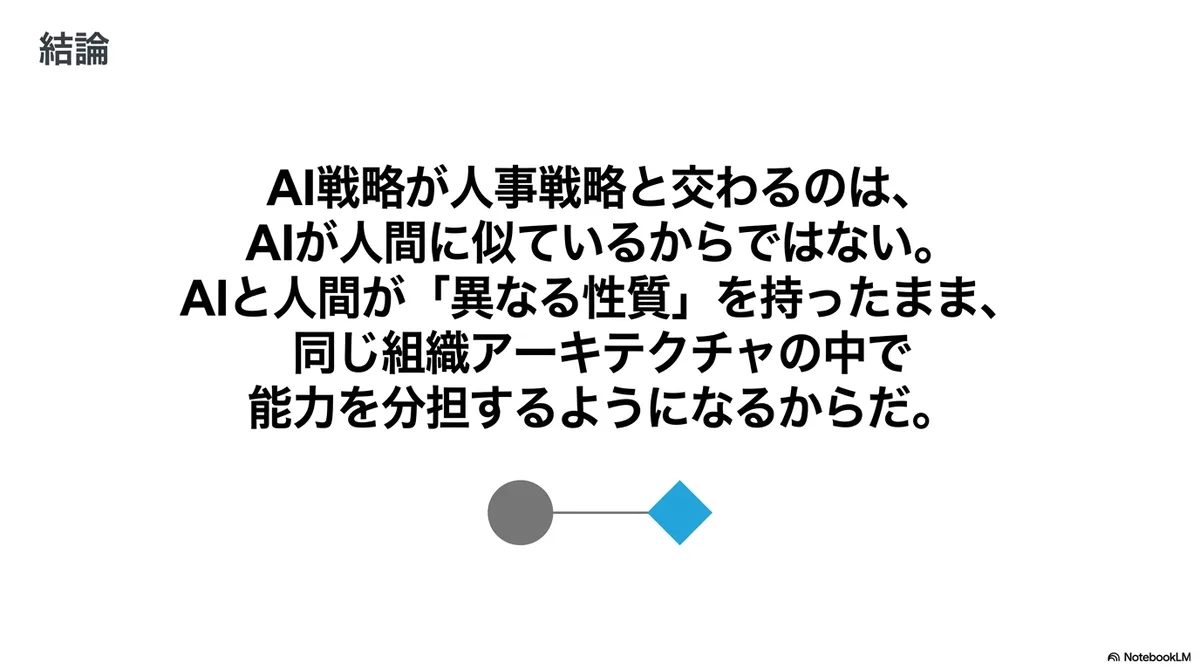
What to entrust to AI and what to leave to humans. Who verifies, who learns, who is evaluated, and who takes on responsibility. I think the integration of AI with HR and organizational strategy this time is an effort not to split that design apart.