How the AI Winners Change Over Time
This article was machine-translated from Japanese by AI (Claude). It may contain errors. Read the original Japanese article.

Among the AI-related startups currently attracting investment are startups in AI physical infrastructure. These cover power generation, transmission, power conversion and cooling technologies, permitting and labor, and, on the breakthrough side, OPUs and quantum. Outside of startups, semiconductor products such as NVIDIA's GPUs and memory are soaring in price.
Bessemer Venture Partners also published an infrastructure-focused article in 2026 called "The AI Data Center Stack." It points out that in 2025, venture investment in the build environment (construction and infrastructure) was dominated by data centers, which accounted for 78% of the capital invested ($4.5 billion of $5.7 billion).
People often say, "In a gold rush, sell shovels and jeans." Right now, around AI, it is not only the gold itself, AI or intelligence, that is booming, but also the surrounding areas.
This has also happened in the diffusion of past technologies.
In the early days of the railroad, it was not only the railway companies that made money, but also steel, coal, civil engineering, bridges, locomotives, land, and finance. In the early days of electrification, profits gathered not only at the power companies but also at generators, copper wire, distribution equipment, and electric motors.
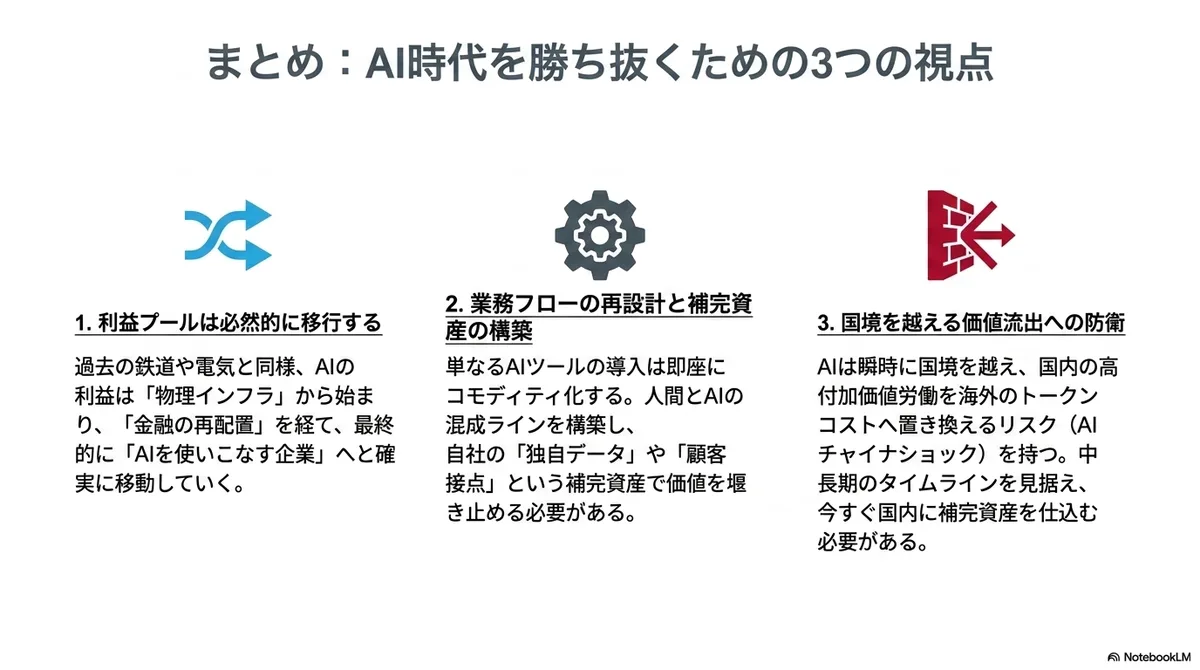
If so, I think that by looking at how profit pools shifted over time during the diffusion of past infrastructure-like technologies, we may be able to see, at least somewhat, who the winners of generative AI will shift to.
And when thinking about high-growth AI startups, I think one of the following strategies is needed:
- Take risks in the areas that will grow sharply in the short term
- Prepare with long-term change in mind
With that in mind, we need to look not only at "where is money likely to be made now," but also at "where the profit pool will move next," and I think we need to build businesses while predicting that change over time.
(1) First, Physical Infrastructure Makes Money
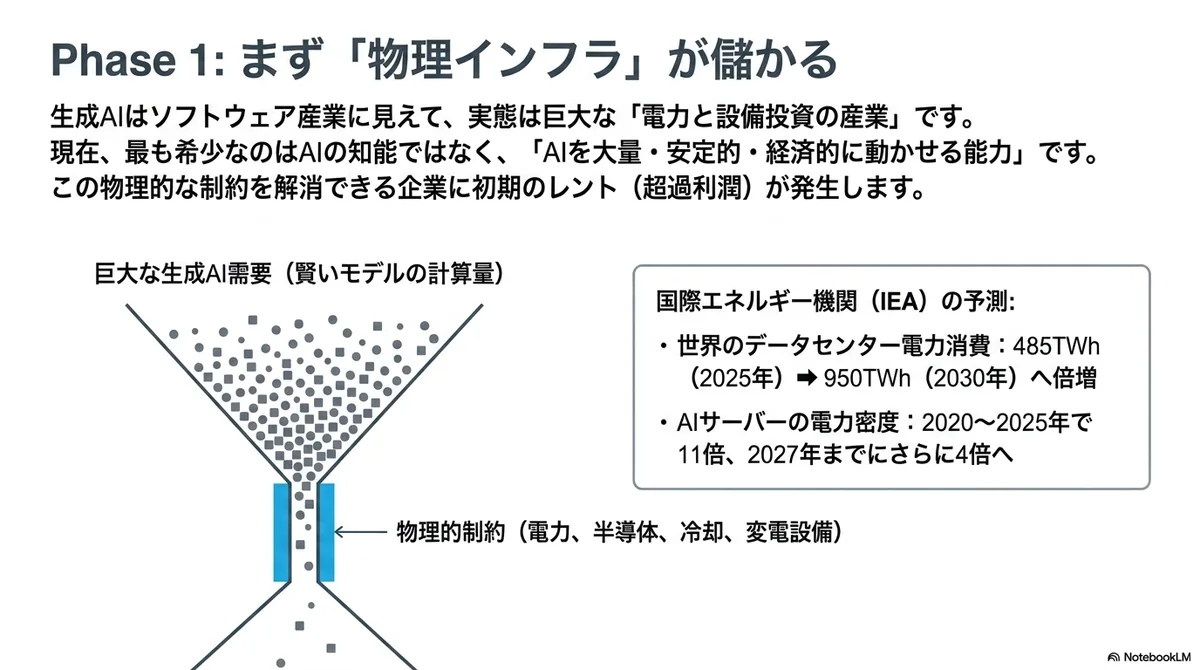
When a new general-purpose technology spreads, the ones who can most easily capture profits at first are not the companies that use the technology, but the companies that hold the constrained resources needed to run it. In the case of railroads, that was steel; in the case of electricity, it was generators and the like.
In the current generative AI movement, money is gathering in GPUs, HBM memory, servers, cloud, data centers, power, cooling, substation equipment, networks, and so on. Generative AI may look like a mere software or intelligence industry, but behind it lies an "industry of electric power and capital expenditure" that requires enormous physical infrastructure.
In fact, the IEA projects that global data center electricity consumption will nearly double from 485 TWh in 2025 to 950 TWh in 2030, and that electricity consumption of AI-focused data centers will roughly triple over the same period. It also says that the power density of AI servers rose 11-fold from 2020 to 2025 and is expected to rise a further 4-fold by 2027, tightening supply constraints on transformers and power conversion equipment.
In other words, the first act of the AI boom is not just a race to develop "smart models." It is a race for the power, semiconductors, data centers, cooling, networks, and talent needed to run smart models at massive scale. Especially in particular regions where all of these come together at once, the structure is one in which companies that can resolve the scarcity are likely to earn rents.
So at this stage, what is scarce is not only "AI intelligence" itself but "the ability to run AI at scale, reliably, and economically."
Seen this way, in the short term (until around 2030?), physical infrastructure companies that run AI tend to be able to capture profits more easily than AI application companies. I think that rushing to target these areas in pursuit of rapid short-term growth as startups is exactly what is happening now, centered on the United States.
That said, a "large profit pool" and a "profit pool that startups can go after" are different things. Within AI infrastructure, semiconductor manufacturing and large-scale cloud are areas where the capital strength of established giants is strong, while I also see startups increasing in areas where there is room for them to enter (for example, transformer startups that ride on NVIDIA's new standards).
New technologies are easier to introduce when demand grows sharply or the type of demand changes significantly. From that perspective, this also looks like a time when new physical technologies are being adopted.
Indeed, VC investment seems to be heading toward such areas, and infrastructure investment firms are also stepping up their investment in data centers.
(2) Then, Financial Expansion and a Change of Owners Occur
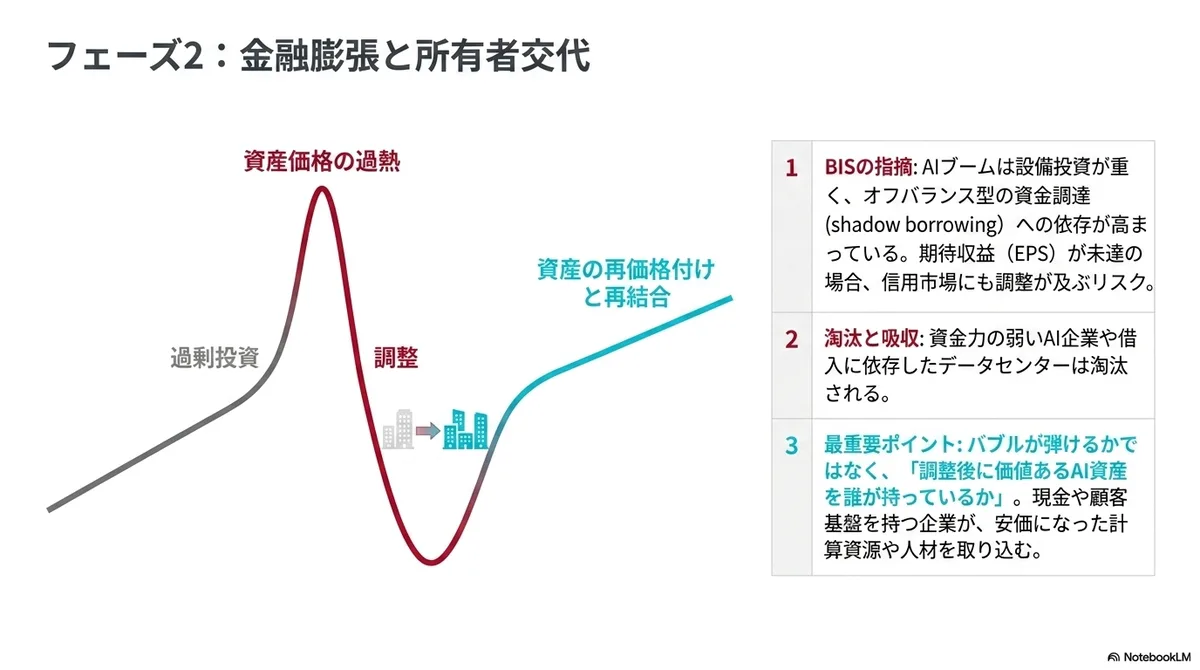
However, infrastructure companies will not necessarily remain the biggest winners.
Overinvestment often occurs with new infrastructure technologies. Looking at the history of railroads, electricity, and the internet, expectations of future growth swelled first, money poured in all at once, companies multiplied, facilities multiplied, stock prices and corporate valuations rose, and then an adjustment followed.
The same could happen with AI.
Carlota Perez explains that in the early stage of a technological revolution, financial capital flows into the new technology in large amounts, and that a sequence tends to follow: a divergence between financial capital and production capital, overheated asset prices, a crash, and then a recoupling.
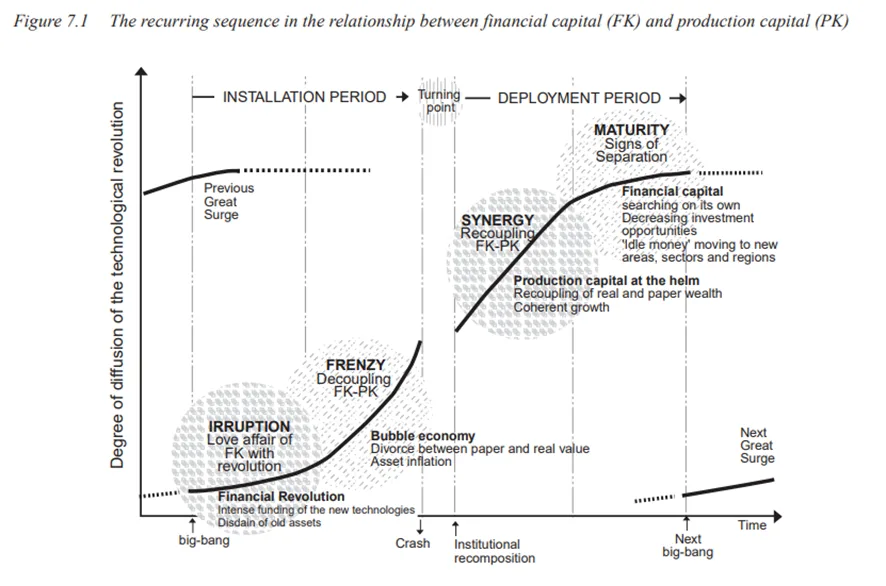
https://carlotaperez.org/wp-content/downloads/books/btr-en/PEREZ_TRFC_Ch%207.pdf
There is a good chance that the same structure will arise. In fact, finance is becoming more prominent in AI infrastructure investment as well.
The BIS points out that AI-related investment is surging both in nominal terms and as a share of GDP, and that, given the scale of future investment, reliance on debt and private credit will grow in addition to companies' operating cash flow. It also states that the sustainability of the AI boom depends on whether AI companies can deliver on their high revenue expectations. Data centers in particular are a capital-intensive industry. They require land, buildings, power equipment, servers, cooling, networks, and operating personnel, and they take time to recoup the investment, giving the business a cost structure different from that of traditional software.
In another piece in the BIS Quarterly Review, hyperscalers are described as increasingly using off-balance-sheet financing, such as JVs, SPVs, long-term leases, capacity offtake agreements, and guarantees, in addition to corporate bonds, which it characterizes as economically close to "shadow borrowing." It also notes that if expected returns fail to materialize, the adjustment could reach not only equity markets but also credit markets.
But what I want to discuss here is what happens after the financial expansion. Probably what happens here is not a slowdown of the technology but a repricing of assets, and a corresponding turnover of players.
For example, AI companies with weak financial strength, data center developers that depend on borrowing, and AI application companies with weak differentiation will likely enter a phase in which they are easily weeded out, through adjustments such as changes in token costs. On the other hand, large companies with cash, regulated industries, and companies that can immediately cut costs with AI may be able to take in talent, compute, customer bases, and intellectual property that have become cheaper.
What matters is which AI assets will retain value after the bubble, and who holds them. From that perspective, I think we also need to start selecting now what to invest in.
(3) Companies That Changed Their Workflows Make Money
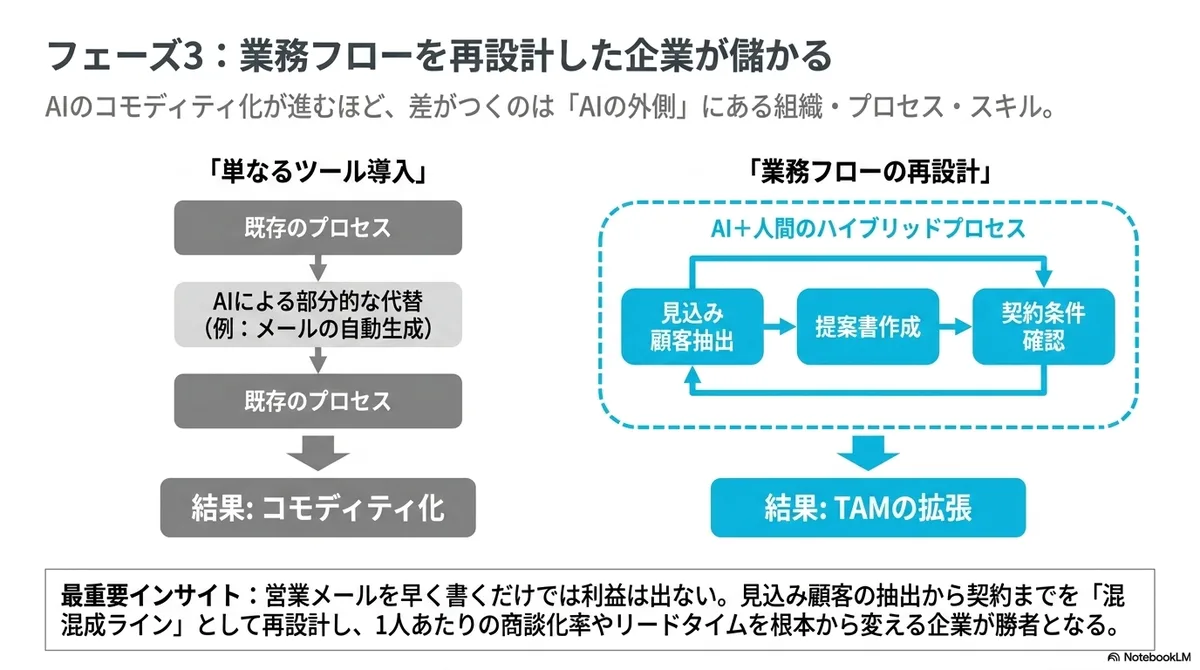
Once infrastructure is in place, the price of compute falls, and AI is built into existing software, the center of profit gradually shifts from AI infrastructure to companies that use AI.
However, the ones that profit here are not "companies that adopted AI" but companies that have deeply embedded AI into their own workflows and customer touchpoints. Just as companies that adopted assembly lines in their factories raised productivity during the spread of electricity, how you change the workflow itself to fit the new technology greatly changes productivity.
Brynjolfsson, Rock, and Syverson argue that general-purpose technologies like AI, even as their capabilities improve, are slow to fully show up in productivity statistics until complementary innovations, organizational changes, and new skills spread. What matters is not only the technology itself but also that the organizations, processes, and skills needed to use it are in place.
For example, simply enabling people to write sales emails a little faster with AI will not produce large profits. On the other hand, if you can redesign everything from identifying prospects, prioritizing them, making first contact, drafting proposals, checking contract terms, invoicing, and proposing renewals as a mixed AI-and-human line, then the number of customers each salesperson handles, the rate of conversion to deals, the lead time to closing, and the churn rate will change.
In the physical domain too, workflows could change greatly once AI reaches a certain level of technology. For example, if autonomous driving is realized in transportation, the workflow of the transport industry will change greatly.
In other words, the change or business to aim for at this stage is not "adopting AI tools" but redesigning the operational line. And whether you can use that not merely for efficiency but to expand the TAM of your own business will, I think, determine how much your revenue grows.
On the other hand, companies that merely adopt AI tools will soon be drawn into competition. This is because many companies can use the same models, the same SaaS, and the same plugins. The more AI itself becomes commoditized, the more the differences will come from what lies outside of AI.
(4) In the Long Run, Companies with Complementary Assets Profit
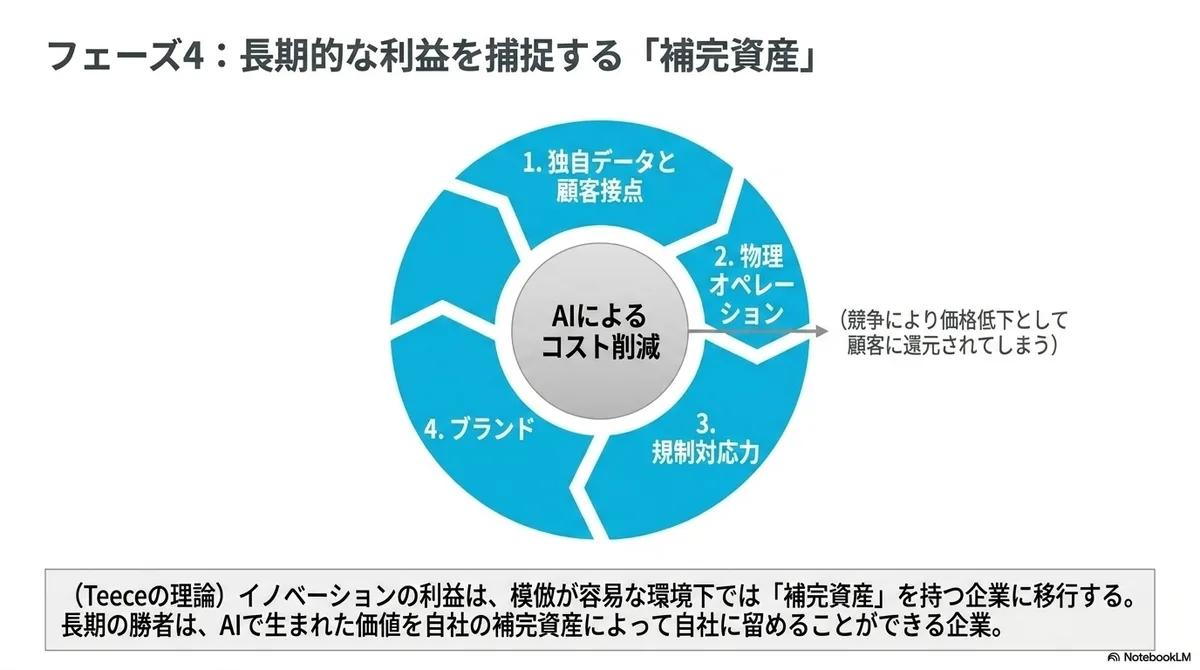
However, productivity gains from AI and companies making money are not the same thing.
Even if AI lowers costs by 10% in some industry, if competition is intense, that portion gets passed on to customers as lower prices. In that case, productivity for society as a whole rises, but the profit margins of individual companies do not.
To keep profits, you need a mechanism for retaining within your company the value created by AI.
This is where complementary assets matter. Teece's classic paper argued that the company that creates an innovation does not necessarily profit from it, and that in environments where imitation is easy, profits can shift to those who hold complementary assets such as manufacturing, distribution, customer touchpoints, and brand.
The same can happen with AI.
In the long run, the strong ones are companies that hold proprietary data or customer touchpoints, companies with regulatory compliance capabilities or brands, and companies with physical operations. When these companies embed AI deeply, it does not end with mere cost reduction; product design, risk assessment, customer service, quality control, and on-site decision-making themselves change.
In other words, the long-term winners may be not only companies that use AI well but companies that have their own field operations and data, and that can capture the value created by AI through their own complementary assets.
Timeline of Past Changes
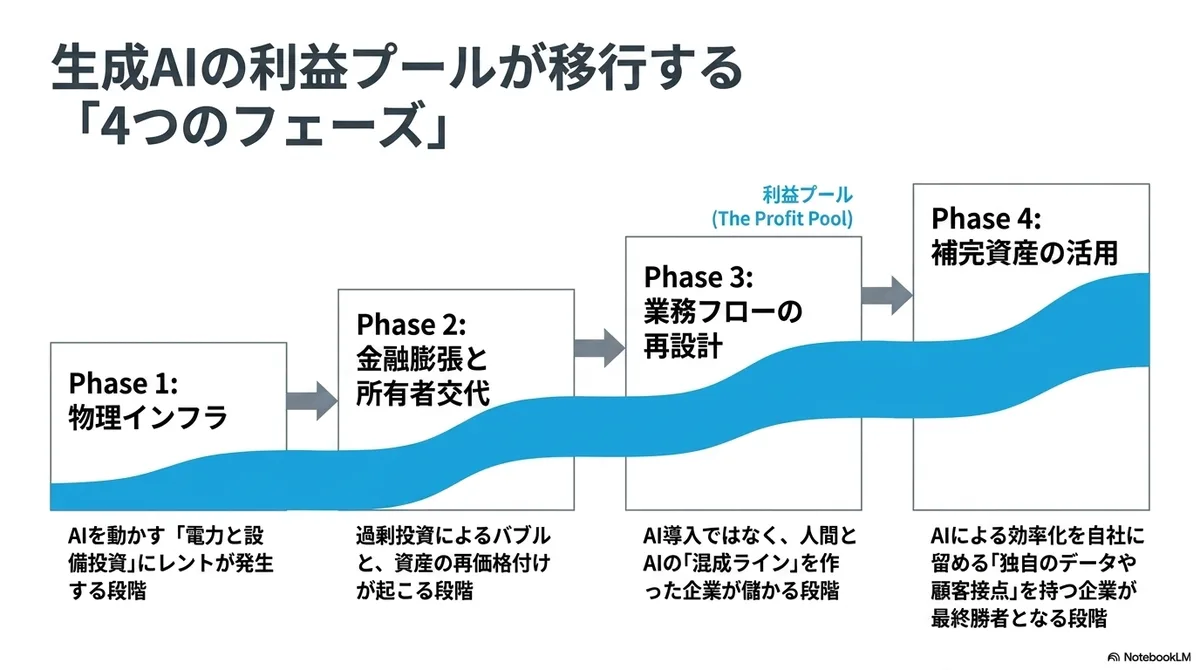
So on what kind of timeline will the AI winners change? And, anticipating such a timeline, what kinds of startups should we start building now?
The winners in railroads and electricity can be summarized as having changed along the following timeline. (Note, however, that there are time lags between countries.)
Aspect | Railroads (from 1825) | Electricity (from 1880) |
Early winners | Ironworks, civil engineering, coal, locomotives, construction contractors, early railway companies | Light bulbs, generators, wiring, meters, copper, Edison-affiliated companies, urban power companies |
Winners at 10 to 20 years | Construction supply chain, promoters, finance, landowners | GE- and Westinghouse-type electrical equipment makers, AC transmission companies, finance, urban power companies |
Winners at 20 to 30 years | Major railway companies, ports, industrial cities, real estate, logistics, wholesale, and retail | Large utilities, heavy electrical equipment makers, electric railways, urban commerce, factories |
Biggest long-term beneficiaries | Manufacturing, distribution, agriculture, and urban real estate that used the railroads | Manufacturing, urban commerce, transportation, and home appliances that made full use of electricity |
(Please note that the phases do not proceed in sequence so much as progress while overlapping.)
Generative AI may move faster than this, but there should be parts we can learn from.
First, for the next few years, it will be physical infrastructure. For a startup, it may be a little late to start now, but there is still a chance.
Next, the shift gradually moves to companies that use AI. But it is not enough to simply use it; what matters is whether they can build new AI-enabled workflows and an organizational operation that can be called AI-native. Then profits gradually shift to companies with complementary assets. Note, however, that even if you improve efficiency and increase the supply side, the rate-limiting factor will be the demand side.
The approach of working with PE firms that OpenAI and others are trying can also be read as a sign of the recognition that it is hard to capture enterprise value by merely selling APIs. It can also be seen as groundwork for becoming, themselves, AI-using companies, which are the next profit pool after infrastructure, or for acquiring complementary assets. Considering the timeline in which it takes several years for a startup to get on track, efforts to go after complementary assets, such as full-stack startups, also seem like something to start building now, at a time when it might seem "too early."
The Difference: AI Crosses Borders
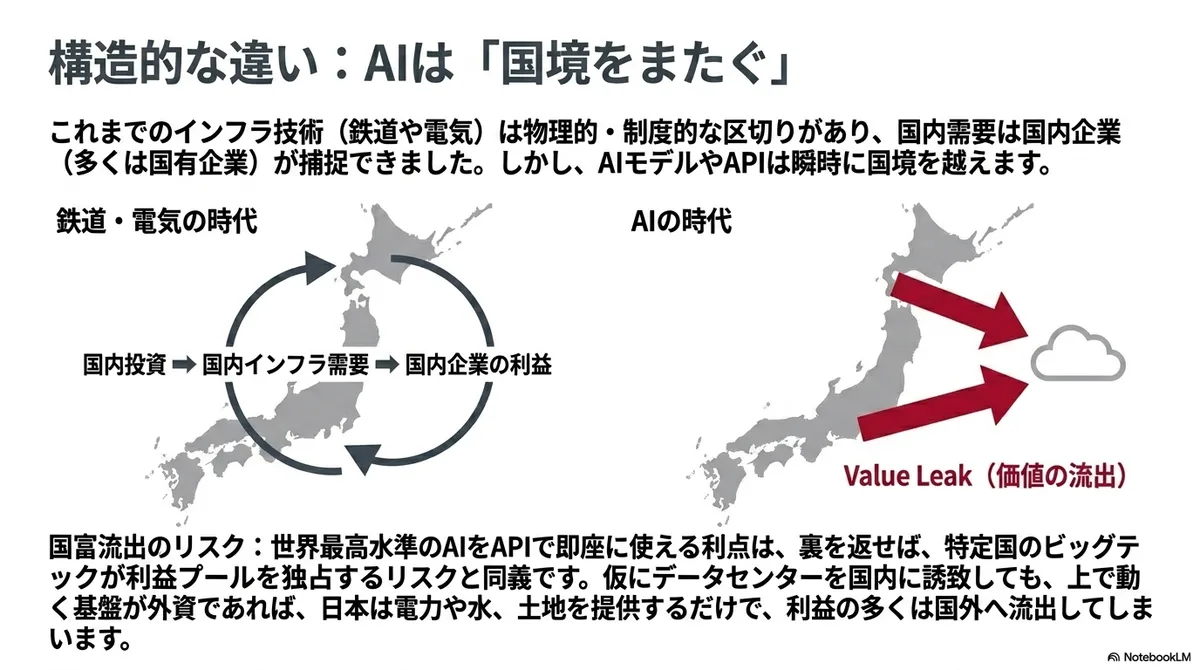
However, AI differs greatly from railroads and electricity. Railroads and electricity were technologies for which institutional and physical boundaries easily formed by country and region. Therefore, it was domestic companies (often state-owned enterprises) that captured domestic demand.
But this time, AI is different. AI models, APIs, and applications are provided across borders. Being able to use world-class AI immediately via API is a major advantage, but it is also a risk that companies in a particular country could hold the AI profit pool. (Just as today's Big Tech holds app platforms and the cloud.)
Also, the domestic investment that occurred with physical infrastructure such as railroads and electricity does not necessarily arise in every country: if data centers are built in a particular country and only the computation results are sent to other countries, infrastructure demand will not arise everywhere.
Even if a data center is built in Japan, if the cloud and AI platform running on it are provided by a foreign operator, then (unless taxes can be properly collected) much of the profit would flow abroad, and Japan's domestic infrastructure such as electricity, water, and land would also end up being used.
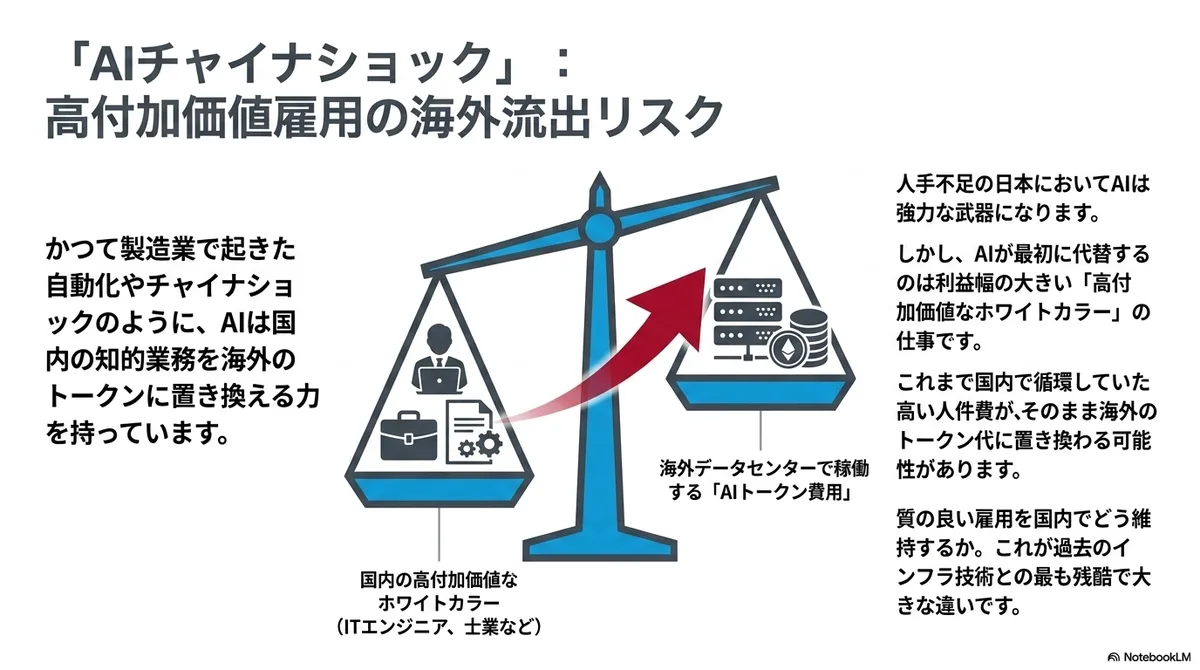
In addition, this time AI is also expected to replace employment in intellectual work with foreign tokens. If so, as with the automation in manufacturing and the job losses caused by the China shock, money that had been spent on domestic white-collar labor costs could be replaced by the cost of AI tokens running in overseas data centers.
AI may play an important role amid Japan's labor shortage, but considering that AI will first be used in high-profit, high-value-added jobs such as IT engineers, insurance, and lawyers, the profits and jobs generated by such occupations could be taken overseas. At the same time, new employment opportunities will also emerge.
When that happens, having to think about how to expand and maintain quality jobs domestically is likely a major difference from earlier technologies.
Building Businesses with the Timeline in Mind
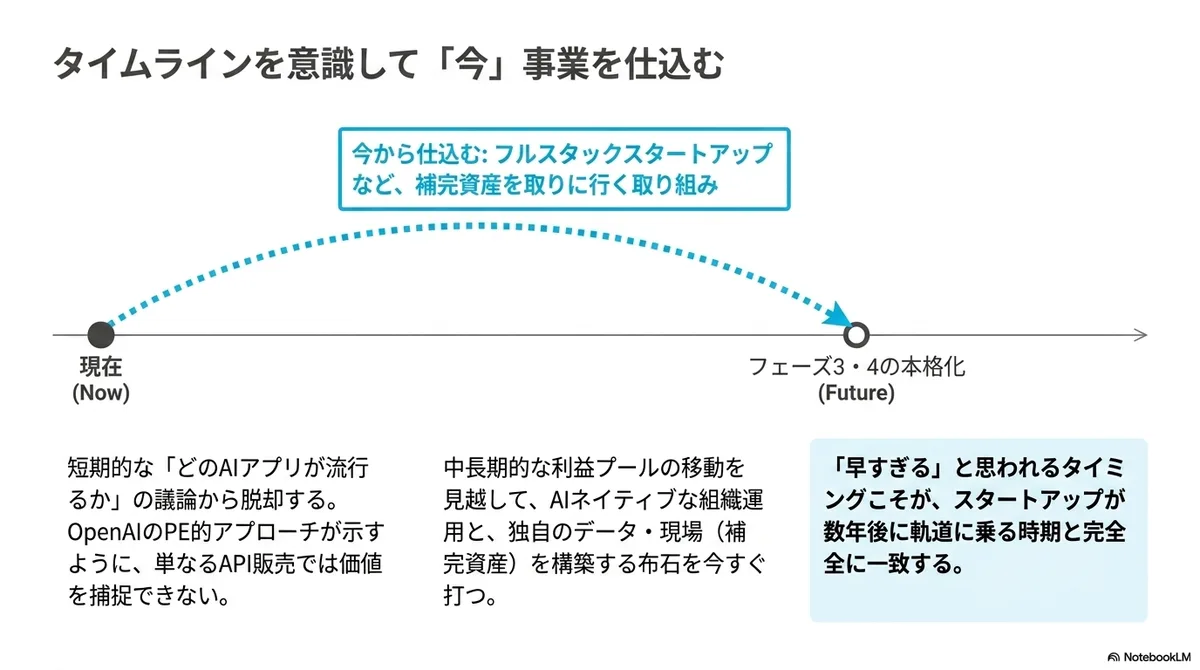
Looking at the history of technology, we have considered that the areas where profit pools are likely to arise in AI-related businesses change depending on timing.
However, this is a hypothesis built using history as a metaphor, and it will not necessarily play out this way, nor is it the answer.
Even so, by viewing the AI boom from this perspective, I think we can discuss not only short-term topics such as "which AI apps will become popular in the short term" and "which model performs best right now," but also how profit pools will shift over the medium to long term.
And I think that being able to discuss, with that in view, what kinds of businesses should be built on what kind of timeline will make discussions about Japan's startup ecosystem more productive.
Related
Thinking About the Second- and Third-Order Effects of AI - 🐴 (Uma)