Organizational Theory for the AI Era, Seen Through a "Theory of AI-Driven Firm Boundaries"
This article was machine-translated from Japanese by AI (Claude). It may contain errors. Read the original Japanese article.
Discussions about AI agents tend to turn into talk about how organizations and managers inside companies should work. I suspect that is because the "organization" is what executives and businesspeople deal with every day.
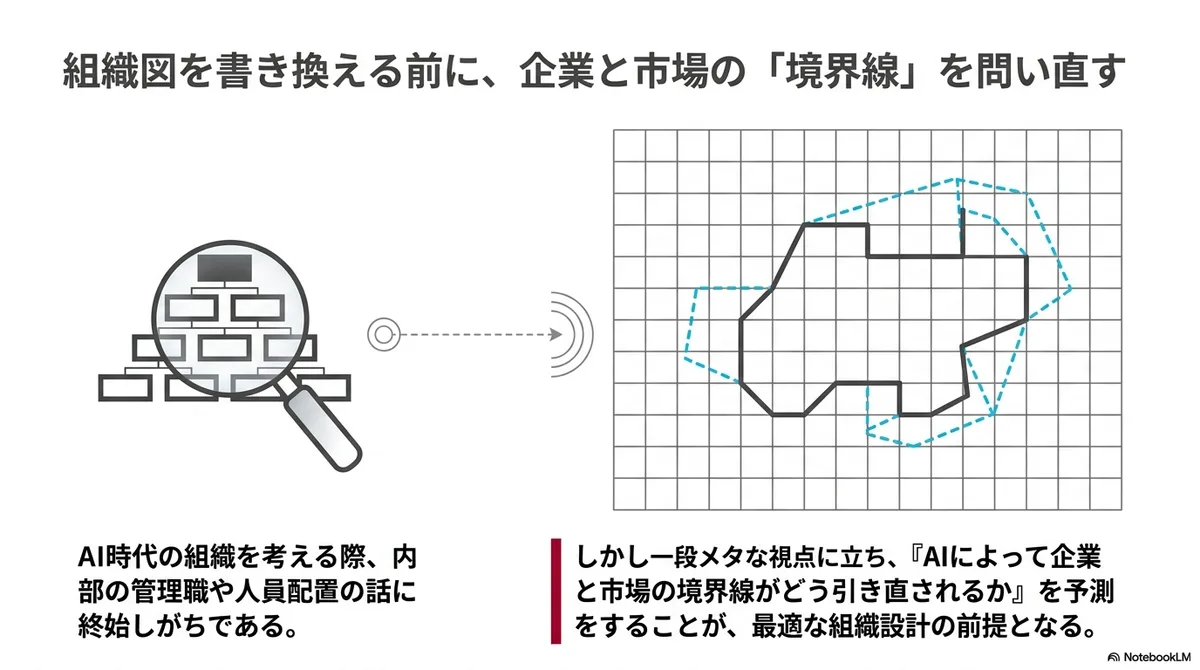
However, how a company's internal organization works is determined by how the company itself exists in the first place.
If so, before thinking about the organization inside a company, we should first think about the shape and outline of the company in the AI era, or, so to speak, "how AI agents will redraw the boundary lines between companies."
By standing one level higher in this way and then thinking about organizations, I believe we can arrive at an organizational theory that is not merely about operational efficiency but is an element of competitive strategy in the AI era.
So in this article, I would like to attempt an exploratory essay: think about a "theory of firm boundaries in the AI era," and then think about organizational theory on top of it.
Specifically, I will examine the outline of companies in the age of AI agents from perspectives such as which kinds of companies can shrink in size once AI agents become widespread, and whether giant platform companies will become even stronger or weaker. I think doing so may also offer implications from the standpoint of startup management strategy.
Please note, however, that this is only an exploratory essay meant to encourage a change of viewpoint, not a prediction that "this is how it will turn out." This question also changes greatly depending on how capable AI agents become. In this article, I assume an AI only slightly better than today's, along the lines of "AI agents are quite useful, but cannot be fully trusted without evaluation, auditing, and permission management."
Why Have Companies Existed?
To think about companies in the age of AI agents, we need to think about why companies have existed, or how the boundaries of a company are drawn.
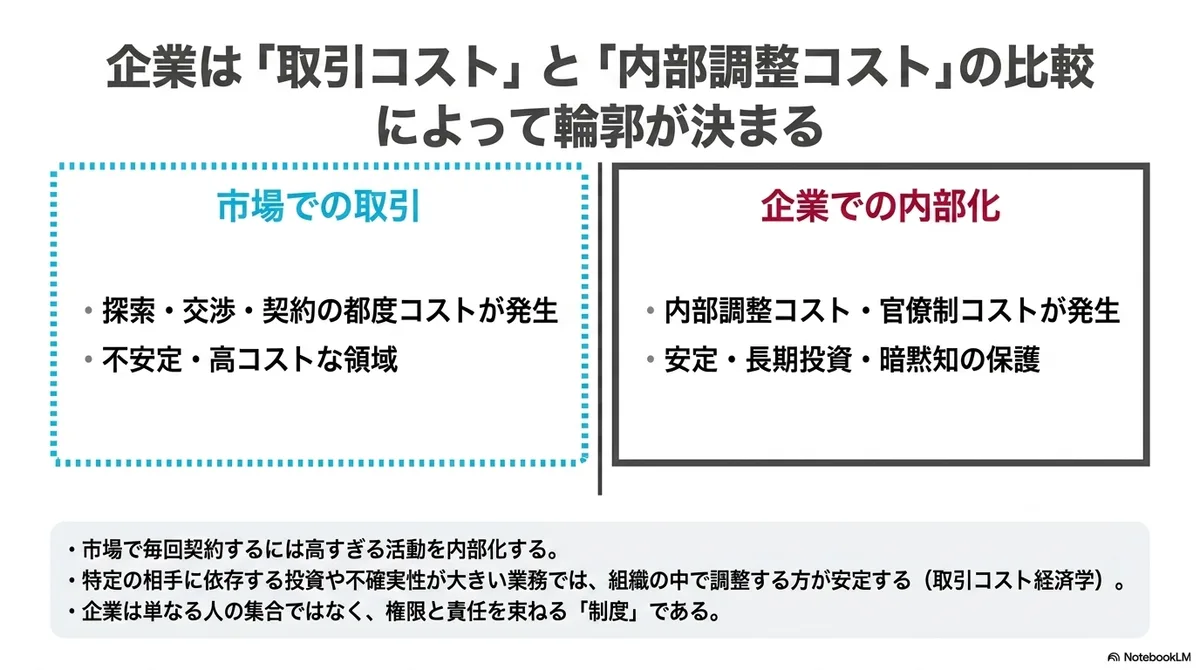
The place to start when thinking about the firm is Ronald Coase's The Nature of the Firm. Coase located the reason companies exist in the cost of market transactions. Finding a counterparty, negotiating, contracting, and confirming performance all take effort. Activities where that effort is large are brought inside the company.
Oliver Williamson developed this argument as a problem of governance. For investments that depend on a specific counterparty, for ongoing transactions, and for work with a lot of uncertainty, coordinating inside an organization is more stable than contracting in the market every time.
However, bringing work inside a company does not make everything cheaper. There are other kinds of costs inside a company as well, such as internal coordination costs and bureaucracy costs.
This way of thinking from transaction cost economics should remain valid in the AI era. The boundary of a company changes according to the comparison between the cost of transacting in the market and the cost of coordinating inside the organization. If so, looking at how AI changes each of these costs makes it easier to think about how the outline of the company will change.
Furthermore, Jensen and Meckling's Theory of the Firm: Managerial Behavior, Agency Costs and Ownership Structure viewed the firm as a problem of agency among stakeholders. Because the interests of shareholders, managers, employees, and customers do not fully coincide, compensation, monitoring, and accountability become necessary. In addition, Grossman and Hart's incomplete contract theory showed that, precisely because there is a future that a contract cannot fully spell out, who holds the residual decision rights is important.
Putting these together, we get the following.
- It internalizes activities that are too costly to contract for in the market every time.
- It protects long-term investment and tacit knowledge.
- It controls access to important resources.
- It becomes the place where losses and responsibility are assigned.
- It guarantees quality and continuity to customers and society.
- Within incomplete contracts, it holds the authority to make the final decision.
In other words, a company can be understood not as a mere collection of people but as an institution that bundles multiple functions.
In the age of AI agents, that vessel called the company will bundle not only the traditional elements of humans, capital, brand, and legal responsibility, but also AI agents, data, and models.
AI Agents Change Multiple Costs at Once
With these theories as a reference, let us consider how AI agents will change the shape of the company.
First, let us think about which costs are likely to change.
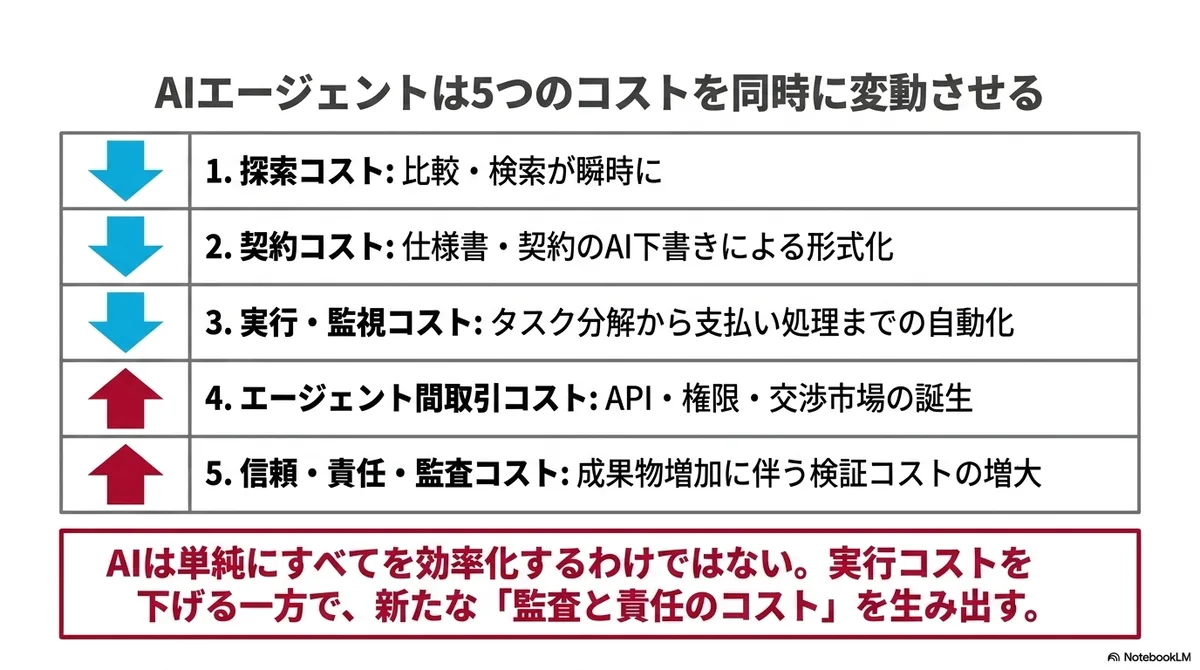
(1) Search costs fall
Buyers can quickly compare suppliers, prices, quality, past track records, and alternatives. Sellers can also use AI to research prospective customers, proposal content, pricing, and competitor information. The number of market participants grows, and finer-grained transactions become easier to conclude.
(2) Contracting costs fall
AI will be able to handle, to some extent, the drafting of specifications, contracts, risk clauses, acceptance conditions, and the like. This makes it easier to contract even for small transactions that previously were not worth it.
(3) Execution and monitoring costs fall in part
AI agents can break down tasks, check progress, detect anomalies, produce reports, and even connect through to payment processing. This lowers, in part, the cost of combining external talent and external companies.
(4) Transaction costs between agents arise
We move from a market where humans look at websites and choose, to a market where AI agents read and negotiate APIs, permissions, reputation, prices, delivery dates, and contract terms. In this market, transaction costs between AIs arise, along with costs such as the track records and audit logs needed for them.
(5) Trust, responsibility, and audit costs rise
As AI keeps executing, the deliverables increase accordingly, and responsibility grows along with the increase in deliverables, so responsibility in the event of failure becomes a problem. The costs of verification and auditing for that purpose will rise.
Summarizing so far, it is easy to understand the boundary of the firm as follows.
Conditions under which marketization (externalization) is likely to advance
Market transaction costs + trust, audit, and responsibility costs < internal coordination costs + bureaucracy costs
Conditions under which corporatization (internalization) is likely to advance
Market transaction costs + trust, audit, and responsibility costs > internal coordination costs + bureaucracy costs
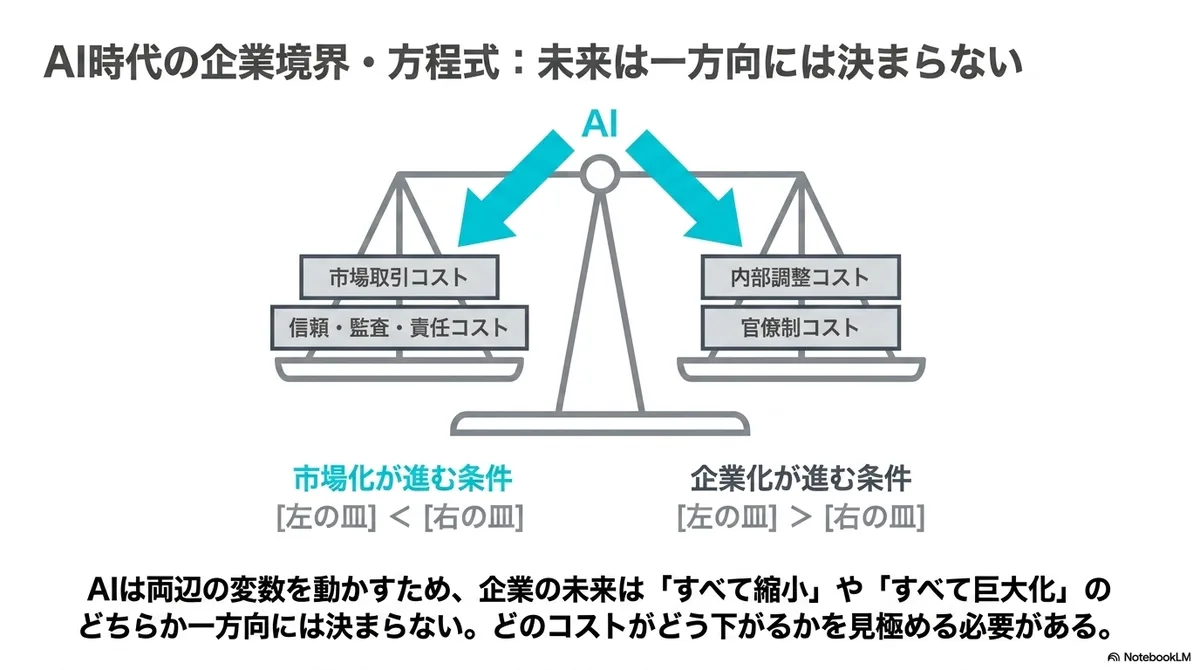
AI lowers the market transaction costs on the left side. At the same time, in some cases it raises the trust, audit, and responsibility costs on the left side. It also lowers the internal coordination costs on the right side.
Therefore, what we can say from this is that whether AI agents will make companies smaller or make large companies and platforms stronger is not determined in a single direction, but what matters is to look at which costs fall, in which domains, and by how much.
Also, depending on the future performance of AI agents, the costs on either side of the formula may change, and whether marketization or concentration advances will differ accordingly. If we can correctly estimate how far such performance improvements will go, a more optimal shape of the firm should come into view.
Which Companies Will Become Smaller, and Which Will Become Stronger?
That is the overall picture, but if we look a little more microscopically at companies' business domains, I think some rough tendencies by type of company will emerge.
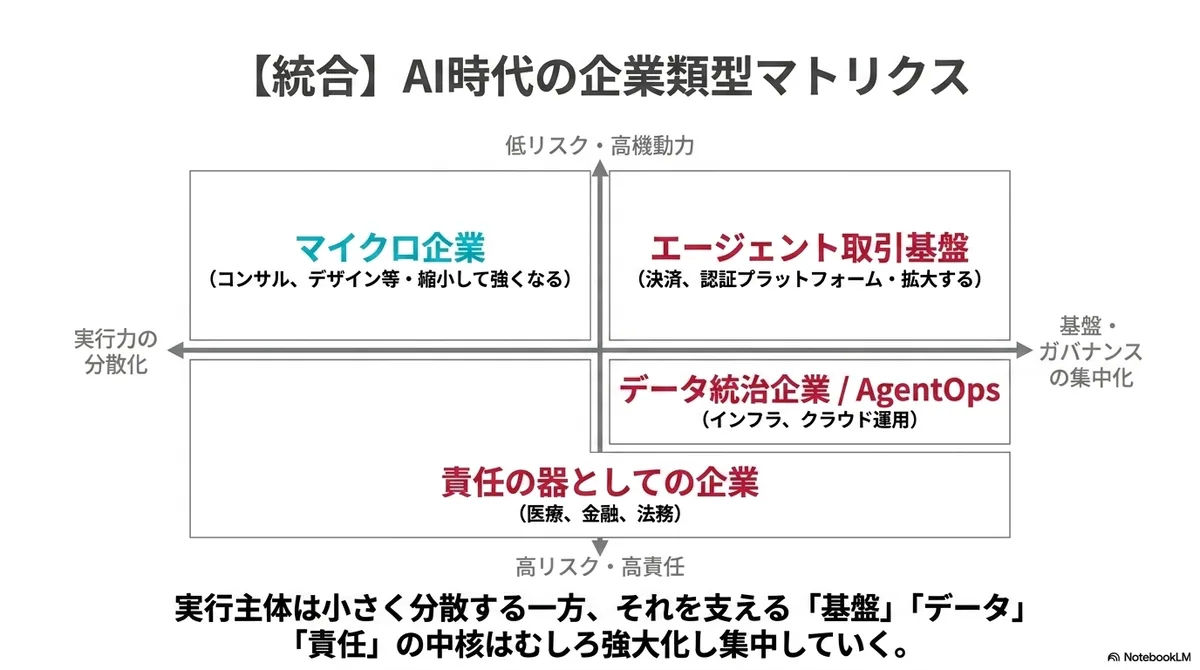
(1) Micro-companies increase
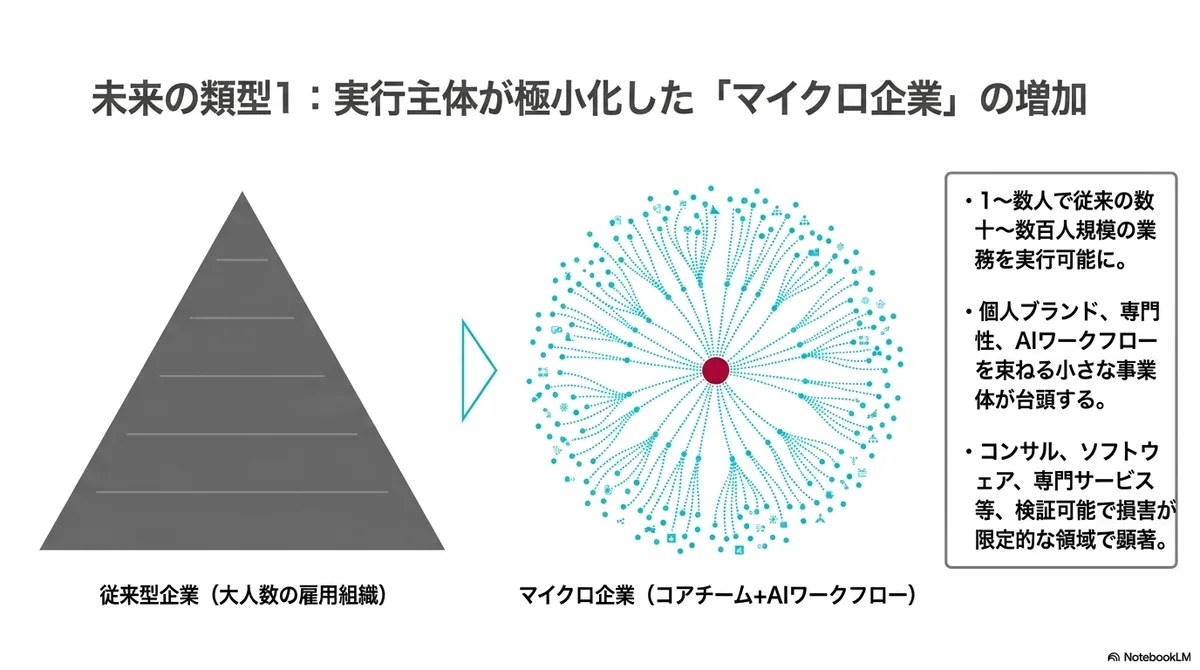
When AI agents enable one person or a small team to carry out work that previously required ten or a hundred people, companies will become not organizations with large numbers of employees but small business entities that bundle AI and other resources.
This tendency will strengthen especially in domains that are a good fit, such as those where
- deliverables can be verified,
- damage from failure is limited,
- regulation is light,
- data access is clear, and
- it is easy to combine external tools.
Examples include consulting, software, education, media, research, design, and some professional services.
In the case of such a business entity, the number of people belonging to it will be small, but AI agents will be relatively numerous, so it will need to adopt an organizational management style suited to that.
However, it should be noted that such micro-companies are likely to depend on platforms such as cloud, payments, AI models, authentication, insurance, and marketplaces. For example, today's freelancer-type people would stand up not as individuals but as micro-companies of "a small number of individuals plus a group of AI agents," and those micro-companies would take on various kinds of execution work on crowdsourcing platforms. That would be close to the picture.
(2) Companies with agent transaction infrastructure become stronger
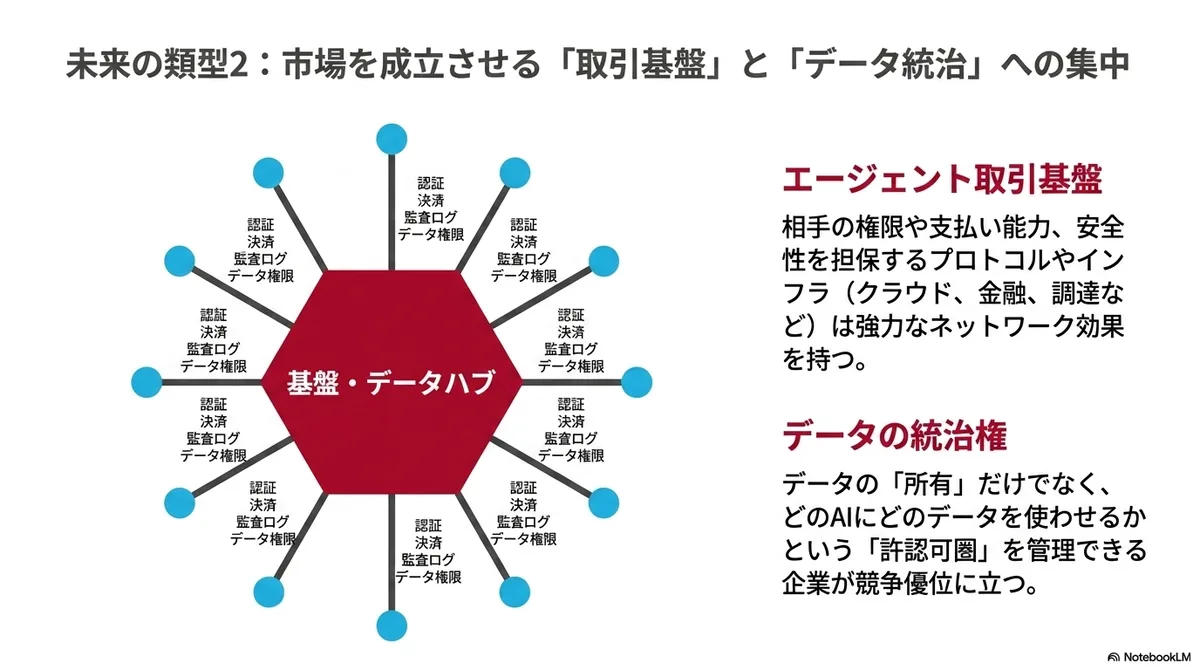
The more AI agents there are, the more we need to confirm things such as whether an AI agent, or the party behind it, is genuine, whether it has authority, whether it can pay, and whether its deliverables are safe. As a result, the value rises of platforms that bundle and guarantee ID and authentication, payments and reputation, logs, insurance, and dispute resolution.
In Coasean terms, this looks like marketization caused by lower market transaction costs. In practice, however, it means that the market itself may come to depend on a small number of foundations. For AI agents to transact with one another, common protocols, APIs, permission management, and audit logs are needed, and because the exchanges of such an agent economy have network effects, some platform will come close to winner-take-all.
Therefore, AI agents decentralize some markets while at the same time concentrating the foundations of the market. And the more markets expand, the more the value of the trust infrastructure that makes markets possible rises.
(3) Companies that bear responsibility become stronger
A company in which a small number of humans remain at the core and delegate peripheral execution to AI agents and outside specialists becomes a company that takes on responsibility, brand, customer relationships, data authority, quality assurance, and insurance against damages.
For example, it is possible for a ten-person company to use AI agents to do work that used to take a hundred people. What matters then is not that the ten people directly handle a hundred execution tasks, but that they allocate authority to AI agents, verify the results, and bear final responsibility for those results.
The more execution is distributed, the clearer it must be who is responsible. This is because, from the customer's point of view, who guarantees the work matters more than whether AI or a human made it.
And the more outputs are produced by having AI agents execute, the greater the responsibility the company bears. If some deliverables then fail and the compensation owed to customers exceeds what the company can pay, that company goes under.
In other words, no matter how much execution is possible, most companies will probably expand only to the extent of the responsibility they can bear. Therefore, even if AI expands execution capability, the expansion of a company is ultimately constrained by its capacity to take on responsibility.
(Incidentally, the limited liability of a joint-stock company is by design a social institution that enables taking on highly uncertain ventures, and taking such risks within a reasonable range should be fine, but in reality not many companies take risk to that extent. Startups, by contrast, are a relatively risk-tolerant vehicle, so they may be able to grow by stepping on the accelerator harder than established companies and taking greater risks than before, saying, "If we make full use of AI agents, we can take this much risk and responsibility.")
This form is likely to spread in professional services, B2B software, research, consulting, auxiliary areas of legal and accounting work, and services for niche industries.
(4) Companies that can govern data become stronger
The performance of AI agents is not determined by general model capability alone. Whether the model can be put to good use changes greatly depending on whether the company can manage customer data and operational logs, learn from failure history, sometimes handle exceptions, and access specialized knowledge and context of use.
Rajan and Zingales's Power in a Theory of the Firm explains power within a firm in terms of access to critical resources in addition to ownership, and the boundary of the firm is determined not only by "who is employed" but by "who can have which data used, for what purpose, and by which model." However, in the age of AI agents, it may be less that a company is fine as long as it owns proprietary data, and more that whether it can manage the permitted scope of data use will determine how well it can put AI to use. This is because what data can be accessed determines what AI produces.
In this case, a company's ability to manage data safely, in terms of consent, authority, reuse, and auditing, becomes a competitive advantage. This is because the more AI agents take over work, the more the design of data access defines a company's boundaries and competitive advantage.
I think this direction will become important in areas such as healthcare, finance, education, manufacturing, R&D, and customer support.
(5) The need for AgentOps companies increases
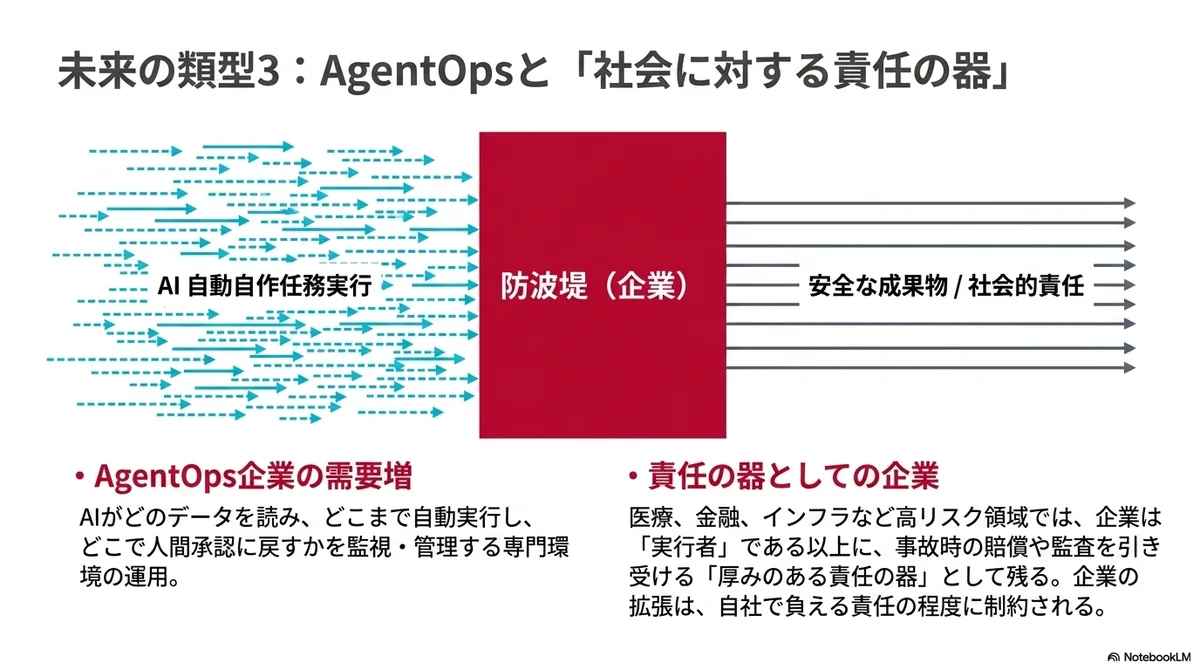
Many companies will no longer be able to handle AI agent model evaluation, permission management, log auditing, and incident response on their own. This means that the more a company becomes one that uses AI agents, the more demand there will be for specialists who support their execution environment.
What is needed here is not mere model operations but the operation of the entire execution environment of AI agents. Looking at model accuracy alone is not enough. It is necessary to manage which data an agent reads, which tools it uses, how far it executes automatically, and where it returns to human approval, as well as whether the model can be connected to operations and data, accidents can be reduced, auditability can be ensured, and it can be stopped when necessary.
In a sense, this is the domain of AgentOps rather than MLOps.
Some of this may be brought in-house, with specialists in charge of AgentOps placed inside companies. On the other hand, outsourcing partners that support AgentOps from the outside will also emerge. These will not be mere system integrators but companies entrusted with AgentOps, which safely builds, monitors, and improves a company's AI execution environment. They would be something like the AI version of companies that provide services such as introducing and maintaining robots in a manufacturing plant.
Of course, there is also a strong possibility that platform companies such as OpenAI will strengthen such model operation functions.
(6) In high-risk domains, companies remain as vessels of responsibility
In regulated domains such as healthcare, finance, law, public procurement, and infrastructure, even when AI assists, licensing, accountability, supervision, compensation, and insurance remain.
The company becomes less an executor than a vessel of responsibility toward society, and therefore, in high-risk domains, AI agents thicken the company's function of bearing responsibility rather than dismantling the company.
Summarizing the discussion so far gives the following diagram.
Internal Organization Moves Toward Projects Organized by Deliverable
What I have described so far is a rough conjecture. Still, after having this kind of discussion and thinking about how the boundaries and shape of companies will change, I think it would be better to consider how the shape of the company would change in one's own domain, and then, on that basis, consider how the internal organization would change, domain by domain.
We could in principle stop at the discussion so far, but I will take one step further and also discuss internal organizational theory.
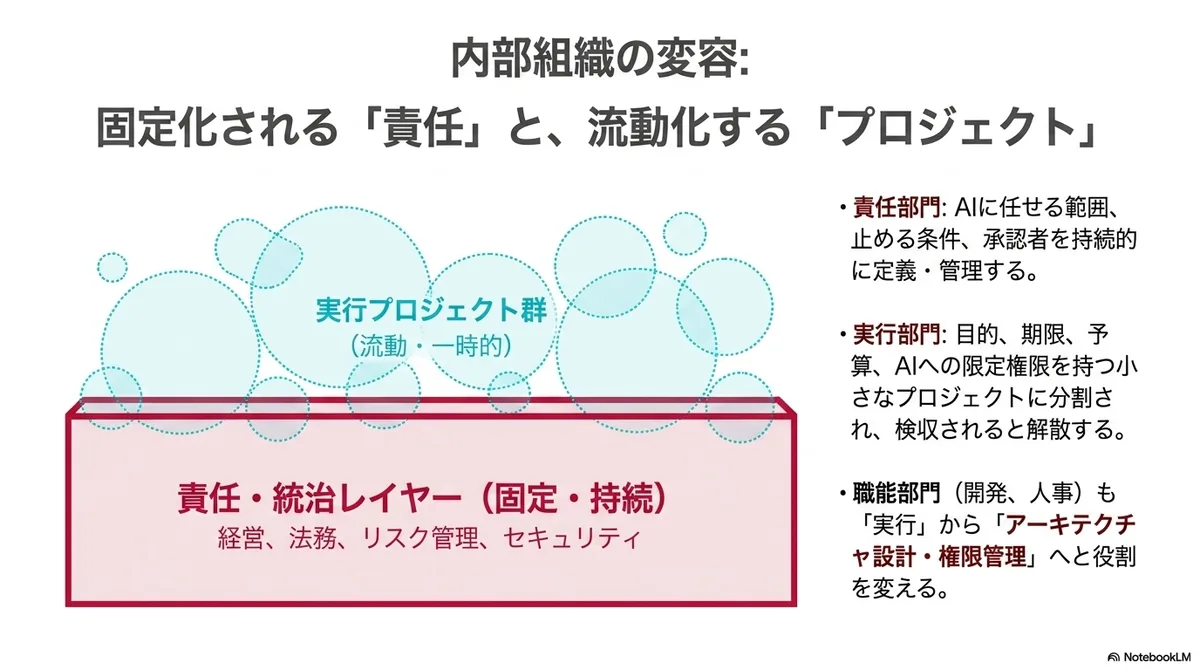
Following this flow, as a broad direction, the force by which departments that bear responsibility persist while the organizations in charge of execution become project-based may operate more strongly than before.
For example, the departments that bear responsibility would handle management, legal, risk management, security, and the like, and would decide the scope to entrust to AI agents, the conditions for stopping them, the logs to retain, the approvers, and the responsible persons.
The execution departments would be divided into small projects, each with a specific purpose, deadline, budget, data authority, AI agents, a responsible human, and acceptance criteria. Such projects would be created for each purpose, such as "validate customer hypotheses for a new market" or "migrate existing code," and would tend to take the form of dissolving once their results are accepted. In that case, the logs and learning remain with the company and are used for the next round of learning.
The role of functional departments will also lean toward holding authority and responsibility rather than executing.
For example, in development, most of the execution is left to AI agents, and humans instead hold architecture, quality standards, security, and the authority to deploy to production. (This may already be happening.)
Legal sets contract templates, risk classifications, and escalation conditions, and takes responsibility. HR, meanwhile, designs which capabilities to keep in humans, which to supplement with AI, and which to buy from the market. The recent trend in Japan of HR staff also taking charge of AI seems to reflect this way of designing organizations.
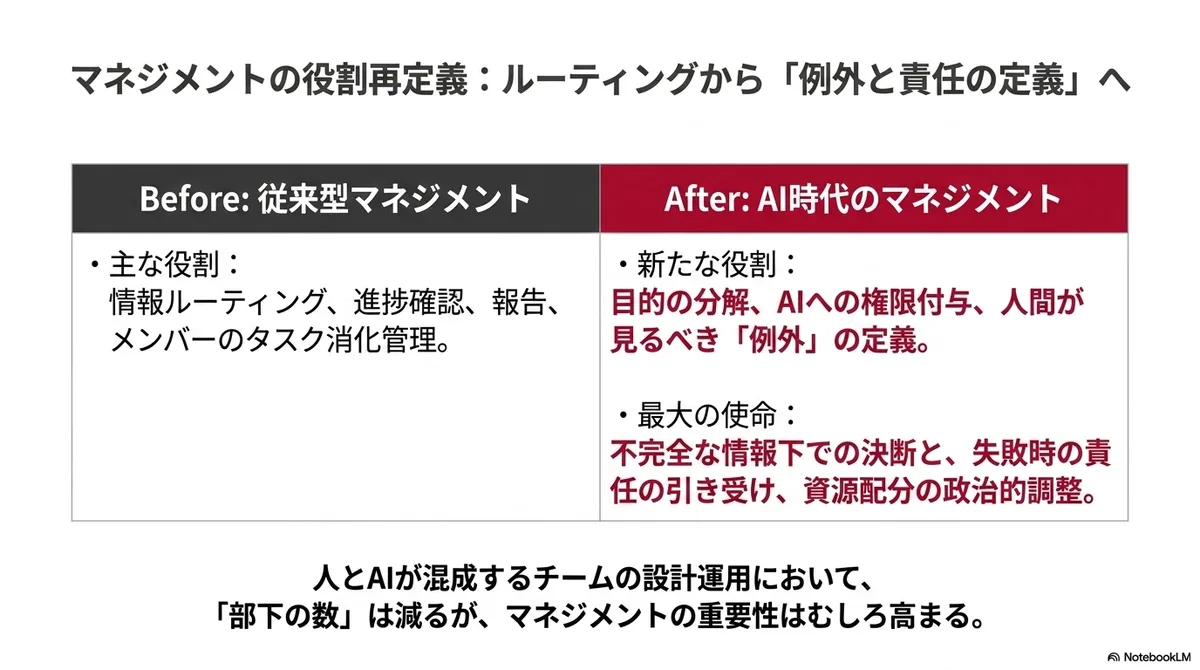
The role of managers will change too.
The information-routing function for running an organization, such as checking progress and reporting, will gradually fade. What becomes important instead is breaking down purposes and goals in order to produce results, deciding the authority and tasks to hand to AI, and defining the exceptions humans should look at. The "number of human subordinates" may shrink, but designing and running teams of mixed humans and AI will become, if anything, more important.
Furthermore, managers will still have the role of making decisions under incomplete information and taking responsibility when things fail. Political coordination over resource allocation within the organization will not disappear either. For example, negotiations such as "because my team has this business importance, I want a larger AI usage budget than other departments" will arise as long as resources are finite, and since some of the information on the preconditions needed to settle such matters is incomplete, AI cannot uniquely derive the optimal solution.
However, turning work into projects also has side effects. Long-term talent development becomes difficult, and tacit knowledge and organizational culture may thin out. It may also tend to skew toward short-term results. Therefore, organizations in the age of AI agents will be asked how to balance the execution power of short-term projects with long-term capability building.
And the more execution is replaced by AI, the fewer opportunities young people have to learn by failing. For that reason, companies may also need to design separately the work they make more efficient and the work they deliberately leave in place for the development of people. (Or else, they could externalize education and hire only people who are ready to contribute immediately.)
In any case, organizational design will become a question not only of staffing but of how to arrange authority, responsibility, data, and AI.
We Need Authority Charts and Responsibility Charts, Not Just Org Charts
An increase in interactions with autonomously acting entities such as agents means, in terms of today's work, that there will be many instances of "human freelancers and contractors coming into and out of the company at unprecedented speed, and of delegating work to them well and accepting their deliverables."
In situations today where there are already many contractors, problems arise such as clarifying what they are to do and deciding how much information to disclose to temporary members, and an organization built on AI agents is an expanded version of that.
And if this design is wrong, an AI agent may unintentionally send confidential information to an external service such as GitHub, change the production environment while holding excessive permissions, or perform inappropriate operations because of instructions embedded in an external document.
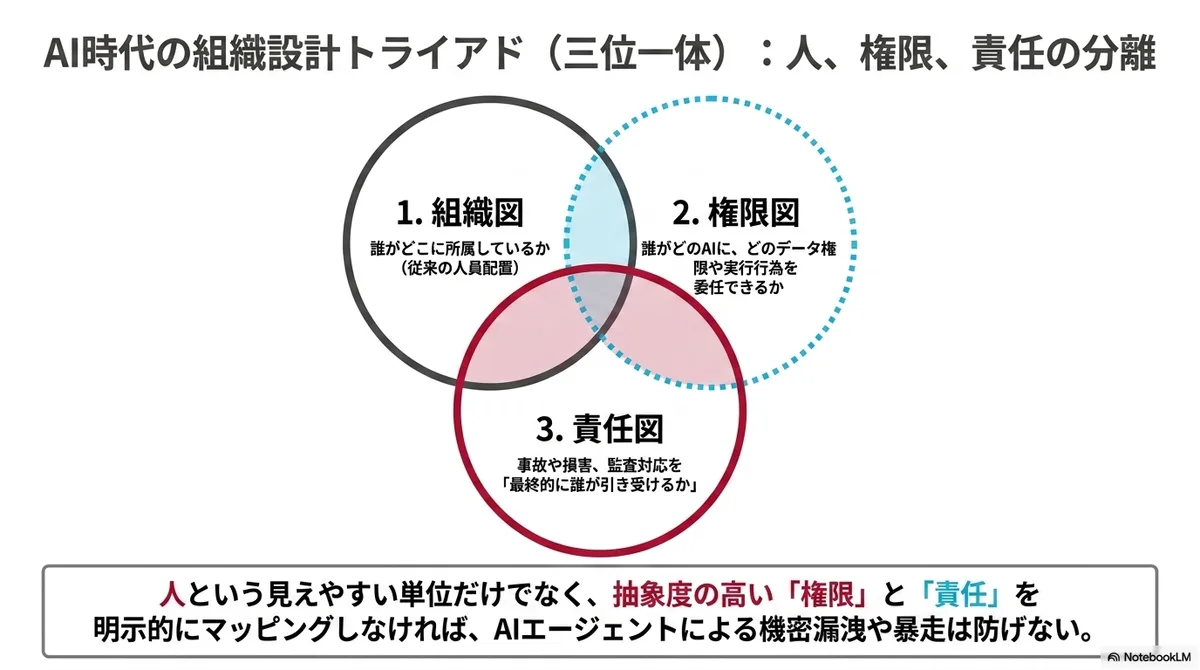
In other words, in the age of AI agents, what becomes more important is not the easily grasped, concrete matter of where people are placed, but the handling of highly abstract things such as authority and responsibility.
In other words, what needs to be done is to prepare, at a finer granularity, multiple mappings in addition to the conventional "person"-based org chart, such as:
- Org chart: who belongs where
- Authority chart: who can delegate which actions to which agents and people (including data)
- Responsibility chart: who takes on accidents, damages, customer explanations, and audit responses
What AI agents in particular need is not the same comprehensive authority as employees, but temporary authority limited to each purpose. It is necessary to define, per unit of work entrusted to AI, which data it can read, which tools it can call, up to what amount it can pay, which environments it can write to, and which operations require human approval.
Today, humans judge things like "it's fine to let an AI outside the organization read this data" or "this task should be done with a more advanced model." What matters is how far we can build a mechanism, with something like metadata, that lets the AI side make such judgments automatically, so that work flows smoothly for the AI.
What to Design First
AI agents break down the functions that companies have carried out and redistribute them.
Then, as in the summary of theory at the beginning, when we view the company as a problem of "how to institutionalize responsible delegation," the following questions will probably need to be asked anew when a company moves into the age of AI agents.
- What should we keep in-house?
- What should we buy from the market?
- Which AI agents should be given which execution authority?
- Which data should be used, and for what purpose?
- Which decisions require human approval?
- Who bears responsibility in the event of failure?
- Where should the results and failures of AI agents be accumulated as organizational learning?
The better a company can answer these questions, the more it will be able to use AI agents not as mere tools for operational efficiency but as a force for redesigning the corporate form itself.
And the conclusion of this exploratory essay is that a company that is strong in the AI era is not one that uses a lot of AI, but perhaps one that can design responsible delegation as an institution.