Implementing Peace
This article was machine-translated from Japanese by AI (Claude). It may contain errors. Read the original Japanese article.
It has been several years since the world order began to shake in a major way.
Having experienced the effects of the invasion of Ukraine from 2022 and the military clashes involving Iran in 2026, I feel anew that "Japan benefits enormously from the world being at peace."
Of course, there were many conflicts before 2022 as well, and the world cannot be said to have been at peace. But since 2022, as various events have piled up, it seems to me that it has become easier for us to feel in a tangible way that when peace in the world wavers, the lives of Japan and the people who live in it waver too.
Now that globalization has connected the world, our daily economic and cultural activities rest on the infrastructure of world peace. Japan's primary energy self-sufficiency rate is only about 15%, and its calorie-based food self-sufficiency rate is 38%. That is precisely why, when peace in the world collapses, the lives of Japan and the people who live in it are easily and strongly affected.
In that sense, world peace is not an abstract ideal for Japan but infrastructure with enormous influence.
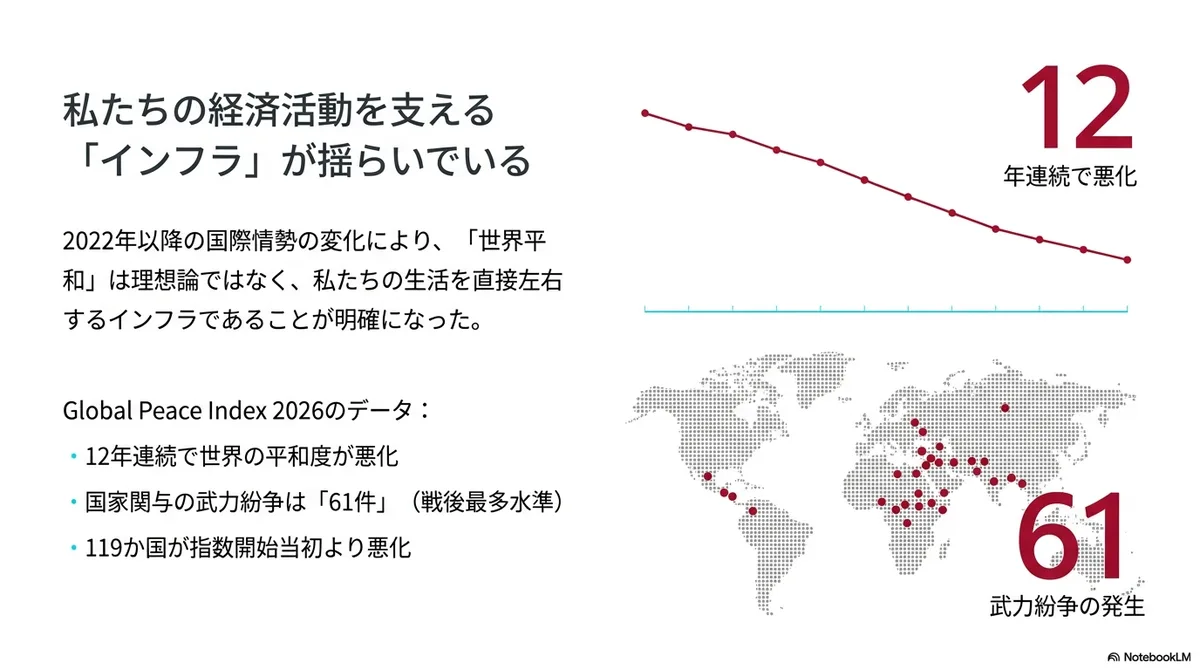
As if to bear out our sense that "peace in the world is collapsing," the Global Peace Index 2026 reports that global peacefulness has deteriorated for 12 consecutive years, and that the number of state-involved armed conflicts has reached 61, the highest level since World War II. It also reports that peacefulness has deteriorated in 99 countries, and that 119 countries are less peaceful than when the index began.
Perhaps because of this background, defense and economic security are being talked about in Japan too, and interest in defense tech is growing among startups.
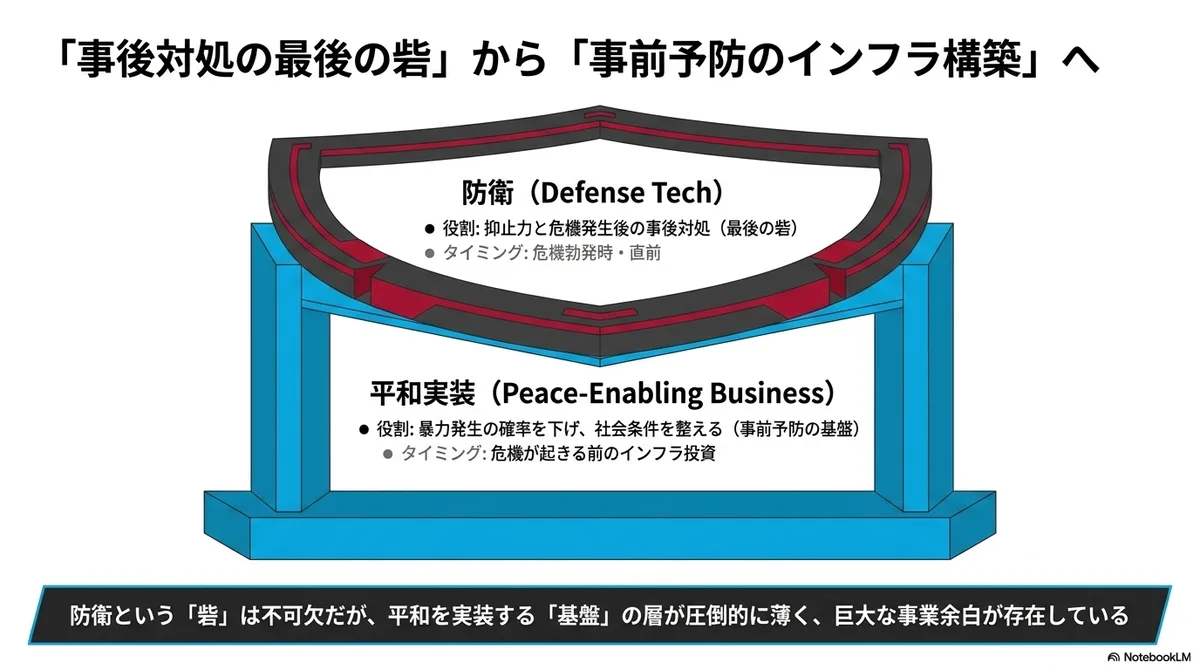
But defense is the last bastion. Strengthening deterrence is necessary depending on the time and circumstances, and in some respects it does keep the peace. Yet more than thinking about how to respond when peace collapses, we also need to think about how to create conditions in which peace is less likely to collapse. That could be called a business of implementing peace.
And I believe that as the number of people who run businesses to implement peace grows, peace will become easier to achieve.
Realizing Peace as a Social System
The word "peace" sounds somehow idealistic, like a wish or an aspiration. You might think it is something achieved through agreements between states, and that the private sector can do little. It is true that for part of peacemaking and peacebuilding, private organizations may not be able to be directly involved.
However, when we think of peace as the state of a particular social system, there is in fact a great deal that private businesses can contribute.
For example, if each country no longer struggles with energy or water, conflicts over resources will decrease to some degree. If nutritious food can be produced cheaply anywhere, hunger and poverty will also decrease. If the information space becomes healthier and people with differing opinions can trust one another, quarrels should decrease. If cultural exchange is possible through entertainment, we become able to picture the faces of the people on the other side.
Some of these things cannot be done by governments or the United Nations alone. Rather, they are made possible by technological development and everyday activities by the private sector.
The private sector may not be able to deal with the problem of dictators in various countries, or make laws function in other countries, but we should be able to create situations that make peace easier to achieve in each country and region, in other words, to run peace-enabling businesses.
A peace-enabling business does not mean that the private sector takes on diplomatic negotiations or ceasefire agreements themselves. It means a business that creates social conditions that lower the probability of violence and destabilization, make it harder for them to spread even if they occur, and speed up recovery. Energy, food, water, the information space, logistics, healthcare, education, employment, local transportation, disaster response, and AI governance could all be its targets.
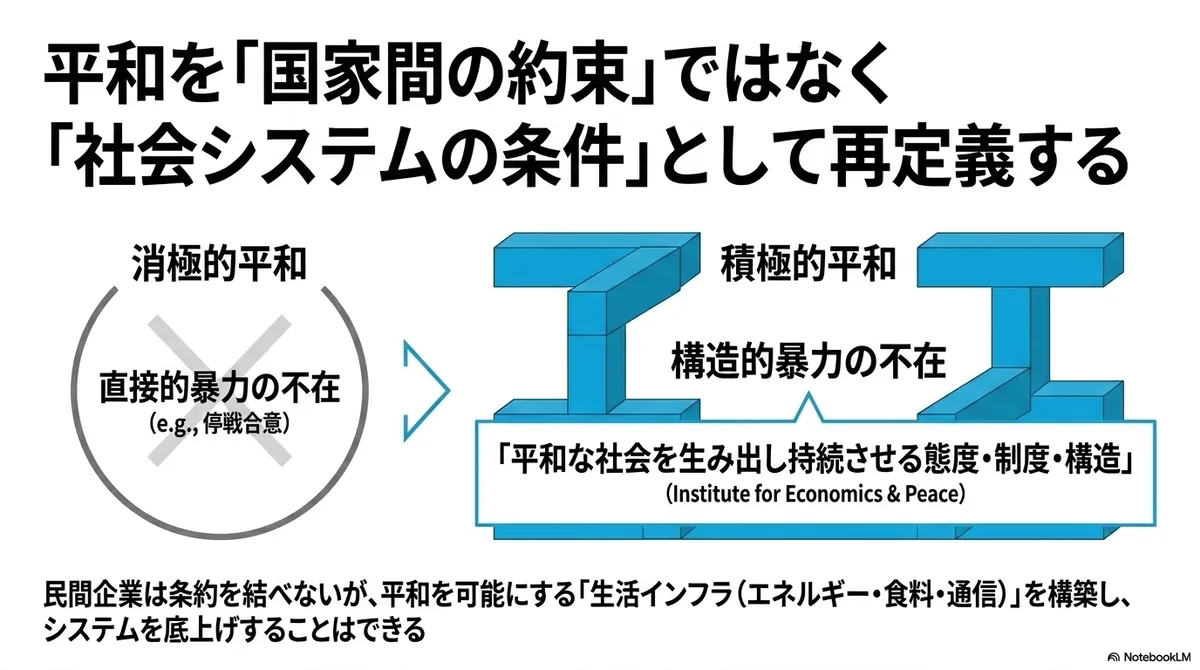
In peace studies, negative peace has been described as the absence of direct violence, and positive peace as the absence of structural violence. The Institute for Economics & Peace defines positive peace as "the attitudes, institutions and structures that create and sustain peaceful societies," and names three elements: attitudes, institutions, and structures.
Of course, it is not easy for the private sector to directly change national systems or the diplomatic order. But companies and private organizations can also have a large indirect influence on people's attitudes, society's institutions, and the structures that support daily life.
I think there are several things that can be done, particularly in the following areas.
- Autonomy
- Cooperation
- Inclusion
1. Autonomy
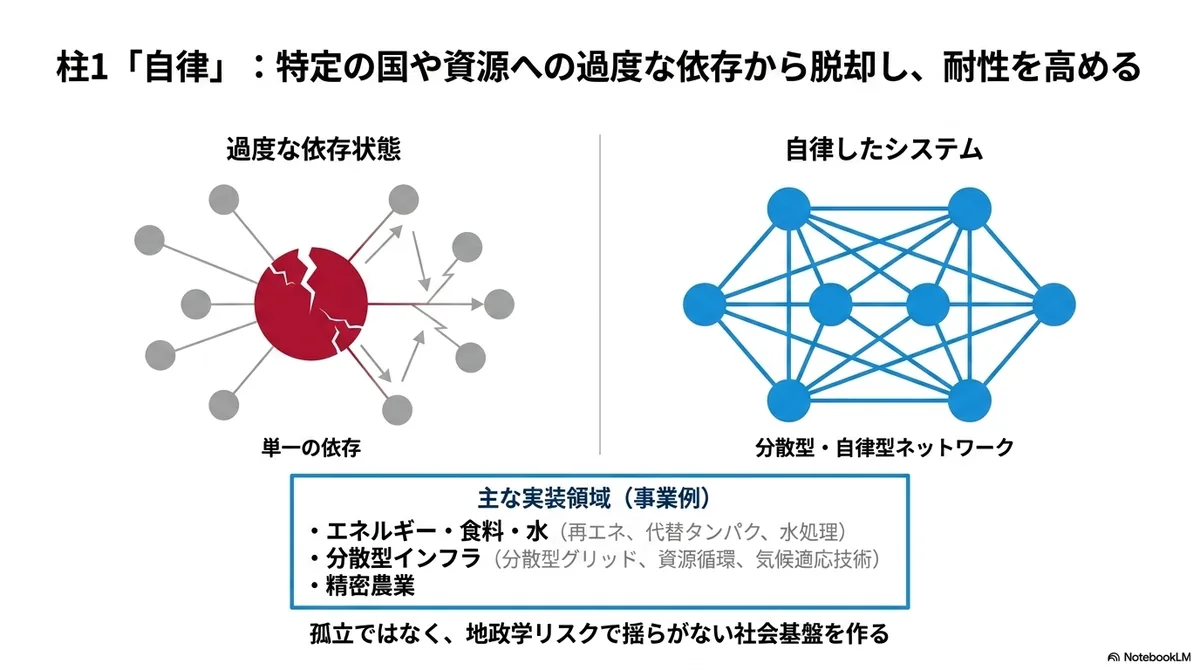
The first is autonomy.
Autonomy here does not mean isolation or self-sufficiency. It means reducing the state in which we depend excessively on particular countries, resources, or supply chains, so that lives and industries are shaken with every crisis.
Energy, food, water, critical minerals, pharmaceuticals, and communications infrastructure are the basic conditions for society to function stably. Japan's energy self-sufficiency rate is low, and its food self-sufficiency rate is below 40% on a calorie basis. Technologies and businesses that reduce such vulnerabilities are security policy, and at the same time they are industries that support peace.
Renewable energy, energy storage, distributed grids, recycling, alternative proteins, precision agriculture, water treatment, and climate adaptation technologies exist not merely for the sake of the environment or efficiency. They also become a foundation for increasing society's ability to withstand external shocks and for reducing anxiety and conflict over resources.
People tend to think in terms of growth strategies. It is true that if a country grows, its terms of trade may improve. But in the present day, I believe that thinking through what is needed from a country's autonomy strategy, and then exporting and sharing the technologies and businesses developed there with other countries, may also become a foundation for the country's future industrial exports.
2. Cooperation
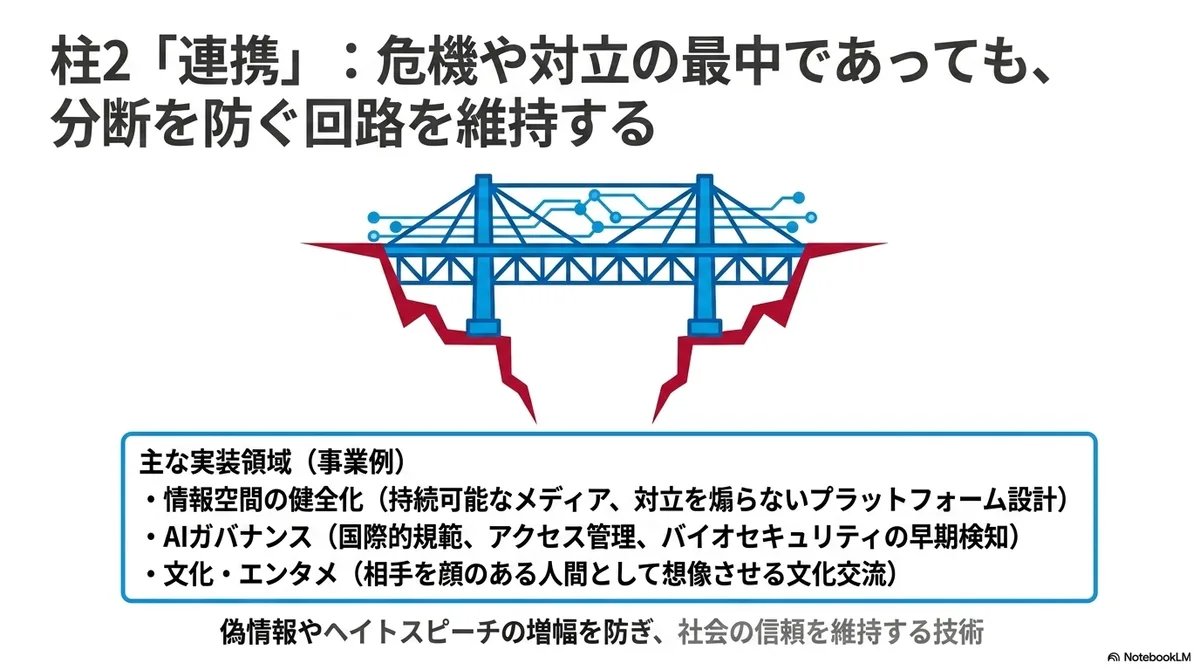
The second is cooperation.
Peace does not arise automatically just because resources are sufficient. People of different countries, regions, religions, generations, and political positions need to be able to keep their relationships intact even while they hold their conflicts.
For that, a trustworthy information space is indispensable. The United Nations has also pointed out that disinformation, misinformation, and hate speech amplify social distrust and raise risks to conflict, democracy, human rights, and public health.
There is quite a lot the private sector can do here. Supporting the sustainability of healthy media. Designing platforms that do not stoke conflict. Creating content that promotes cross-cultural understanding. Building communication infrastructure that keeps channels of dialogue open even in a crisis.
Culture and entertainment are also included in this area. Being able to imagine the other side not as an abstract enemy but as a human being with a face is one of the conditions for peace.
Moreover, advances in AI and the life sciences accelerate infectious disease control and drug discovery, while also possibly raising biosecurity risks in the future. That is why, alongside technological development, we will probably need to put in place, in cooperation, auditing, access management, international norms, and early detection mechanisms.
3. Inclusion
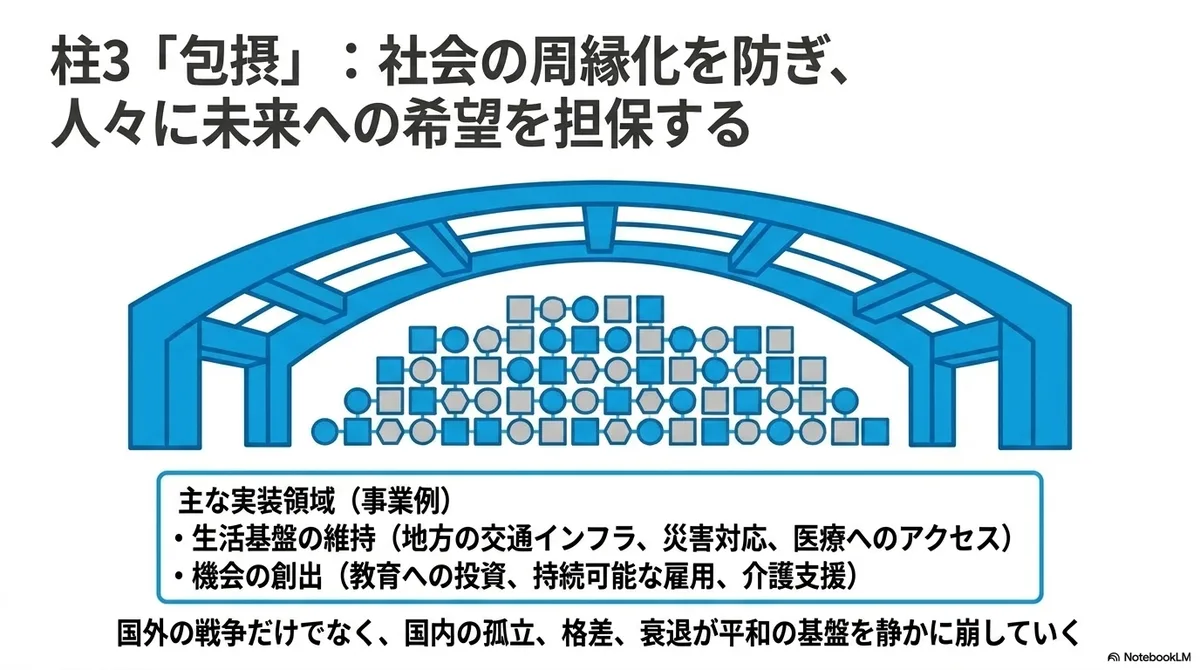
The third is inclusion.
It is not only wars outside the country that destroy peace. Isolation and dissatisfaction within the country, inequality, regional decline, the loss of means of transportation, and lack of access to education and healthcare also erode social stability little by little.
Inclusion means creating the conditions under which people can feel that they have not been abandoned by society, and creating hope for the future. Domestic businesses in employment, education, healthcare and transportation, long-term care, and disaster response for that purpose will also become a foundation of peace in the sense that they prevent domestic destabilization.
Japan has challenges such as a declining birthrate and aging population, regional gaps in transportation, disasters, and shortages of healthcare and long-term care workers. Businesses that solve these not only support life within Japan but can also become peace infrastructure that can be deployed to other countries facing the same challenges.
By viewing things under the umbrella of autonomy, cooperation, inclusion, and peace, I think we may be able to organize conventional climate change measures and social impact businesses under a larger meaning as well.
Four Types of Actors
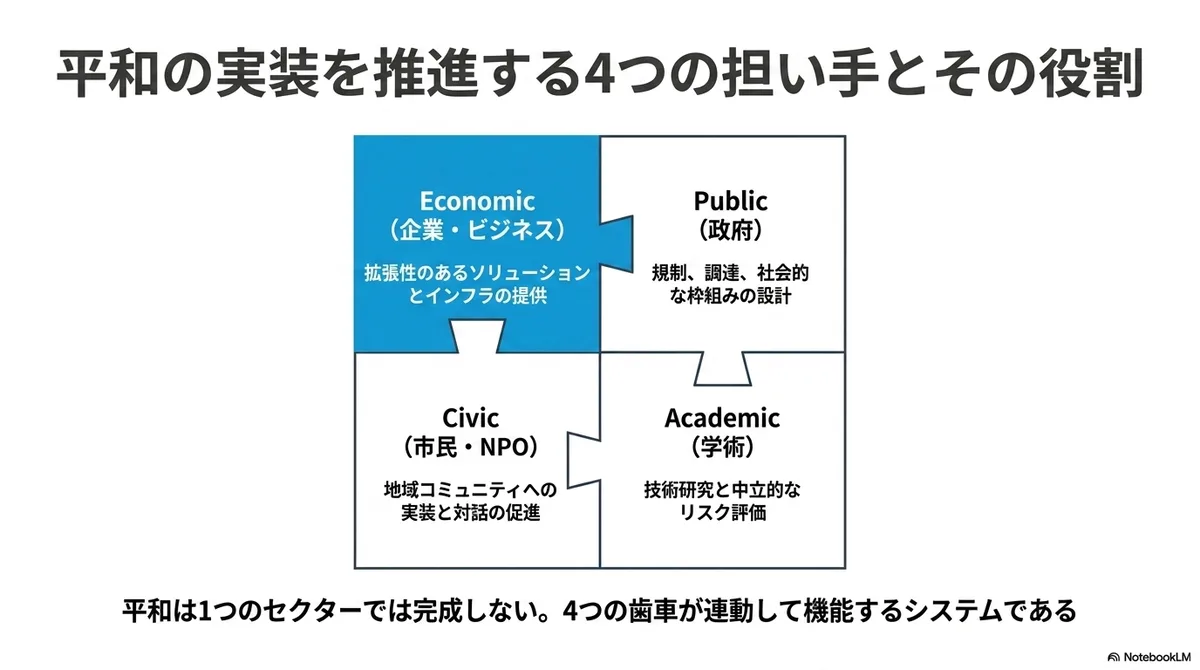
Implementing peace like this cannot be completed by companies alone. Four actors, namely business, government, citizens, and academia, each need to be involved in their own way.
For example, the following four actors will probably be needed.
- Economic (companies and business)
- Public (government)
- Civic (citizens and NPOs)
- Academic (academia)
Within this, their roles should also differ somewhat. For example, they might be summarized in a table like the following.
Area of implementation | Economic | Public | Civic | Academic |
Autonomy | Businesses in energy, food, water, and resource circulation | Regulation, procurement, subsidies, standardization | Local implementation, cooperatives, participation by residents | Technology research, risk assessment |
Cooperation | Media, platforms, cultural industries | Diplomacy, information policy, international frameworks | Citizen exchange, dialogue | Information space, AI, conflict studies, international politics |
Inclusion | Transportation, healthcare, education, employment, long-term care | Social security, local government policy | Local communities | Social epidemiology, urban planning, education research |
And I feel that in each of these areas, we need to launch new activities that have a large impact on peace.
Contributing to Peace Greatly and Quickly
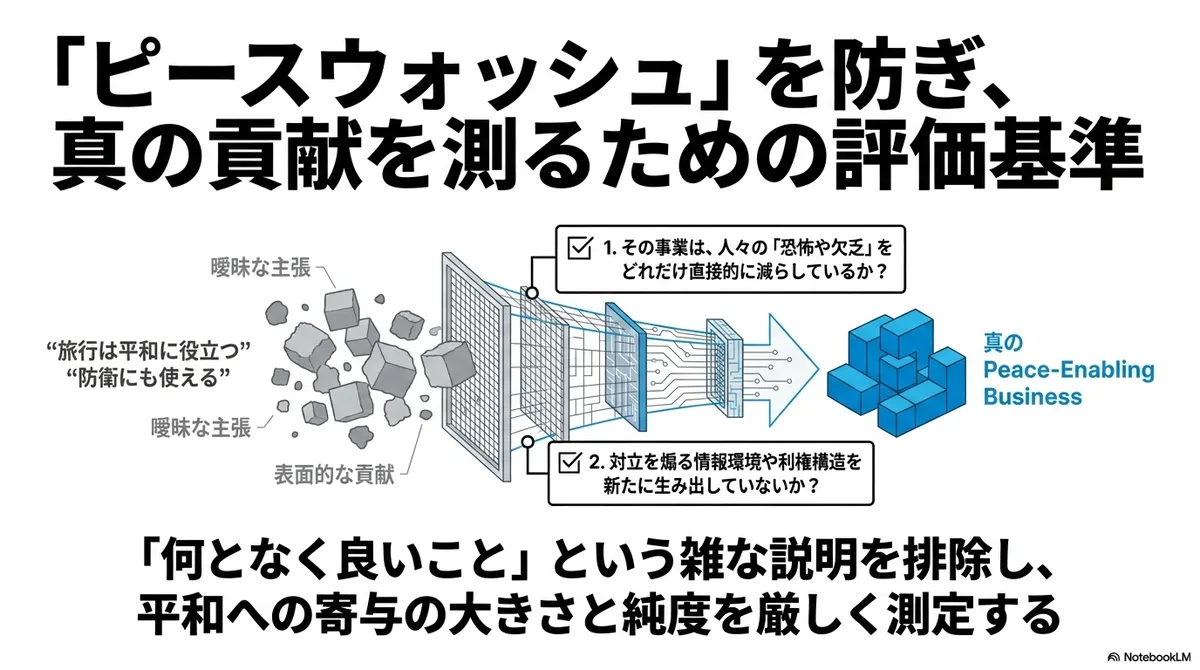
No business is unrelated to peace in some form. But if we call every business a peace-enabling business, the term will quickly become hollow. We need to distinguish between businesses that contribute to peace, businesses that are neutral toward peace, and, in some cases, businesses that undermine peace.
Also, if we truly mean to create peace, we should consider differences in degree and in potential. If vague explanations such as "they're doing something good, somehow," "learning about cultures through cross-border travel helps peace," or "it helps peace because it can also be used for defense" are allowed to pass, we may end up with peacewashing, much like greenwashing.
For that reason, I think we need to rigorously ask how much a business reduces people's fear and want, and whether it is creating an information environment or a structure of vested interests that stokes conflict, and to measure its contribution to peace in some form.
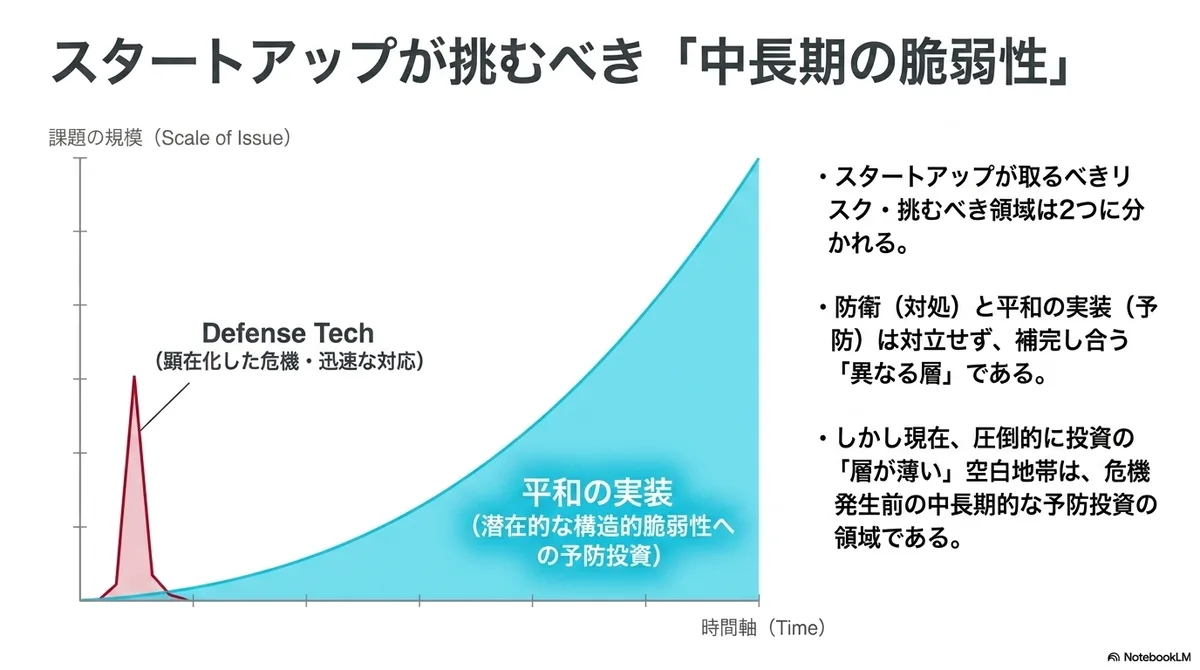
I personally am often involved with startups, so from that point of view, the risks startups take and the domains they take on are:
- Tackling, in the short term and quickly, problems that many people find hard to take on and that have suddenly grown large
- Tackling medium- to long-term problems that many people find hard to take on
If today's defense tech is the former, then the movement to implement peace is the latter.
Defense is necessary to deter crises and to deal with crises that occur. Implementing peace, on the other hand, is preventive investment that reduces vulnerabilities before a crisis occurs. The two are not in opposition, and should be seen as different layers for protecting peace. And I think that now, the layer that is thin is increasingly becoming the latter, relatively speaking.
Why Japan, of All Countries, Should Take On Peace as a Business
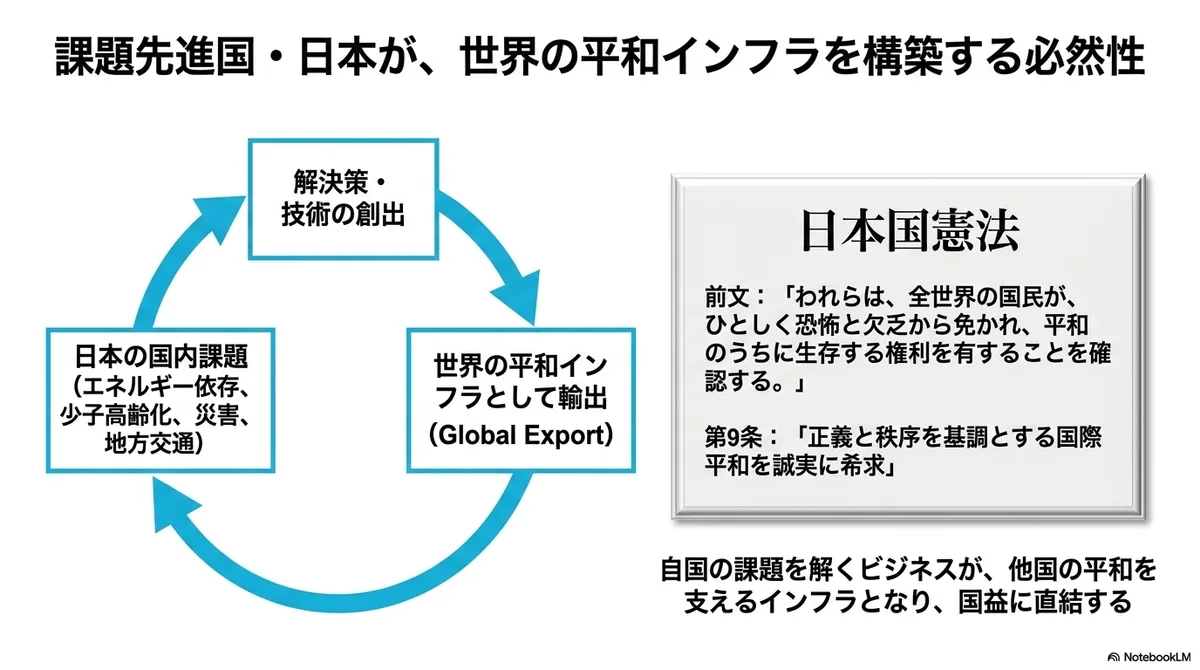
The meaning of Japan taking on this domain is not merely a matter of principle. Japan already faces challenges such as energy dependence, food security, a declining birthrate and aging population, disasters, regional transportation, and shortages of healthcare and long-term care workers. These are problems specific to Japan, and at the same time challenges that many countries will face from now on.
In other words, the technologies and businesses that arise in the process of Japan solving its own challenges can become infrastructure that supports peace for other countries as well. Not as a country at the forefront of challenges, but as a country at the forefront of creating peace.
I stated at the outset that world peace serves Japan's national interest, and precisely for that reason it seems reasonable for Japan to take the initiative in creating peace.
Moreover, the preamble of the Constitution of Japan says:
We recognize that all peoples of the world have the right to live in peace, free from fear and want.
Article 9 also declares that "the Japanese people sincerely aspire to an international peace based on justice and order."
Because Japan places peace in its constitution as the right of the peoples of the whole world, I believe that building peace-enabling businesses is in keeping with Japan's way of being, and also points to a direction for Japan's new position in a changing world.
Conclusion
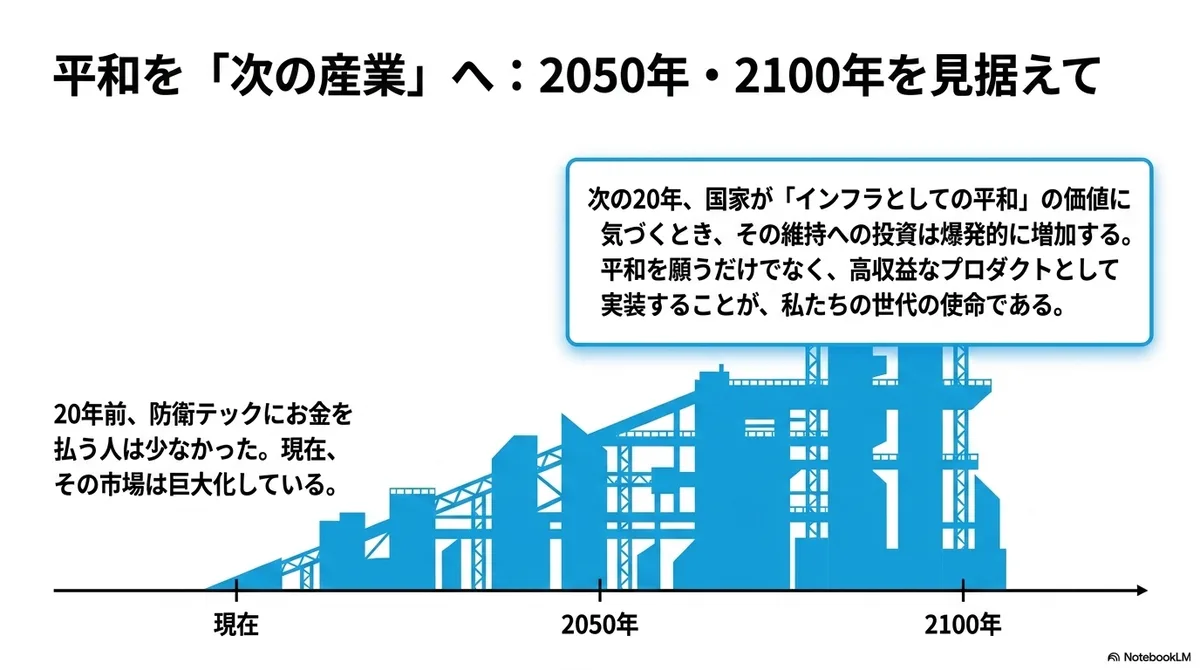
There was a time when almost no one paid for defense tech. But the world has changed over 20 years, and the number of people who pay for defense has grown.
If so, rather than merely following that trend, when we think about "the next 20 years" beyond it, I think there is quite a possibility that the number of people who pay to maintain peace will grow even more. When many countries realize the importance of peace as infrastructure, and that peace is not obtained for free, its value will rise greatly.
Japan is a country that has benefited enormously from world peace. And in its constitution, too, it has declared that it sincerely aspires to international peace. If so, for Japan not merely to wish for peace but to create businesses that make peace possible is not idealism but also a realistic strategy that serves the national interest.
And it should be possible to create peace. The relatively peaceful periods in some regions in the 20th century, compared with the 18th and 19th centuries, were the result of human effort.
If the postwar structure is fraying because of structural changes in the world, then building a new structure anew can be called the work of our generation today, and if we can do it, it should produce large returns in various forms.
Rather than merely wishing for peace, we need to implement it as a reality, and for that, we need to increase the number of people who think the same way in each of the domains of business, government, citizens, and academia.
Turn peace into products and infrastructure, and make it Japan's next industry.
I believe that the accumulation of such efforts will make Japan's position in the world of 2050 and 2100 better.