Accelerating Education in an Age of Declining Birth Rates: How Do We Develop Advanced Talent with a Limited Population?
This article was machine-translated from Japanese by AI (Claude). It may contain errors. Read the original Japanese article.
One of the major challenges we face is the declining birth rate.
The trend in the number of births shows just how sharp the decline is.
- 1985: about 1.43 million
- 1995: about 1.19 million
- 2005: about 1.06 million
- 2015: about 1.01 million
- 2025: about 706,000 (Ministry of Health, Labour and Welfare, Vital Statistics preliminary figures)
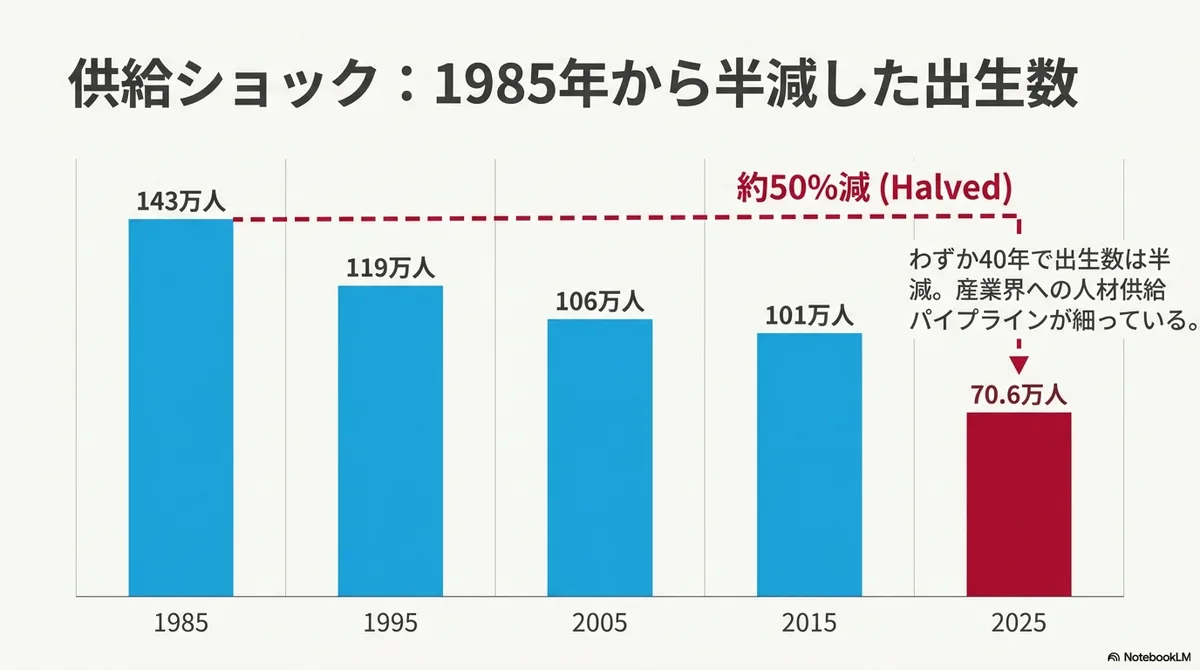
This change is expected to affect many areas, including the survival of educational institutions such as universities, the maintenance of the social security system, and the sustainability of local communities, and these issues are being actively discussed.
One of those issues is that, as a result of the declining birth rate, over the next 20 years the talent pipeline supplying industry will rapidly narrow.
At present, labor shortages, centered on blue-collar work, are spreading as an immediate problem. But looking at the future population structure, it is not hard to imagine that the shortage will spread to white-collar work and, eventually, to advanced talent.
If the supply of such talent shrinks, and domestic companies can no longer hire enough people from within Japan who have acquired the ability to take on high-value-added work, it will become difficult for Japan as a whole to produce high-value-added products and services, and the maintenance of industry and the economy may be put at risk.
This is not yet clearly visible. But as such a supply shortage becomes more apparent, I expect that industry will increasingly demand that the education sector "increase the supply of advanced talent."
Given that the number of children, the base population, is small, this amounts to a demand to raise the rate of conversion into advanced talent. This is quite difficult, but I feel the time is approaching when we will have to think about it in earnest.
Of course, education does not exist solely for the sake of industry or labor. It has diverse purposes, such as cultivating learning and citizenship and supporting individual self-fulfillment. While fully recognizing this, in this article I deliberately narrow my focus to one important aspect of education, "developing talent for industry," in order to make the discussion clear.
A Rough Estimate: What If We Need "300,000 Advanced Professionals"?
To maintain Japan's level of economic prosperity, we need to keep producing a certain number of people every year who can work in high-value-added industries.
By "advanced talent" here, I do not mean people who hold a particular degree. I mean people with competencies such as the ability to define and solve complex problems, the ability to envision and implement new value, and the ability to integrate advanced expertise and make judgments. Think of people who can thrive in fields such as IT and software, advanced manufacturing, research and development, finance, and healthcare and biotechnology.
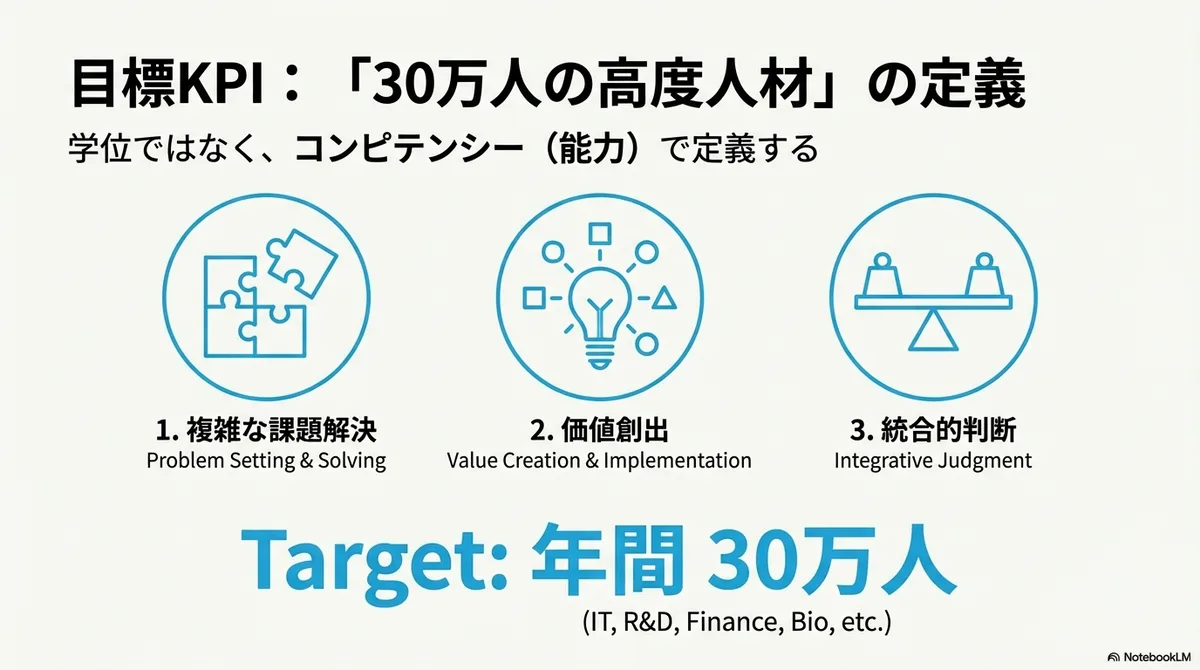
Here, I assume that this number is about 300,000 per year. This is a rough figure, provisionally estimated from the number of people who actually enter high-value-added fields, within a structure in which about 630,000 people enter university each year and about 70,000 proceed to master's programs.
※ This estimate is strictly a "conceptual model." In reality, not only the number of births but also the labor force participation rate, employment of immigrants and international students, and extended employment of older people are important variables, and a rigorous analysis would require flow-and-stock analysis by cohort (group of people born in the same year). Note also that the definition and required number of "advanced talent" may change with shifts in industrial structure and with productivity gains from AI.
If we simplify by using the number of births as the base, the following "conversion rates" emerge.
- Generation born in 2005 (about 1.06 million births): 300,000 ÷ 1.06 million ≒ about 28%
- Generation born in 2025 (about 700,000 births): 300,000 ÷ 700,000 ≒ about 43%
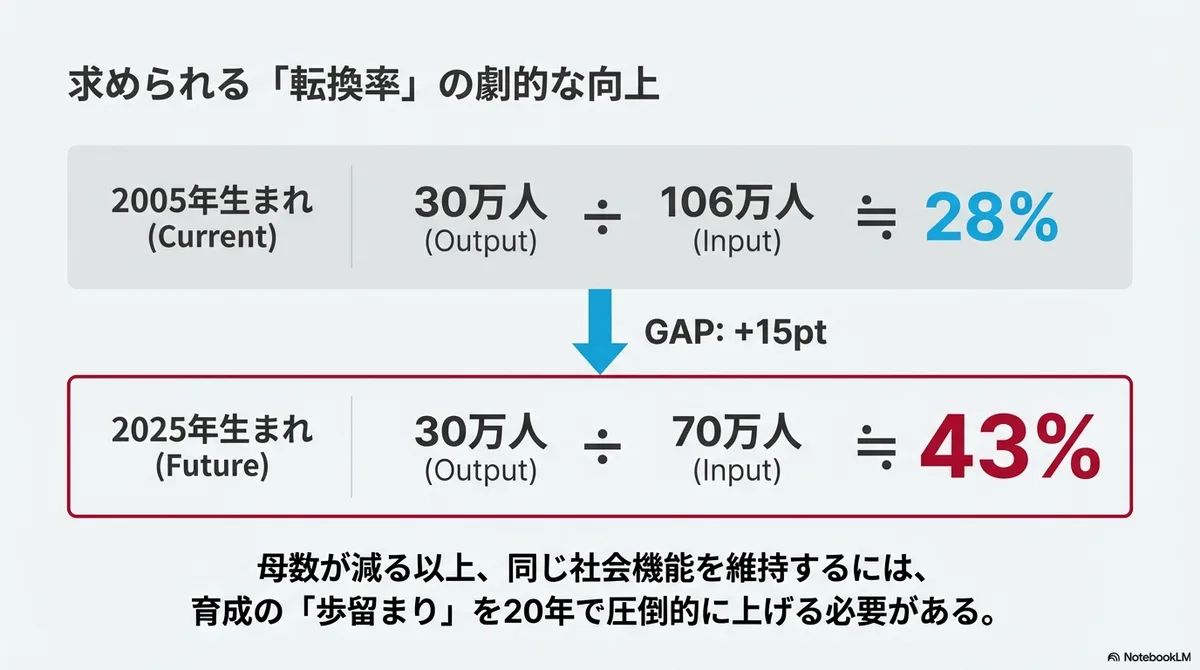
In other words, to keep securing the same 300,000, the conversion rate would need to rise from 28% to 43% over 20 years.
This figure is a rough estimate, but it shows that, because the base population is shrinking, there may be a structural pressure that forces us to raise the efficiency of education and training in order to maintain the same social functions.
Of course, there are levers other than "increasing the numbers through education": expanding the acceptance of immigrants and foreign workers, raising labor productivity per person (including efficiency gains from AI and automation), and transforming the industrial structure itself. But even if these measures are combined, raising the conversion rate through education remains one of the important pillars.
Concurrent Social Changes
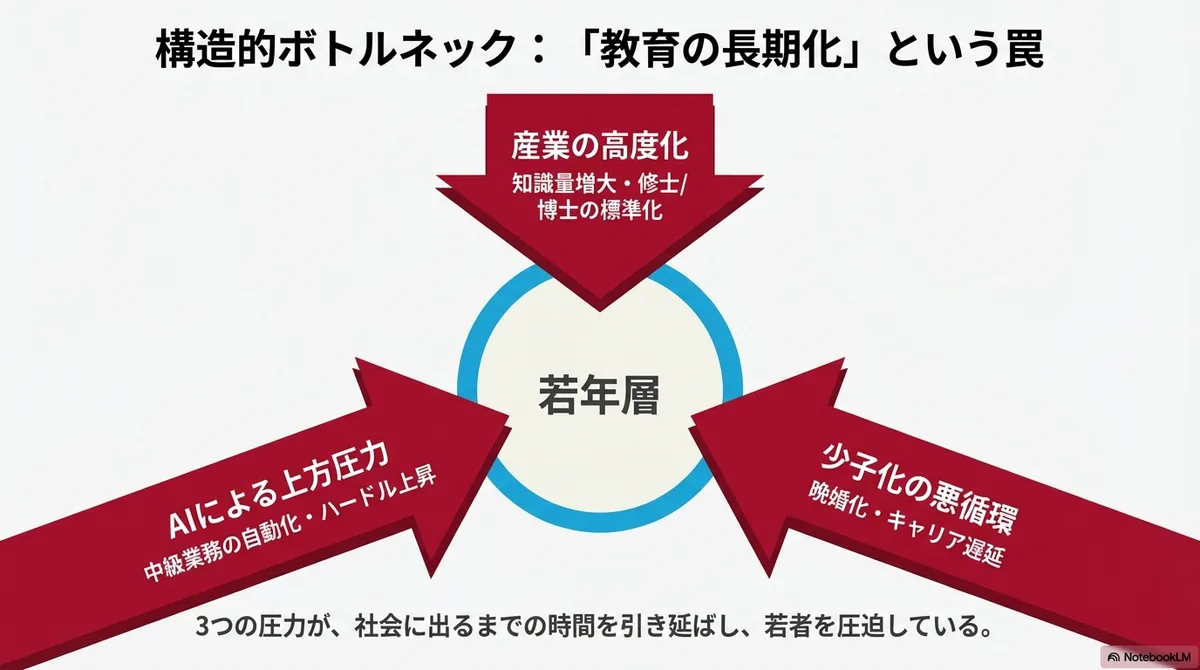
The declining birth rate alone is a difficult problem, but the following changes are also underway at the same time.
There are three representative changes.
- Longer education periods due to industrial advancement
- Pressure toward "advanced jobs" from technological change, including AI
- A vicious cycle of declining birth rates caused by longer education
(a) Longer Education Periods Due to Industrial Advancement
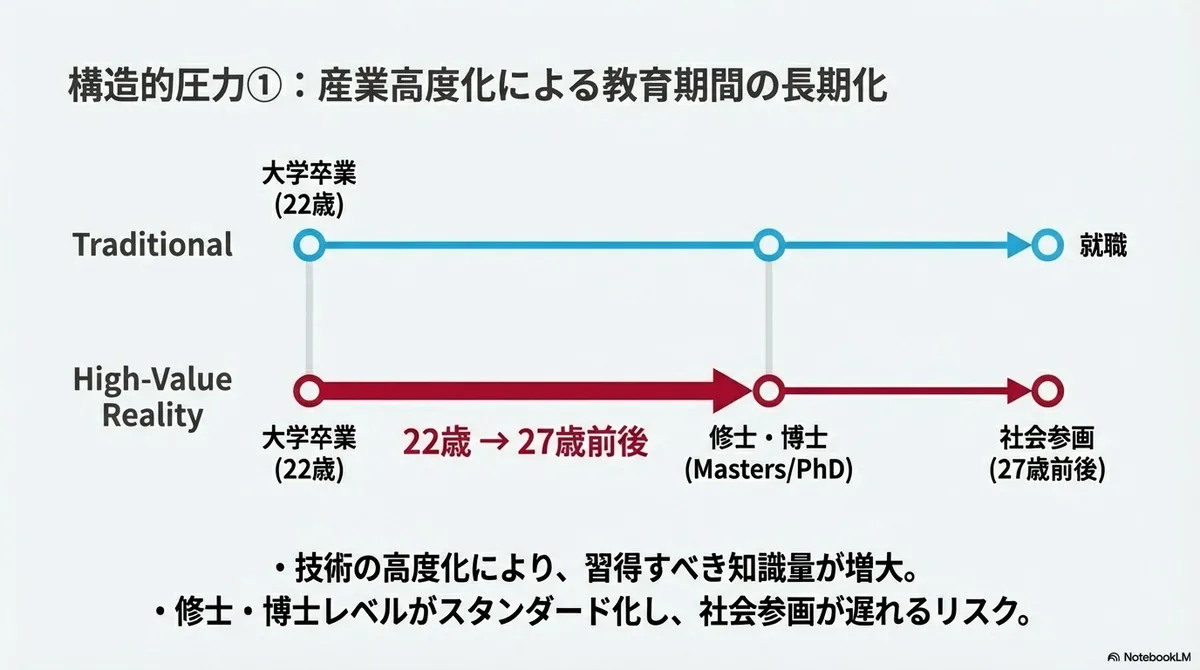
The more advanced technology becomes, the longer the period of education needed to acquire specialized knowledge tends to be.
A growing number of fields are coming to treat a master's degree as the standard, and if more people come to need doctoral-level training in the future, full entry into the labor market could be delayed to around age 27.
(b) Pressure Toward "Advanced Jobs" from Technological Change, Including AI
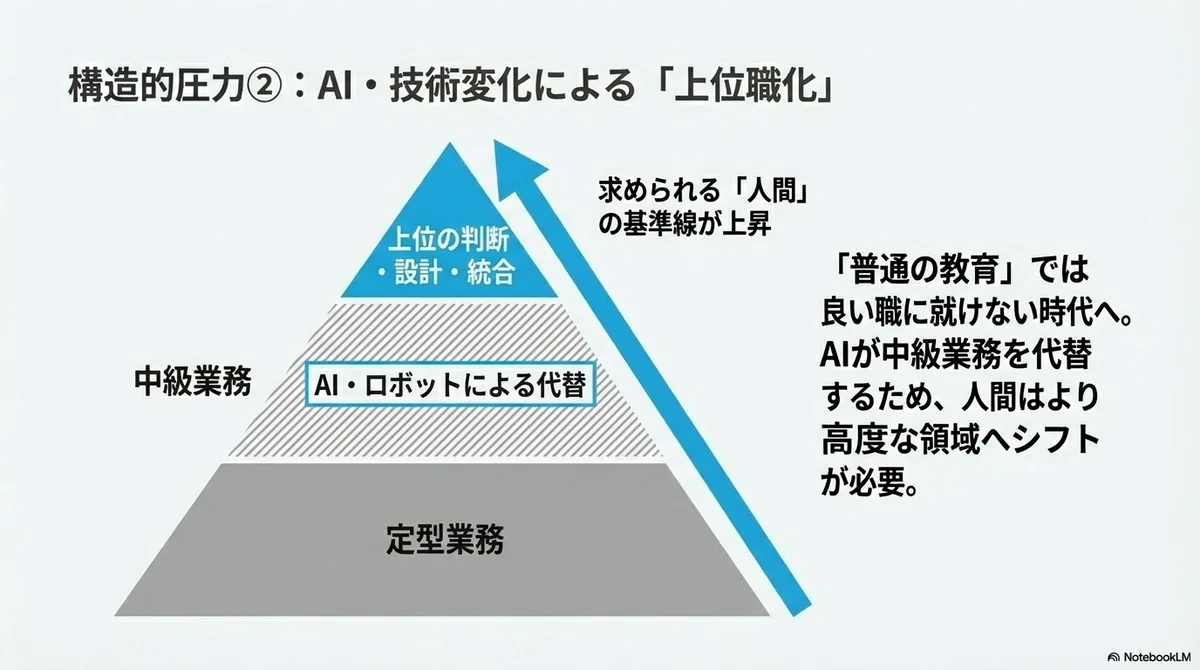
There is an argument that AI will replace mid-level tasks (the impact varies by industry and occupation). If this direction advances, the work that humans should do will be concentrated in more advanced tasks, and "a higher level of education" will become a condition for getting a good job.
The spread of industrial robots and automation driven by labor shortages will likewise push the work done by people toward higher-level judgment, design, and integration, creating pressure to raise the level of learning required.
(c) A Vicious Cycle of Declining Birth Rates Caused by Longer Education
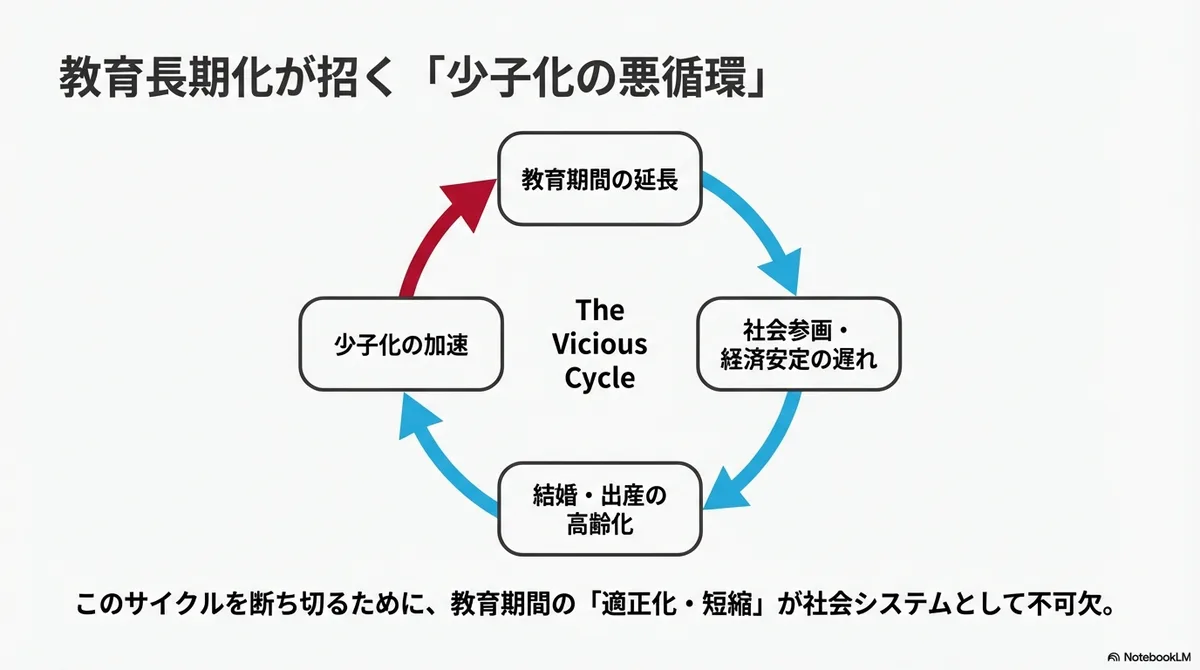
Longer education periods may further worsen the declining birth rate itself. If entry into the labor market is delayed, the time at which people gain financial stability is pushed back, and the age of marriage and childbirth rises. As a result, the childbearing years effectively become shorter, creating a vicious cycle in which downward pressure is put on the number of births.
(Of course, education periods are not the only cause of the declining birth rate. A combination of factors is involved, including housing costs, insufficient childcare support, diversifying values, and job instability.)
Is a "country that earns its living through only a few people" sustainable?
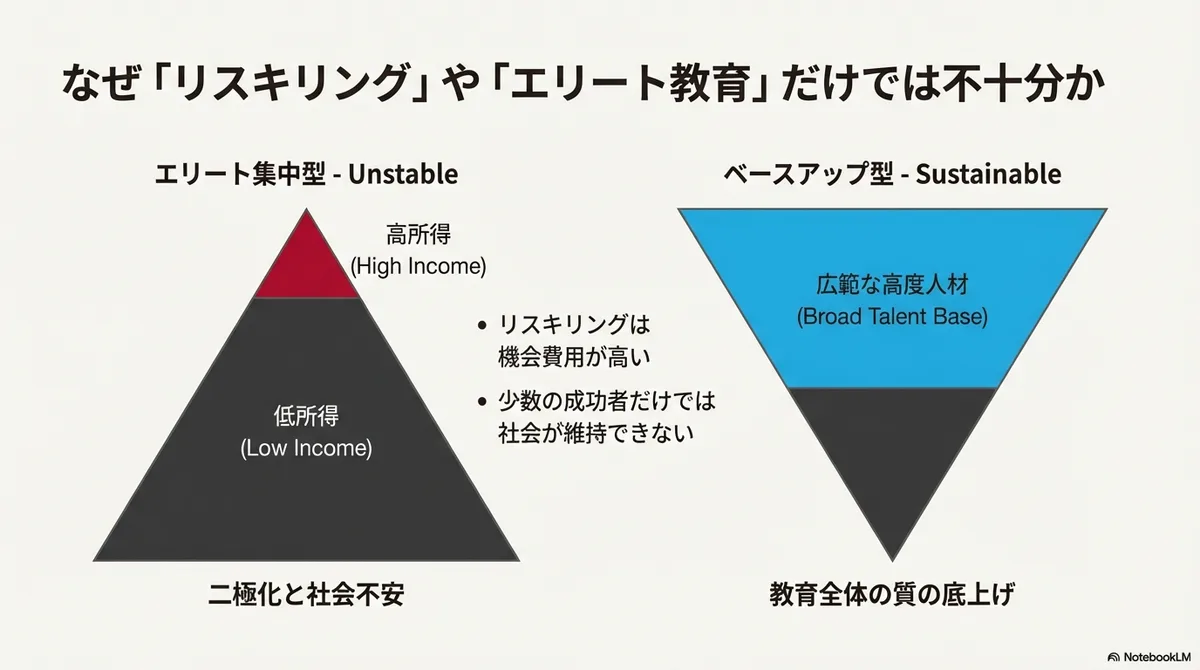
Shifting existing workers into high-value-added industries through reskilling (relearning) is also an important means. However, in an environment where labor is tight and there are opportunities to earn wages, few people can give up that opportunity cost and commit to long-term relearning. A system design that combines generous vocational training with income support, as in the Nordic countries, is a useful reference, but moving to it from Japan's current system would take considerable time.
It might also be possible to build industries that can manage even with the conversion rate unchanged. For example, only the small number who secure advanced jobs would earn high incomes, while the rest would have low incomes, and redistribution would be done well to compensate. But I am concerned that such an extremely polarized social structure would increase social instability.
To maintain the stability and sustainability of society as a whole, it should be desirable for as many people as possible, not just a small elite, to have access to as many "good jobs" as possible. (By "good jobs" here I mean a concept that includes not only wages but also stability, opportunities for growth, dignity, and social participation.)
Thinking about it that way, I believe what is really being asked of us is raising the quality of education as a whole.
Two Challenges Facing Education
(1) Improving the Quality of Education: Raising the Conversion Rate
Because the base population is shrinking, the outcomes that education produces must reach more people. Raising the conversion rate from 28% to 43% is a change that cannot be achieved by making things "a little better." And it has to be achieved within a time span of 20 years.
What matters, as I mentioned earlier, is that this should be not a further lifting of the top tier but a raising of the base: guaranteeing learning opportunities and building mechanisms that let more people reach a high level of attainment.
(2) Reaching the Goal Earlier: Making Learning More Intensive Without Sacrificing Understanding
To break the vicious cycle of the declining birth rate and increase the freedom with which younger generations can plan their lives, I think it would be better, if possible, to optimize the length of education itself. For example, could the acquisition of expertise, which has traditionally taken until around age 27, be brought forward by several years?
"Reaching the goal earlier" does not simply mean cramming and rushing. It means raising the density and efficiency of learning without sacrificing understanding, while maintaining the level of attainment, through a fundamental redesign of curricula, careful selection of what needs to be learned, and innovation in learning processes using technology.
Of course, speeding things up is not necessarily possible, and there will be areas where it should not be done. Still, I think there is meaning in treating the length of education not as a given but as an object of verification.
Two Approaches: "Accelerating Learning" and "Redefining the Goal"
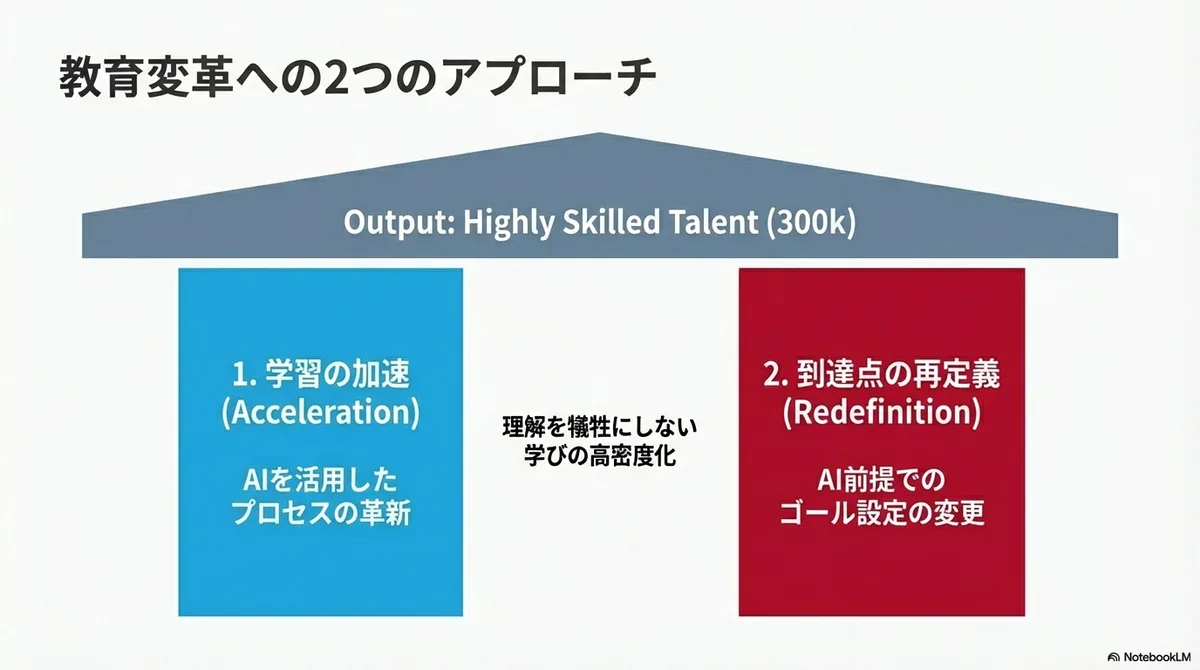
To develop more advanced talent in limited time, we need to change the learning process itself. The approaches fall broadly into two.
(1) Accelerating the Learning Process with AI
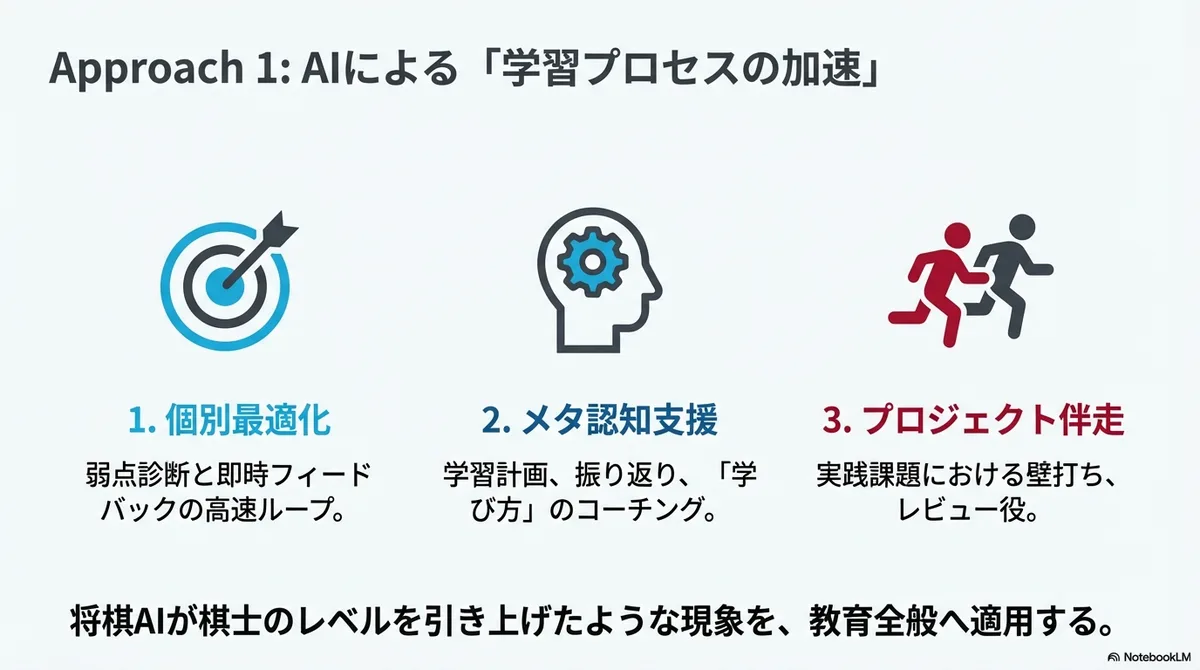
AI has aspects that take away jobs, but depending on how it is used, it can also become a tool that greatly accelerates learning. The following three areas are especially promising.
- Personalization: diagnosing each learner's weaknesses and providing the most suitable exercises
- Metacognitive support: supporting the process of "learning how to learn," such as drawing up study plans, reflection, and analyzing the causes of mistakes
- Real time: giving feedback and hints at the learner's own timing, and running a fast learning loop
- Project companionship: acting as a coach when learners tackle practical tasks, such as organizing requirements, reviewing designs, and identifying risks
Just as the arrival of shogi software changed how professional players study and dramatically raised the level of play, AI educational tools may change the learning path itself and shorten the time needed to reach the goal. Even in the past year or two, the quality of output from people who use AI well has visibly changed. Tools that support learning based on literature and documents are also reaching a practical level, and there is a growing tangible sense of applying them seriously to education.
However, we need to consider carefully whether results achieved in a clearly rule-bound, closed world like shogi AI can be applied as they are to education in general.
(2) Redefining the "Goal" in a World Where AI Is Assumed
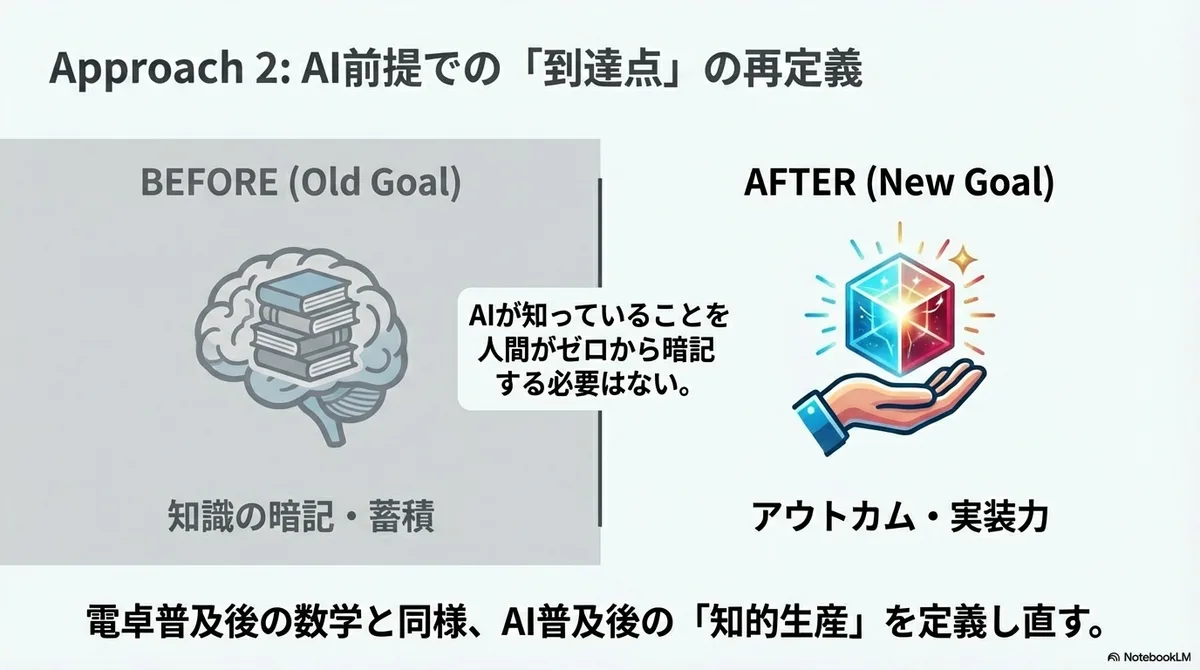
More important still, in a society where AI has become widespread, the range of knowledge that humans must memorize and master from scratch changes. Traditional educational goals and educational goals that assume mastery of AI should differ somewhat.
Just as the spread of calculators once changed the way mathematics is taught, we should redefine "the final destination of learning that humans should reach" on the premise of AI. I believe that this will lead to optimizing the length of education and accelerating the production of talent.
For example, if the traditional goal was "completion of a doctoral program," the new goal on the premise of AI might be to acquire, in one's early twenties, the core competencies that support the ability to carry out advanced cognitive work at the research level: the ability to test hypotheses, to synthesize literature, to carry out experiments and implementation, and to make judgments on research ethics. The goal is not the degree itself, but to design education that can achieve outcomes (deliverables and practical ability) equivalent to it.
These two, "accelerating the learning process" and "redefining the goal," are the two wheels of a car. With only one of them, we will not reach the conversion rate that will be required 20 years from now.
That Is Why We Should Start Exploring Now

In improving learning efficiency with AI, there is no correct answer from the start. Trial and error is essential.
But suppose we set as a goal "by 2045, an education system that can reliably produce people who, in their early twenties, have research capabilities close to those of traditional doctoral graduates." The time left is only 20 years. Working backward, the pace might be to frame the broad outline of measures as hypotheses in the first 5 years, and to repeat verification and implementation in the remaining 15.
Also, in bringing AI seriously into education, we must not overlook several important issues, such as the handling of personal data and evaluation, so the discussion of these matters will need to deepen as well.
When it comes to accelerating education, even if we mobilize everything, including the insights of pedagogy, the findings of cognitive science, and cutting-edge AI technology, we do not know whether we can reach the goal. But unless we try, the answer will never become visible, and if we fail to reach it, Japanese society 20 to 30 years from now could face a very severe situation. If so, we should start now.
In particular, entrepreneurship education, which I am in charge of, is close to society, so I think this is a field where the issue will emerge quite early. In the field of business startups, using AI is already taken for granted, and unless course content changes to keep pace, we could end up teaching "knowledge and skills that cannot be used in practice" (even though transmitting business startup knowledge is not what entrepreneurship education is).
So in the course starting in April, I want to practice this kind of AI-driven transformation of education, accelerating learning and redefining the goal, in my own way and search for answers. While keeping in view attainment (competency-based evaluation), the time needed to reach it, and fairness, meaning whether outcomes are skewed by family background, my recent concern is whether I can first find, within my own work, the starting point of the educational transformation that needs to be achieved over these 20 years.