Classifying Deep Tech Startups by RDD&D
This article was machine-translated from Japanese by AI (Claude). It may contain errors. Read the original Japanese article.
Attention on deep tech startups is growing.
In a document from the Ministry of Economy, Trade and Industry (METI), deep tech is defined as "technology based on scientific discoveries obtained through research in specific natural science fields," but beyond that, anything involving hardware tends to be called deep tech, and teams connected to universities are sometimes called deep tech as well. It is a term with quite a wide reach.
Deep tech startups, used in this broad sense, tend to be lumped together, but what their businesses actually involve differs greatly.
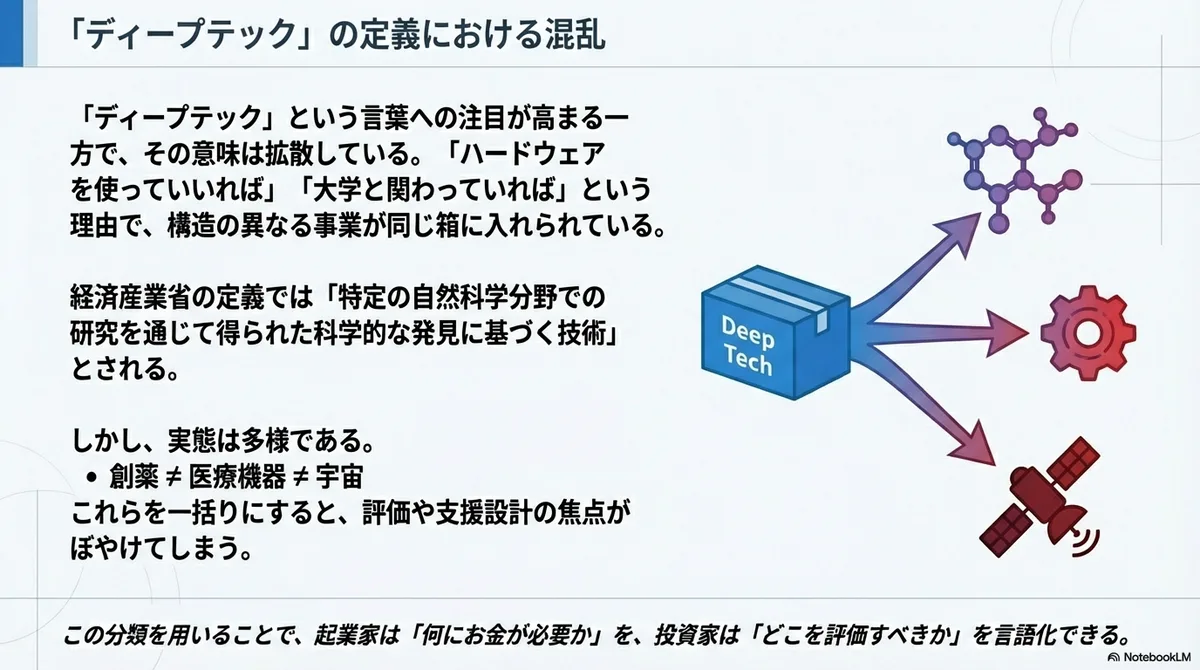
Drug discovery is a completely different thing, and so are medical devices. Many electronics companies depend heavily on their points of contact with consumers. Materials, on the other hand, are rather similar to drug discovery.
In fields like space, rather than any single piece of technology deciding everything, the integration and orchestration of multiple technologies tends to be the source of strength.
In this way, what gets called deep tech has a diversity of technologies and businesses. Even so, if we call everything "deep tech," then on the supporting side as well, such as investors, operating companies, and government, the focus of evaluation and support design becomes blurred whenever we speak of "deep tech support."
In a previous article, I also discussed the need to subdivide deep tech startups and look at them industry by industry. This article is slightly different: it organizes deep tech startups along a cut different from industry, and presents a map for classifying them.
As an auxiliary line for that purpose, I use the RDD&D (Research / Development / Demonstration / Deployment) framework, which I also introduced in an earlier article.
Summary
🔬What Is RDD&D?
RDD&D is a framework that the DOE has promoted, and it takes the initials of the following:
- R: Research
- D: Development
- D: Demonstration
- D: Deployment
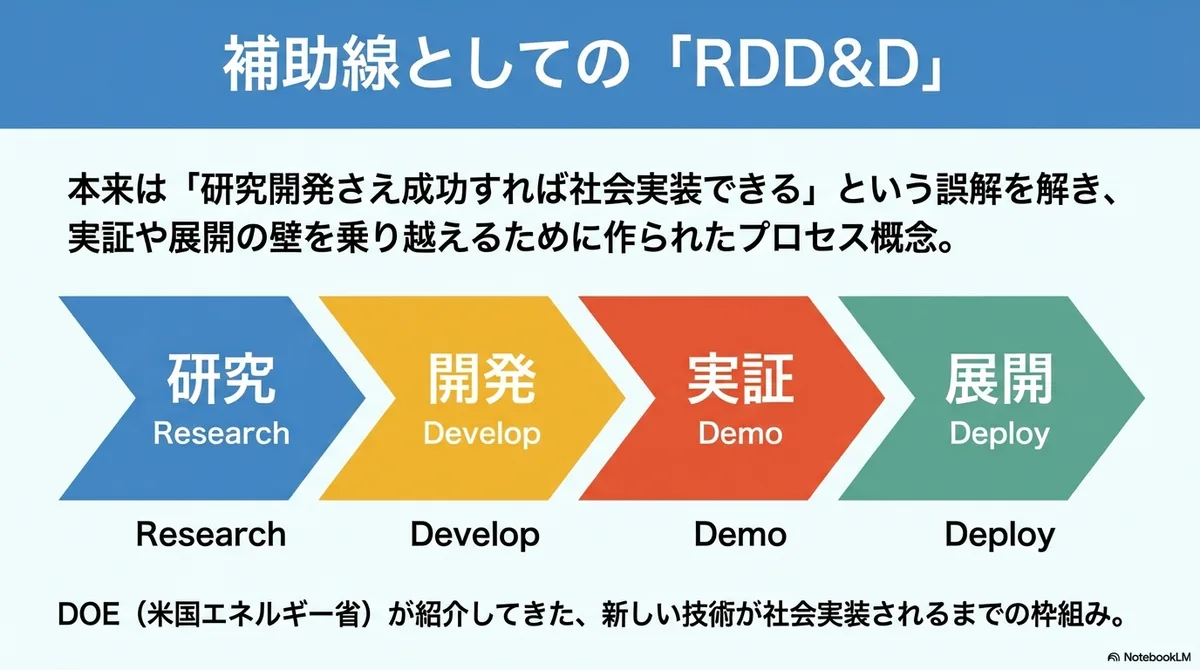
RDD&D describes the process by which a new technology comes to be actually used in society.
I suspect the reason such a term was created is that "R&D" is used so frequently that the misconception that "if research and development succeed, you will reach social implementation" has spread in the US too, and there was an intention to challenge it.
That is all the more so because in fields such as energy, which the DOE oversees, it is common for "the technology exists, but cost and regulatory problems make it hard to spread," so technology development and business development must be advanced with demonstration and deployment in mind.
Incidentally, when RDD&D is organized using TRL and ARL (Adoption Readiness Level), a rough guide is laid out as follows.
Phase | TRL | ARL |
Research | 1-3 | 1-3 |
Development | 4-5 | 1-3 |
Demonstration | 6-8 | 4-6 |
Deployment | 8-9 | 7-9 |
📏Using RDD&D as Coordinates That Show Where a Deep Tech Company Fights
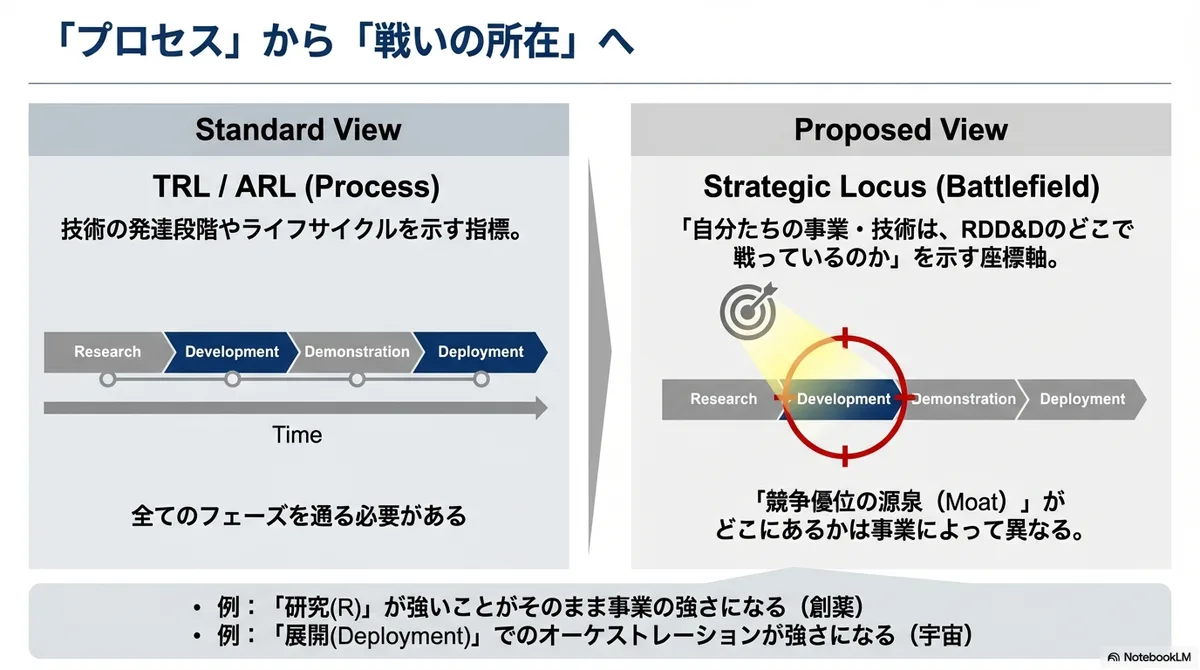
RDD&D is originally a process, a life cycle, that shows the stages of a technology's development. But I think it is also possible to make RDD&D work as a coordinate axis that shows where in RDD&D our own business and technology are fighting.
For example, there are fields where strength in "Research (R)" tends to translate directly into business strength. The typical case is drug discovery.
On the other hand, in fields like space, many businesses depend on Deployment: gathering existing technologies and orchestrating them, building a business model, and spreading it.
Once we can put this "where the fight takes place" into words, we can discuss deep tech not simply as "deep or not deep," but in terms of which phase of RDD&D is the main battlefield.
🔍Breaking It Down
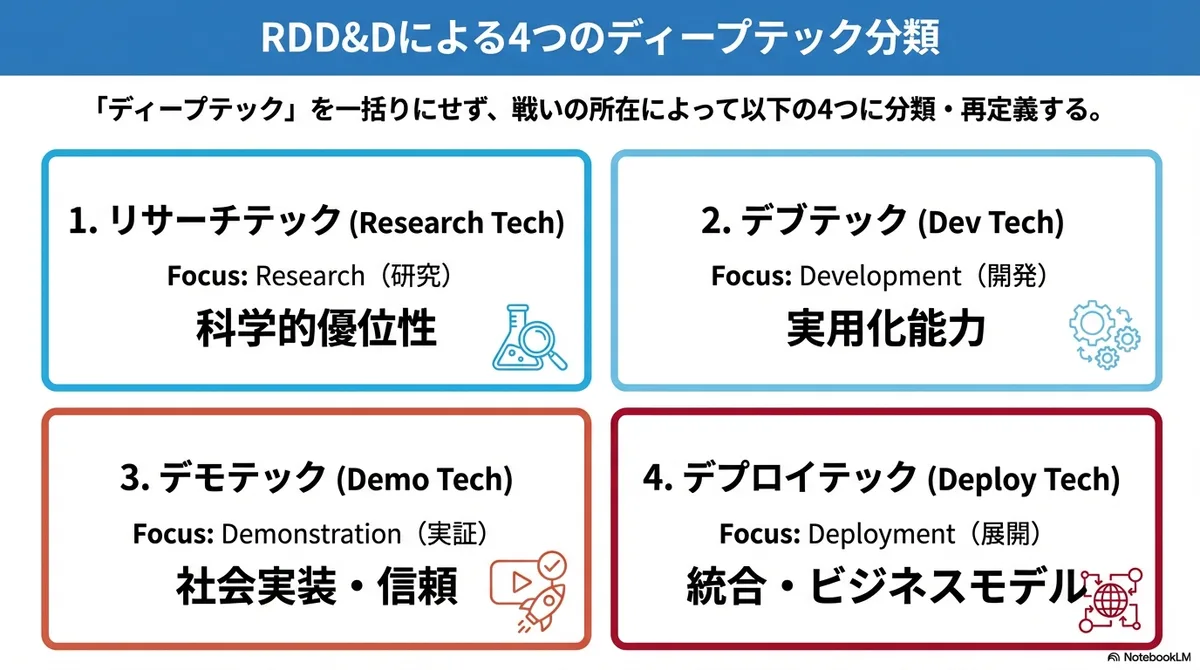
Let us reframe each element of RDD&D from the viewpoint of classifying deep tech.
R: Research
There are cases where the stronger the research, the stronger the technology and the business. For example, an example where research advantage is likely to translate directly is drug discovery (new targets, mechanisms of action, and so on).
This can be called a model and a business field that competes on the strength of science.
D: Development
Development as used here is the phase in which "it is understood scientifically, and we put it into practical use." It is, so to speak, the fight to bring research to a level of performance that can withstand practical use.
It is a field where one competes less on the novelty of the research than on the ability to make it "usable." Additional development is needed, but because it is development for reliability, safety, cost, and regulation, it can also be said that much of it does not become papers.
D: Demonstration
I don't think there are many fields where one competes on demonstration, but in cases like the following, demonstration can be the core.
- Proving performance, safety, and operability in a real environment is indispensable
- Because of the connection to the social implementation side (customers, regulation, infrastructure), PoCs and pilots become valuable
- The leap from "good in theory" to "working in the field" is the biggest wall
In this fight, "the design ability, on-the-ground ability, and relationship-building ability to make a demonstration succeed" decide success or failure.
D: Deployment
Deployment is the fight to connect technology to business on the side closer to demand, and to produce it in volume and spread it.
Rather than a single specific technology being the decisive factor, the strength lies in the very act of combining and orchestrating multiple technologies and connecting them to a business model.
A field like space is an easy example. It integrates a bundle of component technologies, such as satellites, communications, operations, data, ground systems, and mission design, and then builds a business model to connect them to value.
R&D: Strength in Both Research and Development
I think there are also cases of fighting in both research and development. For example, a pattern of having strength in both research and practical application. Take materials: research results are very important, and if you can make a one-of-a-kind product you can earn high profits, but in addition, mass production, processes, quality assurance, supply chains, and so on can easily become dominant.
🎁Focus on How to Fight, Not on the Field
By organizing with RDD&D rather than by fields such as "drug discovery" or "energy," I think deep tech may become a little easier to see.
Of course, each industry has tendencies such as "R-heavy" or "an industry that fights on Deployment," but even within the same field, there are times when the way of fighting differs.
For example, even within the single technology and business field of "storage batteries," some companies fight on performance, as with all-solid-state batteries (and later overtake current products on performance), while others focus on deploying already established lithium-ion batteries and fight on cost.
Even in the same field, the way of fighting differs depending on factors such as TRL. A high TRL does not mean you will win, and in reality orchestration also requires additional technology development.
Even for a technology of which it is said "TRL is low now, but we will win if it is realized," if the market is monopolized first, then no matter how high the performance, entering later often fails to win.
In that sense, I think deep tech looks quite different depending on how the technology is fought for and what the rules of the game in that field are.
🏗️Changing What We Call Them with RDD&D
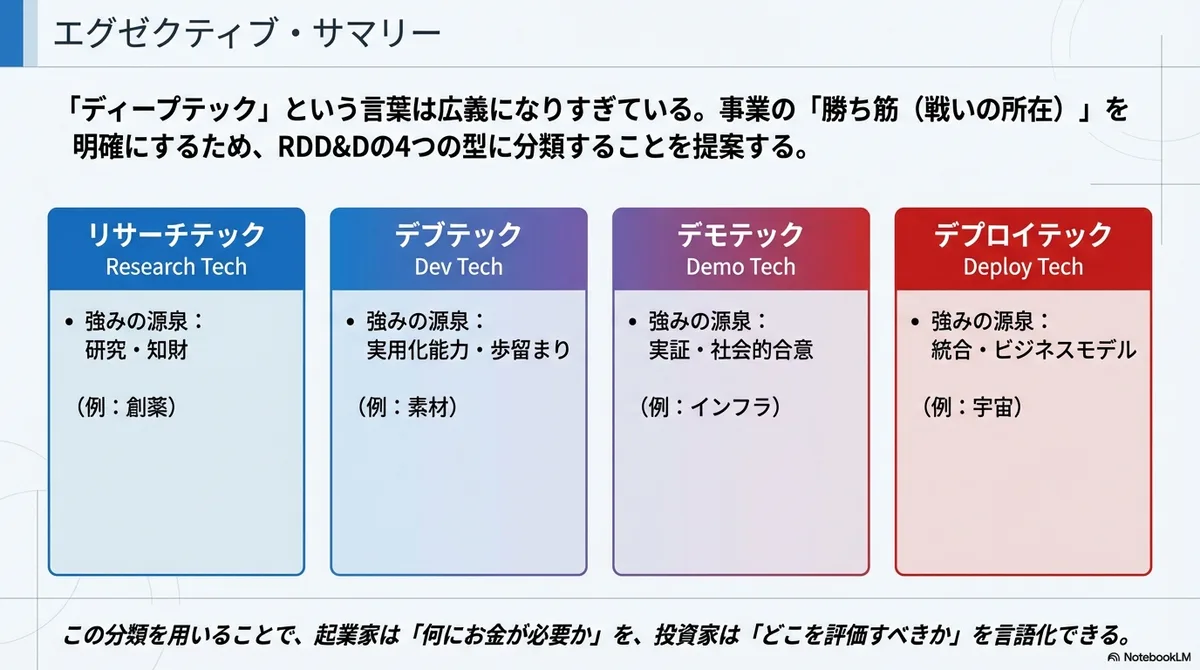
Given the above, rather than lumping everything under the word "deep tech," I think we can classify as follows.
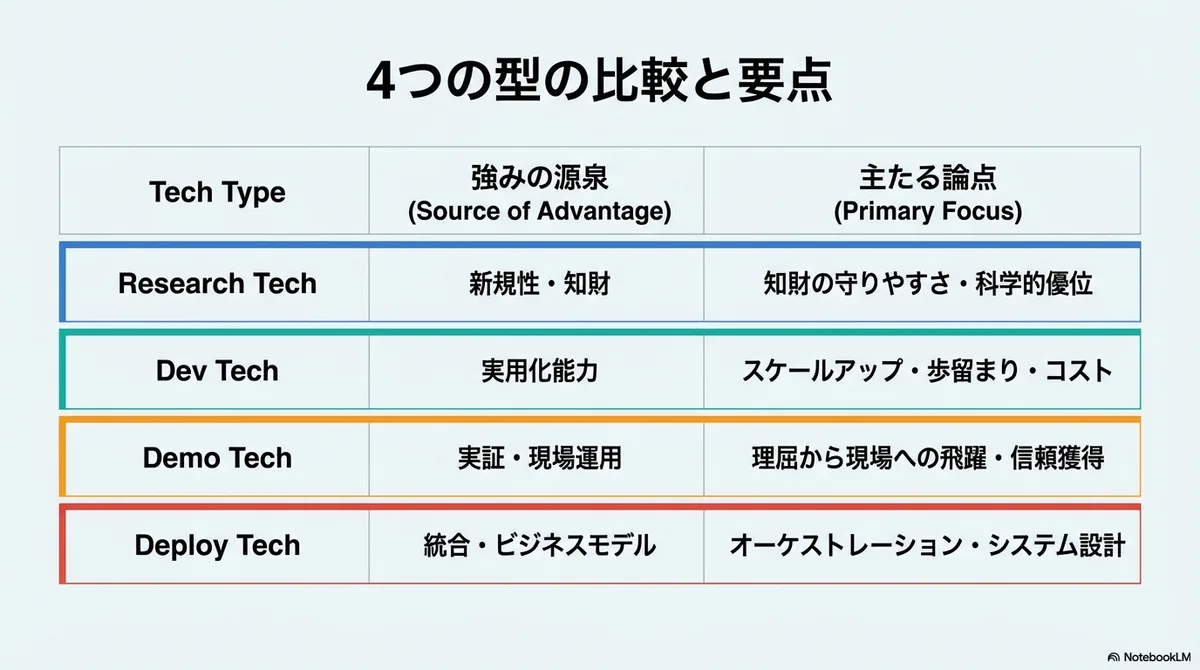
- Research Tech
- Dev Tech
- Demo Tech
- Deploy Tech
I made this classification somewhat forcibly, thinking that clarifying "what kind of fight we are in" would make communication with stakeholders easier, so there is no need to use these names.
Still, having names can make things easier to understand, so I'll lay them out.
Below, I make the characteristics of each type a little more concrete.
1. Research Tech
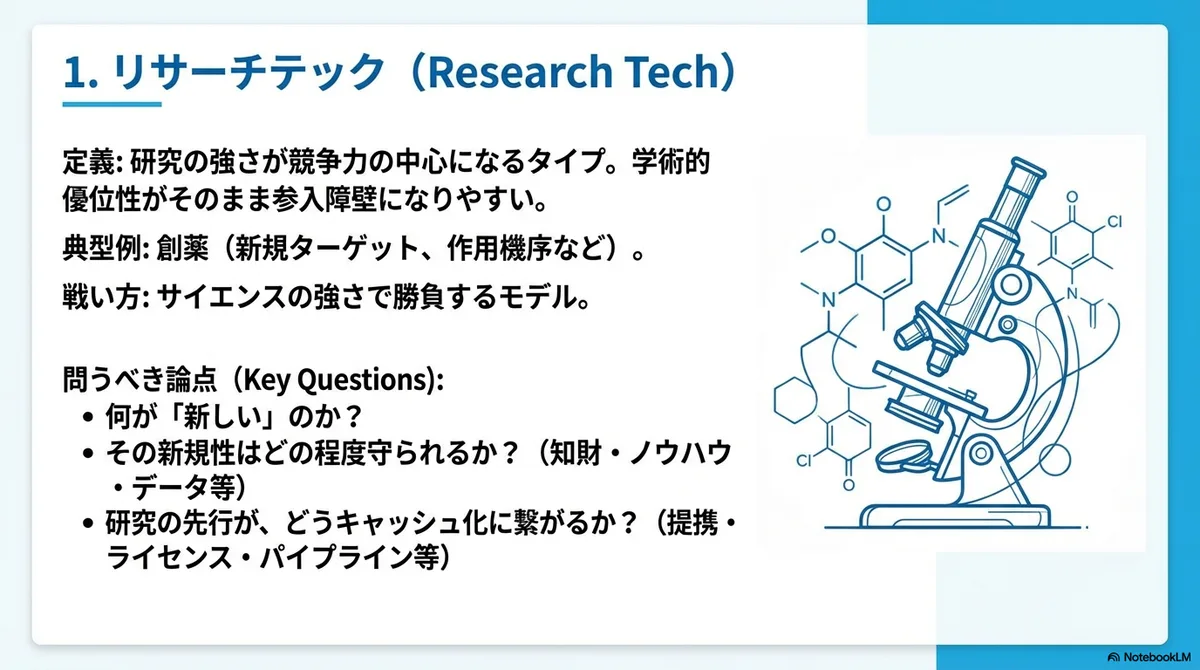
This is the type in which the strength of research is the center of competitiveness.
The source of strength lies in highly novel knowledge, theory, discoveries, and so on. It is a field where academic superiority easily becomes a barrier to entry as it is.
A typical example is, again, drug discovery. This is because research results themselves easily determine business value.
The questions to ask here would be the following:
- What is "new"?
- How well will that novelty be protected (IP, know-how, data, and so on)?
- How will being ahead in research lead to cash (partnerships, licensing, pipelines, and so on)?
2. Dev Tech
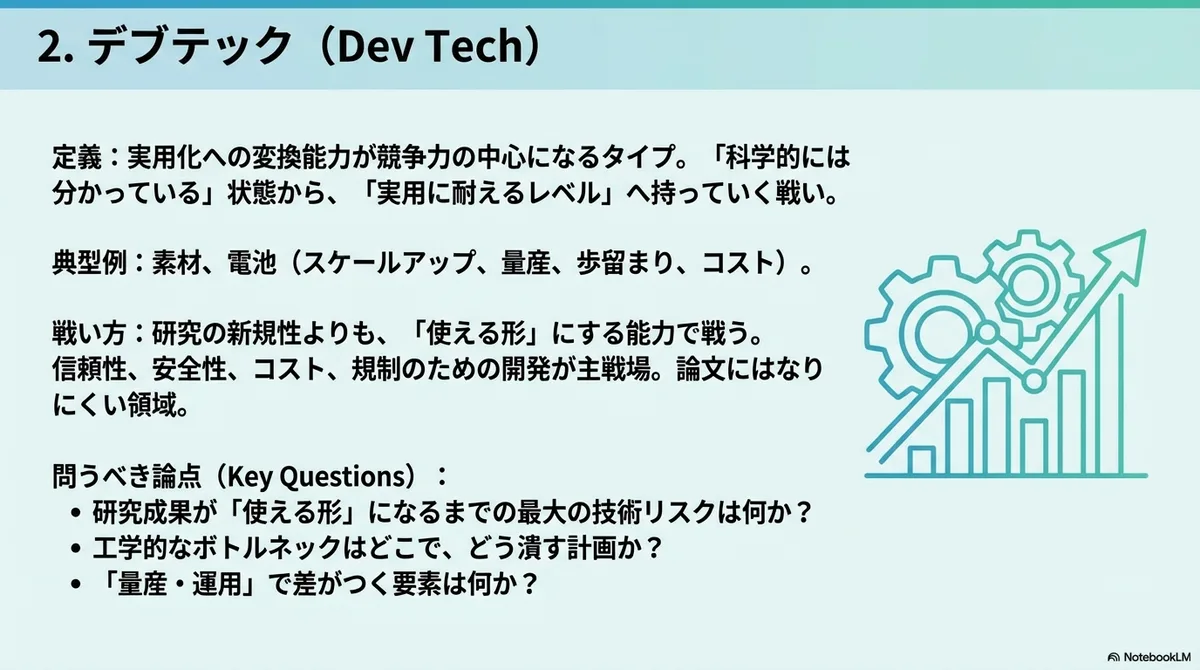
This is the type in which the ability to convert into practical use is the center of competitiveness. The fight will be over whether one has the implementation ability to turn research results into "product, manufacturing, quality, and regulation."
For example, it is a field you can win if you are strong in scale-up, mass production, yield, cost, and designs that withstand field requirements (durability, maintenance, inspection, regulation).
Materials often lean toward this, and even if the research is excellent, the contest tends to be whether you can get over the walls of development, manufacturing, and quality.
The questions to ask here are the following:
- What is the biggest technical risk before the research results become "usable"?
- Where are the engineering bottlenecks, and what is the plan to eliminate them?
- What are the factors that make the difference in "mass production and operation"?
3. Demo Tech
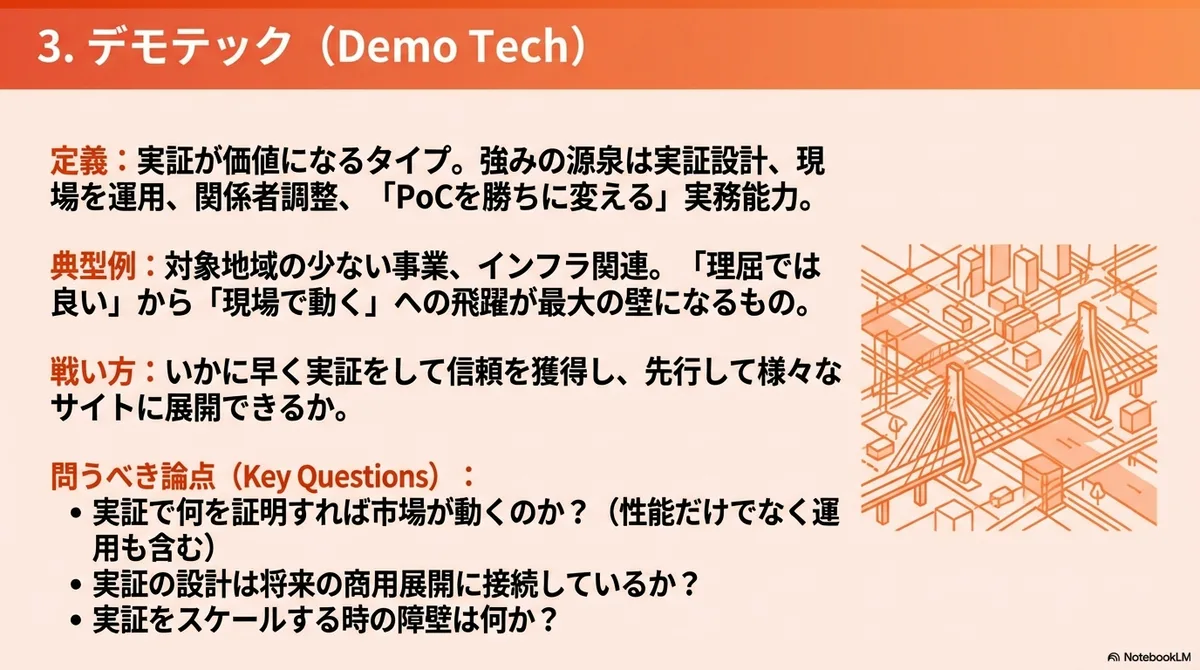
This is the type in which demonstration becomes the value. The source of strength lies in demonstration design, field operation, coordination among stakeholders, and the practical ability to "turn a PoC into a win."
For businesses with few target sites, doing the demonstration first builds trust and allows you to roll out to various sites ahead of others, so this is probably a field where the contest is how quickly you can run the demonstration.
The questions to ask here are the following:
- What must a demonstration prove for the market to move (including operations, not just performance)?
- Is the demonstration design connected to future commercial deployment?
- What are the barriers when scaling the demonstration?
4. Deploy Tech
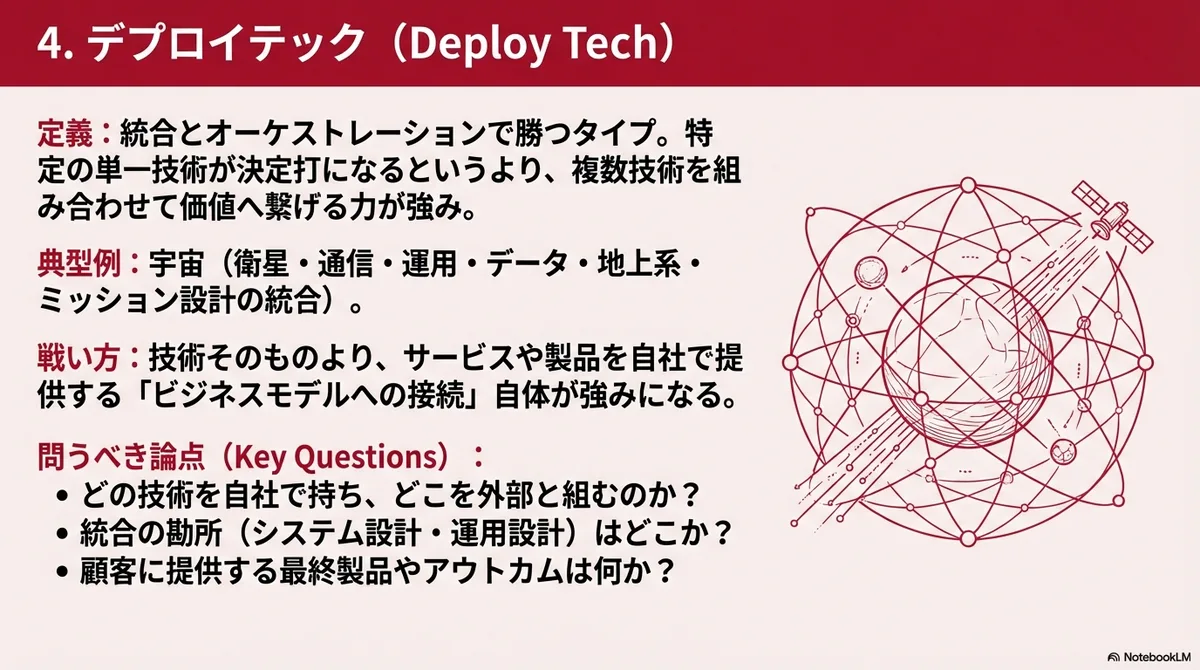
This is the type that wins through integration and orchestration. It lies in the overall implementation ability and coordination ability (orchestration), including technology integration and operation, business model design, partnering, and the supply chain. It also often takes the form of providing a service or product on one's own, rather than providing technology.
A typical example is, again, a field like space, where value is created not by a breakthrough on a single technology but by a combination of multiple technologies.
The questions to ask here are the following:
- Which technologies do we own, and where do we partner with outside parties?
- Where are the crux points of integration (system design, operations design)?
- What is the final product or outcome we provide to customers?
🤝Situations Where This Classification Helps
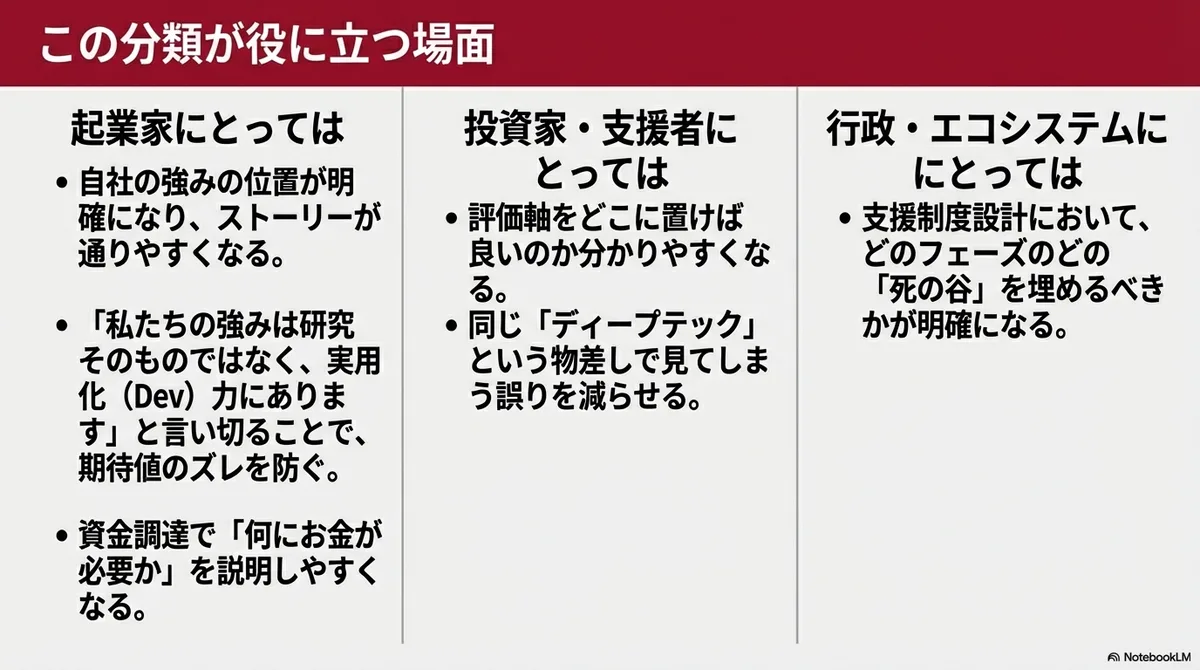
By looking at deep tech startups with RDD&D as an auxiliary line and organizing the foundation of each discussion, I think we get benefits like the following.
For entrepreneurs, the "position of our strengths" becomes clear, and the story goes over more easily. By stating plainly, "Our strength is not research itself but our ability to put it into practical use (Development)" or "It is our integration ability," they can prevent misunderstanding. It will also become easier to explain "what we need the money for" in fundraising.
For investors and operating companies, it becomes clearer where to place the evaluation axis. Should they look at the research, or at the ability to clear manufacturing and regulation, or at operations and integration ability? This should reduce the mistake of viewing the same "deep tech" with the same yardstick.
For government and support organizations, it becomes easier to tailor the design of subsidies, programs, and the provision of demonstration fields to the type of the target.
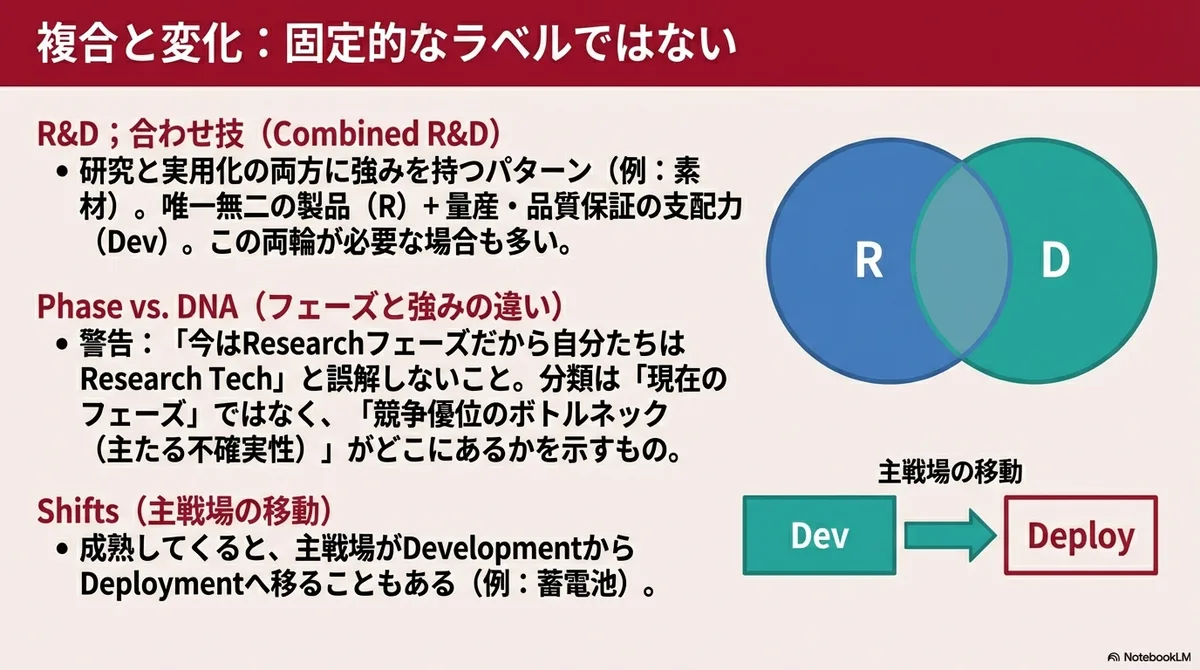
Please also allow me to add that even a single company or business may fight in different places depending on the phase (for example, as it matures, the main battlefield shifts from Development to Deployment).
Also, please be careful not to misunderstand this as "we are in the Research phase now, so we are Research Tech." This classification is not for understanding the "current phase"; it is a classification of where the "bottleneck of competitive advantage (the main uncertainty)" lies. Just because we are doing research now does not mean that, depending on the business, research will be the source of competitive advantage.
Conclusion: From "Is This Deep Tech?" to "Which Deep Tech?"
I think part of the confusion surrounding deep tech arises because the word "deep tech" is so abstract and convenient that businesses with different structures get put into the same box and are partly misread.
I think that if we use RDD&D, as proposed this time, as an auxiliary line, the discussion changes into the following form.
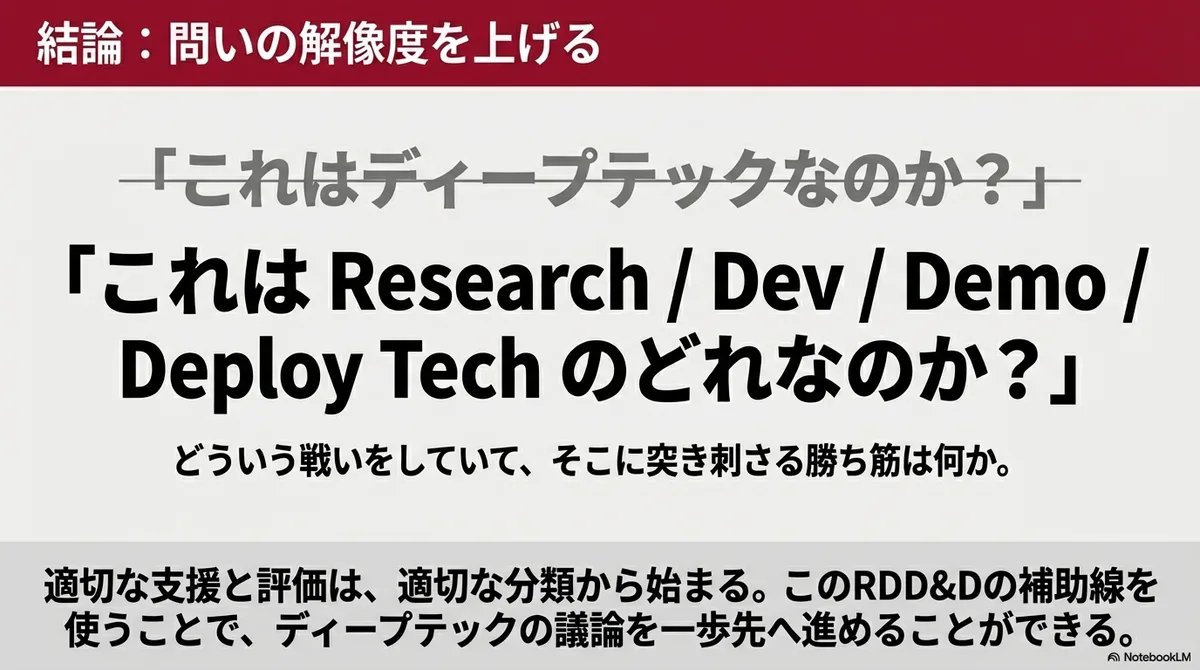
- Not "Is this deep tech?"
- But "Is this Research Tech, Dev Tech, Demo Tech, or Deploy Tech?"
Once we can answer this question, I think we can organize, if only a little, what kind of fight we are in, what winning path is needed there, and what appropriate support is.
I would be glad if the RDD&D classification proves useful as such a practical framework.
Slides