TRL, MRL, and ARL (Technology Readiness Level, Manufacturing Readiness Level, and Adoption Readiness Level)
This article was machine-translated from Japanese by AI (Claude). It may contain errors. Read the original Japanese article.
Many of you have probably heard of the term Technology Readiness Level (TRL).
This standard, abbreviated as TRL, was developed by NASA and is now used to measure the maturity of a wide range of new technologies and innovations. In Japan, too, TRL is sometimes used to evaluate technologies. For example, the figures below are taken from materials of the Ministry of Economy, Trade and Industry and the Ministry of the Environment.
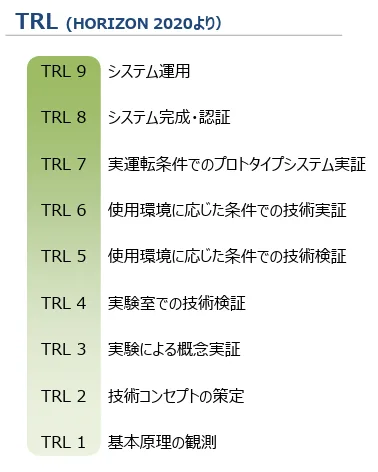
The TRL stages, from a Ministry of Economy, Trade and Industry document: https://www.meti.go.jp/shingikai/sankoshin/green_innovation/pdf/002_02_00.pdf
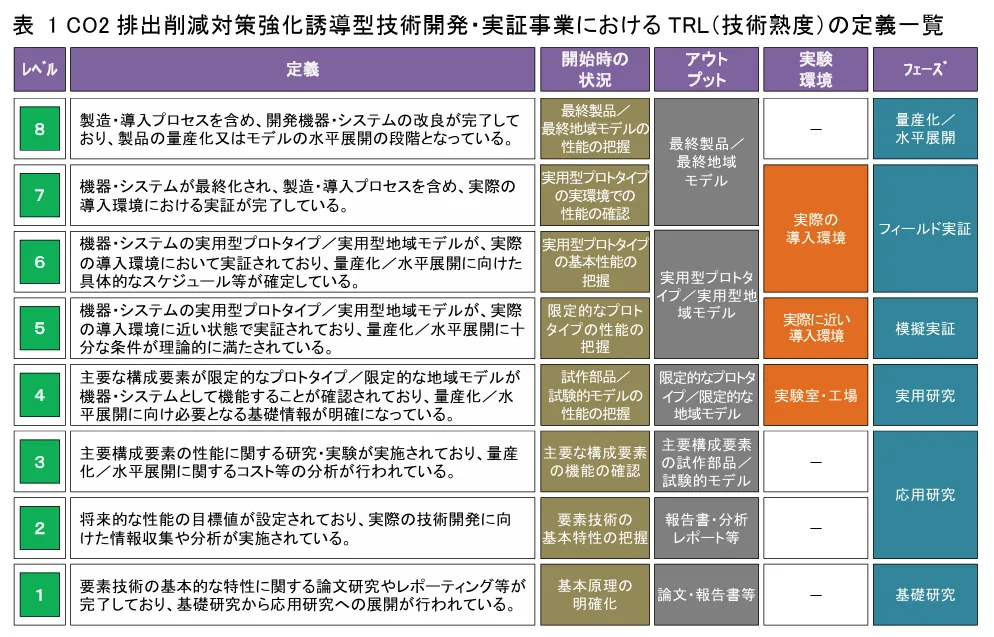
A TRL correspondence table by the Ministry of the Environment https://www.env.go.jp/content/900443533.pdf
A related term, Manufacturing Readiness Level (MRL) , is also used. It indicates the maturity of manufacturing technology and the risks that accompany it, and it answers questions that are hard to assess with TRL, such as reproducibility, production cost, and supplier stability. This one was developed by the U.S. Department of Defense.
When I look through subsidy documents, I often think, "Isn't this technology development really a matter of MRL rather than TRL...?" So having several such terms available is useful when evaluating technologies.
More recently, the U.S. Department of Energy (DOE) has started using the Adoption Readiness Level (ARL). ARL is not often introduced in Japan, so introducing it is the aim of this article.
What Is ARL?
Adoption Readiness Level (ARL) can be rendered as a "level of maturity for adoption."
The reason the DOE went out of its way to coin the term ARL is its recognition that raising TRL alone is not enough to achieve deployment or commercialization. In fact, the DOE's article states that "managing only through TRL stage gates is insufficient for commercialization, so we developed ARL as a complement".
ARL mainly evaluates the following four risk areas.
- Value proposition
- Market acceptance
- Maturity of resources
- License to Operate
The DOE also provides a very simple assessment tool, the Commercial Adoption Readiness Assessment Tool (CARAT), which breaks these down further and evaluates a total of 17 dimensions.
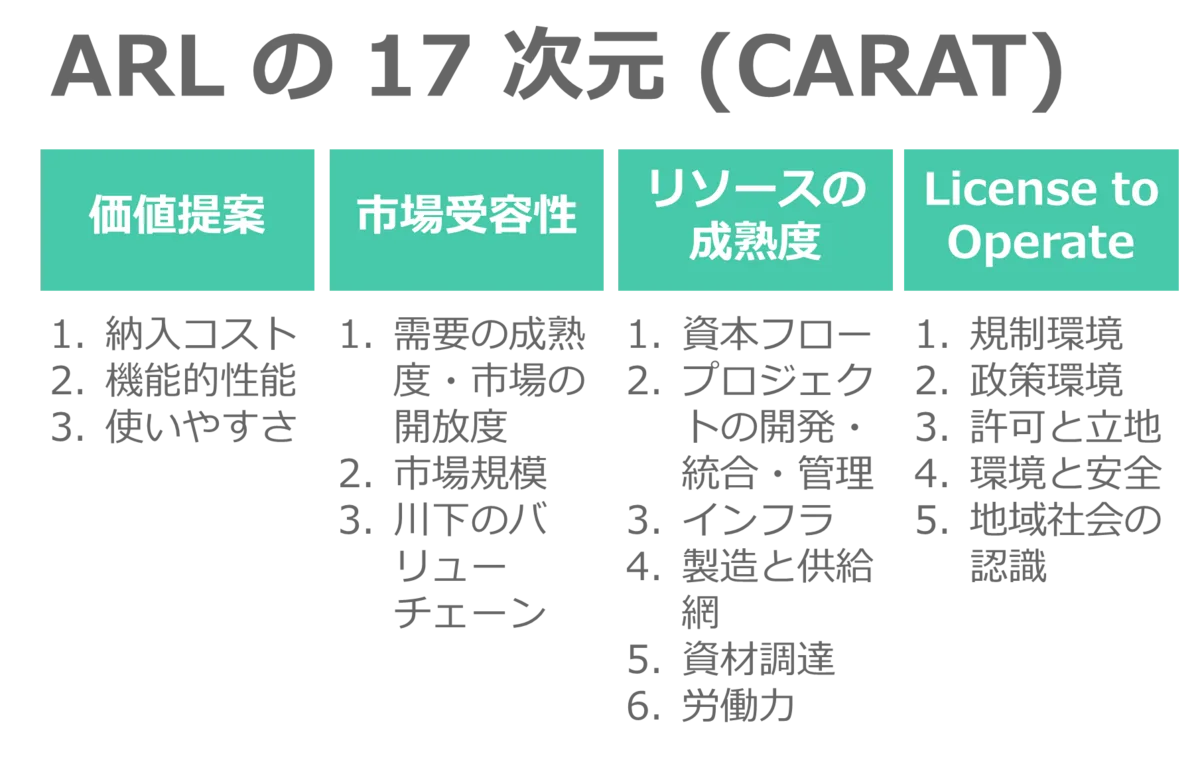
In CARAT, you count how many of these 17 dimensions are at medium risk and high risk, and map those counts onto a table, which yields an ARL score from 1 to 9.
Then, as in the figure below, you put TRL on the vertical axis and ARL on the horizontal axis. If both TRL and ARL are high, it is the "Deployment" phase in terms of RDD&D; if both are low, it is the "Research" phase. You then carry out activities to raise each level.
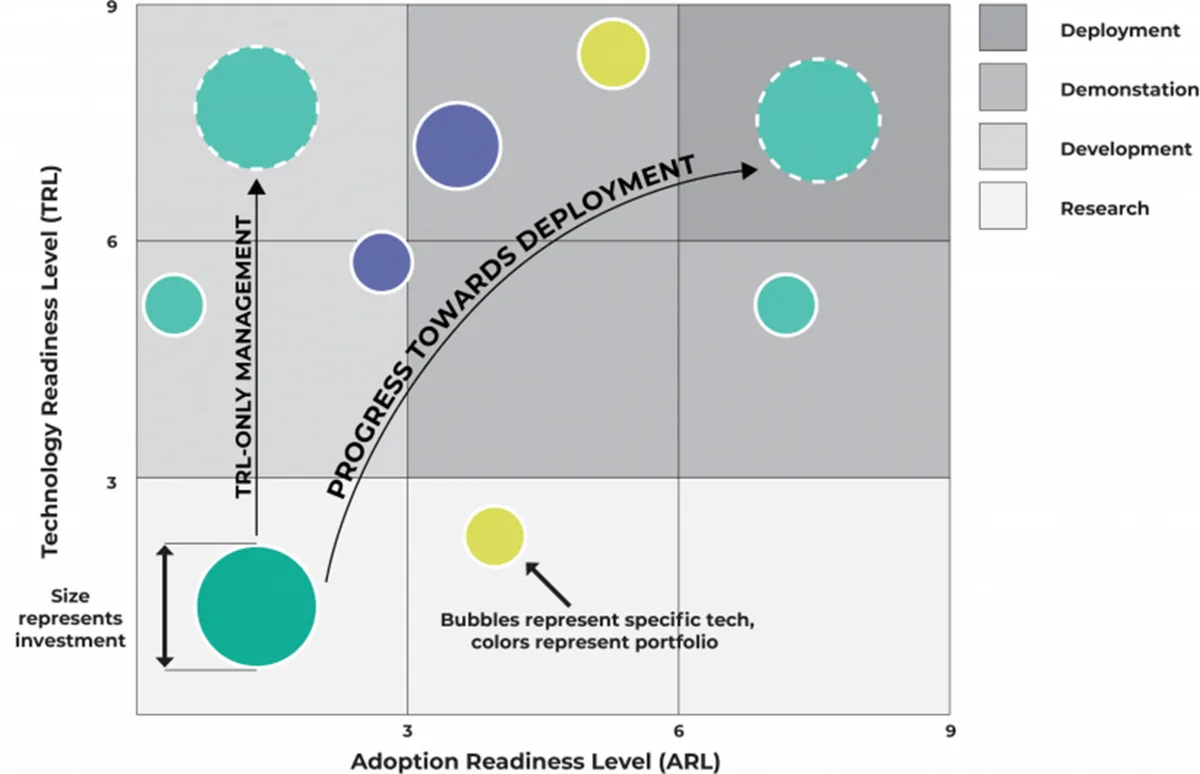
https://www.energy.gov/technologytransitions/adoption-readiness-levels-arl-complement-trl
How to Use TRL, MRL, and ARL
TRL, MRL, and ARL are all merely tools for confirming where you are now, and for discussing how to move up from there.
The newly introduced ARL is by no means purely passive; you can raise the level yourselves. This is because subcategories of License to Operate, such as the regulatory environment and community perception, can also be improved through your own activities.
So I think that, in the case of a research-and-development-driven startup, when considering the progress of your business (not just the technology), you need to proceed while thinking along three axes:
- How to raise TRL
- How to raise MRL
- How to raise ARL
Research-and-development-driven startups in particular tend to think mainly about TRL and MRL, but keeping in mind that ARL is another important axis should help discussions go more smoothly.
And going forward, I think that in Japan, too, new technology development and its support would do better to proceed while evaluating ARL, not just TRL.
Usable for Policy and Subsidies Too
The three axes of TRL, MRL, and ARL also seem to be suggestive when it comes to what kind of subsidies and support should be provided.
For example, Redwood Materials secured a conditional loan of about 280 billion yen from the U.S. Department of Energy, and the situation was as follows:
- TRL was reasonably high
- Part of ARL was high, in the sense that demand was known
- Part of ARL and MRL were low, but putting money in would raise ARL and MRL
I think this was a good move as support for crossing the valley of mass production.
On the other hand, as for activities to raise TRL, depending on the level, money itself is not necessarily effective, and even when an activity does require money, it does not necessarily require a large amount (though a sizable sum may be needed for things like demonstrations).
I think that properly evaluating the TRL, MRL, and ARL of each business will make subsidy screening and the operation of stage gates easier, and that having the ARL axis can also draw attention to the progress on the business development side.
Summary
This was a proposal that the three axes of TRL, MRL, and ARL could be used to evaluate businesses involving technology development well.