Sorting Out "Impact" and "Startup"
This article was machine-translated from Japanese by AI (Claude). It may contain errors. Read the original Japanese article.
Social impact, and the shorthand "impact," have begun to be discussed in startup circles as well. The term "impact startup" has also appeared, referring to a startup that reconciles "solving social problems" with "sustainable growth" and has a positive influence on society.
However, the word "impact" seems to carry multiple meanings, and the word "startup" has also become polysemous. I am concerned that, unless we use each word with some care, there will be more and more occasions when discussions fail to connect.
So, as a way of organizing my own thoughts (though I suspect the people involved have already debated this at length), I am writing an article about the meanings of the words "impact" and "startup."
What "Impact" Brings to Mind
When you hear the words "social impact," what comes to mind? Many people may think of education, healthcare, or environmental issues.
What the word impact refers to apparently differs from one society to another.
For example, looking at the track record of impact investing, the top areas globally are "energy," "finance," and "forests," while in Japan the top areas are "health and medicine," "promoting women's participation and advancement," and "education and child-rearing" (with the caveat that the two cannot necessarily be compared simply).
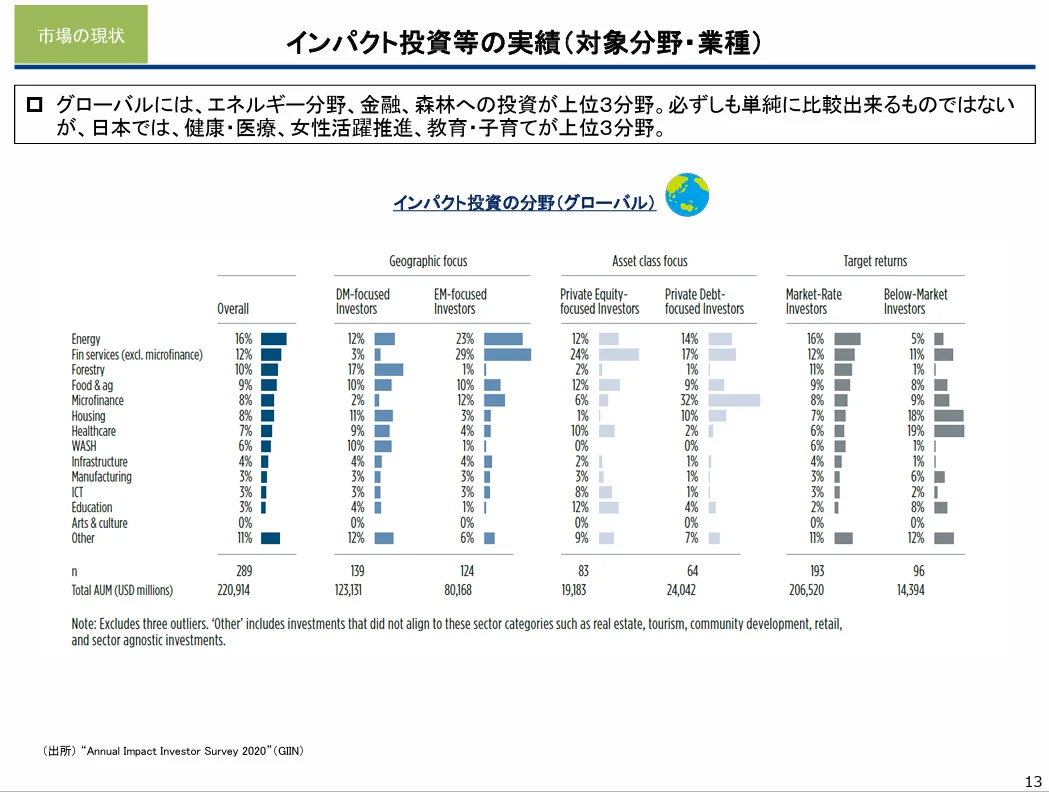
Quoted from the overview materials at https://www.fsa.go.jp/singi/impact/siryou/20221028.html
Even when the same word is used, the substance can differ. For example, "smart cities" are attracting attention as a means of solving "urban problems." The problems that Japanese "smart cities" try to solve are often social issues stemming from population decline, such as the decay of transportation networks and of administrative services, whereas Asian "smart cities" often address social issues tied to population growth, such as relieving traffic congestion. Even if we say we are tackling "urban problems," what that means varies widely.
Impact is also said to arise from solving social problems, but different countries have different societies, and different societies have different social problems, so it is in a sense natural that such differences appear.
Impact Also Changes with the Size of the "Society"
Similarly, I think the impact that is demanded changes depending on the scale at which we view "society." It is not academic, but I think a breakdown like the following is possible, for example.
- Global impact, when the whole world is viewed as one "society" - environmental problems, absolute poverty, and so on
- National impact, when an entire country (Japan) is viewed as one "society" - healthcare, education, relative poverty, and so on
- Local impact, when a region is viewed as one "society" - problems of local transportation, and so on
That the problems differ depending on the scale at which we carve out society also seems natural to me.
An accumulation of local impact can lead to national impact, so the three are not completely independent of each other. Still, I think that when discussing these matters, each party should be aware of what size of "society" the other has in mind.
What "Startup" Brings to Mind
So far I have been talking about impact; from here on, it is about the word "startup."
In an earlier article, I wrote about whether we should distinguish between startups and high-growth startups. The reason I proposed using the words differently is that the word startup is gradually coming to mean "entrepreneurship in general."
For impact startups as well, the discussion changes depending on whether the word startup refers to
- entrepreneurship in general, or
- high-growth startups.
Furthermore, discussions of social impact tend to bring in the options of
- for-profit
- non-profit
ventures, and there will be situations where these, too, need to be considered separately.
The Problem of Intent and Time Horizon
What further complicates the matter of impact and startups is that both are "not yet realized" and are matters of "intent" and "will."
First, take high-growth startups. Such companies aim for rapid growth, but that has not yet been achieved, and at present we do not know whether they will truly grow rapidly. Telling whether something is a startup depends on the intent and will of the company and its founders.
Then there is impact. Placing "more emphasis on social impact than ordinary businesses do" also depends on intent and will (though there are ways to judge it from outward signs, such as whether the company has prepared a logic model).
In addition to intent, there is also the problem of the time horizon. A large company should already be producing some significant social impact through its business, so the main focus is how to measure it. But if an impact-oriented startup has not yet achieved rapid growth, much of the impact it advertises has not yet been realized, and in many cases it will remain at the level of an intention to "make an impact." Judging whether it has impact therefore requires factoring in a time horizon: if it manages to grow rapidly in a few years, it may bring about significant social impact.
Social impact is already said to be hard to measure, and in the case of impact-oriented startups, the addition of time horizon and intent makes impact evaluation even harder.
Beyond the Polysemy of Both Impact and Startup
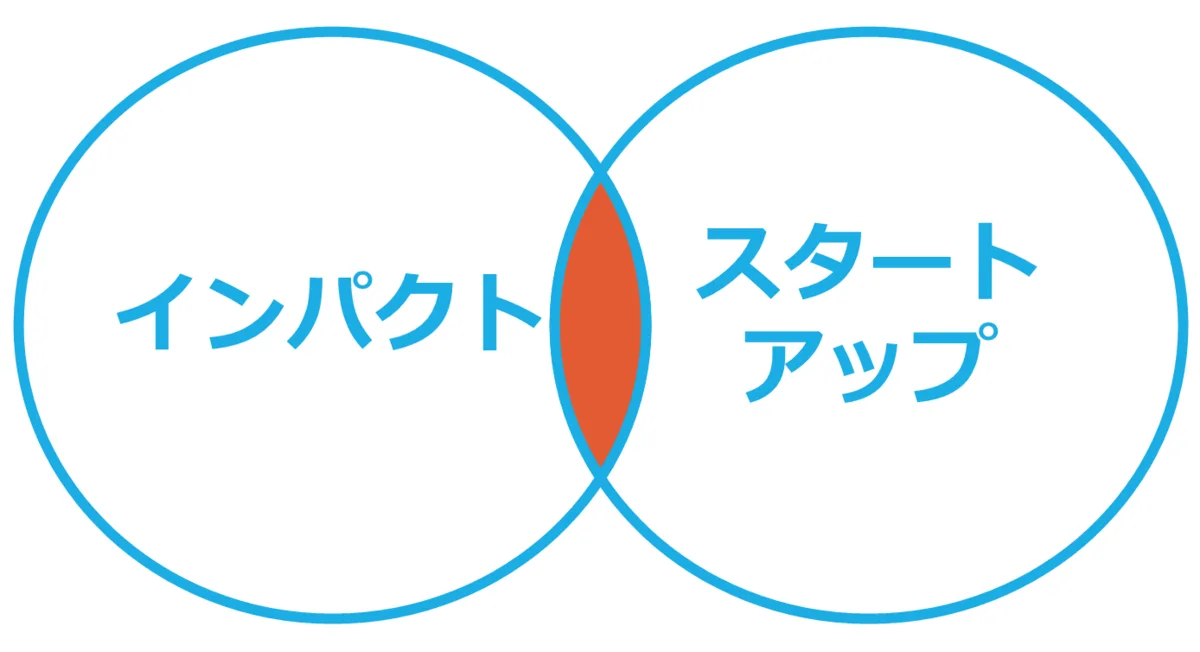
The term "impact startup," which presumably means the AND of "impact" and "startup," combines
- the polysemy of the word impact
- the polysemy of the word startup
multiplicatively, and with intent and time horizon added on top, I think it tends to make discussions confusing.
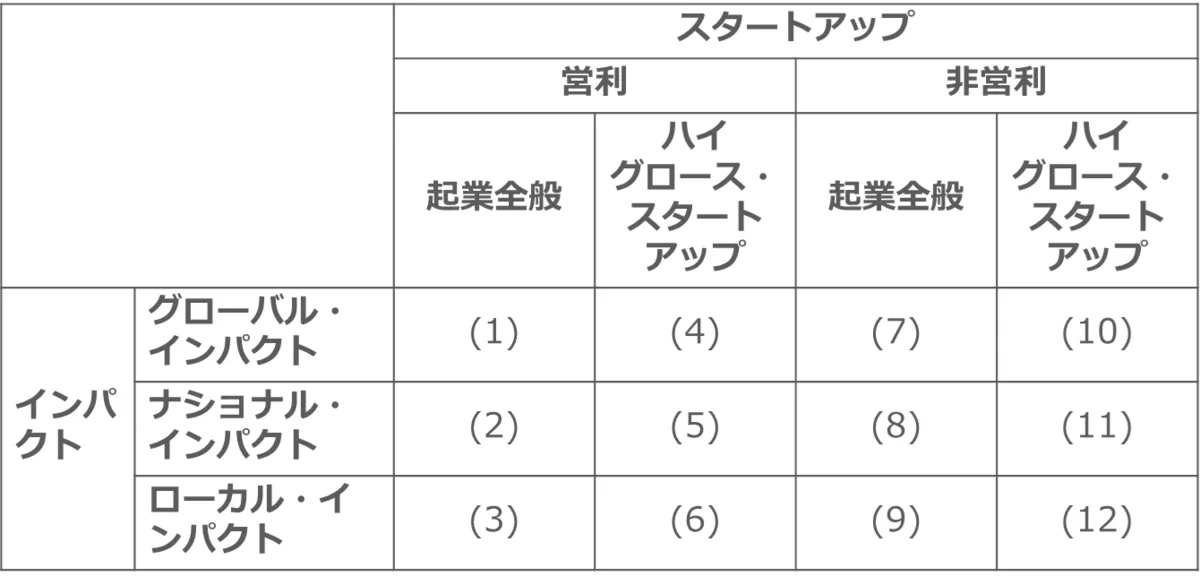
For example, from the breakdown above alone, "impact startup" could refer to about 12 patterns.1
Of course, there is also the view that "we should just discuss them all together." If the aim is to send the message that "entrepreneurship with social impact is important," then it is better to lump them together. A loose definition may also be fine.
However, I think the picture is somewhat different when we consider something more concrete and practical (such as policy). For example, a non-profit venture oriented toward local impact and a for-profit high-growth startup oriented toward global impact would need different kinds of support and would probably hold different opinions on policy, so I think they should be discussed separately.
As a separate matter, if the definition of the term high-growth startup is shifted or stretched, as in "this is a good company aiming for social impact, so even if it won't achieve startup-style rapid growth, let's call it a 'high-growth startup' for convenience," the discussion on the high-growth startup side may well become confused.
As for impact metrics too, whether a uniform set of metrics, such as a metrics catalog like IRIS+, matches Japan's social problems is not necessarily the case, I suspect.
I don't think the debate on this has been settled worldwide, and I think the people involved need to keep striving and searching for something better. At the very least, though, unless we agree in advance on in what sense we are discussing "impact" and "startup," I think the discussion will become confused.
Depending on the case, it may be better to divide the work into units such as a "global impact division," or to set up subcommittees such as a "national impact working group" to carry on the discussion.
"Impact" in Japan
For Japanese "startups," and especially in the area of high-growth startups, which is what is called for now, I think it is better to avoid letting what "social impact" refers to be dragged too far by the Japanese context I showed at the beginning. This is because areas such as "promoting women's participation and advancement" and "education and child-rearing" are also areas with many businesses where the rapid growth demanded of startups, high-growth startups in particular, is difficult.
Not every social problem can be solved by the private sector. Some problems are not suited to being left to the private sector or the market, which is why the public sector and the social sector have existed until now and will continue to be needed. As impact investing and the like spread from here, I think the areas where private companies can start businesses will increase, and that may allow us to support people and address social problems that we have not been able to until now, but not every business area is suited to the private sector.
Even if there are business areas suited to the private sector, whether a high-growth startup is possible in that area depends on the area and the business. And in areas where the public sector or the social sector has been running operations, I don't think the high-growth startup form is all that suitable. Trying to grow rapidly can sometimes create a mismatch with the problem. For example, it is extremely difficult to solve the problem of replacing a declining regional transportation network while growing the business rapidly. This is because such regions saw their transportation networks decline mainly as a result of population decline, and making a profit from them must be structurally quite difficult.
Not every business should necessarily aim to be a high-growth startup. There are options other than startups, such as zebra companies, and there is also the path of remaining a small business. That may sometimes allow a company to stay closer to the social problem and to the people struggling with it. Yet if it raises funds from VCs and so on simply because it is a "startup," there is a real possibility that it will drift away from realizing the social impact it was aiming for.
On the other hand, if what a particular impact startup is aiming for is to be a high-growth startup, then unless the discussion puts more weight on global impact, and not only on the areas that the Japanese sense of "impact" calls to mind, it will be hard to end up supporting companies that will drive Japan's industries in the future.
Of course, as Japan's population shrinks, there is no doubt that many social problems will emerge from here on and that private companies to solve them will be called for, but whether the companies that solve them will lead to creating the industries that earn foreign currency in the next generation seems to me somewhat distant.
There is a great deal to be done in each of the areas (1) to (12), and I believe each business has an important role to play, but if we do not discuss them with some degree of distinction, the discussion will fail to connect and policy goals may go unmet, so I think we should approach it after organizing the terminology as a foundation for discussion.
Summary
Activities such as building a logic model to visualize the social impact of one's business, or issuing an impact report as a startup, are something I personally think many companies, not only startups, should do. I have also written about this in the book "Implementing the Future."
I also think it is a good thing that social entrepreneurship is increasing, and I personally view the increase in "entrepreneurship" in all its forms, large and small, positively in itself. Ideally, I hope we can design a market in which companies with social impact can make a proper profit.2
However, there are many kinds of impact, each is hard to measure and manage, and the support each needs differs. Once the words "impact" and "startup" have gained wide acceptance, I think we will need to break them down more finely and build up discussions suited to each kind of impact, so I am leaving this article as a way of organizing my thoughts.
(※By the way, this article is not a discussion of "impact startups"; it is strictly a discussion of the two separate words, impact and startup.)
Footnotes
-
Some of these seem to be equivalent to, or close to, what are known as "zebra companies." ↩
-
This is not to say that a society where companies providing services close to public services earn the most is a good one. Since responsibilities arise in areas close to the public sector, and if we think they should be bound by law and the like, it becomes doubtful whether it is better for the private sector to do it at all, so in the end I think it will come down to dividing roles between the public and private sectors. ↩