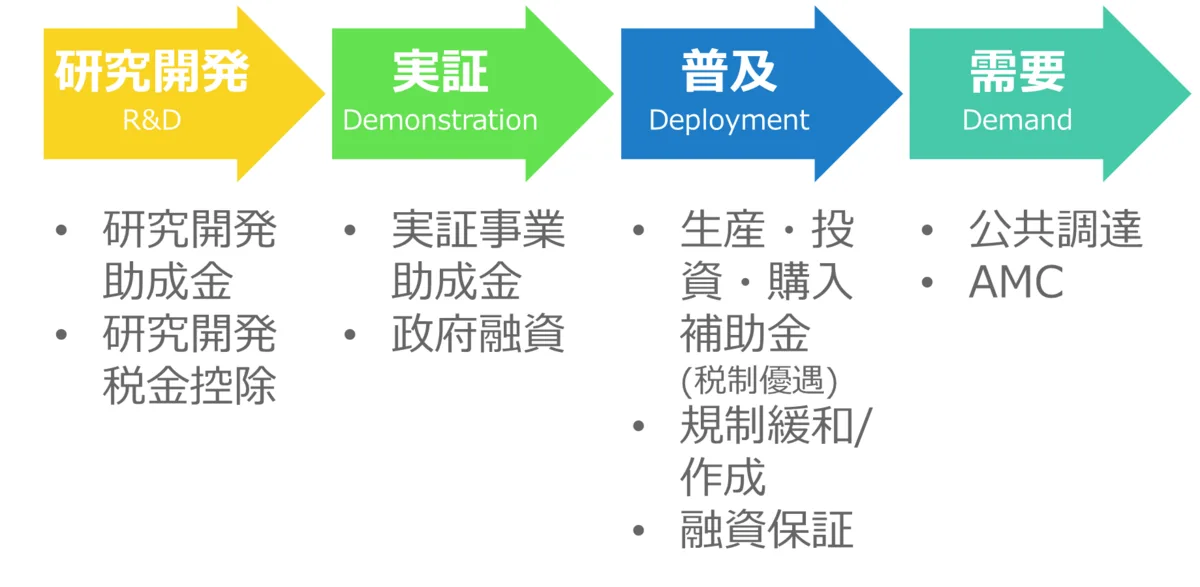
From R&D (Research and Development) to RDD&D
This article was machine-translated from Japanese by AI (Claude). It may contain errors. Read the original Japanese article.
Increasingly, I hear the term RDD&D rather than R&D (research and development).
RDD&D is an acronym made up of the initials of:
- Research
- Development
- Demonstration
- Deployment
For example, the U.S. Department of Energy (DOE) says that the mission of its Office of Technology Transitions is RDD&D. In other words, its mission is to look not merely at the research and development of technology but all the way through to its diffusion.
Let's think a little about this RDD&D.
Why the term RDD&D came to be used
Why is the perspective of RDD&D needed rather than R&D?
It is probably because there is a growing recognition that it is very important, from the standpoint of putting technology into practice in society, not only to pay attention to the R&D on the side that supplies the technology, but also to be conscious of Deployment.
Take energy, where the DOE is involved: even if technology development (R&D) itself goes well, if the new technology is not diffused and deployed, there will be no energy transition. That is why the Secretary of Energy often stresses the importance of Deployment, repeating "Deploy, Deploy, Deploy".
And in fact, unless you develop technology with Deployment in mind, it will not diffuse well. People often say, "We won on technology and lost on business." Perhaps this means that the technology won on the criteria that are highly valued at the R&D stage, such as performance, but lost on the criteria that matter at the Deployment stage, such as cost and ease of operation, and so it did not spread well.
Support for Deployment
Deployment requires support and policies different from those of conventional R&D.
Let's look at the financial side, for example.
In the Deployment phase, large sums of money are needed for mass production, such as building factories. If mass production is not possible, prices do not come down; if prices do not come down, demand does not arise; and if demand does not arise, mass production is not possible. This creates a chicken-and-egg relationship. If this is not broken, the technology that was painstakingly developed ends up going unused. Breaking through requires subsidies at the Deployment stage.
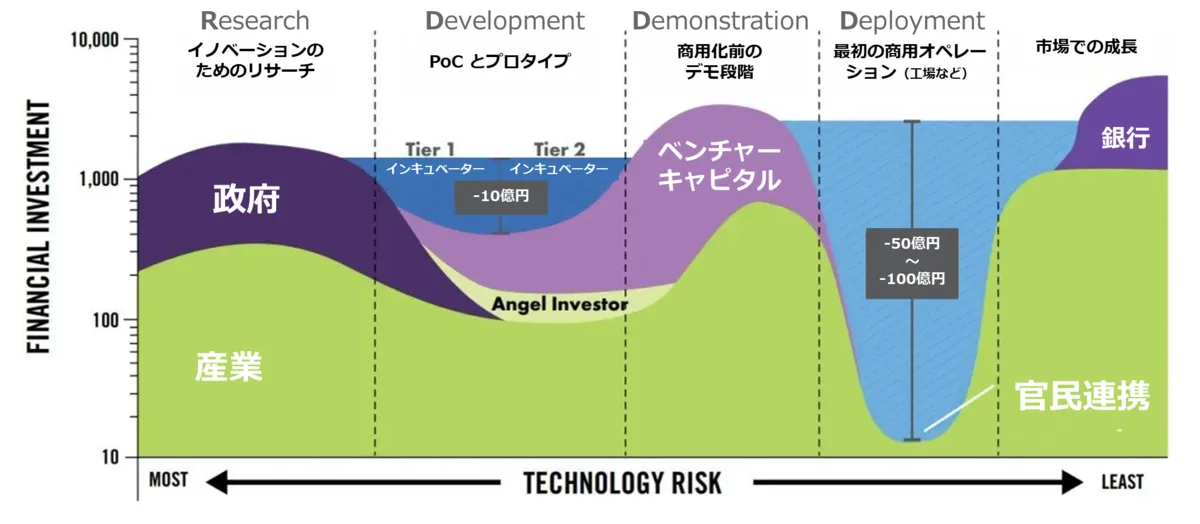
The relationship between RDD&D and money. Partly translated into Japanese from Two More Valleys of Death for Hard Science Tech (mdeia.org) and mapped to RDD&D
The DOE provides support at each phase of RDD&D.
- In R&D, national laboratories and funding for research and development. Programs such as ARPA-E, and, closer to development, SBIR/STTR, I-Corps, and support from the Office of Technology Transitions.
- In Demonstration, offices dedicated to demonstration, and the building of hubs for some technologies such as hydrogen, DAC, and carbon capture.
- In Deployment, things such as loan programs.
In addition, in Deployment, Breakthrough Energy Catalyst and others are trying to play a catalytic role.
"If you can just develop an excellent technology, it will sell on its own" rarely happens. Without this series of support, excellent technology will not see the light of day in the market.
When we think about R&D, too, extending the scope to RDD&D should make what needs to be done visible in more detail. And the view that everything through Deployment matters brings a new perspective to technology development as well.
Until now, the perspective of technology push, that is, the supply-side view of "how do we spread the technology we have made," has been strong. From now on, we have to think from the perspective of pull from the market, that is, from the demand side as well. This is in a sense natural from a business standpoint, but the forms of support were not like that, so perhaps there is a movement to correct this.
The design of RDD&D + D
If we were to add one more D to RDD&D, it would be Demand. As demand grows, technology development may advance to meet it.
Public procurement is one means of doing this. If the government decides to buy only more environmentally friendly products, demand is created there, and product development advances to meet that demand.
There are similar movements in the private sector. The First Movers Coalition has established a platform on which companies that will be early adopters commit to purchases, aimed at creating markets for the technologies needed for carbon neutrality. When a company makes such a declaration, people on the front lines may find it easier to get approval for buying green products.
Also, using an Advanced Market Commitment (AMC), specs are presented in advance and a commitment is made to buy at a high price if they are achieved. This is being done by Frontier and others, which was established with Stripe at its center. For AMCs, the Rethink Priorities report and others are detailed.
Businesses based on technology mainly face two risks, technology risk and market risk. I think that reducing the market risk and raising predictability about "what should we make for people to buy it" may accelerate technology development itself.
Such mechanisms and institutional designs do not work unless they are designed quite well, so it is not simply a matter of doing them. For example, the FIT can be considered one of this kind, and it is said that there have been a number of lessons learned in its institutional design.
Still, if we can raise the predictability of demand, or create demand and thereby generate a market, there is every possibility that innovation and industries will emerge there. It is fair to say that we are now in a period in which innovative ways of creating such demand are being explored.
Summary
This article argues that if you want to start, or to create, an R&D-type startup, it is important to provide appropriate support at each of RDDD&D, that is:
- R&D (research and development)
- Demonstration
- Deployment
- Demand