Calculating the "Theoretical Maximum" of a Deep Tech Business's Impact
This article was machine-translated from Japanese by AI (Claude). It may contain errors. Read the original Japanese article.

When thinking about business ideas for deep tech startups, I believe it is important to establish the theoretical upper and lower bounds before development, in order to see a technology's social impact and business potential.
The maximum social impact is "input × conversion efficiency"
Basically, the size of the social impact is proportional to the amount of output that can be produced. If something better for society (for example, something with a lower environmental burden) can be produced more cheaply and in greater quantity than before, the impact grows accordingly.
And to produce output, you need to convert input into the desired output by some means. That means of conversion is what we call "technology."
If we simplify this idea considerably, the theoretical maximum of social impact is determined by the multiplication of
Input amount × conversion efficiency = output (social impact)

Technology development to raise "conversion efficiency"
New technologies are developed to raise this conversion efficiency, and old technologies are replaced by new ones. Examples include technologies that turn more crude oil into petroleum, or that generate electricity from petroleum.
In some cases, technologies are developed that produce the desired output even when the type of input being converted is changed, raising overall efficiency.
Examples include a technology developed to turn low-quality crude oil into petroleum, a technology developed to generate electricity by burning natural gas instead of petroleum, and a technology that converts sunlight into electricity rather than using petroleum or natural gas (methane).
Input and conversion efficiency have limits
However, looking only at the technology does not tell you the total impact. This is because in many cases there is an upper limit on the amount of input, and in that case, no matter how much you raise the conversion efficiency, there is a ceiling on the impact that can be produced. For example, crude oil reserves are limited. Solar panels require surface area, so the area of the Earth's surface is the limit (although you could place them in space).
Conversion efficiency, too, almost always has a fundamental theoretical limit.
Therefore, considering the theoretical limits of "input amount × conversion efficiency" leads to identifying the upper bound of the impact. (Note: in addition to these, there are times when constraints such as regulations and institutions should be considered, but here I will keep the discussion greatly simplified.)
Cost changes the impact too
The same way of thinking applies when considering the economic side:
Price of input × price of conversion efficiency = price of output
This calculation determines the lower bound of the price of the output (the product).
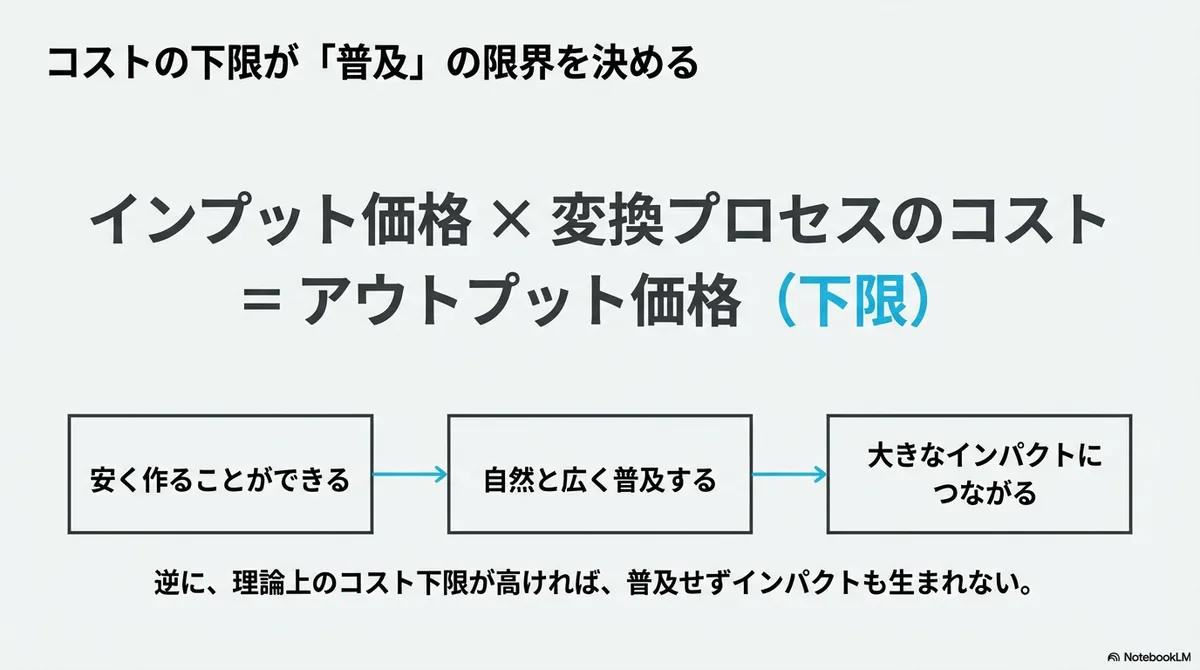
For actual adoption, the key is how low the price of the output product can go in relative terms. If it is expensive, it will not spread and will not produce impact. If it can be made cheaply, it will naturally spread widely and lead to large impact.
In that sense, when thinking about impact, it is important to consider the theoretical lower bound of cost as well.
In other words,
- The upper limit of the input amount
- The upper limit of conversion efficiency
- The lower limit of cost
almost determine the upper limit of the output, and thus the theoretical maximum impact.
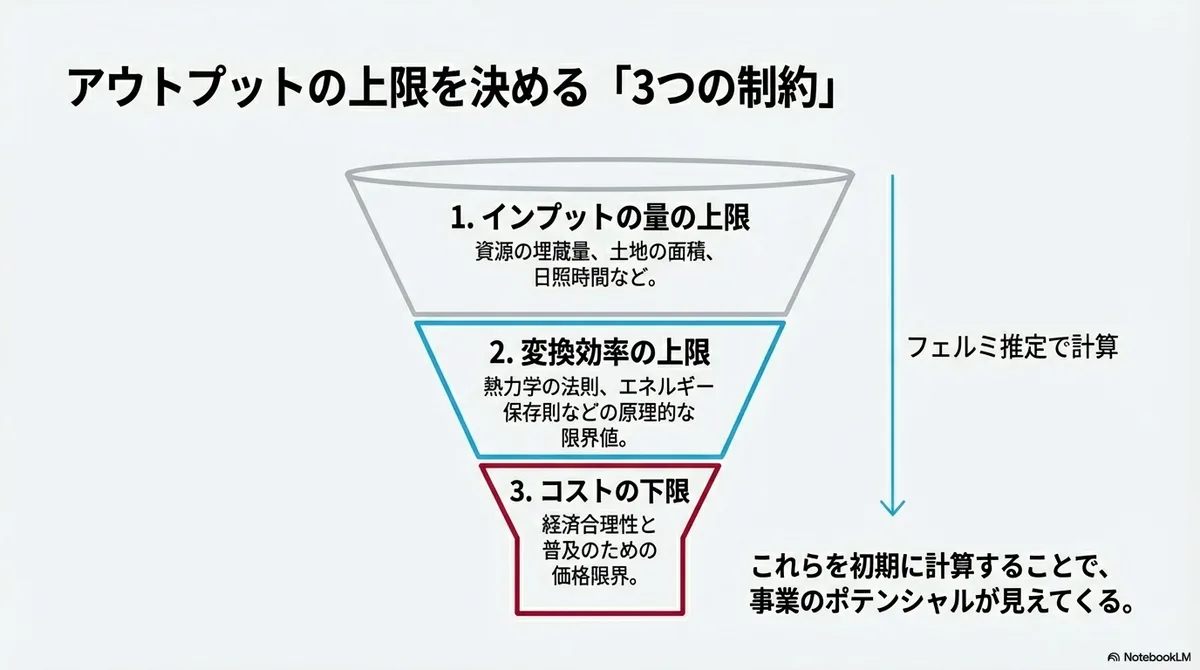
By doing this kind of calculation, a so-called Fermi estimate, at an early stage, you can estimate to some extent the impact you would obtain once that technology is developed.
From here, I would like to talk about these ideas using a few examples.
Example (1): SAF (UCO → HEFA) — constrained by quantity
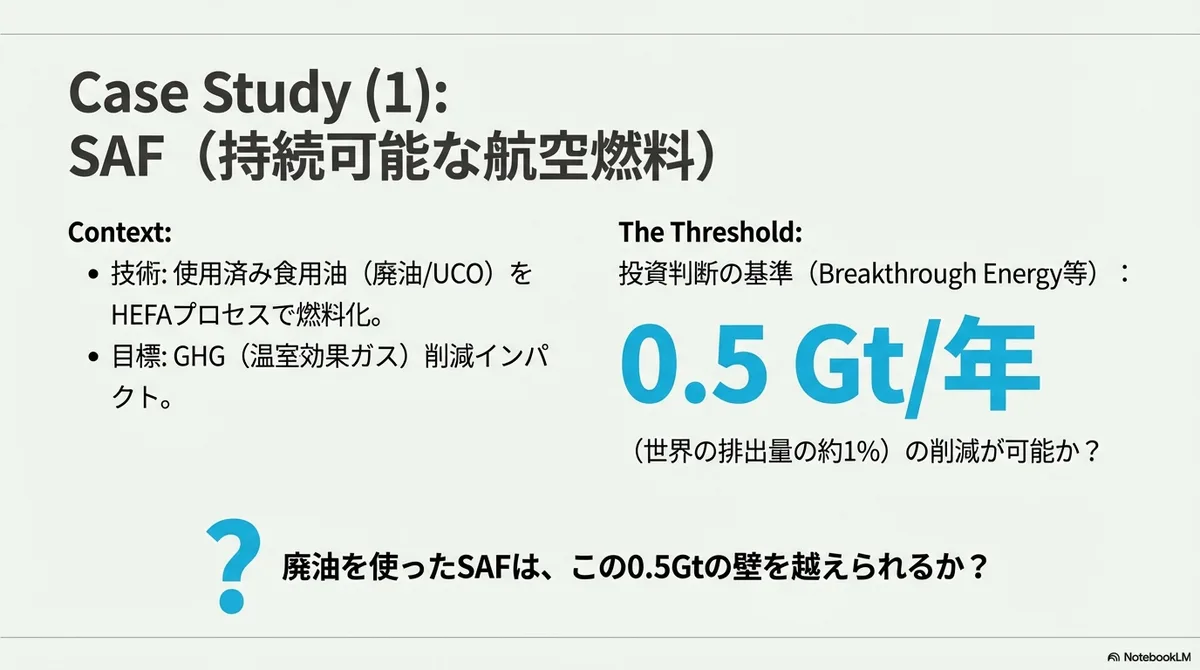
Let us consider the case of turning used cooking oil (waste oil, UCO) into SAF (sustainable aviation fuel) through the HEFA process.
Here, we take "how much GHG emissions are reduced" as the axis for quantitatively evaluating impact. Around 2020, it is said that 59 Gt of GHG (greenhouse gases) were emitted worldwide each year, and Breakthrough Energy and other investors who promote decarbonization emphasize an impact-based threshold: they invest only in businesses that, at scale, could cut annual GHG emissions by 0.5 Gt, that is, businesses that could reduce about 1% of GHG emissions.
Using this value as a reference, let us find, in the manner of a Fermi estimate, how close we can get to 0.5 Gt when using UCO.
Assumptions
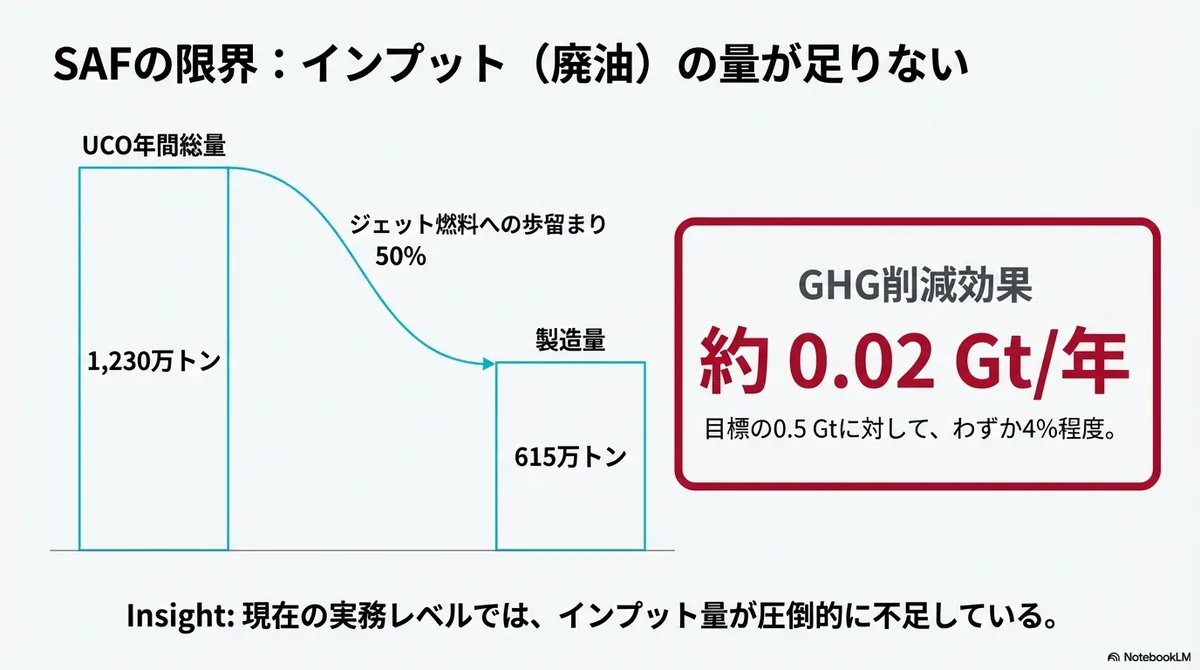
- Annual amount of UCO: we set it at 12.3 million t/year.
- Jet fraction: we assume 50% as the "upper end of the practical range."
- Emissions difference between fossil jet fuel and SAF: we set it at about 75 gCO2e/MJ (= 0.075 kg/MJ). (It is said that fossil fuel is 89 gCO2e/MJ, and fuel made with waste-oil-based HEFA is 14 gCO2e/MJ.)
- Heating value (LHV) of jet fuel: about 43 MJ/kg
- Heating value (LHV) of UCO (vegetable oil): about 37 MJ/kg
Note that this time we honestly evaluate the upper limit for UCO alone, and the energy of external hydrogen (H₂) is not included in the calculation. By-products are also ignored, and alternative uses are not addressed (for example, we do not consider the possibility that diverting UCO to SAF could push diesel and the like back to fossil sources).
1) Upper end of the realistic range (straightforward accumulation)
Let me spell out the calculation steps.
- Step A: feedstock mass → jet mass
12.3 million t × 50% = 6.15 million t (= 6.15×10^6 t = 6.15×10^9 kg) - Step B: jet mass → energy
6.15×10^9 kg × 43 MJ/kg = 2.6445×10^11 MJ - Step C: energy × emissions difference
2.6445×10^11 MJ × 0.075 kg/MJ = 1.983375×10^10 kgCO2e
= 19.83 million tCO2e/year (≒0.0198 Gt)
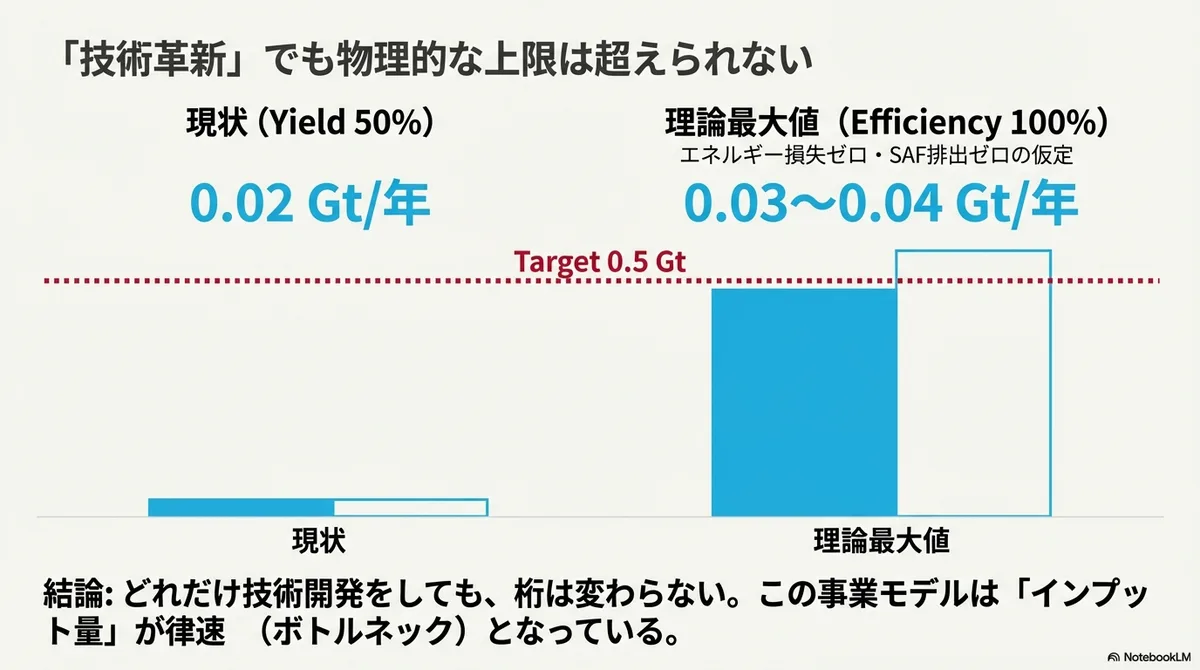
From the above, the upper limit of reduction, looking only at the conversion of the current input at the practical upper limit, is about 0.02 Gt/year.
※ The jet fraction could be raised, but because the total liquid yield tends to fall (a trade-off in slate optimization), I have set it at 50% for the time being.
2) If we develop technology to raise conversion efficiency
A common objection here is, "Wouldn't the impact be larger if we raised conversion efficiency further?" However, because of the first law (conservation of energy), the energy that can be extracted as product cannot exceed the energy contained in the feedstock (UCO).
- Total energy of UCO (theoretical maximum)
12.3 million t (= 1.23×10^7 t = 1.23×10^10 kg) × 37 MJ/kg
= 4.551×10^11 MJ
Even if all of this upper-limit energy could be extracted as jet fuel (that is, the unrealistic assumption of zero loss),
- Theoretical upper limit of reduction (with the emissions difference kept at 0.075 kg/MJ)
4.551×10^11 MJ × 0.075 kg/MJ = 3.41325×10^10 kg
= 34.13 million tCO2e/year (≒0.034 Gt)
And even if we make the extreme assumption that "SAF-side emissions are zero,"
- Theoretical upper limit of reduction (assuming an emissions difference of 0.089 kg/MJ)
4.551×10^11 MJ × 0.089 kg/MJ = 4.05039×10^10 kg
= 40.50 million tCO2e/year (≒0.0405 Gt)
In other words, no matter how much you raise conversion efficiency, 0.02 Gt/year only becomes 0.03 to 0.04 Gt/year, and the order of magnitude does not change.
In this case, what determines the maximum impact is not conversion efficiency but the input.
3) Considering whether the input (waste oil) could be increased further
Even allowing for improved collection rates and economic development, waste oil as an input is said to increase only about 2 to 3 times. No matter how much food culture changes, it will probably not become 10 times larger.
In other words, the input cannot be increased dramatically.
Summary of SAF using waste oil
From these calculations, we see that in the case of SAF made from waste oil, the contribution relative to 59 Gt is small, and in particular that even if technology is developed, there is a constraint on the input side.
In practice, on top of this, the "price of the manufactured product," which factors in the cost of acquiring the input (including supply chain costs) and the cost of converting it using the technology, determines how much actual purchasing it leads to. Even so, this pathway cannot reach very large impact, however cheap those costs become.
Similar calculations can be done for solar panels and the like. In the case of solar power, the input is "area and hours of sunlight," and by entering the theoretical value of the solar panel's conversion efficiency as the conversion efficiency, the theoretical value can be calculated. The maximum changes depending on whether you include farmland, residential land, and so on in that input, but the maximum in each case can be found. (And that potential is quite large.)
Example (2): Hydrogen production by water electrolysis — constrained by conversion efficiency
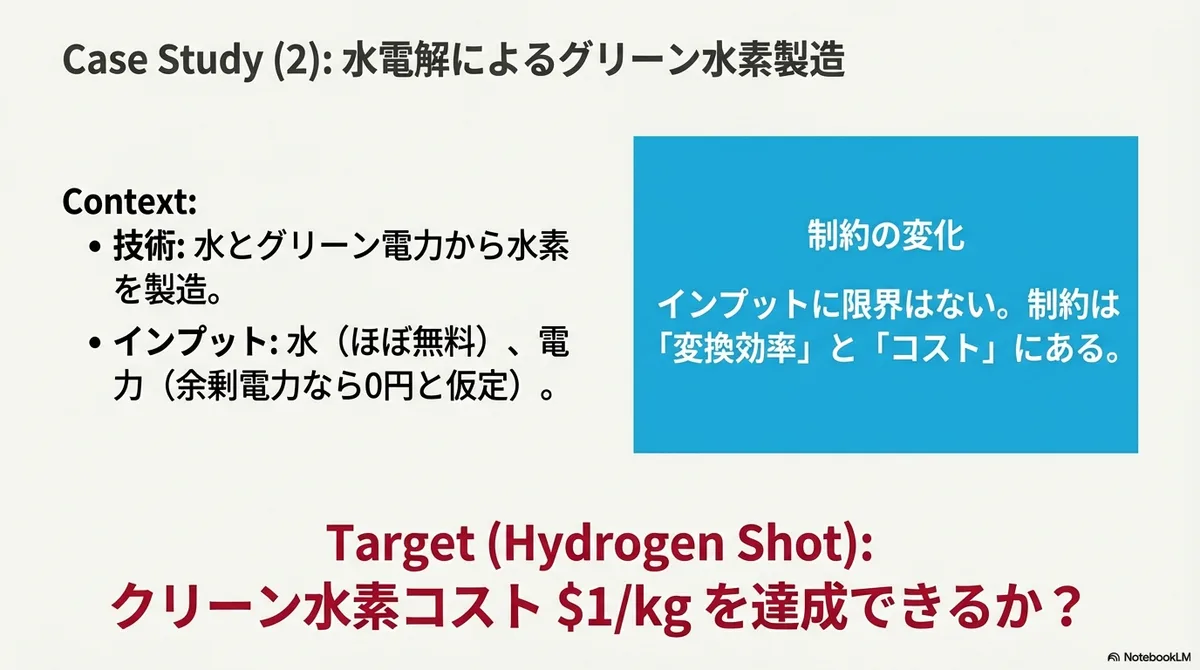
SAF from waste oil is a case where the input is the constraint, but conversely there are also cases where conversion efficiency is the constraint. Let us consider this using water electrolysis for green hydrogen production as an example.
What we use is the framework of "input × conversion efficiency = output (= social impact)."
To simplify, the inputs here are water and green electricity. We assume water is obtained almost for free, and green electricity is assumed to be 0 yen on the premise of using surplus daytime power. This makes it a problem in which the input is not the rate-limiting factor, and conversion efficiency and its cost are.
And as the target value, let us set the US Department of Energy (DOE) goal of "clean hydrogen at $1/kg" (Hydrogen Shot: $1/1 kg).
Under these premises, we will look mainly at conversion efficiency.
1) The fundamental limit of water electrolysis
Water electrolysis splits water with electricity (electrolysis) into hydrogen and oxygen. For this reaction, there is a lower bound on the required energy, below which it cannot go.
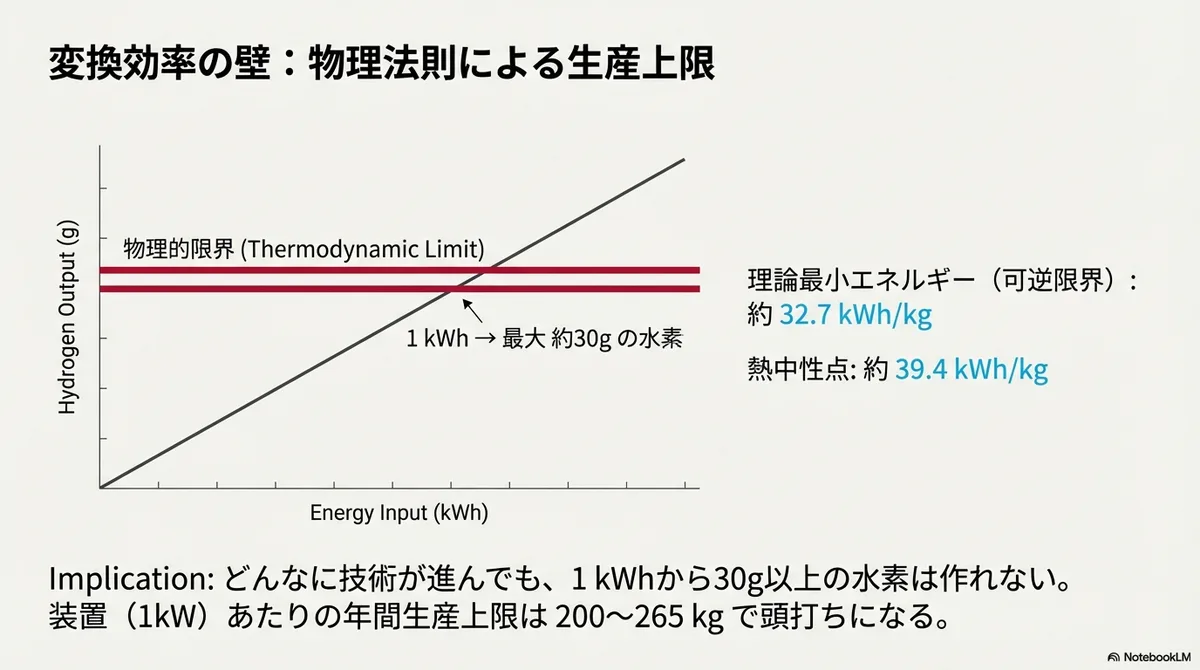
- Theoretical minimum electrical energy (derived from the Gibbs free energy) … about 32.7 kWh/kg (= the "reversible limit")
- The point where heat input and output are zero (the "thermoneutral point") … about 39.4 kWh/kg (= equivalent to 1.48 V)
Considering the theoretical voltages of 1.23 V (reversible) and 1.48 V (thermoneutral), 1.23/1.48 ≈ 0.83, so 39.4×0.83 ≈ 32.7. In other words, no matter how far technology advances, you cannot make more than 30 g of hydrogen from 1 kWh. This is the "wall of conversion efficiency."
2) Input × conversion efficiency = output
Let me put this into this blog's basic formula, "input × conversion efficiency = output."
- 1 kWh → at most about 30 g‑H₂ (= 0.030 kg)
- If you run a 1 kW device for a year (8,760 kWh),
- Ideal upper limit: 8,760 × 0.030 ≈ about 265 kg‑H₂/year·kW (reversible)
- At thermoneutral, about 222 kg‑H₂/year·kW
In other words, "200 to 260 kg per kW per year" is a rough guide to the maximum amount a device can produce.
3) Calculating cost (from 0 yen electricity to electricity at ○ yen)
From here, let us talk about money. When arranged in a form that is easy to calculate, the production cost of hydrogen (LCOH) is roughly
(A) In an ideal world where electricity costs 0 yen:
Only the "cost derived from the equipment" remains. If the equipment costs $1000 per 1 kW, is recovered at an annual rate of 10% (smoothing out interest and depreciation), and can produce 265 kg/year, then
In other words, if the equipment is $2000/kW, it is about $0.75/kg, and if $2500/kW, about $0.93/kg (when close to the reversible ideal). However, at thermoneutral (about 222 kg/year) it is somewhat higher (for example, $1000/kW → about $0.45/kg).
(B) If we realistically pay for electricity too:
For every 1 ¢/kWh (= $0.01/kWh) increase in the electricity unit price,
- At reversible (33 kWh/kg), about $0.33/kg
- At thermoneutral (39 kWh/kg), about $0.39/kg
is added directly on top. For example, at 2 ¢/kWh, electricity alone costs $0.66 to $0.79/kg.
A realistic calculation would add maintenance, utilities, water treatment, gas drying/compression, and so on on top of this (this article simplifies them).
4) The effect on $1/kg
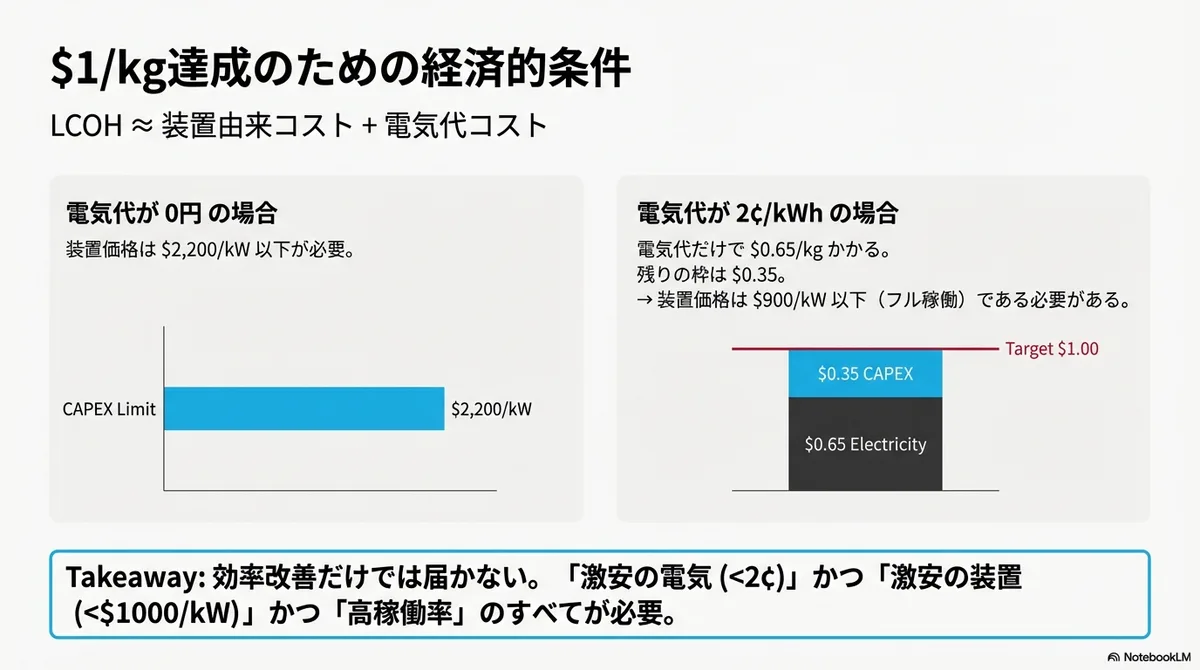
Let us roughly work backward to find the conditions for achieving this $1/kg (with generous assumptions: an annual rate of 10%, zero maintenance, and full operation, that is, 100% facility utilization).
When electricity costs 0:
The equipment price needs to be $2.2k to $2.7k/kW or less (thermoneutral to reversible). If utilization drops to 50%, the allowable equipment price also falls by half.
When electricity costs 2 ¢/kWh (assuming close to reversible):
Electricity alone uses $0.65/kg, so the budget available for the equipment is $0.35/kg. To meet this, the equipment price must be at most ~$900/kW (assuming full operation). If utilization is 50%, the allowable equipment price sinks to about ~$450/kW, which is extremely demanding.
In other words, improving the efficiency of water electrolysis alone will not reach $1/kg. Very cheap electricity (≲1 to 2 ¢/kWh), high utilization, and a quite low equipment price ($~1000/kW class or less) are all needed to achieve the target.
5) Summary
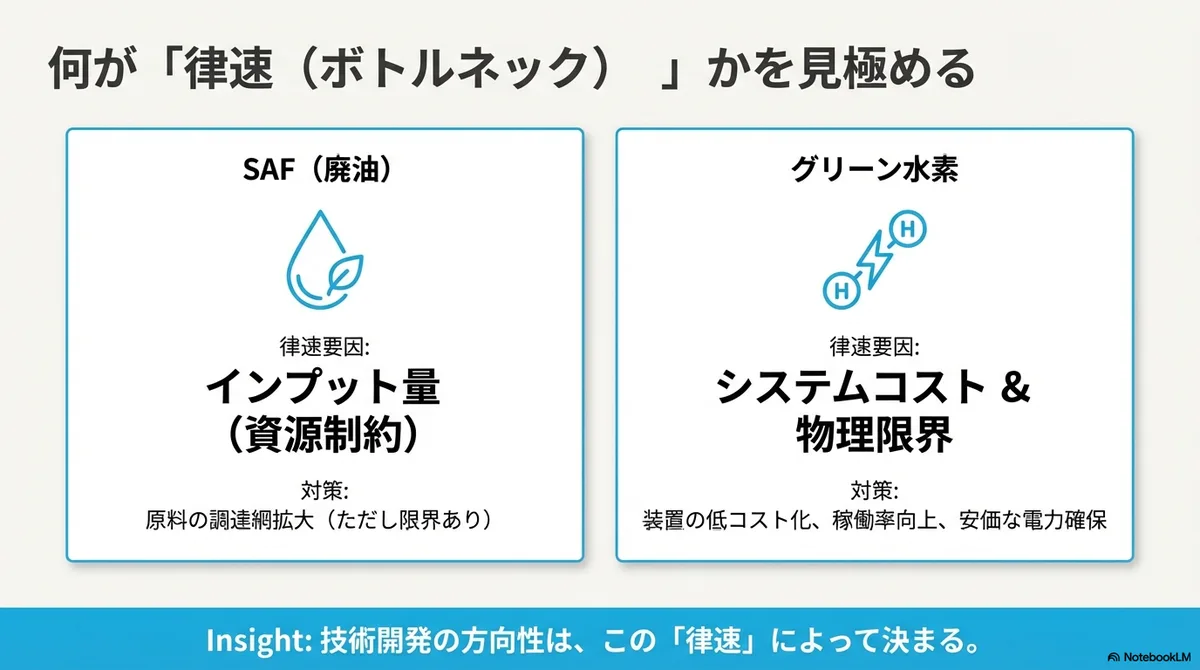
To summarize:
- The wall of conversion efficiency: From 1 kWh, at most about 30 g of hydrogen can be made. 1 kg requires 33 to 40 kWh. This is the physical limit.
- The production ceiling of the equipment: 200 to 260 kg per kW per year is the limit. The equipment's "earnings" top out here.
- The crux of cost: the cheapness of equipment ($/kW), 2) the cheapness of electricity ($/kWh), and 3) utilization (%).
Efficiency improvements matter, but these three are the key players that change the order of magnitude.
Therefore, it follows that research and development that raises not only the efficiency of water electrolysis but also the cheapness of equipment and utilization is the key. Alternatively, it becomes necessary to explore moonshots such as green hydrogen production pathways using electrolysis other than water electrolysis, and underground hydrogen.
(If the calculations are wrong, please point it out…)
Calculating business impact
So far, we have approximated social impact by the amount of output and considered only two things:
- Input
- Conversion efficiency
When thinking about business success, we need to consider the economic side of these. We also need to consider the rise and fall of profit margins due to competition. In other words,
- Input: feed in what can be obtained more cheaply and in greater quantity,
- Conversion efficiency: convert it by a cheaper method, more efficiently, into something of higher added value,
- Profit margin: and provide it more monopolistically

I think the approximate potential of business impact can be calculated by multiplying these three.
Put in an extremely simplified way, it is about:
- Taking more of the cheap stuff (input)
- "Converting (technology)" it into
- more of the expensive stuff (output), and
- how much of that you can "monopolize"
Which is, you could say, only natural.
The meaning of calculating the theoretical upper limit of impact first
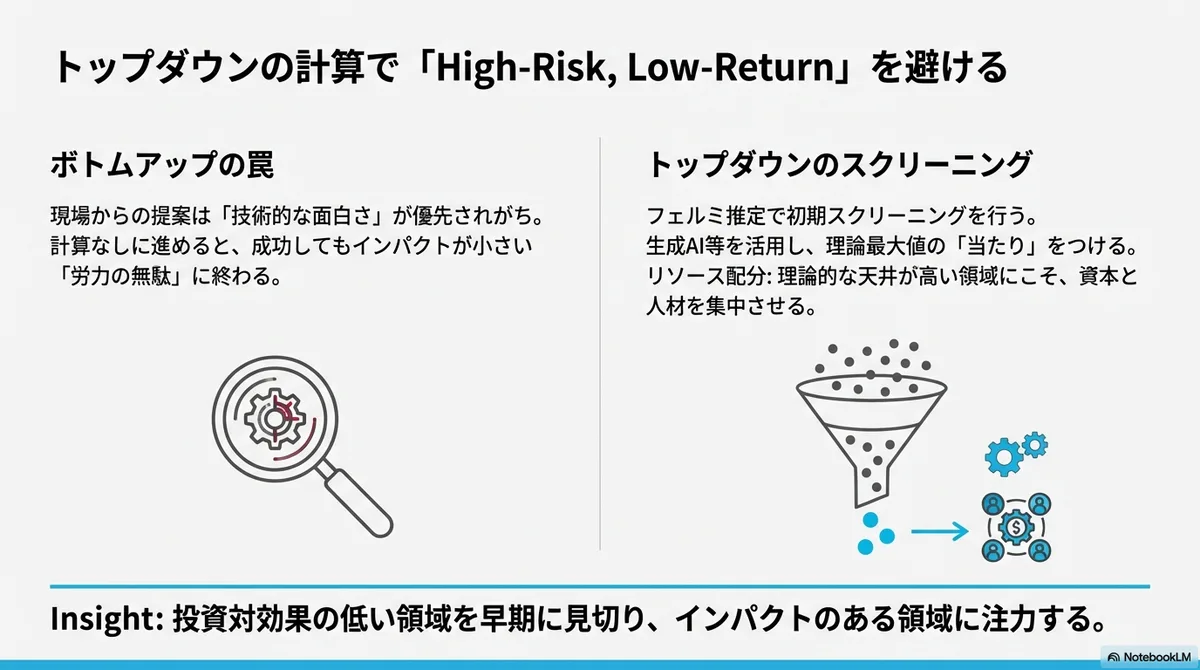
My impression is that research and development in Japan often relies on bottom-up proposals from researchers and engineers. While I think that is fine for the natural sciences and the like, in engineering there are also many situations where social impact is demanded, and when it comes to the "commercialization" of research and development, it is all the more important to calculate that social impact in advance.
In that case, I think there is room to strengthen the practice of doing top-down calculations to evaluate early on "how much impact this technology could potentially bring" and reflecting that in the allocation of R&D budget resources.
In particular, for high-growth startups using deep tech that aim for large impact, whether it "can truly be high-return" can sometimes be seen just by first establishing the input upper limit and conversion efficiency (practical range and theoretical upper limit) as above and doing a simple calculation. Rather, without such a calculation of return potential, it can easily become a high-risk, low-return investment.
Looking at R&D funded by national subsidies, too, it seems that "technology commercialization" with a low impact ceiling is sometimes selected simply because the R&D is advanced. One might say that focusing too much on technology development can cause us to lose sight of the whole picture. There may be cases where it is done while taking into account values other than social or business impact, but even so, in the sense of taking risks (and returns) that the private sector cannot take, I think the perspective of determining the maximum impact in advance is needed more.
(Also, even if the amount of output is not so large, there are cases where market value rises considerably when the technology is strongly demanded for a specific use.)
Verification using generative AI
Recently, using generative AI and literature services such as Elicit has made the work of getting a rough sense of the theoretical maximum overwhelmingly easier. It is very useful for initial screening, such as exploring information, sensitivity analysis of assumption ranges, and consistency checks of premises.
Of course, generative AI sometimes makes mistakes, but if you fix the calculation steps and assumptions in text following the Fermi estimate pattern (input × conversion) and note the basis for each number as you go, I think you can draw an initial overview in a short time. If we use such tools to clear the path in advance, I think funding will go to better projects.
※ The calculations in this article were also done using GPT-5 Pro.
Conclusion
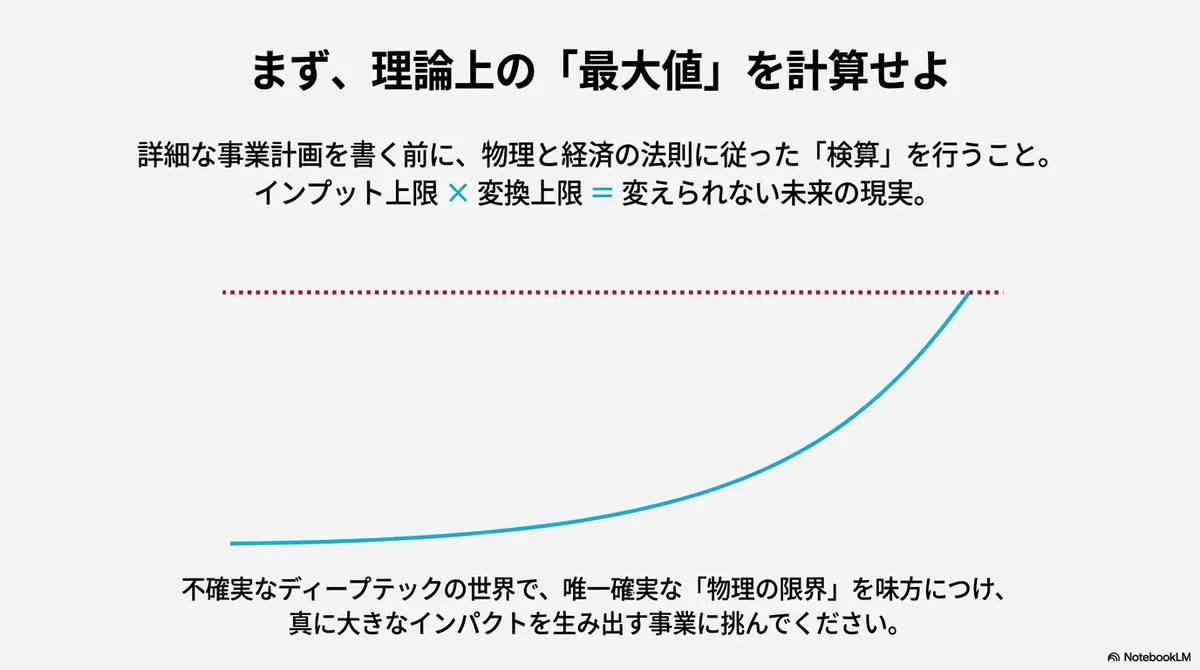
This article introduced the idea of estimating the theoretical maximum using only "input upper limit × conversion upper limit," and then checking by calculation whether there is impact.
The R&D on UCO → HEFA and water electrolysis cited here is by no means meaningless, and since they are technologies that contribute to short- and medium-term decarbonization, I think there are aspects of these technologies themselves that should be promoted. On the other hand, I believe that thinking about "how much impact is theoretically possible" is also important when considering the direction of deep tech startups seeking high returns and of technology development promoted by the state, and I took them as examples to emphasize that.
To sum up, this article suggests that at an early stage of technology development or business development, it would be good to roughly check the upper limit of the impact of that technology or business, and then think about which technology to commit capital and people to.
Please also allow me to add that this is an idea that is effective for businesses where the risk lies on the technology supply side and where it is known that there is a certain level of demand, and it is hard to use for things like IT, where there is risk on the demand side.