The Potential of Non-Profit Company Creation
This article was machine-translated from Japanese by AI (Claude). It may contain errors. Read the original Japanese article.
So far I have written several articles on company creation for for-profit startups and on non-profit startups.
Efforts that combine the two, which could be called "Non-Profit Company Creation" or "Social Company Creation," have also begun around the world.
Examples from around the world
One example is Charity Entrepreneurship, a UK organization founded in 2018. Charity Entrepreneurship (CE) is also featured in Moral Ambition, the new book by Rutger Bregman, who is famous for Utopia for Realists and Humankind. CE conducts internal research to identify ideas that could have a large impact, recruits social entrepreneurs to tackle them, provides a certain amount of training, and even helps them raise funds. It reportedly has produced more than 50 organizations so far.
A slightly different approach is the Global Development Incubator (GDI). Based in Washington, D.C., GDI works with funding foundations and local partners to identify the social problems that should be solved and to design new programs. Then, through a 12- to 36-month incubation process, it builds mainly non-profit ventures.
The overseas organizations above mainly produce one non-profit organization after another.
Because "Social Company Creation" could even include for-profit companies that carry out social contribution activities, "Non-Profit Company Creation" may be the more suitable name.
(Note: I am not saying that for-profit or non-profit is better. I think that where the best point on the spectrum from for-profit to non-profit lies differs depending on the field of business and the problem.)
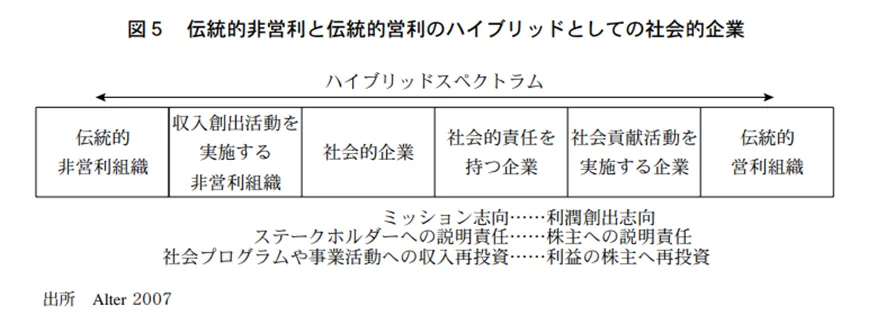
https://oisr-org.ws.hosei.ac.jp/images/oz/contents/662-05.pdf
Why it is needed: maximizing impact
When trying to solve social problems and create a large impact in the non-profit sphere, it is very important to identify "problems that would bring a large impact if solved" and "among them, problems that can actually be solved."
However, I strongly feel that this is quite difficult. In particular, the causes of social problems in non-market areas lie beneath the surface, deep below the problems that are visible, and they are often structural and complex, so it takes considerable effort to find the problem that should be solved.
Yet once you have settled on a problem and started a venture, it becomes hard to distance yourself from the problem you are working on. I get the impression that this tendency is especially strong in social ventures. But it would be a great waste if the precious resource of a social entrepreneur's time were spent on activities that do not lead to much impact.
Of course, solving small social problems is also important and valuable. But in Japan today, where the population is shrinking, I think what we should pay a little more attention to is an orientation toward impact: how much result and social impact an activity will produce.
The potential of Non-Profit Company Creation
Thinking this way, it seems to me that taking on a social problem presented by someone else and maximizing a large impact in a short time, as Non-Profit Company Creation does, is one effective method.
Of course, for that to work, the people doing the organizing must identify social problems that would bring a large impact, and that will probably require research and the like. Still, I think it would be good if some such effort existed and a mechanism for solving those problems were built.
Or, at universities and research institutions too, it would be good for education if there were more efforts that go beyond analyzing social phenomena and instead analyze and work to solve problems on the premise of producing a large impact.
If we develop that further, I think it could even lead to high-risk, high-return research efforts that might be called a DARPA for the humanities and social sciences.
From Will to impact
When I talk about this, though, I am sure some will ask, "Is there will and passion behind it?" I think this tendency is stronger in the non-profit sphere than in the for-profit one.
Of course, I think it is relatively often better to have Will, meaning will and passion, than not to have it. But if we stopped people from starting something just because their Will is thin, no one would be able to start anything.
Moreover, a person's will and passion also grow gradually, and few people know "what they want to do" from the start. Rather, I think most people begin to get involved in things out of a slight interest, and many things gradually sprout from there.
Also, do we need a reason to help people? Not at all.
If someone is in trouble, we should simply reach out a hand, even without any particular Will or reason. If such support results in more people being helped, that should be wonderful.
"Since I'm doing something anyway, I want to do good for society and create a large social impact" is also a perfectly respectable will.
Of course, since we are not the people directly affected, how we reach out requires consideration and humility, fairness, and the principle of "Nothing about us without us." But when I think again about how much result and impact an activity has, as much as about Will, I come to believe that company-creation-style activities like this in the non-profit sphere have great value.
References