Focused Research Organizations (FROs): The Potential of Nonprofit, Tech-Startup-Style Science and Technology Research Institutions
This article was machine-translated from Japanese by AI (Claude). It may contain errors. Read the original Japanese article.

In December 2025, the U.S. NSF announced a new initiative called the Tech Labs Initiative and began collecting input from the community through a request for information (RFI).
Tech Labs is a new operating model that advances research by giving full-time independent teams discretion and milestone-based funding to tackle "technical bottlenecks that are hard to solve within the frameworks of universities and companies."
In NSF's description, a notable feature appears to be a strong focus on going beyond traditional outputs such as papers and datasets, all the way to the translation of prototypes into platforms that can be commercialized.
As for the scale of funding, this is based on press reports and briefings, but the design is large and multi-year: $10M to $50M per team per year, over at least four years.
Tech Labs is said to share a philosophy with the Focused Research Organization (FRO), which has been proposed over the past few years.
Here I summarize how new approaches to science are advancing, centered on the FRO.
❓The Problem
The total number of scientific papers is growing exponentially, and new findings are produced every day. However, there is a shared concern that the pace of truly innovative discoveries, that is, discoveries that overturn existing paradigms, may be slowing down.
Representative examples include:
- The argument that research productivity is declining even as research inputs (people and money) increase (Bloom et al.)
- The argument that the "disruptiveness" of papers and patents is declining (Park et al.)
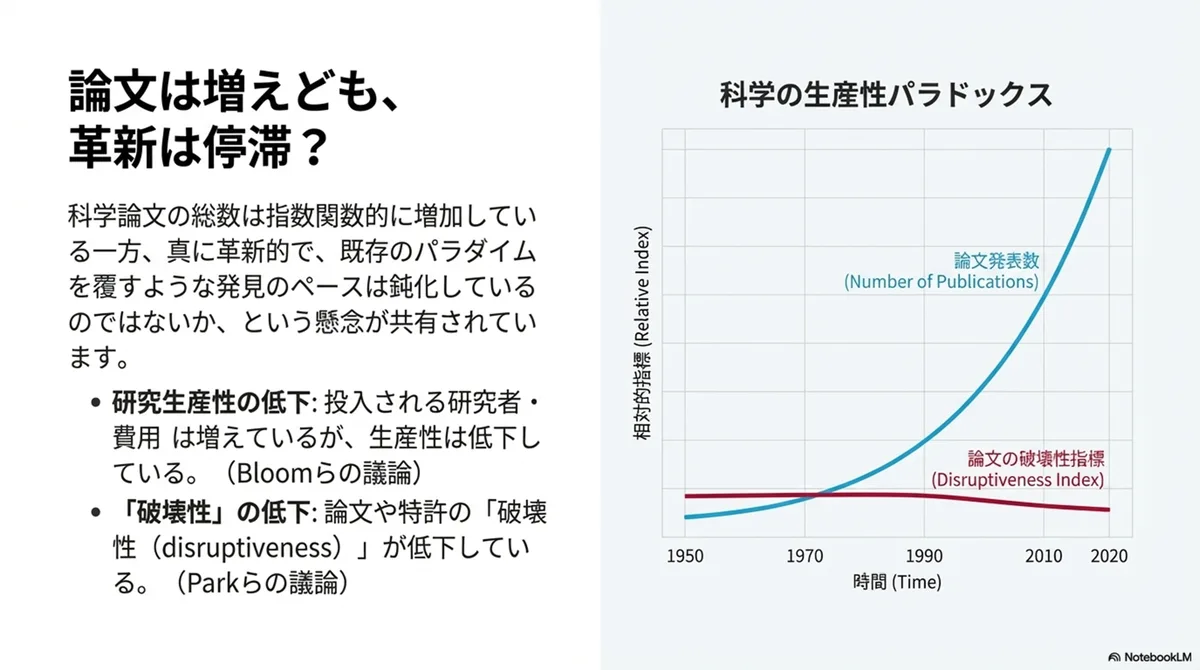
What these arguments suggest is that structural problems (the design of incentives and of operations) may be at work, rather than a lack of effort by individual scientists.
Examples of such structural problems include:
- Evaluation centered on papers
- Bureaucratic funding systems
- Lab-based operations (centered on the PI, built up from short-term hires)
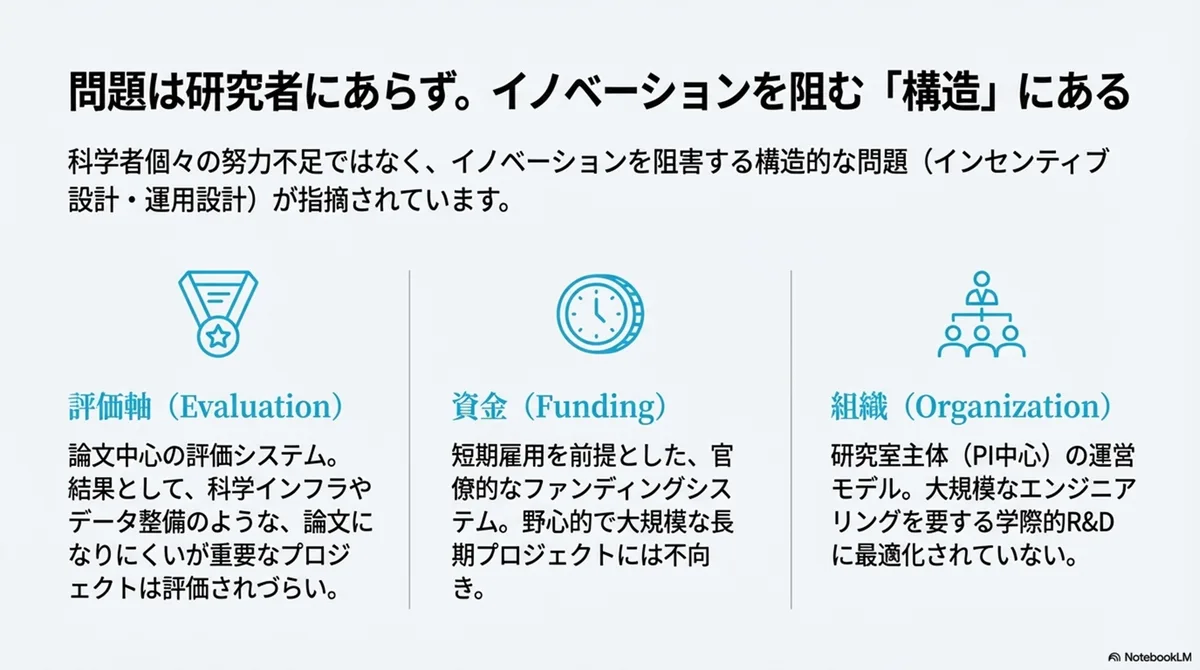
Because of these structures, projects such as building scientific infrastructure or curating data are hard to get recognized in academia, and as a result they tend to go undone.
It has also been pointed out that this lack of shared foundations becomes the rate-limiting step and slows progress across entire fields, forming part of the structure of the problem.
🔬 What FROs Do
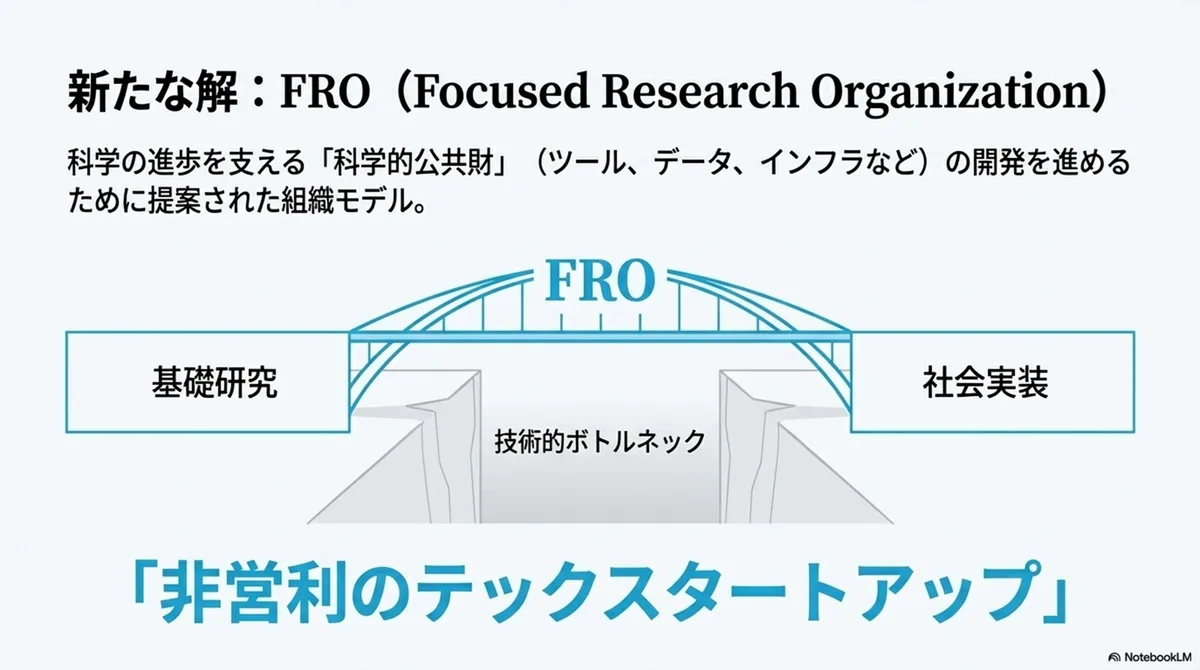
The FRO is an organizational model proposed to develop "scientific public goods" (tools, data, infrastructure, and so on) that support scientific progress, which addresses one of these structural problems.
FROs are often described as "nonprofit tech startups" (for example, a 2022 Nature article was titled Unblock research bottlenecks with non-profit start-ups), and they are run independently, separated from traditional universities and research institutions.
Characteristics of FROs
An FRO is set up with the goal of "solving a specific problem," and
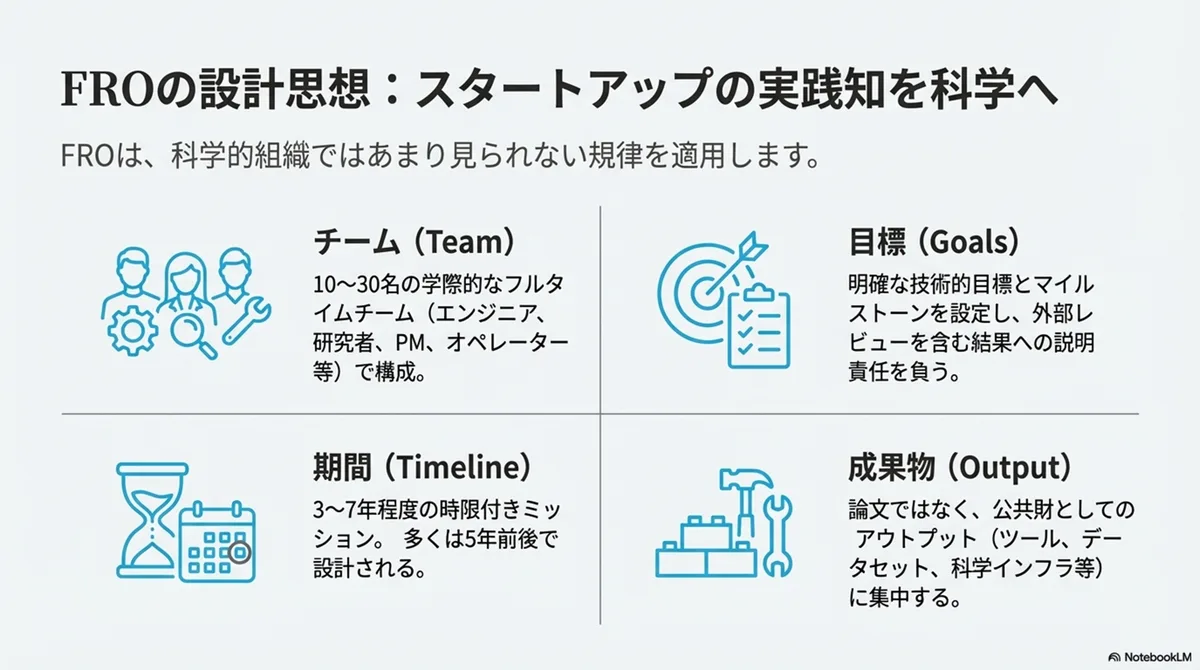
- Inside the organization, an interdisciplinary full-time team (10 to 30 full-time members) is formed, bringing together engineers, researchers, PMs/operators, and others
- The organization receives funding for a fixed period ($20–50M)
appears to be the standard template.
Other characteristics include:
- Clear technical goals and milestones
- Time-limited (typically 3 to 7 years; many are designed as missions of around 5 years)
- Output of public goods (tools, datasets, scientific infrastructure, etc.)
- Accountability for results (including external review)
These impose a discipline rarely seen in scientific organizations.
Because these are carried out as a nonprofit organization, the model is also said to fuse three things:
- The inquiry of academia
- The execution power of startups
- And philanthropy/public benefit
The Problems FROs Take On
However, not every scientific problem suits an FRO. In general, the problems suited to an FRO are understood to be cases where the following conditions are met:
- There is a "technical bottleneck" holding back progress in the field
- It is hard to resolve under the incentive structures of existing organizations
- Results close to "public goods," such as tools, data, and standardization, are important
How FROs Differ from Other Organizations
Summarized in a table, the differences can be put as follows.
Organizational model | Main purpose | Measures of success | Duration |
University lab | Basic research and publishing papers | Citation counts, securing external funding | Long-term (based on the PI's career) |
VC-backed startup | For-profit product development and market launch | Revenue, number of users, company valuation | Short to medium term (until market launch) |
FRO | Development of scientific public goods (tools and data) | Achievement of technical milestones, contribution to the scientific community | Medium term (time-limited, 5 to 7 years) |
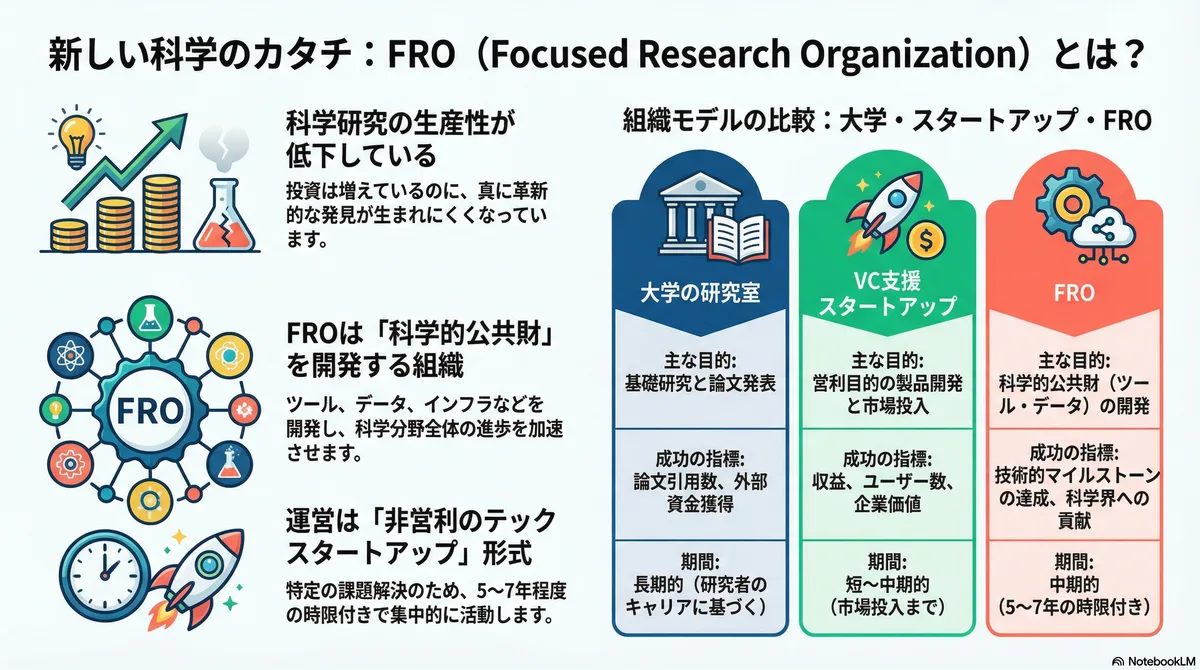
Summary by NotebookLM
❗Examples of FROs
A leading example of an organization that promotes the FRO concept and has "systematized" support for launching them is Convergent Research (founded in 2021). It is known that Google's Eric Schmidt and others were among its early funders.
Convergent does not only provide funding. It identifies FRO-type problems, draws up roadmaps, assembles leadership teams, and supports FROs from launch through operation, making it, so to speak, a startup studio for FROs.
Example: Lean
One example of what they support is the "Lean FRO." Lean is a proof assistant platform used in mathematics, software, hardware verification, and more. The Lean FRO was formed as a nonprofit under Convergent in July 2023 and is described as developing Lean under a five-year mission. (Lean itself, however, began in 2013.)
Recently in Japan, the news that "Lean is being used to prove the ABC conjecture" was also shared, and this Lean is run as an FRO.
Example: Forest Neurotech → Merge Labs
A recent and easy-to-understand development is the report that Forest Neurotech, which had been researching BCIs, is spinning out as a for-profit startup, Merge Labs. According to the report, Merge Labs is working on reading brain activity using ultrasound and is aiming to raise $250M at an $850M valuation. It is also reported that Sam Altman is involved as a co-founder.
Example: OpenAI
The most successful FRO may be OpenAI. Strictly speaking, OpenAI differs from the definition of an FRO (a public-goods mission, resolving a specific bottleneck, being a time-limited organization, and so on), but it was founded as a nonprofit (2015) and has pursued large-scale R&D driven by the mission of AGI, so it can serve as a reference example when thinking about "nonprofit x frontier R&D."
⏩The Evolution of FROs
Behind FROs lies the trend of so-called metascience (the science of the scientific enterprise itself).
In my understanding, whether an FRO-style approach works "depends on the problem," and depending on the problem, the "strength" of the FRO-like system (the rigor of milestones, room for exploration, the balance between open and closed, and so on) needs to be adjusted.
Returning to Tech Labs, NSF itself clearly states
- The discretion of independent teams
- Milestone-based funding
- Translation from prototypes into platforms that can be commercialized, going beyond papers and the like
and seems to be importing a design philosophy that overlaps with the FRO.
On the other hand, while FROs lean toward "public goods (tools and data)," Tech Labs is strongly conscious of "technology translation and the entry point to industrialization" and also tries to solve scientific problems that are especially high-risk within the national agenda, so the purposes are not identical.
In that respect, Tech Labs can even be said to resemble ARPA-type organizations such as DARPA (although they differ greatly in matters such as organizational independence).
On the operational side, there is also talk that Tech Labs aims for flexibility and reduced administrative burden through OT (Other Transaction) agreements.
In the UK as well, it is stated that ARIA, under its Activation Partners framework, is working with Convergent Research on FRO-type opportunity discovery and a Founder Residency.
🗾Implications for Japan
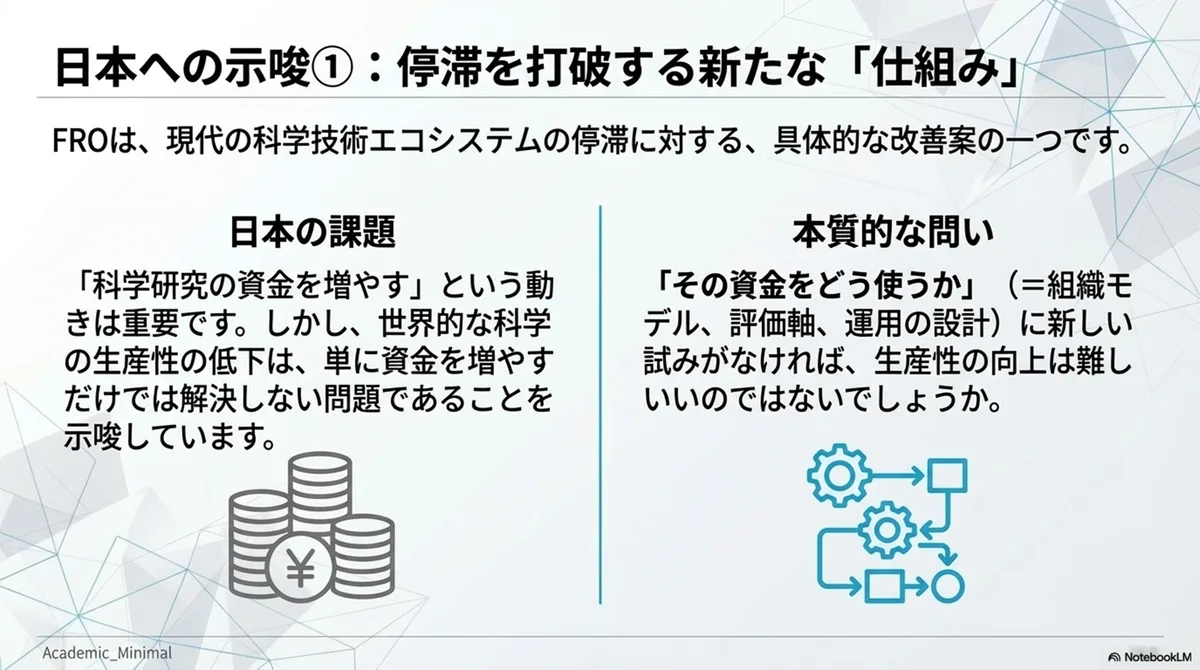
FROs and Tech Labs are one proposal for improving the stagnation of today's science and technology ecosystem.
The movement in Japan to "increase funding for scientific research" is important. But if scientific productivity is declining worldwide, we must recognize in advance that this is not a problem that simply increasing funding will solve.
Probably, unless there are new attempts in "how that funding is used" (that is, the design of organizational models, evaluation criteria, and operations), I think it will be difficult to catch up with the productivity of science and technology in the world.
I have previously covered topics such as DARPA, Private ARPA, random funding, innovation in review, and top-down calculation, and I think how we run such "alternative mechanisms" will bear on productivity going forward.
(These points, including FROs, are also touched on in the following 2024 materials prepared for METI.)
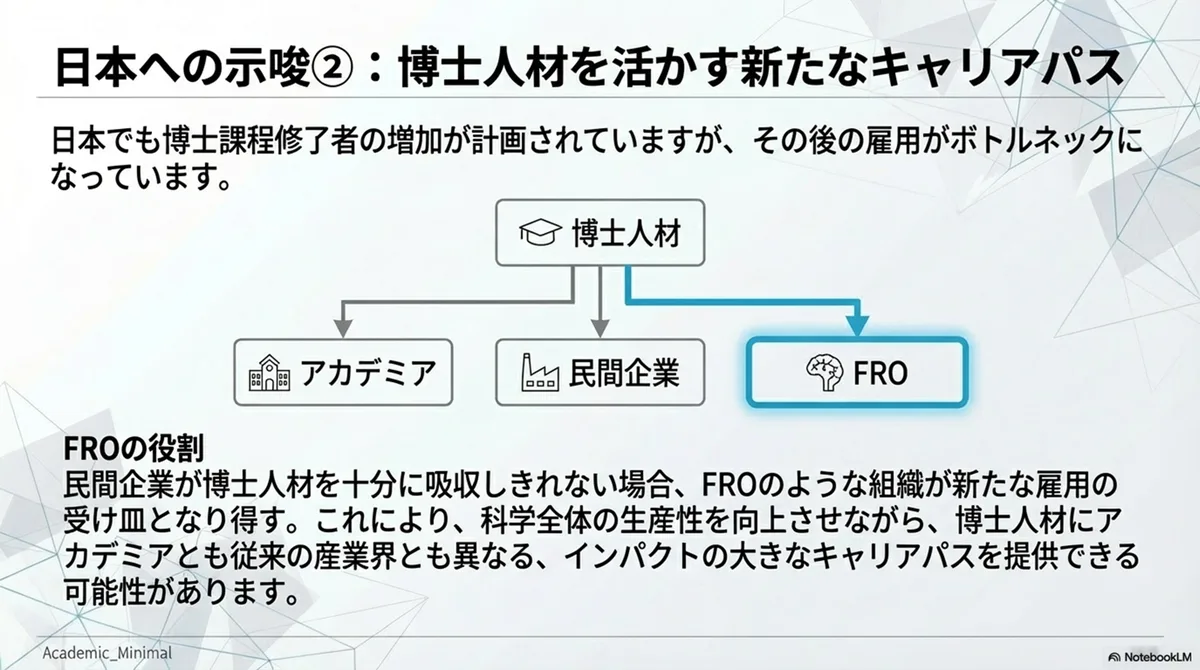
In addition, an expansion of doctoral programs is being planned in Japan.
In that case, however, employment after completing a doctorate tends to become a bottleneck. If the private sector cannot absorb enough of them, creating FRO-like organizations could serve as a place to absorb that employment, and it seems they could offer a route to different career paths while improving the productivity of science as a whole.
I also hope that such organizations will have a good influence on startups.
From that perspective, this article was meant to introduce the FRO, also called a "nonprofit tech startup."
Slides by NotebookLM