Why Metascience for R&D Funding Matters
This article was machine-translated from Japanese by AI (Claude). It may contain errors. Read the original Japanese article.
Troubling news about Japan's research capacity keeps coming. In the ranking of highly cited papers (Top 10% adjusted papers), Japan stays at 13th place on the 2022–2024 average using fractional counting, and the share of time university faculty spend on research has also been declining over the long term. There are encouraging changes, such as the number of doctoral program entrants rising for the third year in a row, but many challenges remain in the research environment.
And this kind of discussion most often ends up, in the end, as a question of money: "how much should we increase research funding?"
I also believe the total amount of research funding matters. With that as a premise, what I want to address in this article is another factor that shapes outcomes alongside the amount: the design of "how" research funds are distributed.
Every year in Japan, a large amount of public money is allocated to research as competitive funding and as operating grants. Design choices such as "what purpose to set," "how many reviewers are needed," "how much to give per project, and for how many years," and "how hard it is to apply" change both the burden of applying and reviewing and what researchers are able to take on. Improvements have been made in Japan, for example through the reform of the KAKENHI review system and its evaluation, but my concern about how funds are distributed is that there may be room for further improvement beyond that.
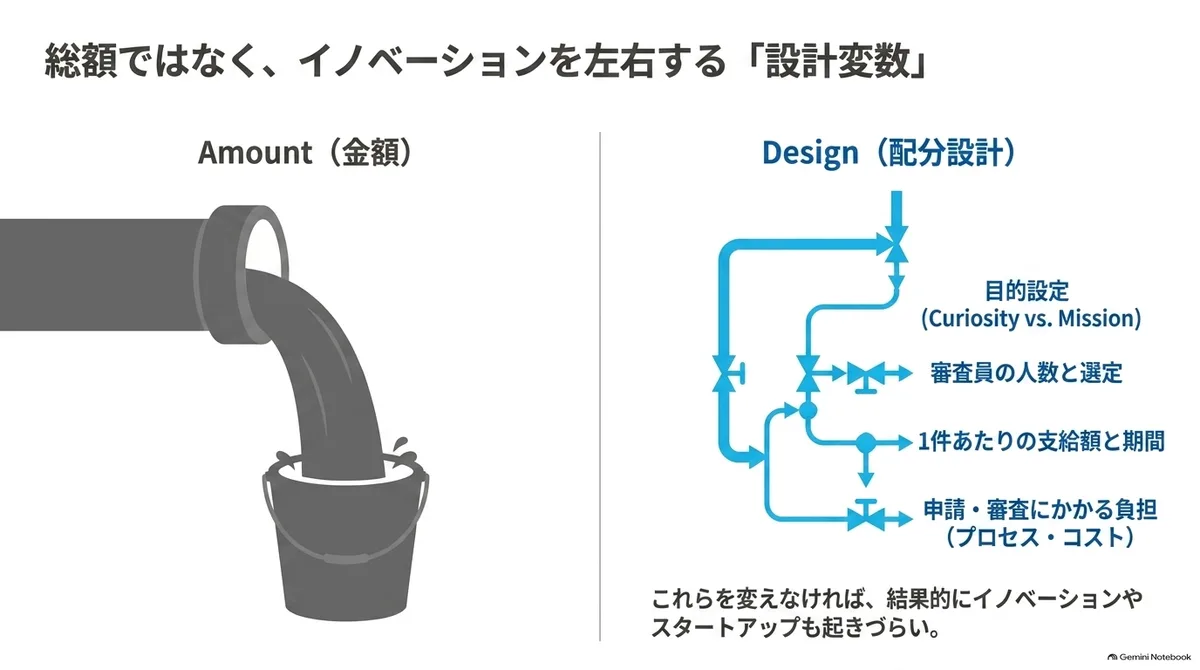
I say this because I myself have been involved in various funding programs as a reviewer, and have supported startups and researchers applying for subsidies and grants. What I strongly felt there was this: unless the way funds are distributed and the review mechanisms themselves change, we cannot deliver enough funding to research that could produce major results, and as a result innovation and startups may also be slow to emerge.
With that concern in mind, I have written about random funding, innovation in grant review, and diversifying innovation policy, among other topics. And recently, new developments in this area have been following one after another, both in Japan and abroad.
Growing attention to metascience
The field that studies how science is conducted and the systems that support it is called metascience (research on research). How research funds are distributed is one of its subjects. It is a research area with a long history of accumulated work, but in the past few years, governments and funding agencies have increasingly begun running experiments themselves.
For example, the UK established a Metascience Unit spanning the government and UKRI in 2024, and is running experiments on review methods and other matters. Its first-year report in 2025 examines, among other things, shortening review times and the degree of agreement among reviewers' evaluations.
Science: A New Golden Age, published in 2026 by the US Office of Science and Technology Policy (OSTP), proposes that each federal science agency have a metascience unit that experiments with funding programs. The NSF has also announced the X-Labs program, which supports independent research organizations, seeking to broaden the forms that R&D-performing organizations can take.
In Japan, the Ministry of Education, Culture, Sports, Science and Technology (MEXT) has started SPReAD, which introduces supplementary use of AI and random selection into review. For fiscal 2027, a budget request of 500 million yen has been submitted for CATALYST, in which researchers and government officials collaborate to study new methods for science and technology policy. And beyond government offices, there are also volunteer-led efforts such as the Metascience Study Group.
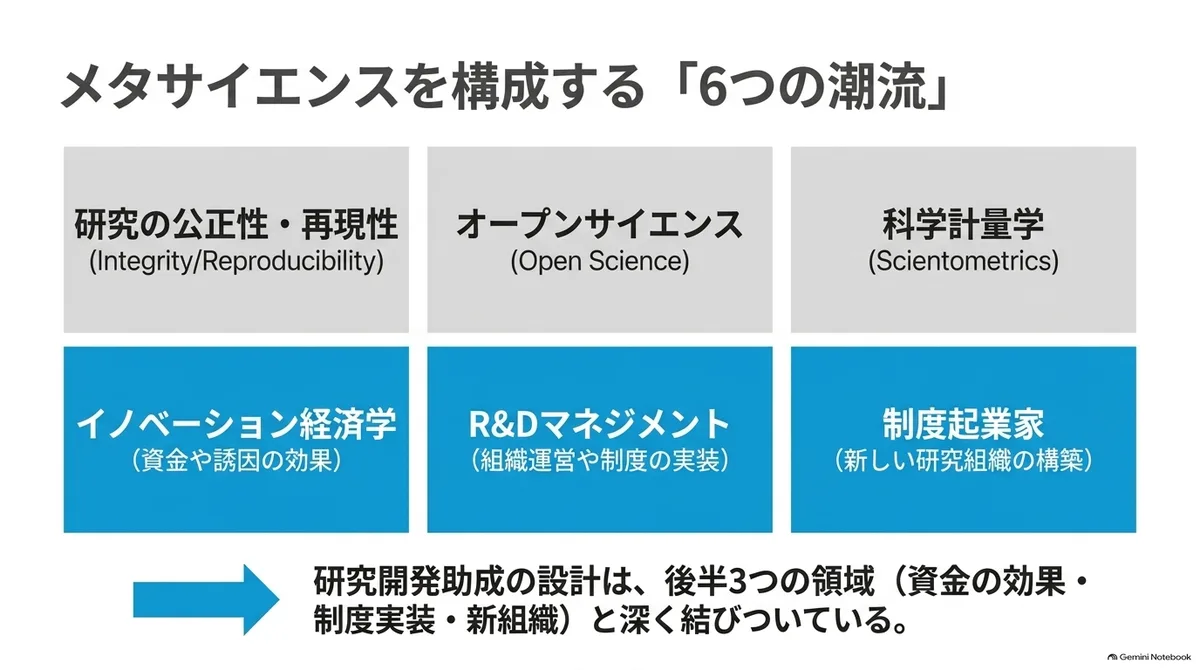
The Institute for Progress (IFP) has also recommended establishing metascience units at science agencies. Caleb Watney and Jenn Gustetic, who are connected with IFP, organize metascience into six camps.
They are: (1) research that improves the integrity and reproducibility of research, (2) open science that promotes the disclosure and sharing of knowledge, (3) scientometrics that measures scientific activity and outputs, (4) innovation economics that examines the effects of funding and incentives, (5) R&D management that studies how research organizations are run and how institutions are implemented, and (6) the work of institutional entrepreneurs who create new research organizations. Research on funding is closely related, in particular, to the latter three.
In this article, I briefly summarize my personal views on "why metascience matters for Japan today," particularly from the perspective of R&D funding.
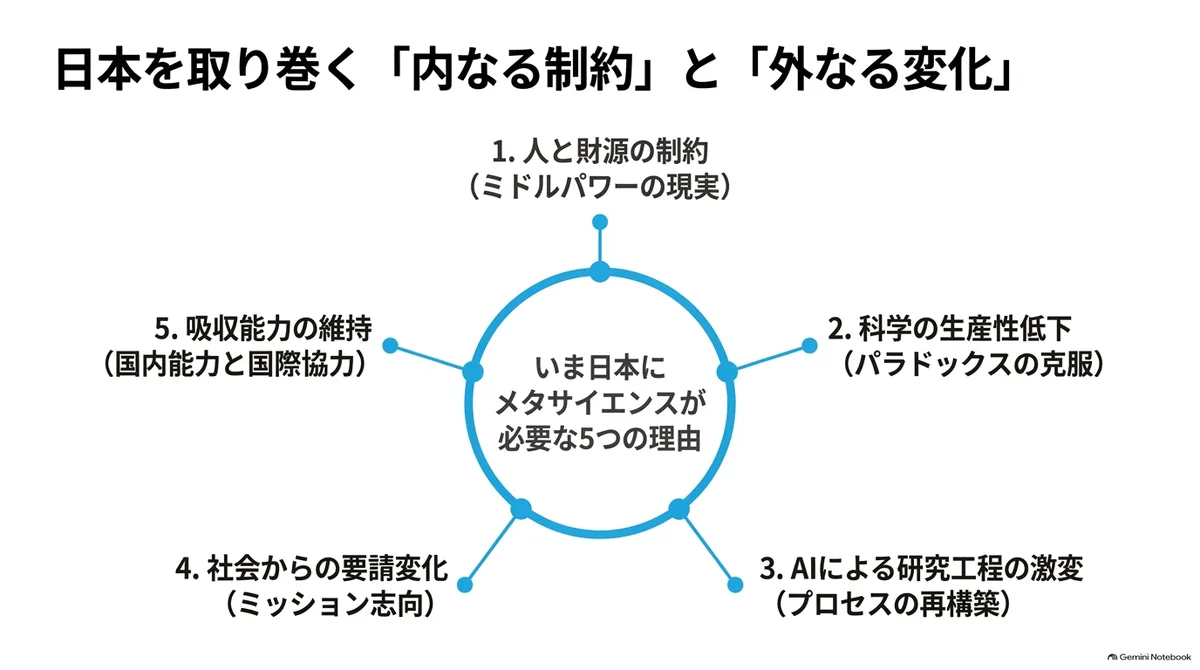
Reason 1: To achieve more results within constraints on people and funds
It is becoming increasingly difficult for a middle power like Japan to compete with the US and China in every field. Fiscally, it is hard to invest at the level of the US and China, and the working-age population, the pool of potential contributors in the first place, will also decline in the years ahead. This means that, besides expanding domestic research funding, it becomes ever more important to decide how to allocate limited people and funds, while also securing funding from science foundations and others abroad and bringing in talent from overseas.
If resources can be allocated effectively, the same amount of money may produce more scientific results. That is precisely why I think Japan, with its limited resources, needs to consciously explore ways to produce more results from the same input of scientific resources.
Efforts such as metascience are important here. It becomes important to keep putting forward proposals for improvement on the question of what kind of allocation can produce more results while reducing costs.
Research funding in particular is not only money that can be spent directly on scientific research. It also includes the costs of the review and administration processes (including outsourcing fees for operations). Even if total research funding increases, if most of it is absorbed by higher administrative costs and by outsourced consulting firms, the research funds left in researchers' hands may not change.
To keep that from happening, I believe that working out how research funds can be used well is a pressing issue for Japan.
Reason 2: To raise the productivity of science
The above was mainly about Japan's circumstances, but science as a whole currently has problems too.
The problem that increasing inputs into research yields progress that does not keep pace is also pointed out abroad. Research by Bloom and colleagues showed that, across multiple industries and technologies, rising research inputs and falling research productivity are occurring at the same time. OSTP's 2026 report also treats diminishing returns on R&D investment as a problem and asks anew whether institutions fit the research challenges.
It is possible that the research challenges themselves are becoming harder, so the way funds are distributed cannot be said to be the only cause, but by allocating resources in a form suited to today's scientific challenges, we may be able to produce more results.
For example, giving individual researchers free money over a long period may produce more results. On the other hand, there will also be cases where a time-limited team given a specific mission is better.
ARPA-E of the US Department of Energy (DOE) is an agency that supports high-risk, transformative energy research that is hard to support through conventional mechanisms. As for the organizations that carry out research, there is also an approach called the FRO (Focused Research Organization). I think NSF's X-Labs also has an idea close to the FRO in that it tackles challenges with independent, dedicated teams.
Arrangements such as universities and national research institutes were also, in a sense, "inventions" for capturing the externalities of society at the time. But today each of them is being asked to take on broader responsibilities than when they were invented, and it seems we are approaching a time to review their roles. Depending on the case, I feel it would be better to keep in view, for example, unbundling the university.
Beyond the form of organizations, the question of what form allows the greatest scientific results when the same funding is given is becoming a challenge for science as a whole. I believe there is some significance in Japan contributing to this, or in producing more scientific results from Japan by finding better answers, and for that, it seems to me that the need is growing to look at the practice of science and technology research itself from a meta perspective, rather than simply increasing the amount of funding.
Reason 3: AI may change the research process
As a more contemporary challenge, there is the possibility that the research process will be transformed by the emergence of a new tool, AI.
Currently, issues such as writing papers and peer review are raised, but if AI is introduced from here on as a general-purpose technology like electricity, assisting intellectual work, the methodology of science could change significantly.
The introduction of electricity into the scientific research process about 100 years ago changed the research environment, including lighting and cooling, and made operations such as electrolysis possible. Oscilloscopes, electron microscopes, and the like expanded the phenomena that could be observed and the ways of measuring. Later, the development of computers advanced complex analysis and the automation of experiments. (For the history of engineering, ETHW's explanation is also a useful reference.)
AI may well be one such tool. I think it is quite likely that the research process will change greatly not only in science and engineering but also in the humanities and social sciences. And one could say that finding the best methods for this is exactly what is being asked at the meta level of science right now. It might even turn out, for instance, that giving everyone ChatGPT Pro produces more results.
However, this is not merely a matter of making the conventional process more efficient; it is also important to think at the level of organizations. I explain the use of AI in business organizations in other blog posts and elsewhere, and science is the same: even if AI can propose promising experiment candidates in a short time, if the equipment is fully booked or there are not enough people to operate it, the number of experiments that can be run may not increase. In that case, allocating resources so that additional research funds go to running shared facilities and hiring technical staff could advance research as a whole, which would be better for the whole system.
And when having researchers use AI, we also need to think together about who operates the equipment and how to provide the necessary computing resources and data. When one step gets faster, the resources needed for other steps increase, so the appropriate allocation changes too. For example, just as OSTP proposes investment in verification infrastructure, as AI spreads we also need to raise our capacity to verify results.
We need to think not only about using AI in individual research steps but about how to accept it into the science and technology research process as a whole. I think a meta perspective is needed there too, and that experimental resource allocation is needed.
Reason 4: Changes in the weighting of research
In addition to changes inside science, what society asks of research is also changing.
In a survey conducted in 68 countries in 2022–2023, there was a gap between the priorities for science that respondents wanted and the priorities they felt science was emphasizing. Also, trust in scientists in Japan is 3.37 on a five-point scale, below the survey-wide average of 3.62.
If various shortages continue in Japan going forward, and science and technology are not contributing to such problems right in front of the public, trust in science may fall again, and the budgets allocated may decrease accordingly.
In parallel, governments in many countries have recently been moving toward mission-oriented innovation policies aimed at achieving societal goals. The reality is that not only curiosity-driven research by researchers but also mission-driven research is being called for from various perspectives.
I think curiosity-driven research by scientists will continue to be necessary, but considering that the public R&D funding addressed in this article is supported by taxes, I also think it is important to respond to such societal demands.
So how to manage that mission-oriented research well still seems to be, in every country, at the stage of groping for answers. This too becomes a subject for experimentation and improvement.
Reason 5: Distributing domestic research capacity and international cooperation
As I said in Reason 1, if we think of Japan as a middle power that does not assume conducting the largest-scale research in every field, it cannot do everything. That is exactly why it needs to hone its own strengths while dividing the work with various countries. On the other hand, if it sets priorities too sharply for that reason, it may lose its absorptive capacity.
Absorptive capacity, in management studies, is the ability to recognize the value of external knowledge, take it in, and put it to use. Its formation depends on the knowledge one has accumulated oneself. If we extend this idea to Japan's science and technology strategy, then in order to use technology from abroad, developing researchers and engineers domestically is also an important aspect. As the United States is now struggling to revive its manufacturing industry, a capability once lost is not guaranteed to return even if a considerable sum is paid later.
On the other hand, if allocations to existing research become fixed, it may hinder entry into new research directions. There is a study showing that in US life sciences, after the death of a prominent researcher, papers increased from researchers with no co-authorship ties to that person, especially from entrants from outside the field. It is not a result that directly shows the effect of changing funding allocation, but entry into new research directions is also an issue I would like to consider in allocation design.
This is precisely an allocation problem, and one that is hard to capture with paper counts. How much to invest in such capabilities and what to verify is, I believe, highly meaningful to re-examine now, as the conditions for international cooperation change.
Resource allocation is strategy
We have looked at several reasons so far.
Science today is undergoing change from intrinsic factors and also from extrinsic threats. To continue and increase public research investment going forward, it is important how we change the process of science itself to produce results and build trust, and I think the method of funding allocation can be a major variable for that. (※However, producing results does not automatically earn political confidence, so other means are needed alongside results.)
According to Chandler's classic definition, strategy is "the determination of the basic long-term goals and objectives of an enterprise, and the adoption of courses of action and the allocation of resources necessary for carrying out these goals." Resource allocation is part of strategy, and the allocation of resources in science is likewise an important matter that shapes a nation's science strategy.
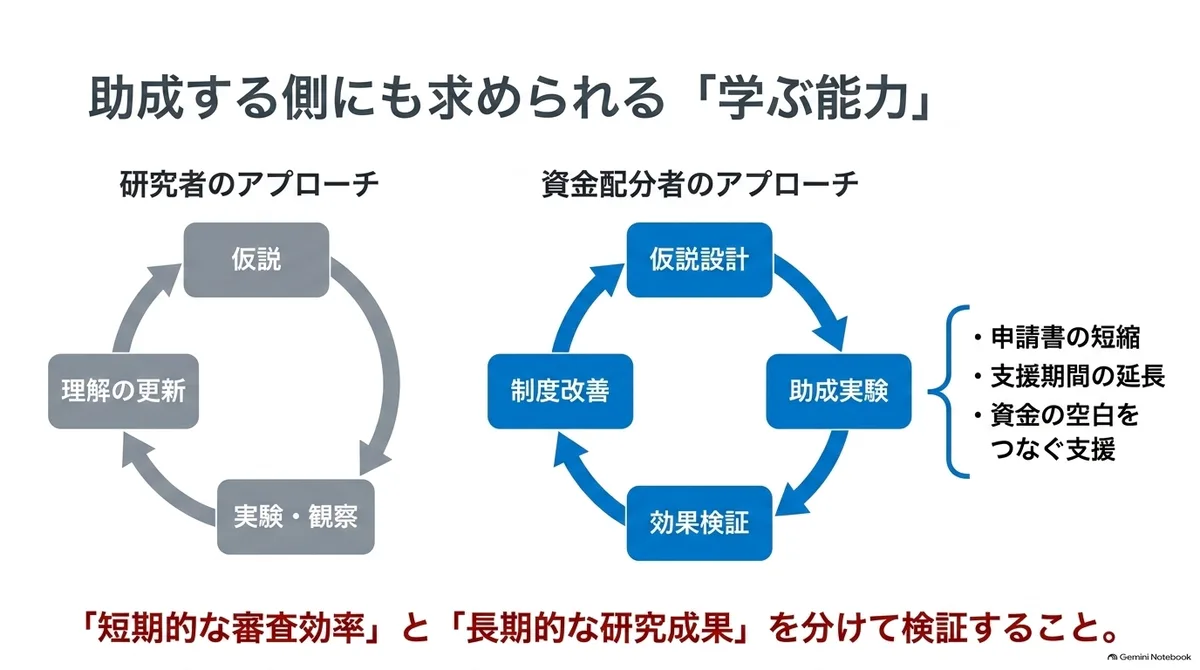
And when expected results are not achieved, just as researchers are asked for the reasons, those who allocate funds also need to examine their conditions of support.
Just as science updates understanding through hypotheses, observation, and experiment, the institutions that support science should be able to adopt the same method. What is called for are experiments that try shorter applications, longer support periods, and support that bridges funding gaps, and then feed the results into the next design. In doing so, I believe that, including the costs of experiments and evaluation, we need to verify short-term review efficiency and long-term research outcomes separately.
A time of such change is also a time when the right answers change. That is why the ability to learn matters for those who support research as well. I think what is truly important right now is for Japan to cultivate mechanisms that let those who allocate funds verify their own methods and keep improving.