Thought and Capital 4 | How Thought and Capital Missed Each Other in Japanese Startups
This article was machine-translated from Japanese by AI (Claude). It may contain errors. Read the original Japanese article.
In 1971, Tadao Kiyonari, Shuichiro Nakamura, Koji Hirao and others published "Venture Business: Small Giants That Sell Brainpower." Drawing on the Venture Capital that was rising in the United States, the book gave a name to a new kind of knowledge-intensive company, one that competes on its research and design capabilities and differs from the traditional small and medium-sized enterprise. The Japanese-made English term "venture company" spread from here. Two years later, in 1973, Nippon Godo Finance, today's JAFCO, was founded, and in the first half of the 1970s Japan saw what is called the "first venture boom."
It was in the first half of the 1970s, the years of the World Expo, that Japan learned the concept of the startup and began building institutions for risk money. This is almost the same period in which, as we saw in Part 3, US VCs began to put their own institutions in place.
Yet Silicon Valley then pulled far ahead. Japan had entrepreneurs, VCs were beginning to appear, and there were people writing thought. So how did thought and capital come to miss each other in Japan?
This article is Part 4 of the series "Thought and Capital." Part 3 looked back at the United States from around 1970 and followed the process by which, in recent years, players who carry both thought and capital have emerged. This time I look at Japan over the same period, mainly from the viewpoint of startups, from the 1970s to the 2010s.
Let me define my terms once more. As in the earlier parts, thought means a framework of thinking that combines a "map" of how to understand the history, present and future of society and its mechanisms, a "yardstick" of evaluation criteria for what to prioritize and what not to allow, and a "course" of direction and action plan for how to change society. A conception is that thought turned into a plan that can be executed in a particular place. Capital refers to financial commitments that bind future resource allocation, such as equity investment and public budgets, and does not include payments for past work, such as manuscript fees or commissioned-work fees.
Venture Business Theory and the First Boom of the 1970s
The concept of "venture business" can be described as an attempt to discover a new type of company and explain its social meaning. And the concept actually moved capital.
The Kyoto Association of Corporate Executives gave rise to an investment company, Kyoto Enterprise Development (KED), which invested in Nidec in the year after its founding (1974). Nippon Godo Finance (now JAFCO), which we saw earlier, was also established with joint investment from Nomura Securities, Nippon Life, Sanwa Bank and others.
The effort to name a new type of company "venture company," to legitimize entrepreneurs, and to connect them to policy and finance took shape almost at the same time the concept was proposed. In a sense, thought reached capital, and capital moved.
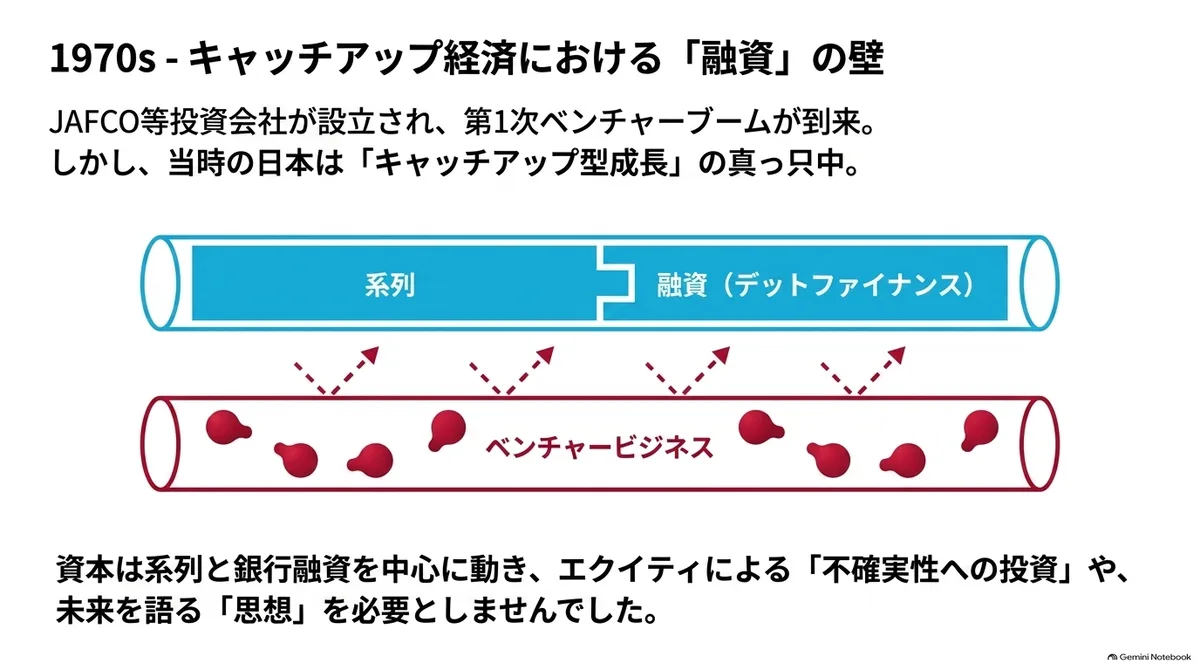
If there was a major difference from the United States, it was that many of the VCs that emerged were affiliated with banks or securities companies. JAFCO itself at the time made loans as well as investments, and grew within its relationships with existing financial institutions. Capital is pressed to speak of thought when it competes for investors and entrepreneurs through thought. Japanese VCs, whose funds and investees both came from within corporate groups and business relationships, had no such need. Investment decisions were also made in the language of corporate evaluation centered on debt finance, and there was limited room for the function of equity that converts a future story into share value.
Still, in light of the goal of the time, catch-up growth, this also seems to have been a rational choice. The strength of Japanese companies then was to follow the cutting-edge businesses of the West, make use of the huge "mother market" of Japan, and overtake latecomers' positions with relatively cheap labor and process-improvement techniques. A business in which independent VCs invest equity in the uncertainty of the earliest stage of a company was not in demand, and for existing companies, funding routes other than equity were working, such as bank loans, policy finance, and shareholdings within corporate groups.
The concept of "venture business" tried once to connect to equity-type capital, but it receded amid Japan's environment, where debt finance was strong, and the turmoil of the oil shock (1973).
The Second Venture Boom of the 1980s
Enthusiasm returned in the 1980s. From the early to the middle of the decade the second venture boom occurred, and distribution and service companies such as HIS, SoftBank and CCC were founded. Whereas the venture business theory of the 1970s mainly tried to capture research-and-development-type companies, the entrepreneurs of this period started from markets close to consumers: travel, the distribution of personal computer software, and rental.
The mechanisms of capital also advanced. JAFCO established Japan's first venture fund in 1982. In 1983, a new over-the-counter stock market that would later lead to JASDAQ was launched. Somewhat behind the United States, which had opened NASDAQ in 1971, Japan too was starting to see, in addition to investment companies investing and lending on their own account, a mechanism that gathered funds from multiple investors, distributed them to unlisted companies, and recovered them through listing.
During the same period, as we saw in Part 1, on the government side, visions of the future of society and industry were also being written. The Fifth Generation Computer Project, which began in 1982, received about 54 billion yen over eleven years as a national project led by the Ministry of International Trade and Industry. In The Knowledge-Value Revolution in 1985, Taichi Sakaiya likewise described a society in which knowledge and novelty are valued more than the quantity of material goods.
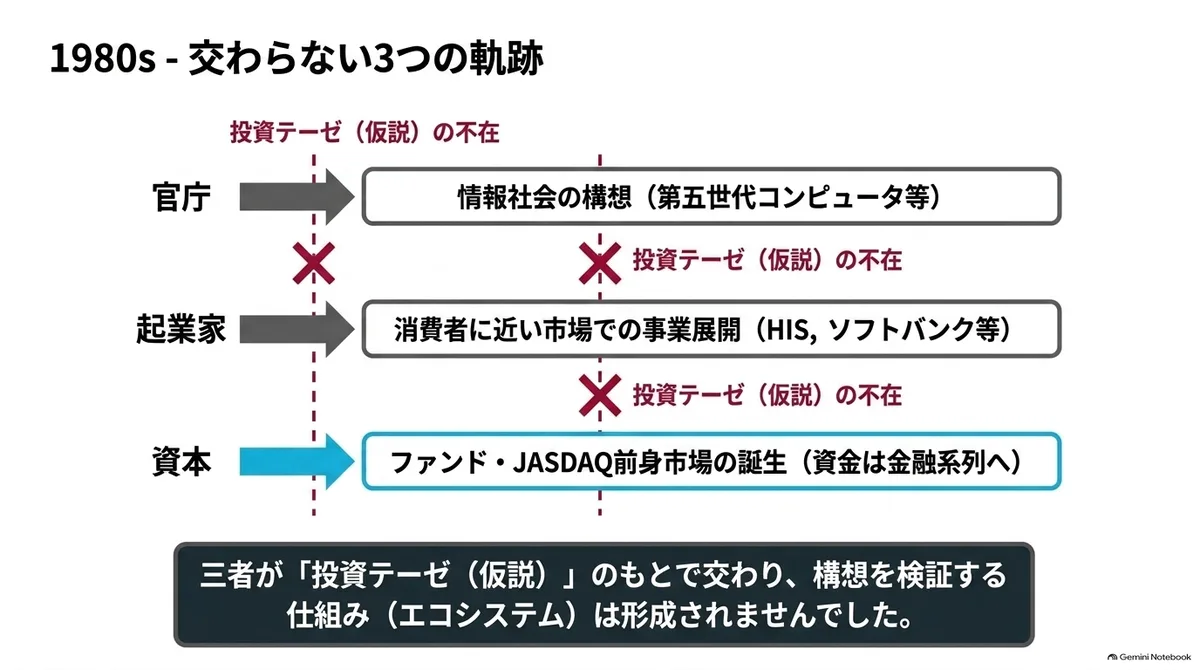
However, the three movements of social vision, entrepreneurship, and the expansion of VCs went along separate paths. The vision of the information society flowed mainly to government agencies and national projects, the entrepreneurs' visions to their own businesses, and VC money into the screening and business relationships of financial groups. The three did not meet under an investment thesis, that is, thought translated into hypotheses for investment decisions, and multiple capitals did not come to test and rewrite the vision.
With this separation left in place, Japan headed toward the collapse of the bubble. While interest rates were raised five times from May 1989 to August 1990, stock price indexes hit their peak at the end of 1989 and then fell sharply as the 1990s began.
Institution Building in the 1990s and Business Opportunity as a Common Language
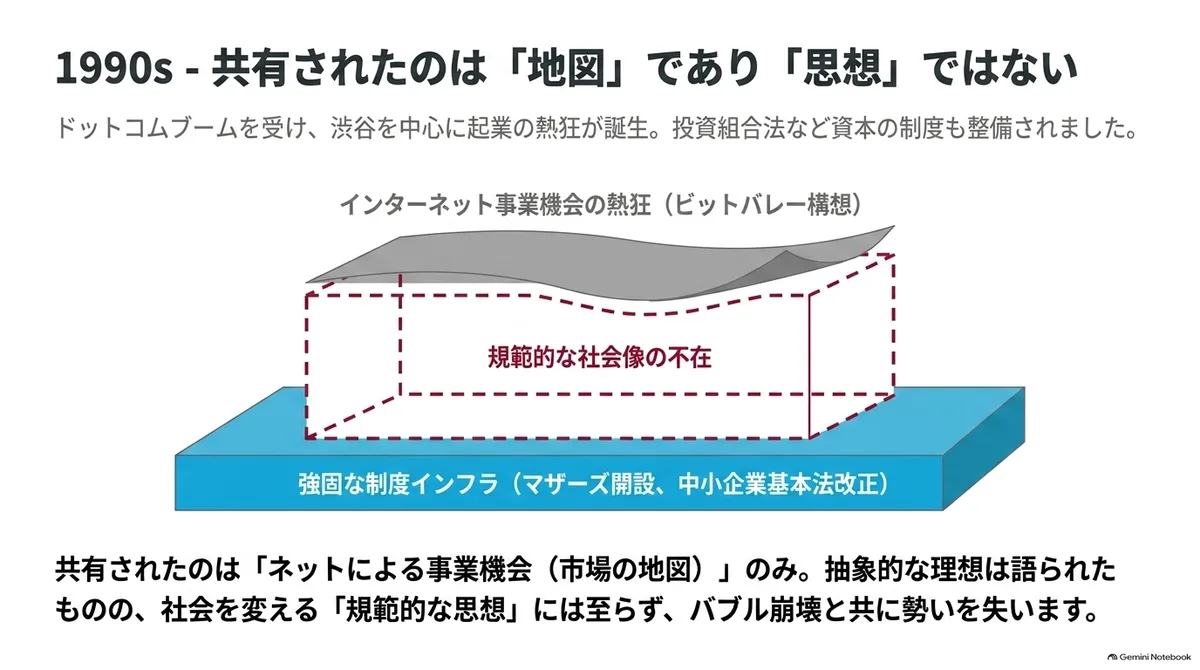
In parallel with cleaning up after the bubble, Japan began to build institutions for entrepreneurship and risk money again. In 1995 the Act on Temporary Measures to Facilitate the Creative Business Activities of Small and Medium Enterprises was enacted, and in 1998 the Limited Partnership Act for Investment and the TLO Act were put in place. In 1999 came the revision of the Small and Medium Enterprise Basic Act and the opening of Tokyo Stock Exchange Mothers, and in 2001 the plan for 1,000 university-originated ventures began. It was a series of policies that repositioned small and medium-sized enterprises from objects of protection to bearers of innovation and company creation, set up the legal form of the investment partnership, promoted technology transfer from universities, and created a market for exits.
Around then, in response to the US dot-com boom, Kiyoshi Nishikawa, the head of NetAge, put forward the "Bit Valley concept," a cluster of internet companies formed centered on Shibuya, and expectations for a new age of entrepreneurship spread.
Bit Valley may seem like a single body of thought, but the center of the shared language seems to have been business opportunity, that is, a map of the markets the internet would open up. Non-monetary norms such as "put the users' happiness first" and "keep the happiness of the whole world in view" were also spoken of, but all were abstract words, and it was difficult to see a normative picture of society in them. But the same was probably true of Silicon Valley in the same period, which was caught up in the dot-com bubble.
Then, beginning with the sharp fall of the NASDAQ market in March 2000, the US dot-com bubble burst, and Japan's Bit Valley also lost its momentum.
In the United States, as we saw in Part 3, activity then revived with the IPOs of Google and others, and VCs who translate thought into investment theses also grew. In Japan at that time, a different movement was coming into view.
Thought and Capital Missing Each Other in the 2000s
Although movements on the capital side slowed in Japan, in the 2000s a movement emerged from the side of criticism to approach the design of the information society. From 2004, Hiroki Azuma led ised (Interdisciplinary Studies on Ethics and Design of Information Society) at GLOCOM of the International University of Japan. Participants spanning research, technology, policy and criticism gathered, including Ken Suzuki, who would later co-found SmartNews, and they discussed the design of the information society in the language of criticism. It was a pioneering venue in the Japan of the internet age.
The results of the study group remained mainly as web serials and books. But the people who read the discussions and the people who allocated capital to multiple businesses in line with the discussions went on as separate people.
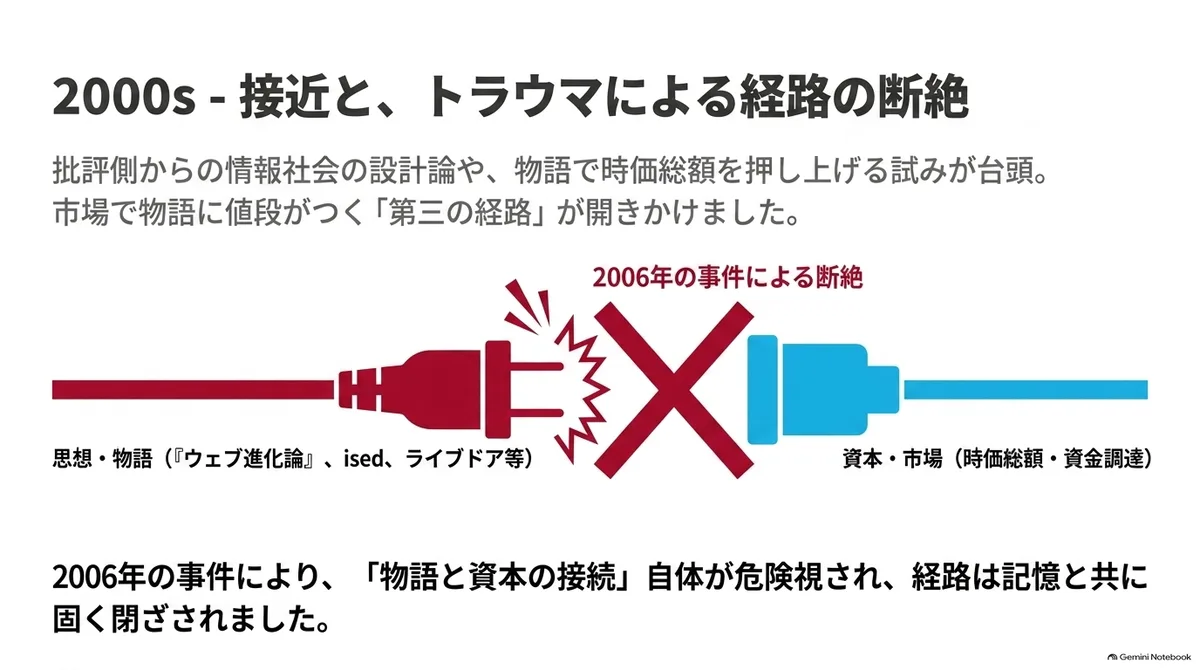
On the market side, too, a connection nearly happened. In 2006, Mochio Umeda's "Theory of Web Evolution" was read by more than 350,000 people, and some entrepreneurs said they entered the world of the web because of this book. A route by which thought proclaiming a future image of society changes people's career choices and leads them to start businesses had begun to open (though Umeda himself said in 2009 that "Japan's web is disappointing" and distanced himself from the field).
Meanwhile, a route by which stories directly move capital was also about to open, in a rough form. Livedoor's management, which pushed up its market capitalization with stories and repeated acquisitions with its own shares, seems to be one symbol of it. But in 2006, the Livedoor and Murakami Fund incidents became social problems, and the very connection between story and capital came to be viewed as dangerous. Just as a route came into view by which a story could be priced in the market, relying on neither corporate-group ties nor government budgets, that route closed along with the memory of the incidents.
ised left discussions of institutional design, and "Theory of Web Evolution" changed its readers' choices. But neither produced a shared market vision that multiple capitals could use.
People Who Carried Both Thought and Business Appeared in the 2010s
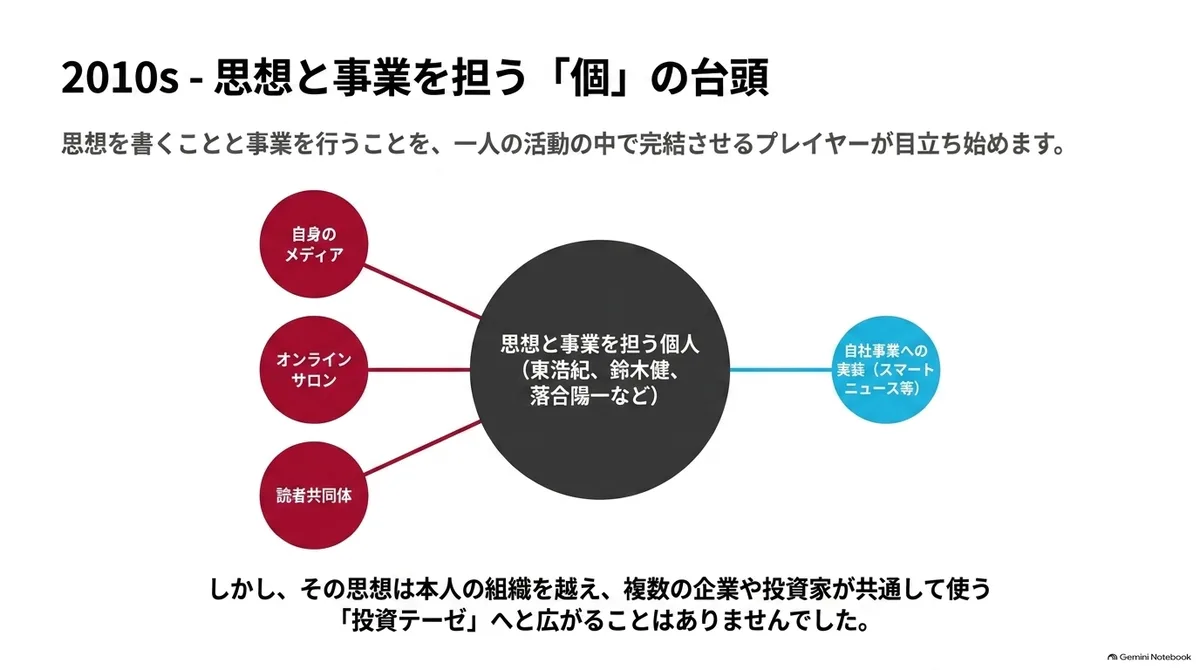
Then in the 2010s, people who carried out writing thought and running a business within the activity of a single person became prominent.
Hiroki Azuma founded Genron in 2010 and, running thought as a business of publishing, events and education, has kept writing images of society, from "General Will 2.0" (2011) to "The Philosophy of Correctability" (2023) and "Peace and Folly" (2025). Ken Suzuki, who had taken part in ised, co-founded SmartNews while conceiving mechanisms of money, voting and governance in "The Smooth Society and Its Enemies" (2013). Yoichi Ochiai also pursued research and business together with worldviews set out in "The Century of Magic" (2015) and "Digital Nature" (2018).
What was distinctive here was that two forms appeared at the same time: people who write thought having their own media and community of readers, and people who start companies themselves and move part of their thought or research into business.
For example, in addition to Genron's publishing, events and Genron Cafe, Azuma runs a streaming platform, Shirasu. Ochiai also built a community of continuing readers and participants through an online salon. Subscription and membership fees became income that allowed the work of writing thought to continue, and also became a route for writers to reach readers without going through publishers or broadcasters.
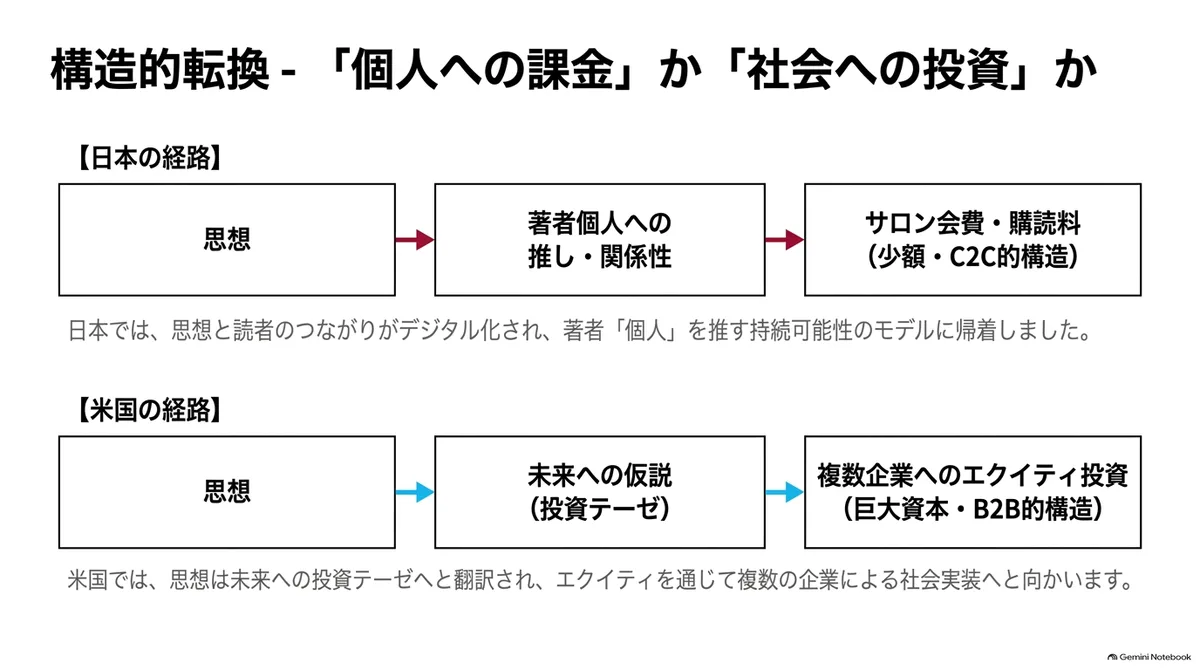
In the critics' circles we saw in Part 2, evaluation and compensation gathered around the name of the individual critic. Streaming and online salons digitized this relationship, thickening the bond between writer and reader and making it possible to exchange money directly, without a publisher in between.
Here, the bond between writer and reader appears as support for the person, not for the person's way of thinking (thought). Equity invests in thought and in the future. Subscriptions and salon fees, on the other hand, remain payment for a relationship with the author. Thought and the flow of money became connected, but whether that was in a form that could be called capital is where Japan and the United States differed greatly, one might say.
Of course, there were also examples that connected thought to business and capital, such as Ken Suzuki's SmartNews and Yoichi Ochiai's Pixie Dust Technologies. In both, thought and research entered the company's own business policy and took shape as a business that received capital. But examples in which thought went beyond the person's own organization and spread into an investment thesis used by multiple companies and investors were limited.
Movements on the Investor Side in Japan in the 2010s
In the US VC media we saw in Part 3, capital paid the cost of producing thought, and investment theses led to discovering entrepreneurs, recruiting talent, and investing in multiple companies. This is because they are in a competition to win investors and entrepreneurs through thought. There is the problem that they are bound by the fund's term and that the futures they talk about lean toward those that can be recovered as rising share prices, but even so, thought is translated into the fund's investment decisions and distributed to multiple businesses.
Japan too had examples, like Suzuki and Ochiai in the previous section, of trying to connect thought and capital on one's own. But such connections remained few and did not spread enough to become a common language across multiple companies and investors beyond a single organization. Media run by domestic VCs also appeared in the 2010s, but articles introducing maps of markets written in Silicon Valley stood out. This was probably because one could invest by importing maps already validated in the United States, without writing one's own theses.
Organized this way, it becomes clear that it was not that Japan lacked people who bet on thought. But thought was not connected to capital; it remained within connections to its author as an individual, or within the individual's own organization. A movement in which other investors would take on risk independently, treating someone's thought or conception as a hypothesis, and develop it into investment decisions did not thicken.
The investor who, as an exception in this flow, kept translating his own map into investment decisions is Masayoshi Son. Under a single map, the "information revolution," he has reorganized SoftBank's businesses and investments over several decades. From software distribution to acquiring telecommunications businesses to investing through large funds, the targets changed, but the map that information would move to the center of society, and the course of betting ahead of the curve, remained consistent. The Vision Fund can be called the greatest example of a map moving capital.
On the other hand, what Son often spoke of were economic goals such as "to make a company whose sales can be counted in trillions, like a tofu maker counts tofu by the block." If you ask whether a new norm is contained there, it rather seems that he uses the norms of capitalism as they are. Perhaps it was because it was a map that brought in no new yardstick that it could move capital on this scale for so long.
The Few Connections Stayed Inside Individuals and Organizations
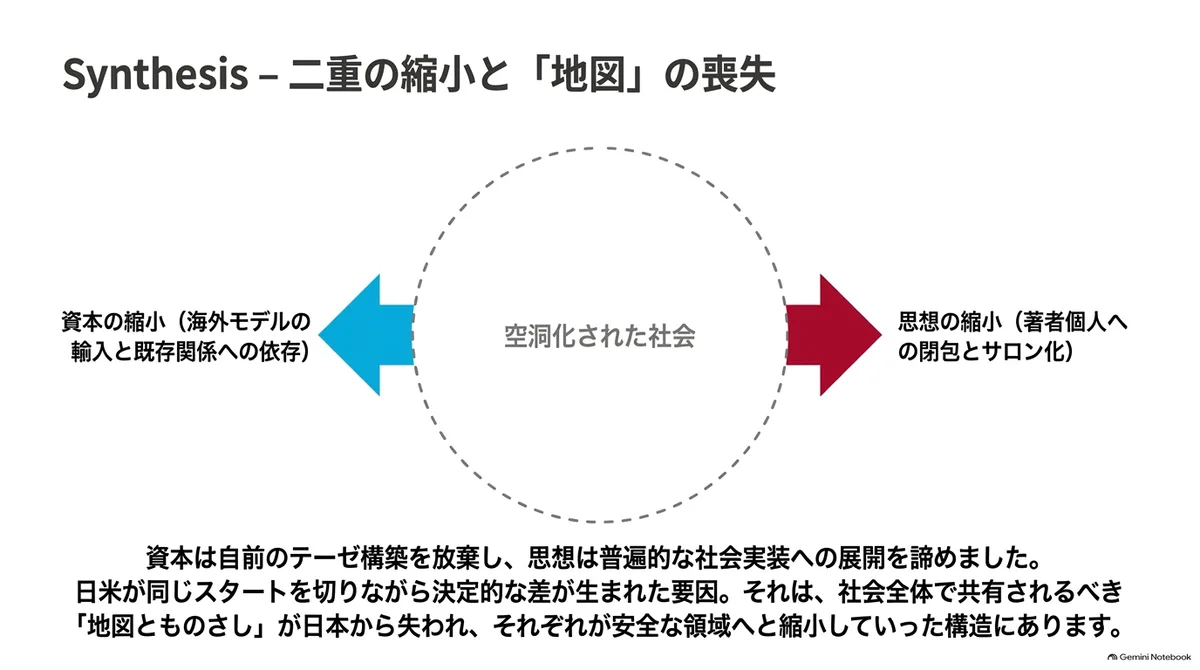
The missed connection we have seen so far can be restated from the standpoint of each of thought and capital. On the capital side, it could import maps of markets written overseas, so it did not need Japanese thought. Also, the third route, in which a story is priced in the market relying on neither corporate groups nor the government, stayed closed along with the memory of the 2006 incidents. And what the thought side found in the 2010s was not a connection to capital but routes such as salons that convert the relationship with the author as an individual into money. Fees and subscriptions made the work of speaking thought sustainable, but they did not extend to hypotheses usable outside the person, or hypotheses that would change society.
Meanwhile, on the government side, as we saw in Parts 1 and 2, visions of the future of society had been translated into policy funding through government agencies and national projects. But gradually industrial policy went quiet, and the government spoke less of the future. It was, in a sense, symbolic that what the government produced and what was widely read in the 2010s was "Anxious Individuals, a Frozen State: How to Live Forward in an Age Without Models," a document that spoke of anxiety about the future.
Then why could Japanese capital avoid competing on thought, and why could the work of speaking about the future continue only in a form that backs individuals? We have seen the capital-side circumstances, such as corporate groups and imported maps, but they alone cannot explain why even the thought side headed toward individual routes. The answer probably lies in changes in society that were taking place outside startups.
So next time, I will look at the process by which, from the 1990s on, narratives of the future shrank from the unit of society to that of the individual. On that basis, I will consider why only the route in which a single individual bundles everything from story to funding grew thick, and why Japan came to entrust to Silicon Valley, rather than write for itself, its maps and yardsticks.