Thought and Capital 1 | How Capital Came to Be Separated from Thought
This article was machine-translated from Japanese by AI (Claude). It may contain errors. Read the original Japanese article.
In March 1970, the Japan World Exposition opened on the Senri Hills in Osaka.
The site was lined with Kenzo Tange's Grand Roof, Taro Okamoto's Tower of the Sun, pavilions by Kisho Kurokawa and other Metabolist architects, moving walkways, videophones, robots, and a plaza controlled by computers. Expo '70 in Osaka was not merely a trade show of products. It was an attempt to build, temporarily, an information society and a city of the future through architecture and technology.

Author: takato marui / Wikimedia Commons CC BY-SA 2.0


What I want to draw attention to here is not what was on display, but what had happened before it.
Tadao Umesao, who wrote The Technique of Intellectual Production, a book still read today, published his "Theory of the Information Industry" in 1963, before Toffler's The Third Wave. The theory caused a sensation; that same year Umesao and others launched a private study group, and the ideas spread into policy as well.
Only seven years later, the scholars who had been discussing the information society were themselves taking part in deliberations on the Expo's theme and in planning the site, and their vision had become an actual group of buildings, passing through the Expo association's plans and public budget, the exhibition decisions of companies, and design commissions to architects. A written idea had passed through the decisions of many organizations, moved money and people, and finally taken the form of a visible city.
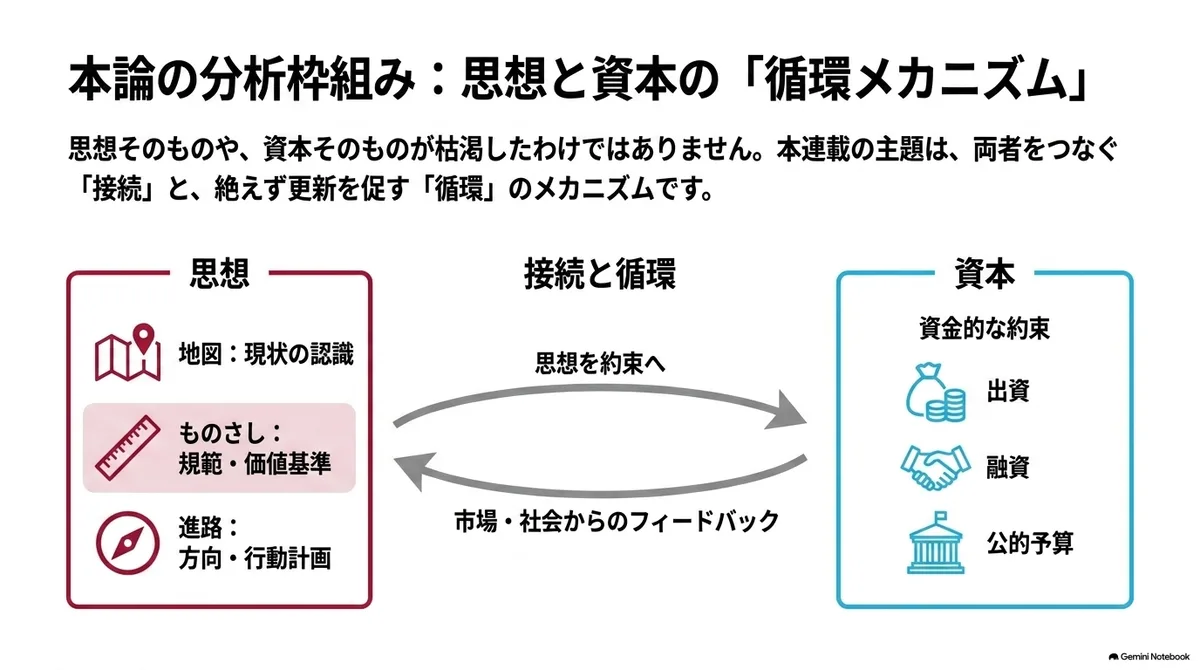
What this series, "Thought and Capital," deals with is this conversion from thought to capital. More precisely, its subject is neither thought itself nor capital itself, but the "and" in the title: the mechanisms that connect the two. In the case of the Expo, that is the chain of "commitments" that turned the scholars' vision into action, running from the theme committee to the budget, the exhibits, and the design contracts.
By thought here, as in the previous article, I mean a framework of thinking that bundles together an understanding of how society works (the map), the norms and criteria of value that decide what to prioritize (the yardstick), and a direction and action plan for changing society (the course). By capital, I mean financial commitments that bind future resource allocation, such as equity investment, loans, and public budgets.
Now, it is sometimes said that in Japan the thought that speaks of the future has declined and the power to envision has withered. This series does not take that view. Visions that draw maps and courses of the future are still being written, and when you look field by field, the mechanisms that turn visions into action are also running in their own ways.
The state has strategy documents, research and development has national projects, and regions have plans. The hypothesis of this series is that what has thinned is neither thought itself nor the mechanisms within each field, but the connections that link them, and the circulation through which thought, money, and people keep moving back and forth along the connected paths.
Of the three elements of thought, I believe that what has thinned in particular is the yardstick, that is, the practice of stating and negotiating, in public, the norms about what to prioritize. Thought flows into execution, but feedback from markets and society also returns to thought and prompts it to be rewritten, and people too circulate between the side that writes and the side that uses. This series traces back through the past the process by which this to-and-fro has thinned.
The reason to consider this question now is that the thought of the future, the capital that realizes it, and political power are concentrating in Silicon Valley in the United States.
In earlier articles, I sorted out the function of thought as infrastructure, and touched on how VCs, who hold a "mechanism for turning stories of the future into capital," are swept along by the power of that capital and enlarge their ways of thinking to a dangerous degree.
Then, in the previous article, I argued that American technology thought, which extends to the meaning of the state, governance, and freedom, is flowing into Japan through the channels of Silicon Valley and startups, and that the reason this inflow proceeds without friction lies less in the skill of the senders than in a vacuum on the receiving side, that is, a lack of Japan's own discourse about the yardstick.
But this vacuum did not arise suddenly in recent years, once the import channels had become established. It must have been built up over a much longer time. This series is also an attempt to lay the groundwork for tracing the origins of that vacuum back to the Meiji era, pinning down its causes, and rebuilding. Put differently, the underlying concern is how Japan should face this situation.
I will think through this view over four installments. In this first installment, I focus mainly on the side of capital, that is, the mechanisms that have turned thought into commitments of funds and organizations. Looking back from the Meiji era to the 1980s, I examine how the connection and circulation between thought and capital were built and what supported them.
Note that this series deals with thought that can lead to the allocation of resources or the design of institutions; it does not intend to measure the value of philosophy or literary criticism as such. Nor is it a story about the insufficient efforts of any particular camp. It is a structural story about whether society had mechanisms to turn thought, from whatever position, into commitments.
The Meiji Era: The Same People Carry Both Thought and Enterprise
Meiji Japan was an era in which thought, vision, and enterprise were continuous within the same small group of people who combined these roles.
The Meirokusha, whose members included Yukichi Fukuzawa, Arinori Mori, Amane Nishi, and Masanao Nakamura, brought together bureaucrats, educators, scholars, and public intellectuals, and through the Meiroku Zasshi spread Western concepts and institutions into public debate. Eiichi Shibusawa was involved in founding and running about 500 companies and organizations, and was also connected with about 600 organizations in social welfare, education, and international exchange. Banking, railways, papermaking, education, and hospitals, work that today would be split into separate fields of expertise, were handled within a single picture of society. The same generation simultaneously carried out a continuous series of activities: translating thought from the West, that is, the map within that thought, debating the yardstick, and carrying out the course themselves as enterprise. Because the people who wrote were the people who executed, feedback from the market in the form of an enterprise's success or failure also returned straight to the rewriting of thought, and this took place within the same people.
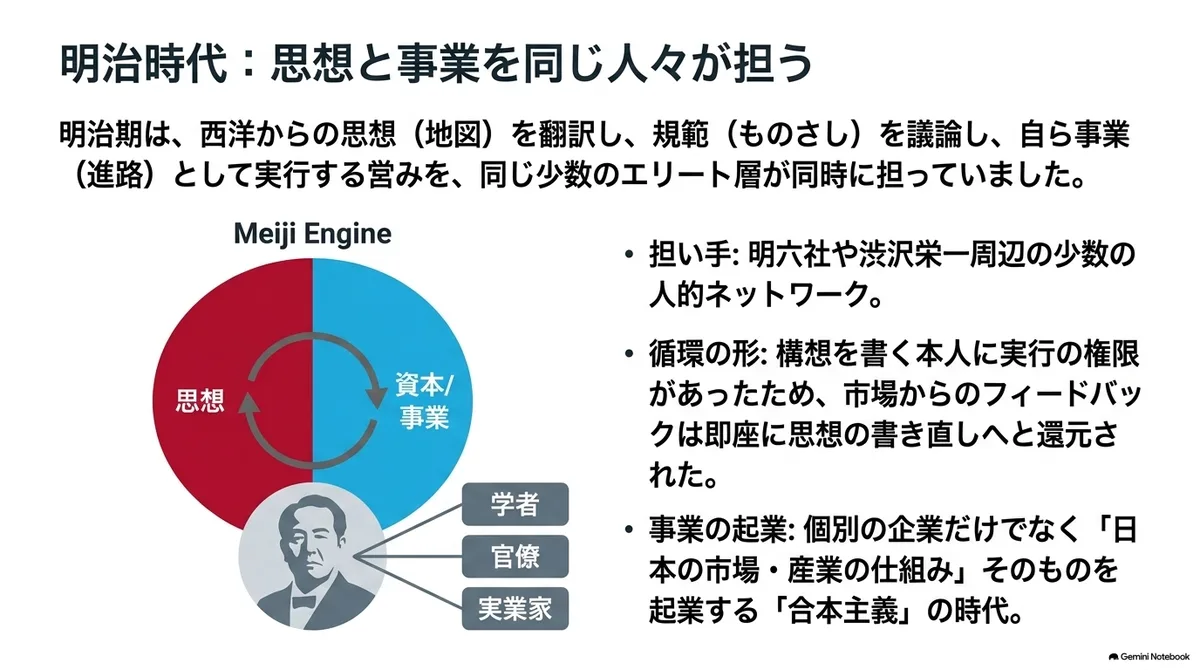
There is something I want to point out here. The practice that Shibusawa had accumulated since the Meiji period was later put into words as guidance for businesspeople in The Analects and the Abacus (1916), and it still tends to be read in that context. But what he was actually doing can also be described as founding the very mechanisms of Japan's markets and industry. The work of rooting in Japan the institutions that gather funds and distribute them to enterprises, namely joint-stock companies, banks, and exchanges, was carried out through the government's legal development and collaboration with many businesspeople, but Shibusawa was at its center. And he explained his idea of reconciling private and public interest with the term gappon shugi (the principle of combining capital).
This is somewhat different from a corporate-level philosophy or code of ethics. It is a story at the level of what markets and industries to create anew, how to make those markets function, and where to direct the growth of the nation's industry; it is a story of market vision and industrial vision.
However, we should pay attention to the environment that made this possible. The Meiji era was a period of nation-building, when the roles of institutional designers, educators, and businesspeople had not yet fully differentiated, and those who wrote visions and those with the authority to execute them overlapped within the personal relationships of a small number of male elites, such as Fukuzawa's disciples and the circle around Shibusawa. In the terms of the opening, what turned thought into commitments in the Meiji era was, alongside the company and banking systems that were taking shape, the relationships among a few people who could move across them.
Nor can this era simply be glorified. The link between thought and enterprise in Meiji was bound up not only with business and education but also with the formation of the empire and the expansion of armaments. Moreover, its bearers were almost entirely limited to a small number of male elites, and women, workers, and colonized peoples were placed outside this link.
This form, in which personal relationships serve multiple roles, differs in its conditions of emergence but can also serve as a point of comparison when considering today's American technology industry. I will take up this point again later.
The Taishō Era: The Rise of Social Movements
In the Taishō period, the actors who implemented thought in society multiplied. The universal suffrage movement and the labor movement spread, cooperatives were organized, and beyond the state and businesspeople, new bearers appeared who turned thought into institutions and daily life.
For example, Toyohiko Kagawa began with relief work in the slums of Kobe, led labor disputes, spearheaded the founding of consumer cooperatives, and is said to have poured the proceeds from his bestselling autobiographical novel Before the Dawn (1920) into the movement. The consumer cooperative whose founding he led continues today as Co-op Kobe. What I want to note here is that the road from thought to enterprise was not only the joint-stock company. Cooperatives, labor unions, and social work were also ways of turning a vision of society into funds, personnel, facilities, and day-to-day operations. This road, which builds enterprises in a place apart from both the state and large corporations, began to take shape in this period.
And what Kagawa and his colleagues built was a form of enterprise built on a yardstick other than profit, namely mutual aid. Adopt a different yardstick, and a different enterprise becomes possible.
The widening of bearers did not stop at labor and cooperatives. In 1920, Raichō Hiratsuka, Fusae Ichikawa, and others founded the New Women's Association and achieved the revision of Article 5 of the Public Order and Police Law, which had prohibited women from taking part in political meetings. This was also a time when people who had been placed outside the Meiji connection began to appear as agents changing the institutions themselves.
The widening of bearers was not limited to the side of enterprise and movements. In this period, general-interest magazines such as Chūō Kōron and Kaizō nurtured a market for public discourse, and intellectuals who made a profession of writing began to appear. The work of writing thought and the work of moving funds, which in Meiji had overlapped within the same people, began to stand as separate occupations. How this differentiation advanced after the war will be seen in Part 2, which deals with the side of thought.
In 1925, the Universal Suffrage Law (though women remained excluded) and the Peace Preservation Law were enacted in the same year. The more the connection between thought and society widened, the larger grew the question of who would control that connection. This tension would take an extreme form in the wartime period that followed.
The Wartime Period: Unification by the State
From the late 1930s through the wartime period, this widening was replaced by a different form. The Planning Board, established in 1937, tried to concentrate the authority to allocate materials and personnel in the state through production expansion plans and materials mobilization plans. The bureaucrats known as the reform bureaucrats, who gained power in this period, among them Nobusuke Kishi (later prime minister), treated industry, finance, labor, science and technology, and national land planning as a whole, and sought to bind corporate management to national goals. The historian Janis Mimura analyzes the thought of national reconstruction by these technocrats as "technofascism" (Planning for Empire; this is a lineage that is also referred to in recent discussions of technofascism in the United States). The authority that connected thought, capital, and enterprise was, at that time, most strongly concentrated in a single place.
But that connection lacked public debate and freedom of choice. The venues for comparing different visions were closed, and science and public discourse became objects of mobilization. That said, it is not that no corrections were made at all. Because of shortages in transport capacity and materials, the quantities and schedules of the mobilization plans were repeatedly forced to change and shrink. What was suppressed was not such practical adjustments but the channel through which one could question the war aims and mobilization themselves in public and choose a different vision. In other words, what existed in wartime Japan was a connection strengthened to the extreme, not a circulation in which feedback returned to thought and visions were rewritten.
What this experience tells us is that it is not a simple matter of reconnecting thought and capital. That thought, capital, and enterprise are connected does not in itself guarantee that the thought is desirable or that its implementation will succeed. Japan has once experienced an era in which the two were most strongly bound together, and knows its consequences. What is needed is not connection itself, but connection that is not concentrated in one place and in which objection and correction circulate.
After that, passing through defeat, Japan moved toward the period of reconstruction.
The Postwar Period: An Era in Which Connection and Circulation Worked Through Shared Goals
The National Income Doubling Plan, approved by the Cabinet in 1960, presented items such as income, employment, housing, roads, ports, and industrial structure as measurable targets. The industrial policy of the Ministry of International Trade and Industry likewise linked capital investment, technology imports, exports, and productivity improvement industry by industry, in steel, shipbuilding, automobiles, chemicals, and electrical machinery.
The vision of the future in this period had one major characteristic. It was strongly of the catch-up type: rather than choosing an unknown society from scratch, it approached production technologies, living standards, and social infrastructure that already existed in Europe and America. Because the ultimate benchmarks and targets for productivity and living standards could be observed abroad, uncertainty about direction was relatively small, and the main problems were the speed of arrival and the allocation of resources.
Under these conditions, bureaucrats, banks, companies, universities, and workers, though holding different interests, could refer to common goals and indicators. Because the fruits of growth appeared widely as employment, income, durable consumer goods, and social infrastructure, it also became easier to form the political consensus to invest present resources for the future. Of course, this achievement of catching up did not proceed on domestic institutions alone; it was also supported by external conditions such as the international environment of the Cold War, the special procurement demand of the Korean War, the fixed exchange rate, and the ease of introducing foreign technology.
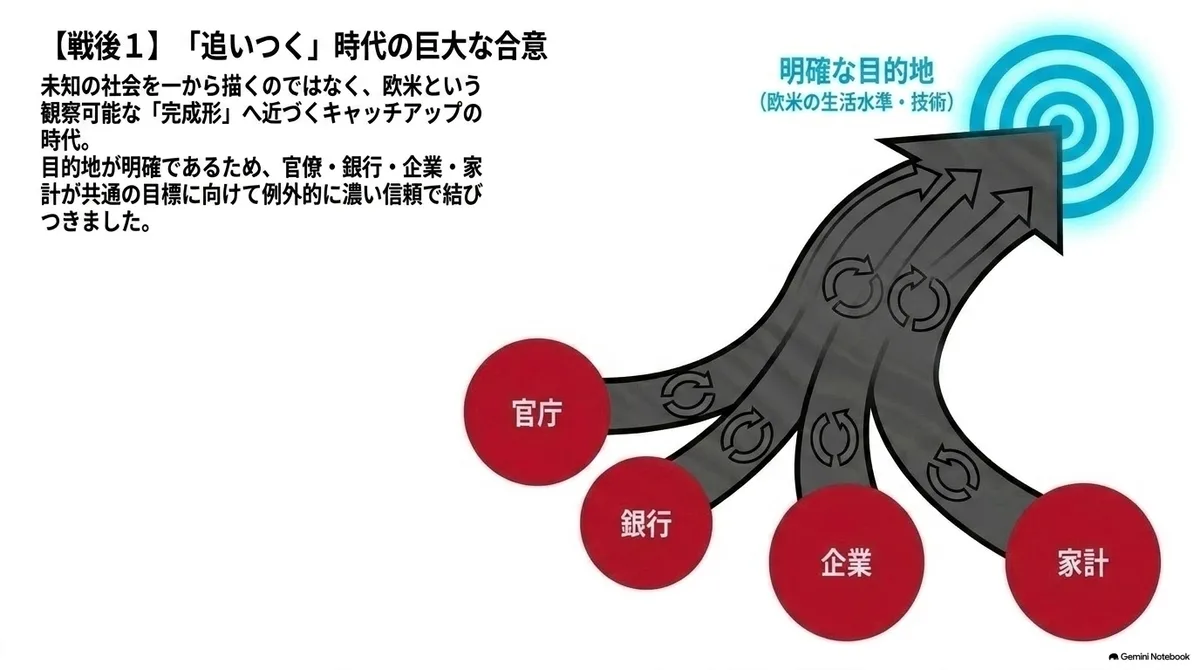
The mechanisms that turned thought into execution were also assembled to fit these goals. The state indicated direction through plans and advisory councils; banks, accumulating information on companies through continuing transactions, took on not only lending but also management monitoring and coordination in times of crisis (how far this function extended to which companies is a matter of scholarly debate); companies retained people through long-term employment and in-house training and accumulated technology; and households responded with rising incomes and purchases of durable consumer goods. National planning, capital investment, lending, employment, and consumption were connected to the same vision of the future to a considerable degree. The circulation in which the results of investment returned to households as income, and consumption and saving in turn supported the next round of investment, was also truly turning. I think there was also hope in it, a sense that "the future will be better than now."
The economic sociologist Jens Beckert, in Imagined Futures (2016), argued that what drives the activity of capitalism is less an objectively predicted future than the "imagined futures" collectively shared by people. What matters is not the optimism of the imagination but the degree to which that future is trusted enough that many actors can commit funds and time to it. Japan in the catch-up era can be said to have been a time when this sharing and trust were exceptionally dense.
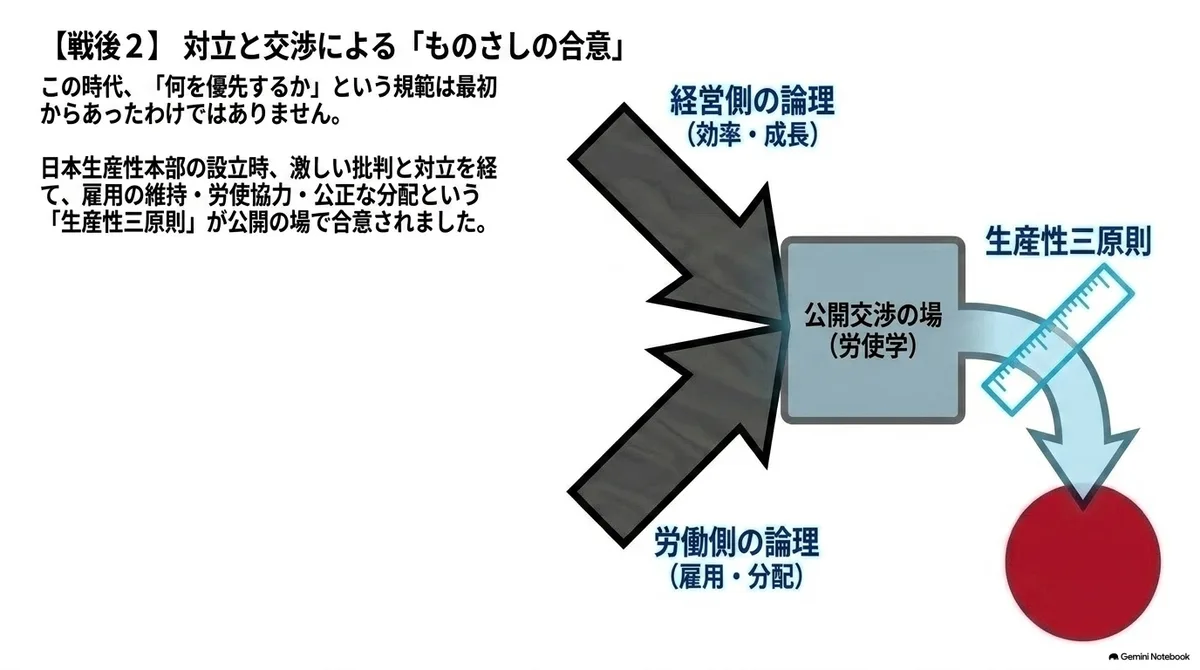
There is also a precedent in which the "yardstick," one element of thought, was actually decided through public negotiation. The Japan Productivity Center, established in 1955, did not at first have the consent of the labor world as a whole, and, while facing head-on criticism that it would "force sacrifices on workers", it set out the three principles of productivity (maintaining and expanding employment, cooperation and consultation between labor and management, and fair distribution of the results) and created a tripartite forum of labor, management, and academia. To the question of how to treat employment and distribution when raising productivity, a question that piling up facts cannot settle, it gave a publicly stated order of priorities as the product of negotiation. And this agreement was implemented in combination with institutions such as long-term employment, in-house development of human resources, and bank-centered corporate finance. Here was one form of the circulation in which, through conflict and negotiation, the yardstick was rewritten in a public arena.
In terms of the three words map, yardstick, and course, Japan in the catch-up era borrowed its map from the completed form of Europe and America, largely agreed on its yardstick as growth and rising living standards, and could treat its course as self-evident. The agreement was not complete, to be sure. Conflicts over pollution, labor, and regional disparities continued over who would bear and who would receive the costs and gains of growth. Even so, the main indicators of rising productivity and income had become goals referred to across positions. In other words, it was an era in which the mechanisms worked even without producing thought as a self-made whole.
What cannot be overlooked here is that, although the coordinating mechanisms linking government offices, banks, and companies, namely advisory councils, industry associations, policy finance, and main banks, certainly existed, they had been assembled on the premise of a destination visible to everyone: catching up. This was an era in which such connection and circulation held.
An Abundant Supply of Maps and Courses of the Future, and the Fixing of Connections
Words discussing a vision of society as a whole, beyond the reference point of Europe and America, were also supplied abundantly in the postwar period. Tadao Umesao's "Theory of the Information Industry" (1963), mentioned at the opening, described a picture in which industries that produce and circulate information move to the center of society. Yūjirō Hayashi established the term with his 1969 book The Information Society, Kazuma Tateishi, the founder of Omron, and others proposed the SINIC theory in 1970, Yoneji Masuda conceived "Computopia," and in his 1985 book The Knowledge-Value Revolution, Taichi Sakaiya described a society in which the creation of knowledge and value matters more than the quantity of material things. In this period Japan was an importer of information society theory and, at the same time, a supplier of it.
Vision did not stop at discourse. The architects of Metabolism, which emerged in 1960, conceived the city not as a collection of completed buildings but as something renewed in response to changes in population, technology, and life. The place where that vision appeared in public was the 1970 Osaka Expo that we saw at the opening. Umesao, Hidetoshi Kato (a thought and cultural critic), Sakyo Komatsu (a science fiction writer), and others also took part in the Expo's conception, and information society theory and futurology were reflected in the site plan.
What is interesting is that they did not intend to make the Expo a simple celebration of technology. The "Group for Thinking About the Expo" (1964), in which Umesao and others took part, argued that the Expo should not end as a trade fair for Japanese products but should be a place to discuss problems such as pollution, resources, population, and inequality. Some of the members who had been criticizing from outside later took part in the actual planning as theme committee members. In the process of drafting the official theme, "Progress and Harmony for Mankind," too, it was argued that science and technology, if misused, could lead humanity to destruction. At this point, a road from criticism to vision, and from vision to the design of companies and institutions, still remained.
Furthermore, the Nomura Research Institute was established in 1965, and in 1970 the Mitsubishi Research Institute was established under the banners of "independence," "interdisciplinarity," and "future orientation." Private think tanks that provided technological forecasts and social visions to policy and companies had also come into being. Most of them, however, were born as affiliates of securities firms or corporate groups, and their revenue centered on commissioned research, and this business structure could also be a constraint on continuing to set public agendas independent of clients' requests.
The distance between these writers and policymaking or business was close from the start. Hayashi came from the bureaucracy, having worked on drawing up economic plans at the Economic Planning Agency, and Sakaiya came from the ranks of MITI officials who engineered the Osaka Expo. Social visions entered advisory councils and long-term plans and moved research and development through national projects. For example, the Fifth Generation Computer Project, begun in 1982, invested about 54 billion yen over eleven years, and under the leadership of MITI the existing major electrical manufacturers each sent researchers. And the SINIC theory was promoted by a businessperson at Omron. Information society theory was tied to the national budget and to companies, created research organizations, and reached corporate technology development. In other words, social visions flowed to government offices and national projects, and business visions flowed to individual companies.
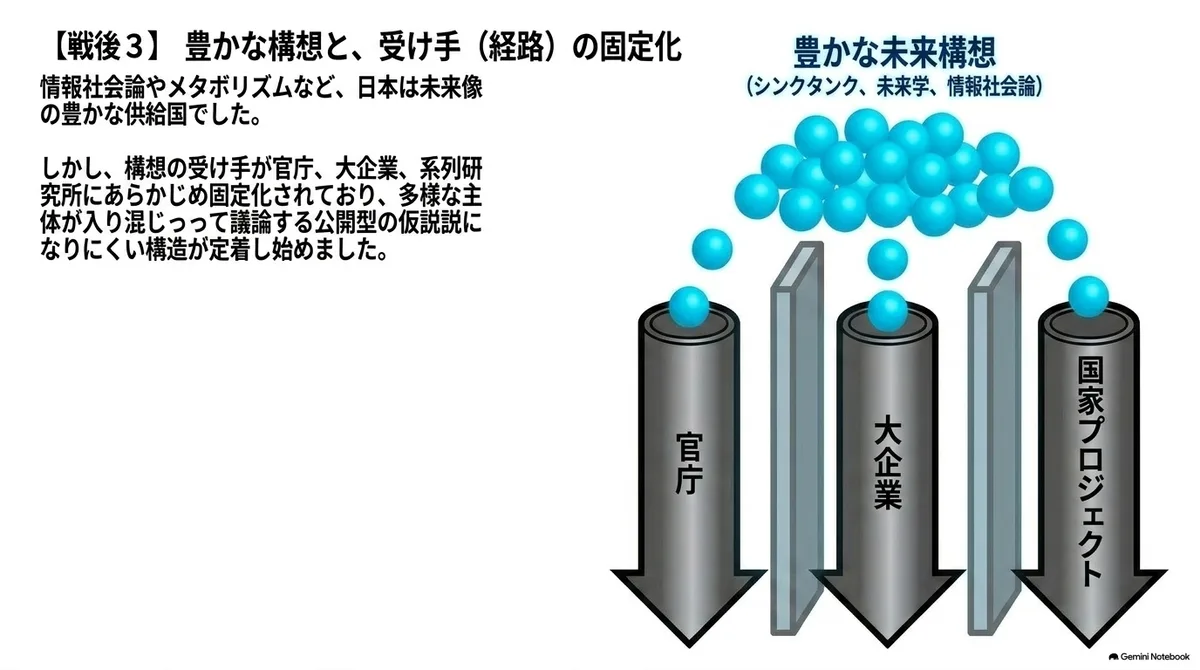
Each of these strands of thought was working well enough, but its recipients became almost fixed by channel. The problem, then, is not that Japan was unable to draw maps of the future. It is that the recipients of visions were predetermined as government offices, large companies, research institutes, and national projects, which made it hard for visions to become open hypotheses discussed and examined together by multiple companies, investors, and researchers. I believe this later became the source of the structure that produced the vacuum.
The 1980s: Catching Up with the Destination, and Cross-Cutting Norms Cease to Be Spoken
Let us now look at what happened from the late 1970s through the 1980s. In this period, Japanese industry began to move from the side that catches up to the side that is learned from. Ezra Vogel's Japan as Number One (1979) was widely read, and Japanese management, with its long-term employment, in-house training, quality control, and keiretsu, became an object of study and imitation. In the terms used so far, at least in the main indicators of manufacturing productivity and living standards, Japan had reached the observable target of Europe and America to a considerable degree. The premise that had supported the postwar connection began to be gradually lost at this point.
A symbolic case is the export of methods of production. Taiichi Ohno's Toyota Production System (1978) systematized it domestically, and after comparative research by MIT's International Motor Vehicle Program it became standard vocabulary worldwide under the name "lean production." However, what transferred easily across borders were the methods that could be carved out as procedures, such as production processes and quality control. The institutions that supported those methods, such as long-term employment, in-house skill formation, and the distribution of results, depend on each country's employment law and labor relations, and so do not transfer in the same form. The methods became the world's, while the institutions and the yardstick remained at home. (I will later look at how the detached methods were combined with customer development theory and agile development in the United States and returned to Japan in the 2010s as The Lean Startup.)
So what happened to the thought that remained in Japan? Here the distinction made at the opening, dividing thought into map, yardstick, and course, becomes useful. Visions that draw maps and courses continued to be supplied openly in the 1980s as well. The government and advisory councils kept producing visions of the future, such as the 1980 science and technology nation concept, the 1986 Maekawa Report, and the 1987 Fourth Comprehensive National Development Plan, and Sakaiya's The Knowledge-Value Revolution, which we saw earlier, is also a book from 1985. What thinned was the yardstick, that is, discussion of norms and criteria of value on the side of capital. Norms about what to prioritize in distributing funds, and especially examples in which multiple norms were compared across boundaries, negotiated in public as in the case of the three principles of productivity, and rewritten, became hard to find from this period on.
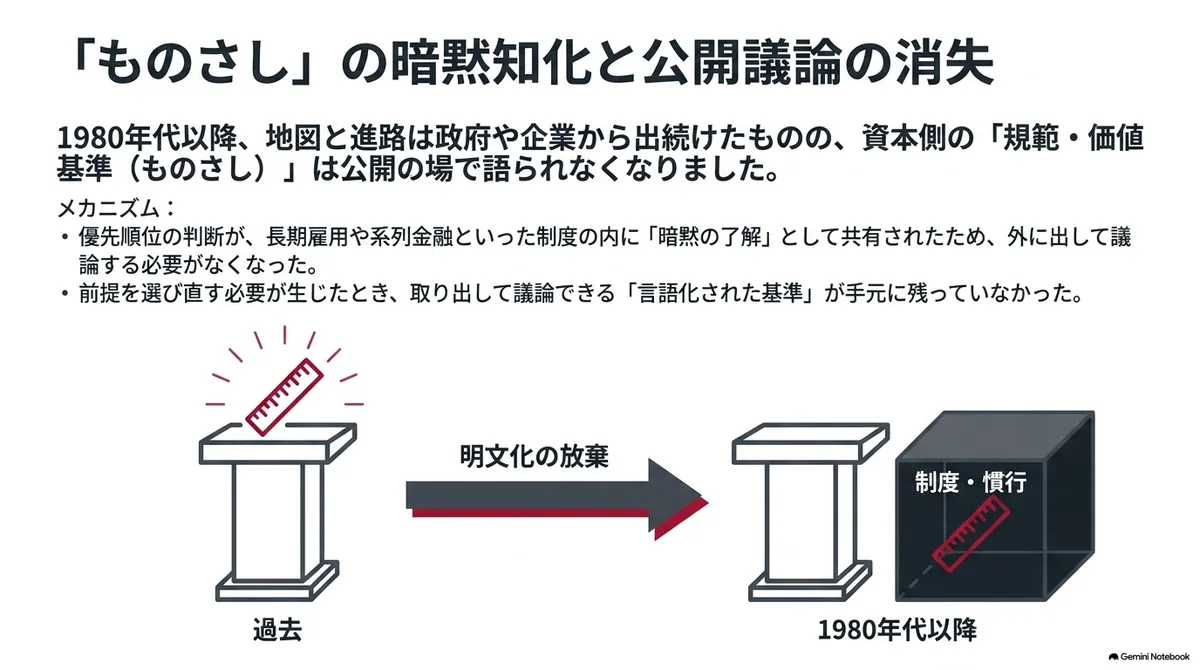
One reason is that what to prioritize was sufficiently handled if it was tacitly shared within institutions such as long-term employment and corporate finance and within industry practice, and there was no need to put it into words and bring it outside. Social visions circulated within advisory councils and national projects, business visions within a company's own medium-term plans, and financial judgments within keiretsu screening, and they were rarely contested outside those channels. Norms and criteria of value continued to be shared inside each channel and each industry, but ceased to be spoken outside them.
In the same period, the forums that cut across channels also changed in character. The futurology movement peaked with the 1970 Expo and receded after the oil shocks, and a forum in which scholars, bureaucrats, companies, and writers discussed a picture of society in a single theme committee was not recreated afterward. The three principles of productivity also changed from an agreement that continued to be negotiated into a premise already achieved. After labor-management cooperation took hold following the 1975 spring wage offensive, the labor-management forum came to resemble a routine procedure for adjusting the size of wage increases rather than a negotiation that questioned anew the yardsticks of employment and distribution.
Of course, the forums of horizontal connection did not disappear. Advisory councils and industry associations remained, and coordination between organizations is even said to have been dense. What changed was the role of the forums: from places where stakeholders of different kinds negotiated thought and its yardsticks, they gradually became channels for adjusting interests under the default premises of each industry.
Looking inside each industry, the circulation in which feedback returned to improvement kept turning actively. Keiretsu finance accumulated information on companies, in-house training accumulated learning on the shop floor, and industry associations kept refining trade practices. The strength of 1980s manufacturing is also a result of this circulation. However, that circulation was complete within each channel and each industry, and was measured by yardsticks internal to each, such as market share and rank within the industry. What closed was not measuring but the negotiating and rewriting, across channels, of what to measure by. The place for comparing multiple norms across boundaries and reflecting them in capital allocation weakened. I believe that the present state described at the beginning, in which the mechanisms of each field run on their own while the connection and circulation linking them have thinned, began to take shape at this time.
And reaching the destination raised the cost of norms and criteria of value no longer being spoken. Once catching up is over, there arises a need to choose again, on one's own, which of several goals, such as growth, employment, distribution, the environment, and international cooperation, to prioritize. Yet the norms that could be used for that re-choosing were not at hand as explicit words; they were merely shared tacitly within institutions and practices. A mechanism that was efficient while the destination was shared shows itself, when the premises need to be chosen again, in the form of having no standard at hand that can be taken out and discussed.
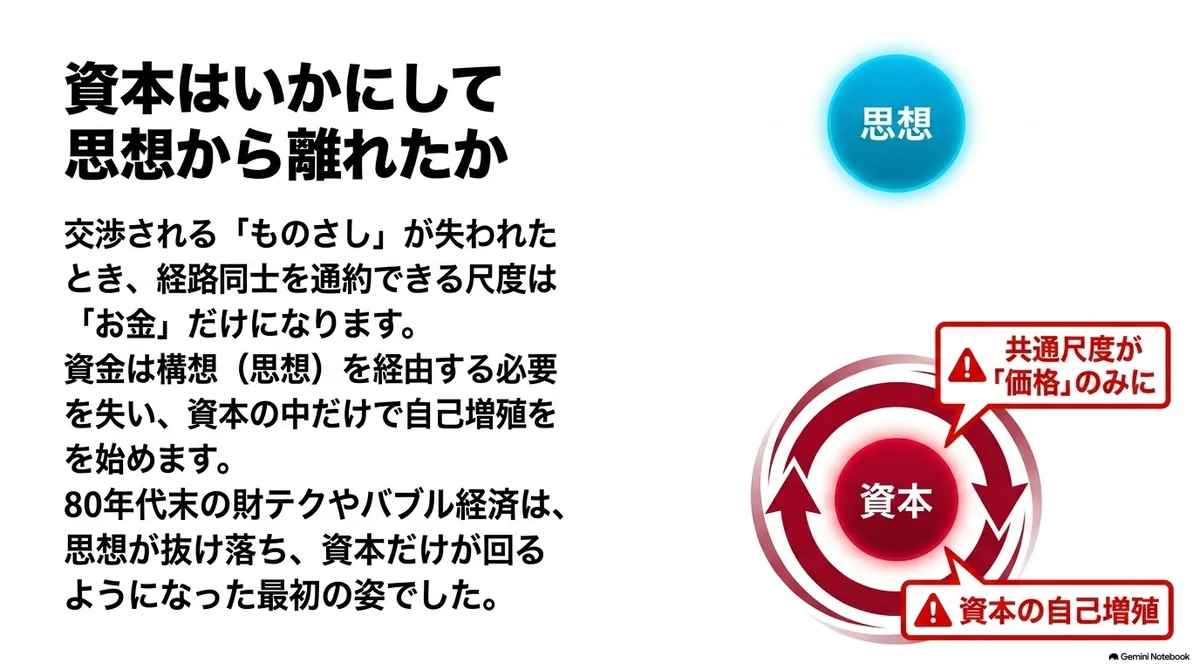
Beyond that lies one more consequence. When negotiated yardsticks are lost, the only scale or standard that can still make closed channels commensurable becomes money. And when only money becomes the common scale, funds no longer need to pass through a vision, and capital begins to circulate within capital. The financial engineering (zaitech) of the late 1980s, when operating companies pursued financial returns rather than their core business, and the bubble in which rising land and stock prices invited yet more lending, can be seen as its first appearance. From a circulation in which thought, funds, and people were supposed to go back and forth, thought and people drop out, and only funds turn. This is what it means for capital to separate from thought. What happens when it is not a vision that gets a price, but a price detached from vision that is used as the common yardstick and makes the judgments, I will look at in the installments dealing with the 1990s onward.
There Was Connection and Circulation, but They Were Supported by a Destination
Let me sum up so far. It is not that Japan lacked thought, or that thought did not move resources. In Meiji, thinkers and executors were within the same personal relationships; in Taishō, social movements were added and the differentiation of the work of writing from the work of moving funds began. In wartime, the state tried to bind everything together, which led to a great failure. And in the postwar period, government offices, large companies, and financial institutions turned visions into policy, research and development, and funds. These were less successive stages of a linear development than separate forms of connection, each differing in mobilizing power, scope of inclusion, openness, and ease of correction.
However, each postwar channel had an almost fixed recipient. A government office's vision went to policy, a large company's vision to its own research and development, and a financial institution's judgments to the supply of funds to existing companies. There were indeed forums that negotiated yardsticks across channels, such as the Productivity Center and the Expo, but they were achievements supported by the special period of being on the way to catching up. When horizontal forums lost their role of negotiation as the destination was reached, only the vertical channels and the circulation turning within them remained. The yardstick became not words spoken in public but a tacit understanding within institutions and practices, and capital began to circulate within capital. At this point, the side of capital had begun to separate from thought (especially the yardstick).
That is all for Part 1. In the next installment, I will look at what was happening on the other side of this circulation, the side that produces thought.