Thought and Capital 3 | How Thought and Capital Were Joined Again in the United States
This article was machine-translated from Japanese by AI (Claude). It may contain errors. Read the original Japanese article.

In 1971, a year after Japan was caught up in the excitement of the 1970 Expo, NASDAQ began in the United States. It was the public market that served as the exit for American startups.
American VC went through a period of trial and error that began in the 1940s with ARDC (American Research and Development Corporation), and by the 1970s it was taking shape as a specialized form of financial intermediation. In 1979, the U.S. Department of Labor issued a rule on ERISA under which the prudence of an individual investment is judged in relation to the portfolio as a whole, which made it easier for pension funds to invest in VC.
The result became visible in August 1995. Fifteen months after its founding, a company that had never turned a profit went public in the United States. It was Netscape, which was building a new kind of software called the browser. On its first day of trading, the stock closed at $58.25, more than double the offering price of $28, and the market capitalization reached about $1.9 billion.
What the market was investing in was a not-yet-certain story of the future in which the internet would become central to society. And this movement of attaching money to such futures continued for the next 30 years, despite a temporary stall caused by the dot-com bubble.
After that, centered on Silicon Valley, a series of practices, "putting a price on a story, turning it into funding, getting it executed, and letting the market judge whether it works", grew into a mechanism for converting thought into capital.
This is the third installment of the series "Thought and Capital." In the first and second installments, we followed the process by which thought and capital drifted apart in Japan, from the Meiji era to around 1990. It was a process in which the combination of people who think about ideas and people who move funds in one person was replaced by a division of labor, and no mechanism was built to take over the work that the combination had performed.
In this installment, we look at the American side. In the United States too, the functions of shaping the future became dispersed from the 1970s onward. We will see how they were then tied together again through equity and startups, and how, through the 2020s, they came to be integrated at high density inside a certain group of large VCs with a high degree of dependence on policy.
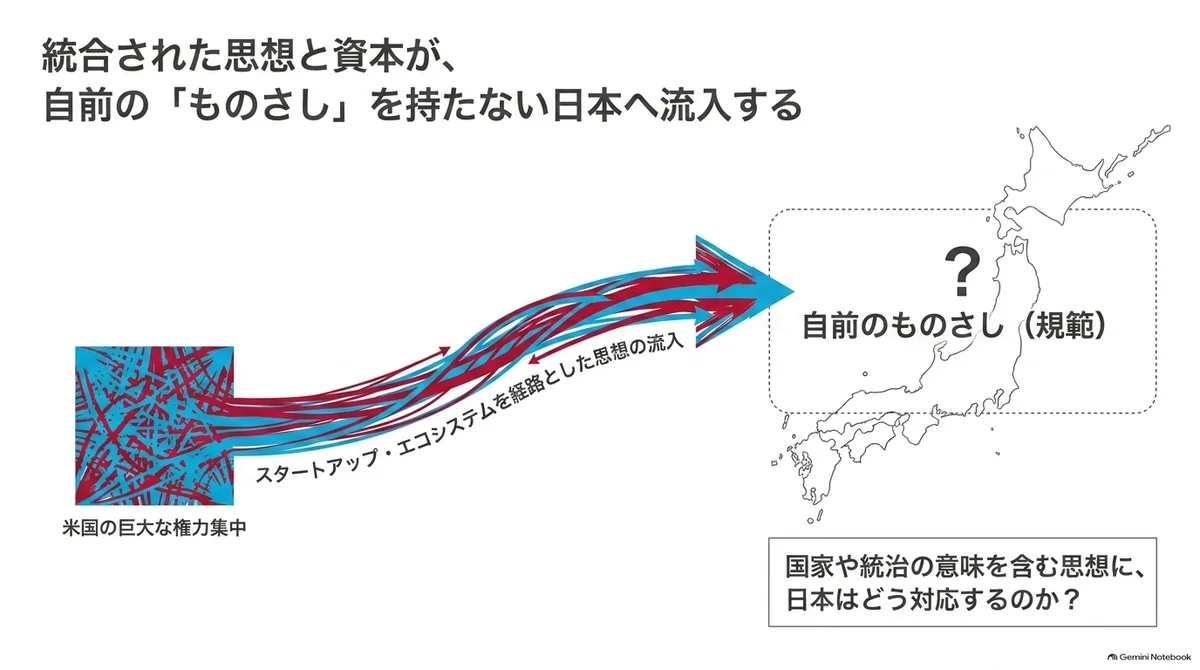
Understanding this American trajectory also matters for Japan today. As we saw in an earlier article, thought is now entering Japan through the channel of the mechanisms that grew up in the United States, and it includes not only methods of business and forecasts of markets but also the meaning of the state, governance and freedom. This installment is therefore an attempt to reread, from the viewpoint of thought and capital, what has happened in the United States, the source that is now carrying thought into Japan.
Below I use the same definitions as last time. Thought is a framework of thinking that combines three things: a "map" that captures the history, present and future of society and an understanding of how it works; a "yardstick," the evaluation criteria for what to prioritize and what not to allow; and a "course," the direction and action plan for how to change society. A concept is that thought turned into a plan that can be executed in a specific place. Capital refers to financial commitments that bind future resource allocation, such as investment and public budgets, and does not include payment for past work such as manuscript fees or commissioned fees.
In the 1970s, the Way of Speaking About the Future Changed in the United States Too
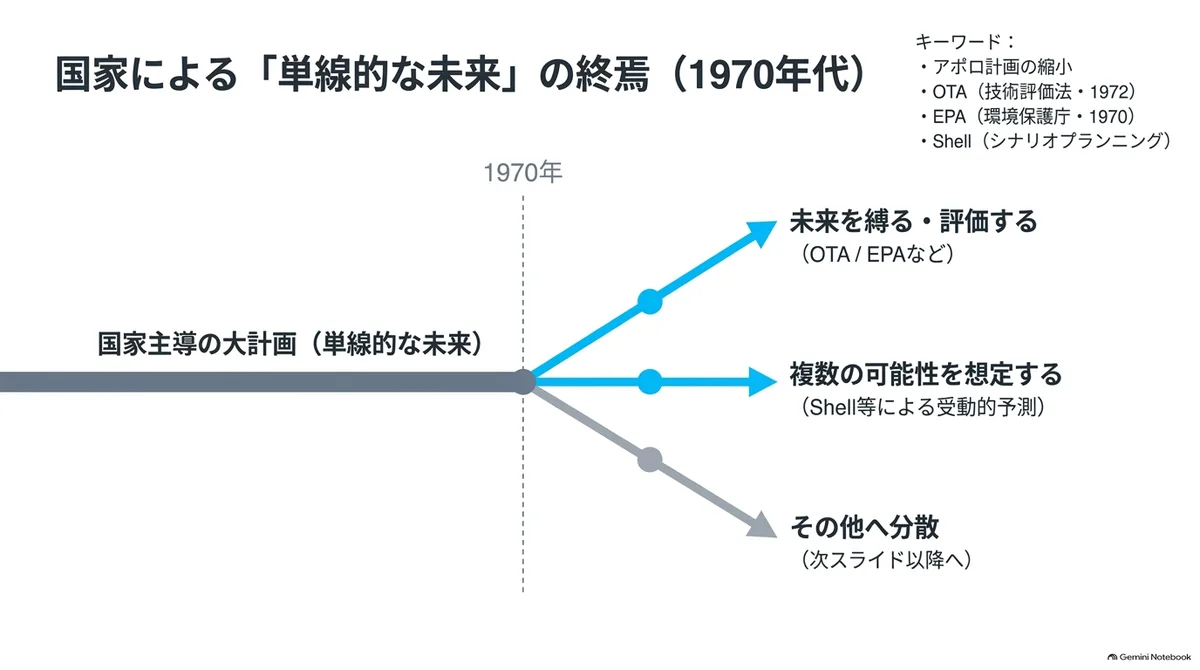
Around 1970, when the Expo was being held in Japan, various changes were also taking place in the United States. What changed most significantly was the way the future was talked about.
American futurology reached its peak of popular enthusiasm from the late 1960s to around 1970, as represented by the founding of the World Future Society (1966) and Alvin Toffler's Future Shock (1970). After that, however, both the way of speaking and those who did the speaking began to change.
One change was that the style in which the state presented a single, linear future through grand plans became less common. Toward the end of the Apollo program, budget cuts at NASA led to the cancellation of several missions, and the era of concentrating resources on one great goal, space development, moved toward its end.
Around the same time, other ways of shaping the future were being institutionalized. With the Technology Assessment Act of 1972, Congress established the Office of Technology Assessment (OTA), a mechanism for Congress to evaluate the direct and indirect effects of technology. In addition, as symbolized by the enactment of the National Environmental Policy Act in 1970, the establishment of the Environmental Protection Agency in the same year, and the passage of the Muskie Act, which mandated reductions in automobile emissions, a system that predicts future harm, assesses impacts in advance and binds companies also took shape. In other words, ways of speaking about the future that "bind the future" increased.
Other ways of talking about the future remained, but their character gradually changed. In the corporate sphere, Shell began using a technique called scenario planning from the early 1970s, and it drew attention because it had examined the 1973 oil shock in advance as one of its scenarios. But this method does not fix the future into a single prediction; it examines multiple possibilities that arise from different assumptions. In other words, the approach had begun to shift from the earlier optimistic, linear forecasting and active shaping of the future to a passive form of forecasting that evaluates multiple scenarios.
At the Same Time, the Advocacy Type Was Added to Think Tanks
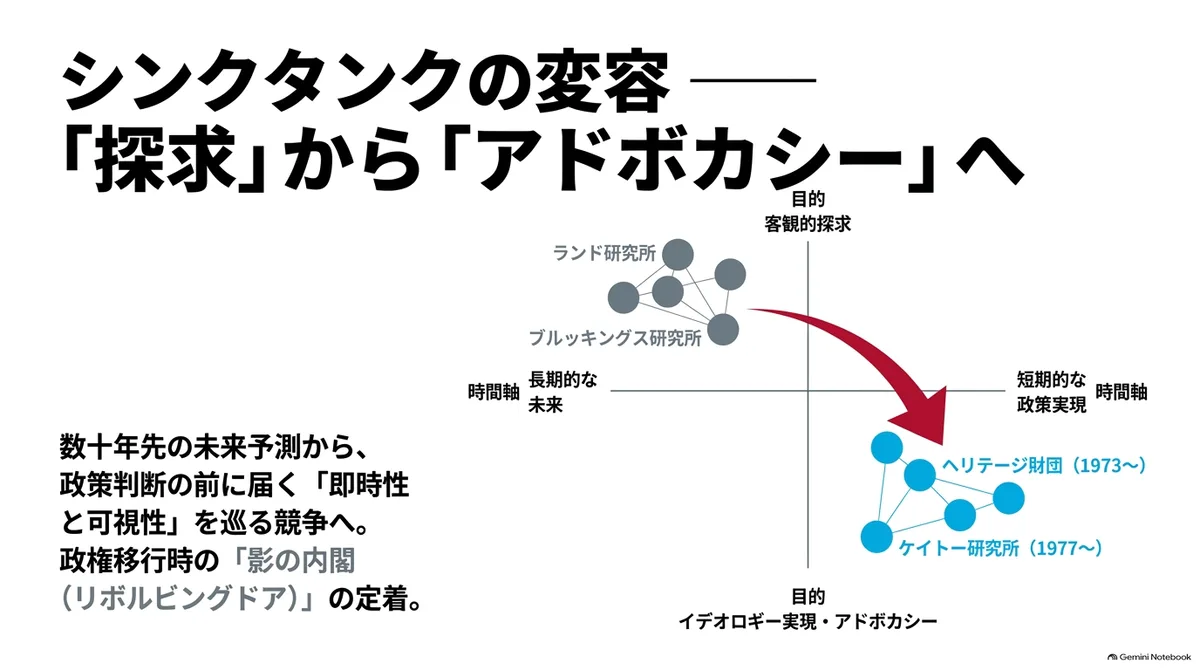
In that same decade, the 1970s, think tanks, another place that had spoken about the future, were also changing. In terms of the typology presented by Kent Weaver, after the "universities without students" and "contract research" types, the "advocacy" type, which puts a clear ideology and the realization of policy at the forefront, began to appear among think tanks around this time.
Until then in the United States, the mainstream had been think tanks like the Brookings Institution and the RAND Corporation, which centered on academic inquiry and objective policy evaluation. Forecasts of the future several decades ahead, such as the one Herman Kahn, who came from RAND, attempted in The Year 2000 (1967), were also part of the work of such organizations.
In the 1970s, however, the presence of organizations that explicitly aimed at realizing policy grew, with the emergence of the Heritage Foundation (founded in 1973) and the Cato Institute (founded in 1977) and the revamping of AEI (the American Enterprise Institute). The operating principles that the Heritage Foundation itself later explained also emphasized timeliness, reaching decision-makers before a policy decision, and brevity, short enough to fit in a briefcase. In the world of think tanks, competition over the visibility of policy proposals, and over their timeliness, intensified. From here, think tanks too produced more short-term, direct recommendations rather than talking about the distant future.
This also had an effect of another kind. A pattern emerged in which, with each change of administration, people were sent into government en masse. This revolving-door pattern took hold, and think tanks came to function as a "shadow cabinet" during presidential transitions. This is one pattern of American policymaking that continues to this day.
In this way, the 1970s were a decade in which the forms of speaking about the future changed. And the functions of shaping the future became dispersed among multiple organizations with different time horizons and formats.
SF Remained as a Bearer of Speaking About the Future
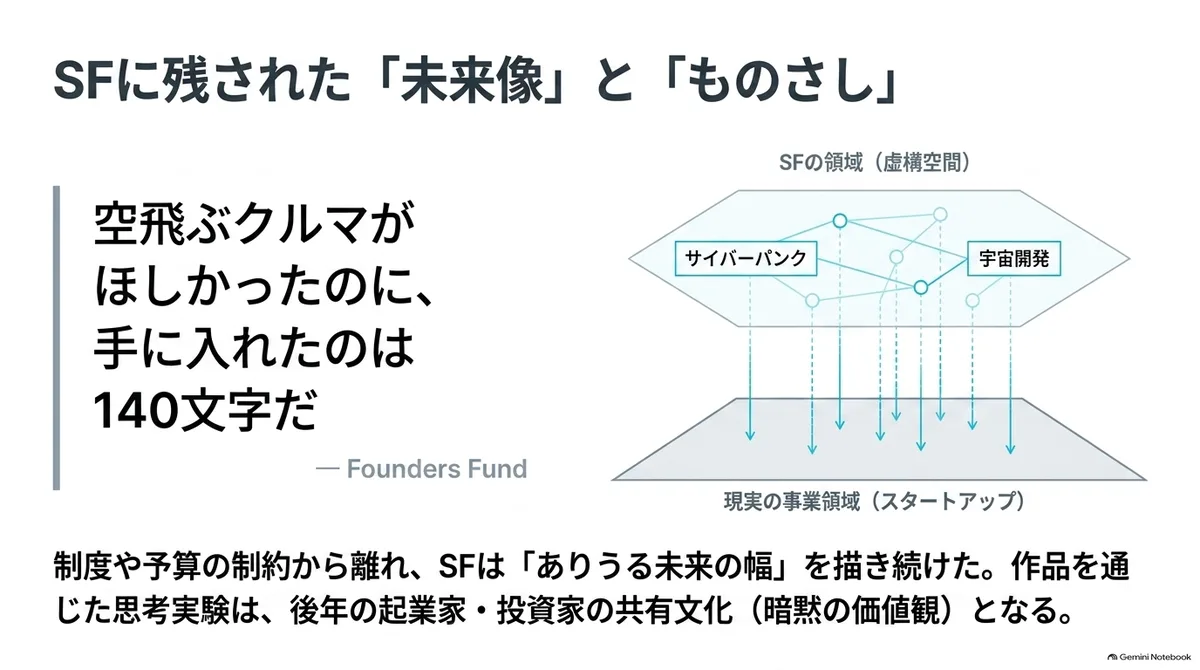
Alongside those changes, one place remained as a teller of the future. That was SF, which I also touched on at the end of Part 2. SF kept its distance from institutions and business plans and continued to depict "images of futures that might be."
SF is, after all, a place of fiction, and the works themselves do not come with the will or the funds to make them real. In exchange, it can portray in advance, as thought experiments, what a society in which a technology has spread would look like and the conflicts that arise there. Not only the works themselves but also the images of the future and the metaphors accumulated through criticism of SF and discussion among readers became widely shared cultural assets that entrepreneurs, engineers and investors could draw on when talking about the future.
In later years, the manifesto "What Happened to the Future?" put forward by Peter Thiel's Founders Fund contained the line "We wanted flying cars, instead we got 140 characters." On a first reading the irritation stands out, but behind it there seems to lie an expectation that startups are precisely the means of turning SF-like futures such as "flying cars" into reality, and the irritation seems to have come from that expectation being betrayed. That is how much SF-style thinking had influenced entrepreneurs and investors.
That said, the early 1970s were a time when many SF works depicting catastrophic futures were being published, in response to the climate of the day: the Vietnam War, the Club of Rome's The Limits to Growth, and the problem of pollution. What began to change this was Star Wars in 1977, and afterward, in the 1980s, SF kept telling images of the future while shifting toward an advanced and decadent cyberpunk.
In Japan during the same period, too, the future continued to be told through SF, through works such as those by Sakyo Komatsu that we saw at the end of Part 2. The reason that SF was not realized in Japan but was realized in the United States seems to me to lie in whether a mechanism that connects the will to realize it with funding had grown up.
In the United States, a mechanism that translated fantasies of the future into business concepts, executed them and attached funding to them had gradually developed. That was financing through equity.
A Mechanism for Putting a Price on the Future
As we saw in the article on the "pendulum between culture and finance", financing through equity carries no obligation of repayment, and it is a financial product in which investors take on the residual value of a business, that is, a large upside that is not yet certain; it is, so to speak, a mechanism for turning a story into money. And an equity story is precisely the language that entrepreneurs and others use to speak of a business's future and obtain funding.
In the case of a listed company, expectations for the future are shown in the public market as a stock price, and a company that issues shares can convert those expectations into present funding. At the unlisted stage, it is VC that takes on the same conversion. If what is expected of a listed company is a future that is reasonably certain, then what an unlisted company bets on is a future that is uncertain but large.
To turn thought about the future into a concept and carry it toward realization, three things are mainly needed: building a hypothesis (a concept) that leads there, having an actor who executes that concept, and having an actor who provides the funds needed for its realization.
In startup investment centered on VC, a division of roles is made in which the founder side takes the role of "concept + execution" and the VC side takes the role of "funding." Furthermore, VC amplifies the concepts it has chosen not only through funding but also through credibility, talent and connections to the next investors.
As we saw at the beginning, in the United States at the end of the 1970s, a large pool of money, pensions, began to flow into this mechanism. A mechanism for putting a price on a future that was not yet certain had begun to function as a place where large amounts of funds could be bet.
SF-Style Images of the Future and the Digital Industry
This mechanism of equity began to operate in earnest in a new field of business only after it was joined with a new industry, the digital.
The center of the digital shifted from semiconductors in the 1970s, to hardware and software in the 1980s, and to the internet in the 1990s. From the 1980s in particular, it was an industry that could be started with a small team and a small amount of money, that expanded rapidly if it hit, and that suited the equity-investment mechanism of raising the stakes in stages.
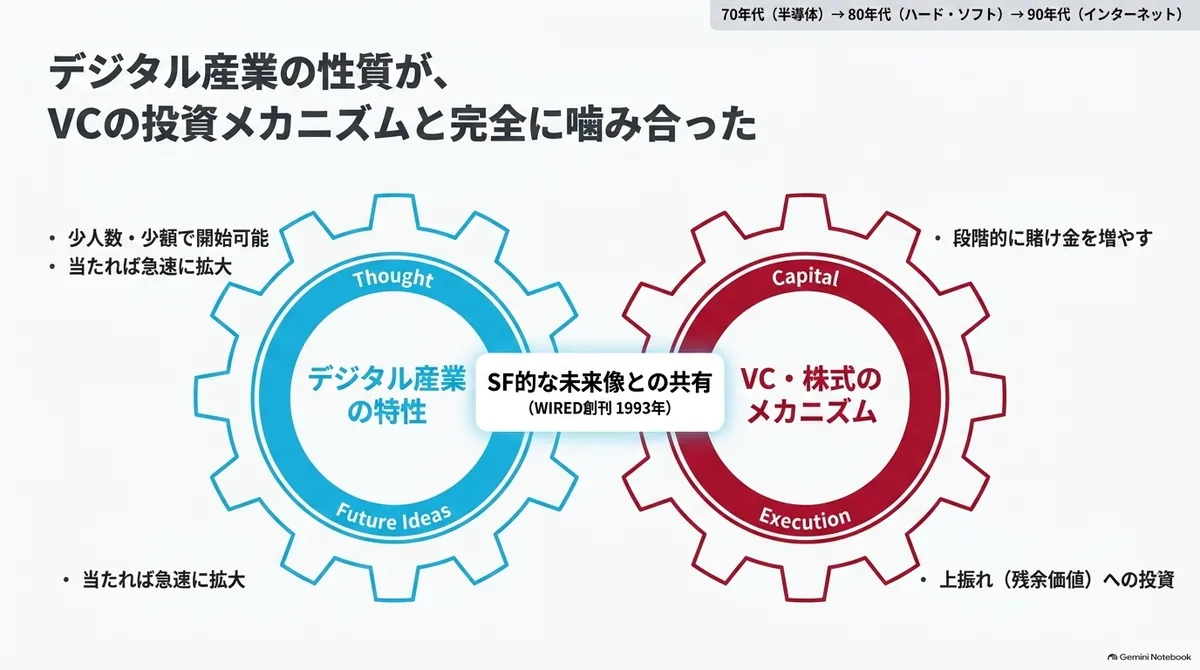
In Silicon Valley in this period, media dealing with SF-style images of the future and the practice of investing in digital businesses appeared side by side in the same industrial sphere. Media such as WIRED, launched in 1993, appeared, and gradually the images and words used to talk about the future came to be shared among fiction, media, engineer culture and startups.
In this era, the role of openly speaking about norms for the digital future was played mainly by writers, activists and media aimed at readers. In 1996, for example, the activist John Perry Barlow issued the "Declaration of the Independence of Cyberspace", which put forward the norm that the sovereignty of governments does not extend to cyberspace. VC's own value judgments did come to the surface through investment decisions, industry associations and the remarks of individual investors, but a form in which they were transmitted continuously from a permanent media outlet or policy department placed under an investment firm's brand was not yet common.
Toward an Era of Expanding VC Functions
From the 1990s onward, a relationship expanded in which entrepreneurs took images of the future from SF, translated them into business concepts, and VC chose those concepts and provided funding. Equity and VC clarified their position as parts of a mechanism that moves images of the future born from various sources, including SF, into execution and has the market test whether they can be realized.
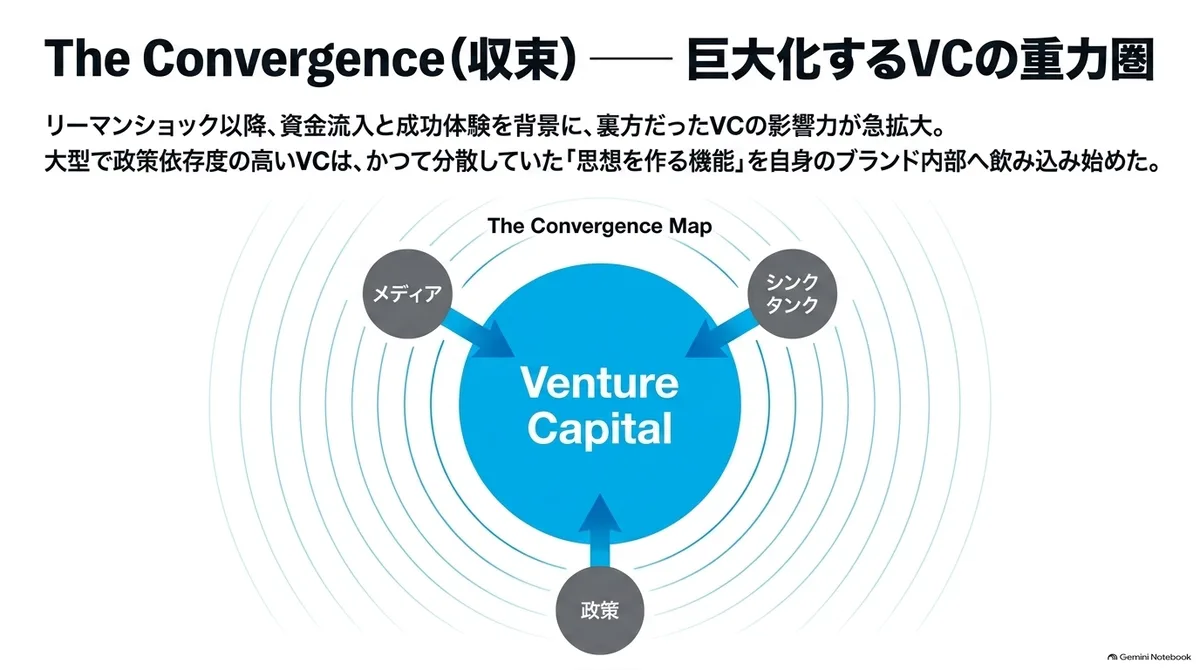
This began to change gradually once VC, which had originally been a behind-the-scenes player, began to gain relative power. In addition to the big successes of portfolio companies such as Google and Facebook, funds continued to flow into the private equity sphere after the Lehman shock, and Silicon Valley entrepreneurs and VCs began to attract attention again. After that, from a situation in which, for a time, entrepreneurs held a relative advantage because starting a company required almost no capital, the number of ventures and management styles that required capital grew, and the influence of VC, which holds the capital, increased again.
The change that occurred here is that VCs began to have functions such as support teams, permanent media, policy activities and research under their funds and brands, and that the scale of these expanded. In particular, some large VCs with a high degree of dependence on policy are taking into themselves functions corresponding to three of the "six places where thought was made" that I listed in Part 2 (social movements; cooperatives and the labor movement; scholarship and intellectuals; publishing and the world of opinion journals; Nagatacho and Kasumigaseki, which make policy; and think tanks). They are:
- The media function
- The think tank function
- The policy function
I will go through them in order.
(1) Owning Media In-House
In the 2010s, some VCs began to own media of their own. The aim was to amplify their own words and to gather funds and talent.
As we saw in Part 2, in Japan the map that depicts society as a whole was, outside the government, made in the shrinking market of publishing and opinion journals, and even in the age of streaming and salons, it was still the readers who paid.
In the United States, a form appeared in which it is not the readers but the VC that pays. a16z, for example, launched its own media, "Future," and began to talk about the future. Future itself ended after a little over a year, but a16z has since continued to run podcasts and publications on a large scale, to keep communicating in a manner integrated with its own investment thesis, and in 2025 it launched an initiative called New Media. In this way, a single picture of how technology will change society is distributed through the media, and that picture attracts investors and talent. The capital and talent that gather are put into companies, and a group of companies is born as the live ammunition for changing society. That is the flow.
But there are two decisive differences from ordinary media.
One is who is paying. It is neither advertisers nor readers; it is the VC itself. That money comes from the returns on the fund's investments. And the return is the success of the portfolio companies. For that purpose, the media promote portfolio companies and spread the rightness of the firm's own thought. Describing this business model, Benedict Evans, a former in-house analyst at a16z, once said, "a16z is a media company that makes its money from a VC business."
The other is whom it is trying to reach. The thought that a VC depicts in its own media reaches readers, but it does not stop there. It aims to repeat the same image of the future until it becomes a premise of society, to attract talent and deals, and even to influence government decisions. Readers are positioned as recipients of a picture of society and, at the same time, as carriers of what might be called an availability cascade.
In other words, such VC media are a means of changing how society sees things and of making entrepreneurs who share the VC's own thought succeed. The work of depicting images of the future and the work of distributing money have begun to enter the same organization, a certain group of VCs.
(2) Expanding the Think Tank Function
The second is the think tank function. Today, some VCs such as a16z publish forecasts of the future of technology as their investment theses. As assets under management have grown, they have also gained the strength to dedicate staff solely to research and communication. In the field of technology at least, it is fair to say that the think tank function, as the work of depicting the future, is being integrated into such VCs.
This movement is conspicuous in some VCs that have large assets under management and that deal with policy-dependent areas such as AI, defense, energy and bio. General Catalyst, for example, has established the General Catalyst Institute and officially describes it as an organization that connects venture capital and government. Lux Capital continuously publishes essays on national security and AI, and has even presented a concrete policy proposal to establish an Office of Economic Defense in the U.S. government. DCVC publishes a Deep Tech Opportunities Report every year. It is a report that analyzes where technological and industrial challenges will arise in the future in areas such as quantum, energy, manufacturing and defense, in connection with national competitiveness. This is closer to the research and future-analysis function of a think tank than to lobbying.
In a16z's case, the media function we saw in (1) and this think tank function are being performed by one and the same investment firm. Work that was traditionally divided among investment firms, research firms, think tanks and lobbying organizations is now being integrated, and its scale expanded, under the investment firm's brand by some large VCs with a high degree of dependence on policy.
(3) Opposing and Absorbing Policy
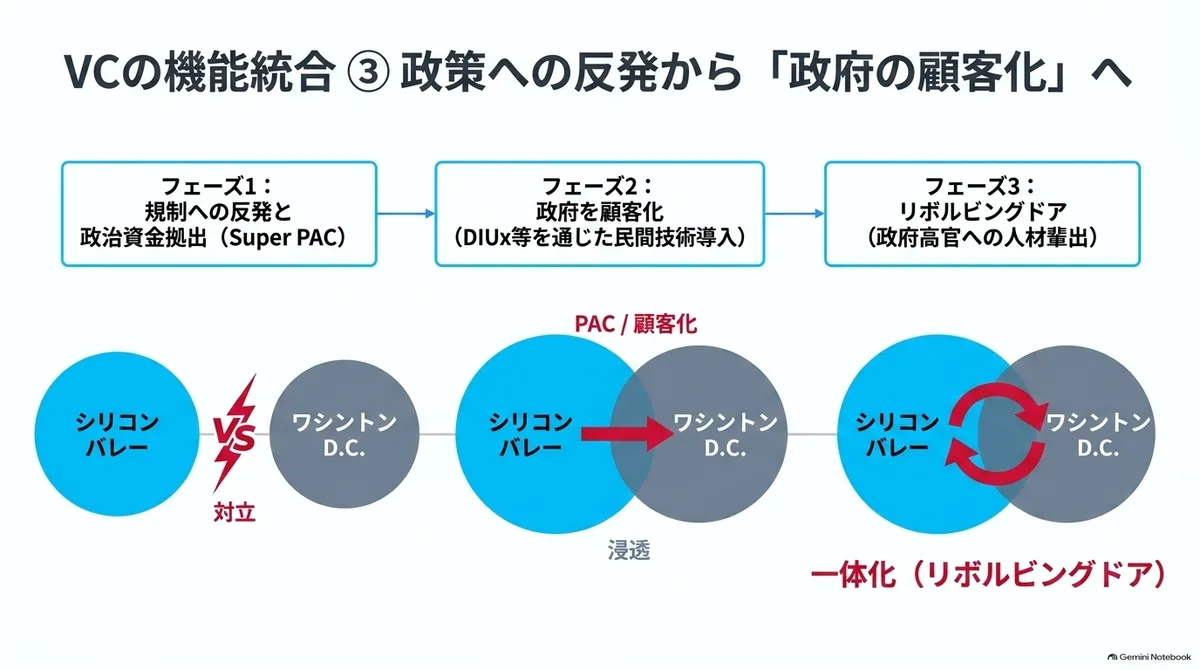
In addition, in the 2010s there was one more change: a reconfiguration of the relationship with the government.
I wrote in an earlier article that Silicon Valley's industrial base has been supported since the postwar period by federal research funding and defense procurement. At the same time, it also has a strong libertarian tendency, and a culture that regards policy as a distant matter or as an obstacle, and a self-image that innovation happens precisely because things are left to the market, still exist today. It was as recently as 2023 that Bill Gurley, formerly of Benchmark, drew cheers by saying, "the reason Silicon Valley has been so successful is that it is so far away from Washington, D.C.."
In the 2010s, however, this complicated relationship began to change. First, conflict arose between Washington and Silicon Valley over regulation of Big Tech and crypto assets. This conflict gave some VCs that valued free markets and invested in these areas a motive to get involved in policy decisions. a16z, for example, increased its points of contact with Washington, such as by submitting policy proposals on crypto regulation. And some of the investors who had until then supported the Democratic Party came to openly push back against the regulatory line of the Democratic administration.
Furthermore, some VCs and investors began to move on the front of campaign funding as well. In the 2024 election, for example, a16z became a large contributor to a Super PAC of the crypto industry. Creating a regulatory environment favorable to portfolio companies is itself becoming part of investment activity. In the 2026 midterm elections too, industries such as crypto, AI and online betting are contributing considerable sums.
Next came the change in the security environment. Riding the wave of defense tech, VCs and startups are trying to turn the government into a major customer. On the government's side as well, the Department of Defense established DIUx in 2015 and built a procurement pathway for bringing private-sector technology into the military. In this way, the government became not only the party that regulates but also a major customer of VCs and startups and a partner with which to execute concepts together.
In addition, in 2025 Scott Kupor, who had been a partner at a16z, became Director of the U.S. Office of Personnel Management, David Sacks, a former PayPal COO, founder of Yammer and VC, became the AI and crypto czar, and Jacob Helberg, who had been an adviser to Palantir, became Under Secretary of State for Economic Growth, Energy and the Environment; the second Trump administration brought in many people from tech. VCs have begun to take on even the revolving-door function that think tanks used to have.
Thus, the period from the 2010s to the 2020s was one in which both wariness of government regulation and the view of the government as a customer grew stronger at the same time.
The Yardstick (Norms) Moves from the Tech Industry's Inner Circle to Society
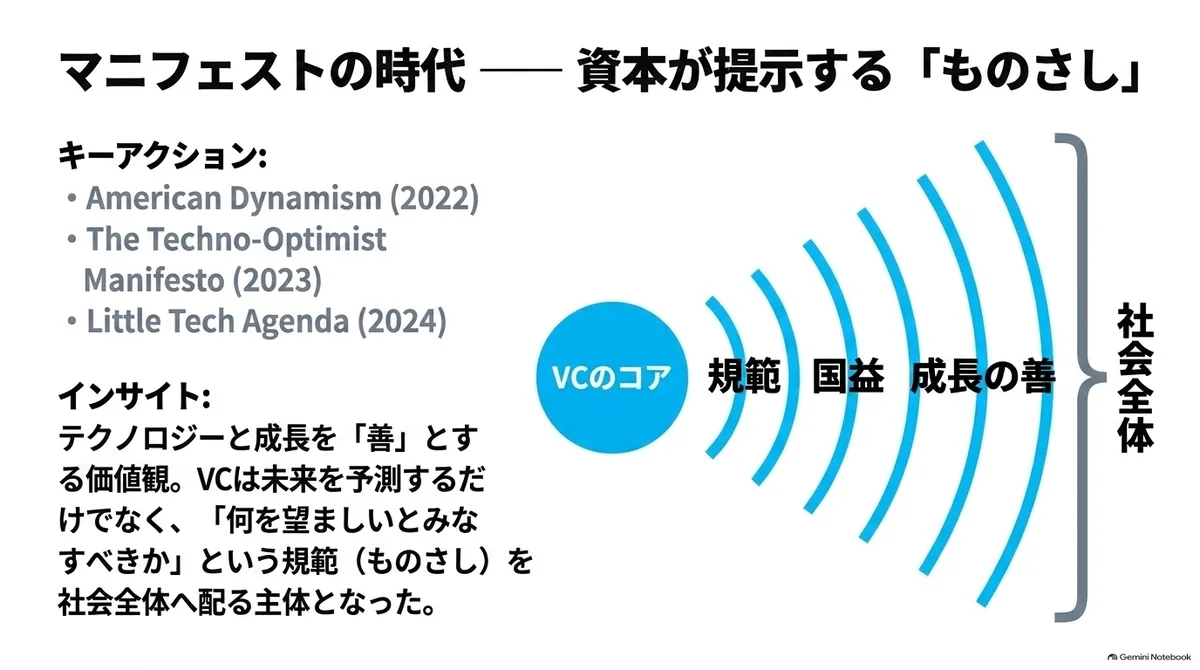
In the 2020s, with these pathways in place, some large VCs with a high degree of dependence on policy began to speak not only forecasts of the future but also thought, to society.
In 2022, for example, a16z put forward "Investing in American Dynamism" and made investing in companies that support the national interest one of its areas of practice. This is an investment thesis, and at the same time it is the work, once carried out by think tanks, of delivering a policy yardstick to policymakers. In addition, in 2023 a16z's Marc Andreessen published "The Techno-Optimist Manifesto," and in 2024 "The Little Tech Agenda."
These are documents that regard technology and growth as good and hold up a technologically strong United States as desirable. In addition to forecasts for portfolio companies, they are communications that present a yardstick for what society should regard as desirable. The capital side's yardstick passed through a stage in which it was spoken through industry associations and individual investors, and a stage in which investment firms put out manifestos, and then advanced to a stage in which some VCs integrate permanent media, policy and research functions with the allocation of funds and distribute it continuously to society.
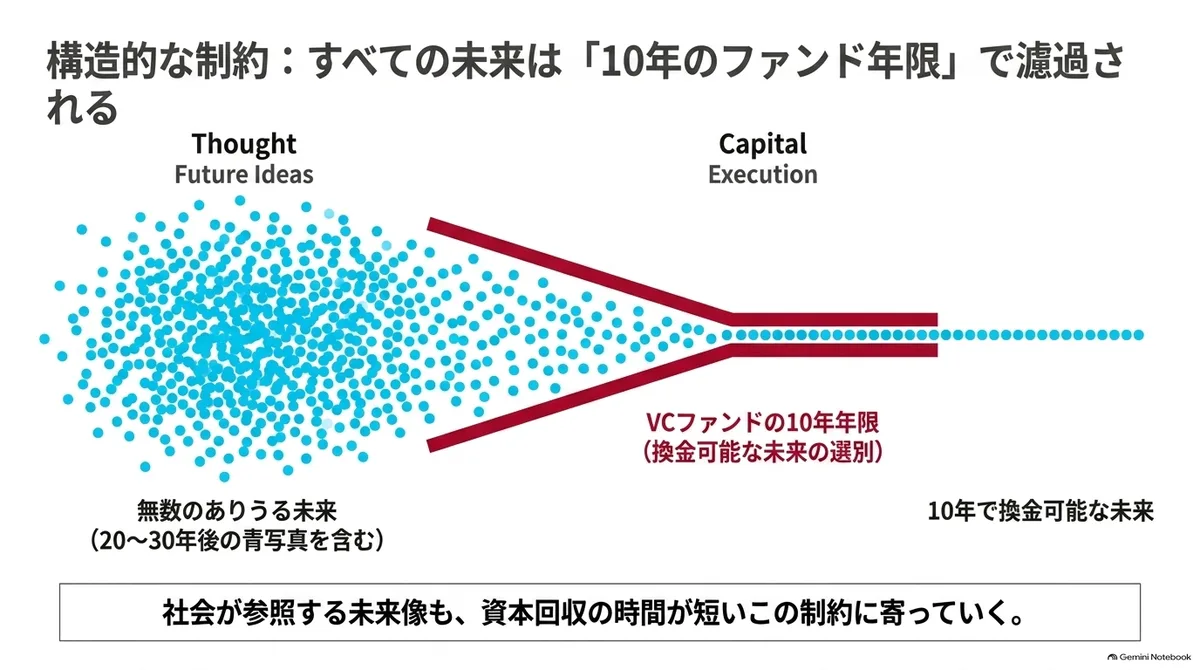
That said, the future that capital speaks of also faces structural constraints. A VC fund usually has a term of around ten years, and within that period it must sell the shares of its portfolio companies and return the money to its investors. In other words, the futures that VC can bet on tend to be limited to those that are expected to get up and running as businesses within about ten years and can be cashed out.
And as we saw in (1), such VC communication is integrated with the investment thesis. Compared with the blueprints for 20 or 30 years ahead that think tanks and futurology once drew, the images of the future that capital speaks of have a shorter time span and lean toward those that can be recouped as a rise in share prices. That the voices speaking the yardstick are gathering in capital means that the images of the future that society refers to will also move toward this constrained kind of image.
And looking back, what SF depicted was not only images of the future. The yardstick for which future to regard as desirable was also woven into the stories. American SF, for example, has been used as an expression of the thought of exit, which aims for "somewhere other than here and now," and also as a tool for depicting Christian visions of the end times. In the line "We wanted flying cars, instead we got 140 characters," a norm is written in: that flying cars are more important than a B2C business like Twitter, which speaks in 140 characters.
The audience that such documents mainly addressed was the inside of the industry, founders and investors, but gradually this is spreading to the whole of the United States, and then to the whole world.
When the Connection Between Concept and Funding Reaches Power
Let me look back over what we have covered so far.
As we saw in Part 1, thought and capital were joined in the Meiji era because the people who made thought and the people who moved funds were the same. Today, the founder side takes on "concept + execution" and the VC side takes on "selection + funding + amplification," and as the two are connected through personal relationships and contracts, the future-shaping function that the combination of roles once performed is reconstituted.
What the Meiji era and present-day Silicon Valley have in common is that the role of conceiving, the role of moving funds and the role of executing are tied together at a closeness that lets each change the others' judgments. But as we saw in the wartime section of Part 1, the fact that thought, capital and business are connected does not in itself guarantee that the thought is a desirable one. In some cases, it can lead to war.
I think that one aspect of what is happening in the United States today can be understood as such a concentration of power.
This time, we have looked at the United States from the 1970s onward, in particular at the movements of the players who speak thought about the future. From the 2010s to the 2020s, a group of large VCs with a high degree of dependence on policy have been integrating, under the investment firm and inside themselves, several of the functions that were once divided among the state, companies, think tanks, media and investors.
The thought born from this has now crossed borders and reached Japan. Thought that includes not only methods of business and forecasts of markets but also the meaning of the state, governance and freedom is coming in through this channel. And as we saw in an earlier article, Japan, on the receiving end, does not have sufficient yardsticks to measure the thought that comes in.
We need to think about how to respond to this. To that end, in Part 4, which deals with Japanese startups, we will look at what was happening in the relationship between thought and capital in Japan during the same period.