Startups as a Pendulum Between Culture and Finance
This article was machine-translated from Japanese by AI (Claude). It may contain errors. Read the original Japanese article.

In my previous essay, "The Thought Surrounding Startups," I traced the intellectual lineage of Silicon Valley, from its dual origins in the state and the hippies to its present-day fusion with power, and described it as a pendulum swinging between "the state and the market."
As a supplementary line of inquiry, this essay follows another pendulum: the back-and-forth movement between "culture and finance."
Startups have
- an aspect as culture (especially subculture and counterculture)
- an aspect as a financial product
The summary "a startup is a financial product" is a correct simplification in financial terms, but doesn't it also leave a sense that something important has been shaved away? To see what was shaved away, this essay traces the history from both sides, culture and finance.
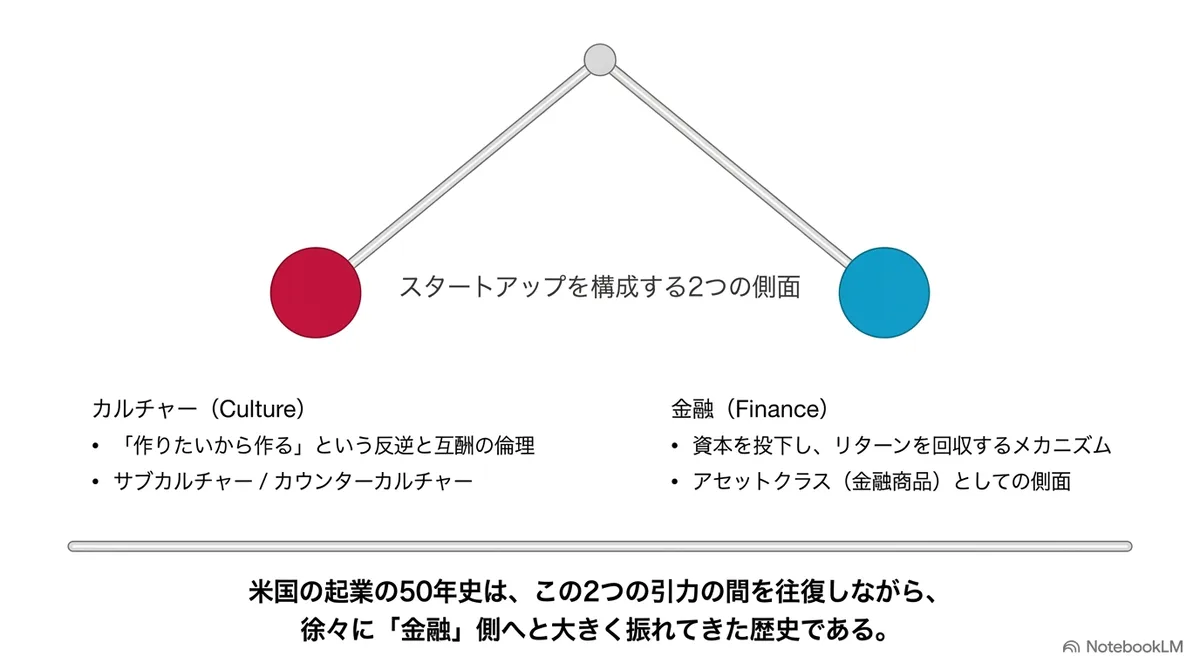
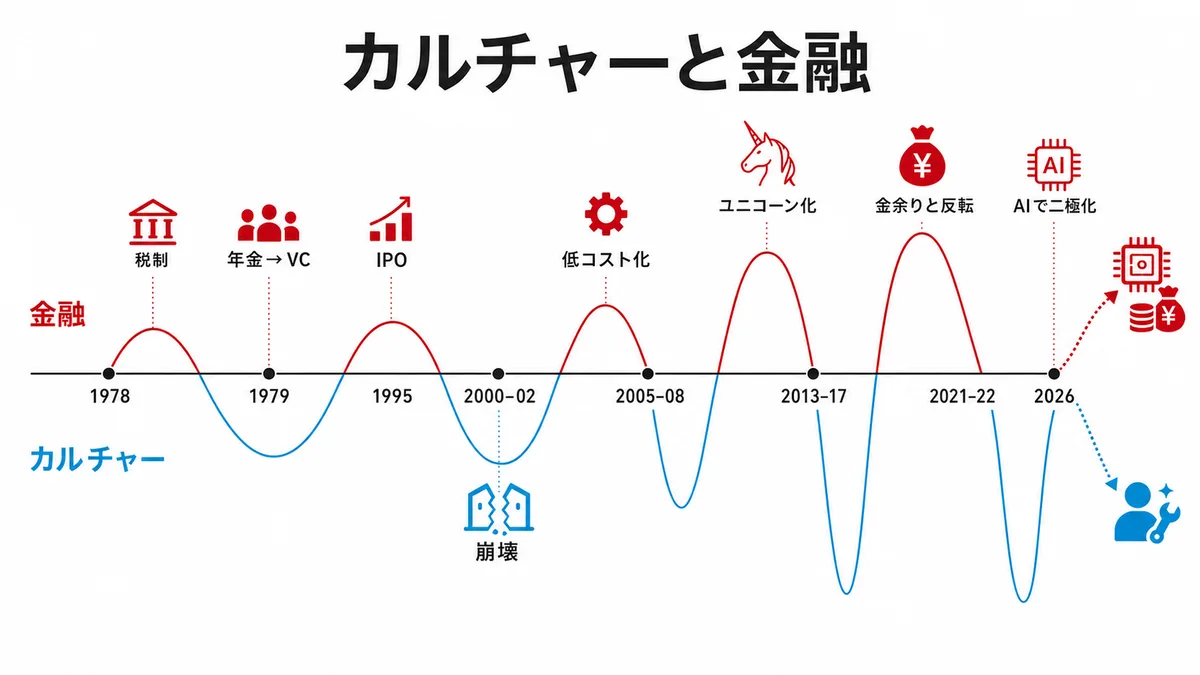
The roughly fifty years of American entrepreneurship (startups) can be seen as a history in which this pendulum between culture and finance has swung wider with each oscillation, swinging heavily toward the financial side. Japanese startups have followed, becoming gradually more financialized since the 2000s. Yet in America, the supposed model, the pendulum itself is now changing character.
What is happening? First, let us look at the moment when the circuit connecting startups and finance was designed.
(Note that what follows is a schematic centered on Silicon Valley software companies and VCs. Please allow me to add that a variety of other developments took place outside it.)
1978 and 1979: The Years Pensions Were Connected to the Garage
The history of Silicon Valley startups becoming financial products is less glamorous than the history of its culture and ideas. But there were two inflection points in the past whose effects built up slowly: changes in American tax law and pension regulation.
One change was the 1978 tax reform. The top marginal tax rate on long-term capital gains was cut from about 49% to 28% (49% was a theoretical maximum that could apply to some high earners). With the top rate on stock appreciation sharply lowered, work that was rewarded in equity became more lucrative. The startup employment model of attracting people with stock options and rewarding them at exit also spread thanks to this tax and stock market environment.
The second change, in 1979, was the so-called clarification of the prudent man rule. Until then, U.S. pension funds had been required to act "prudently" under the Employee Retirement Income Security Act (ERISA). Investing in emerging companies could be regarded as reckless, and commitments to venture capital were limited. But in 1979 the Department of Labor clarified an approach in which prudence is judged not by individual assets alone but by their relationship to the portfolio as a whole, which made it easier for pension funds to direct part of their assets to risky assets such as venture funds.
Before 1979, venture investing was a small, artisanal world in which wealthy individuals and some financial institutions put up money at their own risk. After 1979, institutional money, orders of magnitude larger and bound by fiduciary duty to invest prudently for beneficiaries, was seriously connected to it: the retirement savings of American workers. The garage culture that began with Hewlett-Packard and the funds that sustained it were joined in a single circuit. We can regard this as one of the starting points from which venture investing, and the startups beyond it, later became an "asset class," a category of investment alongside stocks and bonds.
In the same period, neoliberalism was rising on the side of ideas. This was around the time Friedman wrote in 1970 that "the social responsibility of business is to increase its profits," and the 1976 paper by Jensen and Meckling formalized managers as agents of shareholders. In 1981 the Reagan administration took office, Reaganomics began deregulation, and the money game heated up. The narrative of shareholder value, monetary easing, and pension money as live ammunition all came together at the same time and were connected through venture investing around 1980.
Even So, Culture Was the Protagonist
Even once the circuit had been designed, though, money did not flow immediately. From the 1980s to the early 1990s, venture capital was still a small industry in terms of scale. Funds ranged from tens of millions to hundreds of millions of dollars, and the partners were often former engineers or former executives, people who could understand the technology of their portfolio companies themselves. The logic of finance was beginning to creep in, but this remained a world run by people inside the industry, by inside logic.
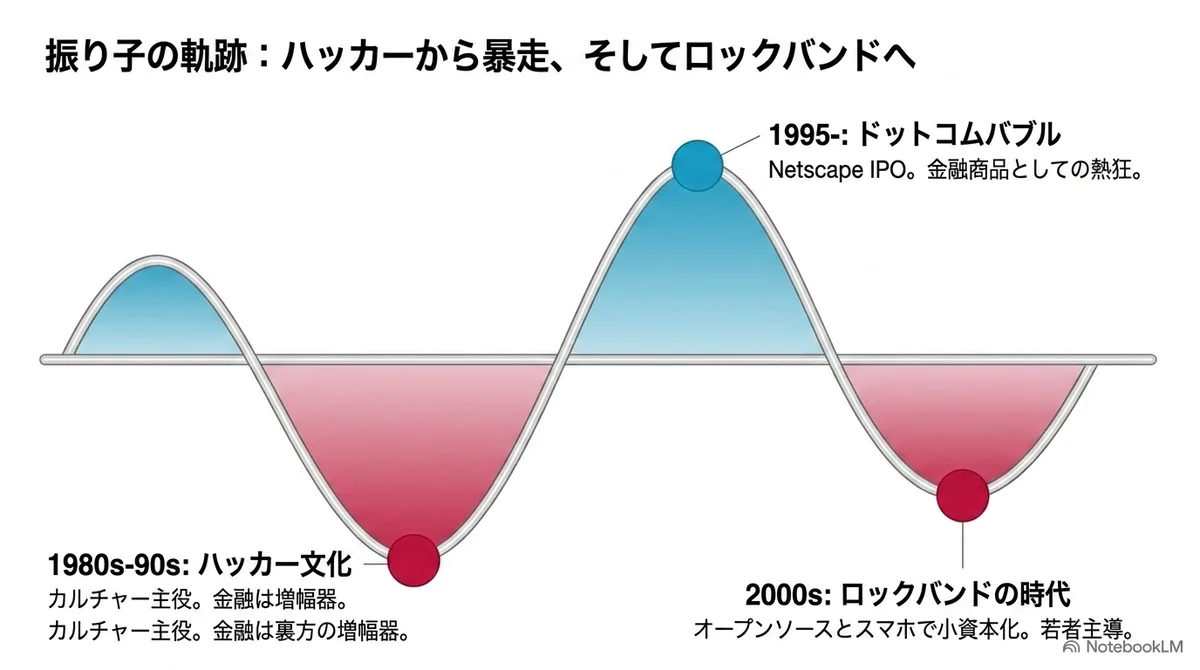
The protagonist of this period was still culture. There was the hacker culture descended from the Homebrew Computer Club, the anti-authoritarian aesthetic symbolized by Apple's "1984" commercial, and the ethics of reciprocity in shareware and free software. There were people who built things because they wanted to build them, and finance played a modest role behind them as an amplifier. That was the balance of power.
The first time this balance came close to reversing was the 1995 IPO of Netscape, founded by Marc Andreessen and others.
Just 16 months after its founding, it went public while still unprofitable, and its share price more than doubled on the first day. At that moment, "shares in a company not yet making a profit" became the object of a frenzy that drew in ordinary investors, and this style of investing spread to internet companies. It was a symbolic moment in which startups became known to the masses as financial products, and it can be called the first outward swing of the pendulum toward finance. Following it, "adults in suits" poured into the software field en masse, and the dot-com bubble occurred.
But this swing ran out of control from its own momentum, and the bubble burst. The collapse that began in 2000 lasted a long time; the NASDAQ fell nearly 80% from its peak by the 2002 bottom, and the pendulum was pushed back.
Still, the scorched earth was not left bare. Because so many companies were founded during the bubble, the American startup ecosystem steadily cultivated many talented people, along with the manners and forms of finance as applied to startups.
The 2000s: The Age of the Rock Band
The startups that emerged after the bubble burst in the 2000s were from an era when the pendulum swung back toward culture. It was the age of the geek again, not of the suit.
One reason was that building things became dramatically cheaper. Free open-source software stacks grew thicker, AWS appeared in 2006 so that buying servers was no longer necessary, and in 2008 the iPhone's App Store opened a distribution channel to individual developers. With a few hundred thousand or a few million yen, you could deliver a product to the whole world. Moreover, smartphone apps were also a frontier market belonging only to the young, where the adults had yet to arrive.
It was an era of culture's dominance, in which those who could build and those who could be amused had the advantage rather than those with money, and one in which the young and the rebellious could take the initiative. Y Combinator, which began in 2005, was a mechanism that rode this current well. Its initial investment was only the equivalent of a few million yen; to a community of hackers it provided a kind of real-business know-how different from an MBA's, and through Demo Day it built a circuit connecting them to the finance that remained as a legacy of the dot-com bubble.
In this era, the success stories of entrepreneurs, looking back now, seem to have taken the form of "a rock band story." Founders start with friends in a garage (a studio), thrill customers with a demo (a product), and shoot to stardom with a major-label debut (fundraising and IPO).
The plot in which a dropout youth or an immigrant rises on talent alone must have looked like a modern version of the American Dream itself. The 2010 film The Social Network showed that this story had become established as a genre of popular culture alongside music and sports.
The place where rock bands and startups intersected in reality, not just as a metaphor, was SXSW (South by Southwest). At this festival, which began as a music festival in 1987 and added film and multimedia divisions (later the Interactive division) in 1994, startups were treated quite literally as one genre of culture alongside bands and films. In 2007, the still-unknown Twitter placed screens in the venue's hallways and kept streaming attendees' tweets; usage jumped several-fold during the event, and it spread rapidly. In 2009, Foursquare made its debut on the same stage. It was a time when startups were discovered at a music festival in the same way that bands are discovered at live-house showcases.
It was not only SXSW. Jobs's keynotes had a heat like the cheers for a rock star performing a new song. Slush in Helsinki is designed as a startup festival that is itself like a club, held amid darkness and lasers. That technology events took on the form of festivals is itself one proof that people from two worlds were intersecting. The dress was T-shirts, not suits, the debut ritual was Demo Day, and the criterion of evaluation was "whether you made something cool." The protagonist of this era's story was not the investor but the founder, the individual engineer.
The 2010s: The Invention of the Unicorn and Financialization
What swung this pendulum toward finance again, and much farther than before, was the flow of money after the 2008 financial crisis.
With zero interest rates and quantitative easing, institutional investors around the world began wandering in search of yield. Government bonds couldn't earn anything. Listed stocks offered little appeal, and regulation of public markets had tightened. So, perhaps from the thought that the only option was to get in early on high-growth companies not yet listed, in the more lightly regulated private markets, even pensions, university endowments, sovereign wealth funds, and mutual funds began to bet directly on unlisted startups. Into the circuit that had opened in 1979, a flood of money finally began to flow.
The vocabulary that symbolizes this era is the "unicorn." When venture capitalist Aileen Lee coined the term in 2013, of the U.S. VC-backed technology companies she surveyed, 39 had exceeded a $1 billion valuation within ten years of founding. They were likened to a mythical creature because they were rare. Ten years later, however, the number of U.S. companies counted by nearly the same criteria had grown to 532, the same label had spread around the world, and the rarity had faded.
Was it around this time that the habit of talking about startups in units of money grew? News headlines changed with it. Once it was "they built something this cool." From this period it became "they raised this much," and money, not coolness, became the yardstick. That may have been necessary to expand the startup ecosystem in terms of people and funds, but it can also be said to have been the moment when finance began to eat culture again.
One of its culminations was probably the SoftBank Vision Fund in 2017. A single fund that raised about 10 trillion yen from Saudi Arabia's sovereign wealth fund and others poured tens of billions to hundreds of billions of yen into a single company, bringing in a new game of "deciding winners and losers by capital itself." Business valuations became prone to diverge from the businesses' actual current performance and came to be priced by a different logic. Startups delayed going public, grew huge while unlisted, and growth rate became the common language.
After that, passing through the peak of excess liquidity in 2021 and the sharp fall caused by the 2022 rate hikes, capital concentration is advancing again as of 2026, with AI, a theme that demands capital, as the detonator.
Just as in the picture Joseph Heath and others drew in The Rebel Sell, it can seem that the counterculture of startups was absorbed by capitalism and went on to inflate it.
And so what became huge in the 2010s was arguably not the startups themselves, but rather the asset management business that handles startups.
Capital Forces Dreams
The story so far, that finance swallowed culture, is only half right, however. A force in the opposite direction was also at work. Capital that had grown huge came to force entrepreneurs to dream big.
The mechanism lies in the return structure of venture investing. VC returns follow a power law, and a fund's performance is determined almost entirely by one or two extreme successes. If a fund is 10 billion yen, an exit of tens of billions of yen is meaningful. But when a fund becomes 100 billion yen or 1 trillion yen, then depending on the ownership stake at the time of investment and subsequent dilution, only a company whose market capitalization reaches several trillion yen can bring the fund a decisive return. In other words, a huge fund structurally needs a "world-changing story" badly. Humanity-scale declarations such as "organize all of humanity's information," "make humanity a multi-planetary species," and "build artificial general intelligence" were at once remnants of hippie and rebel culture and also the stories of the size most consistent with affirming and absorbing the volume of capital that had flowed in.
Moreover, capital changes not only the entrance to the dream but also the exit. Once a company has raised at a high valuation, the design of liquidation preferences on preferred stock and the dynamics that make it hard to cut a valuation make a small success easily regarded by investors as a failure. Depending on the terms, for a company that raised at a valuation of 1 trillion yen, a sale for tens of billions of yen is a defeat (though building a business worth tens of billions of yen is, in itself, a remarkable thing). In the world of culture, an indie label that is small but keeps going is a splendid success. It was the grammar of finance, not culture, that redefined that as failure. Continuing to paint humanity-scale dreams became, for entrepreneurs, a kind of metaphorical covenant.
In the previous essay I explained from the side of ideas why Silicon Valley entrepreneurs can use "humanity" and "civilization" as subjects so casually. What I want to add here is the explanation from the side of finance. A humanity-scale subject was a product of the frontier's position and, at the same time, a product of the size of capital. Entrepreneurs entrusted with hundreds of billions or trillions of yen come to be expected to tell stories about humanity and nations. And the more extreme the story becomes, the more attention it draws from the world, and as long as it is accompanied by some results, it attracts still more money, and the story is amplified.
From Connoisseurship to Price
A scene in culture is, at bottom, an apparatus of evaluation. What is good is decided by the discerning eye of fellow practitioners and the heat of the audience. Finance is also an apparatus of evaluation, and it expresses what is good as a price. What happened over the past decade is that the center of gravity of the evaluation apparatus shifted from the connoisseur's eye for coolness to price.
Of course, price is not the opposite of connoisseurship. The price of an unlisted company is also the result of investors' discernment, negotiation, and supply and demand converging. What happened here was not the disappearance of connoisseurship but a growth in the weight of the kind of evaluation that is easy to express as a price.
The problem is that price strongly demands what can be measured. Metrics, market size, comparables (comps). Or LTV, CAC, and so on. These are worked over with logic to gauge a business's value. But in the earliest stage of something truly new, none of them exist. This is because newness, by definition, means that the yardstick to measure it does not yet exist. The apparatus of connoisseurship existed precisely to evaluate that unmeasurable stage. When price covered it up, the ecosystem took on a blind spot that overlaps exactly with the place where the future is born.
AI is one example. The achievements that supported the development of deep learning came from universities and corporate research labs, and the Transformer, one of the core technologies underlying today's generative AI, emerged from Google researchers. OpenAI began as a nonprofit, and around it open-source communities were refining the technology. While the price-based evaluation apparatus repeated its type-matching of "XX service for the XX industry," the main body of the next era was growing in places where a different kind of connoisseurship, other than short-term market price, was alive (communities of research, hobby, and mission). This does not mean, however, that it had nothing to do with finance. Corporate profits, donations, and later enormous capital also supported research and commercialization. And the moment it hatched, capital rushed in like an avalanche.
Here there is an asymmetry: the community bears the cost of discovery, and the company recovers the profit after discovery. Universities, public research, open source, and users' experiments nurture possibilities that do not yet belong to anyone. Capital selects, from among them, the branches in which commercial viability has become visible, bundles computing resources, intellectual property, and distribution, and encloses them as a business.
This enclosure is not in itself bad. Delivering a discovery to society requires organization and capital. The problem is whether the fruit produced there has a circuit by which it returns to the community that produces the next discovery. If culture discovers and finance amplifies, the pendulum will eventually stop. Only when there is a return path as well, in which funds, people, and knowledge go back from finance to culture, does it become a back-and-forth movement.
Having come this far, the relationship between culture and finance appears not as a simple opposition but as a single movement. When culture discovers and begins to evaluate something not yet measurable, finance amplifies it. As amplification advances, finance takes over the thing itself with the yardstick of price, and new discovery stops. Then the next discovery happens in a scene in the wings, and capital rushes in there like an avalanche. This is a pendulum of continuous motion.
The recent pendulum between culture and finance can be described like this: it swung toward finance in the late 1990s, returned toward culture in the 2000s, swung hard toward finance in the 2010s, and is now moving again with AI as the trigger. Looking back now, the early 2010s, when Japan's startup scene began to heat up, was precisely the borderland between culture and finance. The startup scene then had a strange cohabitation of different kinds of people, from culture and from finance, and it was a time when their balance of power was gradually shifting.
The pendulum in America has not returned to the same place, and its amplitude has grown with each oscillation. The flood of zero-interest money was bigger than the dot-com frenzy, and the concentration of capital in AI now under way, while it does not reach the whole market of 2021 in absolute amount, is higher in its degree of concentration on a specific theme.
The Split Pendulum
So where is the pendulum now? The straightforward reading is that it sits at the peak on the financial side. In reality, however, the pendulum seems to be splitting in two and changing character.
AI has simultaneously produced businesses that are extremely capital-intensive and businesses that can be started with extremely little capital.
Developing foundation models has capital needs reaching the trillions of yen, with sovereign wealth funds and nations themselves as counterparties, reaching the very pole of finance. In the application layer, on the other hand, AI itself lowers development costs, and a handful of makers, sometimes a single one, can build part of what once required a larger team and more funding. It can also be said that the destruction of infrastructure costs that AWS brought about in the 2000s is now happening again in development costs. Of course, cheaper prototyping and development is not the same as cheaper commercialization, which includes customer acquisition, data, quality assurance, regulatory compliance, and operations, and what is becoming small-capital is only a small part of the building. Still, a replay of the old AWS is certainly under way.
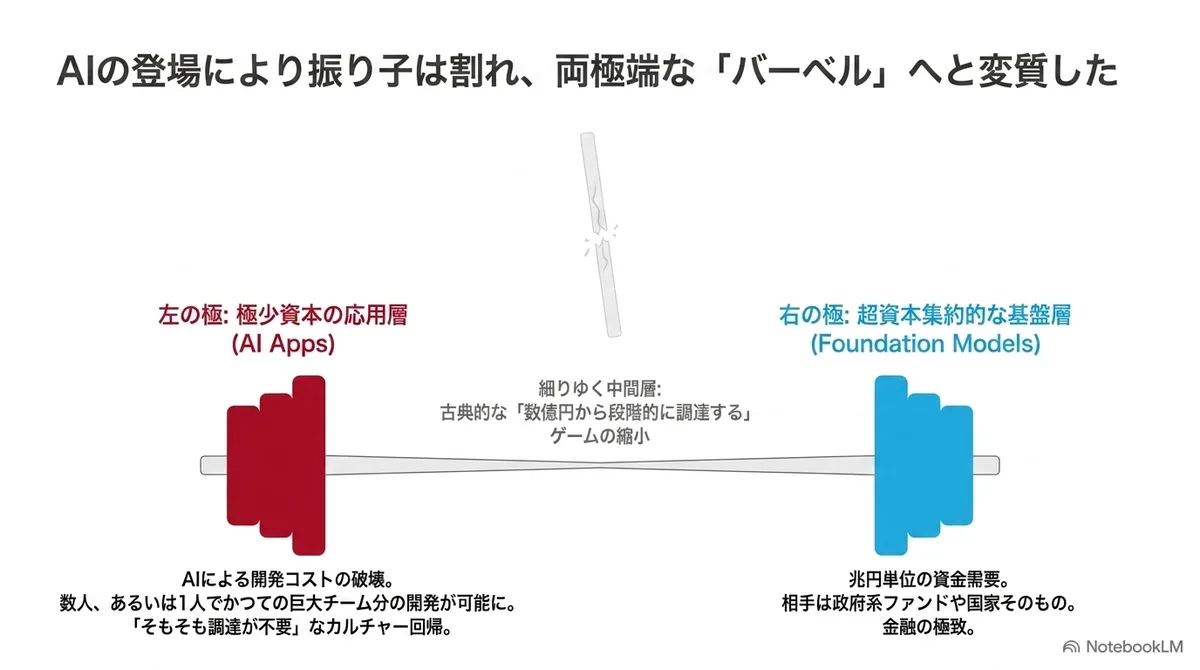
While both poles swell at once, the middle appears to be thinning in relative terms. The classic middle game of 2010s ventures, raising a seed of a few hundred million yen and building up in stages through Series A and B, is under pressure to wither. The cheapness on the application side turns into "no need to raise at all," and against the hugeness of the foundation layer, mid-sized capital is relatively underpowered. Looking at America, even VCs themselves, the providers of money, are under pressure toward polarization, between megafunds and everyone else (in Q1 2026, just five megafunds accounted for 73% of all VC fundraising). The pendulum seems to be ceasing its oscillation and tearing in two, taking the shape of a barbell, with weight only at the two ends and a thin middle. Solve a small problem in front of you in a small way, or solve a big problem of the world in a big way. Those two poles are becoming prominent.
Japan: Startups as Indies
The 2010s American model that Japan took as its example has begun to change in this way. So what kind of ecosystem was Japan, the one doing the chasing, in the first place?
Japan's modern wave of consumer-internet startups began around 2000. (At the time the general term was "venture companies," so I will use the two terms somewhat differently. Also, the history of Japanese venture companies and VCs itself goes back further. JAFCO was founded in 1973, and there were other lineages as well: manufacturing, financial-institution-affiliated VCs, and university spin-offs.)
The wave of internet companies in the 2000s that this essay deals with can be understood as having arisen from an ecosystem entirely different from America's. This group came not from the state (the military) or finance, where American startups originated, but from indie culture. In terms of the pendulum, Japan's culture pole was strong.
As if importing the American dot-com bubble, the Bit Valley frenzy erupted in Shibuya around 1999. The people who founded Japan's internet companies of the 2000s there were mostly from the subculture sphere: personal websites, text sites, rock bands, and doujin-style creation. The i-mode service that appeared at the same time (a pity that, in hindsight, it became a Galapagos platform) also mattered, since it supported the market for IT ventures then. A cluster of Japanese internet ventures was born as the PC culture long rooted in Japan fused with a culture of "making interesting things" and "doing what you want to do." That Shibuya became the center was due not only to cheap rent but surely also to its being a town of youth culture.
This indie character was also supported by a form of finance particular to Japan. Japan had no system equivalent to the 1979 ERISA rule, and the sluice gate through which pension money could flow into ventures remained long and narrow. The providers of VC funds were mainly financial institutions and operating companies; funds were small, and so was the amount that could be bet on a single company. On the other hand, the Tokyo Stock Exchange Mothers market, a "market where you can list small and early," emerged around 2000. Large capital did not come in, but a small exit was close at hand. The rational way to fight in this environment was to build what you liked for the domestic market and list at a market capitalization of a few billion to 10 billion yen or so. For better or worse, a mechanism converging the whole ecosystem there came into being.
It was not only a matter of volume. There was also a difference in the culture surrounding capital. The backbone of postwar Japanese finance was bank-based indirect finance. Money was something you borrowed and repaid, land, equipment, and guarantees were prized, and a business plan was read as a repayment plan. If you attached a personal guarantee by the representative, a business's failure would spill over into the entrepreneur's personal debt. In recent years, systems that make management guarantees unnecessary have been put in place, but in an environment where failure = bankruptcy was taken for granted, hypotheses of a size that did not fit a repayment schedule, or incalculable plans, could not be written in the first place.
Equity has a different nature. There is no obligation to repay, and investors bear the risk on the residual value of the business, including the story and confidence in the management team. In other words, equity is a financial product that can take on a large upside not yet determined, a mechanism that converts a story into money. Indeed, finance has the term "equity story," but one rarely hears of a "debt story." Of course, debt also evaluates future cash flows and business outlook, but it emphasizes the predictability of repayment, not the upside of the story. The history of American culture and finance that we saw in the first half was, in a sense, also a history of extending this "circuit that puts money behind uncertain future value" and "circuit that converts a story into money" from pensions to public markets to sovereign wealth funds.
The Scale of Hypotheses and the Scale of Capital
Setting the histories of the two countries, America and Japan, side by side, one sees that the scale of hypotheses and the scale of capital define each other.
Capital demands a hypothesis of its own size, and a hypothesis attracts capital of its own size. This back-and-forth proceeds like meshing gears. In America, the rotation began from the capital side with 1979 as its starting point, and by the late 2010s it reached the point of forcing humanity-scale hypotheses. That was the result of the American startup ecosystem expanding at an accelerating pace, drawing in the world's money together with the expansion of global financial markets.
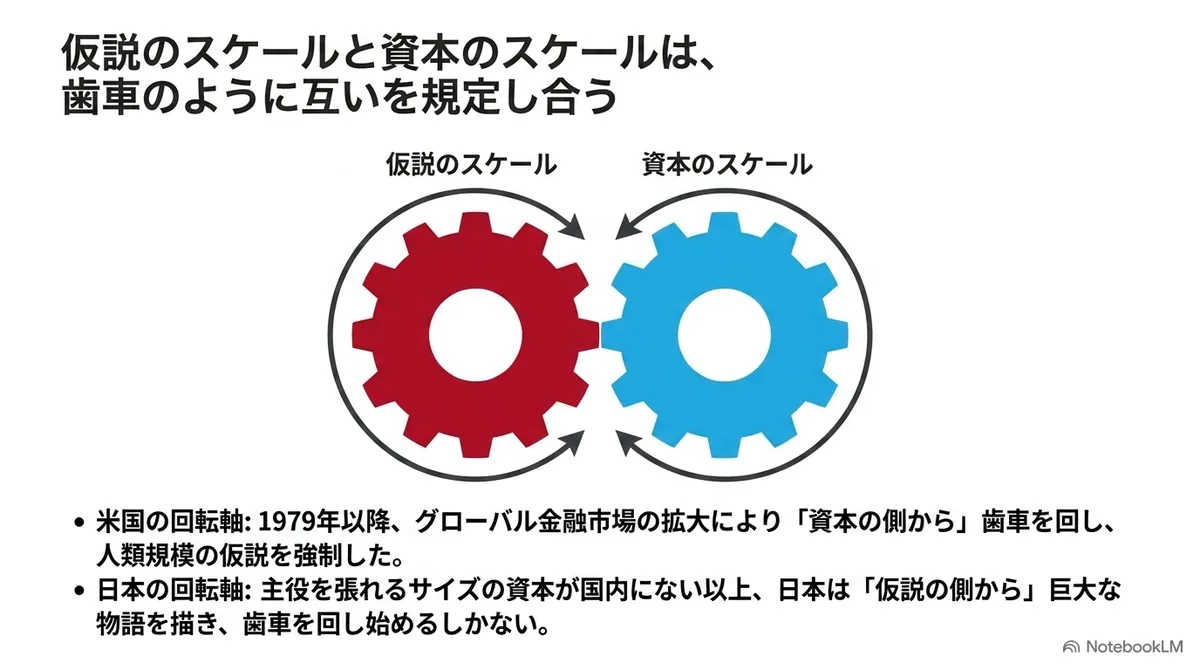
In Japan, on the other hand, this gear started turning about a quarter century later, with the arrival of the Mothers market, and in the meantime, unable to absorb global finance, it settled into a balance at a point optimized for the Japanese market. I think that is the level of roughly 800 billion yen a year in domestic startup funding that has persisted for the past several years. (Whether funding supply of this scale has led to sufficient growth is itself somewhat questionable...)
One might call this stagnant level a failure of Japan, but I should also say that culture-oriented startups had an aspect of correct adaptation to the times. The "market in which everyone wants the same thing," built up by mass media and mass production in the latter half of the 20th century, was dismantled along with the internet, and there was a festive atmosphere in which the world was flattening, liberalizing, and connecting. In that setting, demand branched into countless tastes and communities, and what told you what would be wanted next was not market research but the heat of the cultural sphere you belonged to. In a diversifying world, culture becomes the most sensitive apparatus for discovering value. The long tail so often cited in the Web 2.0 days was precisely a prophecy of this accumulation of niche demand. That culture-oriented entrepreneurship was dominant around the world in the 2000s can be called inevitable.
But practicing this in Japan came with built-in upper limits by design.
The first is the upper limit of cultural translatability. The market for a business born of culture is limited to the community that can share that culture, which generally means that country. Japan itself has several examples of global markets arising from a narrow cultural sphere, starting with games and anime, but successes are very few. Unless its value, embedded in context, is translated into a form (a product, a standard, a protocol) that people who do not share the context can use, it will not grow large. And as long as it is not translated, the market is capped by the population and purchasing power of that cultural sphere. America was in a position to spread its market globally, along with its own culture, through hegemony, but other countries, Japan included, were not.
The second is the upper limit of the reach of hypotheses. The subject of the motive "I want to do something interesting" is the individual. When the subject is an individual, the size of the hypothesis tends to stay within the range a single person can imagine as their own desire. One person's "interesting" is enough to produce a product, but it may not reach the redesign of an industry or the remaking of a social system. To begin with, the person themselves probably would not feel the need.
And the third is the upper limit of the capital circuit we saw earlier, that is, small-scale convergence made by little capital and small exits. Markets that stop at the cultural sphere, individual-sized hypotheses, and small-scale capital circulation. Once these three gears mesh, even if someone has high aspirations and a big hypothesis, as long as the ceilings of market and capital remain, they are pulled back to this equilibrium point.

Recently, the Tokyo Stock Exchange Growth Market's 10-billion-yen listing maintenance standard has been a topic of discussion. Another wall that stands in the way is that going beyond this 10 billion yen is not on the extension of piling up the sales of existing businesses (a likely case for many businesses). When a company operates a business with a limit to its market size, escaping this equilibrium requires a change that could be called a phase transition, remaking product, organization, capital, and demand all at once. But if it IPOs early, it is measured by the quarterly yardstick from the moment it lists, making it hard to keep exploring. Yet if liquidity and market capitalization remain small, it is too small to attract the large capital the phase transition requires. There is a structural problem in which many companies that stopped short of 10 billion yen lose their opportunity in this limbo.
Now, the discipline of the listed market, at least one side of this wall, is being moved by the revision of the Growth Market's listing maintenance standards. The revision was completed in December 2025, and from 2030 a standard requiring a market capitalization of 10 billion yen or more five years after listing will apply. However, this changes the discipline of the listed market and is not a system that directly solves the shortage of later-stage funding itself. Concerns have also been raised at the same time about whether tightly meshed gears can be turned in a different direction, and whether the ecosystem as a whole might break in the process. Even so, since leaving everything unchanged also carries the risk of destruction by outside pressure or of erosion with time, it can be read as having been pushed through. Japan's ecosystem is in a transitional period, at the point of whether it can bring about a phase transition.
What It Takes to Break the Equilibrium: The "Big Hypothesis" as a Vessel for Capital
Let us look again at the roughly fifty years of "startups," an activity with the dual nature of culture and financial product, from the viewpoint of who is the protagonist of the story. Simplifying knowingly, the protagonist of the 2000s story was the individual and culture. It was a story of a rock band's rebellion and rise. From the 2010s on, however, the protagonist, while nominally still the founder, was in practice an age in which capital and finance held the upper hand. It is a story in which the size of the fund determines the size of the dream, and the founder performs the specifications demanded by capital.
Seen from the viewpoint of startups as builders of growth industries, Japan's current situation is a hard road on both the culture side and the finance side. If we continue exploring the path of expressing individuality and produce many startups based on culture, we will either reproduce the equilibrium at the 10-billion-yen wall, where the three gears mesh, or produce a group of companies optimized for the domestic market and somewhat different from companies that earn foreign currency. On the other hand, even if we explore the path of finance, there is no capital in Japan of a size that could play the leading role, and since money can move freely, it will be sucked into America.
If the challenge for Japan's startup ecosystem is how to break this equilibrium, I think the key lies in how large a hypothesis one can draw. What to do with the industries of Japan and the world. What to do with the future of this country, this region, and eventually the world.
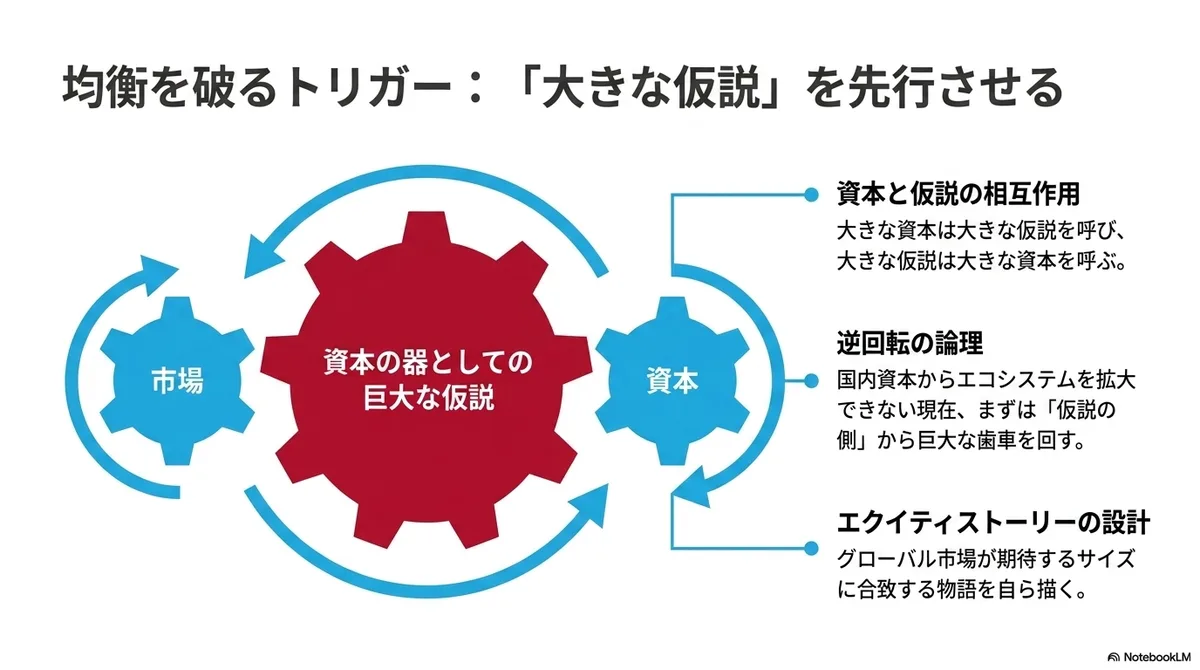
Big capital calls for big hypotheses, and big hypotheses call for big capital. If we cannot turn this structure from the side of capital, we have no choice but to turn it from the side of hypotheses. America grew capital and hypotheses larger in turn, but now that national economies are globally connected and the growth of each country as a whole is not expected to be so large, I think Japan's ecosystem is not in a situation that will let us climb the stairs one step at a time. That is exactly why my current hypothesis is that we need to draw a "big hypothesis as a vessel for capital," one that matches the size global capital expects.
The order may sound backward. Even so, there are two reasons I think this leap is not a pipe dream.
The first is that Japan itself has precedents. In 1946, in the burned-out ruins of Tokyo, Masaru Ibuka wrote the founding prospectus of Tokyo Tsushin Kogyo (later Sony), which set out a hypothesis on the scale of rebuilding Japan through technology, at a stage when there was no backing of capital whatsoever. In 1954, Honda Motor, still a single manufacturer in Hamamatsu, declared to the whole company its entry into the Isle of Man TT race, the world's highest peak. It was a declaration made at a stage with no basis for winning and no capital to fight in the world. In both cases the declaration came first, and the technology and achievements that followed drew people and money. Of course, one cannot generalize from success stories alone. Even so, the order in which aspiration precedes capital is not a new challenge for Japan, but a path that was once realized. If anything, the indie-style entrepreneurship of the 2000s may have been the exception in the history of postwar business founding.
The second is that the location of the bottleneck is shifting. The gap between the world's huge deals and Japan's total funding of around 800 billion yen leads, by conventional wisdom, to the conclusion that "there isn't enough money." But the government has already shown its intention to strengthen the supply of funds, and policies to draw in overseas institutional investors are also in motion. What is clogged is not only money, but the circuit connecting an equity story worthy of pouring money into with growth funding suited to it. If equity is a device that converts a story into money, then without a story worthy of it, money will not flow even if the circuit is opened. Japan, too, is entering a phase in which capital waits for hypotheses.
There are things entrepreneurs can do to start turning the gears from the side of hypotheses. First, design the reach of the hypothesis not from the capital that currently exists in Japan, but from the problem to be solved and the capital it requires. Second, design the flow of capital: for example, the design of shares and contracts that allow overseas money to flow in. However, simple globalization also carries cautions from the government's point of view, because there is a possibility that only the most lucrative stage of a growing business will be taken away by overseas investors. And for individual entrepreneurs, it is often more rational to found a company in America than in Japan, so.
Some may feel that "telling people to hold high aspirations is, in the end, just an appeal to grit." What this essay has argued is the opposite. America's high aspiration was a product of the spirit and, at the same time, a product of the structure of capital. If so, the proposal to put aspiration first in Japan, where the structure is still weak, is not spiritualism but a matter of technique: starting up the same structure from another entrance.
Making Use of the Barbell Situation
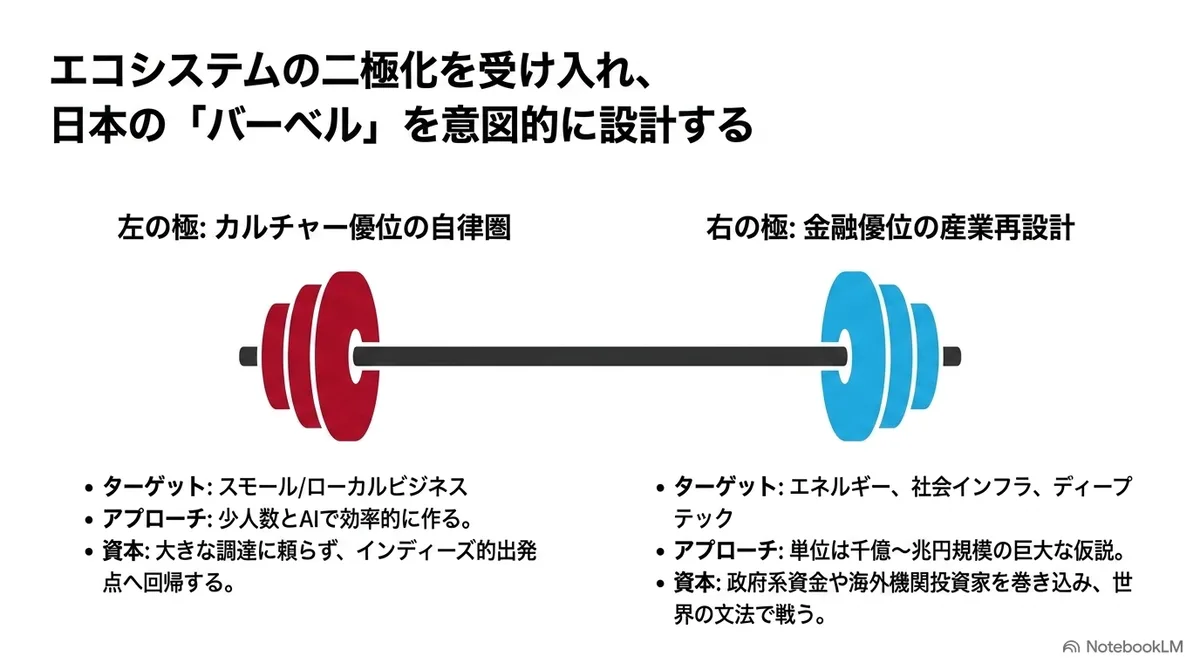
So far this has been about the entrepreneur's side. Next is the ecosystem's side, a question of resource allocation: where to direct the water of the sluice gate that is beginning to open. Earlier I said that the split pendulum, left alone, will take the shape of a barbell. In Japan, however, I think it will not come about naturally, because both policy and the market are still designed around the 2010s middle game. If polarization pressure is intensifying worldwide, we need not merely accept the barbell as an observation but make use of it.
Then, considering how each end should be designed, differentiation, deliberately separating left and right from the yardstick to the form of capital, becomes the center of design. The left pole, "small businesses," is small business and local business, a domain where culture holds the advantage. They are built efficiently by a small team with AI, do not depend on large fundraising, and have their value assessed by connoisseurs of local and cultural spheres. The right pole, "big businesses," is hypotheses on the scale of industry, nation, and world. The unit is hundreds of billions to trillions of yen, the time horizon is over ten years, the providers are sovereign funds, overseas institutional investors, and the balance sheets of large corporations, and energy, defense, infrastructure for a shrinking society, resilience to disasters, and foundational technologies could be named as its domains. It also means that the single activity of entrepreneurship branches into multiple activities of differing natures.
However, I would like to attach a reservation to having named national capital as a provider for the right pole. State money is money that can wait longer than VCs, and it is also of a larger order of magnitude. That VCs around the world are swarming to defense tech is easy to understand from the logic of capital. But in a business where the state has become the largest customer, both demand and evaluation are subordinate to the state's convenience. If the administration or the security environment changes, orders vanish, and the success or failure of the business is decided not by the market but by politics. Because lobbying decides success or failure, the market could conversely end up eating the public. Just as finance ate culture, finance may even swallow the public sphere.
Conversely, there is also the path of living only at the left pole: a Japan that gets by spinning small, good, culture-led businesses. As a way of life for individuals, this can be quite rich, and I think it should not be denied. But it is also true that it is difficult to build a national growth strategy or the economy as a whole on that alone. The money circulating within a domestic economic sphere that shares a culture can only swell to the size of that sphere. Japan is also a country deeply embedded in the global economy: it imports energy and food, and the value of the yen and the management of pension assets cannot be separated from the movements of world markets. Winning foreign equity money is not the only path, but if you want to draw in the world's capital, you must understand the grammar of that finance and fight on the same field under the same conditions.
In industries where economies of scale and network effects operate strongly, the number of companies tends to converge to a few. In a globally connected world, a handful of top companies in the world hold an overwhelming advantage, and if you fight in that world you have no choice but to aim for that position. What can be asked is not whether to turn our backs on global markets and finance, but how to face them. How to form hypotheses at the level of nations and the world. Whether we can produce people, even if few, who take on problems at that level. If we do not think about it before we are pulled further behind, the gap will widen at an accelerating pace. That is exactly why, if Japan cannot be separated from finance and capitalism, it needs to face them.
Where Culture Stands Now
Meanwhile, I want to consider where culture, which was supposed to be one end of the pendulum, is now.
I certainly do not think "the age of culture has ended." But it does seem that "culture is moving away from the startup as a form" is happening. In the 2000s, to bring what was born from culture into the world, the startup form of founding a company, raising funds, and going public was a powerful vehicle. But that vehicle became a tool of the capital side over the course of the 2010s. And if, thanks to AI and the like, a few people can build without fundraising part of what once required large fundraising, culture-originated making has no need to perform an equity story. People who would have become entrepreneurs had they lived in the 2010s can now earn a living as YouTubers.
In a sense, the left pole of the barbell may be the form culture takes after shedding the startup form. For Japan this is not new, either. For Japanese internet startups that began with indie culture, the left pole is also a return to the starting point.
Culture's other home is the wings of the stage. As we saw in the section on the shift from connoisseurship to price, the main body of the next era was growing in places that short-term market prices had not yet reached (for example research, hobbies, open source, and communities of mission). Culture continues to operate there as an apparatus of discovery. As deep learning was, the next something will probably also hatch outside short-term market prices.
In short, one can sum it up this way: the era of culture in the context of startups is ending, but culture itself lives before and outside finance, and the 2010s, when the two were fused, were rather a rare period. And perhaps culture is parting ways with the other pole of the barbell: the people who build big businesses aligned with the problems of nations and the world, and with national industrial policy.
Conclusion
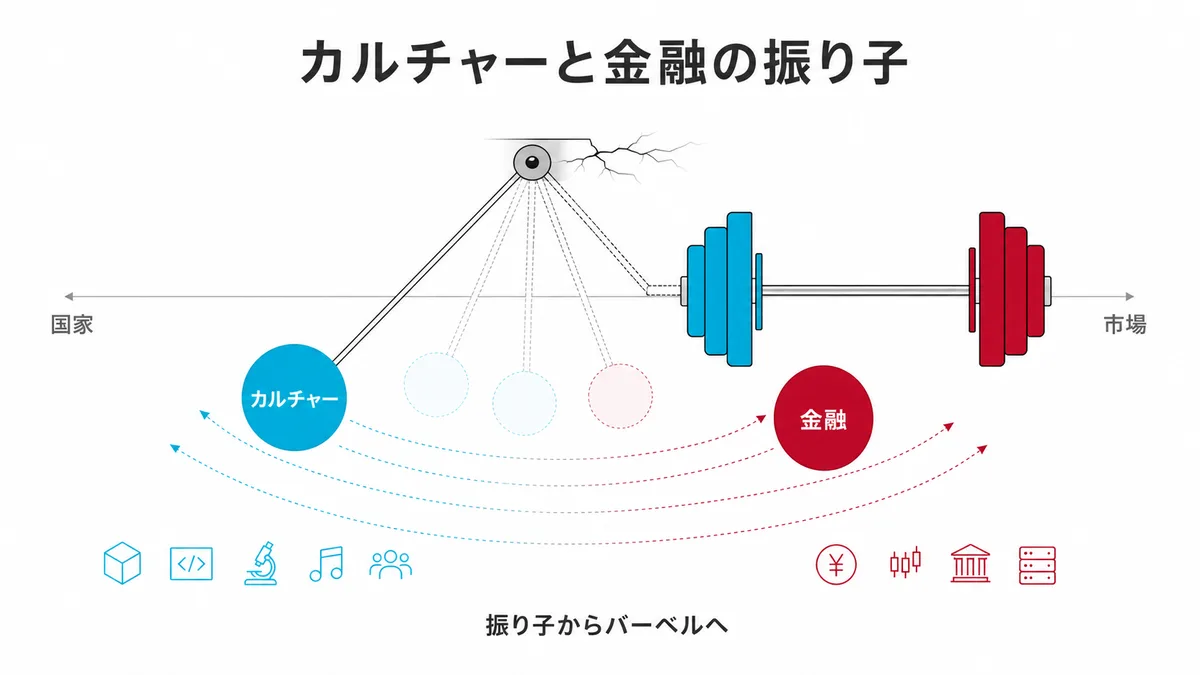
America's roughly fifty years were a history of the pendulum between culture and finance. As its oscillation grew wider, the pendulum now seems to be splitting in two at the financial pole, which demands humanity-scale hypotheses, and changing its shape into a barbell.
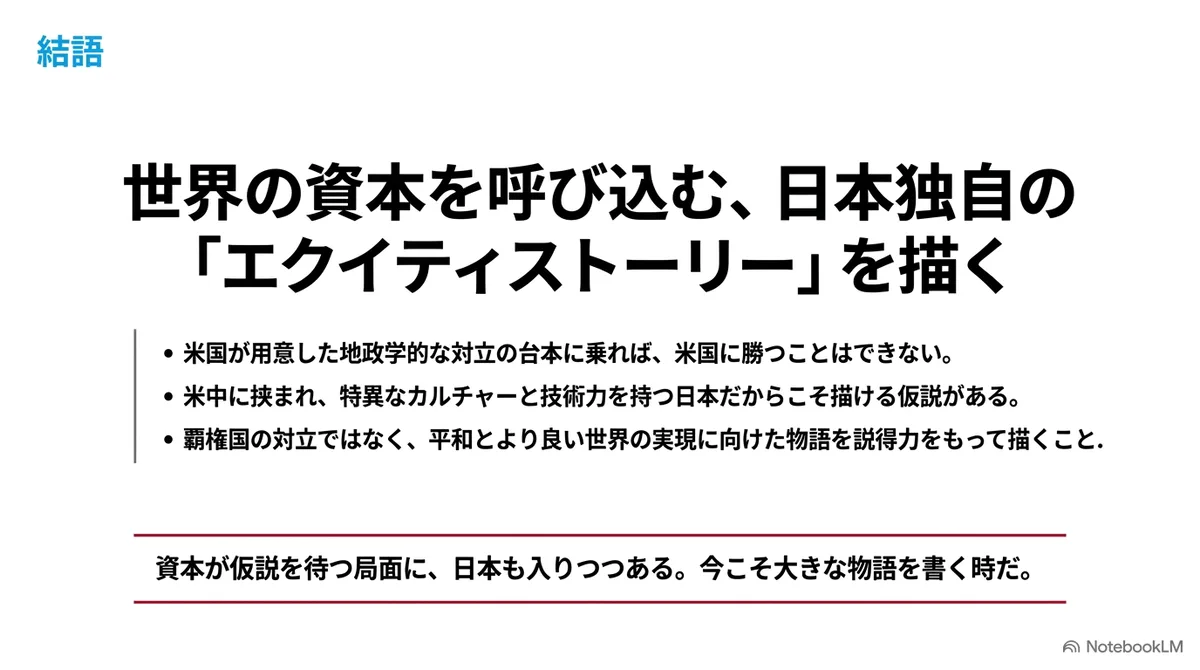
It would be difficult for Japan to follow this continuous growth of culture and finance step by step from here. What Japan can probably do is prepare a vision and hypotheses as a vessel matched to the size of the world's capital, and connect with that capital.
On the other hand, this also carries a risk. An equity story that takes on uncertain future value is easily rewritten into a story of confrontation and defense when it joins with the state. A story that names an enemy has an easier time raising money, being backed by the readily understood demand of fear.
One could ride that story and gather the world's capital with a story of friend and foe. But one could also take in the swollen power of global finance with a story that directs it toward a better peace and a better world. This situation of being asked a humanity-sized question is both a risk and an opportunity.
If you ride a story and a script prepared by someone else, you inevitably end up second. That is exactly why, rather than being pulled along by today's stories of hostility, what is being asked, I think, is whether we can draw, persuasively, a "Japanese equity story" for turning the story of making a better world into funding. If we can do that, we can draw the world's money to Japan.
It is, so to speak, the question of how persuasively we can draw not only Japan's growth strategy but the world's growth strategy, and that means hypotheses and stories in answer to that question are being demanded.
Of course, this is not only Japan's challenge but one asked of the whole world. But Japan is a country that has enjoyed the benefits of being an advanced nation since the Second World War, and it is a country in a special position between the U.S. and China. It is also a country that those around it expect much from, for its culture, such as entertainment, and for its technological capability.
Precisely because it is such a place, I think it may be possible, to a certain degree, to draw a new big hypothesis and deliver it to the world.