Why Follow Ideas for the Sake of Business Now?
This article was machine-translated from Japanese by AI (Claude). It may contain errors. Read the original Japanese article.
Once, the materials needed to anticipate the business environment were technology and the market. Now I feel that "ideas" are being added as a third variable.
Of course, there were other business variables as well, such as policy and regulation. What has changed is that following individual policies alone is no longer enough; we now need to trace them back to the ideas at their source.
This is not a story about how "the humanities are important as a cultural education" or "useful when talking with people from other countries." It is an actual problem: shifts in the ideas that underlie society are beginning to reach our real businesses and lives through regulation and markets.
To give a familiar example, all kinds of policies are being rolled out under the name of "○○ security," and they are starting to affect business. The protectionist tariffs of recent years are one case. Such policies affect prices and impose new constraints on business, and conversely sometimes become new business opportunities.
What these policies have in common is that they deliberately sacrifice short-term price efficiency and the like. In place of the management and policy premise of "liberalization and efficiency" that was shared for roughly 30 years after the Cold War between multinational corporations and the policy elites of the major advanced economies, "things more important than freedom or efficiency" are being set.
My current view is that these ideas, once stable and shared, are now wavering, and that we need to watch them as a variable.
What makes this movement complicated is that it is not a case of one specific new idea overwriting the old one; rather, multiple ideas are jostling over who succeeds the formerly dominant one.
Seen this way, the changes in regulation and markets right in front of us are only on the surface, and we must look at the movement of the tectonic plates beneath them. Looking at this ideological tectonic shift, such as "what society treats as a problem, which outcomes it considers desirable, and which policy instruments it comes to regard as legitimate," has become important once again for thinking about medium- to long-term business strategy.
How Ideas Propagate to Business
As a way of reasoning about why ideas matter for business, there are the pace layers that Stewart Brand presented in The Clock of the Long Now. This view understands human civilization as six layers, in order from the fastest-changing:
- Fashion
- Commerce
- Infrastructure
- Governance
- Culture
- Nature
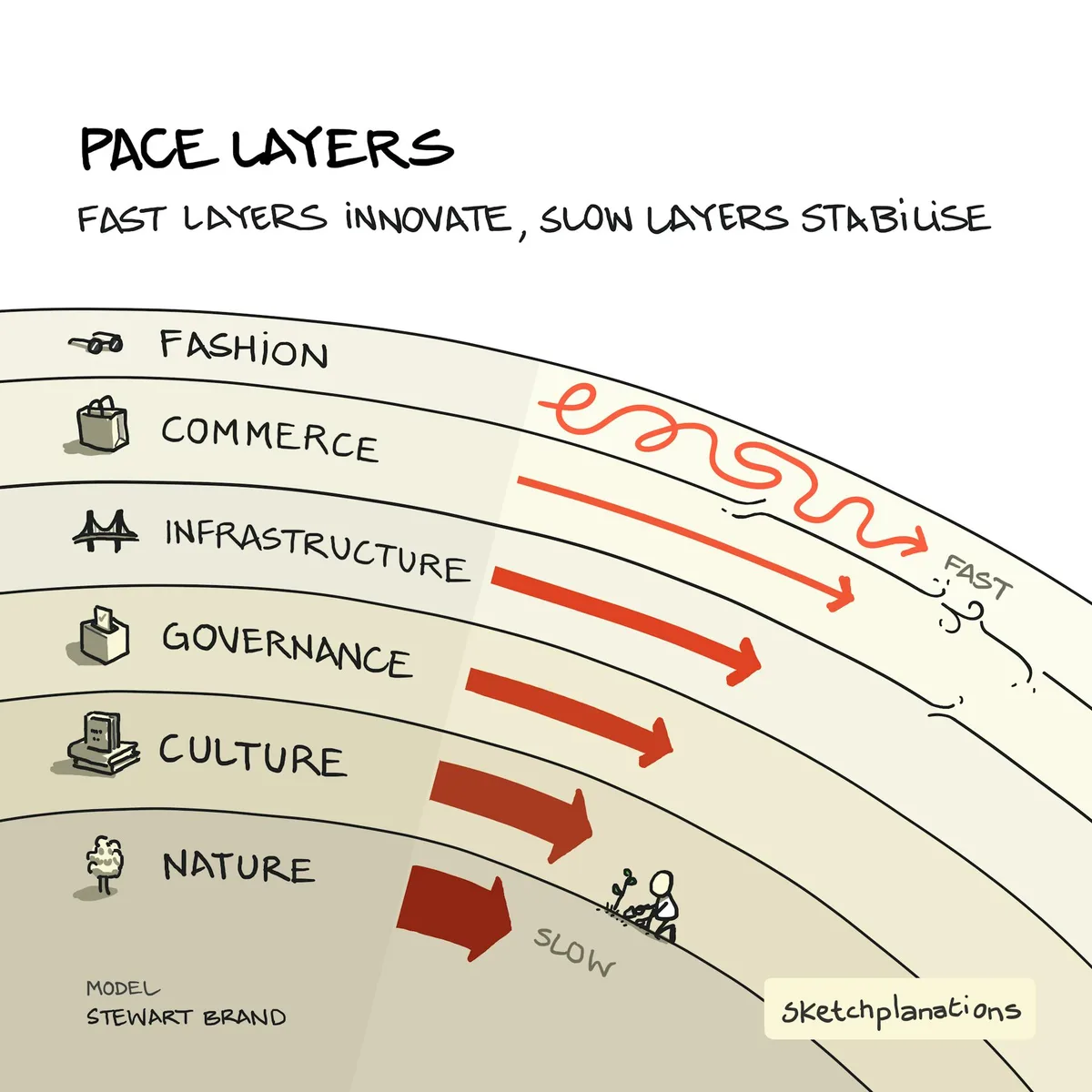
Image: Jono Hey, Sketchplanations
Fast layers generate trial and learning, and slow layers supply memory and stability. Slow layers rarely move, but once they do, their influence lasts a long time across all of the faster layers. Corporate management has mainly moved at the speed of the "commerce" layer.
Drawing on this idea of pace layers, this article organizes the path by which ideological change reaches business conditions as follows.
Ideas → Policy regime → Policy → Market → Business
The role of each is as follows.
- Ideas: normative ideals and cognitive frameworks that orient what society considers desirable and what it recognizes as a problem
- Policy regime: a framework in which a paradigm of policy goals and policy instruments, the political and social coalitions that support it, legal systems, administrative organizations, and so on support one another and sustain a particular policy direction
- Policy: implements policy objectives through laws, taxes, subsidies, regulations, disclosure, standards, public procurement, and their concrete operation
- Market: market conditions such as prices, cost of capital, demand, market access, and terms of trade
- Business: business itself. It responds by changing products, technologies, supply chains, investment, and organization.
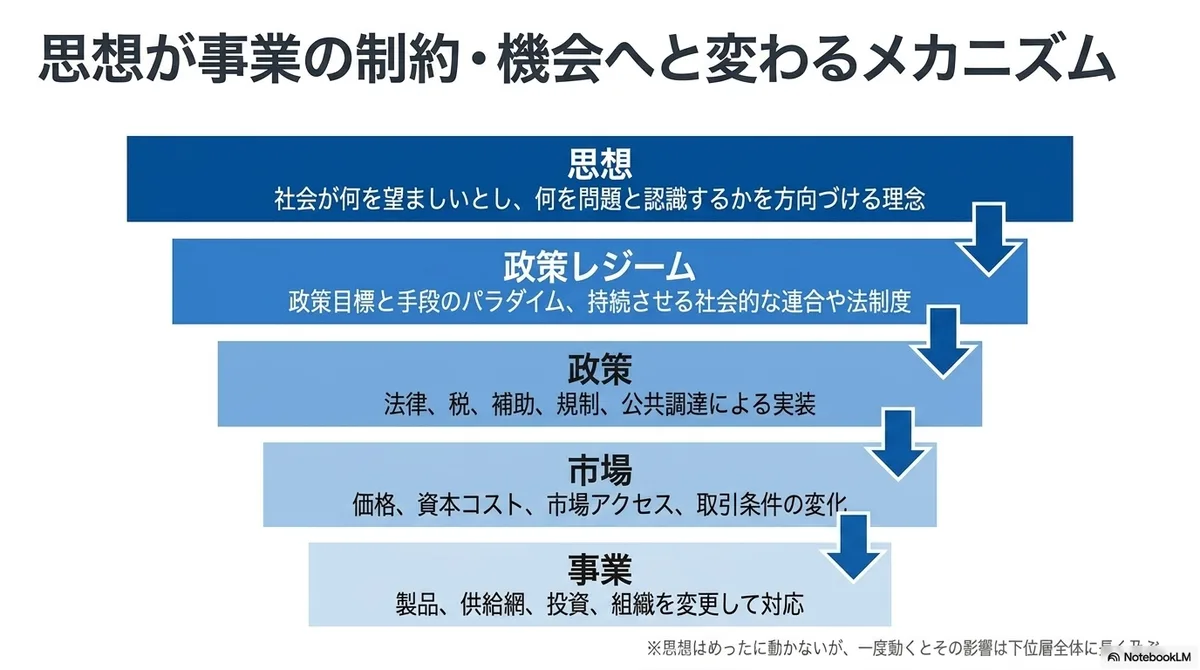
The basic flow is this: an idea is first put forward as a normative ideal; once adopted, it becomes a regime; policy is made on the basis of the regime; policy changes the competitive conditions of the market; and the market forces a response from business.
Of course, this is not one-directional causation. Companies and investors lobby for policy formation, the emergence of a technology can produce a new framing of problems, and a crisis or accident can move policy first. Specific events such as wars, epidemics, and financial crises can also influence ideas.
Even so, when thinking about the long-term business environment, it is worth looking at what regimes and ideas support each individual policy.
The Efficiency Regime in a Flattened World (1990 onward)
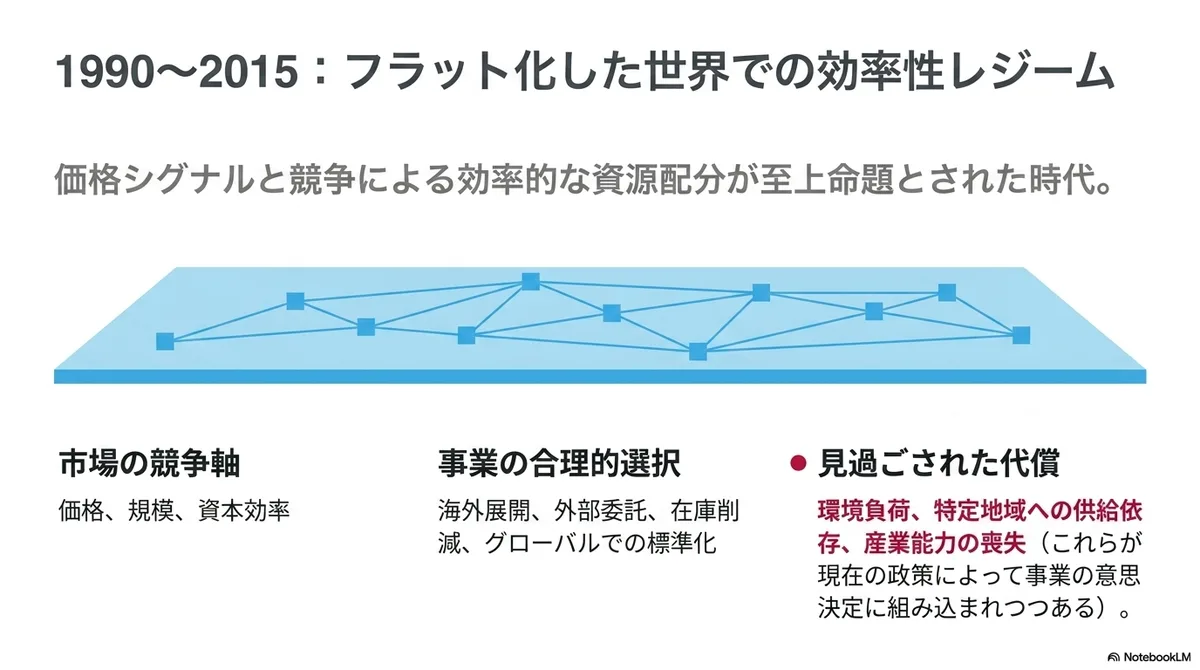
Let us look back at the period since the 1990s through this layered way of thinking.
After the Cold War, what strongly shaped the economic policies of multinational corporations and the major advanced economies was an idea and a regime based on efficiency through international division of labor, market competition, and liberalization. The thinking was that interdependence contributes to peace and prosperity, and that by lowering barriers to trade and investment and letting price signals and competition work, resources are allocated more efficiently.
Of course, it is not that governments did not design markets. Governments designed markets through trade agreements, competition policy, financial systems, intellectual property rights, and so on, but that design adopted policy paradigms such as openness, competition, consumer benefit, and capital efficiency. The Washington Consensus too originally left a regulatory role for government, but it was later broadly extended to mean market fundamentalism.
Under these normative ideals (ideas), regimes and policies were built; in markets, price, scale, and capital efficiency became the main axes of competition; and in business, expanding overseas, outsourcing, cutting inventory, and global standardization became rational choices.
Around 2005, Thomas Friedman's The World Is Flat sold very well (in 2006 in Japan), and it seems to me that it expressed well just that phenomenon, and that mood, of the world flattening and becoming interconnected.
This regime delivered low-priced goods, enormous markets, and cross-border technology transfer. On the other hand, costs such as environmental burden, supply dependence on particular regions, employment gaps between regions, and the loss of industrial capability were sometimes not adequately evaluated among companies' main decision criteria, and that became a problem. And now those costs and dependencies are being brought back into business decisions through policy and markets, in forms such as carbon taxes.
The First Wave: Responding to Climate Policy
Sustainability centered on climate was, for many companies, one of the most visible recent cases in which they experienced a shift in social values becoming a company-wide issue across disclosure, finance, procurement, and technology investment.
Debate about climate change itself long predates 2015, but with the adoption in 2015 of the Paris Agreement and the 2030 Agenda and the SDGs, the framing of the problem and a common language were synchronized internationally.
This change reached business through each stage of the propagation as follows.
- Ideas: Climate stability and responsibility to future generations became legitimate criteria for evaluating corporate activity.
- Policy regime: These were then adopted in principle by countries and institutionalized as a regime.
- Policy: Emissions regulations, disclosure systems, and carbon pricing were put in place.
- Market: Carbon intensity and transition risk entered investment, insurance, and procurement decisions.
- Business: Measuring emissions, setting targets, shifting technology, and making supply chains visible came to be required.
Of course, it is not that policy pushed ideas onto companies in one direction; the activities of scientists, civil society, investors, and standard-setting bodies also spurred policy formation, and conversely there were probably businesses that anticipated such shifts in ideas and responded ahead of time.
Experiences in which social values are translated into business through policy, such as pollution regulation and CSR, existed even before that. But in that the framing of the problem was synchronized internationally and the demands extended not only to a company itself but to its entire supply chain, there were probably not many experiences of this scale. Looking back, sustainability management can be said to have been hands-on training in which the whole company experienced the process by which ideas change social values and those values are converted into business conditions through policy and markets.
The Second Wave: Economic Security
The same propagation is now under way around security and resilience. What has changed is that security and supply chain resilience are no longer matters only for the defense industry or export control departments, but have become company-wide issues that shape the procurement, investment, data, R&D, and capital relationships of a wide range of companies.
At the level of ideas, the priority of values concerning each country's domestic affairs has risen: sovereignty, continuity of supply, technology base, domestic industrial capability, and good jobs. When such ideas become a regime, a variety of economic security policies and industrial policies begin to be rolled out at the policy level.
In the United States, the change of administration in 2025 greatly altered the objectives concerning climate, international cooperation, and relations with allies, but even in the 2025 trade policy document, workers, manufacturing, supply chains, and critical infrastructure are explicitly treated as policy objectives. The same regime has not continued across administrations, but it can be said that part of the framing, which does not simply accept market outcomes and directs trade, investment, and procurement toward national capability and security, is continuous.
In markets, not only price but also country of origin, ownership, continuity of supply, trust in counterparties, and where data is stored have come to be evaluated. In business, what is newly being demanded is multiple sourcing, inventory, local production, traceability, building relationships with governments, and managing access to research information and talent. That is where we are now.
Note that sustainability and security are not two independent constraints; the two merge and adjoin in areas such as critical minerals, batteries, semiconductors, energy, power grids, and data centers. The more decarbonization advances, the more new dependence on particular minerals and manufacturing sites arises, and that becomes a security issue; and the more one emphasizes security and demands domestic or friendly-country production, the more the cost, speed, and technology choices of decarbonization change. On the other hand, there are also cases where the two create synergy, such as building domestic clean-technology production capacity.
Therefore, what companies face today is not a situation in which constraints are added one at a time, but a situation in which the weights of the objective function and the constraints fluctuate politically, and the objectives often conflict with one another. And it can be summarized that multiple ideas competing with one another and changing over time adds fuel to that confusion. It is a situation in which one can no longer speak of the stable premises of the past, such as "liberalization, efficiency, and interconnection."
Changes in Domestic Values
Climate and economic security, covered so far, are problems of different natures, but both were international framings of the problem that greatly changed the external and institutional conditions surrounding companies. From here, let us turn to framings of the problem concerning domestic distribution, livelihoods, community, and state capacity.
As inequality and polarization grow within countries, several movements to do something about domestic affairs have also emerged. Similar movements exist in Japan and Europe, but in this article I will focus on the United States, where the debate is the most advanced and whose spillover to Japan is also large.
For example, the following ideological movements can be cited.
(1) New Conservative Economics
This is a new American conservative economic thought that does not treat free markets or efficiency as ends in themselves and places workers, families, local communities, domestic industry, and the national interest above economic policy. It revisits the traditional conservative economics centered on tax cuts, deregulation, and free trade, and seeks to rebuild, through industrial policy and trade policy, markets that serve the public good (as they conceive it).
Explainer: https://takaumada.substack.com/p/conservative-economics
(2) Common Good Conservatism
This is a conservative thought that holds that society cannot be sustained by individual autonomy and value-neutral procedures alone, and places the "common good" at the center of politics: family, community, the dignity of labor, cultural inheritance, national solidarity, and so on. It does not regard markets or the state as neutral, and seeks to use them to cultivate a moral and communal order desirable for society.
Explainer: https://takaumada.substack.com/p/common-good-conservatism
(3) Progressive Patriotism
This is a progressive thought that does not let words like "the nation," "sovereignty," and "pride" be monopolized by the right or by xenophobia, and reconstructs them as ideals that support equality, inclusion, public investment, and democratic citizenship.
As a political foundation to replace weakening class solidarity, it seeks to retie the sense of belonging to the country into an inclusive national solidarity.
Explainer: https://takaumada.substack.com/p/progressive-patriotism
(4) Supply-Side Progressivism
This is a progressivism that looks not only at redistribution and demand stimulus but at housing, energy, transportation, healthcare, science and technology, and so on from the supply side, asking "why can't we build enough?"
Through permitting reform, public investment, and strengthening administrative capacity, it aims at a "society that can build," one that can actually supply the necessary goods and services in abundance.
Explainer: https://takaumada.substack.com/p/abundance-2026
(5) Productivism
This is a post-neoliberal thought that places at the center of policy not only economic growth and after-the-fact redistribution but what is produced, where, and how, and what kinds of jobs are created.
It emphasizes industrial policy that works on companies' investment, technology choices, and job design, and increases stable "good jobs" in regions and pathways to the middle class.
Explainer: https://takaumada.substack.com/p/productivism
These movements include efforts at different levels of abstraction, such as normative political thought, paradigms of economic policy, and concrete policy agendas, but all of them overlap in trying to return domestic production, livelihoods, community, and state capacity to the center of policy rather than leaving things to market outcomes alone.
Note that among the conservative thoughts listed in the first half, post-liberal conservative thought, including common good conservatism in particular, has currents influenced by Catholic social thought and natural law theory. On the other hand, to understand present-day American politics, the political theology of evangelicals, which has a different lineage, is also important. In Japan too, books dealing with American evangelicals have been published in recent years, and related features have begun to appear in business media. This may be one example showing that interest in the religious thought behind American politics is spreading in the Japanese-speaking world as well.
Evaluation Axes That Are Becoming Fluid and Multi-Purpose
It would have been easy if the changes so far were a story of "one new idea overwriting the old one." But that is not the case; multiple ideas are stirring, and that makes the situation hard to grasp. Moreover, conventional efficiency still matters, and no business can exist while ignoring price or quality. What has changed is that, from a social situation in which "efficiency" was stably weighted, the weights and constraints themselves have become politicized, and the criteria are becoming multiple and fluid. In addition, livelihood-side values such as good jobs and fair distribution are gaining presence against the background of the shift toward domestic-oriented ideas described above.
To summarize, at present at least the following multiple evaluation axes are accumulating, and their strength varies over time and from country to country. Note that the last axis in the table, "livelihoods and distribution," is one that the group of ideas introduced in the previous section is pushing up.
| Evaluation axis | Desired outcomes | Main policy instruments | Demands appearing in business |
|---|---|---|---|
| Efficiency and market integration | Lower prices, productivity, consumer benefit, growth | Market opening, competition, free trade, regulatory reform | Global optimization, outsourcing, standardization, inventory reduction |
| Sustainability | Climate stability, future generations, reduced environmental burden | Disclosure, emissions regulation, carbon pricing, technology support | Measurement, target setting, technology shift, supply chain visibility |
| Security and resilience | Continuity of supply, sovereignty, industrial and technological base | Export and investment controls, tariffs, procurement, industrial support | Redundancy, localization, traceability, policy response |
| Livelihoods and distribution | Good jobs, livelihood foundations, regional capability, fair distribution, public returns | Predistribution, public options, regional industrial policy, conditional support | Wages, location, access, regional investment, returns to the public |
What makes the response difficult is that these values are not always compatible. The cheapest supplier is not necessarily the most reliable supplier, and the technology with the lowest emissions is not necessarily the most desirable technology from a security standpoint. Nor will a policy that increases domestic production necessarily lower consumers' cost of living.
Management from now on will become not the optimization of efficiency but the work of deliberately designing trade-offs among multiple values.
A World That Is Connected but Not Interchangeable
What makes this change different from the sustainability case is that the relationship between values and risk is more geographic and political.
Compared with security, climate policy was an area in which it was easier to share a common unit, CO₂-equivalent emissions, and a global direction of holding down temperature rise. In security, by contrast, whom to reduce dependence on, whom to trust, and which technologies to keep at home varies by country and alliance. And when employment and the like are emphasized in domestic politics, how much a business contributes to "that country" comes to be questioned.
As a result, the world does not split apart completely but reduces interchangeability while remaining connected. Even parts of the same performance are treated differently depending on country of origin and ownership; even the same cloud service has different market access depending on where the data is stored and the jurisdiction; and even the same capital faces different scrutiny depending on the investor's attributes.
So to speak, the world that was once interconnected and "flattened," where things could move freely back and forth, is now, while maintaining that connectivity, turning from flat to bumpy, and within each country, too, competition over which values to prioritize is intensifying. That is the feeling.
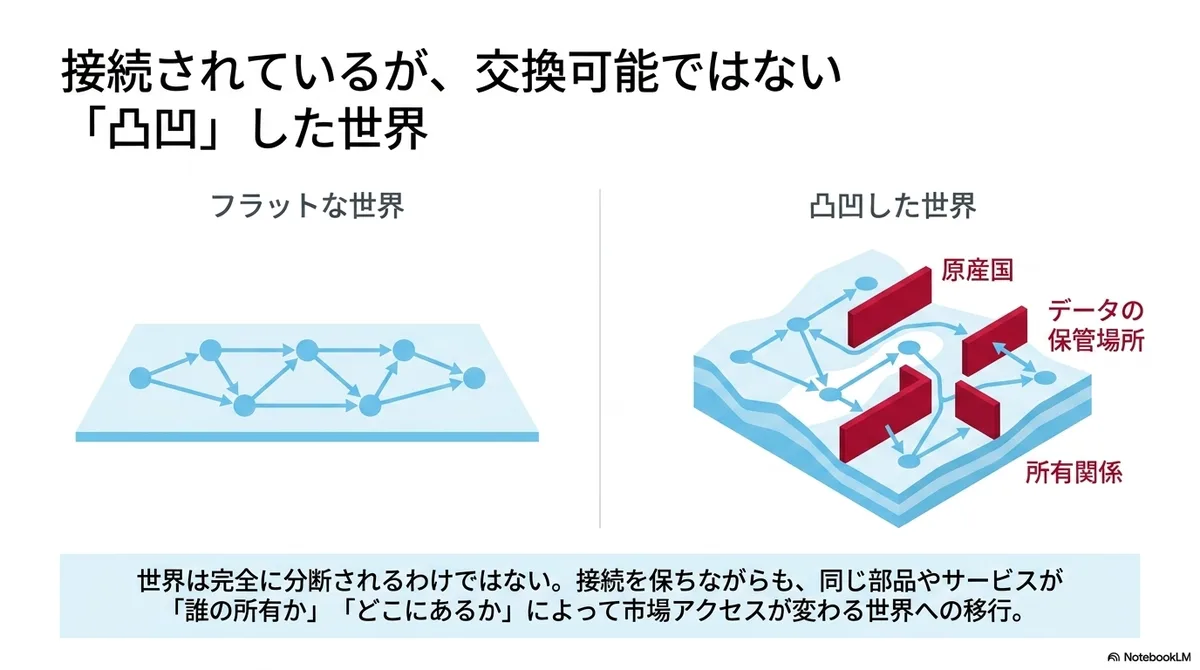
This bumpiness (differences in treatment by country or attribute) changes with elections and changes of government, but because laws, administrative organizations, infrastructure, standards, and corporate investment have inertia, not everything reverts with each election.
In this world, there will be more occasions when a company's own values are tested. This is because it will be asked for what purposes it will accept higher costs, under what conditions it will withdraw from a market, and which suppliers it will not deal with.
And those values do not become business conditions merely by being proclaimed as ideals; they come to be tested in actual capital allocation, supplier selection, market entry and exit, and technology choices. Furthermore, this question does not stop at passive response. As long as competition over which values are desirable continues, companies themselves can also become actors who take part in that competition through their statements and actions.
Of course, even if we follow ideas, we will not know the result of the next election or the exact timing of when regulations are introduced, and it takes time for an idea to become a regime and be reflected in policy. Still, there are things that can be prepared in advance, such as deciding before a crisis comes which values you would give up some profit or growth to protect.
The Mechanism of Transition
Let us step back a little here and consider whether economic security can be handled as "a new set of regulations to respond to now."
Looking back at history, the basic framing of the international economy has changed many times. Free trade and the gold standard in the 19th century, the collapse of order in the interwar period, the postwar Bretton Woods system and embedded liberalism, and the market liberalization from the 1970s onward are rough examples.
Such changes tend to be described in terms of a cycle, such as "happening every 30 years," but it seems to me that looking only at cycles misses something important. What should be drawn out of history is not a cycle but the mechanism of transition.
Simplified, that mechanism looks like the following process. First, crises and failures that existing policies and markets find hard to resolve or explain accumulate, and ideas that present a different framing of the problem emerge. When a new regime forms on the basis of those ideas, policy is made along its lines. Policy then affects the market, and companies operating in the market begin investing on the premise that the new regime will continue.
However, what is happening now is not so much a discontinuous transition in which the liberalization-and-efficiency regime is completely replaced, as a cumulative transition in which, while that regime is maintained to some extent, objectives and institutions concerning climate, security, distribution, and state capacity are piled on top of it.
That is precisely why this change will not end once we respond to economic security. As long as the competition of ideas over multiple values continues, regimes will keep changing, and it would be better to assume that the things we must respond to will increase.
What This Transition Means for Startups
This discussion may sound like a story about large-company risk management, but it is not a distant future matter for startups either.
First, startups so far seem to have operated with a flat world as an implicit premise. In particular, software companies since the internet and parts of the VC model have implicitly assumed a world in which capital, data, talent, and products can move across borders relatively easily. That premise is breaking down, depending on field and region.
And it often takes a decade or more for a startup to grow from founding to a socially meaningful scale. A company founded now will compete not in current business conditions but in business conditions yet to be formed.
Whereas existing companies are asked how to adapt their current businesses, startups are asked what to build from scratch on the premise of the next conditions. Thinking about what changes could occur over that ten-year course bears directly on one's own business, and in some cases one may find a major opportunity there.
Periods of regime transition bring both headwinds and tailwinds.
The headwind is that friction in cross-border expansion grows. The tailwind is that periods of transition are also periods when new demand and markets are formed. In areas such as GX, semiconductors, supply chains, defense, critical infrastructure, and administrative capacity, for example, the government appears as customer, regulator, co-investor, and market shaper, and opportunities for new entrants arise in the gaps left by incumbents optimized for the old institutions. At the same time, however, efficiency is also tested. A balance between the two is required.
For example, questions will include whether customer value remains once policy support is gone, whether the business holds up even if the government is not the customer, and whether regulatory compliance itself becomes a barrier to entry. Whether adapting to one regime sphere will cost you another market, and whether you can reconfigure technology, contracts, and supply chains in response to policy changes that may come, will also be tested.
And Japanese startups, unlike American ones, can be said to be in a position that demands higher strategic sophistication. The United States has huge markets and government procurement, but Japan's domestic market alone is not that large, and it is difficult to grow big by doing the same things as the United States.
Japan is also in a position where it cannot set the world's rules as strongly as the United States. And with constraints on the supply of talent and capital, it cannot adopt a strategy of "if you take enough shots, one will hit." It means we must sharpen our aim.
And what is probably needed is to have an answer to the question of what we will protect and what we will bet on, before others press us to choose which country's regime to follow. I once wrote that a startup is a bet on a question, and a period of regime transition is a time when the premises and odds of that bet move greatly. Making use of this can be one big opportunity for startups as well.
Conclusion
A shift in ideas becomes a tectonic movement in markets and policy, and can become a great earthquake that shakes business. Of course, even if we observe such tectonic movement, we cannot predict the date and time of the earthquake, but we can know where the faults are and where pressure is building. And that observation cannot be done with financial and technical literacy alone. I think that knowledge of politics, history, and the history of ideas will raise the accuracy of observation at least somewhat.
Also, because following ideas does not let us predict the future, there are limits. However, it is possible to run a company that decides what to protect and where to bet before the response options become expensive, that is, before the price of the option rises. For large companies that is risk management, and for startups it could be seen as an opportunity.
Furthermore, as stated earlier, Japanese companies and startups too can be actors who take part in this competition of ideas. In fact, as I wrote in "The Ideas Surrounding Startups," Silicon Valley startups and VCs are taking the lead in joining that competition of ideas. In a sense, a competition has begun not to predict the future of ideas but to make the future of ideas. That is probably Silicon Valley's "The best way to predict the future is to invent it" being pursued from the side of ideas as well. And with overwhelming capital power, at that.
In light of such movements, I think what ideas and attitudes we ourselves will take is being asked now, and I feel it is time to think about what ideas we should create.
Related Articles and Events
Recently, on the subject of ideas, in addition to publishing the article "The Ideas Surrounding Startups" and holding a related event, I have also been accumulating articles on idea-related keywords on Substack.
This article is part of that effort, and in connection with it I will hold an event on July 30, 2026, so please join if you are interested.