Thought and Capital 2 | How Thought Came to Part Ways with Capital in Japan
This article was machine-translated from Japanese by AI (Claude). It may contain errors. Read the original Japanese article.
In November 1970, an extraordinary session of the Diet was convened. It would later be called the "Pollution Diet." In this session, 14 pollution-related bills were passed all at once, and the Environment Agency was established the following year.
It was the same year, 1970, as the Osaka Expo that we saw at the opening of the previous installment. In Osaka, the city of the future was on display, while in Tokyo, laws were being made to stop the harm being done now.
The two events look like opposites. What the Expo spoke of was a vision of the future: what kind of society we would build from here. What the Pollution Diet established was a norm: a future in which that harm continues would not be tolerated.
The latter was translated, through law, administration, and litigation, into the amounts that companies actually pay. Meanwhile, the visions of a desirable future, symbolized by the Expo, gradually lost their path to being translated into funding outside the government over the following decades.
This is the second installment of the series "Thought and Capital." In the previous installment, I looked mainly from the side of capital at the mechanisms that turned thought into commitments of funds and organizations, from the Meiji era to the 1980s. This time, conversely, I look from the side of thought at how its distance from capital changed, focusing in particular on the postwar period.
Within this series of reviews, the question this article asks is why, in the postwar period, written thought stopped connecting with capital.
Centering on "the people who wrote thought," I will look mainly at two things.
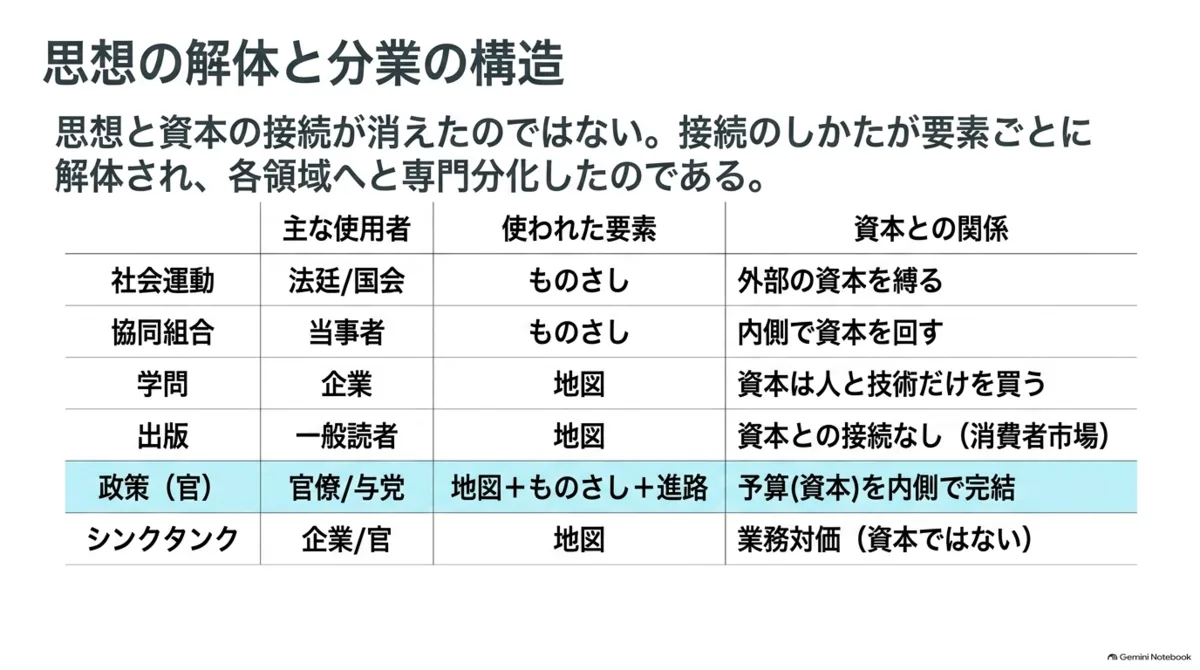
- The first is who used that thought. I will distinguish the cases where the government used it, where courts and the Diet turned it into institutions, where the parties involved in social movements used it internally, where companies bought it, and where readers received it.
- The second is which part of the thought was used. I will look at whether it was the map, which shows an understanding of society; the yardstick, which shows norms; the course, which shows a plan of action; or the thought itself, with all three combined.
Before getting to the main argument, let me sort out some terms.
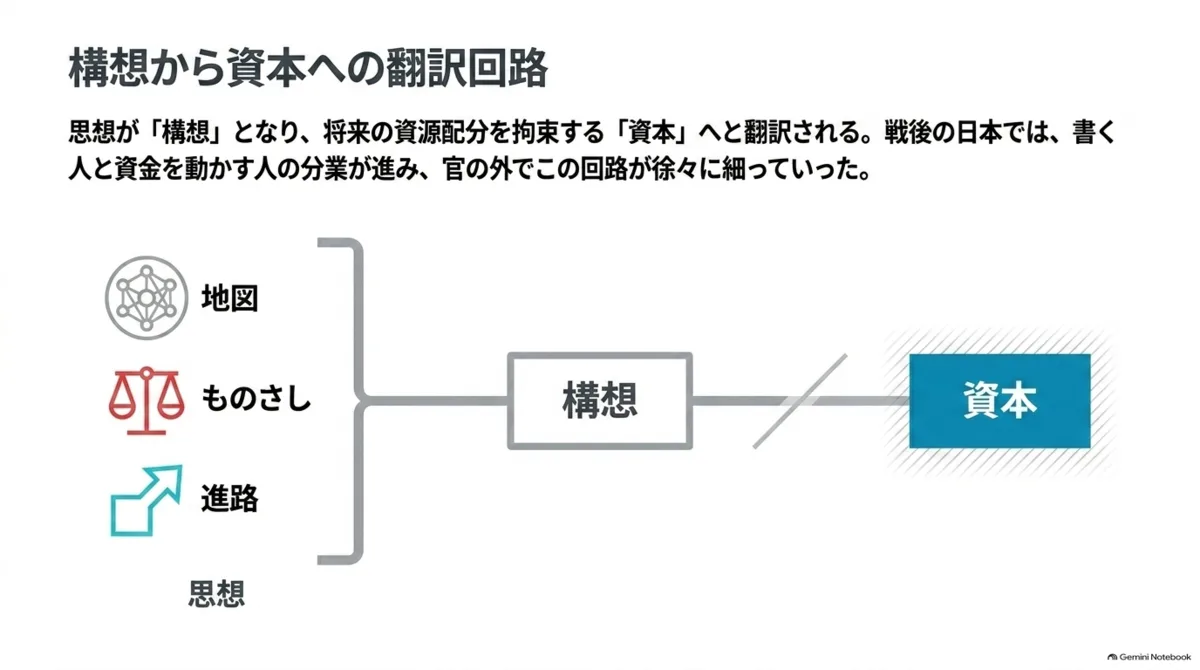
As in the previous installment, thought refers to a framework of thinking that bundles together an understanding of how society works (the map), norms and value criteria about what to prioritize and what not to allow (the yardstick), and the direction and action plan for how to change society (the course). A vision is that thought put into the form of a plan that can be carried out in a specific place. For example, the Expo's site plan that we saw last time, and the government's long-term plans, are visions.
As in the previous installment, capital refers to financial commitments that bind future resource allocation, such as investment and public budgets. However, payments for past work, such as manuscript fees and commissioned research fees, are not included here.
Six Places Where Thought Was Produced in the Postwar Period
As we saw last time, in the Meiji period thought and capital moved as one within the same people; in the Taisho period, bearers distinct from both the state and large corporations appeared; and during the Pacific War, total mobilization bound them to the state. Then, in the postwar period, the division of labor between those who write and those who move funds advanced in earnest, and the circuit that translated thought bundling all three elements into funds gradually thinned out beyond the government.
That is what happened with capital. But thought continued to be written in the postwar period. Among the places where thought was written, this article limits its scope to six major ones that could have had organized exchanges with capital and the state: (1) social movements, (2) cooperatives and the labor movement, (3) academia and intellectuals, (4) publishing and the world of critical discourse (rondan), (5) Nagatacho and Kasumigaseki, where policy is made, and (6) think tanks. I narrow it down by this criterion in order to examine the possibility that thought was translated into funds and institutions (I covered the people who handled thought on the capital side last time).
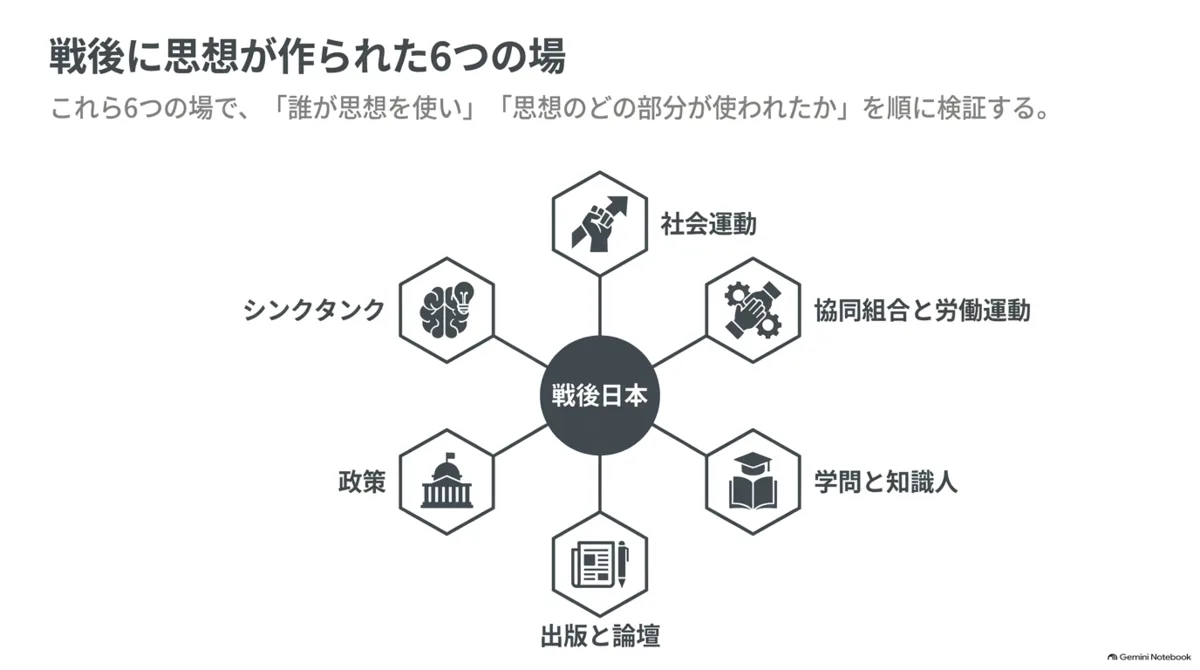
For each of these, I will look in turn at the two questions raised at the outset: who used the thought, and which part of the thought was used.
(1) Social Movements: The Yardstick Became Institutions and Bound Capital
What moved the nation's institutions the most was pollution. The official recognition of Minamata disease was in 1956, and the Kumamoto District Court ruling that recognized the responsibility of the responsible company came in 1973. It took 17 years before it became clear who was the perpetrator, who was the victim, and how much would be paid.
After that, however, the response was swift. From 1971 to 1973, judgments in favor of the plaintiffs came one after another in four lawsuits: Niigata Minamata disease, Itai-itai disease, Yokkaichi asthma, and Kumamoto Minamata disease. In 1972, the Air Pollution Control Act and the Water Pollution Control Act were amended to introduce no-fault liability, so that compensation could be demanded without proving negligence. The Pollution-Related Health Damage Compensation Act of the following year, 1973, created a mechanism that collected levies from companies that emit pollutants and made continuing payments to certified patients.
What happened here is that a norm bound the future of companies, and that constraint was actually translated into the flow of funds. This is because that constraint changed the capital investment decisions of individual companies.
Regulation is a kind of vision for creating a desirable future. But it did not envision a future that might exist; it bound capital and the future in order to prevent a future that must not exist from being created.
Those who used this thought were the courts and the Diet, after the accusations of the parties involved. And what was used was the yardstick of what not to allow. What should be noted, though, is that although companies' funds did indeed move along this path, that was in the sense that the thought was used to bind capital, and what could mainly be bound was the "future that must not exist" derived from past harm.
(2) Cooperatives and the Labor Movement: They Built Their Own Capital and Circulated It Internally
Social movements also had a lineage distinct from binding capital: a lineage that went on to build capital themselves. For example, Seikatsu Club, as a business entity in which consumers take part in decisions on production and distribution, still has about 420,000 members today. The labor movement, too, had a path of rewriting the yardsticks of employment and distribution through negotiations between labor and management, like the three principles of productivity that we saw last time. A path for allocating resources by a yardstick other than profit certainly existed.
However, the capital built here, at least in the examples cited in this article, circulated within the circle of the parties involved, namely union members and workplaces. It changed dinner tables and wages, but from the examples in this article alone, we cannot say that it went on to rewrite resource allocation across society as a whole.
Those who used thought in this lineage were the parties themselves, the union members and workers. What was used was also a yardstick other than profit. While the pollution lineage connected to society by binding capital and the state from the outside, this lineage connected by building its own capital, and circulated it internally. In that it created its own thought and circulated capital on the inside, it was a distinct approach from one that moves external capital.
(3) Academia and Intellectuals: What Was Bought Was People and Technology. The Center of Gravity of Written Thought Shifted to the Map
The ties between universities and capital grew substantially through technology, at least from 1955 to 1975. Between 1955 and 1975, undergraduate students in science and engineering grew about fivefold, from roughly 80,000 to roughly 380,000. Companies received talent through laboratories, and scholarship donations and commissioned research also continued as practical matters. The very fact that criticism of "industry-academia cooperation" became a slogan in the university struggles of the 1960s is proof that this connection was real.
The expansion of ties with capital was also happening in the humanities and social sciences. Of the increase in university enrollment from 1960 to 1975, 83% was absorbed by private universities, which could raise their enrollment limits at low cost without needing experimental facilities. Here too, they did not keep their distance from capital; rather, they had the thickest human connection in the country, in the form of simultaneous recruitment of new graduates.
However, what companies received was the result of selection through entrance examinations and the latent ability to withstand training. As for the content of what had been learned, in-house training taught it again after people joined the company. What companies bought from universities was selected people and technology that had been created, not the thought produced by scholarship, that is, neither the map, the yardstick, nor the course.
At the same time, those who wrote thought also withdrew from the role of writing the whole of thought. There are two main reasons.
The first is the fragmentation of scholarship. Differentiation itself is also a result of research deepening, but in his 1961 book "Japanese Thought," Masao Maruyama wrote that Japanese scholarship and organizations had become the "octopus-pot" type, splitting apart without a common root. Maruyama, who made that diagnosis, was himself a writer who combined the roles of scholar and intellectual, holding a university post while discussing the times comprehensively in the world of critical discourse.
The more differentiation advances, the more the need grows to translate between fields. But that work belongs to no field, and is not valued in the academic world either. Rather, it is more highly valued to specialize and publish papers in international journals. So scholarship stepped back from providing comprehensive thought, and the pattern of university people doubling as intellectuals also thinned out.
The second is an ethic of keeping distance from power. From before the war through the war years, a considerable part of universities, newspapers, publishing, and academia was incorporated into national total mobilization. For that reason, in the postwar period an ethic of keeping distance from power arose on the side of knowledge. For example, it appeared as distance from the military on the academic side, and as distance from the state on the side of criticism.
As a result of these two factors overlapping, among scholars and intellectuals, the weight of work analyzing the state, capital, language, and power relations from the outside increased, rather than writing blueprints and norms for society that would be adopted by the government. In terms of the three elements of thought, the center of gravity shifted to the work of drawing precise maps of power relations, and distance was kept from the work of writing yardsticks and courses addressed to the government.
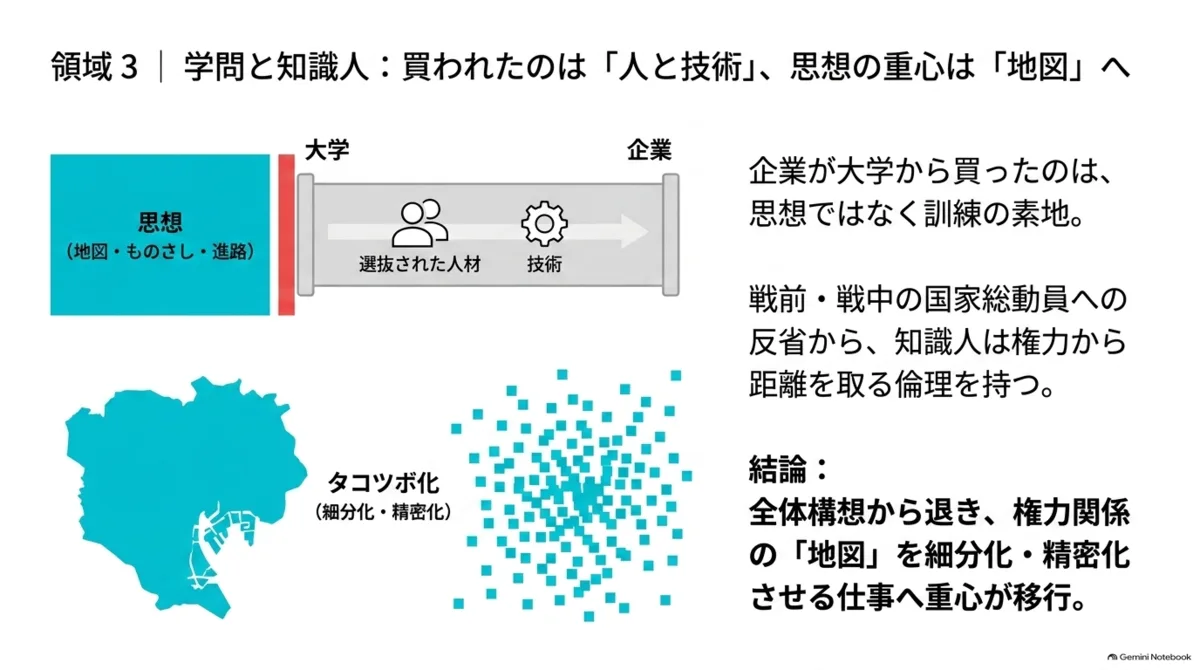
That said, this is not limited to Japan, nor is it simple depoliticization. This is because areas that had been regarded as outside politics, such as family, sex, and education, became new objects of analysis. What changed was not the amount of interest but the objects it was directed at. And the new analyses also connected to social movements. While scholarship and knowledge were used to bind the "future that must not exist," a division of labor took hold in society in which scholars and intellectuals were in charge of criticizing capital and power.
And the role of speaking comprehensively remained with intellectuals outside the university, in the independent sphere, that is, in the world of critical discourse that we will see in the next section.
(4) Publishing and the World of Critical Discourse: The Shrinking and Individualization of the Reader Market That Supported the Systemic Map
As maps grew more precise field by field, where was the map that depicted society as a whole on a single sheet being made? It was probably in the discursive space of publishing and the world of critical discourse that had continued from before the war, ever since the general-interest magazines such as "Chuo Koron" in the late Meiji period and "Kaizo" in the Taisho period.
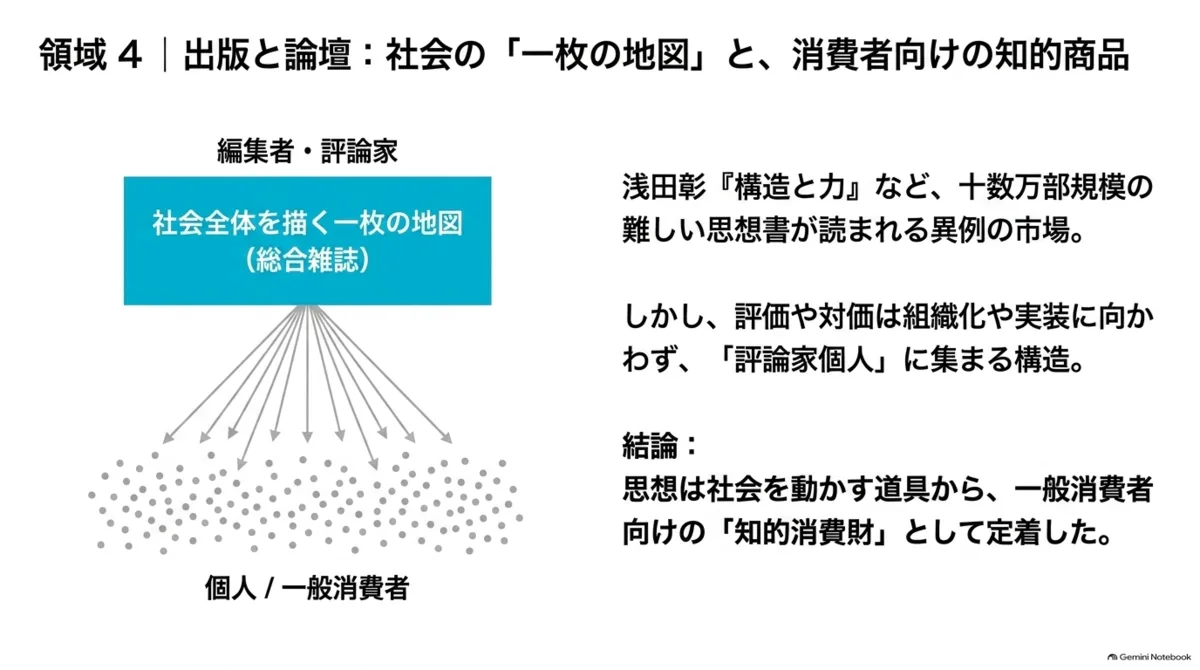
The thought that Takaaki Yoshimoto built in works such as "The Theory of Communal Illusion" (1968) became a reference point for a generation of intellectuals, and its readers prepared the market of the next era. In 1983, Akira Asada's "Structure and Power" sold an exceptional number of copies for a book of contemporary thought, and "Critical Space," which Kojin Karatani and Asada launched in 1991, also continued until 2002. In Japan, a reader market had formed in which difficult books of thought were read in the hundreds of thousands of copies.
This world of critical discourse had a function separate from the market for goods. It was the function of creating a map that depicts society as a whole on a single sheet, that is, a systemic map. Critics, unlike specialists responsible for the details, connected knowledge across politics, economics, culture, and technology, and showed readers where they stood now. Looked at closely, there were many mistakes, but there was a role, and a demand, for giving a big overall picture.
This map was supported by publishing. General-interest magazines lined up politics, economics, literature, science, and international affairs in the same pages and edited them to be read as a single understanding of the times. As debates multiplied and the whole became hard to see, the review of critical discourse, which organized and positioned multiple arguments, became established as an independent form. In other words, although critics supplied the content of the systemic map, it can also be said to have been an institution in which editors connected knowledge, book reviews and periodic reviews positioned the arguments, and the pages as a whole created a single understanding of the times. In postwar Japan, outside the government, this was the main supply apparatus for creating the systemic map.
When discussing such media, some may recall newspapers and broadcasting, which had wider readerships in the postwar period. But what the daily format of pages and programs carried was records of events and fragments of maps for each field. Editorials, too, within a short, unsigned format, were less about logically developing yardsticks than about finding and applying existing ones. The structure in which companies were both readers and advertisers also made criticism of capital difficult. I think the work of depicting society as a whole on a single sheet was concentrated in publishing and the world of critical discourse after all.
On the other hand, in the world of critical discourse, both recognition and compensation gathered on the individual commentator. Articles, books, dialogues, lectures, and so on all basically went to the individual critic. That made it a more sustainable arrangement to put forward one's own name and deliver the work to readers as an individual's work, rather than organizing or taking on implementation oneself. On top of that came the intellectuals' ethic of keeping distance from power, and the main addressee of thought became not the decision-makers who move capital but the general consumer broadly. As a result, thought took on more of the character of an intellectual product for consumers than of a tool for moving society.
In parallel with that, the lineup of writers also changed. From the 1960s onward, bureaucrats, businesspeople, and economists appeared in general-interest magazines and discussed the direction of Japanese society and industry. As with scholarship, as specialization advanced, writing split into forms such as "economics people writing for economics people" and "policy people writing for policy people," and the shared map of thought split into maps for each field.
(5) Policy: The Government Took In the Demand
Next is policy. Since the Meiji period, the central ministries have handled policy research, coordination of interests, and drafting of bills as one package. This structure did not change in the postwar period either, with the main pattern being that the ruling party coordinates the information and draft proposals gathered by bureaucrats. There are also forums such as deliberative councils, but it has long been criticized that the ministries control the research topics and the final reports, and that the councils serve as a "cover" that wraps the responsibility for decisions in outside authority.
This structure has the advantage of allowing policy coordination in the growth period to be carried out quickly, but it also has side effects. The need for political parties to develop their own policy staff became small, and because companies could also take part in policy through industry associations and ministries, they had no need to go through public debate. And thought and visions themselves were created inside the ministries.
On top of this came the condition that there was no real change of government from 1955 to 1993. For a party with little prospect of holding power, there is little incentive to prepare a policy platform, people capable of directing the ministries, or procedures for correcting course in case of failure. Instead, the main activities become denouncing the government's contradictions, blocking policies, and showing principles to supporters.
Organizations that draft policy proposals and deliver them to decision-makers exist in many countries. In Japan, however, bureaucrats took on most of that work, and a division of labor took hold in which social movements and commentators were in charge of criticism.
In this domain, both the users and the makers of thought were the government itself. Only the government could handle, as a single package, understanding society with the map, setting priorities with the yardstick, and presenting an action plan with the course. However, the government did not buy those visions from outside. Making them in-house was the main pattern.
(6) Think Tanks: They Answered the Requests of Companies and the Government, and Sold Maps
As it is said that the largest and highest think tank is Kasumigaseki, it was the bureaucrats who took on policy single-handedly. In the United States and elsewhere, by contrast, there are think tanks as bearers of policy proposals other than bureaucrats, and they also serve as a source of thought. Let me look at this last as well.
As we saw last time, in contrast to that, many of Japan's major think tanks were established as affiliates of financial institutions and large corporations, and had high capability in economic forecasting and commissioned research. But because of their origins, their ability to set questions on their own independently of the parent organization, propose policies, and send talent into the government was limited.
What companies paid for was also mainly only the map of how markets and the economy would move. Think tanks were not pressed to have their own yardsticks; rather, precisely because they had none, as neutral entities they were able to take on a wide range of government-related projects. However, the payments here were compensation for research services, and not capital in the sense of this article, which allocates future resources to the implementation of a vision.
Amid this, there were attempts in Japan too to aim for independent think tanks, but with the thinness of the donation market and the small number of people who move back and forth between policy and administration, it cannot be said that they have yet reached the scale and depth of the American think tank community.
As a result, in Japan, outside the government, the work of creating visions of governance and industry independently of a particular client has been hard to establish as a stable occupation, and tended to be carried out by someone out of their own pocket in the gaps of their main job. The Matsushita Institute of Government and Management, which Konosuke Matsushita established in 1979 with 7 billion yen of his own private fortune, is the representative example, but what it trained were mainly politicians, and it is not a place where creating visions is itself an occupation.
In this way, the circuit that turned thought into visions outside the government and attached capital to those visions thinned out from both the demand side and the supply side.
Summary of the Six
Looking across the six places examined here, what emerges is not that the connection between thought and capital vanished, but that the way of connecting split by element. The yardstick bound capital from the outside through the courts and the Diet, and in cooperatives the parties involved circulated capital on the inside. What companies received from universities was people and technology, and what they bought from think tanks was maps. In publishing, it was readers who supported thought. The demand that turns the map, yardstick, and course into an integrated vision and attaches a budget to it was taken in by the government.
What thinned out beyond the government is the circuit that translates thought bundling all three into visions of a desirable future and commitments of funds. On the demand side, the government produced visions in-house. On the supply side, the specialization of scholarship and the ethic of keeping distance from power advanced. In publishing, recognition and compensation gathered on individuals, and think tanks also took on the role of answering their clients' questions rather than setting questions themselves.
For that reason, beyond the government, it became difficult for those who write thought and those who move funds to connect, and the number of people who draw comprehensive thought gradually dwindled as well. Amid this, what succeeded greatly was not thought that creates a desirable future, but thought that shows the future that must not exist and binds capital.
Within this division of labor, the one speaking most grandly about the future in 1970s Japan was the government. The Comprehensive National Development Plan, the Income Doubling Plan, and "Remodeling the Japanese Archipelago" are all visions in the future tense. Moreover, budgets were attached to them and they moved forward. The reason funds could flow to future-tense visions without waiting for individual buyers and amounts to be determined is that the government held the circuit of its own budget inside.
However, a structure in which only the government has this circuit carries a weakness: when the government weakens, there is no one to take its place. So what happened to the function of speaking about the future and attaching budgets to it from the 1990s onward, when the push for smaller government, economic stagnation, and bureaucrat bashing overlapped? What happened when there was no alternative receptacle outside the government, I will look at in detail in the fourth installment.
What Remained: SF, Which Depicts the Future Experimentally
Meanwhile, in the reader market, a form remained that differed from both today's map and the course for execution. It was SF, which depicts a future that might exist as a thought experiment. As it became harder to depict thought about the future for the real society, including yardsticks, people gradually came to entrust the future to fiction.
The works of Sakyo Komatsu, who took part in the Expo discussed in the first installment and three years later wrote "Japan Sinks" (1973), and the currents of SF overseas, become a node for speaking about what lies ahead.
From the next installment, I will look at the period from the 1990s to the present. In the third installment, I will first take up the situation in America. I will look at the process by which the combination of those who write thought and those who move funds, which we saw in the first installment, reappeared in the U.S. in the form of the startup, and grew into a circuit that ties the will to realize and funding to visions of the future like those of SF. That is not an observation of another country; it is also a dissection of the sources and routes that are bringing thought into Japan now.