Thought and Capital 5 | Who Will Envision Japan's Future?
This article was machine-translated from Japanese by AI (Claude). It may contain errors. Read the original Japanese article.
In March 1973, Sakyo Komatsu's Japan Sinks was published. It is a novel that depicts a future in which the Japanese archipelago sinks into the sea through crustal movement and people must leave their homeland. Within that same year it sold more than 3.8 million copies across its two volumes, which suggests that the future and the shape of Japan as a nation were being widely read about through fiction.
Komatsu was also involved in shaping the philosophy behind the Osaka Expo discussed in Part 1. And Japan Sinks was published three years after the Expo.
What I want to point out here is that, in those days, it was possible to put a vision of the future before the public.
However, I believe that from the 1990s onward, as the role of those who had spoken about society's future in Japan weakened, the channels through which written visions were debated and connected to investment and policy also thinned out. Meanwhile, people from Silicon Valley startups, backed by their enormous capital, have been gaining presence as the new narrators of ideas. In other words, the structure is one in which, just as the capacity to nurture counter-proposals domestically has weakened, ideas from abroad accompanied by capital are flowing in. I have considered this in earlier installments and in another article as well.
This is Part 5 of the series "Thought and Capital." In the articles so far, I have traced the mechanisms by which ideas about the future turn into "promises" such as investments, contracts, and policies. This time, I will look back on Japan since the 1990s and consider how the activity of speaking about society's long-term future, and the mechanisms for receiving it, have changed. On that basis, I will consider what kind of bearers are needed now.
The Established Narrators Who Found It Harder to Speak of a Vision for Society
From the 1990s onward, after the end of the Cold War, the questions and tasks taken on by bureaucrats, business leaders, and intellectuals changed significantly. Against that background, it seems to me that in Japanese society, speaking about the future shape of society gradually became less common, and the channels for doing so weakened further.
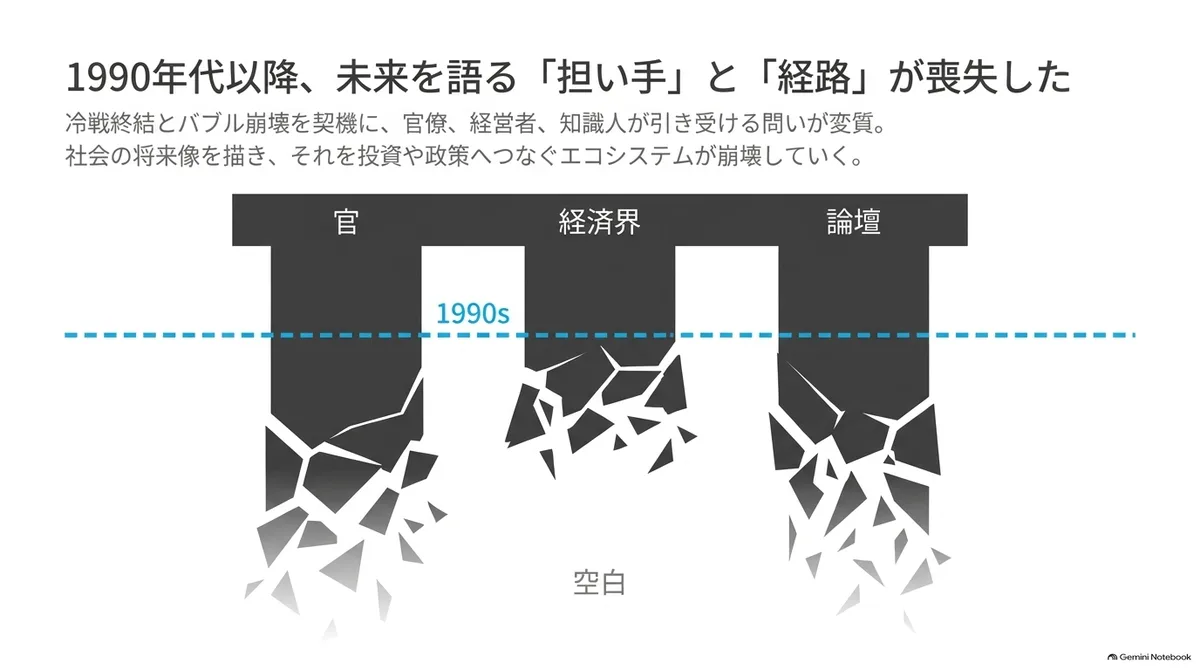
Let us look at each of them from its own angle.
(1) Government: Its Role Shrank
As we have seen in the series so far, in Japan it was mainly the government that presented visions of the future. But after the Cold War ended with the failure of the Soviet Union, a consensus formed on the irrationality of socialist policies, and as the inclination toward small government strengthened worldwide, that role began to shift its power to private companies and citizens.
In Japan during the same period, the government was also losing authority: trust in public administration fell amid the recession that followed the bursting of the bubble in the 1990s, and bureaucratic corruption, scandals, and the system of amakudari (post-retirement placement of officials in private-sector posts) came to light.
The change in the government's role in Japan, from the standpoint of vision, also shows in the 1999 Policy Direction for the Ideal Economy and Society and the Revitalization of the Economy. This document explains that it deliberately avoided the word "plan" in order to signal a shift from government-led direction to a free economy based on independent individuals. It offers a glimpse of a period in which the government itself was reexamining the relationship between setting a course and respecting the choices of individuals and companies.
Furthermore, the 2001 reform of the central government ministries and agencies also changed how the government managed the economy. In a retrospective on economic planning by Mamoru Maekawa, a former Deputy Director-General of the Cabinet Office, he summarizes that the roles of the market and the private sector grew stronger, and the recognition spread that conventional economic planning had served its purpose.
This was when the scope and effectiveness of the visions the government could present became limited. In that case, other bearers, such as private companies and citizens, should have begun to draw up visions themselves and take on their realization.
(2) The Business World: It Prioritized Restoring Management
However, the private companies and banks that were candidates for those bearers were, in the same period, busy dealing with the aftermath of the burst bubble. It is said that handling nonperforming loans took more than ten years, meaning that the private sector, which had been a candidate to take on visions of the future and their realization together with the government, was occupied cleaning up after past investments.
In Japan, banks, the main bearers of capital, had the role of understanding companies' long-term business visions, providing funds, and supporting them in times of emergency. But I think that the banks themselves becoming parties to this crisis made it difficult not only to devise medium- to long-term visions but also to back them with long-term funds.
The progress of globalization in the same period was also likely one of the factors that drew private companies away from Japanese ideas and visions. When companies emphasized overseas markets for their own growth and most of their sales came from abroad, the need for private companies to formulate visions for Japanese society relatively diminished. When national growth and corporate growth become harder to align, companies find it harder to commit to the nation.
Against this background, while restoring management and strengthening competitiveness remained long-standing challenges, there was a structure in which the question of what kind of Japanese society to build once companies had grown was hard for the business world to take on as well.
(3) The Public Intellectual Sphere: Its Foundation, the Publishing Market, Shrank
After the war, it was intellectuals and critics who, from a standpoint different from that of the government and the business world, discussed what a desirable society should look like and informed citizens of it.
But the publishing industry that supported their activity also faced a harsh environment from the 1990s onward. The print publishing market peaked in 1996 and then shrank, and magazine circulation also gradually declined.
In particular, what the editorial departments of general-interest magazines did was bring discussions from different fields to the same readers. There was a place where issues could be reread not only from the economic side but also from the sides of politics, culture, and daily life. As such magazines decreased, even if individual voices continued, opportunities to compare visions of society from different standpoints would decrease.
Meanwhile, a major current in society in the same period was the entrusting of responsibility to the individual, typified by phrases such as "personal responsibility" (jiko sekinin). As living as an individual apart from the group came to be emphasized, the language of the public intellectual sphere also gradually turned toward the individual, and "self-improvement" and the like flourished.
Of course, dealing with individual worries and ways of living can be an entry point to thinking about society. However, when readers have, as paths to improving their own lives, both a path to making society as a collective better and a path to merely surviving, oneself and those around one, it seems to me that in Japan in those days the language of the latter often increased. As a result, "society" gradually faded from awareness, and consequently the language of the public intellectual sphere was also optimized for individuals.
And as capital began to gain great presence, if the visions of intellectuals and critics did not connect to investment or policy, citizens could no longer feel that the ideas in the public intellectual sphere had real effect, and those ideas ceased to be used. I think that, in addition to the decline of the practice of depicting society's future, the weakening of this cycle also overlapped with this period.
Startups Took On the Role of Speaking About the Future
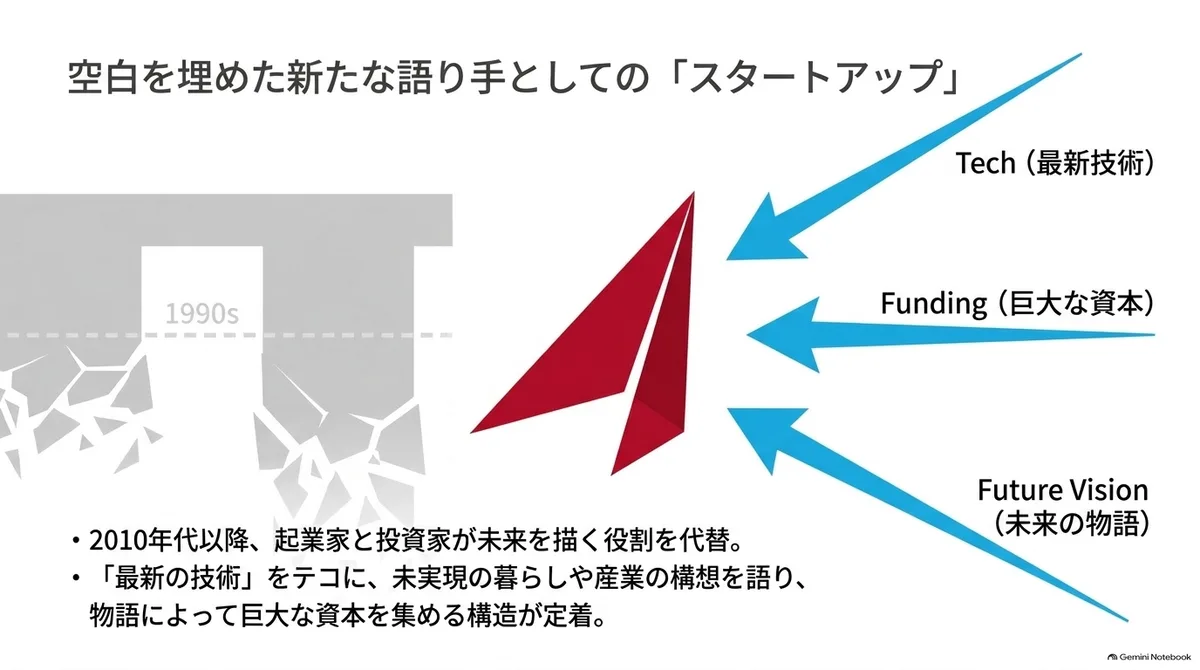
Under these circumstances, from the 2010s onward, people whose work is to depict the future became prominent: startup founders and the investors who fund their businesses.
Their narrative uses "cutting-edge technology" to describe visions of the future, such as ways of life and industries that do not yet exist, and raises funds through that story. Then, by actually building products with those funds, they were able to show the vision of the future and the work that can be started now as connected.
For example, Elon Musk's Master Plan for Tesla, published in 2006, laid out a business path that began with a high-priced sports car and used that money to build more affordable cars. Beyond that, it described a transition from an economy dependent on fossil fuels to one using solar-generated electricity. Here, in addition to a plan for how many cars to sell, there is also a vision of how to change the way society uses energy. For buyers, purchasing a car becomes a way of participating in a desirable future, and for workers, developing the product comes to look like work that changes society.
Moreover, when the person who speaks of a vision also takes responsibility for carrying it out, it gives their words concreteness and persuasiveness. If there is a finished product or a usable service, one can verify part of its feasibility, and by carrying it out while bearing risk, one shows how serious one is. Such risk-taking would also have given those efforts a persuasiveness different from that of discourse.
And if the attempt succeeds, ideas connect to capital. Once capital is obtained, one gains the momentum to realize the ideas, and that cycle begins to turn. Then, in a society where money is the dominant yardstick, ideas backed by capital begin to look like the right answer, and still more capital gathers. Such a relationship between ideas and capital comes to be established. Indeed, the emergence of big successes such as Google and Facebook expanded that cycle greatly.
Furthermore, the government began to take note of such efforts as fuel for the next stage of economic growth, and gradually began to support them. In fact, in Japan too, the government stepped up its support from the mid-2010s. Riding that wave, large companies and others also began to advance collaboration with startups, advocating open innovation and the like.
Here we can see a change in the relationship between the traditional narrators and the new ones. It is the change that the government and large companies that once drew visions of the future had become the side supporting the realization of the visions of the future presented by entrepreneurs and investors. It can also be said that expectations toward startups grew in envisioning and realizing the future.
Startups Could Also Offer Opportunities to Take Part in Building the Future
Individuals moved as well.
From the mid-2010s, a certain number of people began to consider founding startups or changing jobs to join them, probably because they saw a future there. Startups could also show economic returns for doing so.
Moreover, even short of founding a company, I wrote earlier that buying a Tesla is a way of taking part in the future and that working there is another form of participation. Startups were precisely what could offer this kind of opportunity to be involved in the future as an individual. There was an atmosphere in which simply using a startup's product was cool.
In other words, startups not only spoke of a desirable future but also offered various ways for individuals to take part in it. I believe that one reason the government, the business world, and individuals came to entrust the future to startups is that such a circuit for building relationships existed.
Establishing a Pathway to Silicon Valley and the Inflow of Ideas
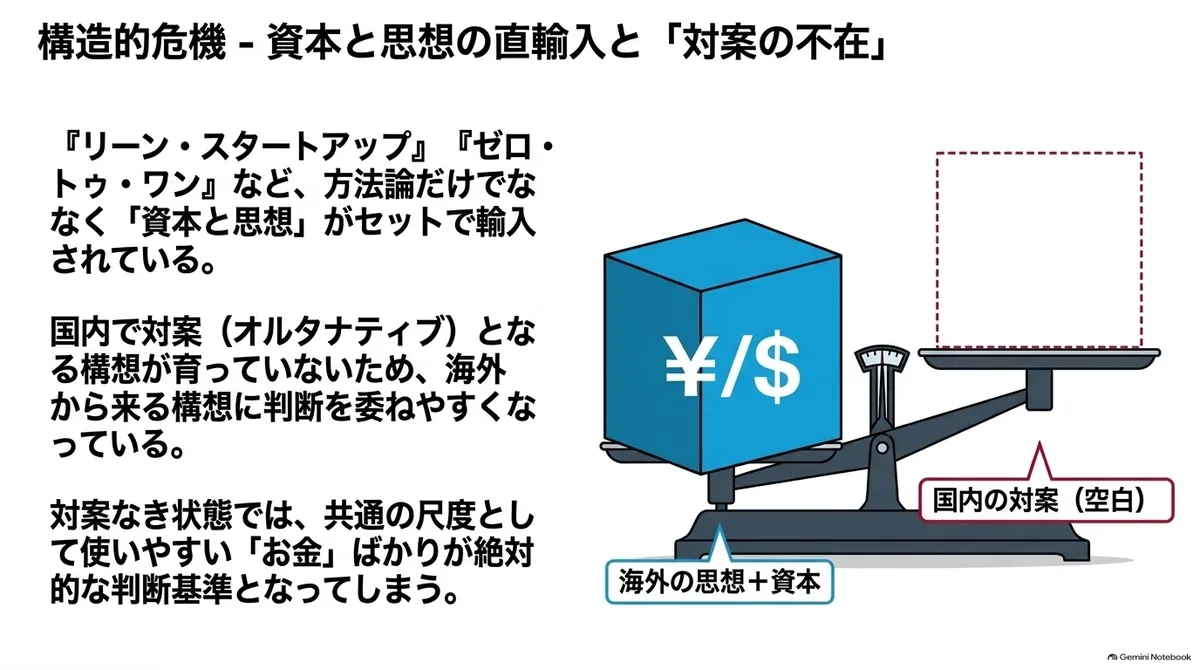
One of the pathways by which Japanese startups themselves learned about visions of the future was Silicon Valley. To learn how to start new businesses, raise funds, and grow them, people watched what Silicon Valley put out, sometimes treating it like an oracle, and phrases and methodologies such as the "Silicon Valley way" were imported. This continues today. The Lean Startup and Zero to One are representative examples.
Through such pathways, what is coming in now is not only methodologies but capital and ideas as a set, and, as I wrote in another article, some of those ideas can become a risk if accepted as they are.
However, if counter-proposals in the form of ideas and visions of the future are not sufficiently nurtured domestically, we may end up importing both the business and the ideas together, uncritically. And given the current situation, I think we are in a state where it has become easy to leave our judgment to visions coming from overseas.
If so, I believe that what is needed now is both people who write ideas that serve as alternatives to those from overseas and the strengthening of the pathways to make them effective as live ammunition.
New Ideas and Their Narrators: Startups of Thought
So who should write those ideas? To answer that, let us once again look back at history.
In the series so far, Parts 1 and 2 looked at how ideas and capital drifted apart in Japan, Part 3 at how ideas and capital fused in the United States, and Part 4 at why ideas and capital did not intersect in Japanese startups.
And I touched on, in Part 1, how the Meirokusha was founded in the sixth year of Meiji and began publishing Meiroku Zasshi in 1874.
What I want to point out here is that, at the time, they were not writing those ideas because someone had commissioned them, nor were they an advisory body to the government or representatives of the people. They began as a small association that posed its own questions.
Similarly, the starting point of the Osaka Expo seen in Part 1 was a private study group launched in 1963 by Tadao Umesao and others. Seven years later, the group's vision became an actual complex of buildings, through public budgets and the decisions of companies to exhibit. The 1971 book Venture Business, discussed in Part 4, was likewise a single book written by three scholars.
All of them began writing their ideas without being asked by anyone, put them before the world, had them tested, and the good ones remained and spread. Just like startups.
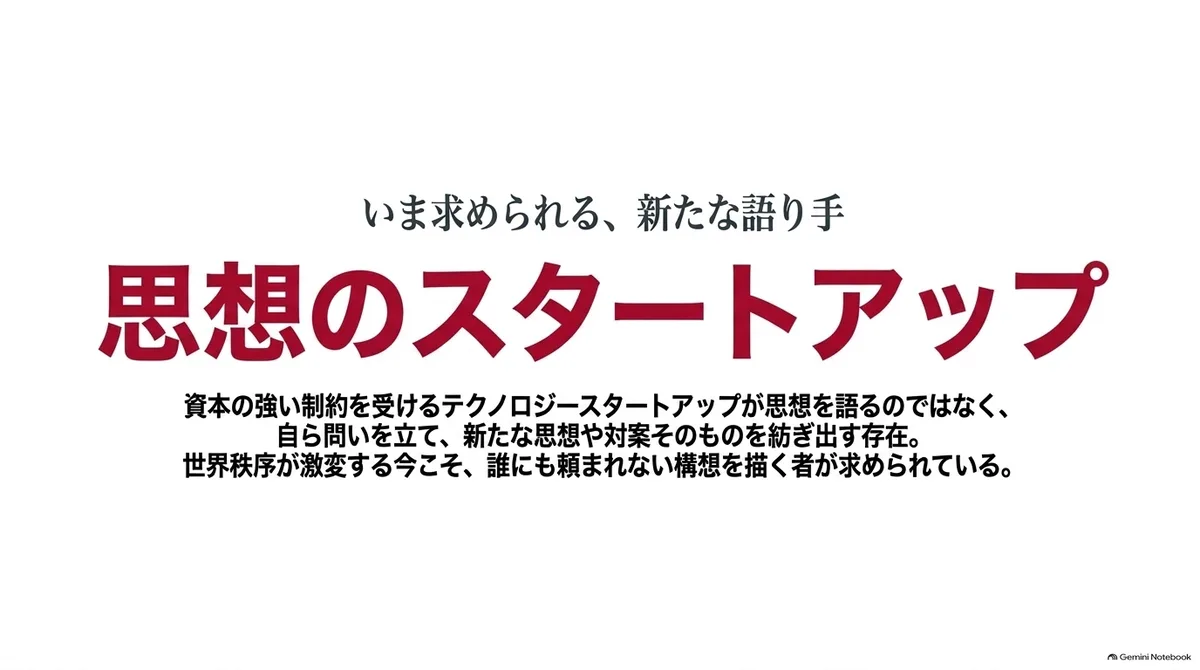
If so, it is right now that "startups of thought" are needed, in order to generate new ideas and create a cycle that nurtures them, isn't it?
This does not mean that startups speak of ideas. It means that someone begins to write ideas (perceptions, norms, courses of action, and so on) anew as a startup-like project. It should be possible even without capital, and I feel that, precisely because the world order is changing greatly, it is beginning to be called for again.
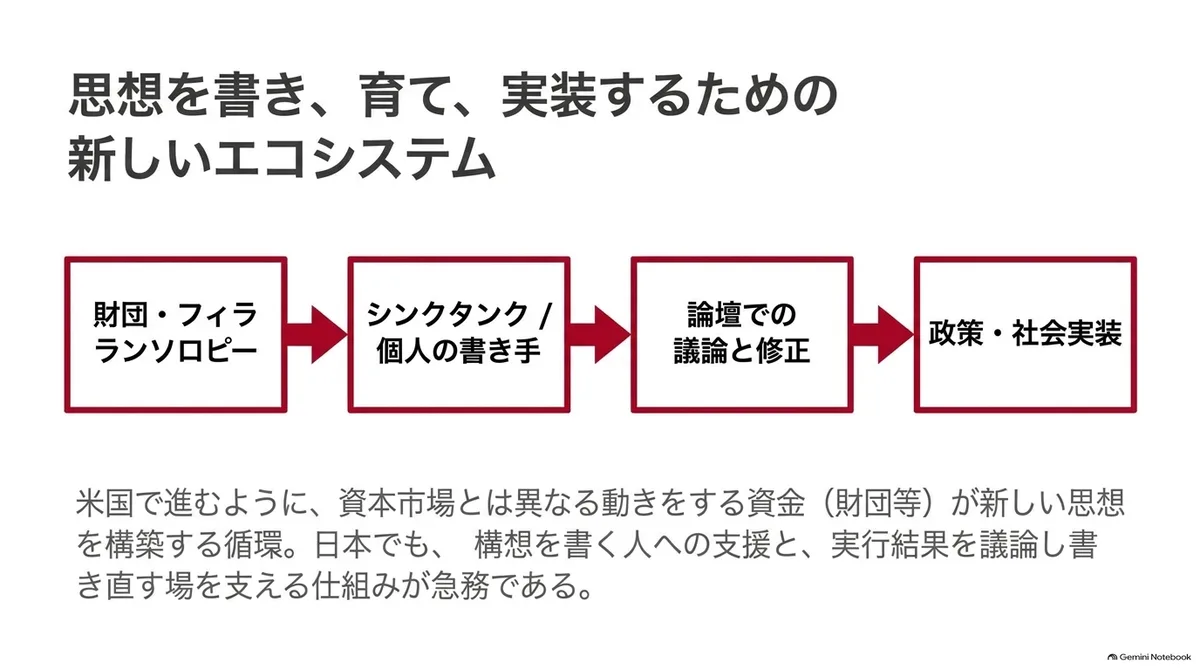
In fact, looking at the United States, money is flowing into think tanks from foundations and others that act differently from capital markets, and new ideas are being built (for example, those introduced in this article). And those ideas are now competing with one another, within the United States and across the world, toward building the next order.
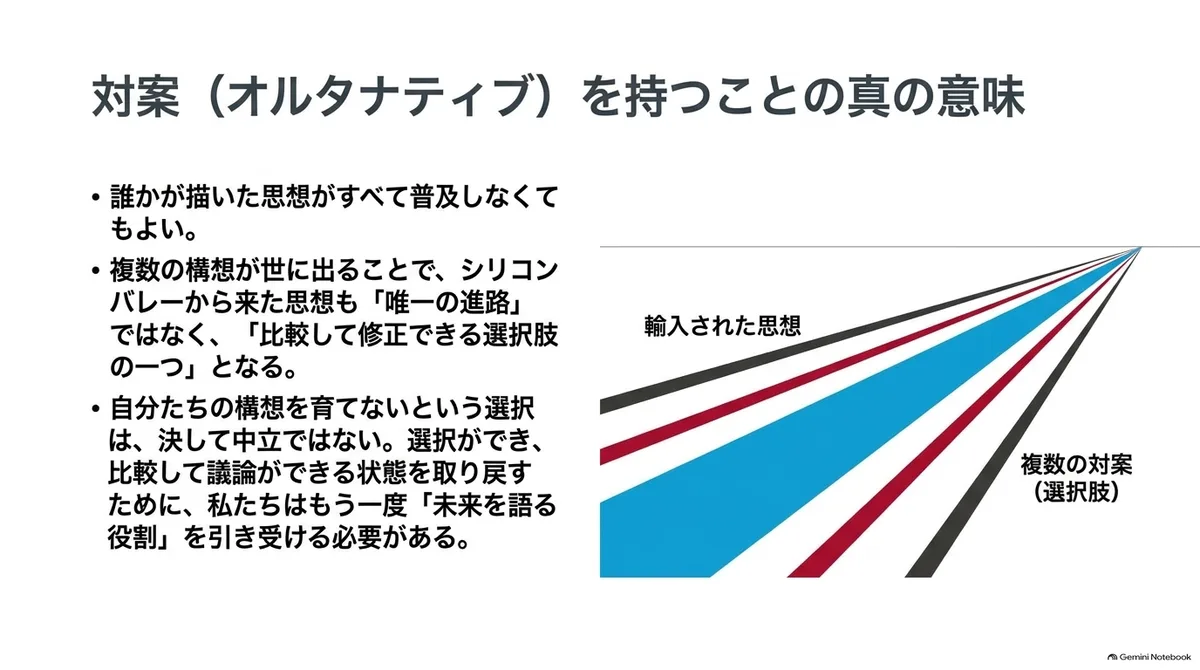
Even if the ideas someone drew do not spread widely, if there are many such efforts and the written visions reach places of debate and execution, then the ideas that came from Silicon Valley too become not the only course but one vision among others that can be compared and revised. The meaning of having alternatives lies in being able to choose and in being able to compare and debate.
Conversely, I believe that the choice not to nurture our own ideas and visions now is by no means neutral. Without them, it becomes easy to leave judgment to others' ideas and yardsticks. Or else, only "money," which is easy to use as a common measure, will be emphasized. In that case Japan would probably be put in a weak position.
That is exactly why I think it is important for more people to take up the challenge of writing ideas and drawing visions, and to support such people more.
In Japan too, I believe that people who write such ideas and craft visions for realizing them need much more support. In addition to attaching capital, both for-profit and nonprofit, to written visions, don't we need to support them all the way to discussing the results of execution and linking that to rewriting the visions?
I believe that building such mechanisms is precisely what would let Japan make its presence felt in the current competition of ideas and contribute to building the next world order.
In the United States, as in the Meiji era, ideas, capital, and politics are becoming one. The government has not stopped at supporting the realization of the visions of the future presented by entrepreneurs and investors; rather, entrepreneurs and investors have begun to wield influence to the point of swallowing the government and setting its direction.
If we do not think that this form of monopoly over wealth and power is at all good, then in a sense the only way to counter it is to increase the number of people who draw different ideas and visions, to strengthen the connections among those ideas, capital, politics, citizens, and various other stakeholders, and to explore alternative forms.
It may be a small attempt compared with the United States. Yet the Meirokusha's Meiroku Zasshi was like a startup that lasted only two years, and still the words and influence that the journal left behind were great and remain today. Considering that, the role of speaking about visions can be taken up again, both by the traditional narrators and by individuals from now on.
For multiple people to create ideas about the future of Japan and the world and to connect them. It seems to me that such efforts are exactly what is called for now.