The Vacuum in Startup Thought: Why The Technological Republic Is Accepted Without Friction
This article was machine-translated from Japanese by AI (Claude). It may contain errors. Read the original Japanese article.
The Technological Republic is getting attention in Japan too. Its author, Alex Karp, is the CEO of Palantir, and the core of his argument is that the technology industry should move away from consumer convenience and reconnect with the purposes of the state.
In addition to this book, what has come in over the past few years includes "technology-supremacist thought," represented by effective accelerationism (e/acc) and techno-optimism; "eschatological thought," which links the singularity (technological singularity) to the salvation or the end of humanity; and, third, "state-rebuilding thought," such as the American Dynamism advocated by a16z, which seeks to advance technology, the state, and capital as one.
Moreover, these are now trying to enter Japan in the form of investment theses, products, and procurement premises, in other words, accompanied by business and capital. They seem to include value judgments that go to the root of society, such as the meaning of the state, security, democracy, governance, and freedom.
Although something containing such large value judgments is coming in, there seems to be no particularly large friction. Of course, part of the reason may be that Japan's security environment is changing, starting with Russia's invasion of Ukraine. Even so, it is strange, when you think about it, that on the whole I feel many people in the younger and mid-career generations accept it favorably (though young and mid-career people do tend to be drawn to what is highly novel).
In this article, I consider the reason for this absence of friction. My view is that the main cause lies less in the cleverness of the senders than in the structure of the receiving side, that is, on our side.
Establishing a Channel for Outsourcing Answers
(1) Establishing a channel for receiving answers from Silicon Valley
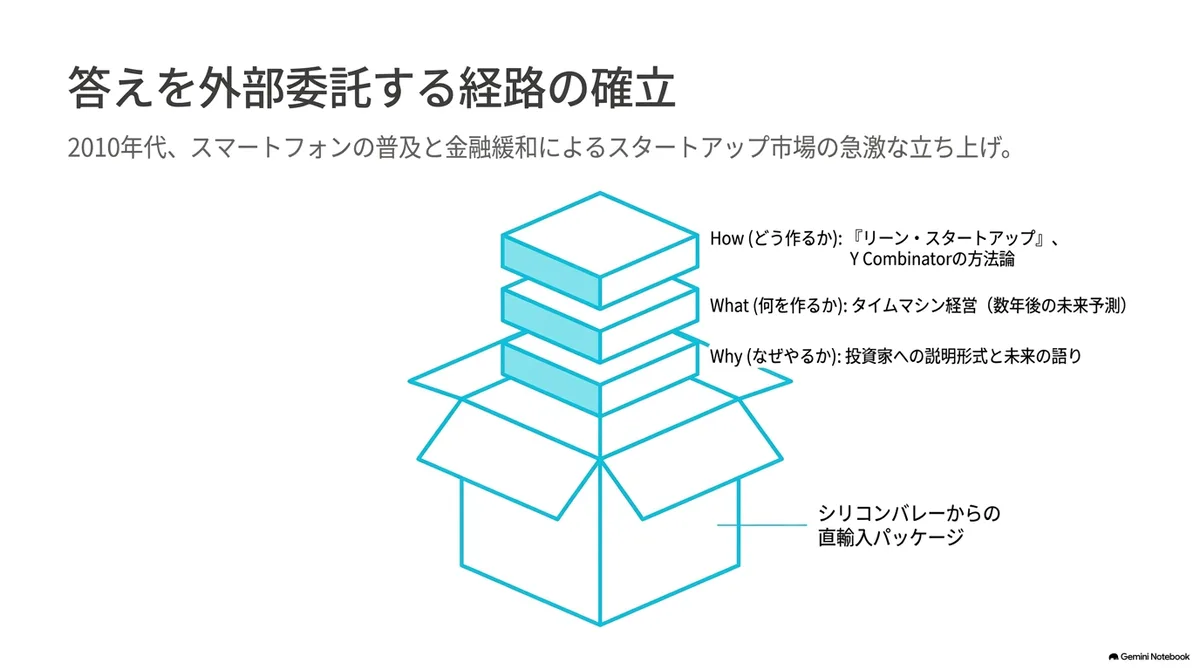
The story goes back to the 2010s. It was the period when smartphones and the cloud lowered the cost of founding a company, monetary easing improved the fundraising environment, and Japan's startup market took off rapidly. In parallel with the market's vessel being put in place, many words and ways of thinking were imported from Silicon Valley. In 2012, the Japanese translation of The Lean Startup was published, and in addition, a whole set was introduced, including Y Combinator-style methodology, pitch formats, and even templates for investment contracts.
This import was rational. There were proven success stories, teaching materials and templates were available, and a format that could be explained to investors was at hand from the start. I am aware that I was one of those involved in that import (though I now reflect, with some regret, that there were many parts that needed to be changed rather than imported directly).
However, what was imported was not only the methodology of "how to build." What a methodology answers is mainly the How. The questions of what to build and why to choose a given field require a different source of supply.
The role of that source was played by a time-machine-management way of thinking: "What happens in Silicon Valley will happen in Japan a few years later." This is a method of market forecasting, and at the same time it is also a narrative about the future. Once you adopt the narrative that "you can see Japan's future in a few years by looking at Silicon Valley's present," there is no longer any need to conceive the future yourself. In other words, in this period Japan was able to get started rapidly by importing not only the How but also the What, the Why, and even the narrative of the future, all together, as the answer.
(2) Outsourcing the narrative of the future, and Japan's Why aimed at the past and present
Meanwhile, during the same period, forms for explaining in one's own words "why we are doing this business" were also being explored within Japan.
One of them is the formative experience. A way of telling that explains a business through difficulties one has experienced made the motivation easy to understand and gave a form that could be explained to investors (I wrote about this problem earlier in "You Don't Need a 'Formative Experience'").
The other is social issues. After the Great Hanshin-Awaji Earthquake and the Great East Japan Earthquake, civic activism and the practice of civic tech spread, and a way of telling that explains a business from issues that have become visible took root. I think this lineage is not itself an imported product, but a valuable accumulation in Japan.
These two share a common structure. In both, the reason for the business is sought in the past or the present. The formative experience ties the narrative to what one has already experienced, and social issues tie it to what has already become visible. No one will question the legitimacy of tackling an issue that already exists. But it is difficult to seek legitimacy for the claim "this is how I want the future to be."
In this way, a division of narrative labor came into being: the past is told by the formative experience, the present by social issues, and the future is imported from Silicon Valley's discourse. The Why as an individual's motivation could be supplied by the formative experience, but the future-tense Why of where to direct industry and society continued to lack anyone to carry it within Japan.
Thus, over 25 years, Japan built a channel for receiving answers about the future's How, What, and Why from Silicon Valley.
I have drawn a considerably simplified picture so far, but I think one reason friction does not arise lies in this structure. And the success of Silicon Valley's companies and 25 years of track record have become trust in this channel. It can also be said that as long as the thought now coming in through this channel arrives in the familiar packages of conventional future forecasts, investment theses, and products, there is a structure that makes it easy for it to come in as though "that is the answer."
But this explains only half of the story. There is still a distance between receiving a package with trust and accepting the value judgments inside it. So let me dig one level deeper.
Thought Is Made of a Map, a Ruler, and a Course
To sort out what is coming in, you must be able to break down what it is made of. For that breakdown, the receiving side needs some kind of criteria for judgment. What constitutes those criteria is the "thought" that I have been taking up for some time.
But the Japanese word for "thought" (shisō) broadly covers everything from philosophy to worldview, doctrine, and attitude, and as it stands it cannot serve as an analytical tool. The situation is the same academically: the concept of ideology seems to have no single agreed definition (the Stanford Encyclopedia of Philosophy also summarizes that multiple usages coexist).
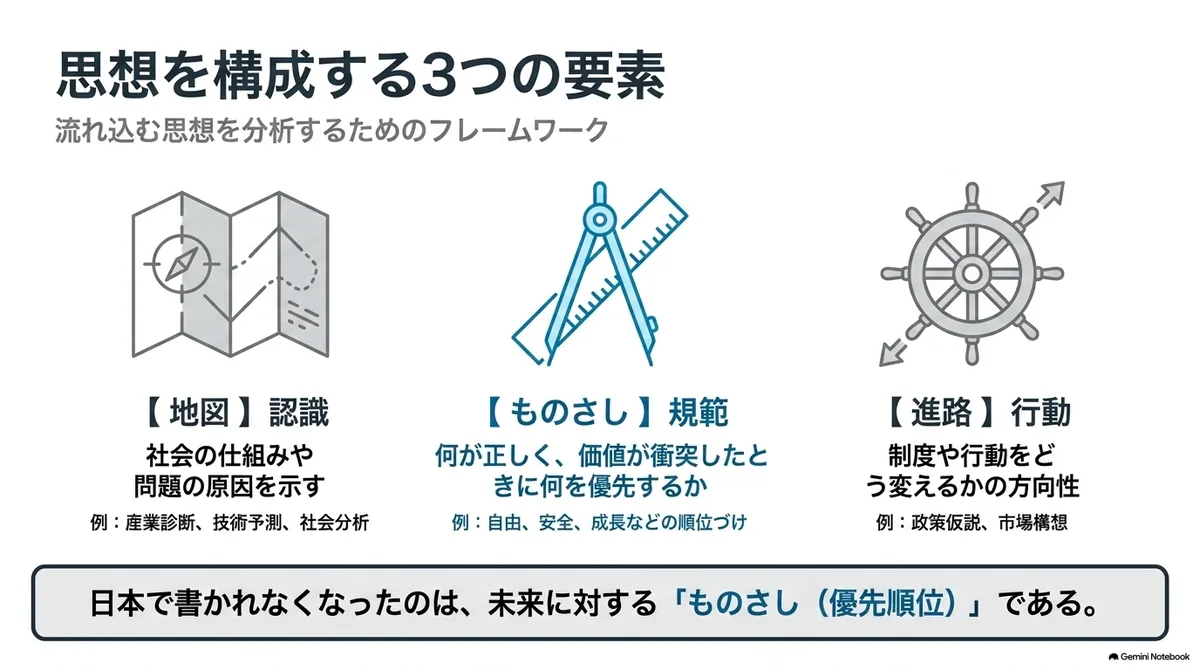
So in this article, for convenience, I treat thought as "a framework of thinking that bundles together a "map," a "ruler," and a "course" concerning society." This is part of Mullins's classic definition of ideology1. Each of the three functions answers the following question.
- Map: the element of cognition. It shows through what history society arrived at the present, what the problems are, and what causes them. It also includes the mechanisms and workings of society, and the outlook for the future derived from present conditions.
- Ruler: the element of evaluation. It evaluates the present state and the expected future, and shows what kind of society is desirable, what is right, and which takes priority when values collide. It also includes the priority among freedom, equality, order, safety, and growth.
- Course: the element of collective action. It shows who moves and how in order to maintain, correct, or transform society.
The image is of work on a nautical chart: spread out the map, lay the ruler on it, and draw the course.
What stood out among the forecasts of the future and the methodologies that came from Silicon Valley in the 2010s were mainly the map and the course. These were the "map" that social mechanisms suffer from inefficiency and can be solved by software technology, and the "course" of how to change them. The ruler was also included, but because neoliberal market fundamentalism was commonly held across the world, little friction arose.
But now, neoliberal thinking is being reconsidered (I have gathered signs of this on Substack), and various kinds of thought are becoming tangled together. Gaining strength among them are the groups of thought, such as effective accelerationism, techno-optimism, and the Dark Enlightenment as summarized in "The Thought Surrounding Silicon Valley," that contain maps and rulers different in kind from those before.
These contain maps such as "the problem lies in democracy and liberalism," rulers such as "the military business beats the consumer business," and, for those ends, investment theses and a course of "accelerate, no matter what." And part of this thought is being deployed, together with the growing capital power of a small number of VCs, as packages that include real businesses such as Palantir and Anduril.
Such packages cannot be sorted unless they are broken down. And to measure what has been broken down, you need a ruler of your own. But in Japan, I think that ruler has not been sufficiently prepared.
The Thought Being Written in Japan Now
So what is the state of that ruler of our own? Because the channel of acceptance for startup thought runs mainly among the young and mid-career generations, I would like to look at the new currents seen in Japan now. In doing so, it is easier to understand if we organize "whom" those thoughts are written for, so let me look in the order of state, civilization, individual, and industry.
(1) The current addressed to the state: digital democracy
Takahiro Anno won about 150,000 votes in the 2024 Tokyo gubernatorial election, and in 2025 won a seat in the House of Councillors as Team Mirai. Digital democracy concepts, beginning with Audrey Tang and Glen Weyl's Plurality, have advanced all the way to implementation through the channels of a political party, elections, and government, which is a rare case even globally.
Looking at the elements of thought, "map, ruler, course," this current has a clear map and course. The diagnosis that the operation of democracy is clogged in terms of the circulation of information and the formation of consensus, and therefore can be fixed with technology, along with the means to do so, has been carried through to implementation in the form of a seat. What seems thin, on the other hand, is the ruler of what kind of society is desirable. What words such as visualization, deliberation, and consensus-building point to is not the content of society but the improvement of its operation. And a future with improved procedures can be called an "efficient future," but without a ruler, one cannot answer the question of how that efficiency is to be measured.
Team Mirai seems to aim to be "neither a full-package party nor a single-issue party, but an issue-focused party." Not presenting a unified party judgment on the issues it does not handle can be called an intentional design. And it may be that it is accepted precisely because it does not present such value criteria. Still, as the policy areas widen, the question of priority, of what to allocate limited budget and time to first, becomes harder to avoid, and I think it will eventually be pressed to present a ruler that serves as an integrating principle (personally, I hope they get past that and keep doing their best).
(2) The current addressed to civilization: degrowth
Next is the current of local governments, cooperatives, and civic movements. An example is the work of Kohei Saito. Slow Down (2020) sold over 500,000 copies and has been translated into many languages. Saito advances a vision of degrowth and the commons, and most recently, in The Apocalypse of the Anthropocene, presenting the concept of dark socialism, he tries to reorganize the mechanism of capitalism itself through cooperatives, local governments, and civic movements. This is a clear attempt at implementation that belongs to the lineage of thought and social movements running from the Taisho era to the postwar period, which we saw in Parts I and III, the lineage going back to Toyohiko Kagawa's cooperatives.
The reason I mention Saito's efforts is not only a matter of for or against the conclusion of degrowth. It lies in the fact that he diagnoses the causality of society (map), presents a different image of society (ruler), and tries to tie it to the agents of implementation, cooperatives and civic movements (course). And he actively tries to convey his words even through media that are seemingly irreconcilable with them, which seems to me one of the rare attempts.
However, the unit of the addressee is civilization, that is, the economic system itself. The larger the unit, the more actors must be moved before implementation. A large distance remains between the attempts in cooperatives and local governments and the scale of the vision of reorganizing capitalism. This is probably a consequence of having chosen the largest unit, rather than a weakness of the vision.
(3) The current addressed to the individual: Reiwa humanism
The third I take up is a phenomenon more than a thought itself. The philosopher Yoshihiro Tanigawa named the way of speaking about the humanities that has appeared since 2016 "Reiwa humanism." It is said to be a tendency of narrative that separates knowledge from competition and monetizability and affirms the self-sufficiency of learning itself through multiple media, with Kaho Miyake, Hiroshi Toya, Ryunosuke Fukai, and others given as examples. As Tanigawa himself has repeatedly noted, this is not a group with a shared image of society or doctrine, but a name given to a period-wide tendency in ways of speaking and ways of reaching audiences common to the era.
What I want to confirm is the scale and the addressee of the demand. For example, Miyake, one of those in this current, wrote Why Can't We Read Books When We Work? (2024), which met large-scale demand, selling more than 100,000 copies in its first week. In it a vision of a "society of half-in work" was presented, but this was humanistic knowledge addressed mainly to individual readers.
That said, this also seems in part to have been adopted as a survival strategy for the humanities. There was probably also the aspect that it was commercially easy to accept: since the 1990s the issues shifted to the economy and the need to speak about society and norms became relatively thin, and from the 2000s it linked cultivation with the flourishing of self-help.
However, since the addressee is the individual reader, such words tend to be received not as hypotheses for moving corporate HR systems or social security in order to realize a vision, but as guidance for how readers live. If the addressee is placed on the individual from the stage of the map and the ruler, it becomes hard for it to connect to visions that flow to industry and the state.
(4) The current addressed to industry: startups and VC
Last are startups and VCs. This is the current that has become the vehicle of thought in the United States, and it is also a current that has the means of implementation, business and capital, built in from the start.
In the 2010s, together with the fact that the expansion of the tech industry drove the global economy, various industries have paid attention to the tech industry, and by extension to the startups and VCs behind it.
Looking at the three elements, the imbalance is clear. The course is abundant. There has probably never been a time when methodologies on how to build, how to raise funds, and how to grow were so well developed. There is a map too. But in Japan, as we saw in the first section, that map was an imported product. And the rulers commonly used in Japan are the formats of the formative experience and social issues, which face the past and the present. Future-tense priorities addressed to industry and the nation, such as which capabilities to hold domestically, which technologies to bet on, and which markets to newly create, do not come out of them.
In other words, the characteristic of this current is not that it has no thought, but that it receives the map and the course from outside and substitutes individual motivation for the ruler.
And now, I think many entrepreneurs are returning, rather than aiming for rapid growth in startups, to more tangible businesses and small businesses, heading toward businesses within their own reach. As a result, the vacuum in discourse about the future is growing further.
Comparing the four currents by object and tense
Lined up like this, we can see that thought is at work in its own place in Japan too. And of course each has ample value. Improving politics really improves life, and improving how individuals live and earn is also meaningful.
On top of that, if we look again with tenses aligned, a picture emerges. The only one that presents an image of the desirable future society as its own ruler is probably degrowth. The other currents all take the present framework of governance and economy as given and do the work of raising performance within it, or try to save individuals. Amid this, thought clothed in humanistic knowledge, such as The Technological Republic, aimed at societies and industries where thought is thin, appears to be flowing in.
Each strand of thought-based discourse is active in a place different from the thought now coming from overseas, and the current hypothesis is this: in present-day Japan, there is a shortage of discourse about the desirable shape of future society and about rulers and criteria of value, and that is why overseas thought can come in without friction.
"Money" as the One Remaining Ruler
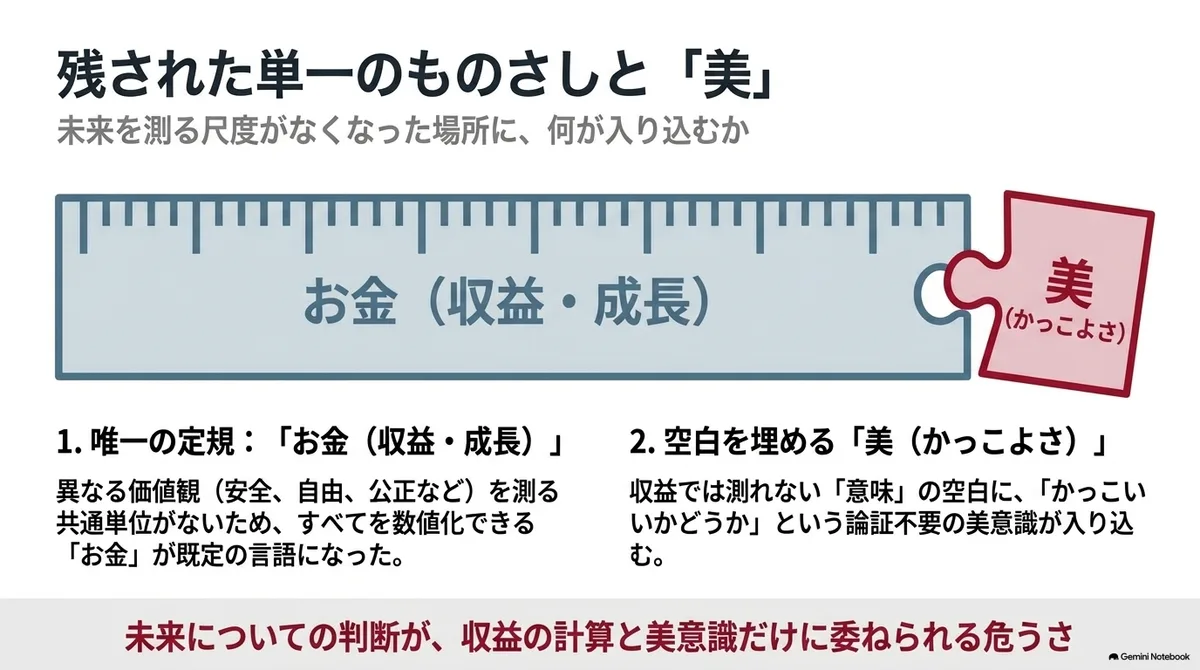
So far I have written that "the rulers are vacant," but strictly speaking they are not empty. One remains. Money.
The criteria of how much one can earn and how fast one can grow are written down, shared in computable form, and used in actual decisions. The imported methodologies we saw in the first section also came in optimized for this criterion. What exists on the ground of business is not the absence of a ruler, but a state in which a single ruler, money, is strong.
Money remained as the only ruler because it is the only one that can put different things on the same scale. Which of safety, freedom, and fairness comes first cannot be settled, because there is no common unit. But money lines them up on a single number line and makes comparison and addition possible. As Jerry Muller argues in The Tyranny of Metrics, this is also a structure in which what cannot be put on the same scale stops showing up in the arena of comparison.
Moreover, money has a function of absorbing tense into the present. Investment is a mechanism that discounts future prices into present prices. It makes the future measurable, but at the same time it undervalues futures and values that have no price.
What is troublesome is not that there is "not one ruler," but that there is "only one." If there were truly nothing, whatever came in would be subject to examination for the time being. But if there is only one, whatever does not collide with that one passes through without being examined. Resistance works only against visions incompatible with profit.
The thought coming in now has exactly that shape. Defense and space are large markets, especially in the United States, and the state becomes the customer. The ruler of money affirms this. It would even rate it highly as a "profitable theme." This is because the only thing available for value judgment is that ruler.
On top of that, this thought brings along what cannot be supplied by profit alone, namely meaning, the answer to what we do it for. It does not compete with the existing ruler; it comes to fill in what that ruler lacks. That is why friction is unlikely to arise and it is easily accepted, I think. Rather than someone sitting in a vacant seat, I think a chair is being carried in from outside to a place where resources have been moving without any seat being prepared.
The Impulse of Coolness
To that, beauty is added. Borrowing the old division of truth, goodness, and beauty, the thought coming in now is built not only on what is happening (truth) and what is right (goodness) but also on the side of beauty (reference: Hatarakimono Radio, "Technology and Coolness"). It is probably no accident that Palantir's name is taken from Tolkien, nor its dark, heavy design, nor the job title "Forward Deployed Engineer." The story that this is work on which the survival of civilization depends, an appearance fitting it, and the heroism of serving the state are designed together.
Aesthetic judgment is the only evaluation that needs no argument. Whether something is profitable can be calculated, but whether it is meaningful to do cannot. And whether something is cool is decided on the spot, without calculation. That is why, in a place with only one ruler, beauty becomes the first to fill the gap of meaning. What should be criticized is not the people who find it cool, but the state of having no ruler at hand other than money and coolness. To have no future-tense ruler also means that judgments about the future are left to nothing but the calculation of profit and aesthetic sense.
To be clear, I do not mean to say there is no backlash in Japan today. There certainly are reactions of rejection toward defense and surveillance. But rejection and selection are different. If you cannot break a package down and separate what you use from what you do not, then wholesale rejection has the same structure as wholesale acceptance. The absence of friction does not mean the absence of resistance, but the absence of criteria for selection.
The Power to Select and Live Ammunition to Choose From
Ordinarily, I think there is no need for market-side players to think about thought or ethics, and, as Joseph Heath argues in Morality, Competition, and the Firm, I think the market should not be that way. But seeing the current situation, centered on the United States, where thought and business are integrated and actively exploit the defects of the market, I think that if we try to judge everything with the ruler of money alone, we will become terribly defenseless.
So let me finally consider what we need when we face American thought from now on.
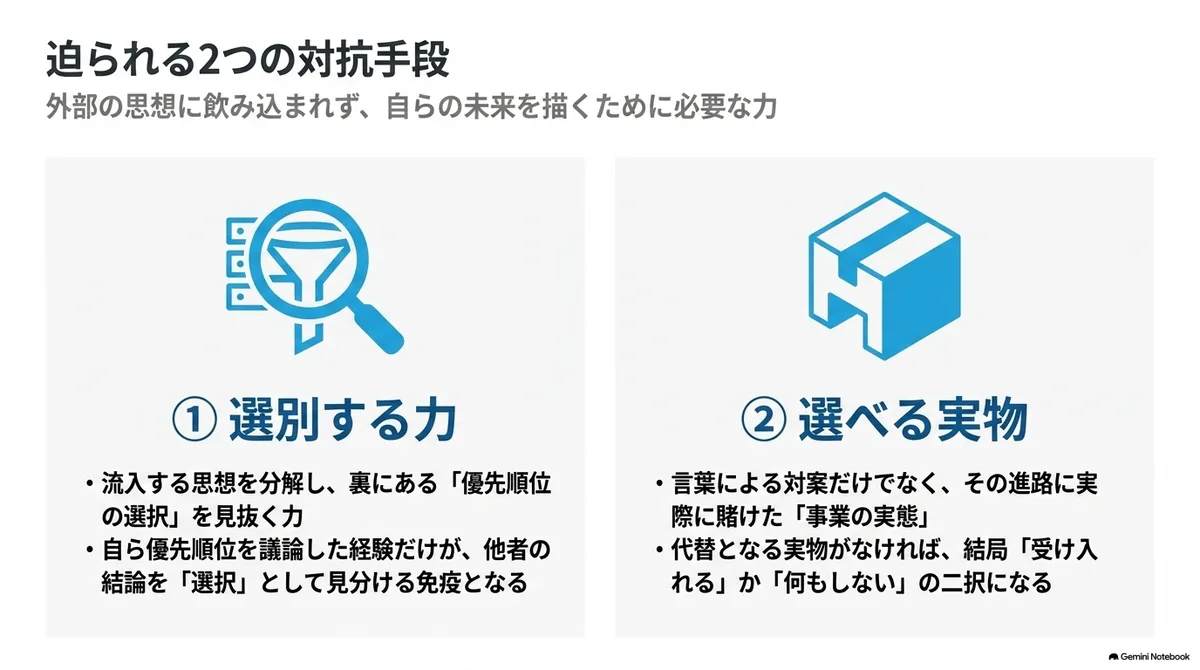
The first is the power to select what comes in. It is the ability to break thought down into the three elements, verify whether its map fits Japan's conditions, check its ruler against our own priorities, and present a different course. The better made a thought is, the more its ruler is presented not as a value judgment but as a consequence of the map. Because it takes the form "given this situation, we should prioritize this," it becomes hard to see that there is a choice in it at all.
What lets us see through it as a choice is the experience of having debated priorities ourselves. The benefit of discussing the future and norms domestically lies, at once, in the effort of reaching good conclusions and, even more, in becoming able to recognize other people's conclusions as choices. That is exactly why I think we need to speak more about the future and about norms. For that, I think we need practical humanities and social-science knowledge that faces society and asks what kind of society we want to build.
The second is live ammunition to choose from. Merely showing a different course in words does not make the counterproposal an option. It can be chosen only when there is a business that has actually bet on that course. You can oppose, but if there is nothing to answer when asked what to use instead, the judgment ends up back at a binary choice between accepting and doing nothing.
Therefore, businesses are still needed here as always. As one form of that, I think it would be good for more startups with a thought about the future to emerge. Discussions and businesses directed at the future of society in Japan and the world, such as how to handle security, how to deal with supply shortages, and what kind of society we want to build as a result, are needed more, are they not? We need to look at American investment theses, but rather than simply riding on them, we need an independent thought built on top of them.
Summary
I have developed the argument that the problem is not that The Technological Republic is being read, but that the system to receive it is not in place. I do not think it is simply a matter of rejecting American thought. Good maps should be used, reading thought that comes from outside is itself a learning experience, and we should make an effort to understand our allies. The problem is whether we have in hand a ruler to measure it with, and whether we accept that thought uncritically.
Friction arises only when selection is working. Seen this way, it is healthy for friction to occur, and I think whether we can create that friction is the condition for using it without being swallowed up.
The hypothesis of this article is that, for that purpose, we should speak more about the future and norms of society.
Note: This article reorganizes the latter half of the argument in the previous piece so that it can be read as an independent article. If you are interested in the whole argument, including the history from the Meiji era to the present, please see that article as well.
Footnotes
-
Mullins additionally requires logical systematicity of an ideology, but there are hardly any ideologies that systematic, and some are closer to a vibe, so I omitted that this time. ↩