Organizing Postwar Japan in 25-Year Increments, and the Questions of the 2020s
This article was machine-translated from Japanese by AI (Claude). It may contain errors. Read the original Japanese article.
As the 2020s enter their second half, I have been thinking a lot lately about what we should be asking now.
One of those questions is "thought," which I have been writing about often in recent articles. I believe the direction of thought becomes the foundation of business and will greatly influence the future of business and startups (see another article on this).
Suppose we understand thought through three elements:
- A map of cognition
- A yardstick of evaluation
- A course as a guide for practice
(I am drawing on Mullins's definition of ideology.) The first of these, the "map of cognition," is said to include an "understanding of the past, present, and future." In other words, to think about the thought of the years ahead, we cannot do without the work of reexamining history so far, alongside thinking about the future.
Recently, a growing number of books looking back on the postwar period have been published, and it seems to me that efforts to draw an overview of this history are underway in many places. I am not a specialist, so I am somewhat hesitant to take a broad look at history myself. But in thinking about the future thought concerning capital and business, I have come to feel that there may also be room for the work of sketching a rough overview of the past several decades in a form that is useful for business.
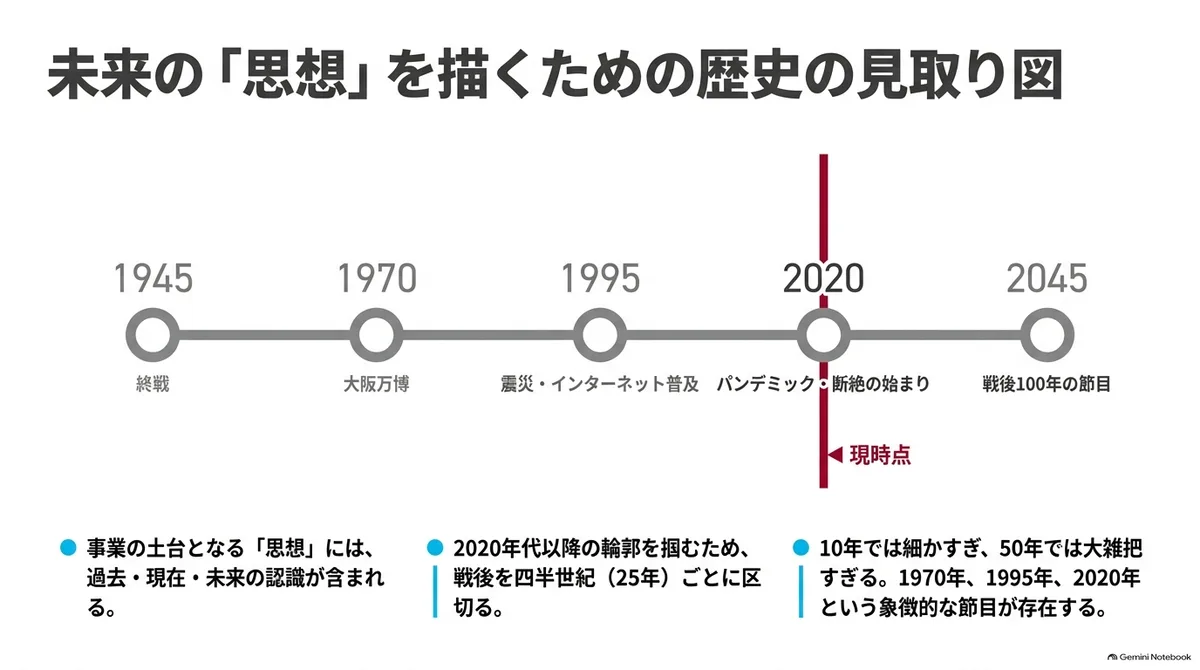
So, as one experiment, here I would like to divide the postwar period into 25-year blocks, 1945–1970, 1970–1995, 1995–2020, and 2020–2045, and organize the changes of each quarter century. The intention behind this is that doing so may make the outline of the coming 2020–2045 easier to see.
I will go into detail below, but if we look back on the challenges each era faced, the questions that arose from them, and who mainly took them on, the flow seems to have been roughly as follows.
- After the war ended in 1945, the question of what kind of state and society to rebuild was taken on mainly by the state and companies.
- From around 1970, the question of what kind of life to build in an affluent society was taken on by close-knit groups such as families, communities, and unions.
- From 1995 onward, as the security provided by the organizations people belonged to wavered, the question of how to live, work, and support one another came to be taken on mainly by individuals. At the same time, individuals also gained greater freedom to start their own businesses and activities and to build organizations. However, the power to decide employment and the allocation of capital gathered not with individuals but with companies and with capital that crosses borders.
And from the 2020s onward, I feel that "questions on a scale that individuals or individual organizations cannot take on alone," such as infectious diseases, security, decarbonization, and population decline, have come to the forefront once again.
Facing such questions requires collective will and power. But as I describe later, over these several decades the bearer of questions seems to have gradually shifted to the individual. If we tried to pull power back all at once into a collective such as the state, it could provoke strong backlash, and carelessly concentrating power also carries the undeniable danger of tilting toward state-centered totalitarian control. Particularly these days, technological progress has made it easier than before for actors with strong authority, such as the state, to exercise control, and that risk is growing.
On the other hand, with the rise of private platform companies that wield influence across borders, concentrating authority in the state does not necessarily solve the problem either. In that sense too, I feel we must think about how things should be from now on in a way that differs from going back to the past.
In that sense, I believe the challenge we face now is how to build a mechanism for jointly taking on big questions while preserving individual freedom.
Comparing Questions and Their Bearers by Drawing Auxiliary Lines in 25-Year Units
From here, taking 1945, the year the war ended, as the starting point, I will look back on the eras while drawing auxiliary lines at every quarter century (25 years).
The 25-year division is only one auxiliary line, but there are several reasons I chose this unit.
- When reexamining a hundred years from the viewpoint of thought, 10-year units are too fine and 50-year units too coarse, so looking at intervals of about 20 to 25 years makes it easier to gain a view toward the present.
- There is the symbolic turning point of "1970," when the Osaka Expo was held (in my earlier "Thought and Capital" series, I also treated 1970 as one dividing point).
- There is the major turning point of "1995," when the Great Hanshin-Awaji Earthquake and the Tokyo subway sarin attack occurred (Masanori Tsujita also treats the 1990s as a dividing line and argues in particular for 1995).
- There is the clear break of "2020," when the spread of the novel coronavirus (COVID-19) began.
- The next, "2045," falls exactly on the 100th anniversary of the end of the war.
Of course, one could also divide the periods by other events such as the oil crises, but I have adopted this quarter-century division to make the overall structure easier to grasp. With that, the "question this article focuses on" and "its main bearer" in each period correspond as follows.
| Period | Question this article focuses on | Main bearer |
|---|---|---|
| 1945–1970 | How to rebuild postwar Japan as a country and society | State and companies |
| 1970–1995 | What kind of life to build in an affluent society | Families, communities, and unions |
| 1995–2020 | How to live, work, and support one another | Individuals |
| 2020–2045 (conjecture) | With whom, and what, and how, to take on jointly while preserving individual freedom | The "we" that is being questioned anew (collaborating joint actors) |
From here, I would like to look at the eras along three paths. First, we move through Japan from 1945 to the present; next, we go back from 1945 to 1870 to put the length of the postwar period in perspective; and finally, we move forward from 1870 to the present on the world's side.
1945–1970: The State and Companies Led Reconstruction and Growth
Japan reached the end of the war in August 1945. The challenge Japan faced immediately after the war went beyond restoring livelihoods and industry; it was to reassemble the very institutions of the state. Under the occupation by the Allied forces, the drafting of the Constitution of Japan and the revision of the Civil Code advanced, and the structures of governance and the institutions concerning the family were greatly renewed. The challenge of "how to rebuild the country and society from here" lay before people's eyes as an urgent question.
The government put institutions in order while negotiating with the occupation authorities, companies hurried to restore production and employment, and, with special procurement demand from the Korean War as one trigger, Japan entrusted much of its security to the United States while concentrating resources on economic development, and companies too achieved rapid growth.
In the course of that growth, labor unions and social movements became active, and there were also strong movements demanding the establishment of rights and the fair distribution of the gains. Even so, the real center of the power that moved society was, it seems, still the state and companies. The two functioned as the leading actors, aligning policies and directions while mobilizing the funds and organizations needed to carry them out.
Companies in particular were both places where people worked and earned income and the central suppliers of the goods needed for an affluent life. During the period of high economic growth, home appliances and automobiles spread rapidly, transforming daily lifestyles, and it can be said to have been an era in which, through the activity of companies driving the expansion of production and employment, the economic growth of the whole country was directly tied to how each person worked and to the life of each household.
At the same time, the net of social security supporting livelihoods also expanded. In 1961, universal health insurance and universal pensions were realized, and a system was put in place in which not only employees but also the self-employed and agricultural workers enrolled in public health insurance and pensions. A structure in which the state designed mechanisms to prepare for the risks of illness and old age, and citizens supported one another by contributing premiums, became a firm pillar for stabilizing life. With earned income from companies and the public social security system as two wheels, this was the era in which the foundation supporting family life was established.
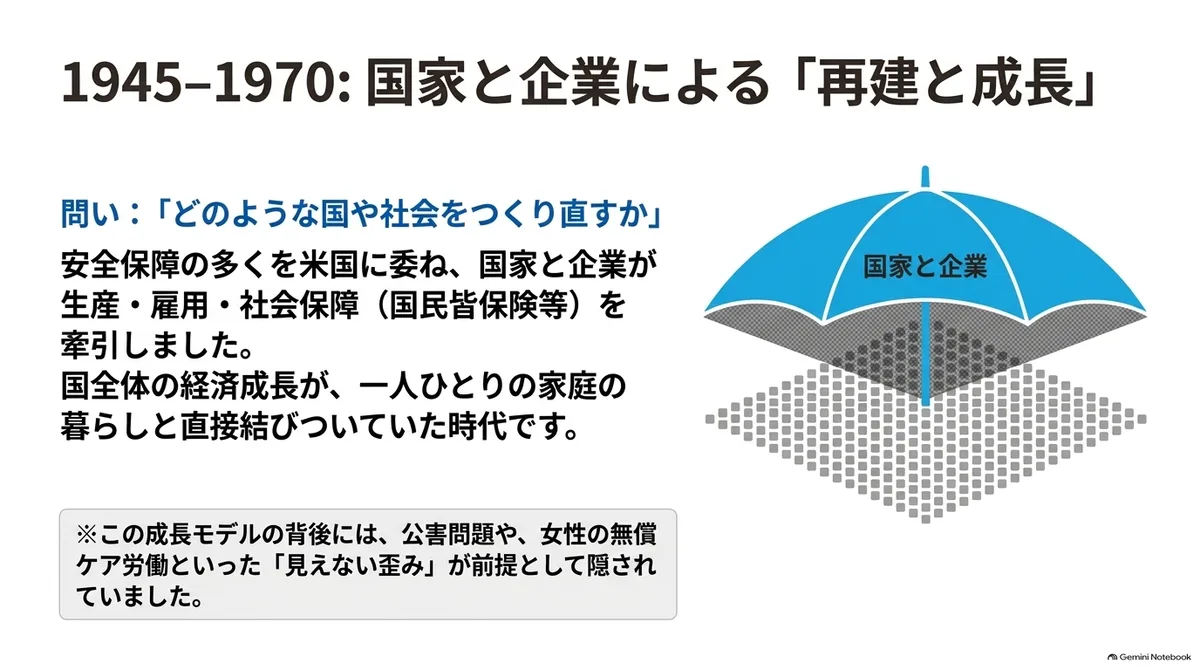
Nevertheless, not a few people were left behind by the benefits of that growth and distribution. Regions suffering from serious pollution arose, and there were groups placed outside the framework of stable regular employment. Within the household, women carried much, without pay, of the care work such as housework, child-rearing, and elder care, and their participation in economic activity outside the home was constrained. There were also regions and people structurally placed outside the framework of "we" of this period, such as Okinawa, which remained under U.S. administration until 1972.
Of these, the gendered division of labor within the household was, I think, treated in this period less as a problem to be solved than as a premise of the growth model, in which companies grew on the assumption of long working hours for men and households supported those men. The burden was imposed, but it was not counted as a burden, and it was placed outside the question the state and companies had taken on, "how to rebuild the country and society."
This first quarter century was one in which incomes rose and material affluence was achieved, while distortions such as pollution problems and the uneven burden of care accumulated. As a result, society's interest gradually shifted to a question in close-knit groups such as families and communities: "what kind of life should the affluence we have obtained be turned into?"
1970–1995: The Demands and Choices of Daily Life Expanded
In the quarter century from around 1970, on the premise of a life supported by corporate employment and national social security, the emphasis shifted greatly toward what people wanted and how they sought to raise the quality of their lives.
This was also the period when a marked change appeared in people's consciousness of affluence. Looking back at the Cabinet Office public opinion survey cited in the Health, Labour and Welfare White Paper, in the 1970s answers valuing "material affluence" and answers emphasizing "spiritual affluence and leisure" began to be evenly matched, and in the late 1970s the latter overtook the former. Behind the movement to seek qualitative fulfillment in life, there seems to have been a shift in the values themselves about what counts as affluence.
And the basic unit of life in this era was the "family." The family was at the center of facing choices of housing, the use of household budgets, children's education, and planning for life in old age. Within it, the family tried to give concrete form to a desirable life while allocating and adjusting who would work and who would take on child-rearing and elder care. It was precisely this unit, the family, and in particular the nuclear family that had increased sharply in the 1960s, that routinely took on the questions of diverse life choices and responsibility for care.
However, problems such as health damage and deteriorating living environments caused by pollution, wages, working hours, and food safety could not be solved by the efforts of individual families alone. In response to these shared problems of daily life, diverse intermediate groups such as residents' organizations, local communities, labor unions, and consumer cooperatives were formed and demanded environmental improvement and the expansion of institutions from government and companies.
What characterized this era was that, rather than the solitary individual, there was first the intimate sphere of the family, and further, intermediate groups mediating between that family and the state functioned actively.
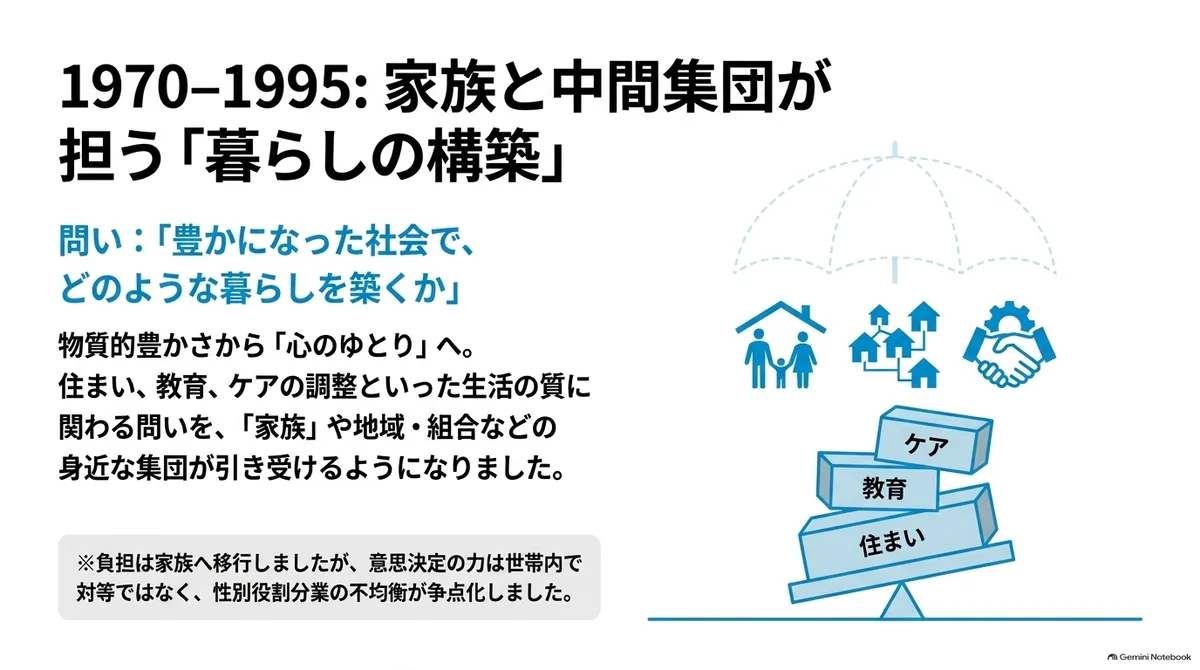
That said, while such families and groups served as safety nets that protected people, a different kind of problem from the previous era appeared in their internal division of roles. The household model of lifetime employment for men and unpaid care work for women, which had taken hold as a premise of the growth model in the previous quarter century, now became the initial condition under which families took on the questions of life. The more families took on questions such as housing, education, and the care of aging parents, the more the burden concentrated on the women within the household. Moreover, the power to decide what to choose and who would bear it was not equal within the household, and I think a structure in which those who bore the burden found it hard to take part in decisions was reproduced inside the unit of the family.
At the same time, in this period the division of roles itself became a point of contention. Movements demanding women's participation in society and gender equality spread, and equality in employment became an institutional issue, while tax and pension systems premised on households with full-time homemakers were also put in place. The family was both a subject that took on questions and a place where its internal allocation was being questioned anew.
Also, not a few individuals felt stifled by the pressure to conform and the burdens of local communities, and the insufficient inclusion of people who fell outside corporate regular employment and the standard family framework also remained a major problem.
Through the trial and error of social movements and institutional reforms seeking to resolve such oppression and inequality, the unit that takes on questions gradually shifted from groups to individuals.
1995–2020: Individual Choice and Burden Were Called into Question
In the 1990s, after the collapse of the bubble economy, as globalization and liberalism spread, the unit that takes on various challenges and questions moved in earnest from organizations and groups to individuals.
The trend of valuing individual autonomous choice and self-responsibility is clearly shown in the policy directions of the time. In 1999, the Economic Planning Agency's "Basic Direction for the Ideal Economy and Society and Economic Revival Policy" placed individual freedom and self-responsibility as the basic principle of action and advocated building an environment that supports diverse career choices and challenges. Each person was encouraged to open up their own path by their own will, and it can be said that an institutional foundation to support that free choice was being sought.
At the same time, the tools and environments for individuals to start activities as principals also expanded greatly. With the spread of the internet, individuals could communicate directly to the world, find collaborators and customers who shared their aims, and start businesses without belonging to a large organization. In the nonprofit sphere too, triggered by the surge of extensive volunteer activity after the 1995 Great Hanshin-Awaji Earthquake, the Act on Promotion of Specified Nonprofit Activities (the NPO Act) was enacted and put into effect in 1998, opening a new channel for citizens to voluntarily take on the resolution of social issues.
In this quarter century, individuals were freed from the constraints of existing communities such as family, community, and company, and became beings required to take on choices about livelihood and employment themselves. On the other hand, one could also say they gained the freedom to act as autonomous agents who create new work and new mechanisms of mutual support. This is a way of taking on questions: raising questions oneself, recruiting companions, and, as needed, building one's own organization. For those who could not fit into the conventional fixed roles, too, the technology and institutional foundations to open up their own possibilities were being put in place.
In the latter part of this era, especially the 2010s, I think phenomena such as the surge of startups and entrepreneurship, and individual influencers who stood out on social media and elsewhere, also functioned as representative devices for taking on questions starting from the individual.
However, even though the bearer of questions had moved to individuals, there were many respects in which the location of power had not moved to individuals. What actually determined the forms of employment and the allocation of capital in this quarter century was not individuals but companies and capital that crosses borders.
With the 1999 revision of the Worker Dispatch Act, the businesses eligible for dispatch were in principle liberalized, and in 2004 dispatch to manufacturing was lifted as well. The share of non-regular employment rose from about 20 percent in 1990 to nearly 40 percent in 2019, and the risk of employment fluctuations was shifted to individuals. Over the same period, corporate retained earnings accumulated, and after the 2015 Corporate Governance Code, returns to shareholders, rather than to workers, came to be emphasized. It seems to me that the norm of individual self-responsibility was also a norm demanded to increase the mobility of capital and labor.
Meanwhile, Japanese companies themselves stepped down from the role of bearer they had played in 1945–1970. While cleaning up after the bubble, they lost their international standing in electronics and semiconductors at the same time, and as they scaled back lifetime employment and in-house welfare, companies ceased to be entities that took on employment and livelihood security and, in return, held social legitimacy. The vacuum was filled by capital that crosses borders, such as overseas investors and rating agencies, and by individuals themselves.
The tools that supported individual empowerment were also, for the most part, overseas platforms. It was on Google and Facebook that individuals could communicate to the world; startups came to rest on venture capital, and individual commerce on markets that platforms provided. It was companies that cross borders that supplied the foundation of individual freedom, and it was they who set the terms of use of that foundation.
And individuals such as the entrepreneurs and VCs who own those platforms came to hold power, gathering wealth, fame, and power.
Overall, the quarter century up to 2020 was an era in which Japanese companies withdrew from having been the substantive providers of social security through long-term employment and the like, and in which individual empowerment advanced greatly. At the same time, it can also be called an era in which structural inequality and gaps in the safety net were shifted onto individuals as a lack of effort in the name of "self-responsibility," harsh competition among individuals arose, and individuals internalized the norms of self-responsibility and meritocracy.
The 2020s: Challenges of Supply and Coordination Overlap
Entering the 2020s, the nature of the challenges and questions society faces has changed greatly.
In the global spread of the novel coronavirus that began in 2020, both the supply capacity of medical services itself and the coordination capacity to allocate strained resources were severely tested. The geopolitical confrontation between the United States and China, which had sharpened from the latter half of the 2010s, also demands responses on a national scale, far beyond what the efforts of individual companies can handle. Furthermore, since Russia's invasion of Ukraine in 2022, securing supply chains for critical goods, including energy, food, and semiconductors, has been newly recognized as a matter of life and death directly tied to national security.
In addition, the transition to a decarbonized society requires a fundamental rebuilding of the entire social infrastructure and huge long-term investment over several decades. And the demand side of that is the global market, so it cannot be settled by domestic decisions alone. Looking at the domestic scene, too, amid rapid population decline and a declining birthrate with an aging population, we face various structural challenges. For example: how to sustain the workforce for medical care and elder care; how to scale down and reorganize social infrastructure and residential areas in a planned way; and who will share the excessive burdens that arise in the process.
Of course, problems such as the threat of infectious diseases, war, the crisis of the global environment, demographics, and aging infrastructure did not suddenly arise with 2020 as the dividing line. But as these difficulties overlap in a compounded way, it can be seen that the question "who on earth will maintain and keep supporting the supply foundations, social institutions, and the very order that are supposed to underpin individuals' free activity?" has once again surfaced to the forefront of society.
History has no strict 25-year cycle, but looking back in this way over the course of quarter centuries, I feel that where we stand now is precisely a transitional period in which the very dimension of the questions is fundamentally shifting.
And if we think about business only on the basis of what has been said so far, one might conclude that "building businesses and startups that are identified with the state may be the shortcut to making money from now on." Before jumping to such a conclusion, I would like to step back a little further and look at history.
Going Back from 1945 to 1870 to Put the Postwar Period in Perspective
So far I have looked at the course from 1945 to the 2020s as a process in which the bearer of questions shifted from the state and companies to families and communities, and then to individuals. In this section, I would like to switch perspective once and turn the clock back from 1945 in 25-year steps to 1870. The purpose is to put the 75 years of the postwar period in perspective by setting it alongside the 75 years of equal length that precede it. In going back, I use the same viewpoint of who was taking on the questions of each era.
First, at the starting point of 1945, production, funds, labor, and speech were all incorporated into the war effort under the National Mobilization Law (1938). It was the state that took on the questions, and the people were in a state of bearing only the burdens, as mobilized participants.
The period one step before that, 1920–1945, was a quarter century in which, just after the people had nearly joined the side of the bearers, the bearer became fixed on the state again. The 1925 universal male suffrage law abolished the tax requirement, and the number of voters rose sharply to about four times. But in the same year, 1925, the Peace Preservation Law was enacted, and debate on the very nature of the state was pushed outside the bounds of permitted speech. Women also remained without suffrage. Furthermore, the May 15 Incident of 1932 destroyed the conventions of party politics, and the center of gravity of decision-making moved to the military and the bureaucracy. In little more than ten years after the realization of universal suffrage, the people were returned from being bearers of questions to objects of mobilization for the questions the state had taken on.
One step further back, 1895–1920, was a quarter century in which the people who bore the burdens rose up demanding to become bearers themselves. The war costs and troops that supported the Sino-Japanese War, which ended in 1895, the Russo-Japanese War, which began in 1904, and the First World War in 1914, were imposed broadly on the people as tax increases and conscription. In that sense, the 1905 Hibiya Incendiary Incident was a protest by people who had endured the burdens of war and were not satisfied with the peace treaty, and the 1918 Rice Riots were an objection to the hardship of livelihood caused by wartime inflation. One can see that, triggered by the Rice Riots, a full-fledged party cabinet was born, and the movement demanding universal suffrage rose nationwide, leading to the realization of universal suffrage in 1925.
And one more step back, 1870–1895, is the quarter century in which the framework of the modern state was built right after the Meiji Restoration (1868). The bearer of the question "how to build a modern state" was the Meiji government, and what the government prioritized above all was the institutional channel for collecting burdens from the people. Through the education system of 1872 and the conscription order and land tax reform of 1873, the duties of education, military service, and taxation came to be imposed directly on each individual, without the mediation of the old domains and villages. Meanwhile, the building of channels for the people to join the side of the bearers lagged greatly, and the state and the nobility drove things alone. The Imperial Diet was finally opened in 1890, but the electorate was limited to men aged 25 or older who paid 15 yen or more in direct national taxes, and their number was only a little over 1 percent of the total population. The Freedom and People's Rights Movement can be said to have been a movement that demanded this channel from the side that bore the burdens.
Going back to 1870 in this way, we can see that the prewar 75 years were an era in which the bearer of questions was consistently fixed on the state. The people and companies were bearers of burdens, but joining the side of the bearers remained limited to the end. By contrast, the postwar 75 years can also be called an era in which the bearer itself came down from the state to companies, to families and communities, and then to individuals.
On top of that, I would also like to turn to the length of time itself. By 2020, postwar Japan had already walked the same amount of time as the 75 years from 1870 to defeat, and its present position lies beyond that.
戦前 75年   1870 ---- 1895 ---- 1920 ---- 1945
                                          |
戦後 75年                                 1945 ---- 1970 ---- 1995 ---- 2020 -- 現在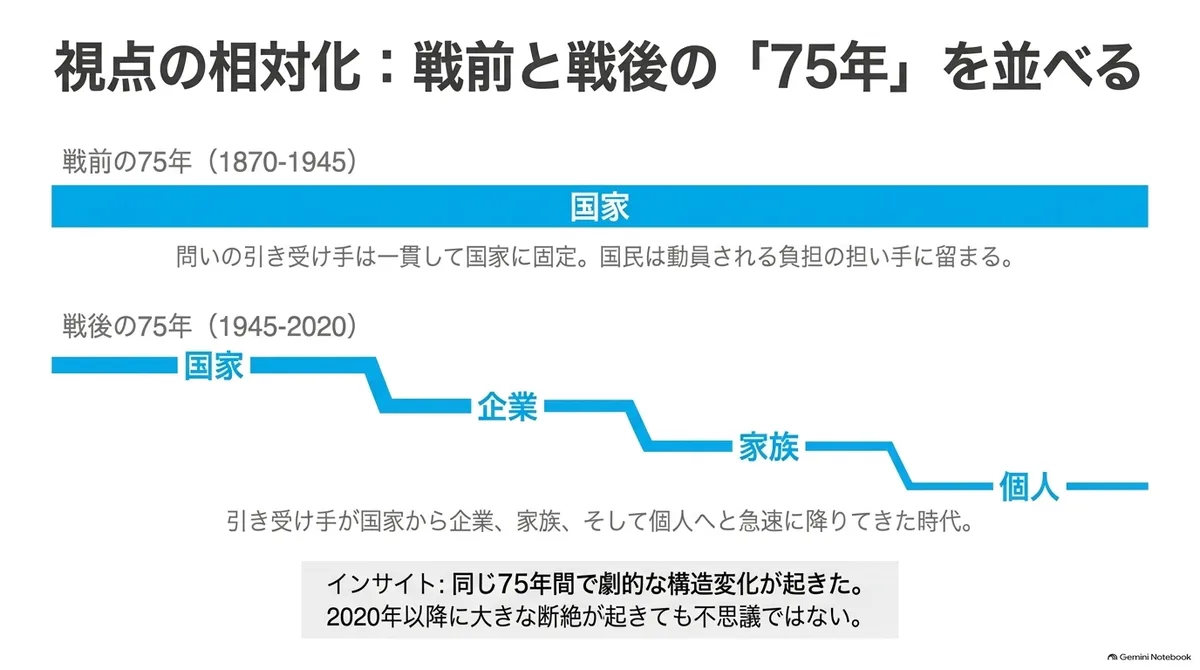
In the prewar 75 years, Japan built the foundations of a modern state, climbed to become one of the great powers, and eventually arrived at total mobilization. In the postwar 75 years, over the same length of time, the location of the bearer moved greatly at each stage. The postwar 75 years can be considered a period of rapid change, and it means that large changes would not be surprising from 2020 onward either.
However, this retrospective follows only events within Japan. Both the nation-building of 1870 and the course of the following 75 years were in fact carried out in the form of answering questions directed at Japan from the world. So in the next section, I would like to turn around while standing at 1870 and this time move time forward from the world's side.
Who Did the World's Questions Reach? 1870–2020s
The changes of each quarter century in Japan have always unfolded within the international environment of the time. Postwar Japan in particular built its prosperity by entrusting much of its security and the maintenance of the international market order to the United States. I believe that unless we understand what was entrusted and how it has changed, we will misjudge the questions we should be asking from the 2020s onward.
So in this section, I will look from the world's side instead. What did the world ask of Japan, whom in Japan did those questions reach, and what did Japan take on and what did it, conversely, entrust to others? I would like to trace this chronologically from 1870, using the same quarter-century auxiliary lines as in the domestic part. If the section following the domestic course viewed the shift of the bearer of questions from the "inside," this section is an attempt to recapture the same movement from the "outside," the international environment.
| Period | Question the world directed at Japan | Addressee of the question | Japan's answer (what it took on / what it entrusted) |
|---|---|---|---|
| 1870–1895 | Open the country | The state | Hurriedly build a modern state |
| 1895–1920 | Act as one of the great powers | The state | Became one of Asia's great powers. Built a state able to endure total war and spread the burden to the people. Turned into a creditor nation |
| 1920–1945 | Maintain international cooperation even amid depression and confrontation | The state | As cooperation among the major powers weakened, Japan too pursued external expansion. Announced withdrawal from the League of Nations (1933) and eventually headed toward total war |
| 1945–1970 | Rebuild as a member of the West. Entrust security to others | The state. Begins to reach companies as the bearers of exports and employment | Entrusted much of its security to the United States; the state and companies led reconstruction and growth |
| 1970–1995 | As an economic power, open markets and adjust trade imbalances | Companies and the state | Companies and the state handled trade friction and the strong yen, while families, communities, and unions supported domestic life |
| 1995–2020 | Conform to global standards | Companies and individuals | Used overseas capital and platforms to expand individual freedom, while also demanding that individuals bear responsibility for responding |
| 2020s | Share the costs of order + ? | ? | The answer is not settled. At the least, payment for what had been entrusted, and a reexamination of what had been postponed, are beginning |
In the three quarter centuries from 1870 to 1945, the addressee of the world's questions was consistently the state. The first question was "open the country." Afterward, Japan entered the competition among the great powers through the Sino-Japanese War, joined their ranks via the Anglo-Japanese Alliance (1902), and by the time it turned into a creditor nation through the First World War, the world's question had changed to "act as one of the great powers."
From 1920 onward, the world's question changed to "maintain cooperation even amid depression and confrontation, and remain within the international order." But after the Great Depression of 1929, the major countries withdrew into blocs based on their own currency areas, and the United States, which then had the greatest economic power, did not actively take on maintaining the international order either. Even on the world's side, which demanded that countries remain within the order, there was no bearer to support that order.
Japan eventually withdrew from the League of Nations after the Manchurian Incident and, as an extension of that, rushed toward total war. The Bretton Woods system and the founding of the United Nations, conceived toward the end of the Second World War, were designed precisely on the basis of this reflection.
The question that the world, in practice the United States, directed at Japan in 1945–1970 was "rebuild as a member of the West, and entrust security to others." Through the gold-dollar standard, the Marshall Plan, GATT, NATO, and the like, the United States provided allies in the liberal camp with a defense system and open markets, and in return led decision-making in the international order.
Under the Japan-U.S. Security Treaty, Japan entrusted much of its defense and concentrated resources on economic growth. The addressee of the question at this time was the state, but the ones who substantively carried out the answer were companies that drove exports and employment, and the destination of the question began to widen from the state to companies. The reconstruction and growth model of the state and companies touched on in the previous section can be said to have been a mechanism that worked only after the external environment of defense and the international market was entrusted to the outside.
In the following 1970–1995, after the Nixon Shock, the two oil crises, and the move to floating exchange rates, the United States steered toward a neoliberal market economy model. In this period Japan became the largest economic challenger within the order the United States maintained, and the world's question changed to "recycle your trade surplus and open your domestic market." U.S.-Japan trade friction and the 1985 Plaza Accord are symbols of this. It was export companies that stood on the front line of the friction, and since external responses too were demanded as the autonomous actions of companies, the addressee of the world's question shifted to companies at this stage.
What I want to note here is the "gap" that questions from outside and questions from inside each reached different parties. From the outside, questions about opening markets reached companies, while on the inside, the questions of daily life were taken on by intermediate groups such as families, communities, and unions. In this quarter century, when the bearer of questions in the world was shifting toward markets and companies, the intimate sphere and local society in Japan were still functioning relatively well. The unit of questions in Japan shifted in earnest toward markets and individuals only after 1995, and I think this time lag may have forced rapid change in a short period in later eras and led to harsh arguments about self-responsibility.
In 1995–2020, with the launch of the WTO (World Trade Organization) and China's accession, globalization advanced, with people, goods, money, and information crossing borders actively. The world's question changed to "conform to global standards," and its addressee skipped over companies and came down directly to each individual living their life. The fact that the 1999 policy direction placed individual freedom and self-responsibility as the principle of action, and that the risk of employment fluctuations was shifted to workers through the expansion of non-regular employment, may also be understood as having had such external demands in the background. If the norm of self-responsibility was demanded to increase the mobility of capital and labor, then it can also be thought of as a question thrown directly from the international community at individuals, with the international community and individuals directly connected.
And during this quarter century Japan entrusted the basic rules of its economy, its digital foundations, and its raising of capital to overseas actors, especially the United States, and expanded individuals' freedom of activity on that premise. It was on huge overseas platforms that individuals could communicate information to the world, and it was the huge tech companies that cross borders that set the terms of use.
As a result, the presence of the state within the country receded relatively. Around the same time, after the 2008 global financial crisis, China overtook Japan in GDP, and discontent erupted within American society as well, asking "why must our country keep paying enormous costs to support the world's order?", leading to President Obama's 2013 statement that "America is not the world's policeman." One could say that payment for what the world had entrusted to the United States had already begun to be prepared in this period.
And entering the 2020s, through the intensification of U.S.-China confrontation and Russia's invasion of Ukraine, the world's question turned into the harsh demand to "share the costs of the international order." Through tariff measures and export controls on advanced technology, the United States has come to press even its allies strongly for a fair share of the burden. The great power that once supplied order has turned into one that strictly demands payment for the burden.
Furthermore, the "world" I have described so far was mainly a Western-centered "world," but over the past twenty years various countries, including the Global South, have entered the circle of this world. And these countries are precisely the ones bearing a large share of the costs of climate change and the like now, and the question of how to share that cost around the world has still not been resolved.
At the same time, as globalization destabilized employment and other conditions within countries, industrial policy returned politically, and as the crisis of economic security was raised, the addressee of the question returned once again to the state. However, the candidates for bearer are not limited to the state. As bilateral and multilateral alliances, regional blocs, and furthermore American mega-platform companies with enormous influence across borders flaunt their power in a way unlike before, middle powers such as Japan and the EU have no counterproposal. With the balance of power lopsided, who should take on this order, and the framework for it, remains undetermined.
Moreover, even if the addressee of the question has returned to the state, it is not necessarily the case that the means needed to answer it are in the state's hands. It is individual companies that decide the shape of employment, capital held by investors who cross borders that decides the allocation of capital, and private businesses that actually move the supply chains.
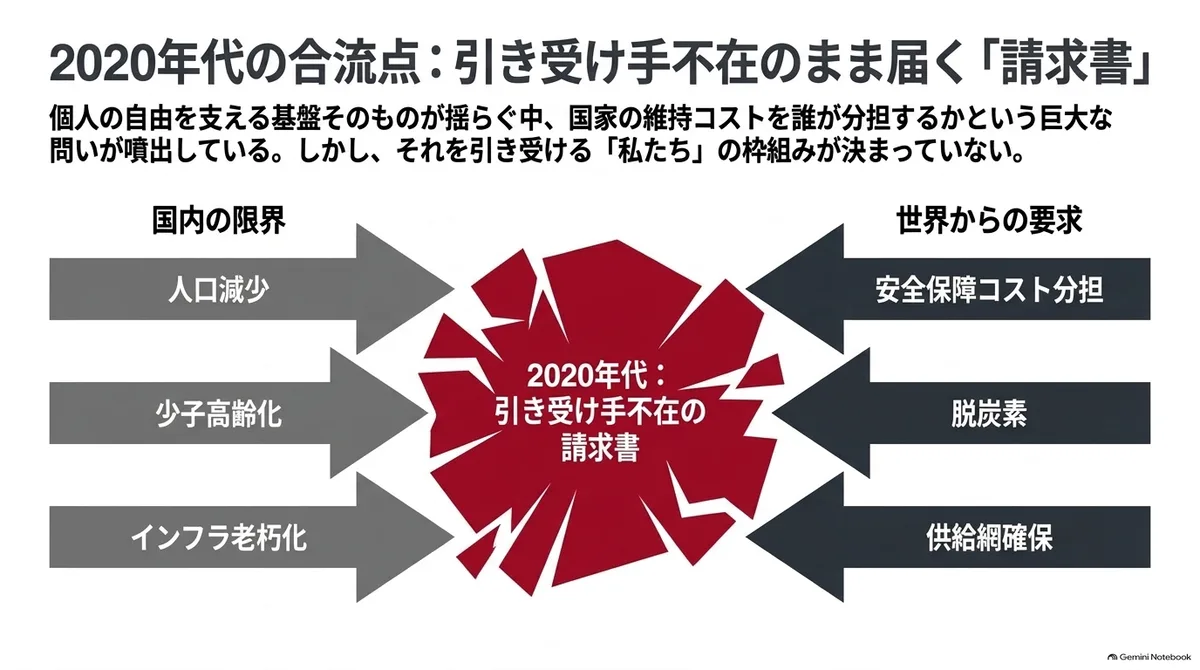
In other words, the bearer of questions came down to individuals after 1995, the power and capacity to decide gathered in global capital, and the bill for maintaining the order is arriving addressed to the state, companies, and citizens. I believe the structural reality that such a twist arises all at once lies at the root of the difficulties of the 2020s.
Amid this, in Japan we increasingly see discourse that tries to return to a former image of the state, such as the political system of the early Meiji era or the high-growth period after the war. But given that the international environment surrounding Japan has fundamentally changed and that it cannot sever its ties with the world, a simple return to past frameworks does not seem to be a realistic solution.
The 2020s as a Confluence
Tracing the two paths, the domestic course and the view from the world, we can see that both reflected, from inside and outside, the same structural movement.
On the inside, the bearer of questions moved from the state and companies to families and communities, and then to individuals. On the outside, the addressee of the world's questions moved from the state to companies, and then to individuals. The three postwar quarter centuries of Japan took the U.S.-supported international order as a given and, within its safe interior, sought "who in Japan should take on the challenges," but this inside and outside were in fact progressing in parallel, intertwined.
What is happening in the 2020s can also be described as these two paths merging. Domestically, structural challenges such as the declining birthrate with an aging population and aging infrastructure have reached their limits, and questions on a scale that individuals or individual organizations alone can no longer hold have burst to the forefront. At the same time, from the world, the external actors who had supplied the international order are pressing us to share the cost of maintaining it. Foundations such as national defense, fair market rules, and the stable supply of energy, food, and critical goods are no longer premises given unconditionally; they have become things that Japan itself must actively take on and support in cooperation with other countries.
Such big questions have been put forward, and while who will take them on remains undecided, the bill demanding payment of the cost has arrived in our hands. That, I think, is where we stand now.
The Impact of These Changes on Business
And the addressees of the bill include not only the state but also business. Postwar Japanese companies rode on U.S. security, open markets, and overseas digital foundations, and enjoyed the benefits of the order. Now that this order is crumbling, payments that someone else once bore, in the form of tariffs, rising procurement costs, and the tax burden to fund defense spending, are now beginning to reach business as well.
There may thus be a path in which the state and business become one again. But the postwar integration worked because three conditions were in place: a course provided from outside, allocation within the country, and the United States bearing the costs. The current state is unsure of its course and has no effective means compared with the United States and China, so even if the Japanese state and business were integrated, the economic prosperity of the Meiji era or the postwar period would not return. The side of business that holds employment and supply networks would end up on the side supporting the state, and would be forced to ask itself what it is carrying that burden for.
Moreover, the partner of integration is not necessarily only one's own state. In capital-intensive fields such as AI and semiconductors, the United States and China stand out, and integration by Japan alone is no match. With alliances, regional blocs, and giant platforms also candidates for bearers, business has to reconsider for itself whom to trust, what to hold in-house, and what to carry jointly with whom.
Furthermore, as long as one keeps fighting on norms and rules set by someone else, it will be hard to beat the house.
And if the state misjudges its course, business cannot function either. Therefore, if business is to become integrated with the state, all the more, I believe the need is growing for business to think through, on its own initiative, the course of the state and how it is decided. Getting that wrong could mean continuing to pay even larger bills.
Five Things to Keep Asking Toward 2045
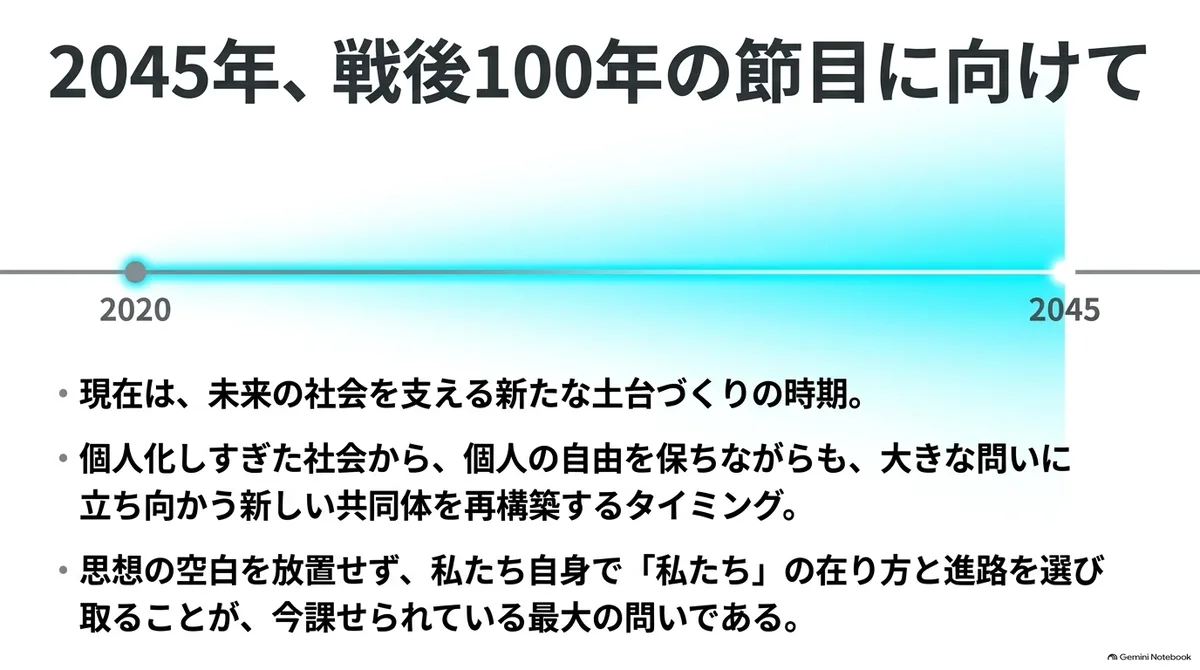
Building on the historical overview so far, what should we keep asking in the coming quarter century from 2020 to 2045?
As we saw in the previous section, this question is not far from business. As I wrote in an earlier article, thought changes the very conditions of business by passing through policy regimes, individual policies, and markets. As is already the case with policies on security and decarbonization, tracing which questions will come to the forefront in the coming quarter century and by what kind of thought they will be bound together is also work for anticipating the business conditions that will form next and for deciding what to protect before a crisis arrives.
In the three quarter centuries of postwar Japan, both the challenges of each era and the actors who took them on were, to a certain degree, shared across society as a whole. But I also think the difficulty of the 2020s lies in the fact that, before dealing with individual challenges, we need to redesign the very premise of "within what framework should the questions be posed anew in the first place."
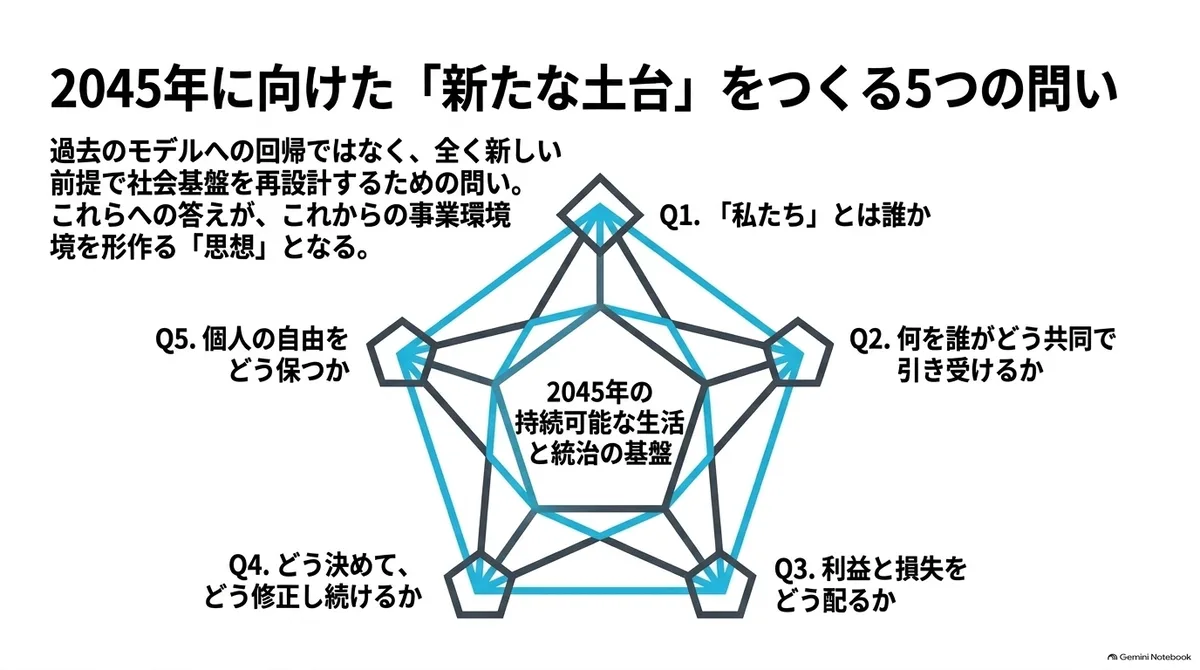
I myself have not yet been able to produce the answer, but I would like to present the points we should keep asking toward the future, organized into five. On that basis, I would like to position these 25 years from 2020 to 2045 as "a period of building a new foundation" to support life in society after 2045.
Just as the quarter century from 1870 built the foundations of modern industry and the state from 1895 onward, and the 25 years from 1945 laid the base for the affluent life from 1970 onward, rebuilding the foundations of society seems to require about a quarter century. The question is how to build, within the world and within Japan, a foundation of sustainable life and governance, so that people's lives can continue peacefully even as population decline and aging advance irreversibly, and so that Japan can keep an autonomous position amid a dramatically changing international order.
(1) Who Is "We"?
Challenges such as the crisis of infectious disease, the drastic change in the security environment, the transition to decarbonization, and population decline cannot be held by a single individual or a single organization alone; there is no choice but to form some joint actor, a "we," and take them on together. But the question first arises of who on earth should be included within the circle of that "we."
Even looking only at the voters living in the country today, conflicts over "we" can be seen between generations. In addition, there is the question of whether it stops at the working generation, whether it includes future generations who will bear heavy burdens, or whether it embraces even the foreign workers who support the front lines of medical care, elder care, logistics, and production, and residents from outside the area.
Who is made a member depends greatly on the principle by which "we" is bound together. The default course of modern Japan was the "nation-state," that is, integration by nationality. But neither consideration for future generations nor the handling of people who move across borders can be fully addressed by the single criterion of nationality.
As options for the foundation of integration, the following paths, for example, can be considered. (They are only options.)
- Being joined by agreement to the constitution and constitutional procedures
- Being joined by the fact of living in the same regional area and sharing living infrastructure such as roads and medical care
- Building on solidarity, facing common life risks and sharing mutual aid and social insurance
- Sharing the "common good" as a desirable image of society
- Being joined by agreeing with the business purpose of solving a particular social issue together
Depending on which principle is chosen, the boundary line between who is inside and who is placed outside should change greatly. Nationality makes it hard to include future generations and residents of foreign nationality; regional living areas make it hard to capture modern people who move often; and sharing a common good, while hard to reach consensus on, produces strong cohesion. A conception may be required of whether to depend on a single foundation or to layer multiple foundations on top of one another.
In addition, if we are to jointly maintain the international order itself, as with security and climate change, then the circle of "we" cannot be closed within national borders, and closing it would not be effective either. The shape of external solidarity, with which countries and regions we take on which challenges jointly, is also part of this question. Conceiving "we" as the bearer of challenges is itself the work of deciding what will bind us together and whom to place outside that framework.
(2) What Do We Take On Jointly, and Who Does It, and How?
I think this question needs to be considered in two stages: "the drawing of the line on how far to carry things jointly," and "the assignment of who specifically carries them."
First, the "line-drawing" on how far to carry things jointly. For about 75 years after the war, the main concern was largely "how to fairly distribute" the fruits produced by economic growth.
But what we face in Japan in the 2020s is a question one step earlier, about the limits of production and supply: "can we even go on supplying the foundations necessary for life in a stable way in the first place?" Alongside the shortage of workers in medical care, elder care, energy, food, and logistics, the challenge of how the whole of society copes with soaring resource prices is also, in every case, a matter of sustaining supply.
Furthermore, as mentioned above, even the maintenance of the international order, such as defense, market rules, and the procurement of essential goods, which until now was taken for granted and entrusted to outside parties, has now become a challenge that Japanese society must actively take on.
Among these challenges, we are asked how far society should take them on as one, and from where they should be left to individual self-responsibility. If the scope of joint responsibility is widened too far, it could invite the totalitarian risk of state control over individuals; conversely, if too much is left in the individual domain, it would further accelerate the harsh arguments about self-responsibility since 1995, and might lead to a situation like that of present-day America.
Moreover, under rapid population decline, I think we need to shift from institutional design premised on past expansion to a "design of contraction" premised on right-sizing. This is the judgment of what to fold up, what to protect, and which functions of life to consolidate in which areas. If the hubs that receive consolidation lack enough medical and transport workers, the consolidation will rebound on residents as a heavy burden of long travel and waiting. The question of how to maintain the housing and infrastructure left behind on the side being withdrawn from also remains unresolved.
The institutions created in the high-growth period assumed only decisions in a phase of expansion, and fair procedures for deciding contraction and withdrawal, and the location of responsibility, have hardly been established. In addition, we need to sort out the order of priority between setting the policy goal as "correcting inequality" or as "securing a minimum stability of life." This is because even if statistical inequality has not widened, it is quite possible for the felt reality of life to become increasingly hard through inflation and service contraction.
Another aspect is the issue of "assignment": who specifically carries out that supply. The state and companies from 1945 left the supply foundation of public services, the families and communities from 1970 left the channels of coordination that support life, and the independent individuals from 1995 left the freedom to pose questions themselves, each as a legacy to the next era.
But the compounded crises of the present cannot be solved by simply returning to any one of the past models. A redesign of the division of roles is required: what the state should run directly, how far private companies should bear public responsibilities, what fills the holes left by dysfunctional communities and families, and how far entrepreneurial innovation can solve public challenges.
This assignment is asked not only domestically but also in international relations. As touched on in the section from the world's side, in the 2020s alliances, regional blocs, and platform companies that cross borders are also lined up as candidates for bearers, and what to carry domestically and what to carry jointly with other countries and foreign companies is also part of this assignment.
These line-drawing and assignment are in fact decided as an inseparable whole. For example, deciding that society as a whole will take on elder care and child-rearing is synonymous with deciding to free those who carry them from the unpaid labor of the family and to treat them properly as public professionals. Opinions may well differ greatly on whether public support for elder care and child-rearing is to be seen as infrastructure for increasing the number of people who work, or as work that families and individuals should handle.
(3) How Do We Distribute Gains and Losses?
However much we may proclaim the ideal of jointly taking on social challenges, unless the rules of distribution, on to whom the gains and losses arising from those efforts belong, are clear, neither the people on the ground, nor private investment funds, nor the residents who bear the burdens will gather.
I believe the biggest reason the development regime of the state and companies after 1945 was widely accepted by the people was that the gains produced by high growth were returned to every corner of society as continuously rising wages and lifetime employment. The distribution to be discussed here is not an after-the-fact distribution simply to share a surplus, but a distribution design that serves as motivation for people to willingly take on difficult roles.
First, there is the question of to whom the gains produced belong. It is a matter of whether they are returned to workers' wages or concentrated on the side of capital as dividends. As the conventional channels that adjusted distribution, such as labor unions and industry-wide labor-management negotiations, thin out, we are asked what can serve in their place.
At the same time, what we should look at is who bears the losses accompanying structural change and how. The jobs lost and the blows to local communities due to technological innovation, changes in trade structure, and industrial contraction tend to concentrate on particular groups, and their effects tend to be prolonged. The people hit are not necessarily able to move easily into new growth fields where gains are created.
There is also the issue of who enjoys the fruits of the "upside" resulting from taking risks. When the development of jointly borne supply foundations or public investment produces great results, the fairness of the distribution of results is questioned: do the returns belong to the entrepreneurs who took on the challenge, to the public that invested, or should they be returned broadly to users?
And what I would like to add as a viewpoint of the time axis is the problem of distribution across generations. Those who have already accumulated assets and the young generation that will form them from now on are placed in fundamentally different conditions. Postponing burdens onto future generations is also an unfair distribution along the time axis. Who will contribute the funds for long-term investments that bear fruit in the 2040s and beyond, and how can distribution models such as social security, which were built on the premise of economic growth, be redesigned for low growth and population decline? These are included in this question as well.
Furthermore, as explained so far, in the 2020s a new issue has entered: how to distribute domestically the burdens demanded from outside the country. As we saw in the section on the confluence, the cost of order is no longer something given unconditionally from outside, and Japan itself has begun to be asked to share it. The increase in defense spending, the price rises that accompany procuring energy and critical goods domestically or within allied countries in the name of economic security, and the blows to export industries from tariffs are all burdens that someone in the country will bear.
Whether this cost will be borne broadly and thinly as taxes, borne by consumers as prices, or borne by particular industries or regions as employment has not yet been decided. Conversely, when industrial policy and public investment advanced in the name of economic security produce gains, who they belong to is subject to the same question.
If there is a pathology to be wary of in the modern age, it is the gravity pulling toward a configuration in which gains are narrowly concentrated in particular wealthy people and large companies, the losses and burdens accompanying structural reform pile onto the same socially vulnerable people, and the power to decide policy tilts toward the voices of those who enjoy the gains. And with this happening on a global scale, and perhaps skewing toward the United States and China in technologies such as AI and the cloud, how Japan creates wealth and how it distributes it will become a big question anew.
(4) How Do We Decide, and How Do We Keep Correcting?
First is the difficult problem of how we can carry out in parallel decisions with different time axes: swift responses to sudden events such as the rapid spread of infectious disease or geopolitical emergencies, preparation for such events, and long-term infrastructure development and investment in research and development looking toward the 2040s.
Also, for grave decisions that cannot be reversed once made, such as withdrawing infrastructure due to population decline, we need to consider whether it is acceptable to apply as is the ordinary majority-vote procedures that are easily swept along by immediate interests. The same goes for climate measures, and we cannot ignore the challenge of how to institutionally build the long-term interests and burdens of future generations, who do not currently hold the right to vote, into present decision-making. Furthermore, when policies or businesses taken on jointly end in failure, we are also asked whether society has a mechanism to examine that failure objectively and, at times, flexibly correct course.
Moreover, in the 2020s there have appeared situations in which, before even asking how to decide, the venue of decision itself is not in Japan, making influence hard to exert. Tariffs and export controls on advanced technology are decided by the United States, burden-sharing within alliances is decided at the table of diplomatic negotiations, and the terms of use of the platforms on which individuals and companies base their activity are set by the companies that operate them.
However fair the procedures we establish domestically, if some of the important decisions that affect burdens are made outside, then how to be involved in those decisions, or how to keep an autonomous distance from them, also connects to questions of how to decide and of governance. In that sense, I believe that taking on what had been entrusted means moving from a position of merely following policies and rules decided outside to the side that participates in the venue of decision, and bearing the costs of participating and of speaking up and making proposals.
Also to be watched closely is the political-economy question, "why are systems with obvious flaws never corrected?" Even though it is widely recognized that labor law, the tax system, and the social security system have structural distortions, their fundamental reform progresses only slowly. Between vested interests with assets and strong organizational power, those in non-regular employment or precarious working conditions, and those proposing new ways, there are marked differences in the resources to access political and policy-making arenas continuously and make their voices heard.
The vicious circle in which economic advantage creates advantage in policy decisions, and the favorable policies further entrench and reproduce existing economic disparities, can be called a structural risk to guard against strongly. I believe that questioning how decisions are made and the process of reviewing them is directly connected to the question of education and guarantees of opportunity: how society as a whole should now nurture and support the young generation who should be the protagonists of society from 2020 to 2045.
(5) How Do We Preserve Individual Freedom Within This?
I believe the freedom, established in the quarter century since 1995, for individuals to choose autonomously how to live, how to work, and whom to collaborate with is a premise to be protected, and that it should be extended as far as possible to those who do not yet enjoy it. At the same time, there is the dilemma that without collective will and power we cannot tackle big challenges such as infectious disease, climate change, and security, and that mutual cooperation and foundations are also needed as the premise that guarantees individual freedom.
And to actually exercise freedom, I think it risks becoming a mere shell unless, beyond a formal abundance of options, the substantive conditions to exercise it are in place. For example: being able to refuse unreasonably poor jobs, being able to move in search of a better environment or opportunities, and being able to endure even if income is temporarily cut off by unexpected hardship. Without these conditions, even if the freedom of choice formally exists, one ends up unable to use it.
And realizing these requires an institutional foundation. To refuse labor under poor conditions, one needs assets to support life for the time being and reliable public benefits; to move to another job or region, one needs opportunities for vocational relearning, and time and financial support to reduce care burdens such as elder care and child-rearing. To endure unforeseen circumstances, a universal safety net that does not break even when forms of employment or work situations change becomes the support.
In the social design of postwar Japan, these livelihood guarantees were mainly provided in a form strongly tied to regular corporate employment and dependent relationships within households. What happened after 1995, I think, was a situation in which, while individual freedom was proclaimed, this old tie was rapidly dismantled, and with the foundations of livelihood guarantees removed, only harsh self-responsibility was left on individuals' shoulders.
That is why, even while watching the various changes in the world's circumstances, we must not forget how society as a whole will guarantee the preconditions for exercising freedom. In doing so, a major issue will be who will take on, and how, the function of coordinating livelihoods that companies and families once performed. There too, the way of being a community will come to be questioned.
In addition, much of the foundation on which individuals communicate, do business, and recruit companions now lies on platforms that cross borders, and the fact that individuals cannot decide the terms of their use also affects the substance of "being able to refuse" and "being able to move." The freedom not to be subordinate to a particular employer should also be the freedom not to be subordinate to a particular platform. How far to guarantee this admits of various methods, such as whether the country should have its own social media and the like, or whether it should have the power to sanction overseas platform operators.
Also, how to prevent the risk that jointly providing generous social security would instead strengthen restraint and surveillance through excessive eligibility requirements and damage individual dignity and privacy is a point to be examined carefully. I think what is required is a design of society that does not burden families with excessive care and overcomes the fragility of being unable to live without being subordinate to a particular employer. I believe this is a shift in thought: not giving guarantees as compensation for sacrificing freedom, but "preparing guarantees as the foundation for truly exercising freedom."
I believe that determining the answers to these five questions, that is, who takes on what and how, becomes in itself the norms and course that are elements of thought.
And the five points are deeply interlinked, and there are relationships in which a choice on one question fundamentally defines the premises of all the others. If the scope of what is jointly taken on is broad, the boundary of "we" expands. If decision-making power is given to those who bear the burdens, the speed of consolidation may slow as they try to avoid those burdens. To move forward with the answers consistent with one another, we cannot avoid choosing a norm (yardstick) of what counts as a desirable society.
And if we cannot design such norms ourselves, norms imported from overseas will enter that vacuum. As I argued in the article 'The Vacuum of Thought in Startups', we have grown used to importing ways of thinking and products, and these days, through digital platforms, AI, and the like, such norms seem to enter more easily.
Conversely, it may be said that this is the time to ask anew about Japan's identity and thought in the postwar international community, which we long entrusted to others and put off.
So although no definite conclusion has been reached at present, taking as clues the new economics and overseas policy agendas introduced so far, the following directions can be considered as candidates for the yardstick.
The axis I used for the organization is the difference in what each conception assumes "we" is bound together by. As I noted in question (1), the principles that bind "we" included the sharing of living areas, the sharing of life risks, agreement with a business purpose, and the sharing of a common good. Once the way of binding is decided, both whom to include in "we" within the country and with whom to jointly carry what beyond the country follow from the same principle. What follows is not a summary of each discussion but my own overview, drawn toward this article's questions, and I leave the detailed examination of each to the linked articles.
- A way of thinking that defines "we" by livelihood. The Foundational Economy, which places the supply of essential goods and services at the center of economic policy; the Affordability Agenda, which asks whether they can be used at prices people can actually pay; the Good Life Agenda, which deals with time available for care and community activity alongside living costs and income; and the public option as a means of making guarantees concrete. This is the idea of jointly guaranteeing the core foundations of life.
- A way of thinking that defines "we" by employment. Examples include productivism, which places "good jobs" at the center, and predistribution, which works on institutions that affect wages, asset ownership, and workers' bargaining power, in addition to after-the-fact redistribution through taxes and benefits.
- A way of thinking that defines "we" by industry. The New Washington Consensus, which links industrial policy to supply chain resilience and economic security, reindustrialization, and place-based industrial policy, among others.
- A way of thinking that defines "we" by governance. Abundance, which removes supply constraints; state capacity, which turns policy goals into results; and permitting reform as its practice. It sets as the standard for evaluating politics whether what is needed arrives at an affordable cost. Related discussions also include Public Upside Sharing, which returns the gains of success to the public for the risks it has borne, and the Captured Economy, which questions the structure by which policy is captured by vested interests
- A way of thinking that defines "we" by sense of belonging. Progressive patriotism, which connects national belonging with equality, inclusion, and public investment. Common-good conservatism, which emphasizes family, community, and the dignity of work, is also a comparison point, but the two diverge on how far to accept individuals' differing ways of life.
Every one of these organizations has weaknesses. If one tries to form a group by livelihood, the treatment of people and countries outside the area becomes ambiguous, and if by sense of belonging, those who do not fit in are excluded. Still, these candidates are not mutually exclusive, and the actual "we" can surely be formed by layering multiple methods, and layering them can cover one another's blind spots. On that basis, which map, norms, and course to choose is the work of "choosing a thought," and the appropriate business will differ depending on the thought chosen.
2045 falls on the 100th anniversary of the end of the war for Japan. I believe we are now entering the fourth postwar quarter century, that is, the period in which we shape the nature of the actors who will take on the questions of the next era. At the same time, we are in a situation where, unless we form some kind of group or community, we cannot answer the present questions either. Amid this, thinking about thought probably also means choosing what kind of "we" to be and what way of being to choose within it, and I believe that this is the question laid upon us.