Avoiding the Confusion Between 'Commercializing R&D Results' and 'Startups'
This article was machine-translated from Japanese by AI (Claude). It may contain errors. Read the original Japanese article.
Most of the companies called university ventures or university startups are founded mainly on research results from universities.
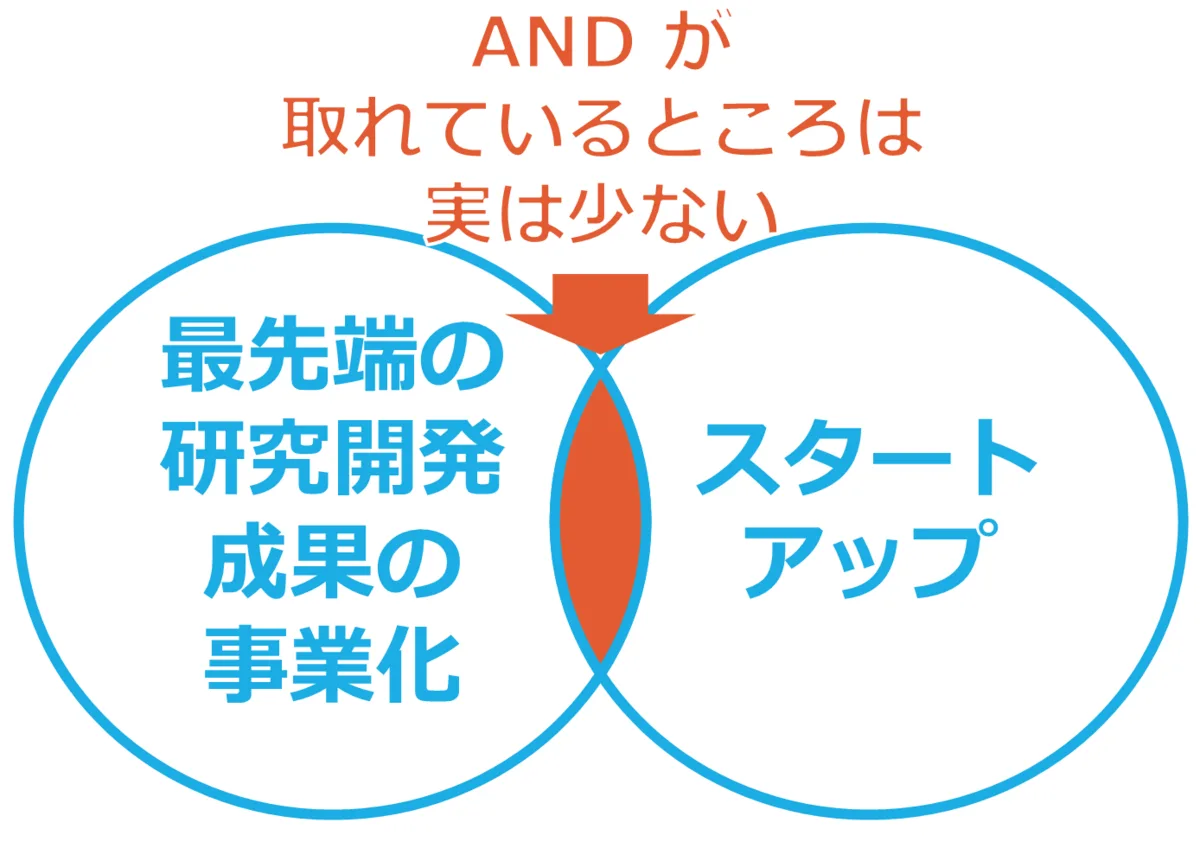
What we should keep in mind is that, although these ventures and startups are "new businesses," they are not necessarily high-growth startups.
In fact, it is no exaggeration to say that most ventures built around "commercializing R&D results" or "technology commercialization" will not become high-growth startups unless they are well designed as businesses.
The reason this needs to be emphasized again is that government policies for creating startups have been increasing lately. For example, subsidies for "startups that commercialize R&D results" are growing, such as the NEDO NEP Pioneer Course, the ICT Startup League, and Gap Funds.
However, aiming to achieve both of the following:
- Commercializing R&D results
- Being a high-growth startup
is quite difficult. And I think that many of today's subsidies are designed with the focus on "commercializing R&D results," taking little account of being a "high-growth startup," which should be one of the conditions.
If the purpose of the support is to produce "R&D-driven high-growth startups," I think the success rate would be higher if the support put its emphasis not on "commercializing R&D results" or "technology commercialization" but on whether a company is a "high-growth startup." And to do that, I believe we need to rethink the design of subsidies, for example by providing subsidies not to technology-driven ventures but to ventures that "start from the business and then use technology."
I also think there is a fairly high chance that if we keep thinking about startup support as an extension of the conventional commercialization of R&D results, we will end up hindering the emergence of R&D-driven high-growth startups.
In this article, I would like to organize the discussion around these points.
Most University Startups Have Revenue Under 100 Million Yen
Startups are expected to grow rapidly. A startup is a company that aims for success of around 10 billion yen in annual revenue within at least 10 years.
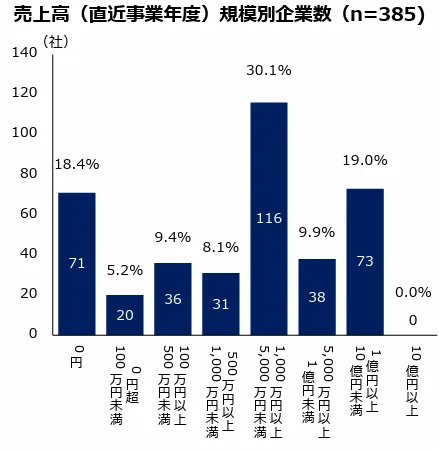
However, most university startups have revenue of less than 100 million yen.
The Ministry of Economy, Trade and Industry (METI) compiles a survey of university ventures every year. Looking at revenue in the results of this survey, the median is 10 to 50 million yen, and even the average is under 100 million yen.
https://www.meti.go.jp/policy/innovation_corp/start-ups/reiwa4_vb_cyousakekka_gaiyou.pdf
This year is by no means special; in a typical year, only around 20% of companies have revenue of 100 million yen or more.
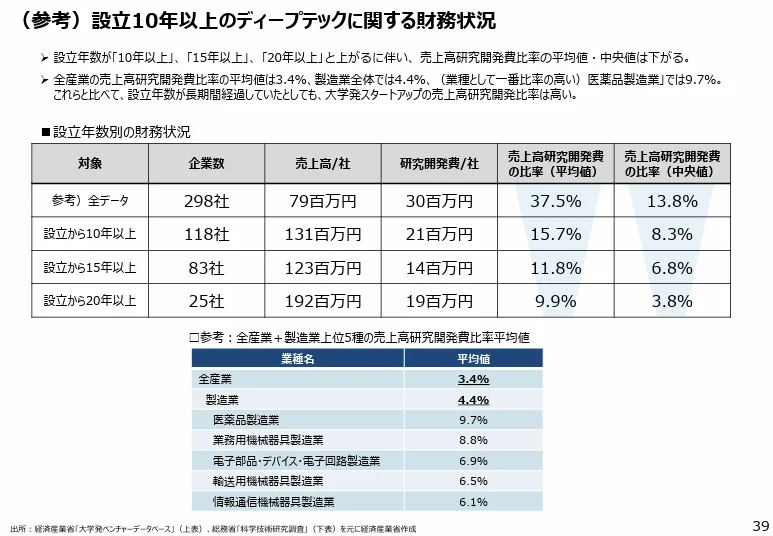
You might think, "Perhaps revenue is low because they were only founded a few years ago," but even among companies founded 10 or more years ago, revenue stays at around 100 million yen. As the table below shows, even companies founded more than 20 years ago (which can hardly be called startups anymore) have average revenue of only about 192 million yen.
https://www.meti.go.jp/shingikai/sankoshin/sangyo_gijutsu/kenkyu_innovation/pdf/028_06_00.pdf
Although the data does not seem to be comprehensive, there is little doubt that the companies called university ventures or university startups remain at very low revenue levels.
In other words, if we keep expanding support as an extension of the current approach, it could simply increase the number of companies with such small revenue.
To avoid that, we need to understand why this is happening and think about countermeasures.
Why Is Revenue So Small?
I think the causes of the small revenue of companies that commercialize R&D results are largely these two:
- Business form
- Market selection
① Business Form
One cause lies in the business form.
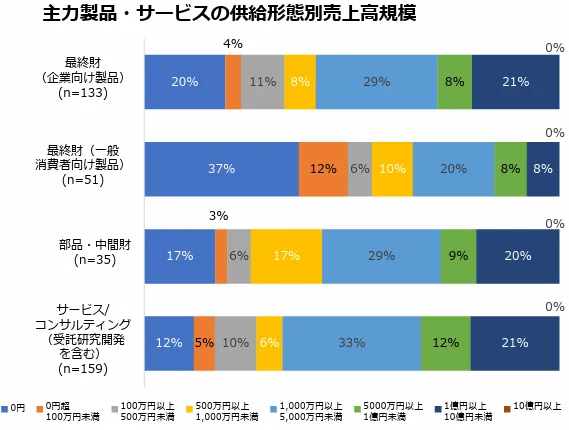
As the figure below shows, consulting and contract development account for a large share of university ventures.
With a labor-intensive business that draws on researchers' expertise, revenue does not grow unless the number of employees grows. But there are few candidates with the expertise, so revenue stays small.
https://www.meti.go.jp/policy/innovation_corp/start-ups/reiwa4_vb_cyousakekka_gaiyou.pdf
Once a company adopts a consulting or contract-work business model, it is difficult to aim to become a high-growth startup with 10 billion yen in revenue. In most cases, a company cannot achieve major growth without building a product that can scale.
I do think there is nothing wrong with starting a business in the form of consulting or contract work, and continuously earning enough revenue for a few people to live on is wonderful in itself. A decision such as "it's enough if we can earn enough money to live on" can also be a legitimate strategy.
However, if such a company is running that kind of business with subsidies meant for building high-growth startups, it does not match the purpose of the subsidies.
② Market Selection
The next cause, I think, is market selection. Whether a business grows rapidly is mainly influenced by the choice of technology and the choice of market, but in terms of revenue scale, it depends heavily on the market.
If the cutting-edge technology developed through R&D is superior, it helps the company beat its competitors. But revenue and profit differ greatly depending on "in which market" it wins. Even if a company beats competitors' technology, if the market is small, it will not generate much revenue.
The exceptions are probably fields such as healthcare, drug discovery, and life sciences. In these fields, if there are good research results and intellectual property has been acquired well around them, a large market often awaits, so "technology commercialization" tends to become a "high-growth startup" as it is.
In other words, these fields are exceptional fields: at the point of market selection there is already a large market, and technological superiority easily becomes a competitive advantage as it is. But most business fields are not like that.
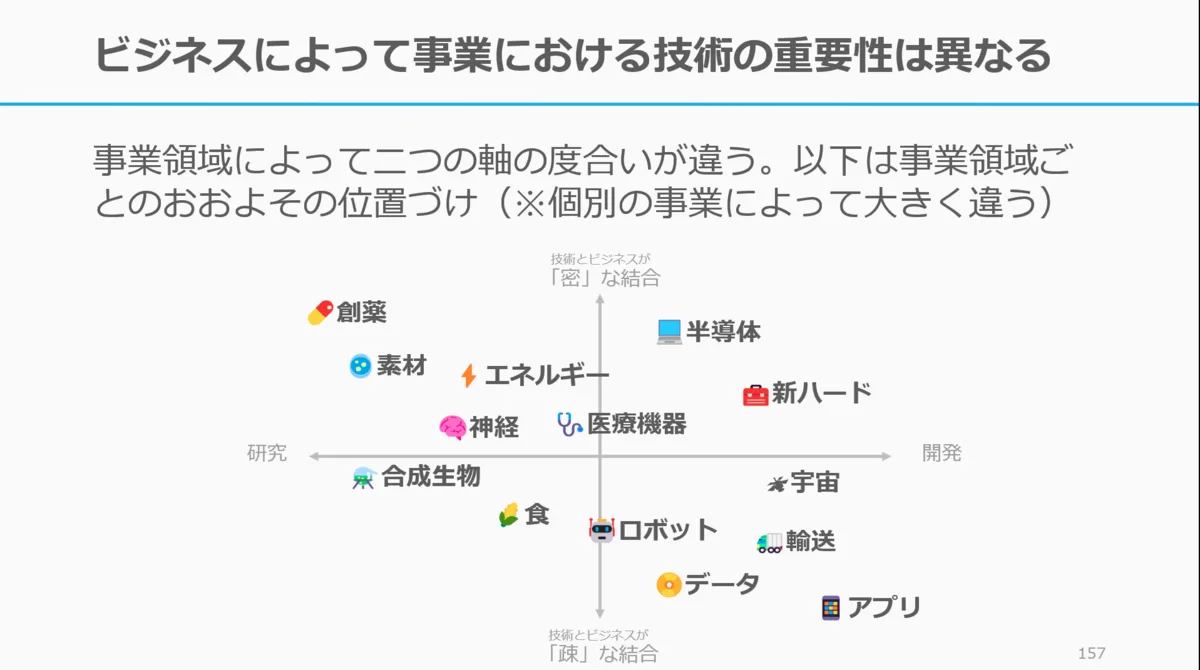
The degree of coupling between business and technology
The Cause: Building Businesses That Prioritize "Not Failing" and Start from "Technology"
I think the reason the business form and market selection turn out this way is that "people are thinking about a business that won't fail, starting from technology."
First, consider the point about a business that won't fail. Consulting and contract development are businesses that are hard to fail at. If the KPI is the number of startups founded or the survival rate, it would almost certainly be best to run that kind of business. If a company has excellent technology, several outside companies will want it, and the company can survive. Moreover, if someone wants to succeed as a researcher rather than in business, it is natural to lean toward the view that being able to do a certain amount of business through consulting or contract development is enough.
But a strategy for not failing and a strategy for succeeding big are usually different, and to succeed big like a high-growth startup, one has to take a different strategy.
The next cause is being technology-driven. In a market where "you can win if you develop excellent technology," you should simply develop excellent technology. Perhaps many markets in the past were also fields where you could win if you could develop a technology that was "cheaper than before" or "higher in performance on the existing criteria."
But in a highly uncertain domain like startups, that is not necessarily so. Starting from the business and gathering whatever technologies are needed to win in that business domain makes the business itself more likely to succeed.
If a constraint creeps in when building a business, such as "we must use a certain technology developed in the lab," the degrees of freedom drop sharply. In gaming terms, it is like a challenge run with self-imposed restrictions. It is not impossible, and it is impressive if you pull it off, but success suddenly becomes much harder.
For incremental R&D of the kind large companies pursue, where the market is highly predictable but there is still a fair amount of technical risk, the conventional "technology commercialization" and "commercializing R&D results" may have been good mechanisms. But when the goal is to create startups, I think we need to look more at the market.
Technology When Thinking from the "High-Growth Startup"
If we want to create high-growth startups, I think it is more likely to succeed to put the weight not on "not failing" but on "succeeding," starting from the business with a question like "how can we build a business with 10 billion yen in annual revenue within 10 years?," and to gather technologies, new or old, as the pieces that business needs.
For example, take a look at Energy Vault, which proposed a new method of energy storage and went public through a SPAC. This startup has developed a system that stores energy as potential energy: it lifts blocks to a height during hours when electricity is cheap, and lowers the blocks to generate power during hours when electricity sells at a high price. Although it holds several patents, it simply raises and lowers blocks, so it is probably not technologically cutting-edge. But it captured the pressing need for energy storage, gathered the technologies for it, and started the company.
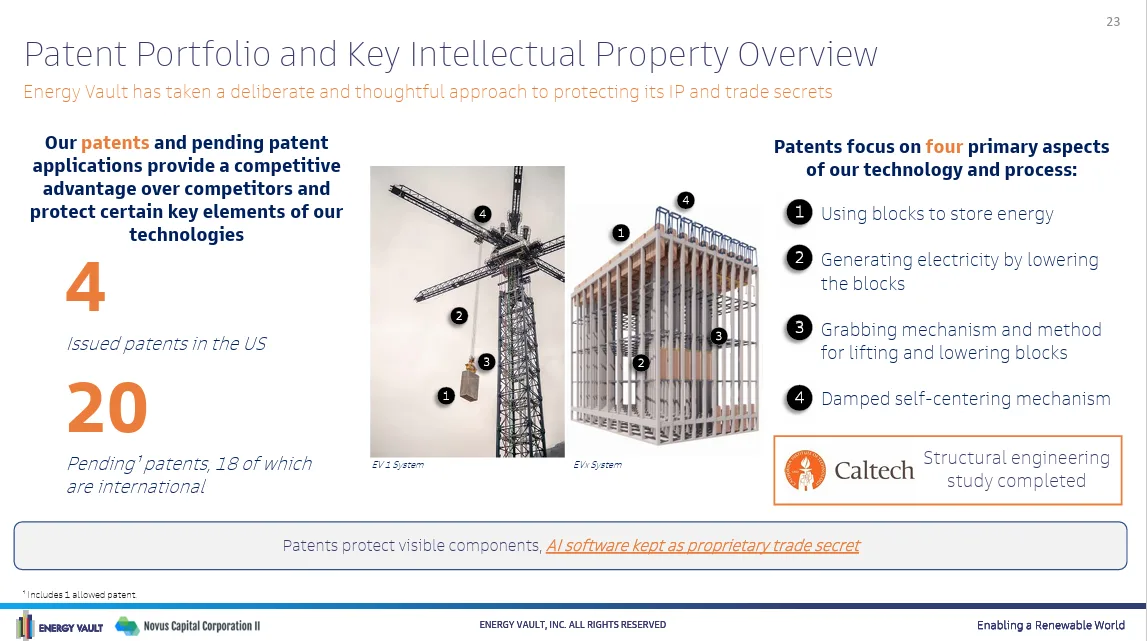
There are patents https://www.energyvault.com/hubfs/EV%20Theme%20Images/Investor%20Relations%20page/EVIP-20210909-051.pdf
When combining technologies, almost without exception some R&D on new elements is needed. Intellectual property may also be created. But that part is not necessarily cutting-edge R&D of the kind that would become a paper.
And in creating and growing such startups, what matters, I think, is not so much a researcher who excels in a single technology but rather a business-side person who combines multiple technologies and orchestrates them.
However, even if business-side people make the effort, the current system offers no support for that kind of technology development. This is because most of today's subsidies are designed to commercialize "cutting-edge research".
There are not many subsidies that can be used to "combine somewhat mature technologies to respond to a newly emerging market." Subsidies almost always require the applicant to be a researcher or to have a joint research agreement with a laboratory. That can promote "commercialization of R&D results," but makes it difficult to produce "high-growth startups."
Of course, there are fields such as drug discovery where high-growth startups are likely to emerge under the conventional form of subsidies, but most fields are not like that.
The Downsides of Technology-Driven Approaches: "R&D" Dependent on Subsidies
Technology-driven subsidies also have several downsides.
The first is that subsidies tend to go to researchers who have no intention of commercializing and simply want to do research.
To prevent that, conditions such as "submit a research plan together with a prospective executive" are sometimes imposed, but I have also heard that the prospective executives who raise their hands for research whose commercialization is several years away were often consultants or retired people.
Another is that it prolongs the life of a business that is not working.
I often see situations where a company has good technology but its strategy and business model are poorly designed, and although it must rethink its business to grow rapidly, it can survive in a small way because it receives subsidies.
This can slow the speed of talent circulation within the ecosystem and tie down the already scarce challengers to a single venture. There is the view that if you keep at it long enough you will eventually succeed, but so far such cases do not seem to be common among university ventures.
Another is the constraint on R&D imposed by subsidies.
Money obtained through a subsidy determines the direction of technology development for about a year. It would be fine if the use of funds could be changed flexibly, but there are few such subsidies, and the company has to keep pursuing the R&D "as planned" that it submitted a year earlier. That may be fine for a large company, but for a startup, a year is a matter of life and death.
It seems to me that these adverse effects tend to arise when supporting startups in a technology-driven way.
A Proposal: Technology Development Grants That Start from the Market and from Startups
To respond to newly emerging markets such as Climate Tech, I think we need grants to support "ventures, thought through starting from the business, that involve R&D on both mature and cutting-edge technologies."
Such grants need not be tied to a laboratory. Rather, it would be preferable to have a mechanism whose funds can be used to propose new research to laboratories, along the lines of "this part is difficult, so we would like to do R&D together." It may be close to NEDO's Program to Discover and Support Young Researchers (Wakasapo), but it could also be called a version closer to startups.
Also, in IT-related R&D, what counts as R&D tends to be ambiguous, and I get the impression that quite a few businesspeople regard simple development without much difficulty as R&D, so I think "technical difficulty" should be examined.
Summary
Providing subsidies for scientific research and R&D is itself important for solidifying the foundation. Even if revenue does not reach 10 billion yen, commercializing research and technology born at universities has considerable meaning.
However, as we have seen repeatedly in this article, "commercializing R&D results" and "technology commercialization" do not necessarily become high-growth startups, and if funds have been prepared to produce high-growth startups, those funds should focus on creating high-growth startups themselves, not on commercializing R&D results or on R&D itself.
If we want to produce high-growth startups through "commercializing R&D results" as before, then unless we ask far more strictly than now, "Is there a business plan to reach 10 billion yen in annual revenue, or to become a unicorn?," we will end up creating many companies with annual revenue under 100 million yen.
I also think one option is to increase support for startups that use technology starting from the business. By drawing in the research needs of the business side, new seeds of research might also be born.