Startups and Rebalancing for "Stability"
This article was machine-translated from Japanese by AI (Claude). It may contain errors. Read the original Japanese article.
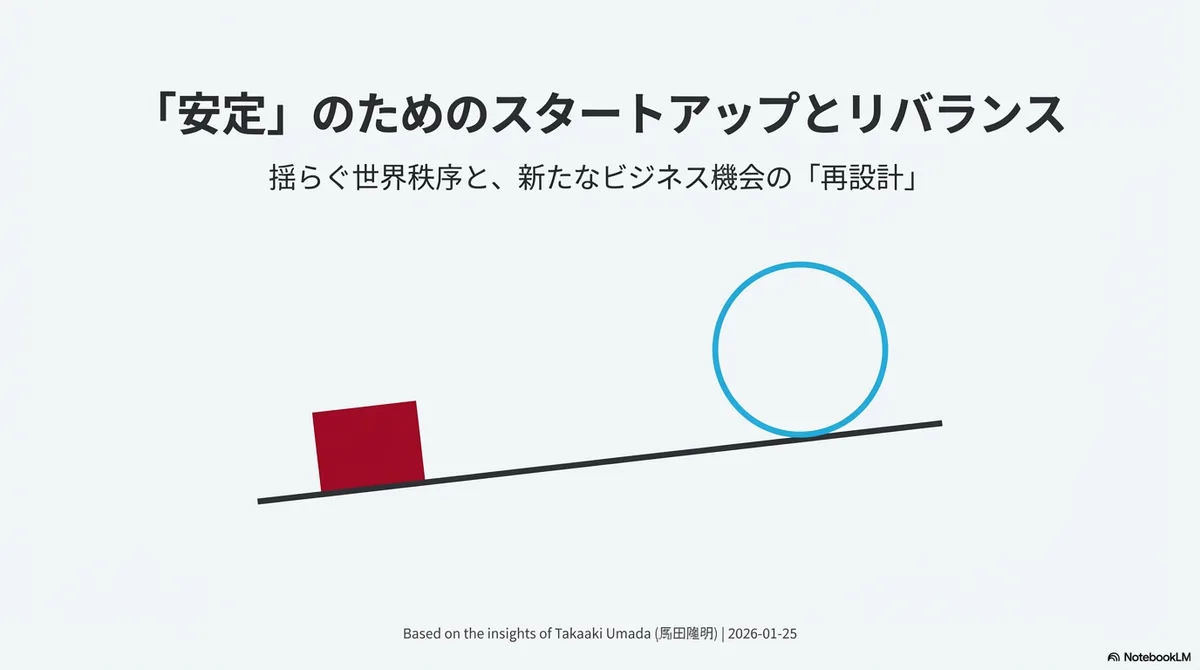
The world now seems to have entered a phase of rebalancing, in which order is being forced to be "rebuilt."
In the midst of this rebalancing, I have recently been thinking that contributing to a new stability could itself become a medium- to long-term market, and that there may be room for new efforts such as startups to take part in that process. (I am not saying that every startup should be like this.)
For example, in other countries, the number of startups involved in traditional security and other forms of security (economic security, cyber, critical infrastructure, and so on) is visibly increasing.
That is only natural, because uncertainty arises where things change, and making use of that uncertainty is what startups do.
Until now, the main theme was uncertainty on the frontiers of economic growth. But now the social "stability" that had been the premise and foundation of growth is itself wavering, and it seems to me that the center of uncertainty is also shifting from growth to the redesign of stability.
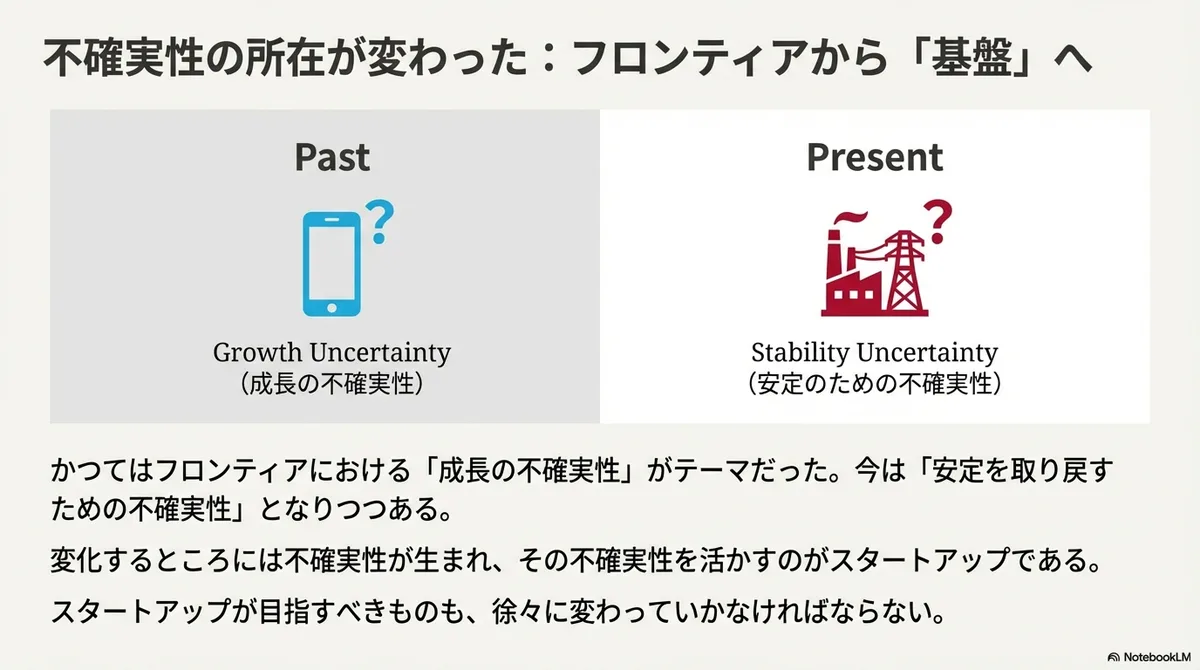
"Stability" and "startups" may look like opposites. It is true that what startups provide is somewhat different from "short-term" security for "individuals." What I am talking about here is stability for "society" over the "medium to long term."
I would like to briefly summarize (albeit abstractly) what I have been thinking about this rebalancing toward stability.
The 2010s: "Startups = Growth" on top of stability
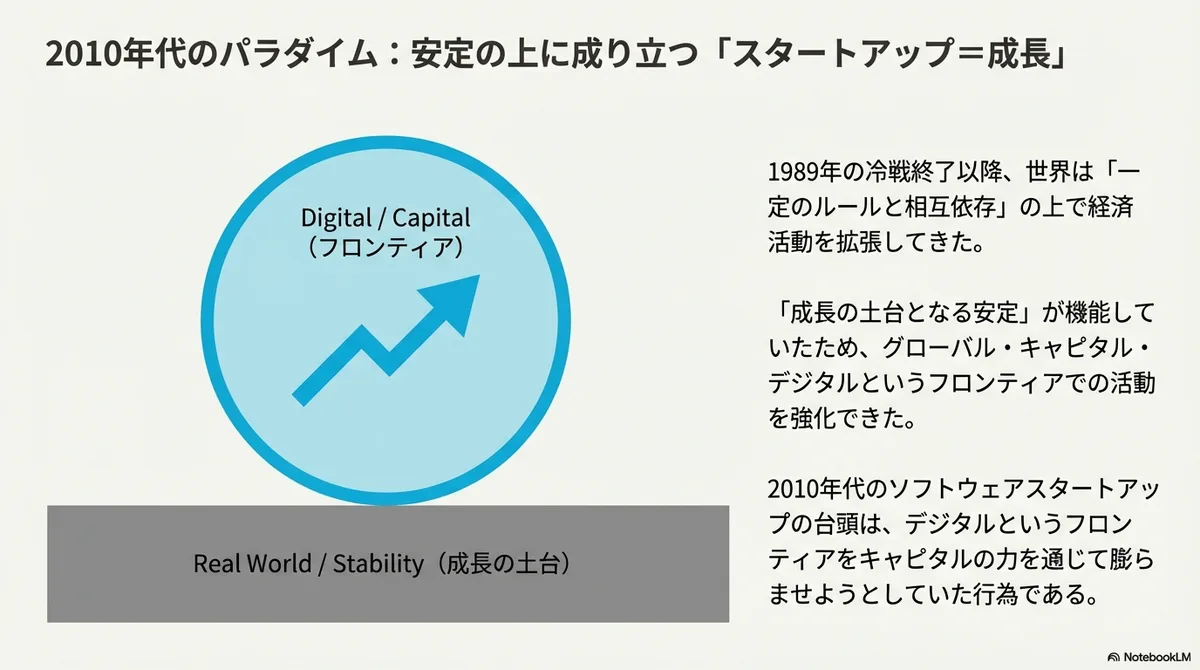
Looking back a little, since the end of the Cold War in December 1989, the world has intensified economic activity on the frontiers of global, capital, and digital (see Hirano, The Course of Management).
Of course, there were financial crises, conflicts, and inequality in the meantime, and not everything was peaceful. Even so, overall, a mode in which economic activity kept expanding on the basis of certain rules and interdependence continued, and in that sense I think "stability as the foundation of growth" was at work.
The rise of software startups in the 2010s can also be seen as a single phenomenon that occurred as the growth of those three markets overlapped. This is because it was an attempt to expand the digital frontier through the power of capital.
Connected globally, supplied with capital, and with software producing speed and compounding. In such a worldview, "growth" itself was probably easy to establish as a theme.
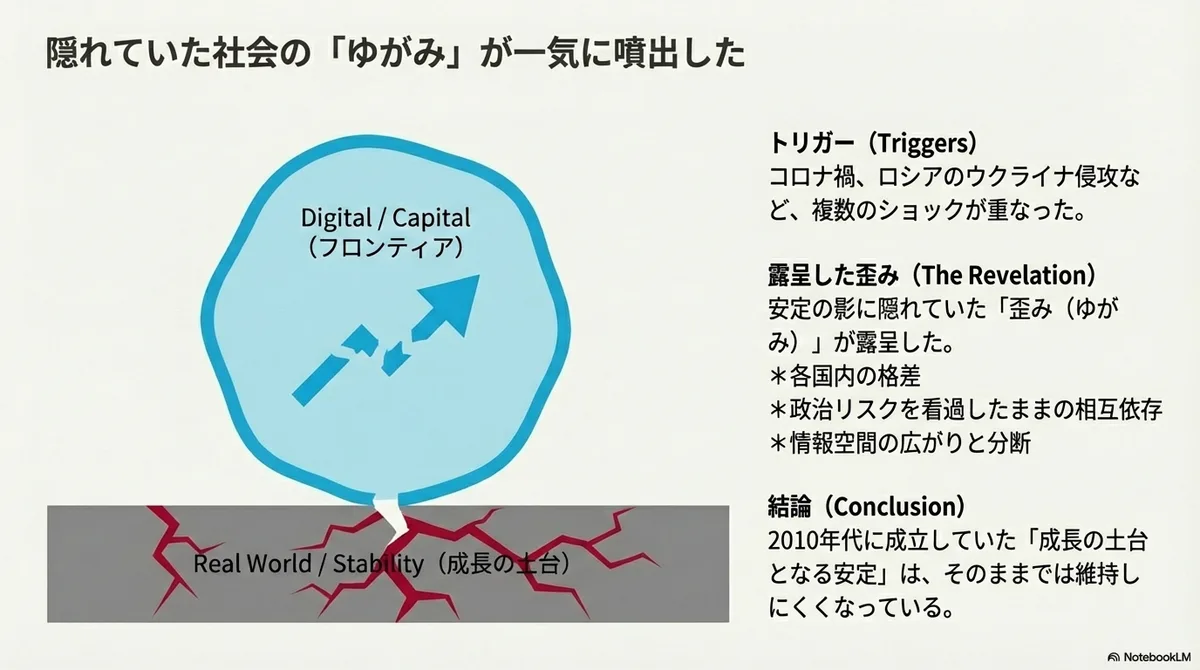
However, after the COVID-19 pandemic in 2020, as multiple shocks piled up, including Russia's invasion of Ukraine, the distortions of society that had been hidden in the shadow of that stability surfaced all at once.
Examples of such distortions include the domestic imbalances within countries produced by global orientation, interdependence that overlooked each country's political risks, and the expansion and fragmentation of the information space. Now that these various problems have been exposed, the "stability as the foundation of growth" that held in the 2010s seems difficult to maintain as it is.
As that foundation wavers, the stable foundation for doing business is also wavering. When uncertainty rises, the cost of capital rises and investment becomes more cautious. When supply chains are disrupted, prices and the premises of daily life waver, and discontent builds. When trust in the information space declines, democratic decision-making is distorted. When countries have to pay attention to security, the economy becomes a secondary concern. Such new uncertainties are emerging right now.
But those new uncertainties also create business at the same time. This is thought to be what is now leading to trends such as defense tech.
In that sense, I think we are now entering a phase of rebuilding the order that supported growth.
Stability and rebalancing: not a solid foundation, but a dynamic equilibrium
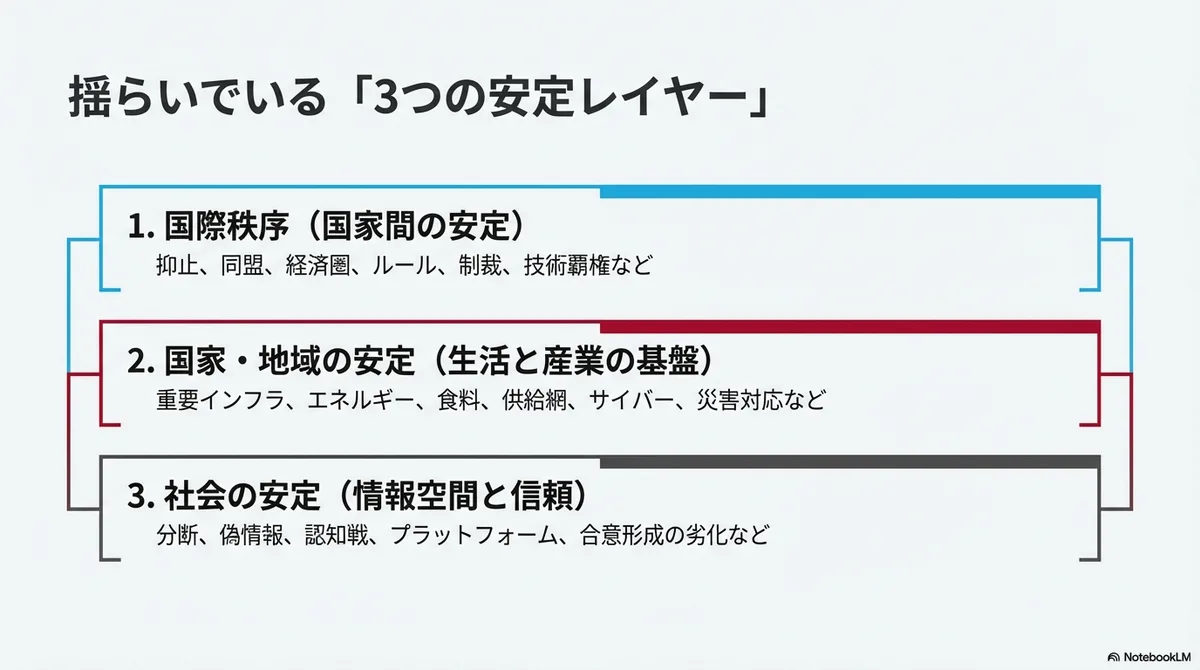
The stability that we feel is wavering now is not single; it spans at least the following three layers.
- Stability of the international order (stability between states): deterrence, alliances, economic spheres, rules, sanctions, technological supremacy, and so on
- Stability of nations and regions (the foundation of daily life and industry): critical infrastructure, energy, food, supply chains, cyber, disaster response, and so on
- Stability of society (the information space and trust): fragmentation, disinformation, cognitive warfare, platforms, the deterioration of consensus-building, and so on
And when it comes to what stability is, you may picture something like a solid foundation, but the stability I would like you to imagine here is "a state of being in balance."
Imagine an obstacle course in which you hold a long pole across your body and walk along a balance beam, like a tightrope walker.
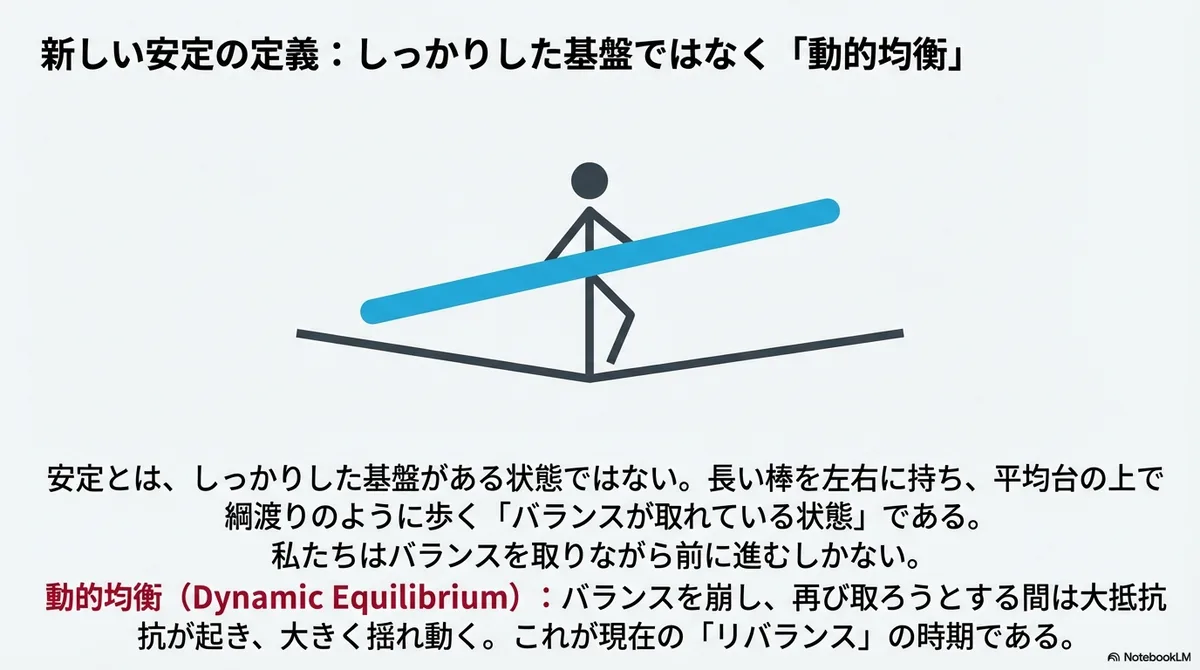
We move forward while keeping our balance. Social stability, I suspect, is less about having a solid foundation and more like walking in balance along a narrow corridor, continuing to maintain a dynamic equilibrium.
And in the course of that tightrope walk, we often lose our balance. When we try to regain balance, our bodies usually sway wildly.
Similarly, order also sways wildly while it tries to regain balance, and I think the present state of the world may be a time of "rebalancing" to move toward a stability (order) different from the existing one.
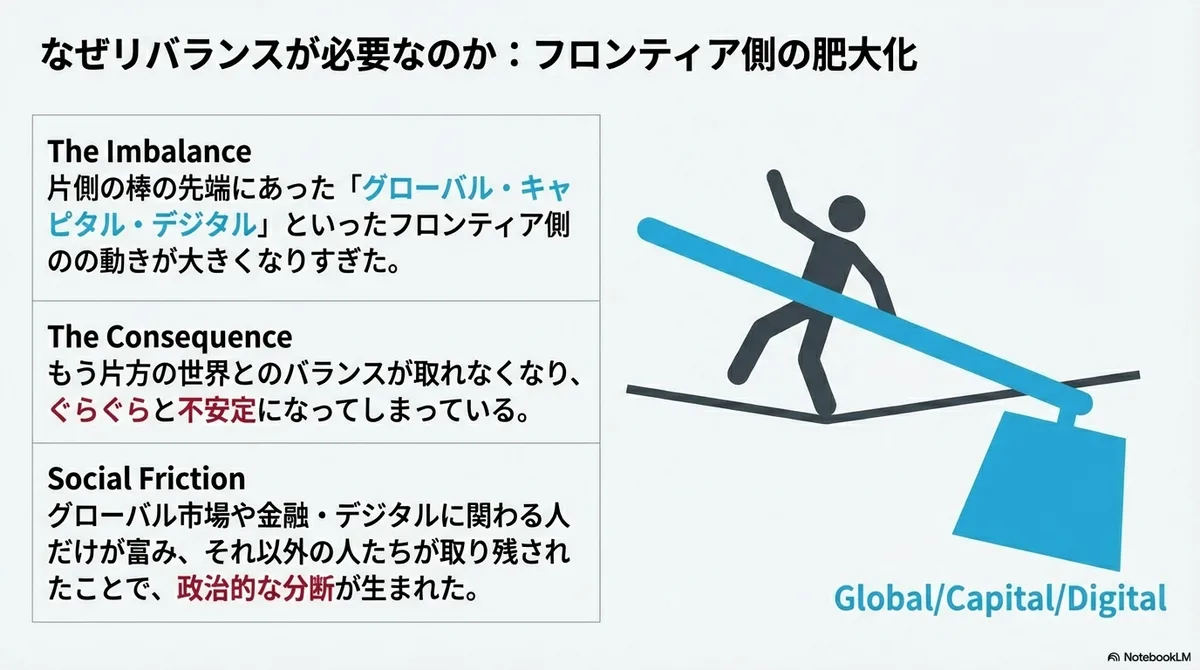
So to speak, it could also be described as a situation in which the movement on the frontier side, such as global, capital, and digital, which was at the tip of one pole, has become too large, so that it is out of balance with the existing world at the other end, and things have become wobbly and unstable.
Only those involved in the global market, finance, and digital grow rich while everyone else is left behind, and digital information dissemination and incentive design contribute to producing political divisions. Our society is losing its balance in the wake of the frontier's development, and that is probably now appearing as various symptoms in countries around the world.
(Accelerationism would argue that by aiming for the extreme of that instability, a new kind of stability can be found.)
In that sense, the uncertainty that startups used to take on was the uncertainty of growth on the frontier. It is now becoming uncertainty in the work of regaining that stability. Framed this way, I think what Japanese startups should aim for must also gradually change.
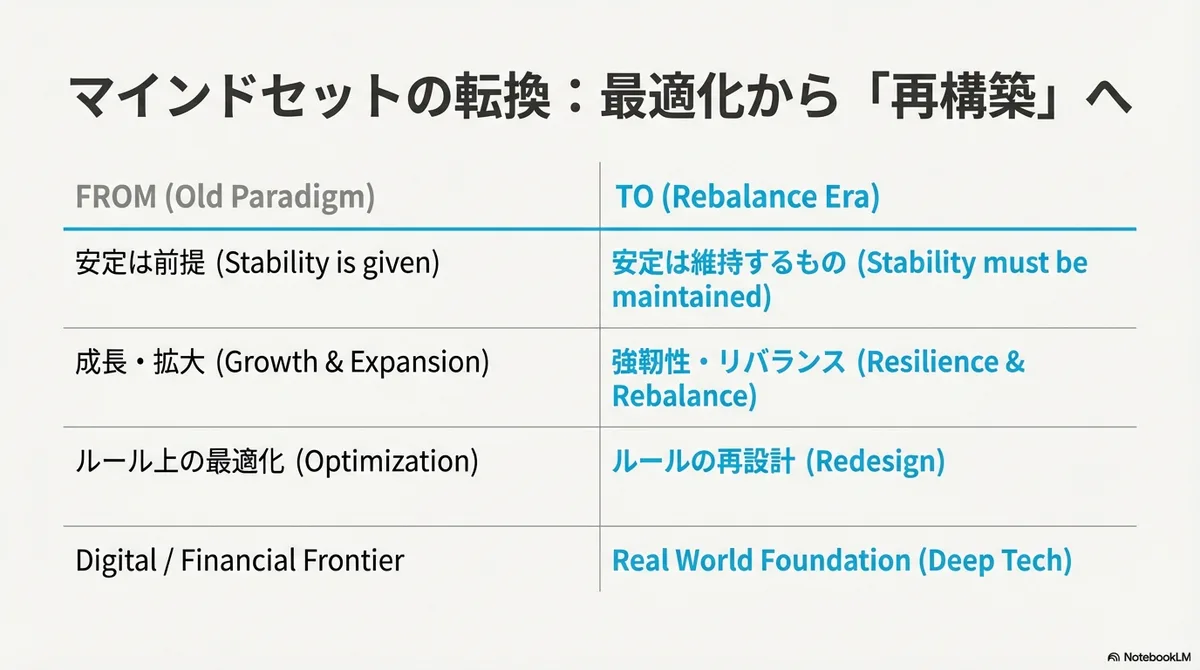
Stability, which used to be a given, has become something that must be maintained consciously, and someone has to pay the cost. We can no longer rest on optimizing for market rules; we have to think about things including the redesign of rules toward a new stability and order. We must also strengthen anew the physical infrastructure, such as electric power and water, on which software depends in order to run, and so on.
Rebalancing as an agenda: stability is not value-neutral
One thing to note is that stability is not value-neutral. Redesigning stability and order always produces winners and losers. The places where burdens fall change, and the existing structure of vested interests may be shaken.
Therefore, in a period of rebalancing, the following are reconfigured: what is valuable, what takes priority, where we depend on others, where we keep things in-house, what we entrust to alliances and markets, and what we make into institutions. That allocation and those relationships are rearranged.
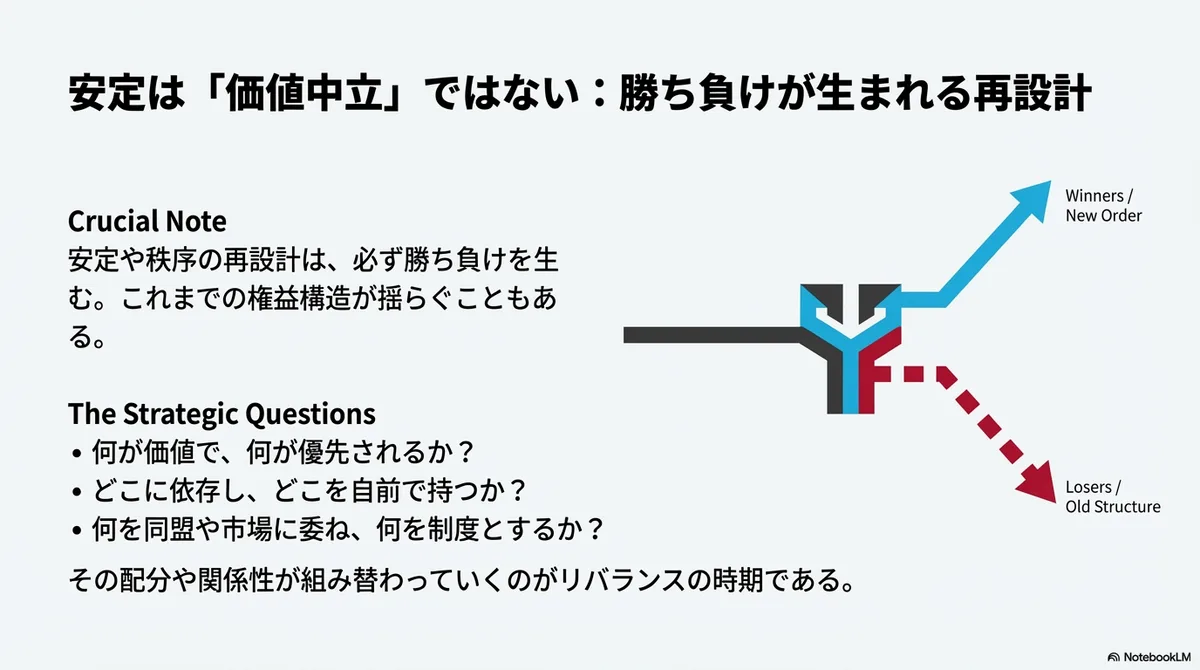
Thinking optimistically, depending on how this rearrangement goes, it may be possible to move toward a form that is somewhat more desirable and fair for the world than in the earlier period when things were balanced.
Conversely, if the rebalancing leans toward a more closed conclusion, conflict between states and between citizens will increase. Economic activity, too, would stagnate in such a situation.
I think this is an age in which we need to think about how we can contribute during such a period of rebalancing.
The challenge changes depending on the vision: do not place the ideal in the "past"
A challenge is the gap between the ideal state and the current state.
Which "new era" you set that "ideal state" in is the key to defining the challenge. Depending on what kind of vision of the future you draw, the challenges we take on will also change.
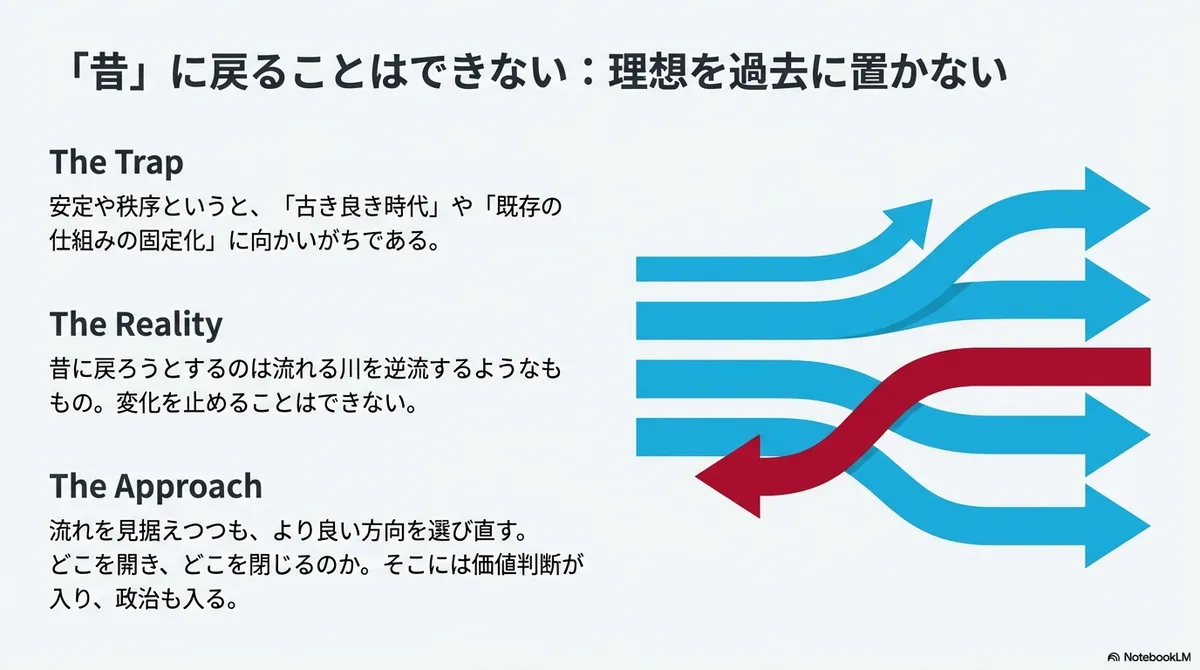
When we speak of stability and order, we tend to drift toward "the good old days" or "freezing existing arrangements." But rebalancing toward a new order should not mean stopping change, and trying to return to the past is like swimming against a flowing river.
Rather, it is closer to choosing a better direction anew while keeping that flow in view, and deciding what to protect, what to let go of, where to create new dependencies, and where to open and where to close. Value judgments enter into this, and so does politics.
But change is also born there. The actors who take on the design of that change are neither the state alone nor large corporations alone. Rather, concrete solutions built up from the front lines are needed, and I think that trial and error is what pushes out the contours of the order. I think startups can play a role in this in several ways.
Many visions and startups: toward the exploration of a new order
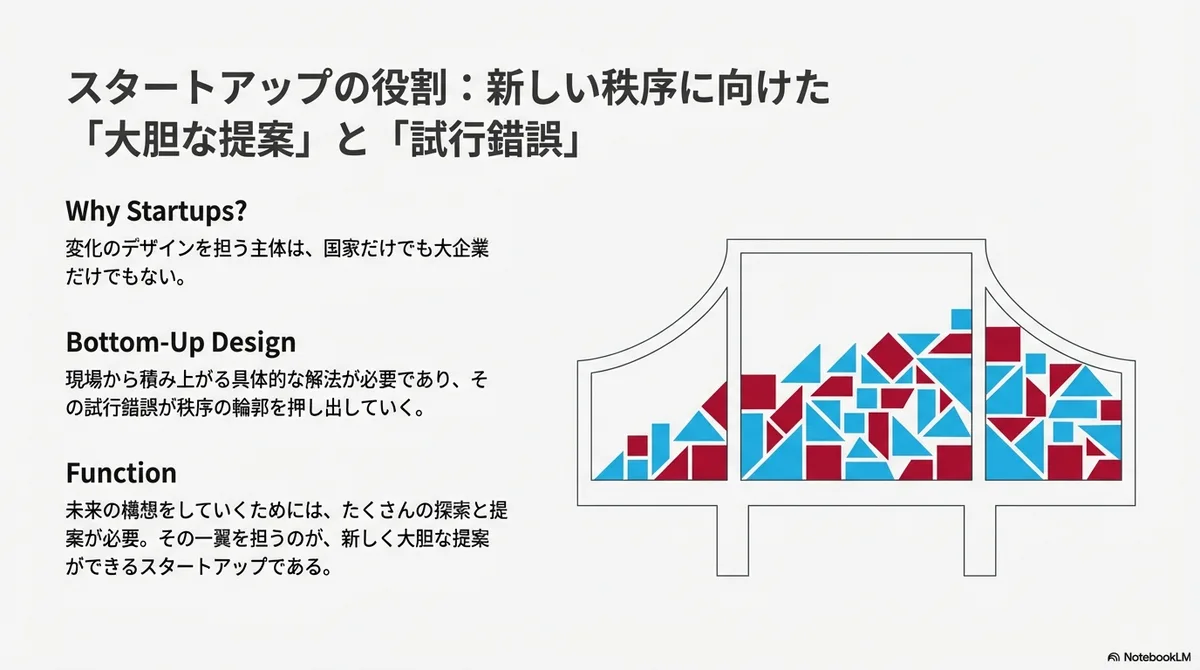
To envision the future, a great deal of exploration is needed, and a great deal of trial and error. Many proposals will be needed.
I think that new and bold proposals like those of startups will play a part in that.
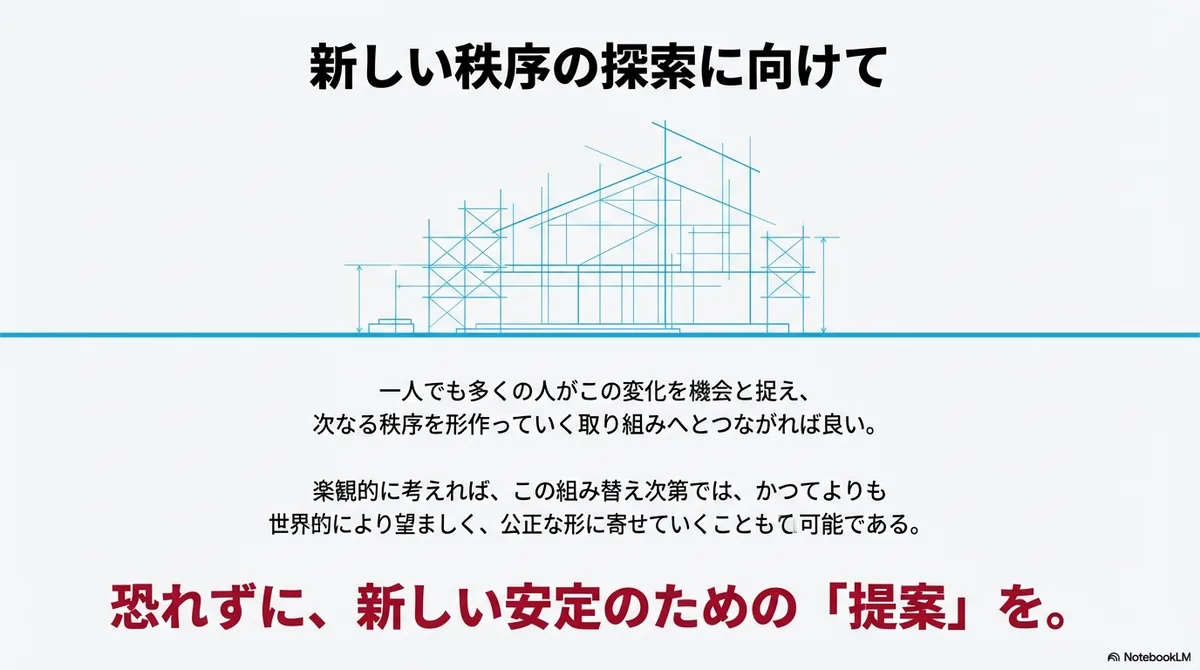
If we are now in a period of rebalancing in which that design is being rewritten on a large scale, and business opportunities arise from it, I hope that as many people as possible will see this change as an opportunity and connect with efforts to shape the next stability and order.
Related articles