Follow National Policy, or Shape It
This article was machine-translated from Japanese by AI (Claude). It may contain errors. Read the original Japanese article.

Over the past few years, it feels as though the startup world has also been growing more attentive to national policy. Every time the government announces priority areas and budgets for semiconductors, space, defense, or AI, VC investment themes drift toward national policy, and entrepreneurs' pitch decks seem to quote more and more policy documents.
I assume there is a genuine desire to contribute to the country in this, but something else has been bothering me a little. It is whether aligning with national policy is the right way for a seed-stage startup to compete. (Note: what I want to think about here is the seed-stage startup, whose business and organization are not yet settled, not the middle or later stage.)
Looking back at the past, by the time the budget for a national policy actually began to flow, the companies that would receive it already existed. For example, when a large fund was set up for the space sector, the startups that became its main recipients were a group of companies founded at a time when the space business was still seen as odd.
If so, what seed-stage startups and investors should do is not chase national policy but look harder at themes that come "before" they become national policy, and I think their role is to explore "the next theme the nation should take on."
(By national policy here, I mainly have in mind strategy documents, subsidies, and public procurement.)
The time lag before something becomes national policy
Before an area comes to be called "national policy," there is a process in which a government agency recognizes the issue, and after expert panels and consultations with stakeholders, it is turned into budgets, laws, and systems. An ordinary initial budget follows an annual schedule, from the budget requests in summer to its enactment the following March. But what takes time is not only the institutional procedure. It is also the time until changes on the ground come to be shared as a policy issue.
There are also politically led documents that precede individual policies, such as the Basic Policy on Economic and Fiscal Management and Reform. Even so, by the time a theme is named as a priority area, the sense of urgency is in most cases already shared among government, industry, researchers, and politicians. A policy document is better described as a record that the issue has entered common understanding than as a pure forecast of the future.
Even in such an environment, I think "buy national policy" tends to hold in listed stock markets such as the Tokyo Stock Exchange. This is because listed companies may see the earnings of their existing businesses boosted by budget execution, public procurement, or regulatory change. Even if the priority area itself has become common understanding, if the impact on earnings is still to come, national-policy stocks can keep rising after the announcement.
Listed stocks also have liquidity, so you can leave the game at any point while the common understanding is being priced into the share price. Even if you get in late, if you play it well, the structure lets you capture part of the gain.
Seed-stage startups and seed investing, on the other hand, satisfy neither of these two conditions. What you bet on is an advantage, not yet recognized by anyone, of a business that does not yet exist, and once you place your money, it cannot be moved for a long time. I don't think the maxim "buy national policy" is itself wrong. Rather, when it is brought into the startup world, the time axis shifts, and I suspect it hardly holds as a maxim.
The "perception gap" that produces seed returns
One source of seed returns is the gap between the world's perception at the time of investment and its perception at the time of exit. You get in cheaply on something no one thinks is important, and you earn the gain by selling high when everyone thinks it is important.
As time passes and a common understanding forms, that understanding is priced into valuations, and capital far larger than seed money begins to flow in. Large companies with track records and execution capacity also enter. At that point the phase in which you can compete on speed of perception ends, and the phase in which you compete on capital begins.
Seen that way, becoming national policy means the phase where you compete on capital. In the United States, even so, a company might be able to raise a large round all at once and fight large companies on execution with the power of capital, but Japan is not that kind of environment.
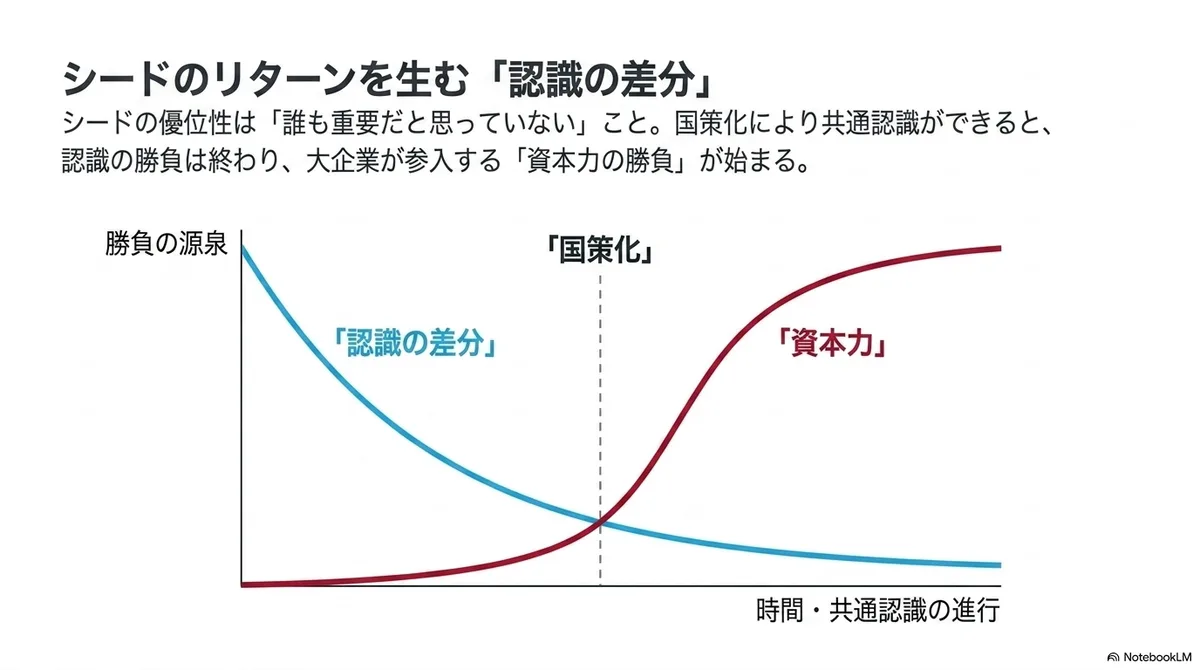
In that case, before large companies come in, a startup needs to launch its business, build its first customers, track record, and barriers to entry, and prepare in advance as the side that will "meet the big capital head-on."
Compatibility between public funds and business exploration
When an early-stage startup chases national policy, it has to look not only at the time lag but also at the nature of the money.
What a seed-stage company needs is money for "business exploration." The core of the value of that funding is the freedom to pivot the next month if the hypothesis about who the customer is and what they will pay for turns out to be wrong.
National support programs target different stages, from research support like KAKENHI to R&D subsidies, SBIR, and public procurement. Some programs support not only technology validation but also interviews with prospective customers and validation of the business model. The question to ask is not whether the money is public or private, but whether the use of funds and the target outcomes match the pace of the business's learning.
If a company that has not finished exploring its business receives money with rigid uses and milestones, hypotheses that have not yet been validated get fixed as a "plan." I often hear stories of organizations whose resources were consumed by carrying out a subsidized project, so that hypothesis testing for their core business stopped.
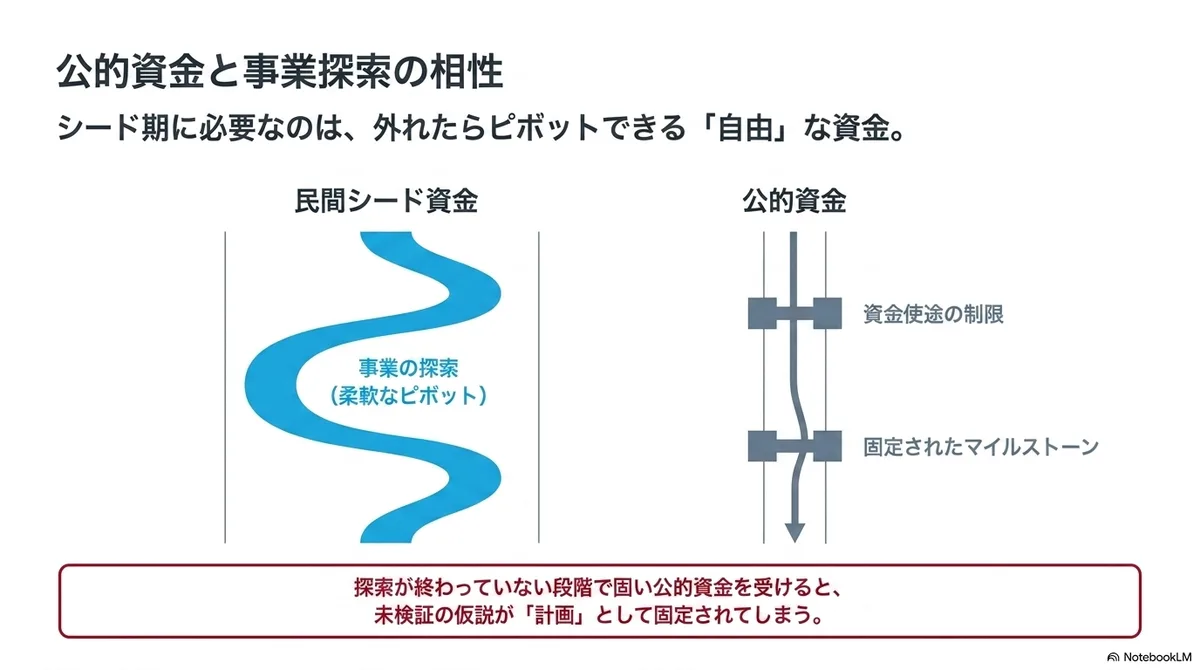
Public funds become a pure tailwind when the uncertainty to be resolved matches the purpose of the funds. In the space sector and others mentioned at the start, I interpret it this way: because those companies had been exploring customers and uses and building up technology even before it became national policy, they were able to put the budget that came later to work as funding for development, manufacturing, and demonstration.
When it is fine to chase national policy: when you can win on a gap other than perception
So far I have been saying that speed of perception is the startup's path to winning. But a startup's advantage is not only speed of perception. Startups have shallow decision-making hierarchies and little organizational inertia, so they have the advantage of being able to do the same thing faster than incumbents. Becoming national policy shrinks the advantage of "noticing early," but the advantage of "moving fast" remains.
The first case is where the component technologies are already available, but how to combine them is not yet established, and the speed of integration and execution is what counts. In areas where demand surges, such as crisis response and defense, the speed of incumbents cannot keep up, and even without a perception gap, a gap in execution speed alone can decide the contest.
For example, in the United States' Operation Warp Speed, Moderna, which had the mRNA technology base, worked with government agencies to advance clinical development, pre-approval manufacturing, and procurement preparation in parallel. The role of government funding was not only to add research money but for the public and private sectors to take on up front the risks that are normally borne in sequence. What was being asked in that situation was not discovering a new theme but how fast existing technology could be delivered as a product.
The second case is where, after long research, the technology is already in hand and is being commercialized. The gap of scarcity in technology and intellectual property offsets the disadvantage in capital to some extent.
The third case is where, as with decarbonization, a change spanning decades has only just begun even at the point it becomes national policy. The broad direction is shared, but which technologies, uses, and business models will win has not been decided. Because many steps of the staircase of perception remain, there is a chance of winning even if you start climbing later.
The fourth case is where national policy calls for a domestic version of a model whose viability has already been proven overseas. The gap you can use here is the "perception time difference" between overseas and Japan.
This fourth way of fighting differs in the nature of competition from the other three. Because the theme is common understanding from the start, entrants appear at the same time, and the outcome is decided by how fast you gather capital and by execution. If it is unclear whether there is demand in Japan, exploration is needed, but when the offering is close to a commodity, it is closer to a model in which you raise a large amount of money in a short time and compete all at once than to a model of exploring over a long time.
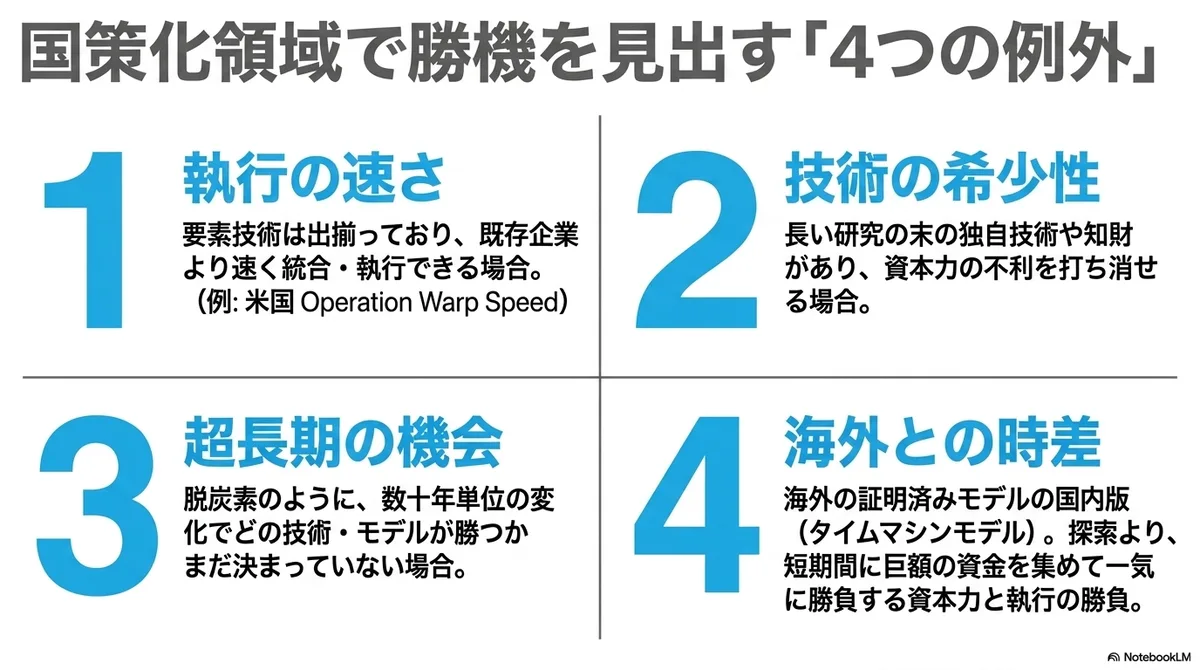
What these have in common is that there is a gap other than the perception of the business opportunity: speed of execution, scarcity of technology, a long-term opportunity, or a time difference with overseas. Conversely, entering only because "it has become national policy," without any of these gaps, strikes me as a bet that is structurally hard to win, since it goes after the perception gap after it has already become common understanding.
In other words, the decision of whether to chase national policy is also a matter of how you answer the question: on which gap do I intend to win?
The logic of forming a fund and the logic of producing returns
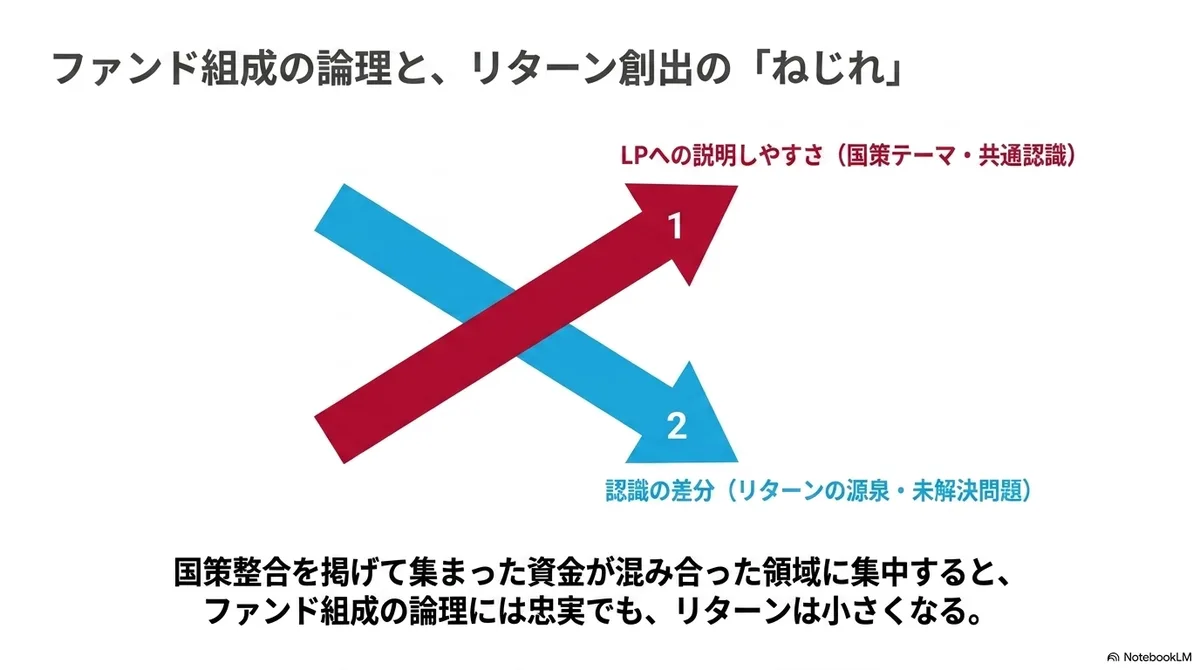
I think there are several reasons VCs also pay attention to national policy. National policy helps not only in finding companies to invest in but also in their own fundraising. A fund that sets a theme aligned with national policy is easy to explain to LPs, all the more in an age when government-affiliated money enters as LPs.
But there is a structural twist here. The more a theme becomes common understanding, the easier it is to explain to LPs, while the room to capture a perception gap shrinks. In other words, themes that are easy to explain to LPs and themes where a perception gap remains tend to be opposites. If money raised under a national-policy theme is invested only in areas that are already crowded, the fund may be faithful to the logic of forming a fund, but the source of returns can be small.
And ironically, when funds that advertise alignment with national policy concentrate in the same areas, the funding gap with areas that precede national policy widens. The stronger the twist becomes, the more attractive betting on the opposite side should become.
If so, I think that even if the signboard is today's national policy, the place to bet should be the unsolved problems left within that policy, or the areas within it that perception has not yet reached.
The responsibility that comes with public funds
One more thing to add: taking on the responsibility of receiving public funds has aspects that differ from ordinary startup investment.
Technology development subsidies, which have been attached to conventional deep tech startups, are easy to justify because public money is going toward exploring possibilities. But public money for execution means promising to use public funds correctly for policy purposes and to create benefits for society. Of course, it is the designers of the system who should design it so that the nature of the funds and this responsibility are balanced, but I think the recipients, too, should receive the money with that responsibility in mind.
This should not be a story of "if you ride national policy, subsidies become easier to get." National subsidies are the taxes of the people. Receiving a 1 billion yen subsidy means receiving about 10 yen from each person in Japan. It is a promise that a "social" return greater than that will be produced.
For that reason, what is examined is whether, with a proper understanding of the policy intent behind the policy, you are fulfilling the role entrusted to you by the government as a public instrument of society. That is a different kind of promise from the one made to investors, "it's fine as long as you produce returns." What is being asked is whether you are prepared to keep such a promise.
If more startups come to use national policy merely as a source of funds, it will not remain a problem of individual companies, and the startup sector as a whole will lose its credibility as a recipient of public funds. I think that is what it means to be involved in national policy.
The option of getting ahead of national policy
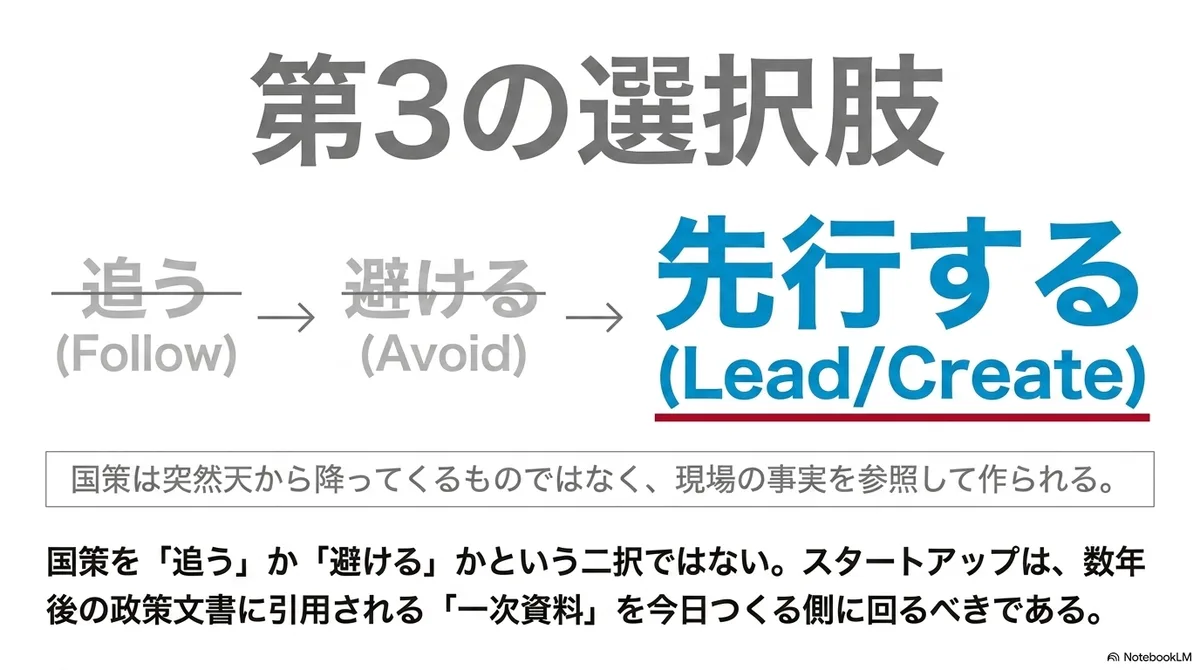
National policy does not suddenly fall from the sky. It is made by referring to facts on the ground. What policymakers refer to are precedents overseas and the "domestic ammunition" that can actually move when the policy is set in motion. For example, I think regulatory sandboxes and the legal framework for the space business were written largely because players appeared first and were in trouble.
If so, a startup that moves a little earlier can become a maker of national policy before it is a beneficiary of it. It means being on the side that creates today the primary sources that will be cited in policy documents several years from now. Beyond the binary of chasing national policy or avoiding it, isn't there a third option: "getting ahead of national policy"?
Moreover, from a societal viewpoint, one of the roles expected of startups is to explore opportunities not yet seen, and the natural order should be for the nation to take up the results of that exploration.
And this option should also be meaningful for Japan's ecosystem as a whole. If national policy is an accumulation of the past, then the fewer the sites and options from which it is compiled, the fewer the options for the next national policy. The challenges taken on by seed-stage startups are for their own returns, and at the same time they can be said to supply the material and options for the next national policy.
And if that is so, startups must after all think for themselves about the shape of Japan as a nation in the future, the shape of Japan's next industries, and what kind of future we want.
The question was whether to have the nation create the narrative of the future and ride on it, or to create it ourselves.