How to Find What You Must Do: A Dividual Approach That Avoids Individual Will as Much as Possible
This article was machine-translated from Japanese by AI (Claude). It may contain errors. Read the original Japanese article.
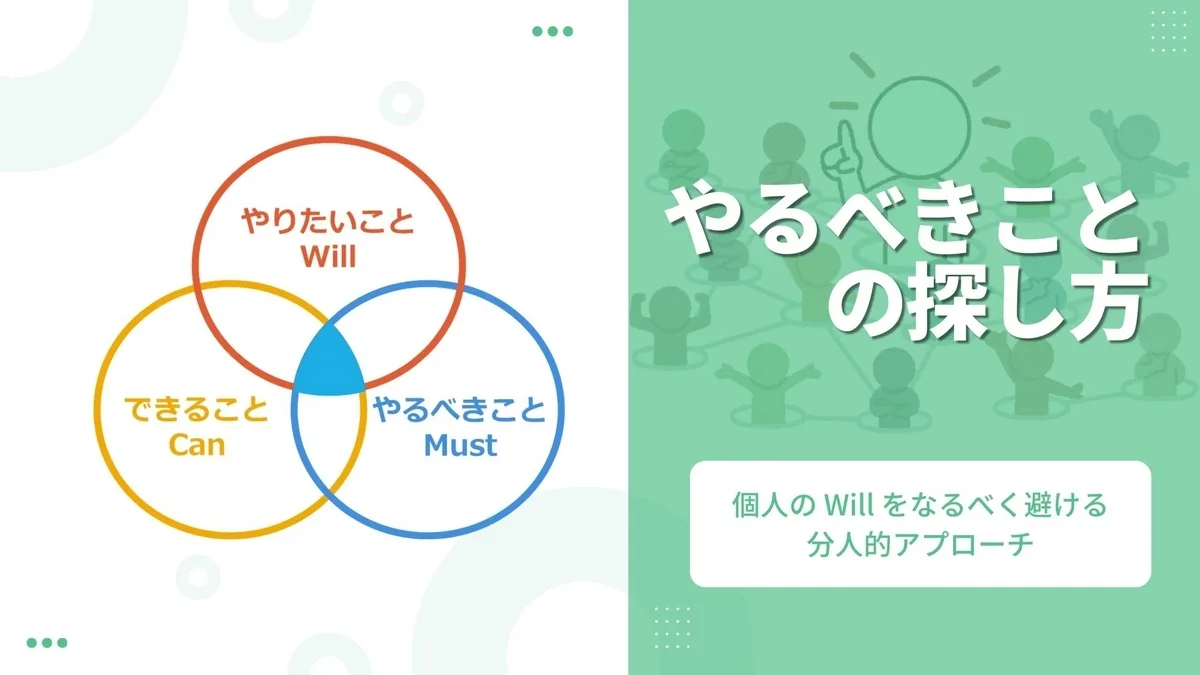
When thinking about a career, the Will, Can, Must framework is often used.
Many people try to start from Will, but starting there tends to lead to a maze and makes it hard to find an answer. Personally, I think that for most people it fits better to see Will and passion as something you gradually grow. (This doesn't apply to people who already have something they strongly want to do.)
So, to people who are troubled enough to come to me for career advice, I recommend starting from Must among Will, Can, and Must.
This is because, of the three variables Will, Can, and Must, the social Must is the hardest to move by your own will. Considering that Can can be expanded by learning various things, and Will can be changed to a fair degree depending on your own intentions, one practical reason is that it is easier to adjust the other variables later if you first pin down the Must, the hardest to change.
Conversely, if you decide on Will first, it is often hard to reconcile it with Must. For example, even if you find what you want to do, you may find that you can't earn as much income from it as you expected. And if you start from what you can do now (Can), you can't factor in growth, which has the weakness that your options don't expand as much as you'd expect.
So, if you haven't found what you want to do, I think the following order is good:
- Loosely decide the social Must you will work on
- Consider your current Can (what you can do), while thinking about how to expand the range of your Can
- Finally, ask yourself about your Will
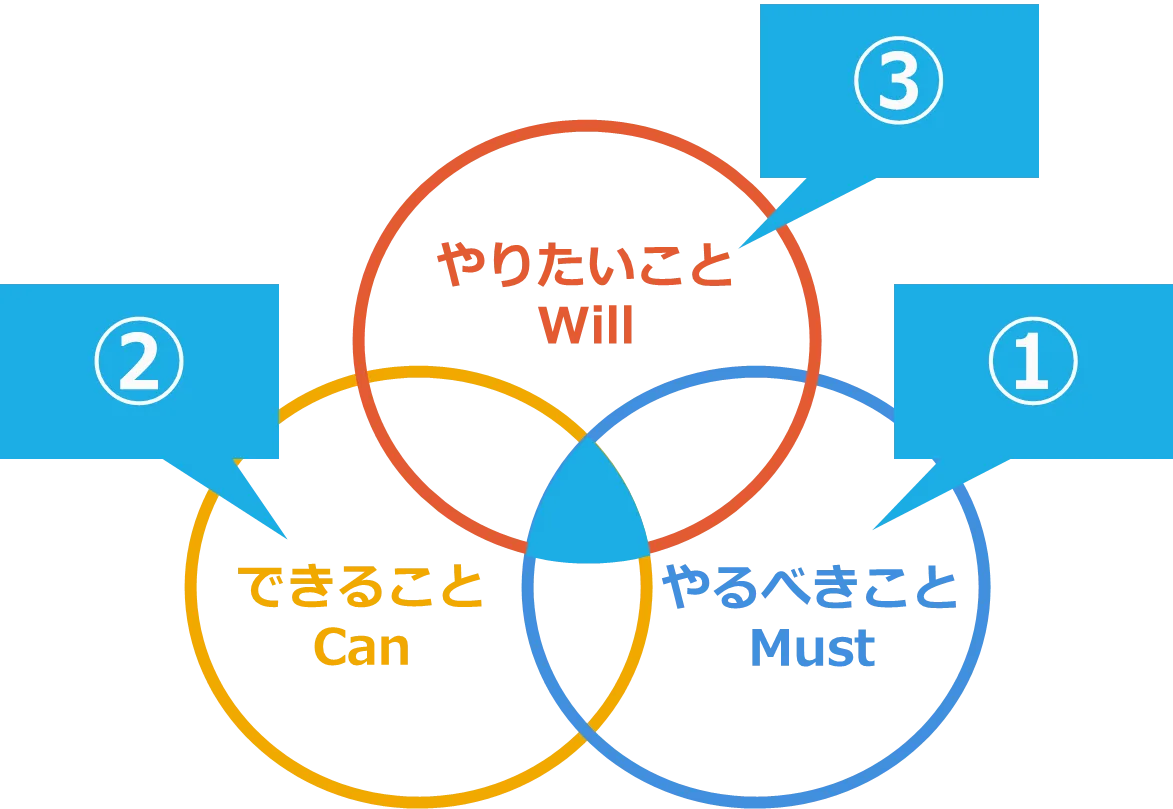
Even when I explain this, though, people ask, "So where should I start?" So here I'll write down my current thinking on "how to decide what I should do (Must)."
3__ Layers: Pincering the Individual__
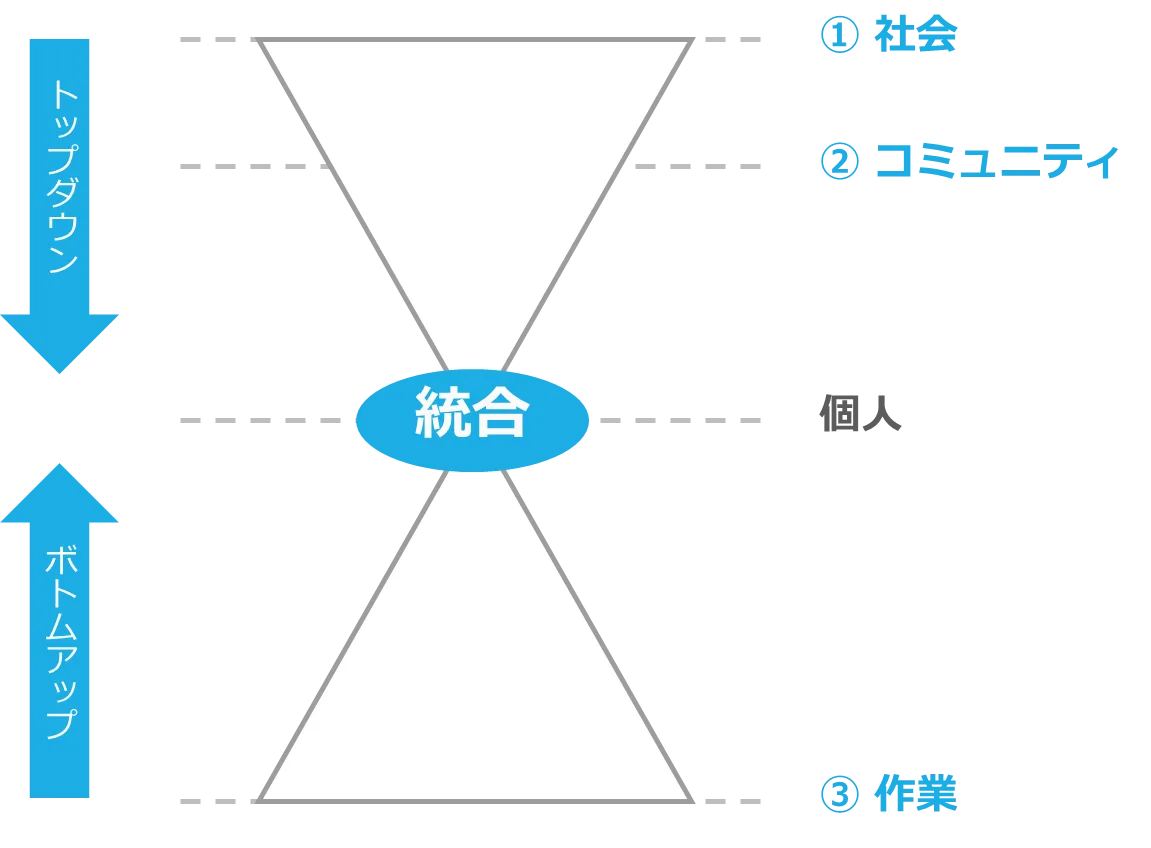
I think it helps to be conscious of three layers when deciding what to do. The three layers are as follows.
- The society layer
- The community layer
- The task layer
The image is that you consider Must, Can, and Will at each layer, and pincer the "individual" in from both sides.
I think the key is to avoid thinking about the "individual" directly as much as possible, and to let the individual emerge from relationships.
① The Society Layer
At the society layer, which has a high level of abstraction, you think in the order Must ➡ Can ➡ Will.
First, Must. Society has all sorts of things that need to be done, such as poverty, inequality, climate change, and health.
These are often the "things that must be done" that the media talks about. I think starting here tends to lead you to a field you can work on for a long time. (In addition, I think it's better to work on problems for which the social demand has lasted a long time.)
However, it is better to consider a social issue that is one or two levels less abstract and more concrete.
For example, climate change is a major social issue. But if you try to tackle climate change itself, you won't know where to start. In such a case, if you make it a little more concrete, such as "within climate change, technological solutions in particular, and within those, startups in particular," then little by little what society needs, what you can do (Can), and what you want to do (Will) start to become visible.
As you make things more concrete in this way, you ask about your Can and Will, and loosely decide your own area of Must.
Once you have loosely decided, the question becomes "why should I, and nobody else, be the one to do this?" Rather than turning it into a matter of the individual, you first lay the layer of community over it.
② The Community Layer
I think it is also important to ask about Must ➡ Can ➡ Will in the community, the intermediate layer connecting society and the individual.
Society often lacks a tangible feel, but a community has one. Also, while you can receive evaluation of what you have produced from society as a whole, in terms of day-to-day evaluation, there will be more from the people in the communities you belong to. If your own value isn't recognized in your community, it is hard to keep up your motivation.
So I think that by exploring what is said to be worth doing within the communities you belong to or want to belong to, and what you can do within them, what you should do will gradually become settled. In other words, at the community layer you explore in the order Must ➡ Can ➡ Will.
In particular, when
- It is said to be something that should be done socially
- Almost no one around you is doing it
- You happen to be in a place where you can do it
all hold, that is a big opportunity.
There is almost nothing that "no one in the world is doing," but there is plenty that "no one in the community is doing." You can't become the person who knows the most about marketing in the world, but you can become the person who knows the most in your company or team.
At the scale of a community, there are blank spaces without end, and there is a lot you can contribute. As you contribute within the community, you come to be given difficult tasks, and your Can gradually grows. As you work on them and learn about areas you didn't know before, your Will gradually settles too, and I think an axis of "this is something I should do" takes shape.
③ The Task Layer
I'd like to say "from the community to the individual...", but I think it is better to imagine more concrete tasks rather than the unit of the individual. For example, conditions like:
- I don't dislike it that much (though I think it's a hassle)
- I think I'm not suited to it, but it's not that I absolutely can't do it
- I have the capacity to do it
- Maybe I could do it
I think that at the task layer, you can think of it as neither "doing what you want to do" nor "avoiding what you don't want to do," but doing what you feel "I wouldn't mind doing."
If you "avoid what you don't want to do," everyone avoids things like administrative work, but if you avoid those, your options become limited. I think you should avoid things you "absolutely don't want to do" or are "overwhelmingly unsuited to compared with others," but things that "feel like a hassle but aren't impossible" or that "you can do about as well as other people" can be loosely kept among your options.
Pincering the Individual from 3 Layers
As a diagram, it looks like this. You pincer from the top-down of society and the bottom-up of tasks, narrowing down in the order Must➡Can➡Will at each layer, and look for what you should do.
I also think it's fine to proceed holding all this loosely, as just a provisional placeholder.
Some Points
What follows supplements the way of thinking above.
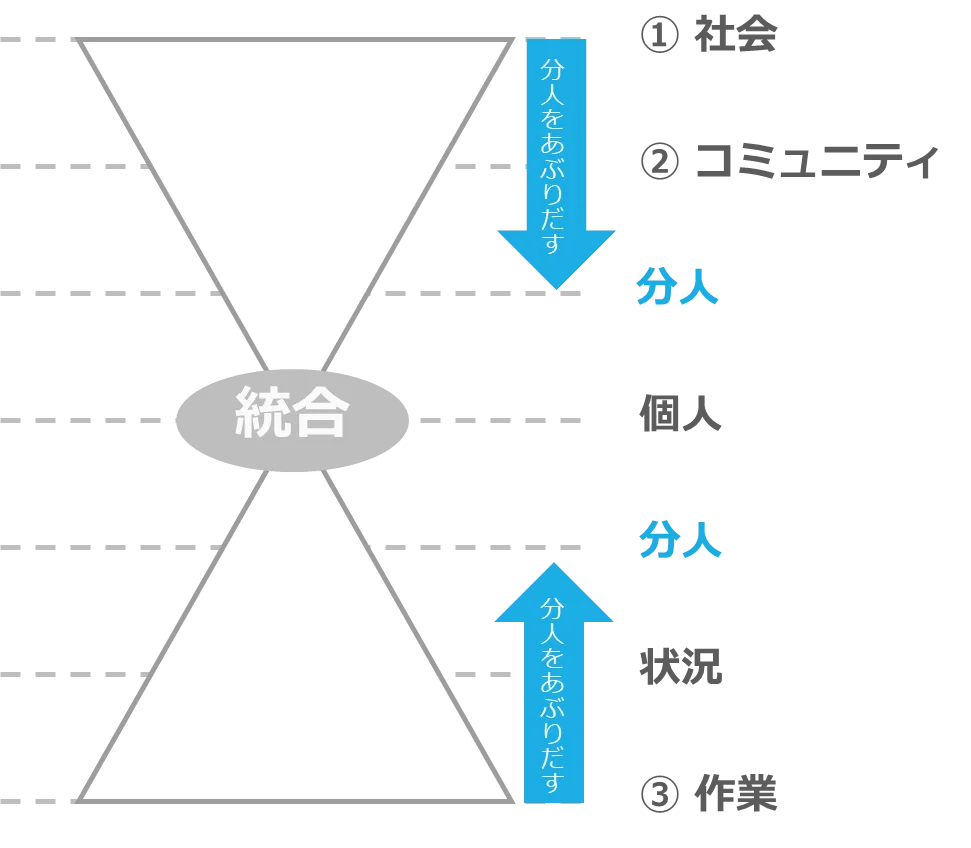
(A) Don't ask the individual directly; go through the dividual
I think the reason people get stuck when they think about their Will as an individual is that the individual is, to begin with, vague and inconsistent, and you can't settle things just by thinking about the individual.
Keiichiro Hirano has proposed the concept of the dividual (bunjin). It is the idea that, without positing "one true self at the center," an individual is made up of multiple selves. If you think that there are different selves in each situation, depending on the environment you are in and your relationships with people, you can see how hard it is to question the individual self in isolation.
And dividuals arise not only from relationships with society and communities, but also from relationships with tasks and artifacts. As the video above mentions, they also "arise through favorite places, favorite music, and favorite books."
Rather than positing a single central individual called the true self, I think it is more practical to see the individual as a whole made up of multiple personalities and the intentions of each moment, and, instead of asking about the individual's will, to place the individual a little more within relationships. That is, to draw out the dividuals within yourself and pincer them from two directions:
- Being aware of yourself within social relationships (top-down)
- Being aware of yourself within artifacts and tasks (bottom-up)
Also, although I wrote "integration," you don't have to integrate at all; it is fine to think of it as choosing opportunities in which the dividuals you like come out more often.
(B) Use Will for negative checks
Some people have a strong Will and some have a weak one. There are also people who can't say their favorite food but can say the foods they dislike.
People who have strong likes, or who find it easy to express them, can probably just follow their Will. But I think people who are lost are usually people whose Will is weak or whose feeling of liking is faint.
In that case, rather than forcing yourself to look for a strong Will, I think you can use Will just for a negative check at each layer. In other words, use it to "avoid what you absolutely don't want to do."
Using Will this way actually increases your options, and I think you can take the positive view that people with a weak Will may actually be able to try more things than people who "can only do what they love."
(C) Explore while deciding loosely
It is hard to have a shocking encounter with "what you want to do" as if finding someone you fall for at first sight, and it is often a misunderstanding. If you only keep digging into the past, such as searching your past for a formative experience, there are no new encounters or challenges.
So I think it's good to decide with the intention of pinning it down only temporarily, get involved a little more deeply, and in the process cultivate your interest and build a sense of conviction.
It is human nature to hesitate if you try to decide everything perfectly from the start. Especially when you are young, I think it is important to hold things loosely, thinking "I can change it later."
(D) Ask someone
If you know what society needs but can't see an angle to make it more concrete, or a hot area within the smaller pieces, it's good to ask adults or read books. You won't find the answer by thinking alone, and the part of society you can see when you're young is quite narrow, so it seems faster to make use of someone else's knowledge.
Suppose someone who has a broad view of society says, "Someone should do this, but I can't (because I'm busy or not suited to it)." If it looks like something you might be able to do, I think it's good to find a "thing you maybe should do" there and try it, gradually upgrading it to a "thing you should do" if it seems doable, or trying something else if it doesn't fit.
Also, just as dividuals arise within relationships, an individual exists within relationships, and if you think of your relationship with that "someone" as one of the elements that make up "you," then asking someone is something only you can do. And it was also "you" who chose to be in that relationship. There is no reason not to make good use of that relationship.
By asking someone in this way, you may also come to see what should be done within the community you belong to.
I think you can gradually find what you should do now, based on such hints.
Summary
Ask in the order Must ➡ Can ➡ Will at each layer, such as society and tasks, make good use of the people around you, and get involved a little more deeply in something within a field with strong social demand. While doing so, increase what you can do and find what you want to do. As you repeat these activities like hypothesis testing, you move forward little by little, and what you should do and what you want to do may become visible. That was the story.