Five Papers and Reports I Want Faculty and Staff Involved in Entrepreneurship Education to Read
This article was machine-translated from Japanese by AI (Claude). It may contain errors. Read the original Japanese article.
As attention to startups has grown across Japan, attention to entrepreneurship "education" has grown as well. As a result, people from a wide range of backgrounds have begun to get involved in entrepreneurship education.
There are almost no specialists in entrepreneurship education, so I hear that in practice it is often taught by faculty with practical experience or by faculty from other fields at the university (such as business or engineering). I also hear that some schools say, "We can't do it ourselves," and commission private companies that have little knowledge of education or research.
You might think that "entrepreneurship education just means teaching how to do business or start a company, so no particular background is needed," but in reality it is quite a complex field. It is also a field in which a variety of insights have accumulated over the past few decades, and I believe that by putting those insights to use, we can offer students a better learning experience.
So I have chosen five papers and documents that I would very much like to be read not only by people who teach entrepreneurship, but also by people involved in entrepreneurship education policy and by people who commission entrepreneurship education from outside providers.
I think reading all of them takes only about two to three hours, so please do give them a try.
- 牧野恵美. (2018). 海外における起業家教育の先行研究レビュー
- Lackéus, M. (2015). Entrepreneurship in Education: What, Why, When, How
- Hägg, G., & Gabrielsson, J. (2019). A systematic literature review of the evolution of pedagogy in entrepreneurial education research
- Nabi, G., Liñán, F., Fayolle, A., Krueger, N., & Walmsley, A. (2017). The Impact of Entrepreneurship Education in Higher Education: A Systematic Review and Research Agenda
- IGL. (2022). Evidence Bites
- Conclusion
This time I have chosen relatively new papers and reports published within the past ten years. I have also tried to list ones that are as easy to obtain as possible.
牧野恵美. (2018). 海外における起業家教育の先行研究レビュー
URL: https://doi.org/10.20801/jsrpim.33.2_92
This is a review paper on entrepreneurship education written in Japanese by Professor Makino, now at APU.
It compactly summarizes several overseas review papers and meta-analyses up to 2018, and because it is available in Japanese, I think it is very useful as a first entry point.
In particular, entrepreneurship education in Japan tends to aim at "raising entrepreneurial intention," but this paper is also helpful for understanding that you cannot say with certainty that education raises entrepreneurial intention, and that it is difficult to influence entrepreneurial intention through education alone.
You can download it from the link above.
Lackéus, M. (2015). Entrepreneurship in Education: What, Why, When, How
URL: https://doi.org/10.1787/cccac96a-en
This is a paper published by the OECD in 2015. The author, Lackéus, is a former entrepreneur and a university faculty member who has published many papers; he belongs to Chalmers University of Technology in Sweden, a university long known for entrepreneurship education. The OECD is also active in many ways in the field of education, and as a report issued by that organization, I think this is a foundational document for modern entrepreneurship education. In fact, as of August 2024 it boasts 1,200 citations, making it a highly influential paper.
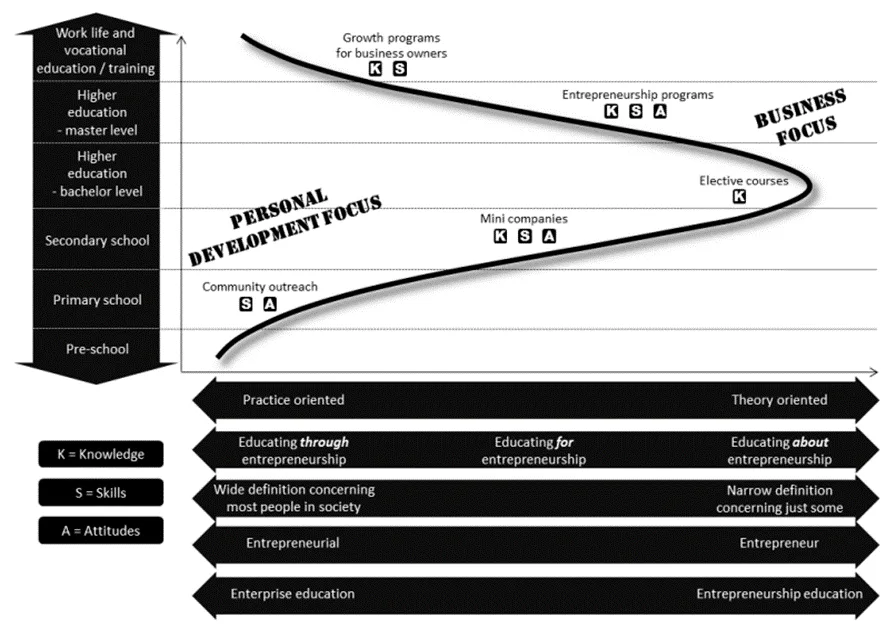
I think this document is useful in educational practice for several reasons: it cites a variety of papers and simply summarizes the debates that have taken place from the perspectives of What, Why, When, and How; it distinguishes between wide and narrow entrepreneurship; and it proposes where the emphasis should be placed according to developmental stage, and how to change the educational content step by step.
If you look only at the United States and at practice, you tend to aim for "narrow" entrepreneurship and entrepreneurship education that leans heavily toward business, with knowledge transmission at the center, so this document should also be useful for cultivating a broader perspective.
Hägg, G., & Gabrielsson, J. (2019). A systematic literature review of the evolution of pedagogy in entrepreneurial education research
URL: https://doi.org/10.1108/ijebr-04-2018-0272
This is a review paper that looks back at how entrepreneurship education research has progressed. If the OECD document mentioned above is the latest snapshot as of 2015, this paper looks back at the changes leading up to it.
Based on the flow from teacher-centered in the 1980s, to process-centered in the 1990s, to context-centered in the 2000s, to learner-centered in the 2010s, it organizes how the Who, What, Whom, and How of entrepreneurship education have each changed.
It gives an overview of how the field moved beyond discussions of entrepreneurship education aimed only at "starting a business," how a How centered on guest lectures and the like is now somewhat outdated, and how different kinds of approaches are being used today. It also touches on the fact that the narrow versus wide distinction mentioned earlier is still contested.
It is a little hard to obtain, but it is a paper where I would like you to look at Table 1 at the very least.
Nabi, G., Liñán, F., Fayolle, A., Krueger, N., & Walmsley, A. (2017). The Impact of Entrepreneurship Education in Higher Education: A Systematic Review and Research Agenda
URL: https://doi.org/10.5465/amle.2015.0026
This is a systematic review of the impact (effects) of entrepreneurship education in higher education. It has more than 2,500 citations and is one of the first works read in this area.
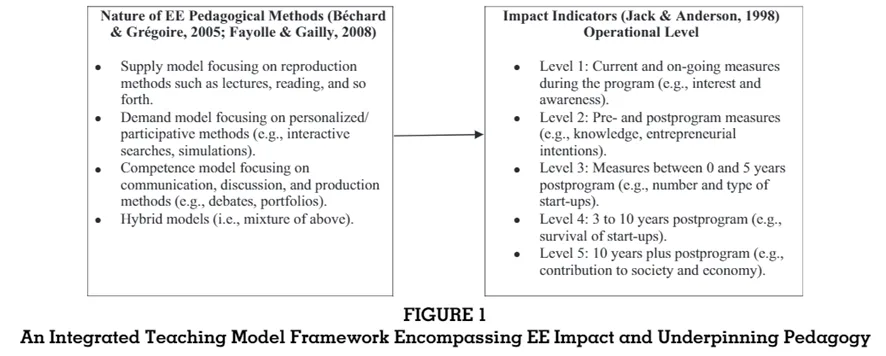
This paper organizes the results of past papers by dividing the effects that entrepreneurship education has on students into five levels along a time axis. For example, many papers measure entrepreneurial intention as the effect, and while many of them report that there is a reasonable effect, it also points out that a considerable number of papers (22%) found no effect or found negative effects, so the results vary quite widely. This suggests that it is not as simple as "if you provide entrepreneurship education, the number of startups will increase."
It also touches on the agenda for future research, such as the fact that there is little research on "whether, even if intention has grown, it leads to action."
There is a link to the paper on Semantic Scholar.
IGL. (2022). Evidence Bites
URL:
https://evidence-bites.innovationgrowthlab.org/topics/entrepreneurship-education/
I think many educators want "insights that can be put to use right away." In that case, it is a good idea to read "Evidence Bites," compiled by IGL.
It summarizes the insights gained from past papers, and simply lays out what seems to be effective and what does not.
I have also translated this.
https://blog.takaumada.com/entry/entre-policy-research-igl-2022
For education in general, please also refer to Visible Learning and the like.
https://visible-learning.org/hattie-ranking-influences-effect-sizes-learning-achievement/
In my personal opinion, to carry out entrepreneurship education appropriately, insights from pedagogy can be put to better use than business methodologies.
Conclusion
The content of entrepreneurship education is still debated and has not been fully settled. However, when discussing and improving education, we need to stand on a common foundation to some extent. I think the academic knowledge that serves as that foundation, while it cannot be called perfect, has a reasonable amount of accumulation behind it.
Not all academic findings can be applied, but if used well, they can help us avoid past mistakes. I believe it is important, in providing better education to students, not to rely solely on individual intuition and experience but to make use of humanity's past accumulation, so if there is anyone who will be getting involved in entrepreneurship education from now on, please do read the papers and reports above.