From "We Can't Because We Don't Have X" to "We Can If We Have X": Entrepreneurial Resourcefulness
This article was machine-translated from Japanese by AI (Claude). It may contain errors. Read the original Japanese article.
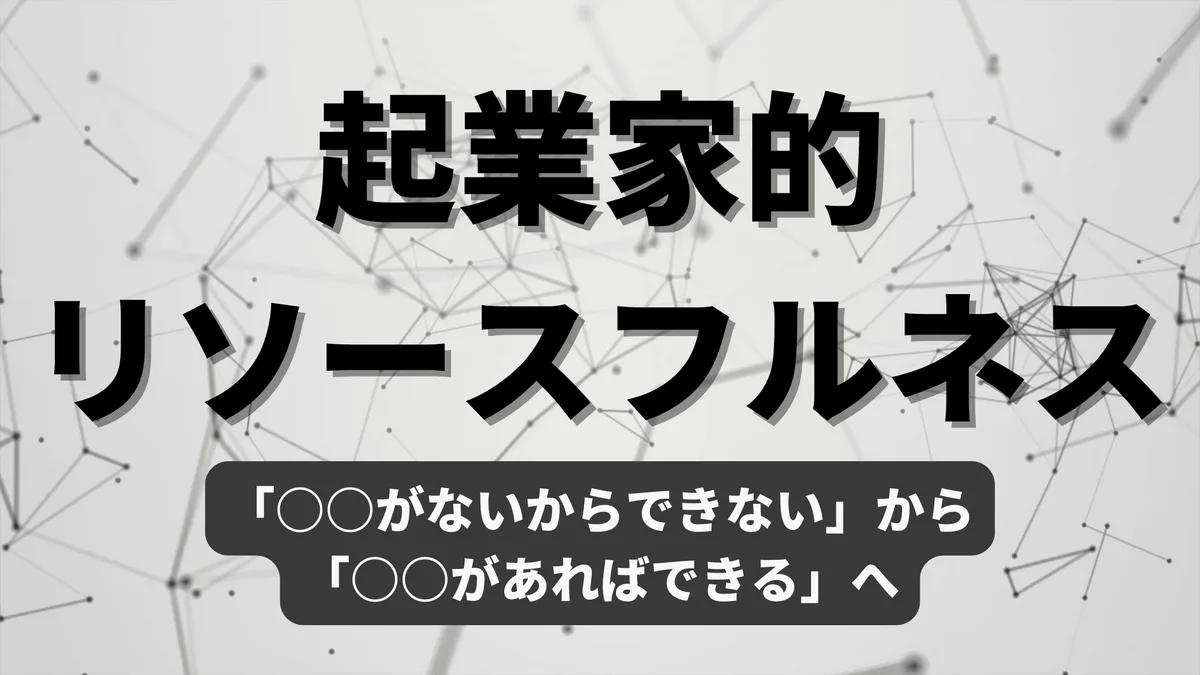
If I had to pick one way of thinking that is distinctive of startup entrepreneurs, I think it would be "a special attitude and set of skills toward resources."
In this article, I introduce that attitude and those skills together as "entrepreneurial resourcefulness."
Using Resources
Entrepreneurs start a business with few resources (people, things, money, and so on), yet they can achieve great results despite those limited resources. This is because they can use resources effectively and allocate them strategically.
That is not all. Entrepreneurs use resources creatively. For example, when they try to test a hypothesis by building a minimum viable product (MVP), they do not build the product to perfection before testing. Instead, they build a concierge MVP (an MVP in which a person provides the service in place of the product) with a minimum of money and time, and so test the hypothesis quickly.
They also combine multiple resources to accomplish more. You could say they get by through ingenuity, combining whatever is at hand in the manner of bricolage.
By using several approaches like these, entrepreneurs can practice Doing more with less (accomplishing more with less).
The effective use, creative use, and combination of resources described so far are possible because entrepreneurs are good at discerning the potential of the resources at hand and putting them to good use. They do not merely see people, things, and money as generic resources. They form their own perceptions and evaluations of those resources, and then take an active stance toward using them. I think this attitude and these skills can be a useful reference for many people.
Acquiring Resources
Excellent entrepreneurs are not only good at using resources; they are also good at acquiring them from outside.
When we want to accomplish something, it is common to find that we lack money or people. Ordinarily, we think only of "making do by being resourceful within a limited budget." In other words, we look for the best solution within the range of the constraints.
Entrepreneurs, however, raise funds or plead with someone to acquire additional resources from outside, and so open a path to getting things done. Financing through loans and investment is the prime example. They think beyond the frame of the constraints, and somehow procure the resources needed to realize ideas that lie beyond that frame.
In other words, entrepreneurs, especially those involved in high-growth startups, practice Doing more with more (accomplishing more with more). Professor Stevenson's well-known definition of entrepreneurship is "the pursuit of opportunity beyond the resources you currently control," and "going beyond resources" is exactly the kind of quality and attitude expected of entrepreneurs.
To put it another way, it is a shift in thinking from "we can't because we don't have X" to "we can if we have X." If you keep this way of thinking in your everyday life, the options you can conceive of should increase considerably.
Using and Acquiring Form a Cycle
Although acquiring resources from outside is important, that does not mean that an excellent entrepreneur is someone who simply says, "Give me resources."
What is needed to acquire resources from outside is trust. For example, with financial credit, a personal track record, and good relationships, trust grows. By leveraging that trust, the risk as seen by others goes down, and large resources can be acquired from outside.
A track record in business is an excellent factor for raising such trust. But to build a track record from nothing, you need to accomplish something with few resources. In other words, you need to practice Doing more with less, and succeed at it.
What this tells us is that entrepreneurs
- Doing more with less - using resources
- Doing more with more - acquiring resources
carry out both of these appropriately, keeping a cycle of using and acquiring turning.
It is not enough to stay with Doing more with less, which tends to stop at saving and efficiency. The "attitude toward resources" needed to accomplish bigger things is to leverage the trust gained that way to do Doing more with more, and to repeat this over and over.
It is like the fable of the "straw millionaire". Whenever an entrepreneur gets something, they leverage it to produce the next result, and with that result they go on to the next round of procurement. The way high-growth startups raise funds in stages is exactly such a cycle.
Many People Can Exercise Entrepreneurial Resourcefulness
I also think that this using and acquiring of resources is not only for entrepreneurs.
Even inside a large company, for example, an excellent manager will try to obtain more resources when budgets are allocated or people are assigned. In some cases, they may team up with related departments to secure a larger budget. They may also try to achieve bigger things by obtaining outside support.
We tend to take resource constraints as constraints that cannot be changed. But that is by no means always so. Using resources well goes without saying, but when you try to achieve more than that, knowing the idea that "if resources are lacking, you can go and get them" should make it easier for our thinking to expand.
If we call this active attitude and these skills toward resources "entrepreneurial resourcefulness," then entrepreneurial resourcefulness is a way of thinking that many people can put to good use.
Summary
Entrepreneurial resourcefulness is an active attitude toward resources. It is a way of producing the greatest possible results from limited resources, and then leveraging those results to accomplish even bigger things.
Practicing it also requires advanced skills. Even so, I wrote this article in the belief that simply knowing such a way of thinking exists can help us exercise resourcefulness in many different situations.
Additional Notes
The 2021 Journal of Business Venturing has a special issue on entrepreneurial resourcefulness. One of its papers frames entrepreneurial resourcefulness as "boundary-breaking behaviors for acquiring and deploying resources in creative ways in order to create and capture new or unexpected value."
Also, with regard to using resources, particularly reconfiguring them, I think this may connect to the discussion of dynamic capabilities.
On the non-academic side, I would like to publish a book on resourcefulness if I can.