Startups and Climate Change
This article was machine-translated from Japanese by AI (Claude). It may contain errors. Read the original Japanese article.
In the economic recovery plans following the COVID-19 pandemic, the two themes that countries keep raising are "digital" and "green." In the green context in particular, carbon neutrality by 2050 is becoming widely accepted as a global agenda.
Climate action drives social change
If the Earth's temperature continues to rise, society will change significantly. We could see more disasters, impacts on crops and water, and even conflicts over resources.
On the other hand, even if we achieve carbon neutrality, society will still change significantly.
The basic course toward carbon neutrality is expected to be (1) electrifying the many things that now depend on fossil fuels, and (2) increasing the supply of affordable, stable, decarbonized electricity. An example of (1) is converting gasoline cars to EVs; examples of (2) include renewable energy. Achieving these will make a transformation of the industrial structure and the power generation mix unavoidable.
In parallel, demand for efficient power transmission using smart grids and similar technologies may also grow. Advances in battery technology as a place to store electricity, as well as hydrogen and ammonia, are also drawing expectations. The parts that cannot be decarbonized will need to be covered by carbon capture, utilization and storage (CCUS) and similar approaches. New industries will emerge in these areas.
In terms of greenhouse gases, it is not only carbon but also methane that is a problem. The main source of methane emissions is livestock farming. Reducing methane would require cultured meat and alternative meat. As a result, the way we produce and eat food will change too.
People are concentrated in cities, and most energy is consumed in cities. If we try to reduce energy consumption, the nature of cities will change as well. For example, if making a city bicycle-friendly would cut more carbon than converting to EVs in the first place, then reshaping the city that way is one possible policy. In Japan, the mandatory compliance with energy-saving standards for new homes, which had been planned for 2020, was postponed, but it seems likely to come back onto the table for discussion (perhaps with even stricter standards).
In other words, whether climate change occurs or we try to avoid or mitigate it, society and industrial structures will change greatly over these 30 years. Many business opportunities should emerge from that, and on a global scale, at that.
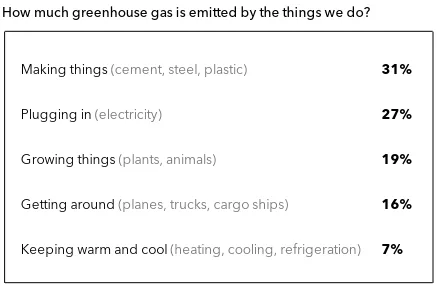
The table below lists the main sources of greenhouse gas emissions, taken from How to Avoid a Climate Disaster. Major changes are expected in these areas.
How is this different from the SDGs?
Over the past few years, the SDGs have been widely embraced by Japanese companies. That is wonderful in itself. However, it was in a sense easy to link the SDGs to one's own business at a superficial level. For example, a company that does SaaS can say it fits "8. Decent Work and Economic Growth" and "9. Industry, Innovation and Infrastructure."
Properly, though, it would have been more effective to link to the 169 SDG targets, clarify which business is expected to contribute how much to which target figure, and connect that to actions toward achieving the goals. In many cases, however, that did not happen, and I think it stopped at affirming the social significance of one's own business by slapping on superficial SDG labels (even so, I do think it is a good thing that attention has turned to the social significance of business).
Carbon neutrality, on the other hand, is clear. This is because the total has to be zero. The goal of carbon neutrality inevitably contains the numerical target of zero. That requires solid commitment, not superficial endorsement.
Furthermore, money is actually starting to flow into carbon neutrality.
For example, the EU has announced Horizon Europe, worth about 12 trillion yen, of which 35% is said to be used for research on green technology1. Japan has also prepared a 2 trillion yen Green Innovation Fund, aiming to energize research and development. The United States has indicated its intention to make infrastructure investment of about 220 trillion yen over eight years, seeking to boost the economy through stronger manufacturing and job creation along with stronger research and development. Many items in it concern climate action, such as making new and old infrastructure clean.
Right now, money is flowing into efforts to address climate change, aimed at the world 30 years from now.
What startups can do
Achieving carbon neutrality will require a great deal of technology development and social implementation. Moreover, we do not yet know whether that technology is feasible. New business models and supply chains may also be needed. Even though we have only 30 years, this field is still full of uncertainty.
I think it is precisely these highly uncertain areas where startups can play their part. In fact, Bill Gates also urges investment in high-return, high-risk research and development in How to Avoid a Climate Disaster.
For example, the technologies listed in that book include the following. If these technologies can be put to practical use and spread through society, I think they could become big companies 30 years from now.
- Hydrogen without carbon emissions
- Grid-scale electricity storage (lasting a full season)
- Electrofuels
- Advanced biofuels
- Zero-carbon cement
- Zero-carbon steel
- Alternative and cultured meat, and dairy
- Zero-carbon animal feed
- Next-generation nuclear fission
- Nuclear fusion
- Carbon capture
- Underground electricity transmission
- Zero-carbon plastics
- Geothermal energy
- Pumped hydro
- Thermal storage
- Food plants resistant to drought and flooding
- Zero-carbon substitutes for palm oil
- Refrigerants free of fluorocarbons
In Japan today, the word DX is in full bloom, but because startups are looking too much toward digital, these areas seem to have been left untouched in return. That also means they are an opportunity.
The surrounding situation and conclusion
It is not only startups; the surrounding situation is changing as well. Looking at the VC side, overseas VCs are increasingly investing in climate-action startups. Funds specializing in climate change have also been launched. When new funds are created in Japan a few years from now, LPs may request climate change as one of the major investment themes. In any case, for a VC that takes pride in thinking on a 10-year span and building new industries, climate change should be one big theme to tackle ahead of the rest of the world.
Universities will likewise have to change. Over the next few years the focus will be on research and development, so I think universities will be expected to play an active role. After that comes social implementation, so I suspect that securing intellectual property with social implementation in view, starting from the current R&D stage, will also become an issue.
About 25 years ago, in 1995, the release of Windows 95 spread the internet and greatly changed our lives. Industrial structures changed too. I think a change of a similar scale is about to happen now, looking toward 30 years from now.
Of course, technology cannot solve everything. Social change will also be needed. Still, it is almost certainly true that technology will mitigate problems and lead us to new solutions. I hope that more startups from Japan will ride that current and contribute to the global social issue of climate change.
Footnotes
-
Incidentally, Horizon Europe's budget also includes funding for entrepreneurship education and the startup ecosystem. ↩